Tag: Tejas Networks

  • Tejas powers up Powertel’s network speed

    Tejas powers up Powertel’s network speed

    MUMBAI: Powertel, the telecom arm of Power Grid Corporation of India, has tapped Tejas Networks to supercharge its pan-India DWDM network with a lightning-fast 400Gb per second upgrade. The project marks another major milestone for the Bengaluru-based tech player, which will design, supply, install, and integrate a next-generation SDN-based DWDM system across new and existing sites.

    Tejas will roll out its flagship multi-terabit TJ1600 DWDM/OTN platform, capable of delivering up to a staggering 1.2Tb per second per wavelength while supporting the cutting-edge alien wavelength technology, a feature that allows seamless data transmission over third-party systems.

    Tejas Networks chief operating officer and executive director Arnob Roy said, “We are delighted to extend our partnership with Powertel to expand their backbone capacity and meet the surging demand for high-speed connectivity from data centres, telcos, government and enterprises. Our alien wavelength solution provides a cost-efficient way to scale bandwidth while ensuring diversity and speed to market.”

    A part of the Tata Group, Tejas Networks designs and manufactures high-performance networking products for telecom, defence, utilities, and government clients in over 75 countries. With this upgrade, Powertel’s network is set to handle India’s growing data surge with more power, precision and, quite literally, a better connection.


  • BSNL dials up pride with India’s first homegrown 4G telecom stack

    BSNL dials up pride with India’s first homegrown 4G telecom stack

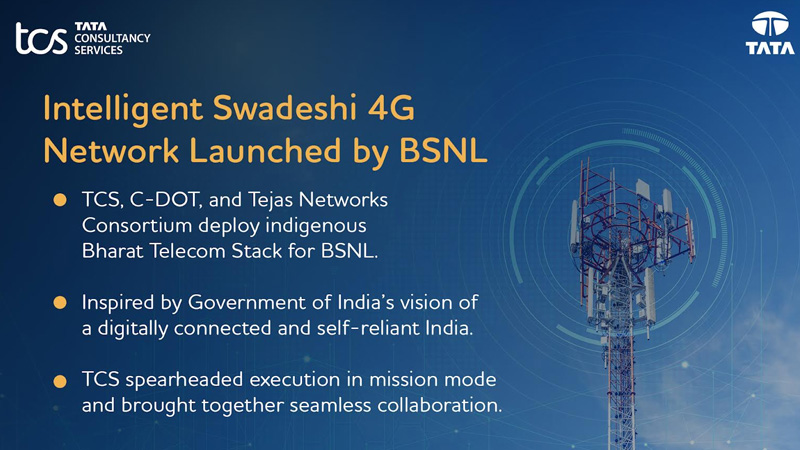
    MUMBAI: India has just made a call that will echo worldwide and it’s a truly Swadeshi one. BSNL, in collaboration with Tata Consultancy Services (TCS), C-DOT, and Tejas Networks, has unveiled the Bharat Telecom Stack, a fully indigenous solution powering 4G and beyond, marking a historic stride towards a digitally self-reliant nation.

    With this rollout, India joins an elite club of just five countries globally to have built a homegrown telecom technology stack. What makes it remarkable is the scale and speed the entire project, spanning 100,000 sites, was completed in just two years, making it one of the fastest 4G deployments worldwide.

    Executed under a “mission mode” governance model, the project saw TCS establish data centres, integrate C-DOT’s EPC Core Application, and deploy Tejas Networks’ base stations and radio infrastructure, all stitched together with TCS CNOPS, a cognitive platform for 24/7 real-time network management. The rollout integrates seamlessly into BSNL’s existing 2G/3G systems, ensuring connectivity continuity while boosting capacity for the digital era.

    For BSNL CMD A Robert J Ravi, the launch was more than technology, it was symbolism: “The nationwide rollout of our indigenous 4G network, built with TCS, Tejas, and C-DOT, is a resounding declaration of an Atmanirbhar Bharat. This ‘Made in Bharat’ stack secures our digital future and bridges the divide like never before.”

    The technology isn’t just about speed or spectrum; it’s about sovereignty. By delivering ultra-secure, standards-compliant connectivity, the stack safeguards national security while democratising access enabling online education, telemedicine, e-governance, and citizen services for rural and urban India alike.

    BSNL’s director (Consumer Mobility) Sandeep Govil highlighted its transformative potential: “This Swadeshi 4G technology, the result of innovation by C-DOT, Tejas, TCS, and BSNL’s workforce, is engineered for scalability. It is a cornerstone for a digitally inclusive society, ready to evolve to 5G and beyond.”

    For TCS and Tejas Networks chairman N Ganapathy Subramaniam, the achievement reinforces India’s tech legacy: “We have put India on the map of only a handful of countries with a comprehensive, trusted, and software-upgradable telecom technology stack. The successful deployment at BSNL is historic, laying the foundation for India’s further contribution to global standards.”

    The launch also reflects TCS’s longstanding role in shaping India’s digital infrastructure from modernising stock exchanges and passport services to healthcare and pensions for defence personnel touching millions of lives across decades.

    With ultra-high bandwidth, energy efficiency (0.1 W/Gbit, 65 per cent lower than average), and intelligence boosting O&M efficiency by 40 per cent, the Bharat Telecom Stack is more than a national achievement. It is a signal loud and clear that India is ready to lead in telecom innovation, connecting every citizen while setting global benchmarks.

    In short: India just built its own dial tone for the future and it’s calling the world to listen.

  • India tunes into the future: D2M phones set to beam broadcast content straight to mobiles

    India tunes into the future: D2M phones set to beam broadcast content straight to mobiles

    MUMBAI: Say hello to television without the internet. At Waves 2025, India’s flagship World Audio Visual & Entertainment Summit to be held at Jio World Centre in Mumbai, a game-changing coalition of technology players will unveil the roadmap to bring direct-to-mobile (D2M) broadcasting to the fingertips of Indian consumers.

    The ambitious push is led by FreeStream Technologies, an IIT Kanpur-incubated deeptech startup, alongside mobile giants Lava International and HMD Global, powered by chipsets and infrastructure from Tejas Networks (formerly Saankhya Labs), with global validation from US-based broadcasting behemoth Sinclair Inc.
    The tech, hailed as a breakthrough in both communications and accessibility, allows live TV, emergency alerts, educational content, and multimedia programming to be delivered directly to mobile phones via terrestrial broadcast signals — bypassing internet or mobile data altogether.

    “This is India’s moment to lead the world in next-gen broadcasting. Lava and HMD are laying the foundation of a robust device ecosystem, and their commitment to scaling up proves D2M is more than a proof of concept — it’s a national opportunity,” said FreeStream Technologies director Sumeet Nindrajog.

    Lava, known for its made-in-India ethos, is ensuring that the price-point doesn’t become a hurdle. “Our D2M featurephone design cleverly integrates the modem and apps in a way that keeps costs low — something that has always defined Lava,” said Lava International executive director Sanjeev Agarwal.

    HMD — the home of Nokia phones — is matching that energy. “HMD has always been about delivering meaningful innovation. With D2M, we’re enabling consumers to access live content and alerts on their devices, without needing Wi-Fi or mobile data,” said HMD CEO & VP India & APAC. Ravi Kunwar. “This is a global first, and we’re proud to be building it in India.”

    Behind the scenes, it’s Tejas Networks’ award-winning SL-3000 D2M chipset — the tech’s beating heart — that makes it all possible. A product of Saankhya Labs (now part of Tejas and the Tata Group), the chip is designed for mobile broadcast reception, even in dense or low-connectivity environments.

    “This isn’t just about watching TV — this is about creating a national broadcast backbone that can deliver everything from emergency alerts to targeted education, from CDN offload to next-gen advertising,” said Tejas Networks  EVP and co-founder of Saankhya Labs Parag Naik. “It’s an empowerment platform, aligned with PM Modi’s vision of a digitally empowered India and Viksit Bharat.”

    Tejas has also built out the full core network platform to support nationwide rollout — integrating both broadcast and broadband layers, a capability rare even by global standards.

    From the other side of the Atlantic, Sinclair Inc, a pioneer of ATSC 3.0 — the broadcasting standard enabling D2M — praised India’s swift strides. “The adoption of ATSC 3.0 in affordable mobile devices underscores the foresight of our global investments, and vindicates our ‘mobile-first’ strategy,” said Sinclair Inc president & CEO Chris Ripley. ““India is now in the driver’s seat. Our next focus is B2X — Broadcast to Everything — which will be vital to achieving the goals of 6G and next-gen applications.”

    Sinclair’s One Media unit has been working with Indian partners to future-proof mobile broadcasting as a core digital infrastructure. Their role isn’t just investor — they’re co-developers and global evangelists.

    Backed by policy momentum and partnerships with Prasar Bharati, the D2M ecosystem has already undergone field trials across live networks. The next step? Nationwide field deployment, with Lava and HMD readying devices for market at scale.

    D2M is now not just a tech demonstration — it’s a political, social and commercial opportunity:
    * To decongest mobile data networks,
    * To deliver content equitably across rural and urban India,
    * And to anchor India’s leadership in media-tech manufacturing.

    With global standards, Indian R&D, and mass-market readiness coming together, Waves 2025 could well be remembered as the moment India turned its phones into broadcast hubs.

  • TCS veteran N . Ganapathy Subramaniam takes chairman’s position at Tata Communications

    TCS veteran N . Ganapathy Subramaniam takes chairman’s position at Tata Communications

    MUMBAI: Tata Communications has handed the keys to its chairman’s office to N. Ganapathy Subramaniam, the tech wizard who spent four decades cutting code and climbing ladders at Tata Consultancy Services.

    The appointment, which took immediate effect today, adds another feather to NGS’s already well-plumed cap, as the seasoned executive continues his post-retirement tour of Tata boardrooms.

    Having hung up his boots as chief operating officer and executive director at TCS last May, the Bangalore-based tech veteran is chairman at  Tata Elxsi and Tejas Networks, making this latest appointment something of a hat-trick for the self-described “software engineer at heart.”

    Subramaniam’s elevation comes as Tata Communications—formerly the state-owned behemoth VSNL—continues its transformation from stodgy telecom operator to nimble digital services provider. With revenues nudging Rs 17,000 crore, the company has been aggressively courting enterprise clients with cloud and IoT offerings that bear little resemblance to its public sector ancestor.

    The company informed the bourses of the appointment through a  regulatory filing.

    For NGS, whose four-decade tech odyssey has seen him shepherd TCS through banking, telecom and public service transformations worldwide, the new role adds to an already bulging portfolio of responsibilities. 

    Beyond his corporate entanglements, he chairs the governing council of Bharat6G Alliance and serves on the institute body at Sree Chitra Tirunal Institute for Medical Sciences and Technology. To ease off from all his hectic engagements, NGS  enjoys nature walks around his Bangalore home.

  • Tejas Networks appoints Sanjay Malik as executive vice-president and chief strategy & business officer

    Tejas Networks appoints Sanjay Malik as executive vice-president and chief strategy & business officer

    MUMBAI: Tata group optical, broadband and data networking products company Tejas Networks has announced the appointment of Sanjay Malik as executive vice-president, chief strategy & business officer, and senior managerial personnel, effective 30 January 2025. His tenure will continue until his resignation or retirement, as per the company’s internal human resource policy.

    Sanjay Malik, a respected business leader in the ICT sector, brings extensive global experience and a proven track record in driving growth and transformative initiatives. Known for his integrity, ethics, and action-oriented leadership style, he has delivered exceptional results in challenging business environments. Malik will work closely with managing director  Anand Athreya and the senior leadership team to shape corporate strategy, oversee business management, and engage with stakeholders.

    During his tenure as senior vice-president and India country head at Nokia Networks, Malik transformed the company into an undisputed market leader within three years, achieving record revenues. He successfully grew Nokia’s market share across wireless and wireline portfolios by focusing on cross-portfolio solutions and new customer acquisition.

    Malik’s career spans roles at Cap Gemini, HP, and Tata Unisys. An alumnus of the National Institute of Technology, Kurukshetra, he also holds a postgraduate degree in business management from the Indian Institute of Management, Mumbai.

    The appointment, approved by the board of directors based on the nomination and remuneration committee’s recommendations, aligns with Tejas Networks’ strategic goals.