Tag: Ted Sarandos

  • Netflix CEOs play coy about Warner Bros Discovery acquisition

    Netflix CEOs play coy about Warner Bros Discovery acquisition

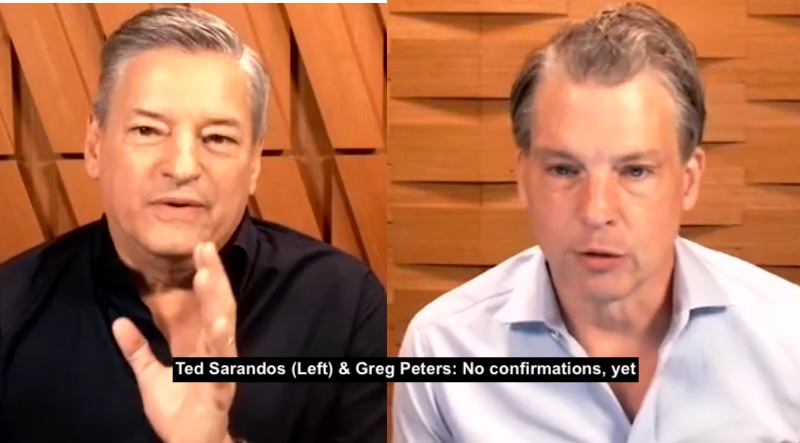
    LOS ANGELES: Netflix is keeping its cards close whilst the rest of Hollywood scrambles for Warner Bros Discovery’s assets. Asked during Tuesday’s third-quarter earnings call whether the streaming giant might join the bidding war, co-chief executives Ted Sarandos and Greg Peters delivered a masterclass in strategic ambiguity: they ruled nothing out, but ruled nothing in either.

    “It’s true that historically, we’ve been more builders than buyers, and we think we have plenty of runway for growth without fundamentally changing that playbook,” said Sarandos. “Nothing is a must-have for us.” 

    Yet he added that Netflix looks at “all” merger opportunities through the same lens—a nod that Warner Bros Discovery’s studio and streaming empire, including HBO, HBO Max and Warner Bros Television, might just pique its interest.

    What Netflix definitely won’t touch are Warner Bros Discovery’s linear networks. “We’ve been very clear in the past that we have no interest in owning legacy media networks, so there is no change there,” Sarandos said. That rules out a bid for the whole company, which Warner Bros Discovery is splitting in two: one entity (Warner Bros) housing the streaming and studio jewels, the other (Discovery Global) lumping together cable channels and Discovery+.

    The carve-up comes after Warner Bros Discovery announced it was reviewing “strategic options” following “unsolicited interest” from “multiple” parties. Paramount is reportedly leading the charge, having offered $20 per share for the lot, then upping its bid to $24—both rejected. CNBC reports that Netflix and Comcast are also circling.

    Peters downplayed the threat of rivals bulking up through deals, pointing to mega-mergers like Disney-Fox, Amazon-MGM and Discovery-WarnerMedia that failed to shake up the landscape. “None of those mergers represented a fundamental shift in the competitive landscape,” he said. “Watching some of our competitors potentially get bigger via M&A does not change our view.”

    The caginess came as Netflix reported third-quarter revenue up 17 per cent year-on-year to $11.5bn, in line with forecasts. Operating income rose 12 per cent to $3.2bn, though it fell short of expectations after a $619m hit from a dispute with Brazilian tax authorities. Shares tumbled 6.5 per cent in after-hours trading, though Netflix insisted the tax spat won’t dent future results.

    By region, revenue in the US and Canada grew 17 per cent to $5.01bn, Europe, Middle East and Africa climbed 18 per cent to $3.7bn, Latin America rose 10 per cent to $1.37bn and Asia Pacific surged 21 per cent to $1.37bn. Netflix now commands 8.6 per cent of US television viewing time, up from 7.5 per cent in late 2022, and 9.4 per cent in Britain, up from 7.7 per cent.

    Hits last quarter included Wednesday season two (114m views), The Thursday Murder Club (61m) and My Oxford Year (81m). The Canelo-Crawford boxing match drew 41m viewers, making it the most-watched men’s championship bout this century, Netflix claimed.

    For now, Sarandos and Peters are content to watch the feeding frenzy from the sidelines. But their refusal to slam the door suggests they might yet crash the party—provided the price is right and the baggage left behind.

  • Ted Sarandos spills the Netflix masala to Indian billionaire Nikhil Kamath

    Ted Sarandos spills the Netflix masala to Indian billionaire Nikhil Kamath

    MUMBAI: What happenswhen a video store clerk-turned-media mogul sits down with a new-gen Indian billionaire?

    Streaming gold. 

    In a riveting episode of People by WTF, Netflix co-ceo Ted Sarandos spilt the tea, dropped truth bombs, and dished out storytelling wisdom in an electric tête-à-tête with Zerodha co-founder Nikhil Kamath. 

    From his Phoenix roots to Hollywood power tables—and yes, dinners with Shah Rukh Khan—Ted held nothing back.

    Sarandos shared his origin story: a would-be journalist whose real education came behind the counter at a video rental store. That humble setting gave him a ringside view of consumer desire—something he scaled up spectacularly at Netflix. “People hated late fees, but they loved discovering something new,” he quipped, summing up the genesis of Netflix’s ‘everything, anytime’ model.

    Sarandos’ India story was peppered with glam. He reminisced about his first meal with SRK—“very different in Mumbai than in LA”—and lauded Aryan Khan’s directorial chops in The Ba**ds of Bollywood*. His creative crush? Sanjay Leela Bhansali. “Heeramandi felt like a dare… he pitched it in LA like, ‘I dare you to make this’,” said Ted, still in awe.

    “For 10 years, I heard India was two years away,” Sarandos laughed. “Now, it feels truer than ever.” With local stories making global noise—think RRR or Kapil Sharma—Netflix doubled down. Sarandos noted that Indian audiences aren’t just watching Bollywood. They are binging Korean anime, true crime, Tamil action, and Turkish dramas with equal zest. “This market’s appetite is unmatched,” he said.
     

    Nikhil Kamath Ted Sarandos

    On leadership, Sarandos kept it brutally real. “Work-life balance? That’s a fantasy,” he shrugged. His playbook: take big swings, fail fast, and hire smart. He credited Netflix’s risk-positive culture to Reed Hastings, who saw streaming coming when dial-up ruled the world. “In 1999, Reed said, ‘Everything will come through the internet.’ It sounded crazy. Turns out, he was right.”

    Sarandos bet big on local stories going global. “Squid Game was never supposed to be a global hit. But great stories travel.” He stays bullish on AI—so long as humans lead the charge. “The art of the prompt will be a human skill,” he remarked, calling AI a cost cutter, not a creator killer. “It’ll help make better films, but won’t replace human imagination or emotion.”

    From gaming titles like Grand Theft Auto to video-forward podcasts, Netflix’s empire keeps expanding. Sarandos sees serious returns in content creation. “The best ROI? Still content. Delivery and monetisation are evolving faster than ever,” he noted.

    His advice to young creators? Make the coffee. “Be a PA, join a writers’ room, see if this is what you really want. Passion often follows excellence,” he urged, advising rookies not to reverse-engineer Netflix’s tastes, but pitch what needs to be told.

    The full episode of People by WTF featuring Ted Sarandos streamed on YouTube—popcorn highly recommended.

  • Netflix bets big on Bharat: Ted Sarandos touts $2bn impact, calls India the next Korea

    Netflix bets big on Bharat: Ted Sarandos touts $2bn impact, calls India the next Korea

    MUMBAI:  “Don’t globalise it. Localise it, then watch it fly.” That was Netflix co-CEO Ted Sarandos’ mantra to Indian creators at the government of India’s Waves  Global Summit 2025, where he shared the stage with actor Saif Ali Khan in a high-wattage fireside chat titled Streaming the New India: Culture, Connectivity & Creative Capital.

    Sarandos came bearing stats—and swagger. Netflix’s investments in India from 2021 to 2024, he revealed, have generated over $2 billion in economic impact, filming across 23 states and 100+ cities, and collaborating with over 25,000 local cast and crew. “That’s not just entertainment—it’s employment, infrastructure, and skill-building,” he said.

    And the viewership numbers? Eye-watering. In 2024 alone, three billion+ hours of Indian content were streamed globally on Netflix—nearly 60 million hours a week. An Indian title made it to the global Top 10 non-English list every single week of the year.

    Saif Ali Khan, now a veteran of both big screens and binge-worthy epics, waxed lyrical about the creative freedoms offered by streaming. “It’s a gift,” he said. “Long-form storytelling lets you explore characters with nuance and intimacy. Streaming is a creative playground—with no school bell ringing at the end.”

    When asked how Indian creators can crack global markets, Sarandos dropped the algorithmic truth: “If you try to engineer something for the world, you end up making it for no one,” he warned. “The most successful global stories—Korea’s Squid Game, Spain’s Money Heist—were deeply local. India must do the same. If it’s not loved here, it won’t work out there.”

    He didn’t mince words. “Don’t water it down for the west. Audiences don’t want diluted. They want real.”

    According to Sarandos, India is teetering on the edge of a Squid Game-scale global breakout. “Korea had years of storytelling before its global moment,” he said. “India is now at that inflection point. The creative base is solid. The reach is already here.”

    Netflix is doubling down on that bet, with buzzy upcoming titles like The Royals and The B*****s of Bollywood joining global juggernauts like Squid Game S2, Stranger Things, and Wednesday.

    When asked if streaming would cannibalise cinemas, Sarandos played diplomat. “India is fan-first,” he said. “Theatres and streaming aren’t rivals—they’re tag-team partners.” Streaming, he added, simply meets audiences where they are. “In India, films move from theatre to streaming at record speed. That’s not disruption—that’s democratisation. India, in many ways, was ahead of the curve.”

  • Netflix shrugs off downturn fears as ad tech rollout bears fruit

    Netflix shrugs off downturn fears as ad tech rollout bears fruit

    MUMBAI: Netflix executives are feeling rather chirpier about their prospects, even as storm clouds gather over the global economy. During their Q1 2025 earnings call, co-CEOs Ted Sarandos and Greg Peters dismissed concerns about consumer belt-tightening, insisting that home entertainment has historically been “resilient” during lean times.

    “Entertainment historically has been pretty resilient in tougher economic times,” Peters told analysts. “Netflix specifically also has been generally quite resilient, and we haven’t seen any major impacts during those tougher times.”

    The streaming behemoth is ploughing ahead with its advertising ambitions, having just rolled out its proprietary ad tech platform in Canada and the US, with plans to expand to its remaining 10 ad markets in the coming months. Peters confidently predicted the company would “roughly double” its advertising revenue in 2025.
    “We aren’t currently seeing any signs of softness from our direct interactions with buyers,” he said. “Actually, to the opposite, we’re seeing some positive indicators from clients as we approach our upfront event.”

    The firm’s first-party ad tech platform is already yielding dividends, offering “more flexibility for advertisers” and “fewer activation hurdles,” according to Peters. In the US, Netflix has significantly expanded its targeting capabilities based on “life stage, interest, viewing mood” and third-party data.

    Sarandos reiterated that the company’s live strategy extends beyond sports, though he confirmed Netflix will broadcast a second NFL Christmas Day game in December 2025. The company will also stream the Taylor-Serrano boxing rematch in July, following on from the Tyson-Paul fight that generated substantial buzz.

    When questioned about potentially competing head-to-head with YouTube in short-form content, Peters struck a pragmatic tone: “We think the biggest opportunity we’ve got is actually going after the roughly 80% share of TV time that neither Netflix nor YouTube have today.”

    Meanwhile, chief financial officer Spence Neumann assured investors that excess cash flow would predominantly be returned to shareholders through buybacks, absent any “meaningful M&A.” The company maintains its full-year operating margin guidance of 29 per cent.

  • Netflix commits a billion dollar investment in Mexico’s entertainment sector

    Netflix commits a billion dollar investment in Mexico’s entertainment sector

    MUMBAI: President Trump wants immigrants from across the border out of the US. Where they go is none of his business. Netflix, on its part is clear where it  is headed –  to Mexico , where Trump wants the illegals to head. 

    Yesterday, the streamer announced that it is going to be pumping in  a billion dollars over the next four years into making entertainment content in the country.

    Ted Sarandos, the streaming giant’s co-chief executive, made the announcement alongside president Claudia Sheinbaum in Mexico City yesterday. The investment marks a significant expansion of Netflix’s presence in Latin America’s second-largest economy.


    The commitment aims to bolster local production companies and stimulate growth across Mexico’s audiovisual sector. Beyond film and television production, the investment is expected to create ripple effects in adjacent industries, from catering and hospitality to traditional craftsmanship.

    Mexican content has proven particularly successful for Netflix’s global audience. The streaming service has already produced hundreds of shows and films in the country, many achieving international acclaim. The new investment signals Netflix’s confidence in Mexico’s creative talent pool and its potential to generate content with worldwide appeal.

    The move comes as streaming platforms increasingly focus on local content production to differentiate their offerings and capture regional audiences. For Mexico, the investment represents a significant boost to its creative industries, potentially establishing the country as a leading hub for Spanish-language content production in the Americas.

  • Why legal professional Kiran Desai swears by Netflix

    Why legal professional Kiran Desai swears by Netflix

    MUMBAI: From being a partner in a successful law firm to taking up employment  in a global corporation can sound strange to some –  but not to Kiran Desai. The legal professional-turned-entrepreneur founded and led Desai & Partners,  a prominent law firm specialising in media, entertainment, intellectual property, and sports law in 2007. Over a 12-year tenure, he built a thriving practice, representing high-profile clients in a rapidly evolving digital media landscape. 

    Then Netflix came knocking in 2019, as he explained in a note on linkedin in 2020: “When I was offered a position at Netflix, I saw an opportunity to be a part of a rapidly growing organisation that could veritably build and help influence the manner in which entertainment is consumed in India. I took a leap of faith and decided to join Netflix. 

    “To leave a law firm which I had founded and built over the better part of my professional career was a difficult decision, fraught with emotion. It was tough explaining to my colleagues and clients that I was moving on and needed to do so for my own personal development. While I had many doubts, one thing I was sure of was self-belief, stemming from the years of experience I had gathered as an entrepreneur, having seen both, success and failure. I was willing to start all over again, without fear of the unknown. While few could confidently predict the future trajectory of this fast-paced industry at the time, by joining the team at Netflix, I believed I would be standing at the leading edge of it. Now, a little over a year later, I can confidently say that it was the right decision.”
    Kiran Desai with colleaguesHe joined Netflix in July 2019 as director – business & legal affairs. Nearly six years later in February 2025, Kiran  was promoted to the role of vice president – India general counsel, from senior director – India general counsel.  
    Over this period, Desai has played a pivotal role in Netflix’s legal strategy in India, helping the company navigate complex regulatory landscapes, forge critical content deals, and support the company’s expansion in a highly competitive market.

    As India remains a key growth territory for Netflix, Desai’s promotion signals a continued commitment to strengthening operations and compliance frameworks in the region.  

    Desai holds an LLM  from Georgetown University Law Center, where he focused on intellectual property, antitrust, and international environmental law, as well as an LLB  and BCom from the University of Mumbai. He actively participated in leadership roles during his academic years, including serving as general secretary of the sports council at the University of Mumbai. His earlier legal roles include serving as counsel at the chambers of senior advocate Shyam Divan and as an associate at DSK Legal.

    Reflecting on his journey with Netflix, Desai said, “Joining Netflix was a leap of faith after years of running my own practice. The company’s culture, built on the values of freedom with responsibility, context over control, and open feedback, has been transformative both personally and professionally. Working here has not only made me a better lawyer but also a better person.”

    Desai highlighted the importance of Netflix’s unique working culture, where employees are empowered to make independent decisions while being supported with extensive contextual information. “The open feedback culture initially felt unfamiliar but has become one of the most impactful aspects of my professional growth,” he added.

    Going by Desai’s admissions, the Netflix culture, which Ted Sarandos and team have built is not just a folklore of books written to make it attractive  for talent to join, it is  reality. Even in India. 

    Desai’s  leadership has been instrumental in supporting Netflix’s ambitious content strategy in India, fostering legal frameworks that enable creative freedom while ensuring regulatory compliance.

    As Desai steps into his new role, Netflix continues to fortify its position as a leader in India’s rapidly growing streaming market, which has seen intensified competition alongside shifting consumer behaviours and expanding internet accessibility.

  • Netflix soars higher and higher  in Q4 2024; FY 2024

    Netflix soars higher and higher in Q4 2024; FY 2024

    MUMBAI: It’s netted a financial performance like never before. Global streamer Netflix concluded 2024 on a high note, achieving significant financial milestones and operational growth. With a focus on re-accelerating revenue, expanding membership, and delivering record-breaking content, the company also outlined its strategic priorities for 2025.

    2024 Financial Performance
    1. Revenue Growth:
    o Total revenue for 2024 reached $39 billion, a 16 per cent increase year-over-year.
    o Growth was supported by strong membership additions and successful content.

    2. Operating Metrics:
    o Operating income surged to $10.4 billion, marking the first time the company surpassed this threshold.
    o Operating margins improved by six points, closing at 27 per cent.

    3. Membership Expansion:
    o Global paid memberships rose to 302 million, with a record annual net addition of 41 million subscribers.

    4. Content Success:
    o Netflix dominated engagement metrics, achieving more viewing hours than its competitors combined.
    o Top content included Squid Game Season 2, Carry-On, and the Jake Paul vs. Mike Tyson fight—the most streamed sporting event ever.

    Q4 2024 Highlights
    1. Quarterly Revenue:
    o Revenue for Q4 increased 16 per cent year-over-year to $10.2 billion, or 19 per cent on a currency-neutral basis.
    2. Net Membership Additions:
    o Added 19 million net paid subscribers, marking the highest quarterly growth in Netflix’s history.
    3. Profitability:
    o Operating income rose by 52 per cent year-over-year to $2.3 billion.
    o Earnings per share (EPS) doubled, reaching $4.27 compared to $2.11 in Q4 2023.
    4. Content Performance:
    o Blockbusters like Squid Game Season 2 and holiday NFL games drove record viewership.

    2025 Strategic Outlook
    Netflix is poised for continued growth, focusing on content innovation, monetization, and global expansion.
    1. Revenue and Profitability:
    o Projected revenue: $43.5-$44.5 billion, reflecting 12 per cent-14 per cent growth.
    o Operating margin forecast: 29 per cent, up from 27 per cent in 2024.
    2. Content Plans:
    o Return of fan-favorites like Stranger Things, Wednesday, and Ginny & Georgia.
    o New live programming, including FIFA Women’s World Cup rights and NFL Christmas Day games.
    o Expansion of gaming, with the successful Squid Game: Unleashed and cloud gaming trials.
    3. Advertising Strategy:
    o The ad-supported tier accounted for 55 per cent of sign-ups in ad-available countries in Q4.
    o Planned rollout of first-party ad-tech in the U.S. by Q2 2025 to enhance targeting and engagement for advertisers.
    4. Free Cash Flow and Debt Management:
    o Expected free cash flow: ~$8 billion.
    o Reduction of $1.8 billion in bonds due in 2025 using proceeds from 2024 debt offerings.

    Netflix Co-CEO Ted Sarandos revealed that the company is eyeing streaming of sports in the near future. (Do we expect some amount of cricket rights competition heating up going forward?  Sarandos said; “Right now, we believe that the live events business is where we really want to be, and sports is a very important part of that, but it is a part of that expansion.”

    The company also unearthed new price points with the standard monthly subscription without advertisements will costing  $17.99, up from $15.49; the Standard monthly package with ads will rising from $6.99 to $7.99; 4K video quality subscriptions will be priced at $24.99 as compared to $22.99 now. This new price will first roll out in north America and will be followed by Europe and Apac later.

    The hope is that the price increase will push customers towards the ad supported tier which will mean higher ARPUs for Netflix. 

  • Netflix lends support to those affected by fires in LA

    Netflix lends support to those affected by fires in LA

    MUMBAI: In response to the devastating wildfires that swept across Southern California, Netflix and its co-CEOs, Ted Sarandos and Greg Peters  stepped up to support those affected. At least that’s what Sarandos  assured  in a blog post last week that the company was committed to aiding  employees and the wider community during this difficult time.

    “Many of our employees and creative partners have been directly impacted by this disaster,” Sarandos stated.

    To facilitate recovery efforts, Netflix has pledged a substantial $10 million donation. This funding will be distributed among several organisations, including the Los Angeles Fire Department Foundation, California Community Fund Wildfire Recovery Fund, World Central Kitchen, Motion Picture and Television Fund, and Entertainment Community Fund, aiming to provide immediate relief and ongoing support.

    In addition to financial contributions, Netflix is directly assisting affected employees, including offering temporary housing solutions for those who have lost their homes. The company is also implementing a double-match for all employee charitable contributions through its giving program.

    Sarandos expressed gratitude to the firefighters and first responders tirelessly battling the flames. “These heroes have been saving lives and communities with little rest,” he remarked.

    Reflecting on the spirit of Los Angeles, Sarandos, a long-time resident, noted, “For many, LA is more than just palm trees and movie stars; it’s a family of hardworking individuals from diverse backgrounds.”

    He higlighted the community’s resilience, stating that while many dreams may currently feel distant, the capacity to rebuild is strong.

    “The next few years will pose challenges, but we will come back stronger than before,” he concluded. 

  • Asia Pacific region leads in Netflix Q3 2024 results

    Asia Pacific region leads in Netflix Q3 2024 results

    MUMBAI: The Asia Pacific region is shining for Netflix. At least as far as net subscribers additions  (net paid adds) are concerned.  The region at 2.28 million net adds in Q3 calendar year 2024 was the topmost contributor. It was followed by  2.17 million net adds in Europe, middle east and Africa (EMEA) and 0.69 million net adds  in the US and Canada.  Latin America saw a shaving off of 0.07 million net adds during the period. This was revealed by the global streaming giant in its  latest financial performance report on Thursday in the US. 

    Overall, that totted up to five million net paid sub adds in the latest quarter, giving the streamer 282.7 million subscribers globally. It also helped increase its revenue to $9.8 billion  – a 15 per cent rise over the corresponding quarter of the previous year. Net income also showed improved to $2.3 billion.  

    The company said it was working on  improving its  product/market fit in APAC and it had a strong local content slate in Japan, Korea, Thailand and India in Q3. As a result, its  revenue growth rate in APAC (19 per cent growth year on year) led all regions.  The  revenue growth figures for the other regions were: US & Canada and EMEA  (16 per cent – 10 per cent growth in average paid members and five per cent growth in average revenue per member) and Latin America (nine per cent). 

    “..(We are)…increasingly seeing a steady drumbeat of hit titles from countries around the world,” said Netflix co-CEO, president & director Gregory Peters, during an earnings call with investment analysts. “…you’ve got Japan. You’ve got Korea. You’ve got Thailand. You’ve got India. This represents, again, that decade-plus investment in those creative communities, working with local storytellers there and making sure that they have the capability to tell their stories in a compelling way. So that’s super exciting and we expect to see more of that.”

    Among the shows and films from APAC  which did well in the quarter included: Tokyo Swindlers  from Japan (10.5 million views) and Culinary Class Wars from South Korea (11.0 million views),  Officer Black Belt  (South Korea, 32.8 million views), and Maharaja (India, 22.6 million views).

    Netflix revealed that it streams around 200 billion hours of content yearly and that engagement continues to be healthy at about two hours per day per paid membership on average, despite the impact of paid sharing.  That is only expected to go up with the push into live streaming of the WWE  for 52 weeks, the Mike Tyson-Jake Paul fight (15 November), and the NFL in December.

    Peters said that “it’s worth noting that our share of viewership in even our biggest countries is still less than 10 per cent of TV time. So we look at this as there’s a huge opportunity to grow that share by.. invest (ing) more in our slate, continue (ing) to improve the variety and quality of our offering.”

    Additionally, it is continuing its push into the ad based free subscription service which grew 35 per cent in term of number viewers getting into it. This is being done through refining the tech in its back end platform , increasing the number of viewers signng up for it and coming up with new formats for advertising.

    On the content front , Netflix  Ted Sarandos said that Q3 had some big hits: Perfect Couple, Monsters: The Lyle and Erik Menendez Story, and Nobody Wants This.

    He added that “we’re really excited about our Q4 slate because it’s filled with great big titles from the U.S., from Brazil, from Korea, from the U.K., from Germany…. Carry-On, Piano Lesson, Spellbound, Six Triple Eight, Emilia Pérez.  So when we look forward into 2025 and beyond, we want to build on that success So our 2025 slate, I look at that as another ambitious step towards this push to make us even greater for our members. 
    So looking into 2025, you’ve got new seasons of our biggest shows: Wednesday, Squid Games, Stranger Things, on top of new shows from Shonda Rhimes and Ryan Murphy, a new Knives Out film from Ryan Johnson, Guillermo del Toro’s Frankenstein, even the return of Happy Gilmore. So we could not be more excited about where we sit right now and where we’re heading.”


  • Can Reed Hastings Netflix the skiing business?

    Can Reed Hastings Netflix the skiing business?

    Ted Sarandos and he totally and irreversibly changed how video is consumed with their streaming service Netflix. Forever. Now Reed Hastings is putting his best forward into the skiing business in the US, according to a feature in The New York Times.

    The 63 year old billionaire plonked an undisclosed sum to buy a controlling interest in Powder Mountain a skiing area in the north east patch of Utah.  The mountain receives close to 360 inches of snow each winter season which makes It a snow lovers delight. Summit, the owners of the mountain – one of the few private ones in the US (most of the rest are leased from the US Forest Service or are on a mix of private and publicy owned land) – had struggled to make a profit despite grandiose plans. Hastings a -an avid skier and snowboarder – jumped at the chance and put down $100 million of his own money and bought the 8,646 acre skiing property in September 2023. He followed that up by acquiring another 2,400 acres adjacent to the skiing area in March 2024.

    Hastings plans to spruce up PowMow (as Powder Mountain is locally called) by installing four chair lifts, building two day lodges with restaurants, private rentals, retail stores and a 40,000 square foot lodge with a state of the art spa.

    2,000 acres of this would be made private, he announced. An enclave at the top would host homes which would be sold at upwards of $2 million each. These would also carry an annual membership fee of between $30,000 and 100,000, which would give homeowners exclusive access to the private skiing area, apart from the 2,400 acres he acquired recently.

    The rest of the mountain which would be left open to the public, will cost skiers $1,399 for a season pass (as against $1,259 previously), seniors above 75 years  $1,049 (as against free). Additionally, there would be no limit on the membership numbers as has been the practice so far. The public area is slated to be opened in 2025.

    Hastings told The New York Times that his move into the skiing business is not a CSR activity.

    “I’m investing a lot of my money in Powder Mountain but my plan was never to subsidise it,: he said. “…I never saw this as a charitable endeavor. We are building a luxury experience on the private side of the mountain…We decided we needed to lure people here by offering a private experience they can’t get anyplace else..”

    And no one knows better than him about providing experiences, especially if you consider how he transformed a movie rental business into one of the most valuable media and entertainment business globally.