Tag: technology

  • DD Free Dish emerged as enabler of competitiveness in M&E industry: Prasar Bharati CEO

    DD Free Dish emerged as enabler of competitiveness in M&E industry: Prasar Bharati CEO

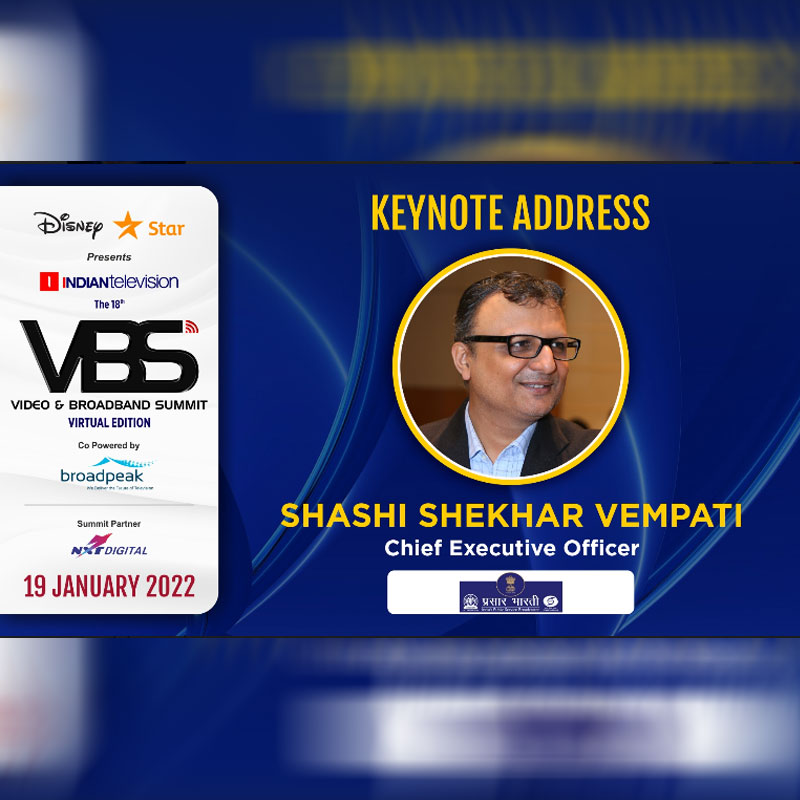
    Mumbai: With a presence in over 40 million households, DD Free Dish has emerged as an enabler of competitiveness in the media and entertainment industry, said Prasar Bharati CEO Shashi Shekhar Vempati on Wednesday, highlighting the stupendous growth recorded by the platform in recent years.

    Vempati delivered the keynote address at the 18th edition of the Video and Broadband Summit (VBS) organised virtually by Indiantelevision.com on Wednesday. The day-long summit was co-powered by broadpeak, with Disney Star as the presenting partner and Nxtdigital as the summit partner.

    Talking about the growth of DD Free Dish, the Prasar Bharati CEO said it was present in two crore households when he joined the public broadcaster in 2017 and has since doubled its base. “It was because of the Free Dish audience that channels like Dangal and genres like Bhojpuri have come of age,” he remarked. “There have been new, upstart channels that have challenged the incumbent bigger media houses. It has created a platform for people to sample content and subscribe to whatever they want to watch.

    DD Free Dish now in 40 million households

    During his five-year association with the public broadcaster, Vempati shared that he has observed striking changes in the way that the TV and video viewing market has evolved. According to him, the key factors that are driving this change are regulatory interventions, the decision by the government to phase-out analog terrestrial TV and the rise of OTT and digital.

    “The pandemic had a tremendous impact on the way we work,” he elaborated. When I joined the organisation, everything was paper-based but now we’ve become IT-based. The situation has forced us to think innovatively and put technology first.”

    Public Broadcaster’s Digital Turnaround

    Prasar Bharati’s digital growth has doubled every year with its YouTube channels clocking more than a billion views every month. The public operator which operates more than 400+ radio stations is now delivering its radio services via the News On-Air app. “While the app has several million downloads and an active listener base, it has also become a proxy for us to understand what people like to listen to on the radio,” said Vempati. “Analytics from the app gives us insights like which is the top city for online radio listening (Pune) and which streams do people prefer in every city. It also lets us know what time people are listening and which programmes they love the most.”

    He added that it was astounding that India has not leveraged its strength as the biggest media market and largest English-speaking market to build a local ecosystem for technology that can support the M&E sector. “As a public broadcaster, we invest (capital spending via government grants) up to Rs 100-200 crore in technology and it is very saddening to see this infusion of funds leaving the country,” he noted.

    Need for indigenous technology-development

    Most of the technology requirements of the M&E industry in India are imported and royalties go to entities in other countries. “We need to build a local ecosystem of technology vendors to supply the industry with all kinds of equipment,” said Vempati. “That’s why it is important that we focus on indigenous standards development.”

    For example, most of the 5G tech stack has been framed by entities in other markets. Prasar Bharati has recently signed a MoU with IIT Kanpur to develop IIndian-specific standards for 5G that allow for convergence between broadband and broadcast. This will allow for new opportunity areas such as direct-to-mobile broadcasting that will be in line with India’s unique needs to deliver content directly to mobile.

    Prasar Bharati developing next generation broadcast solution

    “With millions of people live streaming every event, it is going to raise the costs of the network and the pipes are going to choke. The telcos will not be able to handle so much traffic and that will lead to buffering. The way out is having the ability to offload steaming traffic to broadcast infrastructure if necessary. This benefits everyone including big OTT platforms,” he added.

    Another opportunity area that Vempati sees is innovation in the supply-side economics of content. “Why is content so expensive?” he asked. “There is a need to deliver higher quality content at lower cost and India should be cost leaders in terms of creating content, seeing the enormous talent base that we have. The M&E industry in India is looking for its “Walmart moment” when it comes to bringing down the cost of content. We should find innovative means, technologies, and approaches that can bring down the cost of content.”


  • Microsoft Teams makes ‘Walkie Talkie feature’ available to all users

    Microsoft Teams makes ‘Walkie Talkie feature’ available to all users

    Mumbai: Microsoft Teams has made its Walkie Talkie feature launched in 2020 for frontline workers available to all its users.

    The ‘push to talk’ feature was introduced in 2020 as a way for frontline workers to communicate easily on-field when the pandemic rate was at its peak. “As the frontline faces continuous constraints from labor shortages and supply chain disruptions, they want technology that saves them time, helps them communicate more seamlessly, and maximises their efficiency when completing repetitive tasks,” the company stated.

    Walkie Talkie is now also available on all iOS mobile devices such as iPhones and iPads, in addition to Android mobile devices. It is a push-to-talk (PTT) communication feature that allows users to connect with their group members through a respective channel. No one else can interact with the people inside the channel unless they are given permission to do so. The company teamed up with Zebra mobile devices to implement the digital Walkie Talkie functionality.

    According to Microsoft, the app replaces the need for carrying bulky radios and offers a secure line of communication through Wi-Fi or cellular internet connectivity. The three mobile devices: rugged TC-series, customer-facing EC-series, and the scanning device MC-series will now include the Microsoft Teams’ push-to-talk features. All of them come with a dedicated, built-in button on the side emulating a radio walkie-talkie, that one needs to hold onto while speaking. The voice gets recorded, and then sent to the recipient.

    “With this partnership, we’re excited to be able to provide frontline workers with the ability to use these devices to seamlessly communicate, collaborate, and stay productive in any conditions,” said Zebra Technologies CEO Anders Gustafsson in a blog post.

    Currently, the feature is not pre-installed. To enable WalkieTalkie for use in Teams, organisations will have to add it to the ‘App Setup Policy’ through the admin centre. Once turned on, the feature becomes available on the app within the next 48 hour.

    According to Microsoft, the pandemic drove a 400 percent increase in Microsoft Teams usage among frontline workers from March 2020 to November 2021.

  • SES completes C-Band transition ahead of schedule with Harmonic’s XOS Edge Software

    SES completes C-Band transition ahead of schedule with Harmonic’s XOS Edge Software

    Mumbai: Harmonic (NASDAQ: HLIT) has completed technology upgrades associated with SES’s Phase one transition plan for C-band spectrum in just nine months, it announced on Monday.

    This was accomplished utilising Harmonic’s XOS Edge software-based solution for satellite media processing and edge delivery.

    “Tight-knit collaboration between partnering companies led to a successful world-first deployment of software solutions for the transformation of C-band spectrum,” said Harmonic senior vice president – business development Jeremy Rosenberg. “Deploying software on off-the-shelf appliances for both the uplink and at hundreds of affiliate locations enabled rapid completion of this project, exceeding the FCC’s stringent deadline. It is a testament to the flexibility that Harmonic’s edge media processing provides and has opened the door to additional and ongoing opportunities with video programmers for new edge distribution strategies.”

    Harmonic’s XOS Edge media processing solution, integrated with encryption from NAGRA, enables satellite delivery networks to distribute video services with optimised bandwidth and improved quality utilising the inherent flexibility of software.

    “We are excited to lead this transformation for the communications industry and accelerate the path to 5G,” said SES vice president of technology Steve Corda. “Freeing up the 5G spectrum while maintaining the quality and resilience of critical video services was a significant challenge. We can ensure that millions of people across the United States will continue to receive high-quality programming.”

    The project aims at seamless transition for Comcast Technology Services (CTS) and its Managed Satellite Distribution affiliates.

    “The task of freeing up C-band spectrum was massive and complex,” said Comcast Technology Solutions vice president and general manager of the Communications and Technology Provider Suite Allison Olien. “We are in the midst of a significant technology change, and SES and Harmonic provided a clear and streamlined transition path that assures service continuity for our partners and customers.”

  • GUEST COLUMN: How to combat streaming piracy with OTT’s broken protocol?

    GUEST COLUMN: How to combat streaming piracy with OTT’s broken protocol?

    Mumbai: With vast sums of money to be made, it’s not surprising that streaming pirates are continually upping their game to keep their highly profitable illegal businesses afloat.  A recent global study conducted by Ampere Analysis for Synamedia found that sports streaming piracy alone is worth over $28 billion and the Global Innovation Policy Centre places the global TV industry’s losses from digital piracy between $39.3 to $95.4 billion per year.

    From Bollywood and Hollywood blockbusters to LIVE sports including IPL and women’s football, streaming piracy has reached an industrial scale in India. Within minutes of release, stolen content is circulated, exchanged and sold on open internet sites and social media platforms, such as Telegram and WhatsApp, as well as on closed subscription-based pirate networks and dedicated OTT applications. Some illegitimate, subscription-based pirate services are now so good that consumers think they are using the brand’s own service, damaging the brand of the legitimate service and preventing upsell opportunities.

    But with superior intelligence and the appropriate technology and legal procedures in place, the industry can stay one step ahead, protect its revenue streams and stop criminals siphoning off billions in revenue that rightfully belong to content owners and services providers.

    Pirate profiteers raise the stakes

    Although low quality pirate content filmed surreptitiously in cinemas is still available, as more consumers switch to digital platforms, pirates are using increasingly sophisticated ways to steal content – and deliver it in pristine quality.

    And the pirates’ methods have advanced considerably since they simply exploited “the analogue hole”: in other words, stole content from the HDMI ports of Set Top Boxes. As license owners and operators have increased their protection methods, cracking down with a combination of source-detection and disruption technologies as well as legal action, pirates have been hunting for new and more concealed ways to source content and find the weak link in the chain.

    From Digital Rights Management (DRM) hacking as seen recently with Widevine, to bypassing client watermarking and manipulating legitimate OTT applications, today’s streaming pirates have found ways to steal not just high-quality content but entire OTT services, including redistributing directly from the service provider’s content delivery network (CDN).

    Sourcing, aggregating and distributing content

    A quick Google search will quickly take you into a world of organised crime: industrial scale professional hackers, criminal technology experts with content aggregators, content wholesalers and content resellers conducting the biggest criminal heist the world has ever seen.

    Current anti-piracy approaches – such as DRM, client hardening and concurrency restrictions are simply scratching the surface of OTT piracy and pirates continue to profit.

    Using the intelligence provided by our operational security team and with access to pirates’ scripts, we have unearthed the root source of this problem – the OTT protocol is broken. The technology of OTT delivery makes it simple and cheap to set up as a pirate operator. Pirates don’t necessarily need to break the DRM to steal content. Using pirate servers and clients, pirates are hacking the OTT protocol to get the DRM license and redirect pirate clients to legitimate service and content providers’ CDNs.

    With little to no acquisition or content costs, pirates have become ultimate media super-aggregators. They can bring highly-sought after content together at an unbeatable price with no geo restrictions or competition law challenges – and then redistribute the stolen content to their paying customers at the expense of the video service provider by using their infrastructure undetected. 

    Protecting content across the ecosystem

    With an understanding about the methods used and insight into how pirates operate, Synamedia has developed the industry’s first solution to systemically address the inherent weaknesses that make it easy for pirates to not only steal content but also entire OTT services, including gaining access to the service provider’s CDN.

    Synamedia OTT ServiceGuard makes it possible to securely distribute content on open platforms by validating that only legitimate subscribers and applications are granted authorised access and receive content. It gives each client a unique identity that is not cloneable and allocates secure keys for signing service requests, ensuring all client messages are validated for their authenticity and origin. This has a critical role to play in protecting content, but tackling piracy requires an all-round team approach, blending pre-breach approaches with proactive detection and disruption technologies and solutions.

    Synamedia’s unrivalled intelligence-based model leverages AI technologies alongside human intelligence – including undercover investigators and cyber security, psychology, criminology, and sociology experts – to monitor and map the piracy supply chain, detect, deter and disrupt piracy and orchestrate anti-piracy activities and legal and technical takedowns.

    The financial rewards on offer and the ease of set-up – combined with the low risk of arrest or meaningful punishment – means the problem of piracy will not go away.  But, by making life as difficult as possible for both pirates and viewers of illicit streams and making legal subscriptions more attractive, content owners and rights holders can not only protect their content investments, but video service providers can cut infrastructure costs and create the opportunity to capture new subscribers.

    (Deepak Bhatia is general manager and head of sales, India at Synamedia. The views expressed in this column are personal and Indiantelevision.com may not subscribe to them)


  • Anil Goel named as president of technology at BYJU’S

    Anil Goel named as president of technology at BYJU’S

    Mumbai: In a commitment to further strengthen its technology vertical, BYJU’S has named Anil Goel as president, technology.

    Serving in a leadership role, Goel will strategise the direction of technology within BYJU’S and its group companies and introduce emerging technologies to improve learning outcomes and efficiency in support of the company’s long-term goals, said the ed-tech company in a statement on Tuesday.

    He will also be responsible for the product development, network operations, and implementation of management information systems, software applications, and IT infrastructure, it added.

    “Anil is a proven leader with 25+ years of rich experience in building technology systems and processes in different organisations,” stated BYJU’S chief people officer Pravin Prakash. “At BYJU’S, he will play a key role in building the next-generation technology in the education space. We are delighted to have him on board and look forward to working together and supporting him in achieving the goals.”

    Goel is a highly accomplished, entrepreneurial, innovative, and results-oriented technology executive. With a career spanning over 25 years, he has spent most of his time in the US. Before joining BYJU’S, he was with OYO as group chief technology and product officer. Additionally, having worked with companies like Amazon, RealNetworks, and HyperQuality, his expertise lies in strategic planning, building and extending large software systems and infrastructure, technical architecture, design, product, project management for high availability, high volume transactional systems, websites, and online and mobile applications.

    “Technology is a powerful tool that can transform and redefine the way education is delivered. The team is already delivering cutting-edge technology and constantly innovating the learning space and I look forward to adding my expertise in further strengthening this,” said Goel. “We will focus on developing tech-driven solutions that will empower students with high-quality education and provide engaging learning experiences.”

    Goel holds an MBA degree in marketing from the City University of Seattle and a B-Tech (Hons) in electrical and electronics from Birla Institute of Technology and Science, Pilani.

  • This decade belongs to the ed-tech industry: Practically’s Mahadev Srivatsa

    This decade belongs to the ed-tech industry: Practically’s Mahadev Srivatsa

    The ed-tech sector in India is witnessing unprecedented growth owing to the accelerated adoption of technology. The pandemic further strengthened the trend, with schools, colleges, and educational institutes shifting online, paving the way for the rise of several ed-tech start-ups. Claiming to be India’s first experiential learning app that brings learning alive through immersive videos, interactive augmented reality, and 3D simulations for 6th to 12th graders Practically is one such startup that also scripted its success story during the time.

    Mahadev Srivatsa, who spearheads the brand team as the ed-tech’s VP – marketing & brand strategy, is on a mission to make Practically a household name in India. An evangelist marketer and brand strategist with a keen eye for consumer insight, and over 13 years of cross-industry experience in brand launch & integrated marketing campaigns, Srivatsa has worked across telecom, consumer electronics, auto, and FMCG to name a few. He was recently adjudged Winner in the Thought Leaders category at Voot.

    Srivatsa, who has been previously associated with organisations such as Vodafone-Idea, ASUS India, H&R Johnson India among others, brought in a unique acumen on how traditional and new-age digital mediums can be leveraged to build a brand. He is credited with launching the brand’s first integrated marketing campaign, including crafting the brand proposition, the campaign strategy, and successful rollout that resulted in a 3X growth in both business and brand objectives. The brand’s first national campaign launched earlier last month, ‘Scan Anything’- a disruptive feature that enables students to learn from their everyday observations – also saw a 2X growth in terms of search volumes.

    IndianTelevision’s Anupama Sajeet caught up with the marketer and branding professional for a freewheeling conversation on an overview of the ed-tech marketing space and digitisation in education. Srivatsa also shared insights on the start-up’s roadmap ahead and the role of online education platforms in lieu of the scheduled reopening of schools and institutes for offline teaching in the coming days…

    Edited excerpts…

    On what differentiates Practically from other online learning platforms

    As India’s first experiential learning app designed for students in classes of 6th-12th with a focus on STEM learning, our content is 3D, immersive, and experiential which makes learning fun and engaging for kids. We have a very comprehensive content of 3000+ world-class 3D videos, 1000+ Simulations / AR experiences and are constantly working to make our library amongst the largest. We are also the world’s first ed-tech company to launch the #ScanAnything feature which transforms the mobile camera into an educational tool allowing learners to interact with surrounding elements freely. It can recognise pictures, questions, exercises, proofs, etc., from textbooks, magazines, newspapers including capturing images of any surrounding objects and presenting linked curriculum learning information on the app for the learners to pick their learning journey and resolve doubts instantly. 

    On the challenges faced by the brand to penetrate this increasingly crowded sector

    In ed-tech, the consumer and the customer are different, so the marketing challenge is always to create a campaign that appeals to both sets of audiences. The TG for the campaign was parents of kids of 6-12 grades and kids themselves. The other challenge was communication in a cluttered market, given the amount of SOV (share of voice) by competition in this space of late. Hence the challenge was also to develop communication that breaks the clutter and gets noticed. And finally, we had to do justice to the ScanAnything feature not just in terms of creating awareness about the feature but also the claim that it’s the first by an ed-tech company.

    So, the entire campaign communication was developed to get the perfect balance of keeping the campaign look & feel to reflect the world-class tech and product offering as the hero and at the same time appeal to our younger TG which likes to see communication that is light, snackable and fun. To make the feature believable and showcase its robustness, we designed the print ad in a manner that users could try out this innovative feature straight out of the ad.

    On Practically’s first national campaign

    Given the need to promote this innovative ed-tech feature, the campaign is digital-first with a robust focus on print. The entire campaign was meticulously planned in four phases starting from teasers on social media to launch, post-launch and sustenance. The digital campaign kick-started with the launch of two films on YouTube and a national press release around the campaign proposition of #StopSearchingStartScanning. The films centered around the feature and the tech as the hero.

    A print ad every week for three weeks on leading national and regional dailies was planned to drive awareness and credibility and was uniquely designed to make people engage with the feature. A robust influencer plan with a mix of celebs, micro and macro influencers at a Pan-India level was also executed to create buzz. We will continue to deploy influencers in the future as well. As a medium this is something no marketer can afford to ignore given the digital age, we are in.

    On the key take-aways post the brand’s campaign launch

    The campaign has been well received with over seven million views for our films so far across all social media platforms. We were at four lakh installs before the campaign and in just over a month have grown at a record speed of almost three times to cross one million installs which was our key campaign KPI. All our in-app metrics (MAU, DAU) have witnessed exponential growth and we recently hit more than 1 lakh MAU (Monthly Active Users). More importantly, we are able to sustain the growth as the campaign reaches its final leg. With respect to the feature, on average so far, we are getting 10,000-15,000 scans a day with the highest being 33,000 on the day of our first print ad.  We have had six lakh scans since the launch of the campaign indicating the likeability of the feature and the marketing impact. We have also seen a 2X growth in terms of search volumes.

    On the media mix, the brand looks to target

    The choice of medium for marketing is always dependent on the product and TG. As a marketer, one always selects the optimum media mix desired for a launch or communication. Being an app, our communication will always be digital-first. Going forward, digital and TV alongside print will be the preferred choice for us. With pandemic almost looking like an endemic now, OOH also can be a good bet as a support medium.

    While Andhra Pradesh, Telangana, Karnataka, Tamil Nadu, and Maharashtra are our key markets, we have already gone national with this campaign and will continue to make strides deeper into these markets. As we enter new geographies, our focus will be primarily metro & tier 1one towns for now. We are also present in the Middle East and are expanding rapidly.

    On plans to scale up the brand marketing in 2021

    Getting a million downloads is a dream for any app and is usually the first key milestone and we are delighted at the pace with which we have achieved it, especially the last mile. All our future marketing campaigns will only be bigger in scale than the previous, given our objective is to make Practically the most loved and trusted e-learning brand. The next goal is three million and then eventually 5ive million installs by this financial year for which we have already started planning the next marketing campaign.

    On the role of online education platforms going forward, with schools reopening

    We believe that technology adoption in the education sector is yet to see its peak and the growth trajectory is likely to continue beyond the pandemic years. The lockdown induced by the pandemic has produced a paradigm shift in learners’ behaviour leading to an exponential increase in the demand for ed-tech products in India. As consumers are more aware of the offerings and accessibility, the urge to learn beyond the syllabus will help in bringing in innovations in learning. With steep competition, players need to modify their offerings to engage consumers constantly. With the implementation of the New Education Policy, online learning in higher education will further experience accelerated adoption as people focus more on upskilling and reskilling.

    Also, in what has probably been the biggest change in ed-tech marketing, today every player wants to be a ‘Brand’ and more importantly behave like one!  With the pandemic firmly establishing the trend of blended learning, this decade is looking like the decade of ed-tech in India.

  • Flipkart collaborates with Moj for video and live commerce

    Flipkart collaborates with Moj for video and live commerce

    Mumbai: Home grown e-commerce marketplace Flipkart has collaborated with short video platform Moj to enable video and live commerce experiences at scale. The collaboration will help Flipkart to scale video commerce in the country and engage the next 200 million e-commerce customers.

    Moj currently has over 160 million monthly active users. Besides making e-commerce accessible to millions of first-time users, this collaboration also incentivises content creators in the Moj ecosystem by enabling new commerce-led revenue streams to deepen socio-economic impact.


    “The strategic collaboration between Flipkart and Moj will play a key role in onboarding the next 200 million e-commerce users while creating an ecosystem that benefits all stakeholders involved – from brands and sellers to content creators,” Flipkart senior VP and head corporate development Ravi Iyer said. “Given the diverse cultural fabric of our country and with the intention to offer an inclusive e-commerce experience to every consumer, we continue to bridge the gap between audiences through our regional language interface experience which has played a key role in onboarding first-time consumers. Moj’s wide reach through the Indic languages it operates in is another step in this direction.”

    Mohalla Tech Pvt Ltd (parent company of Moj) chief financial officer Manohar Singh Charan said, “The creator economy led revenue streams are globally seeing a massive upsurge and this collaboration with Flipkart is a step towards developing a concrete revenue stream for creators in India, while also enhancing the social experience of our users on the platform. This also opens the universe for creative in-app integrations towards personalized marketing. The seamless amalgamation of content and commerce will push brands to reimagine how they connect with their consumers and ignite the digital social commerce revolution in India.”

  • Farhad Khan appointed as CTO at DataTrained

    Farhad Khan appointed as CTO at DataTrained

    Mumbai: Edtech startup DataTrained has announced the appointment of Farhad Khan as CTO. 

    In his new role, Khan will aim to enable DataTrained to provide the best learning experience to help students seamlessly go through their learning journey, the edtech company said in a statement.

    Khan holds a bachelor’s degree in computer science and has been working in the tech world for eight years while achieving familiarity with several programming languages. Being a technology enthusiast, he is always on the lookout for a better solution to push forward the company’s growth.

    On his work and thoughts on his new role at DataTrained, Khan said, “I use tech to solve business problems. Right now, I am focused on revolutionising education in India.”

    He further added, “I am very intrigued with DataTrained’s mission to charge up youth with new generation skills required by the rapidly changing industry requirements. Specialised courses offered at DataTrained are very carefully designed and are equipped with adequate skill sets with help in bridging the gap between the freshers’ skillsets and the demand of the industry. As CTO, I aim to enable DataTrained to provide the best learning experience to help students seamlessly go through their learning journey.”

    Previously, Khan has been a serial entrepreneur where his first venture was an information technology and outsourcing company which he started with an aim to enable Indian businesses with technology and expand online.

  • Innovation, design & experience tech needed to meet consumer expectations in new normal: Report

    Innovation, design & experience tech needed to meet consumer expectations in new normal: Report

    Mumbai: It is widely accepted that Covid-19 has accelerated digitisation across every industry in every market. 2020 saw marketers double down on innovating their products and services specifically to pivot in response to Covid-19. 83 per cent of marketers agree that there can no longer be any disconnect between what a brand promises and what it delivers for its customers, communities, and employees, according to a new annual study by global creative experience agency Isobar, assessing the evolution of customer experience design.

    The report ‘Isobar CX Survey 2021: The Rise of Connected Experience’ with insights from over 800 global CMO’s indicates clear agreement between CMOs globally of a permanently transformed approach to marketing post-covid. 86 per cent of marketers agree that every touchpoint can and should tell the brand story, from comms to commerce. Innovation, integration of the brand promise, and delightful interactions enhanced by technology were named as the top three key ingredients needed in the creation of brand experiences. 82 per cent of marketers revealed they are investing or have already invested in creativity and digital technologies to create brand differentiation. Research was conducted in August 2021 via online questionnaires completed by 800 CMOs and marketing directors in eight markets, including India, for this purpose.

    Alternative sensorial brand experiences are on the rise with 86 per cent of marketers saying creating brand design systems for a multi-sensory world is increasingly important, and 36 per cent asking specifically for new craft skills designed for a multi-sensory world from their agency partner. In a first for the industry, Isobar has validated some of these assumptions with CMOs stating that creativity is critical to differentiation in this digital world, with the boundaries of content, commerce, and culture blurring irrevocably.

    The results reveal a ‘new normal’ for marketers, with the overwhelming majority in agreement that innovation, design, and experience technologies are needed to meet consumer expectations post-covid. The results overwhelmingly show an increase in creating new sensorial experiences, delivered through experience technologies and demanding a new set of craft skills that are imperative to creating differentiation.

    Touch-free technologies, gestural technologies, voice interfaces, and virtual brand properties including avatars, idols, products experiences, and configurators are all being increasingly adopted. This is an extension of the findings of the report from 2020 that saw significant marketer adoption of ‘experience technologies’ such as voice, AR, and IoT alongside a significant increase in the value CMOs placed on ideas and innovation in shaping CX strategy. 

    “What stands out is that experience has become an even bigger focus for how consumers are making choices around the brands they invite into their lives. The connected future has arrived—innovation and new experience technologies are now critical in creating differentiation and growth. But it’s a connected experience – creativity that crosses touchpoints, senses, and communities, and that is driving this future. This survey is a call to arms for everyone in the industry to step up or be lost in a sea of sameness,” said dentsu head of innovation and design and Isobar managing partner Sven Huberts.

    Authored by Isobar’s global teams of creative and innovation experts, the report aims to offer insight into how the marketing industry is responding to the changing needs of brands today and to provide inspiration and tools to help the creation of delightful and differentiated experiences of tomorrow.

    “The term ‘Experience’ has changed forever. In a post-pandemic world, for a brand to lead from a customer-centric position, experiences can no longer afford to be one-dimensional. The findings of the survey published in ‘The Rise Of Connected Experience’ report, will give readers a more comprehensive view of a customer’s journey and deep insights into what is driving customer experience,” added dentsu Creative India CEO Amit Wadhwa.

    The report describes the fundamental changes to the way brands are increasingly being built and uses global case studies from Isobar’s client partners including KFC, Philips, Beats, and Volkswagen to illustrate how marketers are shifting strategy. Some of the key changes are that there can no longer be any disconnect between what a brand promises and what customer experiences, and virtual experiences will become as real, human, and valuable as offline experiences. It also summarised that the boundaries between content and commerce, shopping, and storytelling will be blurred beyond recognition. The report also predicts that as digital experiences are called on to build distinctive brand encounters, a new skill set will be needed at the intersection of craft and innovation.

    “The pandemic upended a marketer’s playbook, challenging leaders to position themselves at the forefront of the longer-term shifts in consumer behaviour that result from disruption. However, even at this time of flux, it’s possible to regain a strong foothold and find familiarity by keeping a real-time pulse on evolving customer preferences. Customers are more trusting of what technology can do and they are seeking new experiences that line up with their renewed way of life. I believe the Isobar CX Survey is the ideal destination to source for insights on driving growth in a post-Covid world,” Isobar India group CEO Heeru Dingra commented. 

  • Koo onboards Phaneesh Gururaj as president, technology

    Koo onboards Phaneesh Gururaj as president, technology

    Mumbai: Homegrown microblogging platform Koo on Friday brought onboard Phaneesh Gururaj as president- technology to lead the engineering and innovation team at the company. He has moved from redBus as leader of the engineering and product teams.

    Along with Gururaj, the technology team at Koo will consist of Google – VP of engineering, Badri Narayan; GoJek – VP & head of mobile division, Pavan Kunchapu; Walmart Labs – engineering leader & head of data platforms, Vivek Yadav. This newly appointed team will be tasked to further accentuate the engineering capabilities and ensure that the technology at Koo is prepared to manage the next level of scale.

    “In order to give shape and direction to creating a robust technology platform, Koo has put together a best-in-class engineering team that will work closely with Gururaj in India,” said the company in a statement.

    “Koo is the first social media platform that is being built from scratch in India. With the number of languages and features, Koo will eventually offer a robust technology team that will be the backbone of this effort,” said Koo, co-founder & CEO, Aprameya Radhakrishna. “With tremendous experience in building and managing platforms, Phaneesh and team have the credentials to support the growth expected at Koo.”

    At the end of August 2021, Koo achieved one crore downloads in just 16 months of going live. Koo is currently available in eight languages and has several pioneering technology features, said the company.