Tag: Tax benefits

  • Tax Benefits of ULIP Plans vs. Term Life Insurance: 2025 Update

    Tax Benefits of ULIP Plans vs. Term Life Insurance: 2025 Update

    In India, the world of finance is always changing, especially when you look at life insurance and ways to save on taxes. ULIP plans and term life insurance are popular for those wanting to protect their family and get the most out of tax breaks. If you’re planning to in invest in 2025, it’s good to know the tax differences between these options.

    What are ULIP plans

    ULIP stands for Unit Linked Insurance Plan. These plans mix investment and insurance together. A portion of what you pay goes to life insurance, and what’s left is invested in stocks, bonds, or a mix of both. How well those investments do decides how much your ULIP is worth later on. That’s why ULIPs can be a good pick if you want both insurance and a chance to earn some money from the market.

    What is term life insurance

    Term life insurance is a simple kind of insurance. It gives you risk protection for a set time. If you pass away during this time, your beneficiary gets a payment. It doesn’t have any investment or maturity payouts. People like it because it gives you a lot of coverage for a low price.

    Key tax benefits of ULIP plans and term life insurance

    Tax deductions under Section 80C

    Both ULIP plans and term life insurance premiums qualify for deductions under Section 80C of the Income Tax Act, 1961. You can claim a maximum deduction of up to Rs. 1.5 lakh per financial year.

    ULIP plans: Premiums paid for self, spouse, or children are eligible.  
    Term life insurance: Premiums paid for self, spouse, or children also qualify.

    The premium should not exceed 10% of the sum assured, else the deduction will be restricted. This rule is applicable for policies purchased after 1 April 2012.

    Maturity and death benefits under Section 10(10D)

    Section 10(10D) of the Income Tax Act offers exemptions on maturity proceeds for both ULIP plans and term life insurance, under specific conditions.

    For ULIPs: The maturity benefit, including bonus and top-up premiums, is exempt from tax if the premium amount does not exceed 10% of the actual sum assured. For policies issued after 1 February 2021, if the aggregate premium paid in any year for ULIP policies exceeds Rs. 2.5 lakh, the maturity proceeds will be taxable as capital gains.

    For term life insurance: Since these policies do not have any maturity benefit, the provision is relevant for the death benefit, which is always tax-free for the nominee.

    Death benefit exemptions

    In both products, the death benefit paid to the nominee is fully exempt from tax in the hands of the recipient, regardless of the premium amount paid.

    Taxation of surrender value

    ULIPs: If surrendered before completing five years, the surrender value is taxable as per your income tax slab. After five years, surrender value and gains are tax-free unless the annual premium exceeds Rs. 2.5 lakh for policies issued after 1 February 2021.

    Term life insurance: As there is no surrender or maturity value, this aspect is not applicable.

    Recent changes and 2025 updates

    High value ULIPs and taxability

    The Union Budget, 2021 introduced a rule that greatly impacts ULIP plans. If the annual premium paid on ULIP policies issued on or after 1 February 2021 exceeds Rs. 2.5 lakh, the maturity amount will no longer remain entirely tax-free. Gains above this limit are taxed as capital gains under Section 112A, which currently stands at 10% without indexation benefits for amounts over Rs. 1 lakh. In 2025, this rule remains unchanged. It is crucial for high net-worth individuals to evaluate the implications before purchasing multiple ULIP policies to maximise tax-free returns.

    2025 updates for Section 80C

    Section 80C is still the main way to get tax deductions on premiums you pay for ULIP plans and term life insurance. But, the total limit for each person is still Rs. 1.5 lakh. This includes all the investments that qualify, not just insurance premiums. New options like the National Pension System give you extra chances to save on taxes under Section 80CCD(1B).

    Comparing tax benefits of ULIP plans and term life insurance

    ULIP plans and term life insurance both provide tax benefits, but the nature and scope of these benefits vary. While both allow deductions under Section 80C, ULIPs offer additional advantages like tax-free maturity under certain conditions. However, ULIPs also involve complexities such as potential capital gains tax and taxable surrender value if exited early. The table below summarises the key differences:

    Practical examples for Indian policyholders

    Let us consider two investors, Rahul and Priya.

    Rahul buys a term life insurance policy with a sum assured of Rs. 1 crore and pays a premium of Rs. 12,000 per year. He claims this amount under Section 80C, and his nominee will receive a Rs. 1 crore death benefit, completely tax-free under Section 10(10D).

    Priya invests Rs. 2 lakh annually in a ULIP plan. She claims the premium under Section 80C. Upon maturity, since the aggregate annual premium does not exceed Rs. 2.5 lakh, her maturity proceeds will be tax-exempt under Section 10(10D).

    If Priya’s annual premium was Rs. 3 lakh, only the death benefit component would be tax-free. The maturity proceeds would be taxable as capital gains.

    Important considerations for choosing between ULIP plans and term life insurance

    Assess your financial goals

    ULIP plans suit those seeking long-term wealth creation with life cover. The market-linked nature presents both opportunity for growth and exposure to risk. Term life insurance remains best for those wanting to protect their family with a large sum assured and low cost.

    Evaluate premium limits

    To maintain tax exemption on maturity, ULIP investors should restrict annual premiums to Rs. 2.5 lakh across all policies purchased post-February 2021. Term life insurance premiums tend to be much lower for high coverage.

    Investment flexibility

    ULIP plans offer switching benefits between funds, catering to investors with changing risk profiles. This flexibility is not available with term life insurance.

    Conclusion

    For Indian investors in 2025, both ULIP plans and term life insurance are still key parts of a tax-smart financial plan. Term life insurance is simple, cheap, and covers a lot of risk, so it’s great if you just want protection. ULIP plans give you both life cover and a chance to grow your money with the market, plus good tax breaks if you follow the premium rules. Recent tax changes mean it’s really important to pick the right kind of policy and premium amounts.

    If you understand the tax perks, rules around Sections 80C and 10(10D), and how high-value ULIPs are taxed now, you can invest wisely. Always think about what insurance you need and how much you can save on taxes, and make sure your family’s financial safety comes first, not just quick gains. If you’re not sure what works best for you, talk to a financial advisor.  
     

  • Reasons Why Term Plan is Important in India

    Reasons Why Term Plan is Important in India

    Introduction to Term Insurance

    When it comes to securing the future, we are often reminded to plan for unforeseen circumstances. While talking about making investments, things like mutual funds, fixed deposits, and the stock market emerge as top financial options, making us overlook something really important: term insurance. Term insurance is a simple yet powerful tool that holds the key to ensuring your loved ones’ financial security in case something unexpectedly happens to you.

    Think of it like this: You are a contributor towards your family expenses. Have you considered whether your family will be able to manage financially in case of your untimely death? This is when term insurance, with its straightforward promise, offers your family adequate financial support upon demise during the term policy period. Even with that fundamental knowledge, a lack of information and not being aware of the benefits of term insurance can influence your decision to buy one. So, make a smart choice and read further to know all about it.

    What are the Benefits of a Term Insurance Plan?

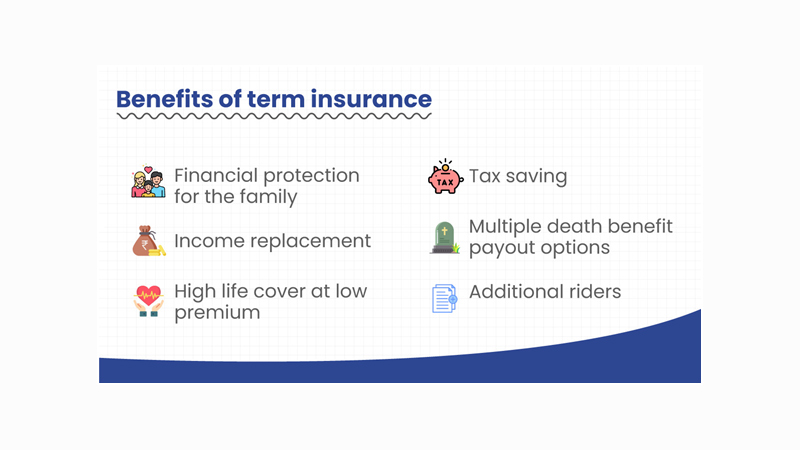
    Term insurance, in essence, is everything mentioned above. However, the following benefits will catalyse your decision to secure your family’s future with a robust term insurance plan:

    Simple: Term insurance is easy to understand; it is a straightforward life cover without any investment complexities. All you have to do is pay your premiums, and your life is covered for a set period, providing clear benefits for your family.

    Affordable: Even though it is remarkably affordable, term insurance offers substantial financial security for your loved ones. For instance, with as little as ₹500 per month, you can provide your family with a ₹1 crore life cover, ensuring they can manage regular expenses, settle debts, and maintain their lifestyle.

    Tax benefits: With term insurance, you can also enjoy tax benefits, ensuring not just financial security for your family but also savings for yourself throughout the process.

    Peace of mind: Term insurance is the best way to reassure yourself that in your absence, your family will have enough financial support to navigate any challenges that arise, offering you peace of mind and security.

    Financial Planning: None of us know what’s in the future. In the event of an untimely demise, relying solely on investments may not prove a wise decision, as they will not suffice to financially protect your family. A term plan, on the other hand, guarantees a substantial payout for considerably affordable annual premiums, ensuring your family’s financial security.

    Income Replacement: Term insurance acts as a vital income replacement tool, ensuring financial stability for your loved ones in your absence. It provides a reliable source of income to sustain their needs and lifestyle.

    Additional Riders to Strengthen the Policy: Term insurance plans often come with riders that you can choose to boost your basic insurance benefits. You can add them to your term plan by paying a nominal additional premium.

    Return of Premium Option: A pure-term insurance plan offers life cover to beneficiaries upon the insured’s death without providing any maturity benefit. However, you can opt for the return of premium option, which entails higher premiums, ensuring a refund of total premiums paid if you outlive the policy tenure.

    Please note: Taxes, levies, rider premiums, and modal amounts are excluded from the refunded premium.

    We hope this blog helps you understand why term insurance is important and brings an end to your contemplation of the benefits mentioned above. To know more, you can access an easy term guide and make a sound decision about buying term insurance for your family.