Tag: Tata Sky

  • Assam’s Prag News aims for better distribution, content tie up

    Assam’s Prag News aims for better distribution, content tie up

    KOLKATA: The north eastern region of the country has been an ignored lot. And it is not just the people, who are asking for attention, but the channels as well that are now vying for more visibility. One such channel is Assam-based Prag News, a 24×7 satellite News channel, which is looking at pan-India presence. The channel has signed a deal with direct to home (DTH) operator Tata Sky to further enhance its distribution in other parts of the country.


    “We have already signed the deal with Tata Sky and as soon as the operator finds the bandwidth, Prag News will be included on the platform,” informs Prag News chairman and managing director Sanjive Narain.


    The News channel which is already available on Airtel Digital TV and Dish TV is also in talks with other DTH operators to ensure better reach. “We will disclose the information about the other players once the deal is finalised,” he adds.


    “It will be a win-win situation for any DTH player if it ties up with Prag News. The arrangement will also benefit the Assamese viewers of the platform,” opines Vinod Jhaveri of VKJ Advisory Services.


    The channel also enjoys a good reach in cable TV homes, across the country. While it is being distributed across the country via multi system operator SitiCable, in parts of Bihar it is distributed through Darsh Network, in J&K by 7 Sea, in Punjab with FastWay and in West Bengal via CTVN.


    Prag News, one of the oldest local news channels of the north east region which was launched in 2000 and operates out of Guwahati, has other plans as well. Taking cue from the tie-up between Times Now and Guwahati based News Live during Lok Sabha election, Prag News is also looking at content tie-up opportunity with a national News broadcaster.


    “Nothing has been finalised as yet on this front,” informs Narain.


    Post Assam chief minister Tarun Gogoi’s decision to step down after his defeat in the general elections and BJP-led government deciding to monitor the states closely, the region has become a hub of new.


    “Mainstream media especially TV has always ignored the north east.  While clubbing all stories under the section ‘North East’ is an easy way out for channels, it is completely unfair to the people there. It is good to know that local channels like Prag News are looking for content tie-ups. If this happens, we can hope to see substantial increase in coverage from different states of north east in the media space,” says a Kolkata based television expert.


    The channel is currently available across Assam and other north-east states and enjoys a viewership of over 10 million. 

  • Broadcom to supply HEVC SoC for Tata Sky Ultra HD STBs

    Broadcom to supply HEVC SoC for Tata Sky Ultra HD STBs

    MUMBAI: Broadcom Corporation has announced that it will be providing its BCM7252 high efficiency video codec (HEVC) H.265 system-on-chip (SoC) to Tata Sky. This will be utilised in the DTH operator’s Ultra HD set top boxes (STBs).


    Tata Sky and Technicolor have teamed up to design and deploy its 4K STBs by 2015. Broadcom’s HEVC-enabled chipsets provide the compression and high-throughput required by operators and OEMs to rapidly introduce Ultra HD subscriber hardware and content. The Broadcom BCM7252 Ultra HD SoC improves coding efficiency and reduces video bandwidth usage by 50 per cent.


    “We are committed to delivering an innovative and world class TV viewing experience. With the arrival of HEVC technology, our subscribers will soon be some of the first in the region to experience the live-action quality that only Ultra HD can provide,” said Tata Sky MD and CEO Harit Nagpal. “As Ultra HD TVs continue to become more affordable and Ultra HD content becomes more widely available, we anticipate increased subscriber demand for Ultra HD-capable set top boxes.”


    “Technicolor is at the forefront of Ultra HD, working to enhance the Ultra HD experience on all screens by providing content preparation and 4K image certification for high quality STBs and video gateways. By leveraging Broadcom’s advanced Ultra HD devices with integrated HEVC compression technology, we can deliver 4K resolution at a frame rate of 60 frames-per-second while substantially reducing the bandwidth required for video transmission, and providing the advanced features and capabilities needed to enable the ultimate home viewing experience,” said Technicolor Connected Home Division senior vice president APAC Georges Laplanche.


    “As consumer interest in Ultra HD continues to grow, Broadcom is delivering advanced devices with market-specific features and price points that allow consumers to enjoy an enhanced viewing experience regardless of their geography,” said Broadcom senior vice president marketing BCG Rich Nelson. “Broadcom continues to demonstrate its commitment to furthering the Ultra HD ecosystem across the globe, providing the innovation required by our customers to drive this technology quickly into the market, particularly as lower-cost Ultra HD TVs drive consumer awareness.”


    Key Features of the BCM7252 Ultra HD SoC

    •    High-performance dual-core Brahma15 10000 DMIPs ARMv7 processors

    •    2180p60 or dual 1080p60 decode and transcode capabilities

    •    Integrated connectivity peripherals including USB 3.0, PCIe, Gigabit Ethernet and MoCA 2.0

    •    Highest level of platform security, content protection and DRM robustness

    •    Dual display allowing presentation of two simultaneous video channels from the same STB via independent HDMI outputs and remote control devices

    •    Dedicated interfaces to a range of Broadcom companion front end cable, DOCSIS, satellite and 802.11ac Wi-Fi devices

  • DTH ops plea: Exclude content cost from AGR

    DTH ops plea: Exclude content cost from AGR

    MUMBAI: The Telecom Regulatory Authority of India (TRAI), last week, came out with the much needed recommendation paper on new DTH licences. The issue had come into light when India’s oldest DTH operator Dish TV was nearing the end of its 10 year licence that was given to it when it started operating.


    While the need for fresh and transparent rules came up, TRAI issued a consultation paper in October 2013 and it was just last week that it came up with its recommendation paper on the same. What most DTH operators were glad about was the reduction in the annual licence fee from 10 per cent of gross revenue (GR) to 8 per cent of adjusted gross revenue (AGR). This would mean that the DTH industry in all will save around Rs 200 crore to Rs 300 crore.


    The AGR is calculated after deducting service tax, sales tax and entertainment tax from the GR. TRAI states that since there has been growing convergence of telecom and broadcast, the 8 per cent is aligned to the unified licence (UL) in the telecom field. The recommendation paper states that in the UL, AGR is arrived at by excluding taxes and charges of ‘pass through’ nature. Even though TRAI states that there is no such charge of ‘pass through’ nature for DTH players, the latter disagrees.


    “We were hoping for either a 6 per cent of AGR or 8 per cent of AGR with ‘pass through’ of content cost,” says Videocon d2h CEO Anil Khera. When a few months ago, the Ministry had sent notices to all the DTH operators to pay the licence fee dues, they had taken the issue to court. Tata Sky CEO Harit Nagpal had then said that the Ministry of Information and Broadcasting had itself asked the Finance Ministry to reduce the fee from 10 per cent to 6 per cent.


    The paper says that two DTH operators had recommended that for calculating AGR, deduction should be made for not just service tax, sales tax and entertainment tax, but also for content costs, transponder costs, hardware sales revenue etc.


    Dish TV CEO and soon to be DTH Operators Association president RC Venkateish says that the fight for exclusion of content cost isn’t over yet. He says, “We will approach the Ministry of Information and Broadcasting to press for content cost to be excluded from the AGR. Like we had said, either it should be removed or else the licence fee should be brought down to 6 per cent of AGR instead of the recommended 8 per cent of AGR.”


    The parliament was told in April 2013 that six private DTH operators paid Rs 307.8 crore as licence fee to the government for the year 2011-12. According to figures furnished in the reply to the Parliament, Tata Sky paid licence fee of Rs 79.3 crore in 2011-12 as against Airtel Digital’s Rs 61.87 crore and Dish TV’s Rs 30 crore. Sun Direct paid Rs 36 crore, Reliance Big TV paid Rs 9.5 crore, and Videocon d2h paid Rs 5 crore.


    For now, the recommendations are pending with the Ministry for approval.

  • Al Jazeera English exposes India’s baby-making booming industry

    Al Jazeera English exposes India’s baby-making booming industry

    MUMBAI: The birth business is thriving in India. Childless couples from around the world are flocking to the country, pinning their hopes on the poor young Indian women willing to bear other people’s babies. Al Jazeera English unveils India’s booming baby-making industry in a special episode of 101 East, a weekly Asian current affairs programming on July 26.

    In poverty-plagued India, the thousands of dollars couples pay their surrogates, can open the door to a much brighter future. About 12,000 babies, produced by Indian surrogates, are for Western clients. Al Jazeera English follows the two Australian couples hoping to bring home a “made in India” baby and, the highs and lows of them trying to bring a baby home, the stories of women who give birth to babies they will never know.

    “If you are just a critic who feels a childless person should live a life of misery and stay childless throughout their life, or a poor person is meant to remain poor all throughout their life then you’ll consider this as something wrong, as something immoral. A farm. A baby-making factory..” said Dr. Nanya Patel, one of the pioneers of the commercial surrogacy business.

    The women and increasingly would-be parents are being exploited as ethics are swept aside in pursuit of profit. But have regulations kept pace with the huge expansion in surrogacy services? Many say this emotionally-charged industry is littered with pitfalls for parents and risks for surrogates. The special episode uncovers the success and failures of India’s surrogacy industry.

    Tune into Al Jazeera on Dish TV 618 and Tata Sky Channel 533 to catch the special episode on July 26, 09.00 AM and on July 27, 10.00 PM IST

  • Tata Sky launches the first ever Scholarship on television

    Tata Sky launches the first ever Scholarship on television

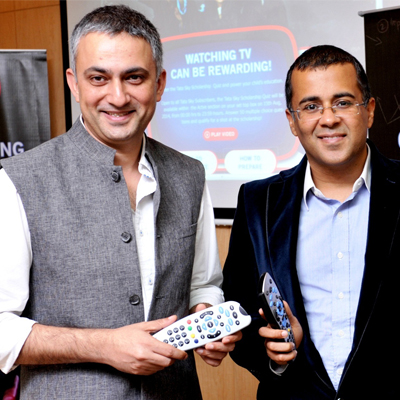
    MUMBAI: Tata Sky, the leading digital Pay-TV player in the country, has taken edutainment to the next level by announcing the launch of the first ever Scholarship for kids that can be availed through television. Author & motivational speaker Chetan Bhagat has been roped in to promote the Tata Sky Scholarship Quiz – a gratifying concept of edutainment.

    For the first time ever television will be the medium of participation for children to win the edutainment based Tata Sky Scholarship. Tata Sky subscribers will be able to participate in the quiz on 15th August’14 by simply answering questions on television, with a click of their Tata Sky remote control, from the comfort of their homes.

    Vikram Mehra, Chief Commercial Officer at Tata Sky explained, “The varied range of learning channels and interactive services for children on Tata Sky has been an apt medium to deliver edutainment and knowledge based content, as kids always grasp more from what they see and hear. Now with the Tata Sky Scholarship Quiz we look forward to quizzing and rewarding children across the country, for their vast exposure to educative content.”

    Tata Sky will roll out scholarships worth Rs. 20 lakhs with top 10 winners being entitled to a scholarship worth Rs. 2 lakhs each. Tata Sky is also launching a kid’s campaign titled – ‘Ab Bachchey Seekhein TV se…’, conveying the fact that television is a good learning aid for children.

    Promoting the TataSky Scholarship Quiz, Chetan Bhagat said, “It gives me great pleasure to be associated with Tata Sky. Their unique edutainment platform gives a great opportunity for children to learn through television. The scholarship provides an impetus to fulfil their future dreams and aspirations.”

  • DTH licensing recommendations: TRAI restricts vertically integrated broadcasters from owning more than one DPO

    DTH licensing recommendations: TRAI restricts vertically integrated broadcasters from owning more than one DPO

    MUMBAI: The Telecom Regulatory Authority of India (TRAI) has come out with some rules and regulations regarding a host of issues including crucial ones such as DTH licences and cross holding. In a recommendation paper that it gave out, it has said that certain restrictions be placed on vertically and horizontally integrated broadcasters and distribution platform operators (DPOs).


    A vertically integrated broadcaster will be permitted to control only one DPO while a vertically integrated DPO will be restricted from controlling any other DPO of other category in the relevant market. For this it has defined the meaning of cross holding and control to be as: ‘a broadcaster includes the broadcaster itself, its subsidiary companies /associate companies/ companies of its relatives, its holding company and subsidiary companies /associate companies/ companies of its relatives of its holding company and any other broadcaster in its control. Similarly, a DPO includes the DPO itself, its subsidiary companies /associate companies/ companies of its relatives, its holding company and subsidiary companies /associate companies/ companies of its relatives of its holding company and any other DPO in its control.’


    In its paper, TRAI states that ‘In order to ensure orderly growth of the broadcasting and distribution sectors and to avoid compromises or limitations on competition, certain cross-holding restrictions may be required to be put in place. Accordingly, the Authority recommends uniformity in the policy of cross holding /control between broadcasters and DPOs and amongst DPOs in the broadcasting and distribution sector.’


    Depending on the shareholding patterns as prescribed by TRAI, companies will have to restructure their operations within one year. Industry sources say that the only two probable companies that are likely to be affected are the Zee group with Siti Cable and Dish TV and the Sun group with Sumangli Cable and Sun Direct.


    However TRAI also states that there can’t be cross holding amongst DPOs of different categories. The paper states, ‘there cannot be any cross holding/control between an MSO (A), MSO cum HITS operator (B) or a HITS operator (C) and a DTH operator (D), while there could be controlling stakes amongst A, B and C subject to market share restrictions, as specified from time to time.’


    DPOs have been given set parameters for market share/dominance. For DTH operators, the relevant market would be the entire country while for an MSO it is the state. The market share of a DPO would be the number of active subscribers of that DPO as a percentage of the total number of active subscribers of that category of DPOs.


    On the DTH side, most operators are glad with the outcome of the paper that will now go through the Ministry of Information and Broadcasting (MIB). Says DTH Operators Association of India president and Tata Sky CEO Harit Nagpal, “We are glad with the outcome. There were two main issues that needed to be addressed: continuity of DTH licences and licence fee. The paper has made both amply clear, the migration process included. When the licence fee of 10 per cent was introduced there wasn’t any additional service and entertainment tax on it. We had been asking for relief on the licence fee to be calculated on adjusted gross revenue rather than gross revenue.”


    The period of DTH licence has been extended from the current 10 years to 20 years while the one time entry fee has been retained at Rs 10 crore. The big relief is the reduction of licence fee from 10 per cent of gross revenue (GR) to 8 per cent of adjusted gross revenue (AGR). An industry source said that the DTH industry earns anywhere between Rs 8000 crore to Rs 9000 crore annually, pegging the savings that will come due to the 2 per cent relief at nearly Rs 200 crore. “The reprieve on overall taxation is the highlight point. Although industry would have liked it to be 6 per cent of AGR, this isn’t bad at all,” said the source.


    Speaking on the new guidelines, Videocon director Saurabh Dhoot says, “This is a step in the direction towards encouraging industry riddled with high taxation and double taxation. However, content cost not included in deduction remains a concern area.”


    Supporting the extension of DTH licence, TRAI states that though the guidelines are silent on the provision of extension, it could not be its intent to disallow them from continuing their business post 10 years of existence. ‘Starting a DTH business entails a huge investment of resources. It would, therefore, be a reasonable expectation on the part of DTH licensees that, on the expiry of the initial 10 year licence, they would be eligible to apply for issue of a new licence, so that they could continue their business,’ it states.


    The new DTH licensing regime has been brought to bring fair degree of stability in the sector, to proper overall growth of the sector as it will create a conducive environment for investment from strategic investors. This will in turn spur innovation in terms of adoption of better technology and services.


    The DTH Operators Association had requested TRAI to consider initial licence of 20 years which it has agreed to give on the lines of Telecom licence while its second request of a 20 year extension has been kept to 10 years. ‘The Authority also recommends that the renewal shall be on the terms and conditions, including renewal fee, specified by the Licensor (MIB), in consultation with the TRAI.’


     AGR is calculated by excluding service tax, entertainment tax and sales tax/VAT paid to the government from the GR. The annual licence fee shall be subject to a minimum of 10 per cent of the entry fee while the licence should have a provision that prescribes that the licensor has the right to modify the licence fee as a percentage of AGR any time during the currency of the agreement.


    The earlier rule of providing a bank guarantee (BG) of Rs 40 crore has been changed. Licencees will have to furnish a BG for an amount that is equal to payable licence fee for two quarters and other dues not otherwise securitised.  The BG has to be valid for a year and renewed on a year on year basis in a way that it will be valid for the entire licence period. New entrants will have to give a fixed BG of Rs 5 crore for first two quarters and then continue in the manner prescribed above.


    Those DTH operators that are serving their time in the existing regime can migrate to the new regime any time during its current licence period. Before migrating, it has to however clear dues and fulfill obligations under the old regime as well as clear legal cases. The ones who want to migrate will have to pay the entry fee again for a new licence but a rebate, commensurate to the remaining licence period may be granted to them.


    The quantum of migration fee will be as follows:


    Migration fee = [Entry fee in the new DTH licensing regime – (Entry fee under existing License/existing license period i.e. 10 years) x (No. Of years remaining in the existing regime at the time of migration)]. In this formulation part of a year is not to be counted.


    Currently, STB interoperability isn’t possible because of the different technologies being adopted by the operators due to their entering the market at different times. Therefore, the bureau of Indian standards (BIS) has been asked to regularly keep updating the standing of STB technology, in consultation with TRAI. A tariff order for DTH was recommended by TRAI last year that allowed an easy exit option to subscribers, ensuring availability of consumer–premises-equipment (CPE – that primarily consists of STB and Dish antenna) at reasonable prices, easy to understand terms and conditions and at the same time, protecting the interests of the service providers. This order is sub-judice in TDSAT.

  • Tata Sky launches ‘TV is Good’ campaign for Kids!

    Tata Sky launches ‘TV is Good’ campaign for Kids!

    MUMBAI: Tata Sky, the leading DTH player in the country, launched its latest ad campaign ‘Ab Bachchey Seekhein TV se’ (Kids learn with television). The ad is set out to convey the fact that while television is a great entertainment medium, it is equally a good learning aid, helping children gain beyond bookish knowledge.


    The campaign is targeted primarily at the parents with children between ages 6 to 12 years, trying to break the myth most Indian parents have on ‘television is only mindless viewing for kids’. Hence one of the three ad films features a young boy stating an interesting fact on how to find out if the eggs are old or new. Similarly the other two ads have two kinder garden aged girls quizzing the audience on facts about ‘rhyming words to orange’ or ‘how to escape a leopard’ that catch you by surprise and leaves you with a smile. All the three ad films deliver the overarching message – Television is good!


    Vikram Mehra, Chief Commercial Officer, Tata Sky said, “Kids today are smart, not just studious. Give them the right content in an interesting package and see them absorb the knowledge at lightning speed. Over the last few years, Tata Sky’s pioneering efforts in ‘education through television’ with interactive (Actve) services and a bouquet of infotainment channels have been very well received by subscribers, specifically kids. With this campaign we wish to take the message to markets across the country on how fruitful learning through television can be.”


    Elaborating on the ad campaign, Abhijit Avasthi, National Creative Director, Ogilvy & Mather, “If you ask any parent they would say that television and education are like chalk and cheese, rather most will insist that television gets in the way of education. But what we found out in research was quite the contrary. Parents are starting to recognize that there is enough wholesome content on television to supplement their kid’s academic learning, more so in smaller cities where there are very few avenues to give kids holistic education, television plays a role to provide that. Our campaign, ‘Kitna kuch seekh saktein hai bacche TV se’ features kids flaunting the interesting pieces of knowledge that they have learnt from the 13 learning channels that Tata Sky has to offer. Actually we ourselves learnt so much while shortlisting these knowledge facts for the campaign. That discovery only fueled our conviction that kids can learn so much from TV.”


    · Name of the ad agency: Ogilvy & Mather

    · Name of the creative director: Abhijit Avasthi


    Isko laga daala toh TV jinga lala!


    YouTube links to the three TVCs:

    Orange – https://www.youtube.com/watch?v=0uhWKas1YSM

    Eggs – https://www.youtube.com/watch?v=A9bErWRuglk

    Leopard – https://www.youtube.com/watch?v=FP9h2sf-aJA

  • TRAI extends DTH licence period to 20 years

    TRAI extends DTH licence period to 20 years

    MUMBAI: The Telecom Regulatory Authority of India (TRAI) has released its recommendations for a new DTH licensing regime today. As part of this, the period of DTH licence has been extended from the current 10 years to 20 years, renewable by 10 years at a time.


    The Regulator has said that the existing licence fee will be reduced from 10 per cent of gross revenue to 8 per cent of adjusted gross revenue, in line with the telecom licences.


    Also, the existing DTH licensees will be permitted to migrate to new regime at any time during the currency of the existing licences. Meanwhile, the one time entry fee has been retained at Rs 10 crore.


    The salient features of the recommended new DTH licensing regime are as follows:


    The   period   of  DTH  license  to  be  increased  from   10  years to  20  years, renewable by 10 years at a time.


    One time entry fee to be retained at Rs 10 crore.


    Existing license fee to be reduced from 10 per cent of gross revenue (GR) to 8 per cent of adjusted gross revenue (AGR) in line with the telecom licenses.


    The existing DTH licensees to be permitted to migrate to new regime at any time during the currency of their existing licenses.


    BIS   to    come     out    with     updated     specifications for     STBs in consultation with TRAI which should be complied by DTH licensees.


    The DTH licensees to be mandated to comply with the tariff order  scheme prescribed by TRAI for commercial inter-operability.


    The salient features of the Recommendation on Cross Holding/Control in the Broadcasting and Distribution Sectors are as follows:


    Policy on Cross-holding/Control to be restructured to bring in uniformity in the broadcasting and distribution sectors.


    Comprehensive definition of ‘control’ to be uniformly adopted in all segments of broadcasting and distribution sectors.


    Relevant market for DTH to be the   entire country and   for MSO /HITS – State.


    Broadcasters and Distribution Platform Operators (DPOs) – MSO /HITS  and DTH operators to be separate legal entities.


    Rationalised and regulated vertical integration to be permitted between broadcasters and DPOs.


    Vertically integrated broadcaster(s) and DPO   to   be   subjected   to additional set of regulations.


    A vertically integrated broadcaster to be permitted to control only one DPO.


    A vertically integrated DPO to be restricted from controlling any other DPO of other category in the relevant market.


    A vertically integrated DPO not to be permitted to acquire more than 33 per cent of the market share in the relevant market.


    The additional regulations for a vertically integrated broadcaster to include:


    The   agreements with   the   DPOs   to be non-discriminatory and   on charge-per-subscriber (CPS) basis.


    To file the   Reference Interconnect Offer (RIO) for approval by the Authority. All Interconnection Agreements to be only on the terms specified in the RIO.


    To make disclosures as prescribed by the Authority.


    The  additional regulations for a vertically integrated DPO would  include:


    DPO to declare its channel carrying capacity and not to reserve more than 15 per cent of this capacity for its vertically integrated broadcaster(s). Rest of the capacity to be offered to other broadcasters on non¬ discriminatory basis.


    DPO   to   publish the   access fees   for carriage of channels over   its network.  The    charging of   the    access fees    should be   on   non­ discriminatory basis.


    To make disclosures as prescribed by the Authority.


    The   Authority  to  come   out   with   appropriate  Regulations/Orders for  the regulatory  framework  and  disclosures  after    the   government   takes  the   policy decision on  the  recommendations.


  • DTH ops face jammers again

    DTH ops face jammers again

    MUMBAI: Direct to home (DTH) operators are already facing annoyed users because of signals being disconnected due to rains. Now, they have a fresh problem to tackle, that of jammers being used in the city of Mumbai to distort DTH signals.


    Bringing the issue to light, the DTH Operators Association of India president and Tata Sky CEO Harit Nagpal has written letters to the Telecom Regulatory Authority of India (TRAI), Sanchar Bhavan, Ministry of Information and Broadcasting, Department of Telecommunications, the Prime Minister’s Office, Ministry of Home Affairs and the Mumbai Police commissioner.


    The letter states that ‘these jammers are being used by anti social elements to disrupt DTH signals and are also a threat to national security as the same are capable of being used to interfere with other signals besides DTH.’


    The letter also states that several incidences of signal losses were found during the FIFA World Cup matches in areas such as Versova, Yari Road and Lokhandwala. The jammers were disturbing the signals of all DTH ops including Freedish. Five specific dates have been tracked which were key FIFA match dates- 4 July, 10 July, 11 July, 12 July and 13 July.


    While locating the area of mischief, the technical team came across destroyed DTH antennas. During the service visits, interference was found in the lower Ku band between 10.7 GHz and 11.7 GHz.


    Similar cases have happened in Noida in 2011 and in Mumbai in 2008 and 2012. While the culprits were put behind bars in Noida, the signal disruption stopped in Mumbai after a written complaint was sent to the police.


    DTH ops feel it could be cable ops that are hampering their service. “Government has made it a fair playing field for MSOs and DTH with digitisation and this has put pressure on some operators to provide quality in their offering such as HD channels, interactive service etc. Just because someone can’t cope with DTH’s offering they shouldn’t get into such low acts,” said a senior executive of a leading DTH brand.


    Nagpal states that Tata Sky has received several complaints from consumers about poor picture quality and freezing of pictures on screen and so it has tracked certain key locations.


    The letter states that according to section 20, 21 and 25A of the Indian Telegraph Act, 1885 and section 3 of Indian Wireless Telegraphy Act, 1933, possession and use of unauthorised equipment and interference with transmission of authorised signals is illegal.


    It ends by stating that the real loser is the DTH operator since there is no continual preventive measure to keep jammers away. ‘Due to such illegal activity the subscribers think that the signal interference is caused by the DTH service providers and they lose goodwill and credibility resulting in loss of subscriber base,’ states the letter.

  • Technicolor ships 11th million STB to Tata Sky; celebrates 10 years of partnership

    Technicolor ships 11th million STB to Tata Sky; celebrates 10 years of partnership

    PARIS: Technicolor  (Euronext Paris: TCH ; OTCQX: TCLRY) is proud to announce two special landmarks in its relationship with Tata Sky India’s leading direct to home (DTH) service provider and HD market leader – the 10 year anniversary of the partnership and the delivery of the 11 millionth Technicolor set-top box.

    These special milestones follow an announcement in May of this year for Technicolor to ship 4K set-top boxes in volume to Tata Sky from early 2015.


    “On behalf of Technicolor, I’d like to thank Tata Sky for its ongoing co-operation and congratulate the company on its achievements as India’s market leader. We look forward to continuing our partnership and helping to deliver even more successful and exciting services to consumers across India in future,” said Michel Rahier, President of Connected Home Division at Technicolor.


    Tata Sky MD & CEO, Harit Nagpal, added “Over the past 10 years Tata Sky’s vision has been to offer its customers the best, most compelling video experience. Technicolor has been a true partner in that quest, delivering high quality products and services. And 2015 will be a great year for our partnership as we deploy 4K STBs across the Indian market, once again, underlying our commitment to delivering the most recent technologies and the highest quality content.”