Tag: Tata Sky

  • TDSAT gives 30 days to Tata Sky, IndiaCast to sign agreement

    TDSAT gives 30 days to Tata Sky, IndiaCast to sign agreement

    MUMBAI: Direct to home (DTH) operator Tata Sky and TV18-owned content distributor IndiaCast Media have got another 30 days from the Telecom Disputes Settlement and Appellate Tribunal (TDSAT) to enter into a content agreement under the ongoing legal spat between the two regarding a disconnection notice.

    TDSAT has ordered that the parties should enter into an agreement either on negotiated terms or on RIO terms within a further period of 30 days.  The interim orders passed earlier continue till next date.

    The matter has been posted under the same head on 22 January 2019.

    This is the second time that Tata Sky and IndiaCast Media have asked for an extension to decide on a content agreement from TDSAT. During the earlier hearing in October, the parties had asked for more time to settle on an agreement. TDSAT had given them an additional 30 days notice to settle the matter.

    Tata Sky had moved to TDSAT against the disconnection notice issued by IndiaCast, citing non-signing of the agreement, in September. The DTH operator had then sought an extension of the agreement, whose term had expired on 31 July, to be operative for a further period of three months.

    The tribunal had directed the parties to either arrive at a negotiated agreement otherwise they must enter into an RIO based agreement in accordance with the regulations.

  • Sony channels back on Tata Sky after a two-month blackout

    Sony channels back on Tata Sky after a two-month blackout

    MUMBAI: All’s well that ends well. A commercial dispute between Sony Pictures Networks India (SPNI) and India’s DTH premier operator Tata Sky has finally been resolved mutually. All Sony channels, which were dropped from the satellite platform, have returned after two-month partial blackout — much to the relief of the consumers.

    According to industry sources, the terms and conditions of the contract between the broadcaster (SPNI) and the DTH operator (Tata Sky) were mutually resolved, though the exact nature of the financial deal has not been revealed.  

    On 1 October 2018, Tata Sky pulled off 22 SPN channels from the platform, which evoked massive anger among consumers. The DTH platform had retained some of the Sony channels on a-la-carte rates, though.

    According to Tata Sky CEO Harit Nagpal, commercial negotiations with the broadcaster had broken down as deals being sought by SPNI would have forced the distribution platform to hike prices for the consumers. Sony, meanwhile, had claimed that the decision by the leading DTH platform was “unilateral”.

    Earlier, SPN had issued a disconnection notice to Tata Sky on 7 September 2018, which was followed by a public notice on 10 September 2018 detailing the same.

    According to a PTI report, SPNI's three-year contract with Tata Sky had expired on 31 July 2018. After the contract got over, Tata Sky had asked for an extension so the deal could come through and it also tried to reach a new pricing deal after 31 July 2018. The talks had failed at this point.

    Later, the Telecom Disputes Settlement Appellate Tribunal TDSAT heard a case relating to commercial dispute on 11 October 2018 and advised the parties concerned to take four weeks to try and reach a mutually acceptable negotiated agreement.

  • Theatre has a new stage with Tata Sky

    Theatre has a new stage with Tata Sky

    MUMBAI: Tata Sky, India’s leading content distribution platform announced Tata Sky Theatre- a 24-hour, first ever ad-free service that brings to its subscribers acclaimed plays and performances from the finest theatre groups on television. Powered by Zee Theatre, Tata Sky Theatre has launched over 100+ plays from across genres – Musicals, period drama, social satire, romantic comedy, crime drama, etc. in a cinematic format to the comfort of your home.

    The service primarily offers Plays in Hindi and English language. Complimenting the envious line-up of plays will be exclusive content relating to Backstage – behind the scenes, Theatre Talks – interviews with cast and crew, etc.

    Present at the launch, Pallavi Puri, Chief Commercial Officer, Tata Sky said, “Tata Sky aims to bring unique and engaging content to our subscribers. Tata Sky Theatre brings rich & imaginative theatre to life on TV screens, which fits in very well with our legacy of innovative special service offerings. In association with a valuable partner Zee Theatre, Tata Sky Theatre will bring to your screens hand-picked plays & performances starring the finest theatre artists.”

    Renowned theatre artists such as Sonali Kulkarni, Amitosh Nagpal, Milind Pathak, Rajeshwari Sachdev, Reema Lagoo, Vikram Gokhale, Govind Namdev and many more will be seen enacting these televised plays. Some of the celebrated plays that you can catch on Tata Sky Theatre would be Vaastav, Wrong Turn, Doll’s House, Agnipankh, White Lily & Night Rider, Scavenger’s Daughter and many more. Tata Sky Theatre’s content library has something in it for everyone.

    Shailja Kejriwal, Chief Creative Officer – Special Projects, Zee Entertainment Enterprises Ltd. said, “Theatre has been the heart of India’s rich cultural heritage for decades now and has played an integral role in shaping our social identity. Committed to delivering extraordinary entertainment experiences, we aspire to revive, restore and spread this rich cultural heritage by bringing the best of Indian theatre for audiences to experience. With Tata Sky Theatre, we bring the purest form of entertainment by offering a variety of plays across genres, each being socially relevant to today’s evolved viewers.”

  • VBS 2018: Media & entertainment industry leaders address pressing issues on Day 1

    VBS 2018: Media & entertainment industry leaders address pressing issues on Day 1

    GOA: Rapid advance in technology and infrastructure, entry of disruptive forces and changes in consumption habits have led the Indian media and entertainment industry to major conversion. The interesting developments are attracting international players to invest in the market, with traditional domestic players adopting new strategies for growth. Where the industry is heading in the next few years is something everyone wants to know.

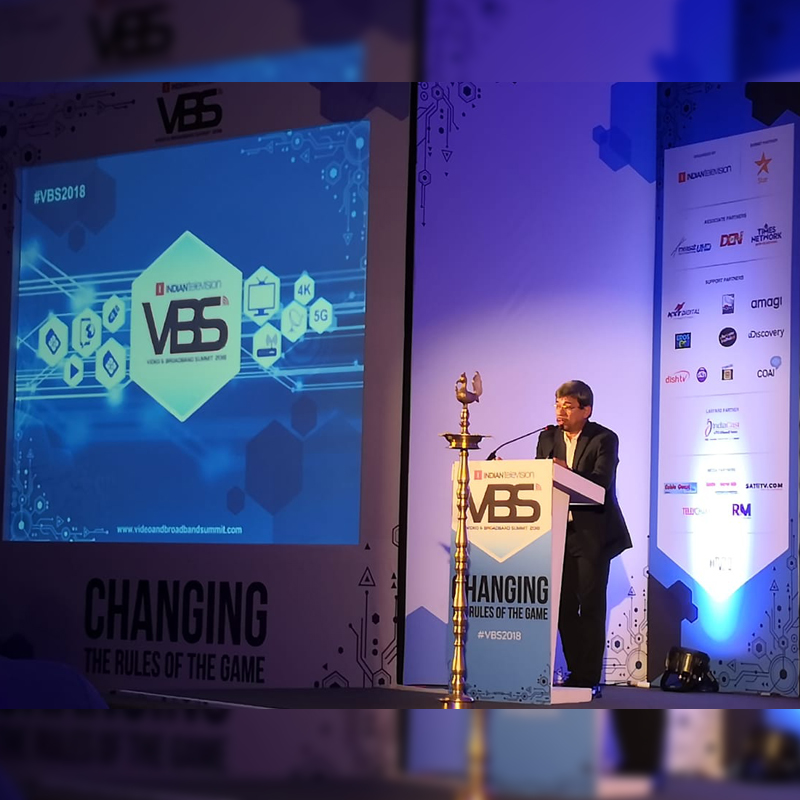
    To seek answers for several concerning questions, Indiantelevision.com brought together industry doyens on the first day of the Video and Broadband Summit. The conference dedicated to industry issues has been supported by esteemed broadcasters, technology companies as well industry bodies. All the speakers agreed that the VBS platform is the perfect stage to discuss relevant issues as well as to gain new insights while sharing their experience.

    Indiantelevision.com founder and CEO Anil Wanvari set the tone for the day with his welcome speech. He spoke about how demonetisation and GST put pressure on business in last couple of years. He also highlighted how the burgeoning OTT industry is throwing new challenges to traditional TV, cable and DTH operators along with the new tariff order that is likely to reshape the trajectory of the sector. He also added how a disruptive force like Jio FTTH is fueling the transformation.

    The first session moderated by Anil Wanvari was about the future of digital delivery platforms where Tata Sky chief content officer Arun Unni, PwC India partner Raman Kalra and One Take Media founder and CEO Anil Khera participated. As the influence of video and broadband has become unmistakable now, Tata Sky recently rolled out a broadband service. While he was asked about how it stands out, Unni said customer centric nature of the business makes their service different. While broadband and telco players are throwing a challenge for distribution, Khera thinks India still has potential for DTH and cable growth owing to almost  90 mn households still unpenetrated by TV. Kalra said while pay-TV and OTT platforms will stay together, there will be a constant battle among players to stay relevant to consumers with proper content.

    In a fireside chat with Anil Wanvari, COAI director general Rajan Mathews spoke about various issues in the telecom industry. He said consumer choices are changing rapidly today, hence the model which is working at present, may get disrupted in future. He also spoke about the high cost of utilizing satellites in the country despite them being produced and launched at very low cost. Talking about 5G, he said it will take a while to be rolled out and added that it would be focusing on education, health, traffic management, smart cities and agriculture.

    Anil Khera who has now ventured into the value-added service space after spending considerable time in the DTH industry, explained the importance of this vertical and how DTH players are utilizing it.

    Another engaging session where audience also took an active part in the discussion, was about monetising TV in times of transition. ZEEL chief growth officer Ashish Sehgal, KMPG India media and entertainment partner and head  Girish Menon and TAM India CEO LV Krishnan spoke on the issue. “Only thing TV can't do is engagement which digital platforms allow but you cannot build your brand without TV,” Sehgal made a very important comment.

    The eventful day ended with a fireside chat between Viacom18 COO Raj Nayak and Anil Wanvari. Nayak shared glimpses of his inspirational journey in the industry and Viacom18 where he was the brainchild of several successful endeavors. Talking about the future, he said it will belong to those who can create content which is compelling. Moreover, he also said content cost is not going down but it's going up across broadcasters. Giving the example of Netflix’s change of fortune with House of Cards, he added that for changing the trajectory of the business, delivering two-three golden nuggets every year are enough.

    For more insights stay tuned for the updates from the second day of video and broadband summit 2018!

  • Tata Sky ventures into curated short content with Shorts TV

    Tata Sky ventures into curated short content with Shorts TV

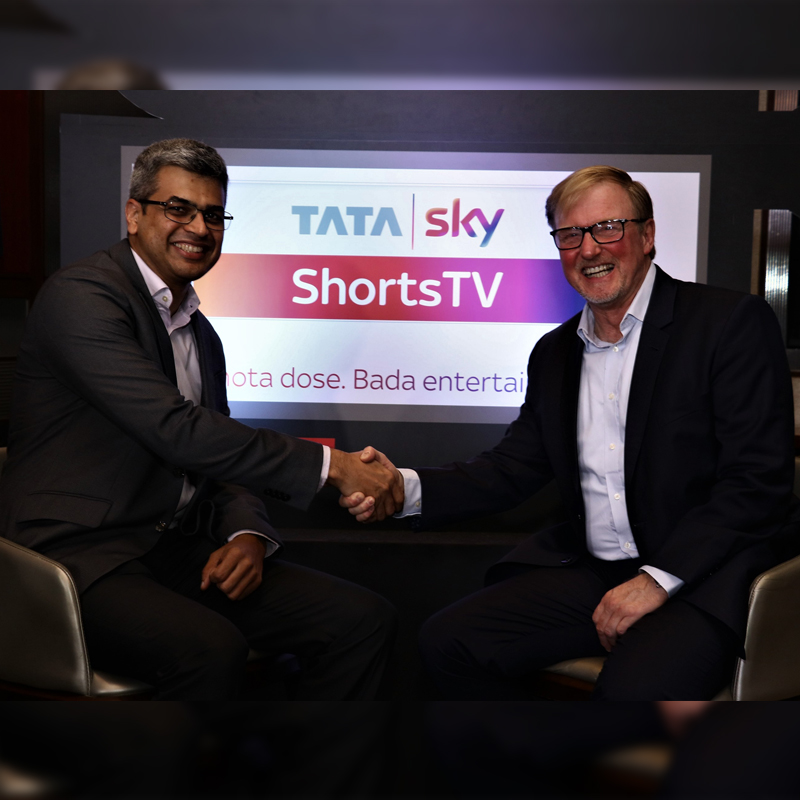
    MUMBAI: India’s leading DTH player Tata Sky has entered into a partnership with a London-based television channel Shorts TV for its new platform Tata Sky ShortsTV.

    The newly launched platform is one of a kind in the country, dedicated to curated short stories and films. The subscription price for this service has been fixed at Rs. 75 per month. Along with availability on the telly screen, the service is also available on the mobile app as well as the DTH operator’s website.

    “We were always keen to bring beautiful short form content on our platform, but we needed to find the partner who did it right. That’s how we found Shorts TV team who really knew how to curate short films properly,” Tata Sky chief content officer Arun Unni said, announcing the launch of the new service here yesterday.

    Shorts International Ltd chief executive Carter Pilcher, who mentioned they had scouted for other Indian partners, said, “We are thrilled to partner with Tata Sky. They’re India’s cutting-edge content distributor and as their launch of Tata Sky ShortsTV proves, they’re way ahead of the crowd.”

    Pilcher added that the new Tata Sky ShortsTV service was a good addition to the DTH operator’s value-added services portfolio and will be a “huge success with millennial audiences”.
    ShortsTV has also partnered with Royal Stag Barrel Select Large Short Films to bring a flood of India’s most original and powerful short films to the Tata Sky platform.

    The curated platform will feature a line-up of ,2000 premium titles, including the best of Oscars, Cannes, etc. apart from a comprehensive collection of recent Indian short stories and films. There will be original content in regional languages also. Interestingly, there are also collaborations with some of the Indian film schools, including Hindi film director-producer Subhash Ghai-promoted Whistling Woods.

    “Tata Sky ShortsTV aims to be that destination where a curated selection of 2000+ of the world’s best short films can be enjoyed on a 24×7 basis. Our partner has worked hard for more than a year to localize the proposition with 500+ Indian short films,” Unni explained.

    Though Unni did not mention the targeted subscriber number, he did admit a good service goes to 10-15 per cent of the relevant base as experience has shown them. “Hence, these statistics guide us for this particular service and its growth potential,” he added.

    For promoting the content, Tata Sky will use every available medium to talk to consumers.

    Some of the international offerings include God of Love, Bear Story, Atlantic, Henry, Borrowed Time, Curfew, Blood Money, A Sense of History, Neighbours, Walls, Blue Season, Midnight of My Life and Picture Paris. Also featured will be the likes of Chutney, Ahalya, Shunyata, Aamad, Kheer, Arre Baba, Urmi’s Cat, Naughty Amelia Jane, all critically acclaimed films.

    Shorts International is headquartered in London and is represented in the US by Shorts Entertainment Networks, a wholly owned subsidiary located in Los Angeles. The company is led by CEO Carter Pilcher, and is owned by Shorts Entertainment Holdings with AMC Networks as a significant minority shareholder.
  • Tata Sky to launch Telugu and Tamil cinema

    Tata Sky to launch Telugu and Tamil cinema

    MUMBAI: Tata Sky recently launched value-added services – Tata Sky Telugu Cinema and Tata Sky Tamil Cinema, priced at Rs 45 per month. The ad-free services are affordable by people of all age groups, geographical and socio-economic boundaries.

    With this, Tata Sky not only increases the plethora of offerings in Southern markets but also caters to movie buffs across the country. With its customer-centric approach and aim to provide the best of content to its subscribers, the two new services will provide Telugu and Tamil Cinema at the comfort of people’s home.

    Tata Sky CCO Arun Unni said, “Telugu and Tamil film industries today have a fan following that transcends the state boundaries and captures the interest of viewers across the country. To cater to the ever-increasing demand for regional cinema, Tata Sky has partnered with Star Maa for Telugu films and Star Vijay for Tamil films to offer the best of content in an ad-free format to all movie lovers.”

    South market, with the highest TV viewership across the country along with a large appetite for movies in regional language provides Tata Sky an opportunity to offer high quality regional movies on medium of choice. The content library ranges from the latest blockbuster movie premieres, before their screening on television, to classic movies – with movie options for all age groups.

    Tata Sky's bouquet of regional cinema services now includes Tata Sky Telugu, Tata Sky Tamil, Tata Sky Bangla, Tata Sky Punjab De Rang, Tata Sky Marathi and Tata Sky Kids Cinema.

  • TDSAT asks SPN, Tata Sky to reach an agreement in 4 weeks

    TDSAT asks SPN, Tata Sky to reach an agreement in 4 weeks

    MUMBAI: The Telecom Disputes Settlement Appellate Tribunal (TDSAT) has heard the case on the recent commercial dispute between Sony Pictures Networks India (SPN) and Tata Sky on a failed negotiation. TDSAT heard the case on 11 October and advised the parties to take four weeks to try and reach a mutually acceptable negotiated agreement. Moreover, it also rejected the relief sought by Sony Pictures Networks seeking Tata Sky to carry all its channels.

    “The other interim prayer is to direct the parties to enter into negotiations for a period of at least four weeks. The prayer is with a view to enable the parties to enter into fresh negotiations so as to arrive at a mutually acceptable agreement based on negotiations,” the tribunal said. Even if required, the parties may seek extension of this period as per the order.

    SPN issued a disconnection notice to leading DTH platform Tata Sky on 7 September which was followed by a public notice on 10 September. Following the development, the latter proposed a RIO based agreement effective 30 September midnight for 10 channels only out of which just two channels was accepted by the former.

    Dushyant  Dave,  learned  senior  counsel  appearing  on  behalf  of  the SPN   raised   the  grievance   that  Tata Sky  has  not  been  fair   to  those customers   and   subscribers  who  were   earlier   viewing  the  channels   of  the petitioner  because  it  required  the  viewers   to  give  a  missed  call  on  a  given number  in case  they  wanted  to  view  the  relevant  channel  even  out  of  the  10 channels  selected  by the respondent.

    Kapil Sibal, on behalf of Tata Sky, submitted that if SPN was guided by consumer interest it would not have given a notice of disconnection while the parties had been negotiating renewal of the previous contract of Rs 800 crore. The court also noted that SPN asked for Rs 1700 crore even after losing the IPL rights to Star.

    “On a careful perusal of the relevant materials noted above,  we are of the view that now when the parties are being governed by terms of petitioner's RIO for which respondent has sent its acceptance and such agreement is effective from 01.10.2018 after notice to the viewers and subscribers,  it would not be in the interest of justice or equity to grant any interim relief so as to reintroduce the old agreement even for a period of four weeks as per the interim prayer,” the tribunal said after hearing both the parties.

  • DTH subscriber growth slow in first half of 2018

    DTH subscriber growth slow in first half of 2018

    BENGALURU: Growth of direct to home (DTH) subscriber base of private players in India was the slowest in five half-years for the half year ended 30 June 2018 (HY 2018, half year under review) as per Telecom Regulatory Authority of India (TRAI). The good news is that the quarter ended 30 June 2108 saw a reversal of fortunes. From a loss of about 30,000 (0.003 crore, 0.3 million, 0.3 lakh) subscribers in the quarter ended 31 March 2018 (Mar-18), DTH subscriber growth was positive 18.4 lakh (0.184 crore, 1.84 million) for the quarter ended 30 June 2018 (Jun-18, quarter under review).

    The figure below shows a q-o-q growth of DTH subscribers between the period Mar-16 and Jun-18.It may be noted that Mar-16 growth of 25.5 lakh (0.255 crore, 2.55 million) is with respect to Dec-15.

    According to TRAI data, the overall private DTH active subscriber base grew by 0.419 crore or 4.19 million (7.8 percent) in calendar year (CY 2017) to 4.19 million or 67.56 million from 6.256 crore or 62.65 million in CY 2016. Comparatively, in 2016, the overall private DTH active subscriber base grew by 6.67 million or 0.667 crore (11.9 percent) from 55.98 million or 5.598 crore in CY- 2015.

    Please refer to the figure below for the DTH subscriber numbers as per Trai data:

    The merger between Dish TV and Videocon d2h that was effective since October 2018 has created the largest DTH services company in India and the second largest globally in terms of number of active subscribers. Please refer to the three figures below for approximate market share of the private DTH players in India in CY 2017, CY 2017 and CY 2018:

    It must also be mentioned that the government’s FreeDish DTH service is the largest DTH player by far in terms of subscribers with an estimated 22 million or 2.2 crore subscribers in 2016 as per the KPMG-FICCI Indian Media and Entertainment Industry Report 2017 (KPMG-FICCI M&E Report 2017) titled Media for the Masse: The Future Unfolds. It must however be noted that an exact number for registered or active subscribers is not available since this is a free DTH service. Also, the merger of Videocon d2h with Dish TV will create the largest private television carriage player in India and quite likely the second largest in the world, be it cable, internet television or DTH or any other.
     

  • Trai vs. Star case: next SC hearing on Sept. 18

    Trai vs. Star case: next SC hearing on Sept. 18

    MUMBAI: The Supreme Court has deferred the hearing of Star India’s petition against TRAI tariff and inter-connect order to 18 September 2018 due to insufficient time. This is the fourth time in this month that the hearing has been deferred. Despite the impending ruling, several broadcasters have already published their RIOs.

    Zee Entertainment Enterprises Ltd (ZEEL) was first out of the blocks in publishing the RIO, declaring the MRP and nature of channels in connection with its tariff order , which had a 31 August deadline. The Punit Goenka-led company was followed by TV18 Broadcast Limited ( TV18), Sony Pictures Networks India Private Limited (SPNI), who adhered to the regulator’s directive on September 4. Later, Disney India, Turner India International, Sun TV Networks have also published their RIOs in compliance with the order.

    All the broadcaster have stuck to a maximum 15 per cent MRP discount to distributors. Earlier, Madras High Court chief justice did not uphold TRAI’s proposal of allowing highest 15 per cent cap on discounts despite giving the go-ahead to all other proposals. As any clarification did not come from TRAI, all the broadcasters are adhering to the order to avoid any further confusion.

    The TRAI tariff orders, first contested in Madras High Court by the petitioners, were cleared by the Chennai court with certain riders after hearings that continued almost over 16 months in front of two benches of the court.

    Though the petitioners were unable for comments, a legal eagle explained that the very fact the Supreme Court has allotted a day for hearing the petition of Star India and Vijay TV, which basically revolves around copyright and why the regulator doesn’t have jurisdiction over such issues, highlights the fact that the judge doesn’t want to take a decision in a hurry.

    After the Madras HC had given a thumb up to TRAI tariff order, and both the petitioners and the defendant (TRAI) had filed caveats in the Supreme Court, the regulator had bowled a googly saying that its tariff order would come into effect from 3 July 2018 () as all judicial compliances had been completed.

    “Having complied with  the  judicial  mandates  in  the  matter,  the Telecommunication (Broadcasting and Cable) Services (Eighth) (Addressable Systems)  Tariff   Order, 2017 and  the Telecommunication (Broadcasting and Cable) Interconnection (Addressable Systems) Regulations, 2017 as upheld by the Hon’ble Madras High  Court and the Telecommunication (Broadcasting and Cable) Services Standards  of   Quality  of  Service and  Consumer  Protection (Addressable Systems) Regulations, 2017 come into effect from 3rd July 2018,” the regulator had said in a statement pointing out that all timelines mentioned in the original order should be adhered to immediately.

    According to TRAI, implementation of the new regulatory framework will “bring in transparency”, enable provisioning of affordable broadcasting and cable TV services for the consumer and, at the same time, “would lead to an orderly growth of the sector”.

  • SC adjourns Star India’s petition on TRAI tariff order to 13 September

    SC adjourns Star India’s petition on TRAI tariff order to 13 September

    MUMBAI:  The Supreme Court has deferred the hearing of Star India’s petition against TRAI tariff and inter-connect order to 13 September 2018 due to insufficient time. This is the third time in this month that the hearing has been deferred. Despite the impeding ruling, several broadcasters have already published their RIOs.

    Zee Entertainment Enterprises Ltd (ZEEL) was first out of the blocks in publishing the RIO, declaring the MRP and nature of channels in connection with its tariff order, which had a 31 August deadline. The Punit Goenka-led company was followed by TV18 Broadcast Limited ( TV18), Sony Pictures Networks India Private Limited (SPNI), who adhered to the regulator’s directive on September 4. Later, Disney India, Turner India International, Sun TV Networks have also published their RIOs in compliance with the order. 

    All the broadcaster have stuck to a maximum 15 per cent MRP discount to distributors. Earlier, Madras High Court chief justice did not uphold TRAI’s proposal of allowing highest 15 per cent cap on discounts despite giving the go-ahead to all other proposals. As any clarification did not come from TRAI, all the broadcasters are adhering to the order to avoid any further confusion. 

    The TRAI tariff orders, first contested in Madras High Court by the petitioners, were cleared by the Chennai court with certain riders after hearings that continued almost over 16 months in front of two benches of the court.
    Though the petitioners were unable for comments, a legal eagle explained that the very fact the Supreme Court has allotted a day for hearing the petition of Star India and Vijay TV, which basically revolves around copyright and why the regulator doesn’t have jurisdiction over such issues, highlights the fact that the judge doesn’t want to take a decision in a hurry.

    After the Madras HC had given a thumb up to TRAI tariff order, and both the petitioners and the defendant (TRAI) had filed caveats in the Supreme Court, the regulator had bowled a googly saying that its tariff order would come into effect from 3 July 2018 as all judicial compliances had been completed.

    “Having complied with  the  judicial  mandates  in  the  matter,  the Telecommunication (Broadcasting and Cable) Services (Eighth) (Addressable Systems)  Tariff   Order, 2017 and  the Telecommunication (Broadcasting and Cable) Interconnection (Addressable Systems) Regulations, 2017 as upheld by the Hon’ble Madras High  Court and the Telecommunication (Broadcasting and Cable) Services Standards  of   Quality  of  Service and  Consumer  Protection (Addressable Systems) Regulations, 2017 come into effect from 3rd July 2018,” the regulator had said in a statement pointing out that all timelines mentioned in the original order should be adhered to immediately.

    According to TRAI, implementation of the new regulatory framework will “bring in transparency”, enable provisioning of affordable broadcasting and cable TV services for the  consumer and, at the  same time, “would lead to an orderly growth of the sector”