Tag: Tata Play

  • “We have penetrated globally, and that shows the strength of our content”: Travelxp’s co-founder & CEO Prashant Chothani

    “We have penetrated globally, and that shows the strength of our content”: Travelxp’s co-founder & CEO Prashant Chothani

    Mumbai: Having endured two difficult years due to Covid-19, travel channel Travelxp is now looking at strong growth. Travelxp co-founder & CEO Prashant Chothani said that the broadcaster, which recently launched in Portugal, will also expand its presence in 10 more countries in future. It will also triple the content output compared to pre-Covid. He mentioned that the broadcaster is profitable while noting that content costs have more than doubled, in part due to sharply rising airfares.

    In an interaction with Indiantelevision.com, he said, “We have just launched in Portugal, which is our 81st country and 21st language. We will launch in 10 more countries in the upcoming months. We will soon be introducing a dedicated feed for Latin America. The aim is to enter more markets. We will ramp up our content & production initiatives to make up for the time that we lost due to Covid-19. As you know, we are a travel channel and nobody could travel. So, producing travel content was impossible. That was the biggest drawback. Now we are ramping up content production like never before. The aim is to cater to the accelerated market growth and demand.” 

    Growing during Covid-19: In India, the channel is produced in English and then dubbed into Hindi, Bengali, and Tamil. More Indian languages will come by the end of the year or the beginning of next year. “We will launch at least three to four new languages in India.” He maintains that the channel is profitable. 

    He added, “Even during Covid-19, our subscription revenues almost doubled worldwide. 95 per cent of our revenues come from subscriptions. During Covid-19 we did several distribution deals. People were sitting at home and viewing the world. We have almost grown two times. India was stagnant. 95 per cent of our revenues come from subscriptions. We are largely a subscription-driven business globally. Advertising is something that we introduced recently.”

    “Audiences’ minds are open when they watch us, and they are in a great mood to receive advertiser messages. The communication impact is much higher. People are in a happy state of mind when they watch us. We have very high-end advertisers who value the kind of audience that we bring. The plan going forward is to ramp up marketing initiatives, affiliate marketing initiatives, and work with platforms around the world. Viewers will be updated on the content being produced,” Chothani said.

    Content costs: He noted that the content production costs have at least doubled and, in some cases, have tripled. The cost of travel has shot up. “The flight that earlier cost Rs 40,000 now costs Rs 1,20,000. Also, content production costs are at an all-time high. But at the same time, we will produce three times the amount of content compared to pre-Covid. We have to do justice to the platforms that we are present on. We have to showcase not only good but the best quality content.”

    Distribution: He maintains that not being part of a distribution network is not an issue. Today, he said, with the NTO (new tariff order), Trai wants to de-bundle. Success, he maintains, is about a channel’s USP and not being part of a network. “Nobody produces the kind of content that we do. We have penetrated globally, and that shows the strength of our content. We talk to mainstream audiences in various countries. In India too, there is an advantage. It all does not boil down to the network. That is irrelevant if the content is bad. If the content is good, anybody can sell it.” He added that NTO will keep on evolving. “People have different views on it. It is confusing. Where it will go, there is no clarity. It is caught between regulation and litigation. There is also no clarity between linear and non-linear as the latter is not regulated.”

    “The distribution platforms have been impacted more. People work around it, which means that you adjust your business plans. There is both a B2B2C and D2C business. It depends on where you are and how you are being impacted. I think that DD Freedish may be a bigger issue for some broadcasters and platforms than the NTO. With changing times, channels have to change. If viewership is falling for a channel, then the programming strategy for that channel may not be correct. Or in the case of a platform, maybe the platform does not have the channel that subscribers want. It is not that viewership per se is falling. It is just that viewers have gone elsewhere. For us, we are happy with the viewership.”

    At the same time, he also noted that distribution platforms have to make an effort to educate consumers about the content available on various channels. In a B2B2C, the B in the middle has to properly market to the C at the end. “There has to be the proper focus between both the Bs to reach out to the C.”

    Content strategy: In terms of shows on Travelxp, he said that they are about the destination, food, culture, history, and heritage. The aim is to have the travel experience percolate into the viewer’s mind. “It is about having travel content that is informative, well researched, and produced with the highest production quality. This makes the difference. It is not a fiction show where you have to think of new stories. We have to ideate new ways of experiential travel that can be introduced and what new destinations in the content line-up can be showcased. Till now, we have filmed in 65 odd countries. There are always new ways of presenting content and presenting a destination. Each piece of content is unique. It is completely different.”

    Shedding light on the amount of time it takes to produce a show, he said, “It takes nine to 10 months to create a show of two to three hours. Research takes two months at least. One month is spent on pre-production, getting the required permissions, etc. One to 1.5 months is spent on production. Then two months are devoted to post-production in terms of things like colouring, grading, etc. It is like making a movie. We will make a movie about that destination. You cannot go wrong when it comes to research. It is not like filming for a social media platform. You cannot take away from what they are doing, but the audience there consumes it for fun.”

    “People consume us for information, knowledge, entertainment, and infotainment. People come to us. On social media, travel content comes to you. It is content that comes by the way. People, on the other hand, watch Travelxp by appointment,” he explained.

    The travel scenario: He noted that right now there is a huge boom in travel and it is about revenge travel. But he also explains that things will be moderated in a few months. He does not think that Covid-19 and monkeypox will be a challenge. People, he noted today, do not care about it. “I don’t think people are even bothered about them. Nobody is withdrawing from travel due to any threat. Unless something dramatic happens, there will be no impact,” he said.

    The potential inflation impact: He does, however, concede that inflation is a challenge. The challenge will be seen months down the line. That is because people plan their travels slightly in advance. So the inflation impact on travel will come up pretty late. There is a time lag. He noted, “The cause and effect time lag will be there, and at the same time, revenge travel will settle down. Between 3-6 months, you will see revenge travel moderately. Things will become real.”

    “Inflationary pressures will add to the travel impact. There will be a scale down from the travel levels that are being seen now. This is a temporary travel boom being seen now. My hope, though, is that more and more people will want to travel now, which will be very good for us and other travel stakeholders. Earlier, travel was a luxury. Now people view travel as a necessity.”

    Travelxp, he added, also plays the role of a memory re-collector for viewers who have visited a destination that is being showcased. “It is also a great infotainment entertainer. You want informational content that gives you relief from the pressure of the inflationary times that we live in. Viewers get refreshed and inspired by our content. Viewers relive memories with us. People remember our content for a long, long time.”

    The challenge: Right now, the challenge for the travel industry is that the stakeholders, like airports, are struggling to cope with the huge demand. “Fares are exorbitantly high; airports and hotels are facing financial pressure. Revenge travel is happening. People just want to travel. We are exploring new destinations. We are also revisiting destinations that we have covered in the past, and we aim to show viewers how they can explore the same destination in a new way. Our job is to excite travellers,” he said.

    Being about the big screen: On digital, Travelxp has an app which was launched in the previous quarter. But he stressed that content created is meant to be watched on the television set, not on the mobile. That is why features like augmented reality will not play a role in Travelxp.

    “Travelxp is a big-screen television experience. We are not producing content for mobile phones. There you fight with the likes of Youtube and Instagram, where user-generated content comes into play. Television cannot work for augmented reality. Even on non-linear apps, everything has shifted to the television set.”

    He also noted that it is a false statement that content viewership is migrating from TV to OTT. People are also taking OTT and are also watching linear TV. It remains to be seen if OTT growth remains high. The base was low, he explains. In the long run, the current distribution platforms like Tata Play and Hathway will offer an aggregated offering of linear and non-linear. The aggregator model also has a role in Travelxp’s distribution plans, he explains. “The future will see everything available. You can buy an app on a standalone basis and also through the aggregator route, where both TV channels and OTT apps are available in one place.”

  • Pay DTH operators lost 1.6 mn subscribers in quarter ended 31 March 2022: TRAI

    Pay DTH operators lost 1.6 mn subscribers in quarter ended 31 March 2022: TRAI

    Mumbai: The number of pay direct-to-home (DTH) subscribers decreased sharply from 68.52 million to 66.92 million in the quarter ended on 31 March 2022, as per latest Telecom Regulatory Authority of India (TRAI) performance indicator report. It has lost a total of 1.6 million subscribers during the period.

    DTH operators have seen a consistent decline in their subscribers since reporting an all-time high of 70.99 million subscribers in December 2022.

    Also read: DTH segment expands its subscriber base by 1.01 mn in 2020 | Indian Television Dot Com

    The number of private satellite TV channels permitted by the ministry of information and broadcasting (MIB) for uplinking or downlinking also decreased from 909 to 898 channels. Broadcasters reported 345 pay channels down from 350 pay channels in the quarter ended on 31 December 2021. The number of free-to-air (FTA) channels also declined from 543 to 540 during the same period.

    Tata Play continued to be the leading DTH operator with 33.23 per cent market share down from 33.48 per cent in the previous quarter. Bharat Telemedia’s share stood at 26.24 per cent down from 26.37 per cent.

    Also Read: Geo-targeted campaigns ramp up as brands go hyperlocal

    Dish TV India increased its market share from 22.04 per cent to 22.10 per cent. Sun Direct also increased its market share from 18.11 per cent to 18.43 per cent.

    [[{“fid”:”1087009″,”view_mode”:”default”,”fields”:{“format”:”default”,”alignment”:””,”field_file_image_alt_text[und][0][value]”:false,”field_file_image_title_text[und][0][value]”:false},”type”:”media”,”field_deltas”:{“1”:{“format”:”default”,”alignment”:””,”field_file_image_alt_text[und][0][value]”:false,”field_file_image_title_text[und][0][value]”:false}},”attributes”:{“height”:”416″,”width”:”700″,”class”:”media-element file-default”,”data-delta”:”1″}}]]

    As per the ministry, there are 1764 registered multi-system operators (MSOs) in the country.

    There are 12 MSOs and 1 headend-in-the-sky (HITS) operator whose subscriber base is more than one million, according to the TRAI data.

    GTPL Hathway widened its lead as the largest MSO in the January-February-March 2022 quarter with 8,232,240 subscribers followed by SITI Networks at 7,281,041, Hathway Digital at 5,455,919 and Hathway Digital 4,458,103 subscribers.

    [[{“fid”:”1087019″,”view_mode”:”default”,”fields”:{“format”:”default”,”alignment”:””,”field_file_image_alt_text[und][0][value]”:false,”field_file_image_title_text[und][0][value]”:false},”type”:”media”,”field_deltas”:{“2”:{“format”:”default”,”alignment”:””,”field_file_image_alt_text[und][0][value]”:false,”field_file_image_title_text[und][0][value]”:false}},”attributes”:{“height”:”444″,”width”:”700″,”class”:”media-element file-default”,”data-delta”:”2″}}]]

    There were 20 internet protocol TV operators in the country as of 31 March 2022.


  • Geo-targeted campaigns ramp up as brands go hyperlocal

    Geo-targeted campaigns ramp up as brands go hyperlocal

    Mumbai: Location-based targeting or geo-targeting has increasingly become an important tool in the marketer’s toolkit to deliver the right message to the right audience at the right time. While TV enables mass reach and is a key medium for national brands trying to achieve objectives such as brand awareness, salience and top-of-mind recall, geo-targeted allows advertisers to speak to the audience that is relevant to the brand.

    Many new-age advertisers want to be present on TV. However, the target audience may be confined to a particular geography and effective media planning aims at having minimal or no wastage of the marketing budget which is not possible through the pray & spray approach of TV.

    There are limited options for brands to target a specific market in a way that offers the scale of TV and the flexibility of targeting offered by digital. This needed gap is addressed by geo-targeted ad solutions offered by DTH platforms such as Tata Play which allows brands to target specific geographies via TV.

    “Geo-targeted campaigns work very well when it comes to test marketing in specific geographies or to boost reach in a brand’s high priority market. The primary marketing objective of a geo-targeted campaign is the localised reach with minimal cost and zero spills to non-brand markets. Certainly, geo-targeting plays a major role in the overall media mix as it uplifts the brand & communication reach by targeting the core markets with no spillover, thus facilitating prudent optimization of investments,” said Initiative’s senior vice president of business Dhirendra Singh.

    Geo-targeted ad solutions offered by DTH platforms offer a vast potential to brands that are looking for advertising options that are cost efficient and deliver the relevant reach. Tata Play’s geo-targeted solution ‘search and scan (S&S)’ banner shows the brand’s ad on the TV screen whenever the channel is swapped. This solution allows brands to target specific geography, for example, brand X may only want to target Uttar Pradesh. It also allows that brand to showcase different versions of the same ad in different geographies, allowing for contextual advertising. For example, brand X shows the Tamil version in Tamil Nadu and the Hindi version in Uttar Pradesh. 

    “Geo-targeted advertising gives advertisers the much-required hyper-local reach, especially if one has a creative specific to that market insight. Geo-targeting is used majorly for hyperlocal campaigns and should gain momentum as now we are seeing more localized campaigns by large brands,” said Tata Consumer Products head of media, digital & PR Taranjeet Kaur. 

    This solution has attracted brands from across categories including food delivery, retailers, consumer products, and mattress brands. Several brands such as Swiggy, Sleepwell and Ikea have invested in Tata Play’s advertising solution. 

    A leading brand that leveraged Tata Play’s geo-targeted ad solution noted that it helped the brand stand out during the festive season which is usually cluttered by many brand campaigns. 

    It explained, “As a local plus national brand, geography-based advertising is crucial for us when planning advertising campaigns. While newspapers and billboards are very effective, DTH ensured that we were unmissable when it came to our target group.”

    Home furniture and accessories retailer IKEA also leveraged Tata Play’s platform for their geo-targeted campaign. “Geo-targeted DTH advertising allows us to reach the majority of the TV viewing audience with the flexibility of playing a mix of long and short creative edits. Through geo-targeting, we could utilise the platform (Tata Play) in the markets we are in operation. Overall, DTH helps us overcome the limited reach of regional TV channels (especially in Mumbai) and added incremental reach,” said IKEA India’s country marketing manager Anna Ohlin.

    “IKEA in India has a presence in seven cities (in four states) only so far and country-wide targeting or advertising is not an option as that will create an unnecessary spill and result in consumer expectations that can’t be met at present,” she added. “With geo-targeted media planning, we reach out to consumers in the markets we are present either through offline or online stores.”

    Geo-targeted ad solutions by DTH platforms may be leveraged by brands that want to reach consumers in a specific geography or focus their ads in a location where their products are available. This allows brands to allocate their marketing budgets more efficiently.

    “Geo-targeted campaigns can benefit any brand. However, the life stage and footprint of the brand plays an important role when it comes to leveraging such platforms,” noted Initiative’s Singh. “Digital media also offers geo-targeted campaigns, but from a TV perspective, currently, there are very few opportunities and hence there is an immense opportunity to ramp up this space with newer avenues which will bolster increased participation by media and marketing fraternity.”

  • Zindagi to premiere Nikkhil Advani’s short film ‘Guddu Engiineer’

    Zindagi to premiere Nikkhil Advani’s short film ‘Guddu Engiineer’

    Mumbai:  “Your task is not to seek for love, but merely to seek and find all the barriers within yourself that you have built against it” – based on this simple yet impactful poem by Rumi, Zindagi announces the Indian television premiere of its romantic short film, “Guddu Engiineer.” 

    Setting the perfect vibe for a Sunday binge fest, “Guddu Engiineer” is a story that will nudge your hearts and leave you ecstatic and wanting more. 

    Produced by Monisha Advani, Madhu Bhojwani (Emmay Entertainment) and Zee Entertainment Enterprises chief creative officer – special projects Shailja Kejriwal and directed by the versatile Nikkhil Advani, featuring talented actors Prabuddh Dyma (Guddu) and Pranali Ghogare (Sonia) in the lead, the film is set to premiere on Zindagi’s DTH platforms Tata Play, Dish TV and D2H on 10 July at 8 pm.

    “Guddu Engiineer” traces the story of three friends living at a hostel in Varanasi. Guddu, the primary character, who can’t speak, falls in love with Sonia. To celebrate her birthday, he makes a list of her favorite things and makes an attempt to fulfill all her wishes. However, a certain turn of events causes him to make a choice between love and hate, which in turn alters everything around him. 

    Talking about his film, director Nikkhil Advani said, “I believe films and stories inspire people and bring to them a different perspective of things each time. Great stories help connect to a larger audience and rise above all kinds of barriers.  A film like “Guddu Engiineer” is like a warm hug and speaks volumes about love in its own little way. I am looking forward to the television premiere of the film and I am sure audiences will enjoy this one!”

    Actor Prabuddh Dyma added, “”Guddu Engiineer” is a film that is supremely close to my heart. Getting an opportunity to work with Nikhil sir and to be directed by him was supremely special.  Playing Guddu, a person that can’t speak was challenging yet rewarding. The film is brought to life by the characters that surround him, they are relatable and their performers are exceptional. The film, just like Guddu, is all heart and I am looking forward to the premiere of this film on Zindagi’s DTH platforms.”

    Recently launched on DTH platforms Tata Play, Dish TV & D2H, Zindagi has been instrumental in bringing content from across borders and has emerged as the audience preferred destination. “Guddu Engiineer,” aims to instill the spirit of love, hope and friendship in the hearts of the Zindagi audiences yet again!

  • Tata Play unveils new animated content platform Toons+ for kids

    Tata Play unveils new animated content platform Toons+ for kids

    Mumbai: Cartoons and Anime have unarguably been the most preferred form of entertainment for kids. To cater to this growing and varied demand of kid’s entertainment, Tata Play (formerly known as Tata Sky) on Monday introduced a new platform service – Toons+. Created for kids across all age groups and fans of anime, Toons+ is dedicated to transporting viewers to the animated universe of fun and adventure in the language of their choice. The extensive library of popular cartoon and anime shows are available in Hindi, Tamil, Telugu, Marathi, Bengali and Punjabi, and will appeal to both kids and adults alike.

    The plus in Toons+ indicates the vast bouquet of cartoons, anime and movies, that have been curated and presented in six languages to offer a non-stop, ad free experience. Toons+ will be bringing back cartoon shows like Simba and the King Lion, Bablu Dablu and anime shows like Fury Spinner, Unite-2-Blast along with short engaging content like Captain Pepe, Rattic Mini, Pat & Mat etc., in delightful bundles. Kids can also enjoy cartoon movies like “Felix Around the World”, “Gattu: Lolipop in Fantasy” and much more. Widening the watch list of children, the service will also introduce a charismatic world of anime with popular anime shows like World Peacekeepers, Drago Monsters, Thunder Machines, Armor Monsters and cartoons like Billa Jassos, Gormiti, Kung Fu Masters and more. These Anime shows are exclusive to Tata Play and will be premiered for the first time on Toons+. Tata Play will also offer non-subscribers of the service a sampling time of two minutes. Launched at a price of Rs 60 per month, this service is sure to entertain kids across regions with power packed content.

    Tata Play chief commercial and content officer Pallavi Puri said, “The newly launched Toons+ furthers Tata Play’s endeavour to provide entertainment for all. We have seen a rising demand for fresh kids content over the years, and we believe, Toons+, with its exclusive curation of international cartoons and anime content, will become the next entertainment hub for the fans of this genre. Keeping the diversity of audience in mind, we are also presenting the content in six different languages which will just add to the viewer engagement.”

  • ‘Demand-driven’ communication satellite GSAT-24 launched; capacity leased to Tata Play

    ‘Demand-driven’ communication satellite GSAT-24 launched; capacity leased to Tata Play

    Mumbai: NewSpace India (NSIL) on Thursday successfully launched GSAT-24 in its first “demand-driven” communication satellite mission post space sector reforms, leasing the entire capacity on board to direct-to-home (DTH) service Tata Play, as per a news agency report.

    The 24 Ku-band communication satellite was built by Indian Space Research Organisation (ISRO) for NSIL. It will provide pan-India coverage to meet DTH application needs, stated the report.

    The satellite was launched by French company Arianespace in French Guiana (South America).

    As part of the space reforms announced by the government in June 2020, NSIL incorporated in March 2019, was mandated to undertake operational satellite missions on a “demand-driven” model, wherein it had the responsibility to build, launch, own and operate satellites and provide services to its committed customer.

    GSAT-24 is configured on ISRO’s proven I-3k Bus with a mission life of 15 years.

    “Demand-driven” mode basically means when a satellite is launched, one will know who the end customers are going to be and what’s the kind of utilisation and commitment so that you have very effective utilisation of this satellite capacity once it goes into orbit,” the news report said qouting an NSIL official.

    “Earlier the mode was supply driven, with capacity being leased after the launch with largely no firm commitment by customers beforehand,” the official added.

    “The entire mission including satellite, satellite launch, launch campaign, insurance, in-orbit maintenance, transformation and support is fully funded by NSIL. Once the satellite is in orbit it will be fully funded and owned by NSIL,” NSIL chairman & managing director Radhakrishnan Durairaj also opined in the report.

    Post the successful launch of GSAT-24, NSIL would own and operate 11 communication satellites in-orbit and meet the bulk of the communication needs of the country.

    NSIL is the commercial arm of ISRO and a public sector undertaking by the Government of India.

  • Tata Play announces entry into home security solutions

    Tata Play announces entry into home security solutions

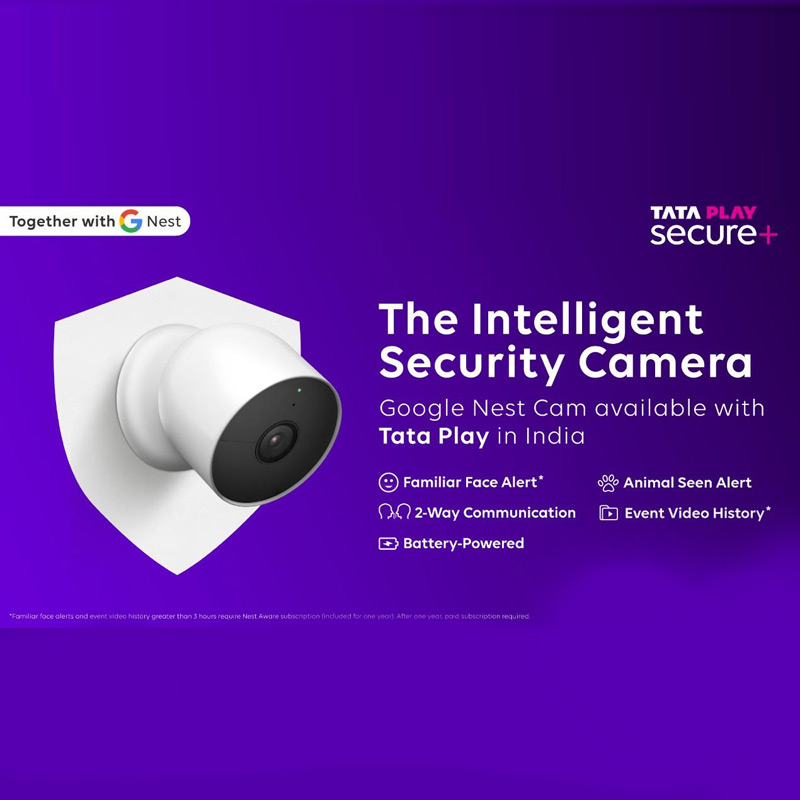
    Mumbai: Tata Play on Thursday announced its entry into home security solutions with the launch of two products Tata Play Secure and Tata Play Secure+.

    Tata Play is collaborating with Google to bring to India the Google Nest security camera for its subscribers via Tata Play Secure+. Tata Play Secure+ is a bundled service that includes battery-powered Google Nest Cam, an annual Nest Aware subscription and a Google Nest Mini.

    In the first phase of its launch, the offering will be available for Tata Play subscribers in 10+ cities including Mumbai + Navi Mumbai, Thane, Pune, Hyderabad, Chennai, Bangalore, Kolkata, Delhi + NCR, Lucknow, and Jaipur.

    “With the launch of Tata Play Secure and Tata Play Secure+, we aim to help our subscribers build a safe and secure ecosystem, be it home or workplace,” said Tata Play chief commercial and content officer Pallavi Puri. “This new offering is in line with our endeavour to provide experiences beyond entertainment. We are happy to partner with Google for the Tata Play Secure+ offering to bring to India a truly state-of-the-art home security experience.”

    “We are thrilled to collaborate with Tata Play to bring to India our new-generation Nest Cam and Nest Aware service,” said Google head of hardware business development India and South Asia. “These deliver a great experience thanks to our deep innovations in on-device machine learning, an intuitive user experience, and the highest level of privacy and security that gives people complete control over the information they share. With features like the ability to detect people, animals, and vehicles, the ability to be used indoor and outdoor, HDR, two-way communication and more, we can’t wait for people to experience enhanced smart security.”

  • Digital channel Zindagi to launch on DTH platforms as a value-added service

    Digital channel Zindagi to launch on DTH platforms as a value-added service

    Mumbai: Digital channel Zindagi which features popular Pakistani soap operas will now be available on DTH platform Dish TV, D2H and Tata Play as a value-added service. The service will be available starting on 23 May.

    The channel launched in 2014, had gone off the air in July 2017 and its content was only available on the OTT service Zee5. Now, the shows Kitni Girhain Baaki Hain with Kirron Kher as the narrator, “Aunn Zara, Sadqay Tumhare” amongst others will be available to DTH subscribers. The channel’s launch is backed by an innovative content strategy of airing two episodes back-to-back.

    Apart from fiction shows, the service will also showcase acclaimed movies like “Baarish aur Chowmein” featuring Taapsee Pannu and Amit Sadh, directed by Tigmanshu Dhulia; “Toba Tek Singh”, based on a short story by Saadat Hasan Manto, featuring noted actor Pankaj Kapoor and directed by Ketan Mehta; “Silvat” written by Faraz Arif Ansari and directed by Tanuja Chandra with Kartik Aaryan in a leading role; “Saari Raat” a film by National Award winner Aparna Sen starring Konkona Sen Sharma among others.

    “It’s a proud moment for us as we reach yet another milestone and launch Zindagi across key DTH platforms,” said Zee Special Projects chief creative officer Shailja Kejriwal. “What started as a salient idea between a few people deeply invested in the belief of cross border cultural collaborations grew to become one of the most loved television channels in the country. Zindagi took its journey ahead on OTT fueling the digital consumption needs in the country, and the community of believers continued to grow. Today, we add new partners, new believers in Tata Play, Dish TV and D2H, as we take Zindagi to every corner of the country.”

    “There’s a huge fan following for nuanced and author-backed storylines in our country,” said Tata Play chief content and commercial officer Pallavi Puri. “Tata Play Zindagi’s content library is very slice-of-life… they are humari zindagi se milti julti kahaniyan, which we believe will be a treat for the viewers who like relatable narratives.”

    “We firmly believe that providing relatable, wholesome, unique, and relevant content is the most effective way to engage with our subscribers,” said Dish TV India Limited head – VAS Shruti Kumar.

    “We are delighted to announce Zindagi Active as the latest addition to our comprehensive value-added service portfolio. With this, we offer our subscribers the stories that are emotional and enthralling, series & movies that resonate with them, their families, and relationships. We hope to bring together people/communities beyond our country’s border who share similar values, cultures, and traditions. Our Active Services brings the most appealing and relevant content to our subscribers, and the latest addition of the Zindagi Active service reaffirms our commitment towards them,” she added.

  • Zee Theatre expands its content slate with four musical blockbusters

    Zee Theatre expands its content slate with four musical blockbusters

    Mumbai: Zee Theatre brings star-studded stage productions like “The Sound of Music”, “Hairspray Live!”, “Peter Pan Live!” and “Billy Elliot: The Musical” to the small screen. This is the first time that four international musical blockbusters can be seen on Indian television.

    A glorious month of star-studded, award-winning musicals will begin with “The Sound of Music Live!”, which will be aired at Tata Play Theatre on 29 May, followed by “Hairspray Live!”, “Peter Pan Live!” and “Billy Elliot: The Musical“. Over the years, these musicals have been adapted to stage and as well on the big and small screen with great success and Zee Theatre’s offerings have much to recommend them, including stunning production values, captivating performances and large helpings of nostalgia. With these treats, Zee Theatre has not only diversified its slate but will tap into new audiences who will discover for the first time, the energy and verve of immersive musicals.

    “The Sound of Music” revisits the much-loved musical score with Carry Underwood, the multiple Grammy and Academy of Country Music Awards winning sensation. Underwood stars as Maria along with Stephen Moyer, Audra McDonald, Christian Borle, and Laura Benanti. Directed by Beth McCarthy-Miller and Rob Ashford, this true story based on Maria Von Trapp’s memoir, ‘The Story of the Trapp Family Singers’ has been a resounding hit from the time its first Broadway production was unveiled in 1959. Thanks to its central love story, ageless music, and family-centric wholesomeness, the musical has become an eternal favourite. Its cinematic version was the highest-grossing film of 1965 and starred Oscar winner Christopher Plummer and Golden Globe Award-winning actor Julie Andrews.   

    Explaining why Zee Theatre is bringing these musicals to Indian television, ZEEL chief creative officer-special projects Shailja Kejriwal said, “Indian audiences are no stranger to musicals. Our cinema and theatrical traditions thrive on musicality and dance. Musicals are also a huge part of Broadway and West End and we have curated some that will resonate the most with Indian audiences. “The Sound of Music“, “Hairspray Live!”, Peter Pan Live!” and “Billy Elliot: The Musical”  are genre-defining stories that span coming-of-age dilemmas, love, self-discovery, and a lot more enthralling generations worldwide. These productions have much to recommend them and we are thrilled to introduce them to families across India.”

  • DTH sector lost 0.37 mn subs in the quarter ended 31 Dec’21: Trai

    DTH sector lost 0.37 mn subs in the quarter ended 31 Dec’21: Trai

    Mumbai: The total active subscriber base of the pay direct-to-home (DTH) sector declined from 68.89 million at the end of September 2021 to 68.52 million at the end of December 2021, as per data provided by the Telecom Regulatory Authority of India (Trai). This is in addition to the subscribers of DD Free Dish, the free DTH service offered by Doordarshan.

    Tata Play maintained its position as the leading DTH player increasing its market share from 33.34 per cent to 33.48 per cent. It was followed by Bharti Telemedia that also increased its market share from 26.11 per cent to 26.37 per cent. Dish TV India ceded market share from 22.65 per cent to 22.04 per cent. Sun TV Direct gained market share from 17.91 per cent to 18.11 per cent.

    Trai reported the subscriber base of 12 major multi-system operators (MSO) and one headend-in-the-sky (HITS) operator who have a subscriber base of more than one million. GTPL Hathway continued to be the leading MSO followed by Siti Networks, Hathway Digital, Den Networks and Thamizhaga Cable TV Communication. While most MSOs lost subscribers during the quarter, Thamizhaga, Kerala Communicators Cable, Nxt Digital (HITS), V K Digital Network and Nxt Digital (Cable TV) gained subscribers. Notably, Nxt Digital (HITS and Cable TV) gained the highest number of subscribers at 436,990.

    [[{“fid”:”1074109″,”view_mode”:”default”,”fields”:{“format”:”default”,”alignment”:””,”field_file_image_alt_text[und][0][value]”:false,”field_file_image_title_text[und][0][value]”:false},”type”:”media”,”field_deltas”:{“1”:{“format”:”default”,”alignment”:””,”field_file_image_alt_text[und][0][value]”:false,”field_file_image_title_text[und][0][value]”:false}},”attributes”:{“height”:”517″,”width”:”700″,”class”:”media-element file-default”,”data-delta”:”1″}}]]

    There were 909 private satellite TV channels at the end of December 2021 compared to 906 channels at the end of September 2021. Additionally, there were 350 pay channels out of which 253 were SD channels and 97 were HD channels.

    The number of internet subscribers decreased from 834.29 million to 829.30 million during the quarter. There were 792.08 million broadband subscribers and 37.21 million narrowband subscribers. The number of wired internet subscribers increased from 24.47 million to 26.58 million with a quarterly growth rate of 8.62 per cent. The number of wireless internet subscribers decreased from 809.82 million to 802.72 million.

    [[{“fid”:”1074119″,”view_mode”:”default”,”fields”:{“format”:”default”,”alignment”:””,”field_file_image_alt_text[und][0][value]”:false,”field_file_image_title_text[und][0][value]”:false},”type”:”media”,”field_deltas”:{“2”:{“format”:”default”,”alignment”:””,”field_file_image_alt_text[und][0][value]”:false,”field_file_image_title_text[und][0][value]”:false}},”attributes”:{“height”:”500″,”width”:”700″,”class”:”media-element file-default”,”data-delta”:”2″}}]]

    In the wired internet segment, Reliance Jio Infocomm held 17.18 per cent market share with 4.57 million subscribers, followed by Bharti Airtel at 4.20 million subscribers. In the wireless internet segment, Reliance Jio held 51.79 per cent market share with 415.72 million subscribers followed by Bharti Airtel with 28.21 per cent with 226.45 million subscribers at the end of the quarter.

    The total number of VSAT subscribers decreased from 289,557 to 288,848 during the quarter. Hughes Communications is the market leader with 135,374 subscribers and market share of 46.87 per cent, followed by Nelco at 76,166 subscribers and market share of 26.37 per cent at the end of the quarter.

    The average revenue per user (ARPU) per month of wireless services customers increased from Rs 108.16 to Rs 114.16 over the quarter. The average data usage per month for a wireless subscriber was 14.97 Gb.