MUMBAI: Tata Motors is reshuffling its boardroom as India’s biggest carmaker prepares to spin off its commercial vehicle business into a separate listed entity. The Mumbai-based company announced sweeping changes to its leadership on 26 September, with three independent directors stepping down and a new managing director taking the helm.
The biggest change sees Shailesh Chandra appointed as managing director and chief executive, replacing Girish Wagh, who will move to head the soon-to-be-listed TML Commercial Vehicles. Chandra, currently joint managing director of Tata Motors Passenger Vehicles and Tata Passenger Electric Mobility, will serve a three-year term from 1 October.
Three independent directors are departing as part of the reorganisation. Hanne Sorensen, a former Tata Consultancy Services board member, will step down on 30 September but remain on the board of Jaguar Land Rover, Tata Motors’ British luxury car unit. Kosaraju Veerayya Chowdary and Guenter Karl Butschek will both leave on 1 October to join the commercial vehicles entity’s board.
Replacing them is Sudha Krishnan, a former senior civil servant who retired in 2020 as member finance to India’s Space Commission and Atomic Energy Commission. Krishnan, who has four decades of experience in public policy and finance, will serve a five-year term as independent director.
The changes come as Tata Motors executes a composite scheme of arrangement approved by India’s National Company Law Tribunal. The demerger, which becomes effective on 1 October, will see shareholders receive one share in TML Commercial Vehicles for every share they hold in Tata Motors.
In another significant move, P B Balaji will resign as group chief financial officer on 17 November to become chief executive of Jaguar Land Rover. He will be replaced by Dhiman Gupta, currently chief financial officer of Tata Passenger Electric Mobility. Unusually, Balaji will rejoin Tata Motors’ board as a non-executive director on the same day he steps down from his executive role.
The restructuring reflects Tata Motors’ strategy to separate its commercial vehicle operations from its passenger car and Jaguar Land Rover businesses. The company is also transferring Rs 2,300 crore worth of non-convertible debentures to the commercial vehicles unit as part of the demerger.
The board changes were approved at a meeting that ran from 2pm to 5pm on 26 September, with all appointments subject to shareholder approval.
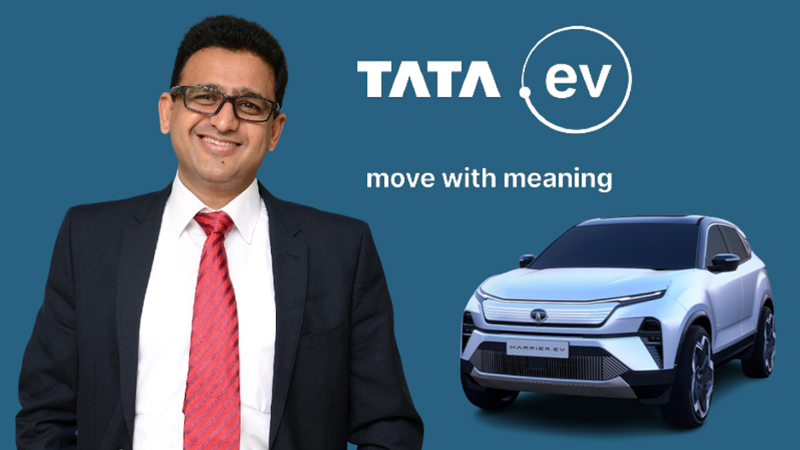
Mumbai: Incorporated on 21 December 2021, Tata Passenger Electric Mobility, a subsidiary of Tata Motors, has unveiled its new brand identity, TATA.ev, marking a pivotal step in India’s EV revolution. Aligned with sustainability and innovation, the identity embodies “Move with Meaning,” uniting values of sustainability, community, and technology. The Orbit logo and Evo Teal color symbolise a circular ecosystem and tech-forward commitment. This evolution reflects Tata’s drive toward a greener future while emphasising customer experiences. With a 70 per cent market share in four-wheeler EVs, Tata’s pioneering journey includes selling over one lakh EVs, showcasing a commitment to sustainable mobility.
Indiantelevision.com on the sidelines of the press conference, caught up with Tata Passenger Electric Mobility Ltd (TPEML) head, marketing, sales and service strategy Vivek Srivatsa to talk about the idea behind the EV business, their TG, market share, etc.
Edited Excerpts:
On Tata Motors being the first auto manufacturer to launch an EV in India
Yes, the first mainstream EV cars with the Nexon EV in 2020. When I say mainstream, it means you can use it like any normal car, i.e., it comes with the right warranty, safety, and all that. We launched the Nexon, the Tigor and the Tiago which was showcased last year in the IPL.
On TPEML’s market share and the idea behind getting into the EV business when India had not yet opened up to the business
We saw the signs early. A large part of Western Europe was adopting to EVs and India’s government was strongly pushing EVs and on the kind of subsidies being offered for both manufacturing as well as for customers in terms of GST reduction, made it a very compelling business case, as well as a use case for customers. Of course, it involves some capital investment and some R&D, but we thought we should do it for the betterment of the country in terms of moving towards more sustainable mobility sources.
But also, when we saw internally in Tata Group, we had all the ingredients ready to move into this, which probably other companies did not have. We had Tata Power, we had Top Auto Components who make the batteries for us. We have obviously Tata Motors expertise in making cars. We have TCS who make software. So, we have all the basic requirements already in place, we just have to create the ecosystem together and take advantage of the government’s subsidies and incentives to give a viable product.
On the buying trends of Indians today and are you urban-centric or reaching out to your TG’s in the tier-2 and tier-3 market
Electric vehicle (EV) adoption is surging robustly. The initial 10,000 sales spanned 44 months, while the subsequent 40,000 were achieved in just 15 months. The next 50,000 sales took only nine months. This strong acceleration indicates that achieving the next milestone of 100,000 sales might take 12 months.
When we launched Tiago, more than 25 per cent of our sales came from the smaller towns. Smaller towns have an inherent advantage in that there is no restriction on parking space. Requiring parking space for charger installation poses a challenge in urban areas, while smaller towns face no such issue. Two-wheeler EVs are already hugely used in smaller towns. So as a concept, it’s not alien to them. They are very focused on the cost of operation. EV is one-eighth or one-tenth the cost of operation of traditional cars and the distances they travel also is not too high. So, EV use case for smaller towns is actually perfect and we are seeing very fast adoption there.
On Tata Motors building up sustainability, educating your consumers and carrying it forward in various activities in CSR and other things
Firstly, at the Tata Group level, there is a group-level commitment under something called ‘Project Aalingan’ towards sustainability. Tata Motors is the same, we have committed to be carbon neutral by 2040 which is the most ambitious target for an Indian automotive company. We have committed to be water neutral by 2030. So, firm commitments have been made and that is internal. Through EV adoption and the work with our customers, we are pushing sustainability into the lifestyle of our consumers as well.
First is obviously, by using EV itself, we’re saving carbon emissions, but we’re taking it beyond with the new brand design and the practices to follow for our community will teach them other elements of the community in terms of long use items, i.e., the longer you use anything, the better it is for the environment, whether it is clothes, gadget or anything. Safe disposal is very important. CSR activities, like educating the underprivileged, and clothes donation for the underprivileged, among others are the ones we are going to formally pursue. These are anyway strong active pillars of what Tata Group does. So, it is actually an extension in a modern way. Not only are we focused on sustainability at a Tata Motors level, but we are also focused on the CSR activity, which actually is a parallel line to sustainability.
On conceiving the campaign film and its conceptualisation
The new brand design has been conceived by our partners, Landor & Fitch. They helped us lay this out. There were a few challenges because there are so many aspects. On the business side, it’s a growing business is a very demanding consumer. On the sustainability side, we have made firm commitments and we needed to showcase that also. Also, it has to be a brand design, which is able to be present across all our touchpoints, i.e., digital, retail, communicating offline, online, and digital. So, it took about a year for us to put this together. I think it will help us give a firm direction to, whatever we do in the future.
On the significance of the bridge
So, the bridge brings humanity to whatever we do. It allows us to express ourselves better. You can treat it like a floating underline. It allows us to express things better. It’ll also be immediately recognisable as a TATA.ev communication. It does bring in a certain level of expressiveness without
costing too much and not being on your face.
On their future plans and the EV’s price range
We aim to sell close to one lac EVs, this financial year. What we have committed is, we want to look at about 50 per cent of our portfolio or sales being on the electric side by 2030.
Our EV’s range starts from just below 10 lakhs and goes up to 22 lakhs right now.
Mumbai: Tata Passenger Electric Mobility, a subsidiary of Tata Motors and the pioneer of India’s EV revolution today launched its new brand identity, TATA.ev, for the EV business. This new identity is aligned to Tata Motors’ commitment on sustainability & pioneering innovation as well as Tata Group’s focus towards community development. The new brand identity embodies the core philosophy of “Move with Meaning,” unifying the values of sustainability, community, and technology. It is the first step towards providing differentiated and meaningful experiences for customers in the form of a collective initiative to move towards an electric future that is better for the planet and its inhabitants.
As the EV offering grows, spurred on by surging consumer demand and a robust, thriving product lineup, customers expect a unique experience across all touchpoints, from the brand to the product and its ownership cycle. TATA.ev identified a clear need for a new consumer-facing brand identity that strengthens commitment to the future of mobility.
Move with Meaning
The word “move” captures how the company is in the business of mobility but also acts as a launchpad to think of this new brand identity as a collective human movement towards EVs, and towards a safer, smarter, greener future. The words “with meaning” build on the intent – they power up what TATA.ev stands for with a clear focus on responsibility, collective action, and future readiness.
Commenting on the new brand identity, Tata Passenger Electric Mobility Ltd head, marketing, sales and service strategy Vivek Srivatsa said, “We are entering a new era with TATA.ev. Our new brand identity for electric vehicles underlines our commitment to accelerate the adoption of clean energy mobility solutions. We intend to drive positive change in the automotive industry with the focus on sustainability, community, and technology. Both the products and services are intended to create highly differentiated and meaningful consumer experiences. The brand personality is humane, honest, invigorating, and conversational – a rallying point for those curious about having a better impact on the world.”
Key highlights of TATA.ev’s brand identity:
The brand identity of TATA.ev, developed with Landor & Fitch, reflects the brand platform ‘Move with Meaning’ with sustainability at its core. All design decisions are purposeful and deliberate in the same spirit as the brand strategy. The visual design embodies ‘Move with Meaning’ and is accessible, open, and environmentally friendly.
● The Orbit: The “.ev” in the logo mark is enclosed within the Orbit. The dot pattern from Tata Motors’ branding is now made of larger circles in a distinct grid. This orbit embodies how TATA.ev fosters a circular ecosystem of human and environmental interaction, all progressing toward creating a brighter future.
● The brand colour: The brand’s distinct Evo Teal colour, a fusion of technology and sustainability, symbolises TATA.ev’s innovation and tech-forward capabilities, while highlighting the brand’s commitment to move towards a sustainable future.
● Inter Typeface: The open-source Inter typeface reflects modernity and accessibility. The adoption of an existing font was a decision born by the brand’s sustainability first approach.
● The sound of TATA.ev: The intent with the motion and sonic logo is to balance between tradition and innovation, and create a feeling of progressing forward. The sound of the brand combines electronic circuits and a powerful ripple sound – truly inspired by the intersection of nature and technology.
● The character: The ‘bridge’ element has been introduced to infuse character into the typography, imbuing the communication with a sense of motion and dynamism.
Doubling down on its commitment to sustainability, TATA.ev has been designed with key actions, which ensure it follows an environmentally friendly approach:
● To reduce ink usage, print collaterals are designed on a white base
● To reduce battery consumption and energy usage, all digital collaterals follow a dark mode approach and are designed on a Black base
● To ensure wide accessibility, smaller file sizes, quicker loading times, and optimized performance, the font family used is Inter, an open-license and variable font family, to further align with the sustainable approach.
All consumer-facing communication will begin to assume the new brand identity and will be rolled out in a phased manner.
With a dominating market share of over 70 per cent in the four-wheeler EV segment, Tata Passenger Electric Mobility has consistently demonstrated its pioneering spirit by introducing cutting-edge technologies and innovative products. Responsible for actively shaping the future of mobility, the company also recently crossed the milestone of selling one lakh Tata EVs. This momentous journey underscores the brand’s unwavering commitment to drive positive change and contribute to a sustainable future for India. To ‘Go Beyond’, the company has already declared its three-phase EV strategy, with plans to offer different body styles at several accessible price points, meeting the evolving needs of consumers. The company aims to set new benchmarks in the EV segment by focusing on seamless connectivity, state-of-the-art design, exceptional performance, and uncompromised safety across its electric vehicle lineup.