Tag: Tata Communications

  • Content piracy making b’casters invest in good tech for security: Tata Communications VP Brian Morris

    Content piracy making b’casters invest in good tech for security: Tata Communications VP Brian Morris

    Somebody had aptly said that a new development brings along with it not only benefits, but also various downsides. If technology is opening up new frontiers of content delivery to consumers, the menace of content piracy too is rising globally. So, it’s almost always a race against time to find neutralizers to a menace like piracy for content owners and technology & security companies. 

    And, Tata Communications is one such company that not only helps its customers deliver content, but also does continuous research in safety methods. That’s just one of the many reasons why the company continually makes major investments in building and improving state-of-the-art global communications network. One such example of investments is the $1.19 billion spent on the company’s global subsea fibre network — the company claims it is one of the world’s largest and most advanced —- that covers 700,000 km or more than 17 times around the world; the only Ethernet ring serving the Middle East; more than 400 points of presence on five continents, apart from ownership and operation of over 1 million sq. ft. of data centre space in 44 locations worldwide.

    In an interaction with Indiantelevision.com, Tata Communications VP and GM – Global Media and Entertainment Services Brian Morris holds forth on various aspects of content delivery, tackling content piracy and the need to have a good technology partner for broadcasters.

    Excerpts:

    As broadcasters deliver content on multi-platform like social media and OTT, how can they ensure that they have the highest levels of content security integrated within the core of their business operations and across various delivery platforms?

    Today, content owners, enabled by technology providers, are taking control in a world where the viewing patterns of consumers are dramatically changing due to advances in mobile and flexible content provisioning. The broadcasting counter-revolution is about staying ahead of the game and providing viewers with the platforms and services that give them more control when it comes to dictating their own viewing experiences.

    For broadcasters and Over the Top (OTT) and streaming network providers, this means enabling content to be delivered via non-traditional distribution channels, to support on-demand and catch-up services that allow viewers to watch whatever content they want, whenever they want, on any device.  It is also enabling the disruption of regionalization and rights management as content owners seek to extend reach and distribute their content on a global basis.

    Hence, emergence of OTT and streaming players and growing adoption of various smart devices, in an increasingly growing connected world, has forced pay-TV operators to offer their content on multiple networks and multiple devices. This gradual transformation has led to roll out of parallel systems requiring adoption of multiple service delivery and content security platforms resulting into management complexities.

    To manage the multi-service / multi-platform environment, media service providers need to adopt unified security approach to meet security requirement on any device and any type of content (live or on-demand). Below are the key trends in unified content security space:

    # Single security client combining CAS (conditional access systems) and DRM (digital rights management) functionalities to support DVB, IPTV STB and OTT based media distribution

    # Adaptive security solutions compatible with any devices (including device with HWRoT, Open STBs like Android STB, Legacy STBs without HWRoT and Open CE devices)

    # Security solutions to meet requirements for enhanced content (UHD, HD HDR, early release content) – MovieLabs , an R&D JV of six major motion picture studios, has come with new content security ECP guidelines

    # Security solutions to support open consumer devices – software based security solutions compatible with customer owned devices.

    Is forensic watermarking a step in the right direction when it comes to content security?

    It is the prerogative of content owners to do any kind of watermarking. We, at Tata Communications, are fully supportive and capable of carrying any watermarking through our infrastructure. Forensic watermark is a great help when it comes to content security. It offers a range of benefits to broadcasters and content providers and some of them are the following:

    # Single solution to fight against content redistribution across the value chain– For the content owner, the source of leak can be found out; while for the licensee, session-based watermarking enables them to identify which OTT account or smart card the pirate stream is originating from.

    # Lower total cost of ownership with easy deployment and scalability – all consumers (irrespective of the device they use) receive watermarked content, and not just those users who own watermarked enabled devices.

    # Fast time to market on deployed devices and existing workflows – there is no need for specific client side hardware, which makes it easier to deploy to existing devices.

    # Renewable, robust security based on a centralized design – central architecture is more secure, in order to make it impossible for pirates to exploit the client device and easy to renew if a breach occurs.

    The main limitation of forensic watermarking technology is the occasional occurrence of false positives in which legal copies of a document, image, video or program are tagged as unauthorized. Forensic watermarks have gained acceptance in the software and digital video industries. Other applications in which the technology holds promise include digital music and electronic books (e-books).

    With the rise of number of OTT platforms in India, are the players taking security breach or its possibility seriously as Indian security systems generally tend to be lax?

    A mega-trend noticed in the broadcasting industry in India is the rise in non-traditional content viewing and distribution. With the growing adoption of smart devices and the millennial audience of the country, with 50 per cent of the population under the age of 25, looking to consume videos on-the-go, the video-on-demand is on an exponential growth. This growth has raised a number of concerns around public safety and privacy issues, both at an organizational and a national level.

    OTT players are, therefore, looking to adopt a unified security approach that can meet the security requirement on any platform and any region. An important change noticed amongst the Indian broadcasters is the investment made in technology partners who can keep up with the demand of maximum uptime, reach and security. A strong network player can carry the content applications securely and smoothly. 

    Do you feel that the level of piracy of Indian content within and outside India is growing?

    Piracy has become a major issue for broadcasters globally. One example of this would be the final episode of Game of Thrones’ season five in 2015; it was illegally downloaded 1.5 million times before it had even aired. This shows that there is a complete breakdown of geographical boundaries and India is seeing a boom in online piracy too. The recent addition of Netflix and other big OTT players in the country is an additional reason of worry for the industry. 

    According to a study conducted by Evisional and America’s Motion Pictures Association (MPA), Indians form the largest group to download Indian copyright content from torrent sites. So, broadcasters are not only looking to harness the power of non-traditional distribution methods to get their content to the consumer, they also face a battle to decrease illegal broadcasting.

    If piracy is a growing phenomenon, are Indian broadcasters and content owners really alive to the problem and taking safety measures or these are just ad hoc moves? 

    The biggest challenge for broadcasters is: how do they make content available to global audiences in real-time and in different file formats ranging from HD TV, to tablets and smartphones to protect their content and minimize piracy? Cases like the Game of Thrones are a wake-up call. While there is no foolproof way to completely block content piracy, but iinnovative broadcasting organizations are increasingly looking to fibre to run their content on. The readily available bandwidth of fibre enables the transport of live video in higher resolutions, with more security and more potential for customization than other methods. Fibre is also ideal for moving large video files.

    Content transcoding and delivery technology in the cloud is also making headway. It enables broadcasters to move content files to the cloud and transcode them into broadcast quality formats ready for immediate transmission and secure delivery to selected destinations. This means that it is possible to make authorized content available for simulcast in HD format. with the aim of helping broadcasters and content creators transcode media files into broadcast quality formats ready for immediate delivery and transmission globally. This drastically reduces the delivery time compared with traditional solutions that rely on the physical transport of media, meaning the time to view can be reduced across all regions.

    Considering that Tata Communications also operates in APAC region, how seriously piracy is taken by players in that region?

    According to a recent report by digital TV research, OTT TV and video revenues for 17 countries in the Asia Pacific region will reach $18,396 million in 2021. Another finding shows that Game of Thrones has been crowned as the most pirated television show for a few years with data collected from the first 12 hours during season six’s premiere episode showing that India stood as the second country in top downloads. Content piracy clearly ignores geographical boundaries and the unauthorized distribution of premium content is here to stay. 

    However, with the entry of global players like Netflix, RedBull Media House, OTT players are realizing that content offering and content security are two important factors that will help them differentiate from each other. A technology partner that can help with their global distribution requirements over a secure network is becoming a need. Tata Communications’ partnership with Red Bull Media House or distribution of live Formula1 races over Sky television are some of the recent partnerships we have seen as a result of these requirements.

  • Content piracy making b’casters invest in good tech for security: Tata Communications VP Brian Morris

    Content piracy making b’casters invest in good tech for security: Tata Communications VP Brian Morris

    Somebody had aptly said that a new development brings along with it not only benefits, but also various downsides. If technology is opening up new frontiers of content delivery to consumers, the menace of content piracy too is rising globally. So, it’s almost always a race against time to find neutralizers to a menace like piracy for content owners and technology & security companies. 

    And, Tata Communications is one such company that not only helps its customers deliver content, but also does continuous research in safety methods. That’s just one of the many reasons why the company continually makes major investments in building and improving state-of-the-art global communications network. One such example of investments is the $1.19 billion spent on the company’s global subsea fibre network — the company claims it is one of the world’s largest and most advanced —- that covers 700,000 km or more than 17 times around the world; the only Ethernet ring serving the Middle East; more than 400 points of presence on five continents, apart from ownership and operation of over 1 million sq. ft. of data centre space in 44 locations worldwide.

    In an interaction with Indiantelevision.com, Tata Communications VP and GM – Global Media and Entertainment Services Brian Morris holds forth on various aspects of content delivery, tackling content piracy and the need to have a good technology partner for broadcasters.

    Excerpts:

    As broadcasters deliver content on multi-platform like social media and OTT, how can they ensure that they have the highest levels of content security integrated within the core of their business operations and across various delivery platforms?

    Today, content owners, enabled by technology providers, are taking control in a world where the viewing patterns of consumers are dramatically changing due to advances in mobile and flexible content provisioning. The broadcasting counter-revolution is about staying ahead of the game and providing viewers with the platforms and services that give them more control when it comes to dictating their own viewing experiences.

    For broadcasters and Over the Top (OTT) and streaming network providers, this means enabling content to be delivered via non-traditional distribution channels, to support on-demand and catch-up services that allow viewers to watch whatever content they want, whenever they want, on any device.  It is also enabling the disruption of regionalization and rights management as content owners seek to extend reach and distribute their content on a global basis.

    Hence, emergence of OTT and streaming players and growing adoption of various smart devices, in an increasingly growing connected world, has forced pay-TV operators to offer their content on multiple networks and multiple devices. This gradual transformation has led to roll out of parallel systems requiring adoption of multiple service delivery and content security platforms resulting into management complexities.

    To manage the multi-service / multi-platform environment, media service providers need to adopt unified security approach to meet security requirement on any device and any type of content (live or on-demand). Below are the key trends in unified content security space:

    # Single security client combining CAS (conditional access systems) and DRM (digital rights management) functionalities to support DVB, IPTV STB and OTT based media distribution

    # Adaptive security solutions compatible with any devices (including device with HWRoT, Open STBs like Android STB, Legacy STBs without HWRoT and Open CE devices)

    # Security solutions to meet requirements for enhanced content (UHD, HD HDR, early release content) – MovieLabs , an R&D JV of six major motion picture studios, has come with new content security ECP guidelines

    # Security solutions to support open consumer devices – software based security solutions compatible with customer owned devices.

    Is forensic watermarking a step in the right direction when it comes to content security?

    It is the prerogative of content owners to do any kind of watermarking. We, at Tata Communications, are fully supportive and capable of carrying any watermarking through our infrastructure. Forensic watermark is a great help when it comes to content security. It offers a range of benefits to broadcasters and content providers and some of them are the following:

    # Single solution to fight against content redistribution across the value chain– For the content owner, the source of leak can be found out; while for the licensee, session-based watermarking enables them to identify which OTT account or smart card the pirate stream is originating from.

    # Lower total cost of ownership with easy deployment and scalability – all consumers (irrespective of the device they use) receive watermarked content, and not just those users who own watermarked enabled devices.

    # Fast time to market on deployed devices and existing workflows – there is no need for specific client side hardware, which makes it easier to deploy to existing devices.

    # Renewable, robust security based on a centralized design – central architecture is more secure, in order to make it impossible for pirates to exploit the client device and easy to renew if a breach occurs.

    The main limitation of forensic watermarking technology is the occasional occurrence of false positives in which legal copies of a document, image, video or program are tagged as unauthorized. Forensic watermarks have gained acceptance in the software and digital video industries. Other applications in which the technology holds promise include digital music and electronic books (e-books).

    With the rise of number of OTT platforms in India, are the players taking security breach or its possibility seriously as Indian security systems generally tend to be lax?

    A mega-trend noticed in the broadcasting industry in India is the rise in non-traditional content viewing and distribution. With the growing adoption of smart devices and the millennial audience of the country, with 50 per cent of the population under the age of 25, looking to consume videos on-the-go, the video-on-demand is on an exponential growth. This growth has raised a number of concerns around public safety and privacy issues, both at an organizational and a national level.

    OTT players are, therefore, looking to adopt a unified security approach that can meet the security requirement on any platform and any region. An important change noticed amongst the Indian broadcasters is the investment made in technology partners who can keep up with the demand of maximum uptime, reach and security. A strong network player can carry the content applications securely and smoothly. 

    Do you feel that the level of piracy of Indian content within and outside India is growing?

    Piracy has become a major issue for broadcasters globally. One example of this would be the final episode of Game of Thrones’ season five in 2015; it was illegally downloaded 1.5 million times before it had even aired. This shows that there is a complete breakdown of geographical boundaries and India is seeing a boom in online piracy too. The recent addition of Netflix and other big OTT players in the country is an additional reason of worry for the industry. 

    According to a study conducted by Evisional and America’s Motion Pictures Association (MPA), Indians form the largest group to download Indian copyright content from torrent sites. So, broadcasters are not only looking to harness the power of non-traditional distribution methods to get their content to the consumer, they also face a battle to decrease illegal broadcasting.

    If piracy is a growing phenomenon, are Indian broadcasters and content owners really alive to the problem and taking safety measures or these are just ad hoc moves? 

    The biggest challenge for broadcasters is: how do they make content available to global audiences in real-time and in different file formats ranging from HD TV, to tablets and smartphones to protect their content and minimize piracy? Cases like the Game of Thrones are a wake-up call. While there is no foolproof way to completely block content piracy, but iinnovative broadcasting organizations are increasingly looking to fibre to run their content on. The readily available bandwidth of fibre enables the transport of live video in higher resolutions, with more security and more potential for customization than other methods. Fibre is also ideal for moving large video files.

    Content transcoding and delivery technology in the cloud is also making headway. It enables broadcasters to move content files to the cloud and transcode them into broadcast quality formats ready for immediate transmission and secure delivery to selected destinations. This means that it is possible to make authorized content available for simulcast in HD format. with the aim of helping broadcasters and content creators transcode media files into broadcast quality formats ready for immediate delivery and transmission globally. This drastically reduces the delivery time compared with traditional solutions that rely on the physical transport of media, meaning the time to view can be reduced across all regions.

    Considering that Tata Communications also operates in APAC region, how seriously piracy is taken by players in that region?

    According to a recent report by digital TV research, OTT TV and video revenues for 17 countries in the Asia Pacific region will reach $18,396 million in 2021. Another finding shows that Game of Thrones has been crowned as the most pirated television show for a few years with data collected from the first 12 hours during season six’s premiere episode showing that India stood as the second country in top downloads. Content piracy clearly ignores geographical boundaries and the unauthorized distribution of premium content is here to stay. 

    However, with the entry of global players like Netflix, RedBull Media House, OTT players are realizing that content offering and content security are two important factors that will help them differentiate from each other. A technology partner that can help with their global distribution requirements over a secure network is becoming a need. Tata Communications’ partnership with Red Bull Media House or distribution of live Formula1 races over Sky television are some of the recent partnerships we have seen as a result of these requirements.

  • CommunicAsia2016, EnterpriseIT2016 and BroadcastAsia2016 open with a view of a digital future

    CommunicAsia2016, EnterpriseIT2016 and BroadcastAsia2016 open with a view of a digital future

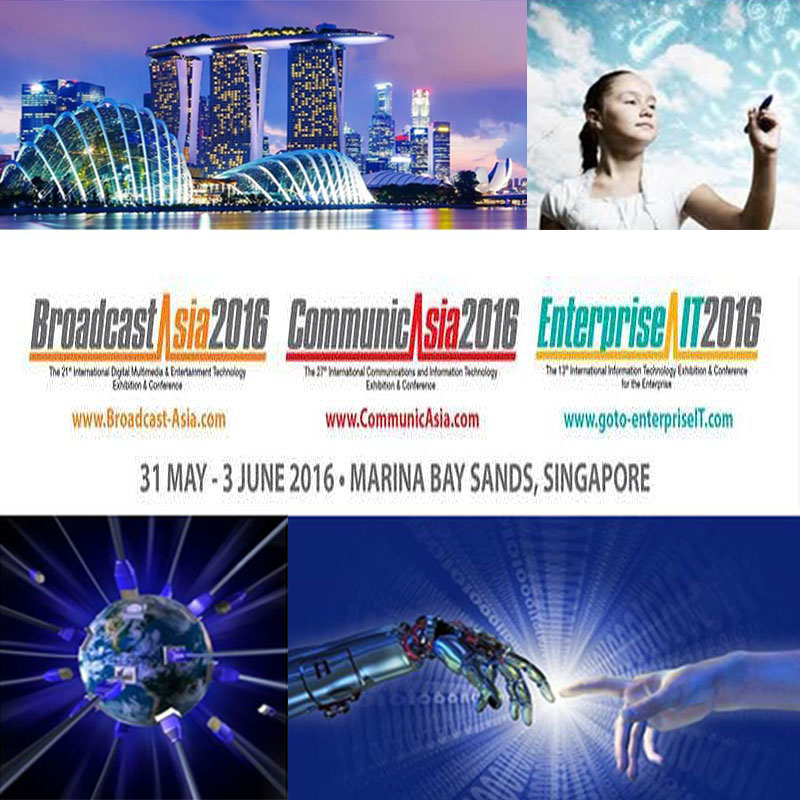
    MUMBAI – Robots, Virtual Reality, Drones, and Smart Devices – these are the innovations fueled by digital transformation that will pave the way of Asia Pacific’s future. With digitisation and smart technologies enhancing productivity, these innovations form the heart of CommunicAsia2016, EnterpriseIT2016 and BroadcastAsia2016 which opens today, from 31 May to 3 June 2016, at Marina Bay Sands, Singapore.

    From taxi bookings, travel lodging to courier arrangements, digital transformation which includes integration is at the heart of businesses’ and consumers’ lives today. On the back of digitalisation, bringing together the movers and shakers in the world of information and communications technology (ICT) and media, the event will gather about 1,800 exhibitors and 34 international pavilions from 53 countries and regions, bringing innovations critical for digital transformation in the region.

    “Disruptive models from businesses like Uber and Netflix – who are speakers of this year’s events – have propelled organisations’ into innovating and reinventing themselves to stay ahead in a digitally transformed world. The programme for CommunicAsia2016, EnterpriseIT2016 and BroadcastAsia2016 presents participants with cutting-edge technology from robotics, Internet of Things (IoT) manifestations, virtual reality (VR) and more, alongside topical, forward-thinking conversations led by industry thought leaders,” said Lindy Wee, Chief Executive, Singapore Exhibition Services.

    Gabriel Lim, CE-designate of the IMDA and Co-Managing Director of IDA said, “We are moving into an exciting digital future, marked by connectivity and creativity, which will bring about exciting possibilities for Singapore. The new IMDA will help Singapore seize these opportunities, by implementing the Infocomm Media 2025 masterplan, and creating a vibrant and globally competitive ICM sector here. CommunicAsia and BroadcastAsia are important shows that bring different parts of the ICM ecosystem together, creating platforms for individuals and companies to take the ICM sector to new frontiers. We look forward to working with our international partners and industry stakeholders to create a brighter future for us all.”

    CommunicAsia2016 and EnterpriseIT2016: Powering digital transformation
    Smart technology paves the way towards a smarter and more simplified digital lifestyle, producing countless opportunities that transform how people live, learn, work and play.

    Extending conversations from smart technology to smart city development, for the first time, this year’s programme will feature the Asia ICT Innovation Forum, held in strategic partnership with Huawei. Happening today, the forum features speakers from the World Economic Forum, Singapore’s Smart Nation Programme Office, Huawei, Facebook and BT and more. Participants will be immersed in presentations and discussions on technology’s impact to Asia Pacific’s digital economy, how businesses can make global digital inclusion a reality, and the value of Big Data analytics in today’s digital era.

    In addition to macroeconomic discussions, also new this year is the invitation-only CIO Forum, organised in partnership with the CIO Academy Asia, on 1 June. Speakers from IDA, The Farrer Park Company (Asia’s first integrated hub for healthcare & wellness), Tetra Pak and Agile Development, will provide CIOs and CTOs with the how-tos and pitfalls to avoid in delivering digital transformation for organisations.

    Today’s sharing economy with disruptive app-based business models entering the Asia Pacific market have raised discussions and drive for new ideas. Giving participants the platform to gain insights, network and spark ideas for innovation, IdeasCollider, a mini-conference held in collaboration with The Innovators Institute on 2 June 2016, will feature speakers from Galen Growth Asia, Padang & Co, Samsung Asia, SAP Innovation Center Network and more.

    IoT and connected devices remain to be of interest to businesses and consumers in the region. Bringing to life latest IoT innovations, theNXT@CommunicAsia2016 showcases products and solutions that can make enterprises, cities and consumers smarter, greener, and more efficient. Visitors will get to see the ‘Double’, a first of its kind surveillance robot for home use by OTSAW, and the Birloki system, an urban street connector and space activator aimed at boosting city environmental spaces by Nerei, among many others.

    Beyond ‘NXT’, other showfloor highlights include ST Electronics’s launch of its Next-Gen Connected Bus Stop. The system leverages on smart sensors, smart phones to capture and analyse wide-ranging data including number of passengers at bus stops, bus loads and traffic conditions to provide timely and useful bus information for commuters. Operators can optimise operational efficiency and resource utilisation, as well as maintain high quality of services to commuters. In addition, ST Electronics is signing a Memorandum of Understanding at its booth today with US-based Motorola Solutions, to co-create innovative technologies for advanced secured communications in public safety, national security and enterprise sectors across the region.

    Over at the Huawei booth is a series of innovative solutions developed to help accelerate digital economic development, ensure a nation’s safety and security, enrich an individual’s lifestyle and most importantly, build an ICT infrastructure for a Better Connected World.

    Asia’s largest gathering of satellite players at SatComm2016
    As the cornerstone of the world’s ICT system, satellite communications continue to play an important role in enabling and promoting digitisation. 2016 sees the largest gathering of satellite players from the region, with participation from Inmarsat, Intelsat, MEASAT, Singtel and more. The exhibitors will be showcasing the latest innovations from HTS monetisation and deployment models, to methods of customisation of spot beams and frequency reuse.

    BroadcastAsia2016 unveils content from core to beyond boundaries
    Content consumption has experienced an incredible shift with the influx of new content creation methods and delivery strategies. With broadcasters and content providers across Asia battle for viewers and look for innovative ways to monetise their content, BroadcastAsia2016 will bring together top industry service providers to showcase an entire ecosystem of the latest end-to-end solutions needed to stay ahead of the curve.

    On spotlight are new innovations from first time exhibitors such as CISCO, Dell, Tata Communications, Level3 Communications andHyku. For instance, Dell is showcasing how content experiences can be rejuvenated with the latest in 360 degree VR capabilities, andHyku, social TV application with patented second-screen sync technology designed to better connect and engaged hyper-connected consumers of today.

    Consumer expectations in the region increasingly present new challenges to provide more convenient and reliable access to content.Building on the success of its debut last year, the popular TV Everywhere! Zone returns with an emphasis on OTT and multiscreen solutions and explore the entire value chain of non-linear broadcasting.
    In addition to the TV Everywhere! Zone, attendees can explore other themed zones, including the Cinematography/Film/Production Technology Zone – where exhibitors are demonstrating the latest motion picture production tools and software capabilities – and the Post Production Hub where industry experts will share their knowledge and experience using technology showcased at BroadcastAsia2016.Oscar nominated, multi Grammy-nominated producer of soundtracks, classical and jazz recordings and former Senior Vice President ofSony BMG Masterworks, Christopher Craker will be a part of the lineup at the Post Production Hub, as well as award winning sound designer and composer of The Lord of the Rings Trilogy, The Hobbit, King Kong, Dave Whitehead.

  • CommunicAsia2016, EnterpriseIT2016 and BroadcastAsia2016 open with a view of a digital future

    CommunicAsia2016, EnterpriseIT2016 and BroadcastAsia2016 open with a view of a digital future

    MUMBAI – Robots, Virtual Reality, Drones, and Smart Devices – these are the innovations fueled by digital transformation that will pave the way of Asia Pacific’s future. With digitisation and smart technologies enhancing productivity, these innovations form the heart of CommunicAsia2016, EnterpriseIT2016 and BroadcastAsia2016 which opens today, from 31 May to 3 June 2016, at Marina Bay Sands, Singapore.

    From taxi bookings, travel lodging to courier arrangements, digital transformation which includes integration is at the heart of businesses’ and consumers’ lives today. On the back of digitalisation, bringing together the movers and shakers in the world of information and communications technology (ICT) and media, the event will gather about 1,800 exhibitors and 34 international pavilions from 53 countries and regions, bringing innovations critical for digital transformation in the region.

    “Disruptive models from businesses like Uber and Netflix – who are speakers of this year’s events – have propelled organisations’ into innovating and reinventing themselves to stay ahead in a digitally transformed world. The programme for CommunicAsia2016, EnterpriseIT2016 and BroadcastAsia2016 presents participants with cutting-edge technology from robotics, Internet of Things (IoT) manifestations, virtual reality (VR) and more, alongside topical, forward-thinking conversations led by industry thought leaders,” said Lindy Wee, Chief Executive, Singapore Exhibition Services.

    Gabriel Lim, CE-designate of the IMDA and Co-Managing Director of IDA said, “We are moving into an exciting digital future, marked by connectivity and creativity, which will bring about exciting possibilities for Singapore. The new IMDA will help Singapore seize these opportunities, by implementing the Infocomm Media 2025 masterplan, and creating a vibrant and globally competitive ICM sector here. CommunicAsia and BroadcastAsia are important shows that bring different parts of the ICM ecosystem together, creating platforms for individuals and companies to take the ICM sector to new frontiers. We look forward to working with our international partners and industry stakeholders to create a brighter future for us all.”

    CommunicAsia2016 and EnterpriseIT2016: Powering digital transformation
    Smart technology paves the way towards a smarter and more simplified digital lifestyle, producing countless opportunities that transform how people live, learn, work and play.

    Extending conversations from smart technology to smart city development, for the first time, this year’s programme will feature the Asia ICT Innovation Forum, held in strategic partnership with Huawei. Happening today, the forum features speakers from the World Economic Forum, Singapore’s Smart Nation Programme Office, Huawei, Facebook and BT and more. Participants will be immersed in presentations and discussions on technology’s impact to Asia Pacific’s digital economy, how businesses can make global digital inclusion a reality, and the value of Big Data analytics in today’s digital era.

    In addition to macroeconomic discussions, also new this year is the invitation-only CIO Forum, organised in partnership with the CIO Academy Asia, on 1 June. Speakers from IDA, The Farrer Park Company (Asia’s first integrated hub for healthcare & wellness), Tetra Pak and Agile Development, will provide CIOs and CTOs with the how-tos and pitfalls to avoid in delivering digital transformation for organisations.

    Today’s sharing economy with disruptive app-based business models entering the Asia Pacific market have raised discussions and drive for new ideas. Giving participants the platform to gain insights, network and spark ideas for innovation, IdeasCollider, a mini-conference held in collaboration with The Innovators Institute on 2 June 2016, will feature speakers from Galen Growth Asia, Padang & Co, Samsung Asia, SAP Innovation Center Network and more.

    IoT and connected devices remain to be of interest to businesses and consumers in the region. Bringing to life latest IoT innovations, theNXT@CommunicAsia2016 showcases products and solutions that can make enterprises, cities and consumers smarter, greener, and more efficient. Visitors will get to see the ‘Double’, a first of its kind surveillance robot for home use by OTSAW, and the Birloki system, an urban street connector and space activator aimed at boosting city environmental spaces by Nerei, among many others.

    Beyond ‘NXT’, other showfloor highlights include ST Electronics’s launch of its Next-Gen Connected Bus Stop. The system leverages on smart sensors, smart phones to capture and analyse wide-ranging data including number of passengers at bus stops, bus loads and traffic conditions to provide timely and useful bus information for commuters. Operators can optimise operational efficiency and resource utilisation, as well as maintain high quality of services to commuters. In addition, ST Electronics is signing a Memorandum of Understanding at its booth today with US-based Motorola Solutions, to co-create innovative technologies for advanced secured communications in public safety, national security and enterprise sectors across the region.

    Over at the Huawei booth is a series of innovative solutions developed to help accelerate digital economic development, ensure a nation’s safety and security, enrich an individual’s lifestyle and most importantly, build an ICT infrastructure for a Better Connected World.

    Asia’s largest gathering of satellite players at SatComm2016
    As the cornerstone of the world’s ICT system, satellite communications continue to play an important role in enabling and promoting digitisation. 2016 sees the largest gathering of satellite players from the region, with participation from Inmarsat, Intelsat, MEASAT, Singtel and more. The exhibitors will be showcasing the latest innovations from HTS monetisation and deployment models, to methods of customisation of spot beams and frequency reuse.

    BroadcastAsia2016 unveils content from core to beyond boundaries
    Content consumption has experienced an incredible shift with the influx of new content creation methods and delivery strategies. With broadcasters and content providers across Asia battle for viewers and look for innovative ways to monetise their content, BroadcastAsia2016 will bring together top industry service providers to showcase an entire ecosystem of the latest end-to-end solutions needed to stay ahead of the curve.

    On spotlight are new innovations from first time exhibitors such as CISCO, Dell, Tata Communications, Level3 Communications andHyku. For instance, Dell is showcasing how content experiences can be rejuvenated with the latest in 360 degree VR capabilities, andHyku, social TV application with patented second-screen sync technology designed to better connect and engaged hyper-connected consumers of today.

    Consumer expectations in the region increasingly present new challenges to provide more convenient and reliable access to content.Building on the success of its debut last year, the popular TV Everywhere! Zone returns with an emphasis on OTT and multiscreen solutions and explore the entire value chain of non-linear broadcasting.
    In addition to the TV Everywhere! Zone, attendees can explore other themed zones, including the Cinematography/Film/Production Technology Zone – where exhibitors are demonstrating the latest motion picture production tools and software capabilities – and the Post Production Hub where industry experts will share their knowledge and experience using technology showcased at BroadcastAsia2016.Oscar nominated, multi Grammy-nominated producer of soundtracks, classical and jazz recordings and former Senior Vice President ofSony BMG Masterworks, Christopher Craker will be a part of the lineup at the Post Production Hub, as well as award winning sound designer and composer of The Lord of the Rings Trilogy, The Hobbit, King Kong, Dave Whitehead.

  • Irish TV selects Tata Communications as global technology partner & OTT service provider

    Irish TV selects Tata Communications as global technology partner & OTT service provider

    NEW DELHI: Ireland’s first ever International TV channel Irish TV has tied up with Tata Communications to bring the network’s content directly to North American viewers for the first time.

    Using Tata Communications’ Media Ecosystem platform, Irish TV will provide a rich content experience and on-the-go access to 40 million Irish residents in the U.S. with international expansion plans to other regions in the near future, according to an announcement made today in Las Vegas.

    This comes immediately after Tata Communications signed an agreement with Asian Television Network Canada to provide OTT services.

    Irish TV founder and CEO Pierce O’Reilly said: “We needed a global network that was flexible, reliable and would deliver a seamless, high-quality experience to our audiences. We’re excited to partner with Tata Communications to launch this new distribution capability and open up greater possibilities to the services we can provide in the future.”

    He added: “It was important for us to have a connectivity partner that would not only help us launch our television offering in North America but also around the world.”

    Irish TV will leverage Tata Communications’ end-to-end managed over the-top (OTT), playout services and connectivity to deliver content in an intuitive app format. This will make the network’s unique mix of local and Irish productions available to North American viewers across multiple formats such as iOS devices, Android, Roku, Amazon Fire TV, Google Chromecast, Apple TV and smart TV’s. Viewers will be able to access exclusive local content from every county in Ireland and Irish communities across the UK and the United States.

    The Tata Communications Media Ecosystem combines traditional video contribution services with IP-based connectivity to create a flexible and innovative global media platform. The ecosystem enables seamless global transport and management of content as a cloud-based managed service and supports global media distribution requirements, OTT and mobility applications.

    “By harnessing the power of our Media Ecosystem, Irish TV will be ideally positioned to reach the vibrant market of Irish nationals and Irish Americans living in the US,” said Tata Communications CEO for Growth Ventures and Service Provider Group Rangu Salgame. “Our unparalleled OTT platform and video distribution capabilities, underpinned by our global fibre network, enable Irish TV to bring its new audiences the best viewing experiences, anytime, anywhere, on the device of their choice.”

    Irish TV has a plethora of content revolving around Irish culture, creating national and local content in all 32 counties in Ireland, and in Irish communities abroad in London and Manchester with rapid expansion across the United States in New York, New Jersey, Boston, Philadelphia, Chicago, Washington DC, Austin and Los Angeles‎, among others.

  • Irish TV selects Tata Communications as global technology partner & OTT service provider

    Irish TV selects Tata Communications as global technology partner & OTT service provider

    NEW DELHI: Ireland’s first ever International TV channel Irish TV has tied up with Tata Communications to bring the network’s content directly to North American viewers for the first time.

    Using Tata Communications’ Media Ecosystem platform, Irish TV will provide a rich content experience and on-the-go access to 40 million Irish residents in the U.S. with international expansion plans to other regions in the near future, according to an announcement made today in Las Vegas.

    This comes immediately after Tata Communications signed an agreement with Asian Television Network Canada to provide OTT services.

    Irish TV founder and CEO Pierce O’Reilly said: “We needed a global network that was flexible, reliable and would deliver a seamless, high-quality experience to our audiences. We’re excited to partner with Tata Communications to launch this new distribution capability and open up greater possibilities to the services we can provide in the future.”

    He added: “It was important for us to have a connectivity partner that would not only help us launch our television offering in North America but also around the world.”

    Irish TV will leverage Tata Communications’ end-to-end managed over the-top (OTT), playout services and connectivity to deliver content in an intuitive app format. This will make the network’s unique mix of local and Irish productions available to North American viewers across multiple formats such as iOS devices, Android, Roku, Amazon Fire TV, Google Chromecast, Apple TV and smart TV’s. Viewers will be able to access exclusive local content from every county in Ireland and Irish communities across the UK and the United States.

    The Tata Communications Media Ecosystem combines traditional video contribution services with IP-based connectivity to create a flexible and innovative global media platform. The ecosystem enables seamless global transport and management of content as a cloud-based managed service and supports global media distribution requirements, OTT and mobility applications.

    “By harnessing the power of our Media Ecosystem, Irish TV will be ideally positioned to reach the vibrant market of Irish nationals and Irish Americans living in the US,” said Tata Communications CEO for Growth Ventures and Service Provider Group Rangu Salgame. “Our unparalleled OTT platform and video distribution capabilities, underpinned by our global fibre network, enable Irish TV to bring its new audiences the best viewing experiences, anytime, anywhere, on the device of their choice.”

    Irish TV has a plethora of content revolving around Irish culture, creating national and local content in all 32 counties in Ireland, and in Irish communities abroad in London and Manchester with rapid expansion across the United States in New York, New Jersey, Boston, Philadelphia, Chicago, Washington DC, Austin and Los Angeles‎, among others.

  • Tata Communications delivers live 4K feed of Formula 1

    Tata Communications delivers live 4K feed of Formula 1

    MUMBAI: Tata Communications has become the  first company to  deliver a live  4K feed from  a  Formula 1  event. The  landmark  was achieved  during the  practice  session  at  the  2014  Formula 1 Singapore Airlines Singapore Grand Prix where live footage was delivered end-to-end over Tata Communications’ global video connect network, to Formula One Management’s (FOM) Technical HQ in Biggin Hill, UK.


    Demonstrated to  an  exclusive  group  of  broadcasters, the  live  delivery  highlighted  the  next  generation  4K broadcast capabilities afforded by fibre-optic cable, as well as illustrating how the future of 4K sports broadcasting could look.


    Tata Communications F1 business managing director Mehul Kapadia said, “Last year we were able to showcase our broadcast capabilities by transmitting a live JPEG 2000 feed from the same Grand  Prix in Singapore. This year we have taken a huge step in next generation broadcast with the  first-ever transmission of a live 4K feed from  a Formula 1 event.  It is another milestone in our journey with Formula One Management and shows the real potential of sports broadcasting  over  our  video  connect network,  as well  as the  quality  and  speed by  which  it  can  be delivered.”


    4K broadcasting promises ground-breaking definition and also presents the challenge of significantly increased bandwidth demand. Typically, Tata Communications provides 120 megabits per second (mbps) for JPEG 2000. During the  Biggin Hill showcase, the telco provided 500mbps for a single feed. This was made possible  with the  company’s  global  video  connect network,  delivering  video  and  converged IP services seamlessly for high quality sports events.


    Formula  One  management  chief  technical  officer John Morrison commented, “Formula  1  racing  is  the  pinnacle  of cutting edge technology, and provides the ultimate showcase for innovation. 4K is an exciting new technology which could have great potential when it comes to sports broadcasting. We are focussed on given F1 fans the best possible experience, which is why we are pleased to be supporting Tata Communications in bringing 4K closer to reality.”


    The live demonstration also highlighted the global capability of Tata Communications’ dedicated Video Connect Network which affords 4x redundant connectivity between source and  destination, while ensuring zero  packet drop for a smooth viewing experience.  


    The network also offers ready connectivity to key media hotspots globally including stadiums, teleports, broadcasters and direct-to-home, cable and over-the-top service providers. In a world  where customers have  more  choice  than  ever  before  when  it  comes to  content   consumption,  Tata  Communications specialised media network helps deliver a high-quality service regardless of the location, format and bandwidth required.


    Kapadia added, “Consumer demand for high quality and live content across different platforms is now the norm and with the emergence of bandwidth hungry production workflows, especially that of 4K broadcasting, quick turnarounds and availability of content  across multiple platforms are hygiene factors for content  owners. Having the world’s  only  wholly-owned  global  fibre-optic  ring  of super-fast  cables  means that  we  are  able  to fully exploit  the potential of new technologies such as 4K, from locations across the globe; and give broadcasters and content  owners the ability to reach an ever more demanding audience with ever higher quality content.”


    In February 2012, Tata Communications signed a deal with Formula One Management to deliver world-class connectivity to all Formula 1 race locations over its global network.

  • Binay Tiwari forays into entrepreneurship

    Binay Tiwari forays into entrepreneurship

    MUMBAI: Vserv.mobi director – global marketing & product Binay Tiwari has decided to wear the hat of an entrepreneur and has thus resigned from his current role. 


    Tiwari through a statement said, “Over the past three years I’ve had an amazing time working with Vserv and its partners across the world, to push forward the mobile internet ecosystem. Today, I stand at a juncture, where I’m keen to take a new path towards ‘starting up’ something new of my own. We are living in exciting times, where technology is changing the world at an unprecedented pace, and I hope to leverage the massive opportunities that this presents.”


    Tiwari had joined Vserv in August 2011 as its general manager. He was later promoted as the global marketing head in March 2012 and as the director of global marketing and product in April last year. Tiwari had previously worked in companies like InMobi, Vodafone, Tata Communications, GE Capital International Services and Mukunda Gems.

  • Frost & Sullivan: Growth Opportunity for Broadcast, Cable and DTH Companies is in Multiscreen

    Frost & Sullivan: Growth Opportunity for Broadcast, Cable and DTH Companies is in Multiscreen

    MUMBAI: Frost & Sullivan is all set to host the third edition of its ‘Digital Media India Summit’ on June 24, 2014 at Le Meridien, Delhi. The summit aimed towards participants from broadcasters, pay TV operators, digital media service providers, digital equipment manufacturers, and production houses, will seek to address trends such as collaborative workflows, asset management, multiscreen video acquisition, and distribution.


    Digitization has changed the way in which video is consumed, and presently video content is available to viewers over multiple media and devices. This ubiquitous demand for video has made it a ‘screen-less’ enigma for media businesses. On one hand, media companies have to enhance linear TV content and services to make it attractive as a pay TV offering; on the other, they have to make their content available over multiple devices via multiple platforms to satisfy consumer demands and keep a check on the competition. With 160 million cable and satellite households in the country, and many more viewers internationally for Indian content, the country presents an enviable opportunity for the media industry worldwide. Yet, broadcasters and service providers along with advertisers are grappling with the innumerable complexities of both technology advancements as well as next generation business models. In this regard, the Digital Media India Summit aims to seek solutions and a way forward for the Indian digital media industry.


    Vidya S. Nath, Director, Digital Media, Frost & Sullivan says, “An otherwise vibrant growth market, India’s challenge lies in its legacy of older technologies, regulations, and policies. The growth of the industry will depend on how the various stakeholders work to innovate with technology adoption for new business models, supported by a fresh look at regulation for the video business in India.”


    The key areas of discussion at the summit will include next generation business models for TV everywhere, cloud based solutions for media and entertainment, digital asset management, collaborative workflows and digital rights management, along with challenges in the regulatory environment in India for the broadcast and service provider industry. These topics will be analyzed and discussed by various speakers from across the breadth of the industry, such as:


    ·        Vynsley Fernandes, Director, Castle Media

    ·        Satya Gupta, Advisor, FICCI, SAAM Corp Advisors, ex-TRAI

    ·        Ujwal Nirgudkar, Chairman, SMPTE-India Section

    ·        George Kuruvilla, Director (O&M), BECIL

    ·        Subhashish Mazumdar, Sr. Vice President, IndusInd Media & Communications Ltd.

    ·        Sameer Kanse, Business Head – Tata Communications Media Services

    ·        Roop Sharma, President, Cable Operators Federation of India, and many others


    In addition, we will also have senior international analysts and thought leaders from Frost & Sullivan including:

    ·        Joe Fristensky, Partner and Global Head, ICT Practice 

    ·        Mukul Krishna, Sr. Director, Digital Media (Global)

    ·        Vidya S. Nath, Director, Digital Media

    ·        Avni Rambhia, Principal Analyst, Digital Media


    The summit will also witness one-of-its-kind Growth and Strategy Workshop hosted by Frost & Sullivan for the CXOs that will help senior executives leverage in-depth market analysis to identify opportunities and formulate business strategies. These will include analyst presentations and group discussions, and use diagnostic tools and techniques to translate market, technical, and economic implications into specific growth opportunities. These sessions have proven to improve productivity and foster growth for our clientele worldwide.

    Tata Communications is the Event Partner for the Summit, meanwhile, the Media Partners are – Broadcast & CableSat, Cablequest, Convergence Plus, Digital Studio, Indian Television, and Light Reading India.

  • Tata Communications delivers live F1 video feeds to Chello DMC

    Tata Communications delivers live F1 video feeds to Chello DMC

    MUMBAI: Tata Communications recently announced that it is providing the official F1 licensee/broadcaster Chello DMC live Formula-1 video feeds via its wholly owned fibre network for the first time this season.


    The high quality video feeds, broadcast on Dutch sports channel – Sport1 – will be used for the channel’s full 2014 race season coverage.


    Tata Communications is the official connectivity provider of Formula 1 and by giving Chello DMC access to the video feed it stands to benefit from the deal. Six live feeds and an additional unilateral feed from all 19 races this season will be distributed via the fibre network for broadcast on the Sport1 channels and via the Sport1 app.


    The investment in fibre by Chello DMC is in line with its wider strategy to provide clients, such as Sport1, with the expertise and technology to increase the value of its broadcast content through improved quality, choice and cost efficiencies. By using Tata Communications’ fibre network for delivery, Sport1 now has the opportunity to provide its subscribers with not only a complete race overview, but also additional services, such as onsite commentary, across all devices.


    Chello DMC VP & GM Jelmer Kleingeld said in a press statement: “Formula 1 is one of the most popular spectator sports in the world. As the Official Connectivity Provider of Formula 1®, Tata Communications already has the major fibre operations in place making it possible for us to pick up high quality content at an improved latency rate. We are committed to providing a highly innovative service to our client Sport1 and this new distribution capability opens up greater possibilities for the services we can provide to our clients in the future.”


    Consumer demand for high quality, live content across different platforms is growing, and at the heart of this change is the transition towards fibre networks to deliver the highest quality live and file-based video, securely and to numerous devices (televisions, tablets, smartphones and laptops). The secure and massive bandwidth provided by our fibre helps broadcasters to effectively monetise their rights, especially for live events.


    Tata Communications CEO – Growth Ventures Rangu Salgame added: “For Tata Communications this is another important development in our role as Official Connectivity Provider of Formula 1® and proven track record in providing global media solutions to our clients. By delivering the highest quality video feeds over our wholly-owned fibre network we are able to offer clients of Formula One Management, such as Chello DMC, enhanced experiences.”