Mumbai: LogiNext, a global technology company that offers a SaaS vehicle routing and last-mile delivery platform, has announced the appointment of Keyur Shah as vice president- marketing.
The company is looking to chart an aggressive growth trajectory and in his new role, Shah will be responsible for driving strategic marketing initiatives to help support this growth of LogiNext brand and customer base, it said in a statement.
A seasoned sales and marketing professional, Shah brings on board a wealth of international experience in translating technology into simplified business benefits. Based in Singapore, he has been associated with leading technology companies such as Lumen Technologies andTata Communications, managing marketing and product management functions for them globally. His vast repertoire of international experience in marketing B2B technology products adds immense value to his portfolio.
“It is a pleasure having Keyur on board with us at LogiNext. A marketing industry veteran with his experience and subject matter expertize, will add tremendous value to the team, and help us in achieving our business goals,”said LogiNext founder and CEO Dhruvil Sanghvi. “The SaaS wave is here to stay, and by 2025, I am optimistic that Indian SaaS revenues would be north of $15 billion. With Keyur coming on board, his expertise in the SaaS space will be a great value addition to LogiNext’s efforts to grow in this space.”
“The LogiNext team has built a winning product that has made its mark across various industry sectors both in India and globally. This is evident in the customer feedback and also through reviews on various analyst reports and Peer Insight portals,” said Keyur Shah. “I am quite excited and looking forward to new challenges and learning as I work alongside the team to take the LogiNext brand to the next level. I would like to express my gratitude to Dhruvil, for placing his trust in my efforts towards achieving the same.”
Mumbai: Tata Communications, a global digital ecosystem enabler, has appointed Kabir Ahmed Shakir as its chief financial officer. Kabir will join on October 21st, 2020 and will be responsible for the strategic financial management of the company, including investor relations.
Kabir brings with him nearly three decades of leadership experience in strategic financial management with a sharp focus on growth, strong business processes, and operational execution across diverse industries and geographies. Until recently, he was the CFO at Microsoft India, responsible for Microsoft’s overall finance leadership across all entities in India.
Kabir has extensive experience in global markets. Prior to Microsoft, he spent 23 years with Unilever in leadership roles across the globe – as International Funding Director in the Netherlands, Global Supply Chain Finance Director in the UK, CFO of the Home and Personal Care business in India and Global CFO for the Skincare category in the UK.
Tata Communications MD & CEO A.S Lakshminarayanan says, “I am pleased to welcome Kabir into the leadership team at Tata Communications. Kabir brings with him extensive functional expertise together with deep understanding of digital businesses and start-ups. As the company looks to implement the new vision to be a global leader in enabling digital ecosystems, Kabir’s experience will be valuable in driving transformation programmes as well as profitable and sustainable growth for the company.”
Shakir says, “I am very excited to join Tata Communications. The company has shown remarkable business performance which is being recognised by the market and key stakeholders. Tata Communications have a clear, ambitious strategy and a strong leadership team. I look forward to building on the company’s financial strategy and delivering value to shareholders, as the company continues on its path of achieving profitable growth and being seen as a leading digital ecosystem enabler globally.”
NEW DELHI: Heightened internet penetration and increasing base of smartphone users has helped generate a positive hype fore-sports and gaming in India. Amounting to 15 per cent of the global total, Indian gamers are leading the change in how gaming and tournaments are perceived in the country. The process has been further accelerated by the Covid2019 pandemic, which has drawn a significant chunk of Indian players and viewers online.
Technology is playing a key role in this process and Tata Communications has been at the forefront of enabling these technical interventions. Elaborating on how the company is leading the next generation of e-sports and gaming community into the future with its robust systems, global head media and entertainment Dhaval Ponda addressed the audience on the day one of the first Games, E-sports & More Summit (GEMS), organised by Indiantelevision.com and AnimationXpress.com.
He said, “We have the experience of working within the industry in the US, South Korea, and Europe. And we have worked with not only publishers but also technology platforms to individual gamers. We are looking at the gaming sector to evaluate the monetisation opportunities to give us a significantly better industry and significantly better experience as a community.”
Tata Communications is now striving to provide technical support to the Indian e-sports and gaming community across three key areas: digital infrastructure, streaming platforms, and production and broadcasting.
“Digital Infrastructure is something that is very close to us. The global submarine cable infrastructure is owned and operated by the Tata group. Currently, one-third of the internet infrastructure, from a consumption standpoint, is supported and managed by Tata Group and this can be the vehicle for every single aspect of viewing interaction; whether it’s streaming, or playing on mobile/iPad/PC and posting the content – the nearest CDN server will be able to do it. Also, these streams are in real-time,” he elaborated on the first aspect.
He added that their servers are running on low latency that gives a niche experience to the viewers without any lag in video quality.
Earlier this year, Tata Communication had also announced the launch of a 100G media backbone in collaboration with Swedish communication equipment maker, Net Insight, to enable broadcasters, sports organizations, OTT companies, and E-sports businesses to offer streams with up to 4K UHD resolution. Ponda promised to take it up to 8K UHD quality.
The conglomerate is already involved in remote production of some of the biggest e-sports and gaming tournaments, from completely virtualising the production to getting it on cloud servers.
“These are the points for people to consider where they can deliver a unique experience. An ultra-low-latency delivery is something that is absolutely vital for e-sports and gaming and this is something that will become a core component of the viewing experience. So by ultra-low latency, we are talking about a second or two-second delay between the event actually taking place and consuming it on a platform or video stream that we put live anywhere in the world,” he said.
Additionally, Tata Communications has set its sights on creating an exceptional pre-game and in-game experience for players. “Our comprehensively managed security service also includes DDoS attack detection and mitigation along with web application firewall and unified threat management. It is very important for the publishers too because one DDoS attack in a big event will mean people going somewhere else,” he said.
Ponda signed off by saying that things are looking pretty exciting when it comes to e-sports in India. “We’re attempting to take it mainstream, which means at par with tier-1 sports, whether it be football or rugby, or cricket.”
NEW DELHI: E-sports and virtual gaming in India is no longer limited to one-player play-to-win matches or personal entertainment without any benefits. It is now getting players recognised and driving immense monetisation across the spectrum. A fully-fledged industry now, it is supported by a larger play of schemes: from planning to development, production to play, and broadcast to post-broadcast content. And what has been at the centre of this evolution is quality content.
E-sports and gaming content production has come up as a separate genre of its own attracting technicians, creators, influencers, and publishers on board. Although the industry is still in its nascent stage, there is a wide scope for it to grow and flourish. To discuss current trends and the way ahead for the same, an elaborate panel of leading industry experts came virtually together for the Esports Production: Going Remote panel of Games, E-sports & More Summit (GEMS) presented by indiantelevision.com and AnimationXpress.com, co-powered by Tata Communications. The panel was supported by associate partner CapeTitans Games and support partner Loco by Pocket Aces.
Moderated by GoLive Games Studio founder and CEO Ravi Kiran, the panel was led by Anand Pimprikar (Tata Communications head sales BD – India, media and entertainment services), gaming/e-sports veteran Anurag Khurana, LXG director e-sports and broadcasting Kiran Noojibail, ESPL CEO Michael Broda, MPL VP-devops and reliability engineering Mukta Aphale, Playtonia Esports co-founder Sanupam Samantray, and Sky esports founder and CEO Shiva Nandy.
The speakers unanimously agreed that e-sports and gaming content is not just limited to live streams and India hosts a great pool of talent – be it technicians or players, or content creators who can take it a notch higher.
Hailing the role of content in popularising the category, Pimprikar noted: “Content drives viewership and that drives role models (for the upcoming generation of players). Therefore, it is very important to improve the quality of production, say like IPL, on both linear and essential channels.”
Multiplayer: The more, the merrier
On the sporting level, the panellists pointed out that to improve the quality of content in any e-sport or game, it is essential to make it multiplayer and interactive.
Broda said on the subject: “What I think about e-sports beside it being skill-based and competitive, it must be multiplayer. In fact, it is important for any sport to be successful. One-on-one games are good for play-to-win, real money-making challenges, but on an overall industry perspective, it is very important to go multiplayer.”
What makes multiplayer fun, added Noojbail, is that it shows glimpses of players playing the game live, making it interactive for people who are playing as well as those who are watching. “Interactivity plays a key part as unlike other games, you cannot see the player directly while playing e-sports. The entire e-sports perception eventually revolves around what the end-user gets to see and that’s where the value of e-sports content becomes even stronger,” he explained.
Noojbail also insisted that there is a dire need to curate good post-content, which goes live after the matches to keep the audience hooked. Aphale pointed out that currently, only the audience that wants to better their own game is watching the e-sports and gaming streams and broadcasts, unlike the tier-1 offline sports. This needs to be changed.
Going forward, there are two major aspects that content producers must keep in mind: how to separate the production control rooms (PCR) from the site and then how to virtualise the whole PCR, said Pimprikar.
To this end, Aphale suggested that the technology needs to focus on making the mobiles lighter so a player doesn’t have to download a lot of gaming-related programmes, and then let the cloud servers do the entire processing.
E-sports a big hit in small towns
Additionally, the panellists pressed upon the need to take e-sports to grassroots levels in India and equipping the game applications with technology and content support in regional languages.
Of the 6 crore active users on MPL, about 83 per cent of the gamers come from tier-2 and tier-3 cities, signifying that the format is already very popular there, Aphale pointed out. Therefore, they are looking for more game developers, technicians, and talents to drive the next leg of growth.
Nandy said that his aim is to further expand the presence of e-sports and gaming in every nook and corner of the country. In fact, he has already started providing streaming services in all major south-Indian languages.
Training is key to success in global arena
According to Khurana, the Indian e-sports and gaming ecosystem also requires a strong backend support system in the forms of coaches and trainers.
“I feel we have great players when it comes to the domestic circuit but we fail when we go international. It is because we are not focussing on organisation and skill development within the sector. There is a great need for psychologists, coaches, and the whole supporting sports staff within the esports ecosystem,” he explained.
Samantray seconded the thought and shared that with Playtonia, the team is already working on these lines. “We are actually working at the grassroots level and are planning to bring a certification as well as a university dedicated to e-sports.”
NEW DELHI: Gaming and e-sports is swiftly going mainstream in India and for the industry, it’s only onward and upwards from here. PUBG ban not withstanding, the sector is giving stiff competition to major sporting events while simultaneously attracting broadcasters, aggregators, players, and viewers – all the markers of a robust ecosystem of growth and success.
However, there are still certain areas that need work in order to fully tap into the industry’s potential. At the first Gaming, E-sports, and More Summit (GEMS), presented by indiantelevision.com and AnimationXpress.com, co-powered by Tata Communications, this hot-button issue was taken up and thoroughly examined by industry experts.
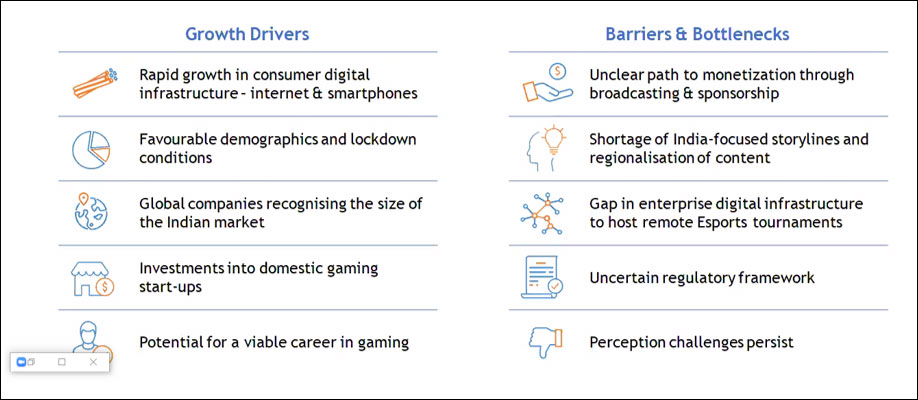
Opening the two-day-long virtual summit with his keynote address, Tata Communications global head media and entertainment Dhaval Ponda shed light on the emerging trends, growth drivers, and barriers impacting the Indian e-sports and gaming industry.
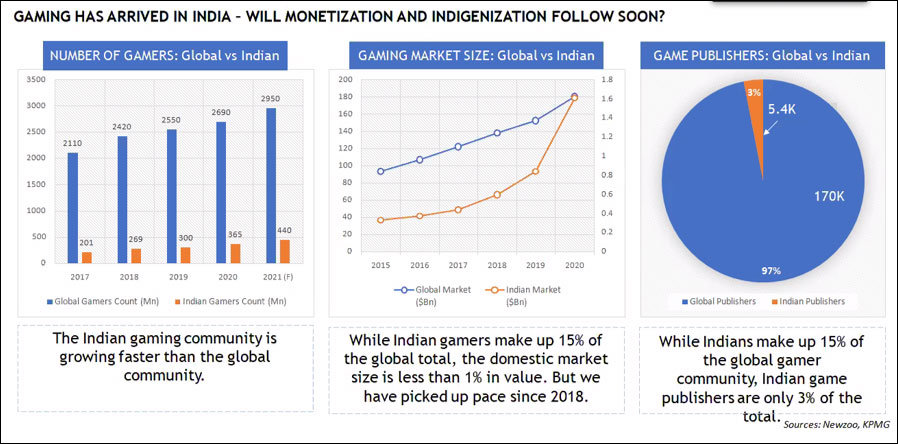
While the Indian gaming crowd is growing at a faster click than the global community, it is still not getting the right monetisation and publishing support within the country, says Ponda. Indian gamers today make for 15 per cent of the global total but the domestic market size is less than 1 per cent in value. Indian game publishers are only 3 per cent of the global value.
Though he insisted that things have started improving since 2018, there is still a lot of work that needs to be done in the sector of broadcasting and monetisation.
“We are seeing that e-sports gaming content is now being treated by these broadcasters as good as tier-1 traditional sports, and is being watched by millions of viewers. So, you (broadcasters) are also going to attract the same rights-holding fee that you would charge from tier-1 sports, like cricket and football,” stated Ponda.
Broadcasts will not only be crucial to gauge interest and get tongues wagging about e-sports,but also sustain andreinforce the community, he explained.
He added that the platforms also need to consider what else they can do beside streaming e-sports live to grab eyeballs, and make it an wholesome experience for viewers as well as the gaming community. “If you are investing, try and understand how you can be unique in your content. Ask yourself if you can have content outside of just gaming,” said Ponda. To drive his point home, he added: “For example, the way you document the NBA champions. Everyone knows where the player was born, what their history is.”
Ponda insisted that a similar culture needs to be developed for players in e-sports and gaming categories too. “People want to know who they (the players) are and where they are coming from. It is the sort of content that also sustains engagement and active viewership.”
User-experience is also going to be a crucial factor in promoting and supporting the community. “The digital infrastructure needs to grow leaps and bounds in terms of broadband and mobile internet availability. Furthermore, a sound cloud architecture, transcoding infrastructure and CDN infrastructure is required to have a good viewing experience,” he said.
Artistic and technical talent for the game development side is quite crucial too, Ponda pointed out, and suggested that the industry take inspiration from gaming studios in LA, London, and south Korea to finetune the culture within India.
NEW DELHI: The gaming and e-sports industry in India is quickly levelling up, Covid2019 possibly being the biggest booster augmenting its growing popularity amongst the masses and advertisers alike. With more and more people spending increased time on these virtual platforms promising thrill, excitement, fun, and also lucrative career opportunities, the industry is staring at a massive boom.
Albeit, there are some underlying issues related to data safety, screen timing, the nature of the games, and some peculiar nationalist sentiments to be addressed, and a growth plan to be charted that can offer the most to all stakeholders involved; from technicians to designers, to players, to aggregators, to advertisers, and to the viewers.
Indiantelevision.com and AnimationXpress.com will, therefore, be facilitating the process of direct communication amongst all the people involved in the process with its proprietary gaming, e-sports, and more summit, GEMS. The summit is co-powered by Tata Communications.
The two-day virtual conference will bring together the biggest gaming studios, game developers, broadcasters, OTT platforms, streaming giants, pro players, brands, and agencies to discuss the next level of this raging saga.
Our speakers will include the likes of Trinity Gaming founder and CEO Abhishek Aggarwal, Nodwin Gaming director Akshat Rathee, Reliance Entertainment Digital CEO Amit Khanduja, Pocket Aces founder Anirudh Pandita, ESPL CEO Michael Broda, and Parle Products Pvt Ltd sr category head marketing Krishnarao S. Buddha, among many others.
MUMBAI: Tata Communications is a digital ecosystem enabler that powers today’s fast-growing digital economy, the company enables the digital transformation of enterprises globally, including 300 of the Fortune 500.
This partnership comes at a time when Tata Communications is focusing on the digital transformation of sports broadcasting and live streaming to aid Sports Federations and Rights Holders.
Tata Communications currently delivers over 5,000 live sporting events globally, including majority of motorsports in Europe, cricket, football, and most major global sports federations.
Low latency streaming is another key focus for Tata Communications who help their clients to build a greater audience share. With nearly 30 percent of the world’s Internet routes travelling over its network, Tata Communications has established itself as a leader in the increasingly digital, cloud-powered, and IP-enabled media and entertainment industry.
Tata Communications, global head and general manager of media and entertainment Dhaval Ponda said: “We are very happy to have appointed iSportconnect as a strategic partner. This is another step for us as we look to continue and expand our work within the industry.
iSportconnect Founder and CEO Sree Varma commented: “At iSportconnect, we are thrilled to now be working alongside a company such as Tata Communications. This partnership with Tata Communications is a statement from us here at iSportconnect and how we hope to play a key role in their market growth and look forward to a successful partnership.”
iSportconnect’s Consultancy division works to help our clients with commercial development, marketing and communications and business strategy surrounding the world of sport. We help to provide business intelligence, global sports market entry strategy and support and are constantly on hand as advisors 24/7 for our clients. Some of our consultancy clients include the likes of LaLiga, Sodexo, Sportradar, Hookit and ATPI.
MUMBAI: Tata Communications, a leading global digital infrastructure provider, and NEP Broadcast Solutions, a division of NEP Group, are together enabling the remote production of VIVO Pro Kabbadi League (PKL) for Star Sports, the number one sports broadcaster in India and subsidiary of 21st Century Fox. Now in its sixth season, this is the first time that PKL is being produced remotely by harnessing superfast connectivity.
The PKL is the largest league in the nation in terms of footprint, and the second most popular sports league in terms of viewership after the Indian Premier League (IPL). The 2018 season consists of 138 matches taking place over 91 days (October 7th 2018 – January 5th 2019). It is being streamed across six channels and in five languages – Star Sports English, Star Sports Hindi, Star Sports First, Star Sports 1 (Tamil), Star Suvarna Plus (Kannada) and Star Maa Gold (Telugu).
Given the back-to-back schedule of events in multiple locations, Star Sports has partnered with Tata Communications and NEP to streamline and reduce the cost of the broadcast of PKL with remote production.
This means that production teams don’t need to travel to each venue, and the different localised broadcasts can be brought to audiences more efficiently.
During each match, the remote production team (the director, vision mixer, audio engineers, EVS operators, producers and graphics team) operates out of the Star Sports facility in Mumbai, whereas the production crew along with NEP’s engineering team (cameramen, sound assistants, talent producers and the production management) are on-site. They collaborate seamlessly in real-time to deliver every moment of the action to more than 200 million viewers using Tata Communications’ Video Connect network. It ensures the smooth transmission of a combination of signals and camera feeds from each fixture because of its ultra-low, four- frames-per-second latency and hitless switching capability. NEP’s flight pack Broadcast Lite – which allows a quick set-up in minimum space without any compromise in functionality and quality – makes it easy for Star Sports to produce both the world feed and regional language feeds. These consist of 27 unilateral camera feeds that are sent from the venues to its Mumbai hub, and 4 return feeds that are sent back to the venues, along with associated AES audio feeds.
“As India’s number one sports broadcaster, we have always pushed the boundaries of what’s possible,” a Star India spokesperson said. “Harnessing the joint capabilities of NEP and Tata Communications allows us to bring this incredible — yet logistically complex — series of matches to millions of Kabaddi fans across India without a glitch. And, thanks to the efficiencies gained through remote production, we can focus our efforts on enhancing how people are able to enjoy and engage with their favourite sport.”
“The millions of kabaddi fans across India don’t want to miss a millisecond of the on or off-court action, which means that the production of each PKL match needs to be completely seamless,” said Brian Morris, Vice President and General Manager, Media & Entertainment Services, Tata Communications. “At the same time, broadcasters are under pressure to increase efficiencies and reduce costs to ensure good return for their sports investments. To deliver the highest-quality content to audiences and create a TV experience that is closest to witnessing a match live in the stadium, more and more broadcasters globally are following in Star Sports’ footsteps and embracing remote production.”
“We are delighted to partner again with Star Sports and Tata Communications on enhancing the viewer experience by seamlessly broadcasting sporting events to millions of fans using remote production. This teamwork demonstrates that leveraging the unified force of leading organisations can drive innovation in the broadcasting industry while improving efficiencies,” said Saeed Izadi, President, Broadcast Solutions, NEP. “Together, we are redefining the production of kabaddi in India.”
In less than a year, this is Star Sports’ second major remote production project with Tata Communications and NEP. Earlier this year, the two companies joined forces for the remote production of the entire VIVO IPL 2018 league that consisted of 60 matches taking place over 50 days in nine cities.
MUMBAI: Tata Communications has inked a deal with Singaporean TelcoTech MyRepublic as it looks to expand its services portfolio from broadband to mobile.
While MyRepublic’s new mobile services are now available locally in Singapore only, it wants to venture into Australia, New Zealand and Indonesia in future.
The cloud-based Tata Communications MOVE™ platform will enable MyRepublic to become a mobile virtual network operator (MVNO) without having to make any capital investments in its mobile network infrastructure or service management.
MyRepublic is also looking to capitalise on the growing MVNO market, which expected to be worth US$ 75.25 billion in the next five years. With support of Tata Communications MOVE™ platform, the company wants to transform itself into Singapore’s first cloud-based MVNO.
“The MVNO market is consolidating and within the next five years, 80% of existing MVNOs using a traditional ‘thick model’ will struggle in a market that is transitioning to the cloud,” GlobalData Asia Pacific Research head Dustin Kehoe said.
Tata Communications MOVE™ also will power MyRepublic’s dynamic mobile plan offerings through its core network offering and end-to-end service management.
“Yet the resources needed for building and managing your own mobile network, as well as the services on top, is preventing many from taking the plunge. Tata Communications MOVE™ eliminates the cost and complexity of becoming an MVNO, helping ambitious companies like MyRepublic deliver innovative mobile services, anywhere in the world,” Tata Communications chief product officer Anthony Bartolo said.
MUMBAI: Tata Communications has collaborated with Skyline Communications to use the latter’s DataMiner platform as the end-to-end network, service, SLA, and operational support system for its global media services.
Tata owns one of the world’s largest wholly-owned fiber optic network, and Skyline leads globally in end-to-end multi-vendor network management and OSS software solutions for the broadcast, satellite, cable, telecom and mobile industry.
Skyline regional account manager Pramod Gupta said, “The DataMiner multi-vendor platform monitors and orchestrates services across any technology, regardless of vendor or type of technology, end to end. The platform is fully agnostic to specific technologies, and as such has the unique capability to book, reserve and activate services truly end to end.”
Tata general manager Brian Morris said, “It is our constant endeavor to ensure that we keep our service offerings ahead of the curve to ensure top-notch quality to be able to deliver a world-class customer experience”.
Skyline CEO, Ben Vandenberghe said, “Our market-leading platform provides end-to-end visibility and dashboards on the quality, performance and availability of the network, the services and the customer experience,”
The new DataMiner Service and Resource Manager (SRM) is the foundation of any dynamic media network. DataMiner SRM is introduced technology which truly links service and resource management with the network itself an operator can only book and activate resources that are effectively available for use.