Tag: tariff order

  • Sun TV Network announces new channel pricing

    Sun TV Network announces new channel pricing

    MUMBAI: While broadcasters are still waiting for the Supreme Court hearing on the TRAI tariff order, most of them are publishing their reference interconnect offer (RIO) already in compliance with the order. Sun TV Network has also announced its RIO almost one week after the TRAI deadline of 31 August.

    The broadcaster has also stuck to a maximum 15 per cent MRP discount to distributors. Earlier, Madras High Court chief justice did not uphold TRAI’s proposal of allowing highest 15 per cent cap on discounts despite giving the go-ahead to all other proposals. As any clarification did not come from TRAI, all the broadcasters are adhering to the order to avoid any further confusion.

    Sun TV Network’s 25 standard definition channels will be available on a-la-carte basis under Rs 19, as required by regulations. For HD channels, the a-la-carte rate has been fixed at Rs 19. The network has also announced thirteen SD bouquets and three HD bouquets. Targeting the entire belt of South India, Sun Ultimate SD and HD bouquet have been priced at Rs 65.

    While most of the broadcasters have published their RIOs, Supreme Court is yet to decide the final destiny of the digital television pricing. It again deferred the hearing of Star India’s petition filed against TRAI tariff and interconnect order to 11 September 2018. The case was first contested in Madras High Court and the high court upheld the tariff order with certain riders.

    However, while the supreme decision is still awaiting, major broadcasters have already come up with channel prices. TV18 Broadcast Ltd (TV18), Zee Entertainment Enterprises Ltd (ZEEL) and Sony Pictures Networks India Private Ltd (SPNI), Disney India have made available several bouquets targeting audiences of different natures. The first three broadcasters have also highly focused on regional bouquets. ZEEL was the only broadcaster to publish its RIO before the given deadline. Star India, one of the petitioners against the tariff order has not filed its RIO yet.

    Sun TV Network channels have good viewership across all markets in South India. In Tamil market, Sun TV retained its first position with 938999 impressions ‘000s, as per BARC data week 35. The network’s Malayalam GEC Surya TV retained third position in the market with 127136 impressions ‘000s. In Kannada and Telugu markets also, the network’s channels retained positions among top 5 channels.
  • Disney India reveals new TV channel prices

    Disney India reveals new TV channel prices

    MUMBAI:  One by one, broadcasters are announcing their new channel rates as per TRAI’s tariff requirements. The latest to join the bandwagon is Disney Broadcasting (India) Ltd. Its reference interconnect offer (RIO) will be effective from 29 December 2018. The deadline given by TRAI was 31 August for publication of RIO, declaration of MRP and nature of channels, in connection with its tariff order.

    All Disney India channels will be available on a-la-carte basis, as required by regulations. The a-la-carte of all eight channels including SD and HD channels are under Rs 15 per month. Given the different nature of Disney’s offering in Indian TV sector compared to other broadcasters, it has come up with only one bouquet called Universal Bouquet which has been priced at Rs 10. The bouquet excludes only Disney International HD which has the highest price of Rs 15 on the a-la-carte rate chart.

    While most of the broadcasters have published their RIOs, Supreme Court is yet to decide the final destiny of the digital television pricing. The Apex Court again deferred the hearing of Star India’s petition filed against TRAI’s tariff and interconnect order to 11 September 2018. The case was first contested in Madras High Court and the high court upheld the tariff order with certain riders.

    Meanwhile, major broadcasters have already come up with channel prices. TV18 Broadcast Ltd ( TV18), Zee Entertainment Enterprises Ltd (ZEEL) and Sony Pictures Networks India (SPNI) have made several bouquets available targeting audiences of different nature. Three of the broadcasters have also focused highly on regional bouquets. ZEEL was the only broadcaster to publish its RIO before the given deadline. Star India, one of the petitioners against the TRAI tariff order has not filed its RIO yet.

    Disney India’s offerings for kids have more popularity in the country compared to its entertainment segment. According to week 35 BARC data, two kids channels from the umbrella, Disney Channel and Hungama were at second and third positions respectively in the kids genre. The first one had 105399 impressions ‘000 and the second one 100401 impressions ‘000.

  • SC adjourns Star India’s petition on TRAI tariff order to 11 September

    SC adjourns Star India’s petition on TRAI tariff order to 11 September

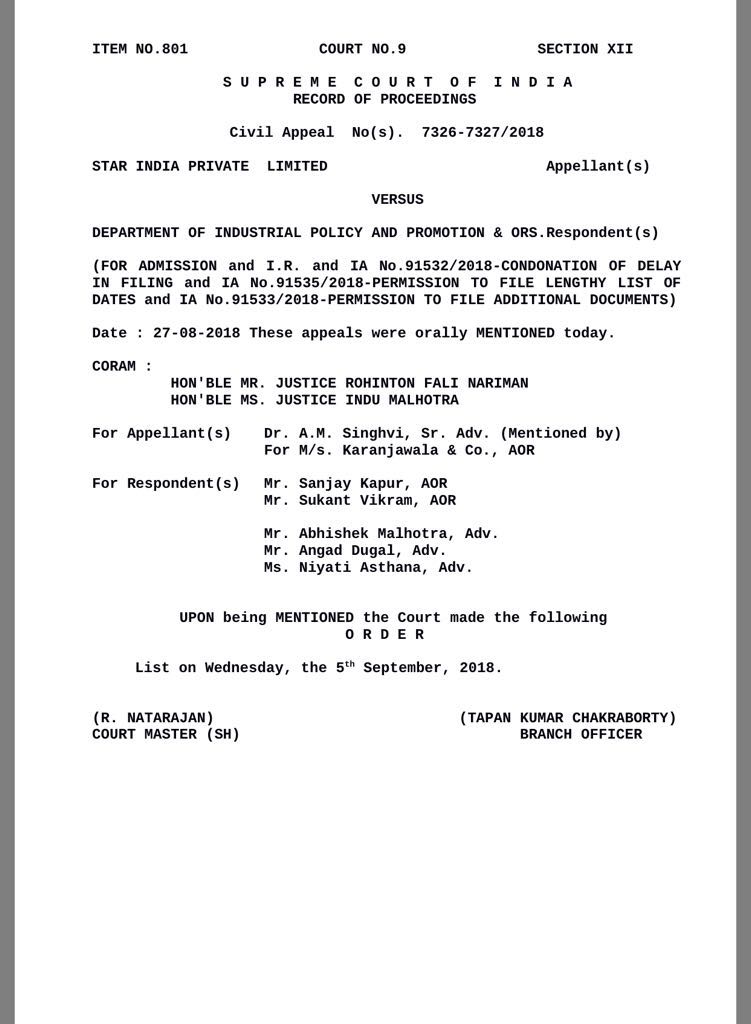
    MUMBAI: The Supreme Court has deferred the hearing of Star India’s petition against TRAI tariff and inter-connect order to 11 September 2018.

    Zee Entertainment Enterprises Ltd (ZEEL) was first out of the blocks in publishing the RIO, declaring the MRP and nature of channels in connection with its tariff order, which had a 31 August deadline. The Punit Goenka-led company was followed by TV18 Broadcast Limited ( TV18), Sony Pictures Networks India Private Limited (SPNI), who adhered to the regulator’s directive on September 4.

    The TRAI tariff orders, first contested in Madras High Court by the petitioners, were cleared by the Chennai court with certain riders after hearings that continued almost over 16 months in front of two benches of the court.

    After the Madras HC had given a thumb up to TRAI tariff order, and both the petitioners and the defendant (TRAI) had filed caveats in the Supreme Court, the regulator had bowled a googly saying that its tariff order would come into effect from 3 July 2018 as all judicial compliances had been completed.

    “Having complied with  the  judicial  mandates  in  the  matter,  the Telecommunication (Broadcasting and Cable) Services (Eighth) (Addressable Systems)  Tariff   Order, 2017 and  the Telecommunication (Broadcasting and Cable) Interconnection (Addressable Systems) Regulations, 2017 as upheld by the Hon’ble Madras High  Court and the Telecommunication (Broadcasting and Cable) Services Standards  of   Quality  of  Service and  Consumer  Protection (Addressable Systems) Regulations, 2017 come into effect from 3rd July 2018,” the regulator had said in a statement pointing out that all timelines mentioned in the original order should be adhered to immediately.

    According to TRAI, implementation of the new regulatory framework will “bring in transparency”, enable provisioning of affordable broadcasting and cable TV services for the   consumer and, at the  same time, “would lead to an orderly growth of the sector”.

  • TV18, Sony Pictures India announce new channel rates

    TV18, Sony Pictures India announce new channel rates

    MUMBAI: Days after Zee announced its new tariff rates, TV18 Broadcast and Sony Pictures Networks India (SPNI) have also made public their own rates, in accordance with TRAI tariff rules.

    IndiaCast, the authorised distributing agency of TV18 channels, has updated the new format based Reference Interconnect Offer (RIO) on its website. This updated RIO will be effective for the term commencing from 29 December 2018. SPNI has also published its new RIO on its website.

    All TV18 channels will be available on an a-la-carte basis, as required by regulations. The a-la-carte rate of all SD & HD channels is under Rs 19 per month. The maximum retail price (MRP) of the basic bouquet for Hindi speaking market (HSM) named as Hindi Base starts at Rs 36 which includes Colors, MTV, Rishtey and CNN News 18. The Hindi Ultra pack has been priced at Rs 58. There’s an India Base pack which includes important channels from all regions and each genre at Rs 79.

    The broadcaster has announced multiple bouquets for several regional markets including base and ultra-pack both in SD and HD. Karnataka Base pack will cost Rs 53, while Maharashtra Base pack price has been fixed at Rs 45 and Bengal Base at Rs 41.

    SPNI is also providing a total of 32 channels including SD and HD on a-la-carte basis at under Rs 19 per month.

    SPNI has also declared ten bouquets concentrating on different regional markets as well along with focusing on its premium channels. The base pack BST Regular pack has been fixed at Rs 55 while its variants of regional languages are priced higher. SPN Blockbuster Pack priced at Rs 86.4 includes SET, Sony Yay!, Sony BBC Earth and ESPN. The Blockbuster pack also has variants with Bengali and Marathi languages.

    Two different packs focusing on the South Indian market are also available. The Big HD pack with all HD channels is priced at Rs 116 where Sony Marathi HD is proposed to be launched in place of TEN Golf HD. While the viewers of HD channels are growing slowly but gradually, two HD bouquets, one for South, are also available.

    The deadline given by TRAI was 31 August for publication of RIO, declaration of MRP and nature of channels, in connection with its tariff order. Zee Entertainment Enterprises Limited (ZEEL) was the only broadcaster to publish its RIO before the given deadline.

    Star India is the only big broadcaster which has not filed its ROI yet. The broadcaster is also one of the main petitioners against the TRAI tariff and interconnect order which will now be heard on 5 September by the Supreme Court.

  • SC defers hearing of Star India petition on TRAI tariff order to 5 September

    SC defers hearing of Star India petition on TRAI tariff order to 5 September

    NEW DELHI: The Supreme Court has deferred the hearing of Star India’s petition filed against TRAI tariff and inter-connect order to 5 September, 2018.  The order had been given a go-ahead by the Madras High Court.

    The TRAI tariff orders, first contested in Madras High Court by the petitioners, were cleared by the Chennai court with certain riders after hearings that continued almost over 16 months in front of two benches of the court.

    Though the petitioners were unable for comments, a legal eagle explained that the very fact the Supreme Court has allotted a day for hearing the petition of Star India and Vijay TV, which basically revolves around copyright and why the regulator doesn’t have jurisdiction over such issues, highlights the fact that the judge doesn’t want to take a decision in a hurry.

    However, ahead of 31 August 2018 deadline for publishing TV channel prices in a new format Zee Entertainment Enterprises Ltd  (ZEEL) has made public its channel prices in line with the tariff order, setting an example for owners of other TV channels.

    All ZEEL channels will be available on a-la-carte basis, as required by regulations, and the consumers will also have the option to choose from specifically created bouquets for Hindi speaking markets (HSM) and different regional language markets like Marathi, Bangla, Odia, Bhojpuri, Tamil, Telugu, Kannada and Malayalam.

    After the Madras HC had given a thumb up to TRAI tariff order, and both the petitioners and the defendant (TRAI) had filed caveats in the Supreme Court, the regulator had bowled a googly saying that its tariff order would come into effect from 3 July 2018 as all judicial compliances had been completed.

    “Having complied with  the  judicial  mandates  in  the  matter,  the Telecommunication (Broadcasting and Cable) Services (Eighth) (Addressable Systems)  Tariff   Order, 2017 and  the Telecommunication (Broadcasting and Cable) Interconnection (Addressable Systems) Regulations, 2017 as upheld by the Hon’ble Madras High  Court and the Telecommunication (Broadcasting and Cable) Services Standards  of   Quality  of  Service and  Consumer  Protection (Addressable Systems) Regulations, 2017 come into effect from 3rd July 2018,” the regulator had said in a statement pointing out that all timelines mentioned in the original order should be adhered to immediately.

    According to TRAI, implementation of the new regulatory framework will “bring in transparency”, enable provisioning of affordable broadcasting and cable TV services for the   consumer and, at the   same time, “would lead to an orderly growth of the sector”.

  • ZEEL announces new TV channel prices ahead of deadline

    ZEEL announces new TV channel prices ahead of deadline

    MUMBAI: Ahead of 31 August 2018 deadline for publishing TV channel prices in a new format and a day before the Supreme Court hears a case relating to TRAI’s new tariff regime, Zee Entertainment Enterprises Ltd  (ZEEL) has made public its channel prices as suggested by the regulator in 2016, setting an example for owners of other TV channels.

    All ZEEL channels will be available on a-la-carte basis, as required by regulations, and the consumers will also have the option to choose from specifically created bouquets for Hindi speaking markets (HSM) and different regional language markets like Marathi, Bangla, Odia, Bhojpuri, Tamil, Telugu, Kannada and Malayalam, an official statement from ZEEL said on Monday evening.

    The Punit Goenka-led ZEEL’s initiative to be first off the blocks with a-la-carte pricing could very well put pressure on other broadcasters to follow the example. Goenka also happens to be the president of the Indian Broadcasting Foundation, an industry body that claims its members manage 350+ TV channels and about 90 per cent of television viewership across the country.

    [[{“fid”:”836178″,”view_mode”:”default”,”fields”:{“format”:”default”,”alignment”:””,”field_file_image_alt_text[und][0][value]”:”graph”,”field_file_image_title_text[und][0][value]”:”graph”},”link_text”:null,”type”:”media”,”field_deltas”:{“1”:{“format”:”default”,”alignment”:””,”field_file_image_alt_text[und][0][value]”:”graph”,”field_file_image_title_text[und][0][value]”:”graph”}},”attributes”:{“alt”:”graph”,”title”:”graph”,”height”:266,”width”:624,”class”:”media-element file-default”,”data-delta”:”1″}}]]

    Meanwhile, according to ZEEL, for each market, there will be multiple bouquets available to consumers across the country at different price points. Each bouquet would constitute a mix of channels of different genres, including general entertainment, movies, news, infotainment and music. The starting bouquet (B1) is likely to exclude English entertainment and English movie channels whereas the premium bouquet would include all channels offered by Zee.

    ZEEL is likely to keep the prices of Hindi language bouquets from Rs. 45 upwards. For other languages, bouquet prices will be higher in those markets where Zee has multiple offerings and lower in other cases. For the discerning high definition (HD) consumers, Zee is creating additional bouquets that will make it convenient for various operators to offer to their respective subscribers, the statement said. The Hindi language HD bouquets are likely to be priced Rs. 60 upwards.

    ZEEL has decided to offer all its News channels along with its other popular channels like Zee Anmol, Big Ganga and Big Magic as part of these pay bouquets. As a result, these channels would not be available in the FTA pack.

    In a related development, the Supreme Court is scheduled to hear a case filed by Star India and Vijay TV against Madras High Court clearing regulator TRAI’s new tariff regulations, which were first announced middle 2016 but has been in suspended animation since late 2016 due to various legalities.

  • SC to hear Star India petition on TRAI tariff order late August

    SC to hear Star India petition on TRAI tariff order late August

    NEW DELHI: The Supreme Court today listed for 28 August the special leave petition filed by Star India and Vijay TV against a tariff and inter-connect orders of regulator TRAI that had been given a go-ahead by the Madras High Court.

    The TRAI tariff orders, first contested in Madras High Court by the petitioners, were cleared by the Chennai court with certain riders after hearings that continued almost over 16 months in front of two benches of the court.

    Though the petitioners were  unavailable for comments, a legal eagle explained that the very fact the Supreme Court has allotted a day for hearing the petition of Star India and Vijay TV, which basically revolves around copyright and why the regulator doesn’t have jurisdiction over such issues, highlights the fact that the judge doesn’t want to take a decision in a hurry.

    The next date of hearing of the case in the apex court on 28 August 2018 is few days before the deadline kicks in for filing of new inter-connect agreements by stakeholders of the Indian broadcast industry.

    After the Madras HC had given a thumb up to TRAI tariff order, and both the petitioners and the defendant (TRAI) had filed caveats in the Supreme Court, the regulator had bowled a googly saying that its tariff order would come into effect from 3 July 2018 as all judicial compliances had been completed. 

    “Having complied with the judicial mandates in the matter,  the Telecommunication (Broadcasting and Cable) Services (Eighth) (Addressable Systems) Tariff Order, 2017 and the Telecommunication (Broadcasting and Cable) Interconnection (Addressable Systems) Regulations, 2017 as upheld by the Hon'ble Madras High  Court and the Telecommunication (Broadcasting and Cable) Services Standards  of   Quality  of  Service and  Consumer  Protection (Addressable Systems) Regulations, 2017 come into effect from 3rd July 2018,” the regulator had said in a statement pointing out that all timelines mentioned in the original order should be adhered to immediately.

    According to TRAI, implementation of the new regulatory framework will “bring in transparency”, enable provisioning of affordable broadcasting and cable TV services for the consumer and, at the same time, “would lead to an orderly growth of the sector”.

    Keep tuned in for another episode of this legal saga, which started to air sometime in 2016.

  • Tata Sky mulls fresh petition against TRAI tariff rollout

    Tata Sky mulls fresh petition against TRAI tariff rollout

    MUMBAI: Indian DTH operator Tata Sky is exploring options of filing a fresh petition in Delhi High Court against a Telecom Regulatory Authority of India directive to implement a new tariff regime from 3 July.

    Industry sources indicated that though Tata Sky withdrew its petition filed in the morning, it could again move the court protesting on various grounds the rollout of the TRAI tariff regime.

    The Delhi court, which is still to pronounce a verdict in a case relating to tariff and inter-connect orders of the regulator after being moved by Tata Sky and Airtel Digital TV over a year back, however, today refused to entertain the DTH operator’s fresh contempt plea against TRAI and said if the petitioner wished it could file a fresh petition.

    Tata Sky had pleaded that TRAI media statement, issued 3 July 2018 directing broadcast and cable industry stakeholders to start rolling out the new tariff and inter-connect regimes with immediate effect, amounted to contempt of the Delhi High Court.

    TRAI yesterday had said in a statement that its long-pending tariff and inter-connect orders, first issued in 2016, was to be implemented from 3 July 2018 with stakeholders to follow deadlines mentioned in the directive. The regulator had justified its stand by saying all necessary judicial compliances too were followed.

    “Having complied with  the  judicial  mandates  in  the  matter,  the Telecommunication (Broadcasting and Cable) Services (Eighth) (Addressable Systems)  Tariff   Order, 2017 and  the Telecommunication (Broadcasting and Cable) Interconnection (Addressable Systems) Regulations, 2017 as upheld by the Hon’ble Madras High  Court and the Telecommunication (Broadcasting and Cable) Services Standards  of   Quality  of  Service and  Consumer  Protection (Addressable Systems) Regulations, 2017 come into effect from 3rd July 2018,” the TRAI statement had said.

    The statement had further stated that “in compliance to the direction” of the Delhi High Court, the regulator had “duly filed an affidavit” on 3 July 2018 in the court on implementation of   its tariff and other related orders as they were cleared by another high court.

    Meanwhile Star India, also expected to open up another legal front at the Supreme Court on the tariff issue, hasn’t yet made a move.

    Still, industry people do admit that though TRAI may have directed implementation of its new tariff regime, but there is lack of clarity on the issue of 15 per cent cap on discounts offered by broadcasters on the prices of TV channels.

    While upholding TRAI’s right to give directives on tariff-related matters, Madras High Court had given a thumb down to the capping of discounts offered. While stating that its tariff order was to come into effect from 3 July 2018, the regulator had not clarified whether the discount cap stayed or was done away with.

    Keep tuned in for more developments on the tariff issue as it refuses to go away or get settled once and for all.

    Also Read:

    TRAI says b’cast & cable tariff, inter-connect orders come into effect 3 July

    Star files caveat in Supreme Court on TRAI tariff order

    Third Madras high court judge gives TRAI tariff order thumbs up

  • TRAI says b’cast & cable tariff, inter-connect orders come into effect 3 July

    TRAI says b’cast & cable tariff, inter-connect orders come into effect 3 July

    NEW DELHI: The Telecom Regulatory Authority of India (TRAI) today issued a statement stating that its tariff order for the broadcasting and cable sector will come into effect from 3 July 2018 as judicial compliances have been complied with.

    “Having complied with  the  judicial  mandates  in  the  matter,  the Telecommunication (Broadcasting and Cable) Services (Eighth) (Addressable Systems)  Tariff   Order, 2017 and  the Telecommunication (Broadcasting and Cable) Interconnection (Addressable Systems) Regulations, 2017 as upheld by the Hon’ble Madras High  Court and the Telecommunication (Broadcasting and Cable) Services Standards  of   Quality  of  Service and  Consumer  Protection (Addressable Systems) Regulations, 2017 come into effect from 3rd July 2018,” the regulator said in a statement pointing out that all timelines mentioned in the original order should be adhered to immediately.

    Star Tv and Vijay Tv had moved Madras High Court against the TRAI tariff order late 2016 and after protracted hearing the court finally gave its final judgement earlier this year. Subsequently Star and the regulator had both filed caveats at Supreme Court. Meanwhile, Tata Sky, Airtel Digital Tv had filed petitions in Delhi High Court on matters relating to the tariff order and the case is still pending a judgement or direction.

    According to TRAI, implementation of the new regulatory framework will “bring in transparency”, enable provisioningof affordable broadcasting and cable TV services for the   consumer and, at the   same time, “would lead to an orderly growthof the sector”.

    Some of the important activities and timelines are as under:

    #The  Telecommunication (Broadcasting and Cable)  Services (Eighth) (Addressable Systems) Tariff Order, 2017: Declaration ofMRP and nature of channels by broadcasters within 60  days; declaration of network capacity fee and  distribution  retail price  by distributors (DPO)  within  180   days; reporting by broadcasters within 120  days.

    # The Telecommunication (Broadcasting and Cable) Interconnection (Addressable    Systems) Regulations, 2017:    Publication     of     Reference Interconnect Offer (RIO) by   broadcasters   within 60   days; publication of referenceinterconnect offers by distributors within 60 days; Signing of the interconnection agreements within 150 days;

    # The Telecommunication (Broadcasting and Cable) Services Standards of   Quality of   Service ·and Consumer  Protection (Addressable Systems) Regulations, 2017:  Migration of the subscribers to the new framework within 180  days; Establishment of customer care center, website, consumer care channel and publication of manual of practice within 120 days.

    It would be interesting to see how the original petitioners react to the latest TRAI salvo. The regulator and petitioners were not available for immediate comments.

    ALSO READ:

    Third Madras high court judge gives TRAI tariff order thumbs up

    Star files caveat in Supreme Court on TRAI tariff order

    TRAI tariff order’s impact on the industry

    Decks cleared for TRAI tariff order implementation as HC declines stay

  • Impending tariff order implementation pushes Dish TV to sign short-term contracts

    Impending tariff order implementation pushes Dish TV to sign short-term contracts

    MUMBAI: Keeping in mind the recent Madras High Court judgement in regard to tariff order and interconnect regulation, India’s largest direct to home (DTH) brand Dish TV India is now focussin on short-term deals. As the recent judgement brought tariff-order closer to the reality, the DTH brand’s move has factored in the impending  tariff order implementation.

    The recent judgement upheld the order of Chief Justice Indira Banerjee, giving a green signal to  TRAI’s powers to frame tariff for the broadcasting sector. It has helped TRAI move forward to create a transparent and non-regulatory framework.

    According to media reports, Dish TV chairman and managing director Jawahar Goel spoke about the short-term contracts while talking to analysts. “We will get the content at the same cost as a cable operator in Chennai like Arasu Cable. The same price will be applicable to us,” Goel said on an optimistic note hoping the tariff order would remove discrimination.

    He also mentioned that the recent merger of Dish TV and Videocon d2h has managed to reduce content costs in some cases. “I can say the broadcasters have recognised the combined entity. Earlier we used to give 7%, 8%, 5% increase. This is no longer the case rather. In some of the cases, we have reduced the content costs while some agreements are still pending,” he said.

    Another face of the company, Dish TV India Group CEO Anil Dua emphasised on the importance of the unity in industry to implement the tariff order. He termed the Mera Apna Pack as a predecessor to the implementation of the Tariff Order.

    “We are the only one I guess in any of the DPO including cable or the DTH industry who are geared up to sell the pay channel based on the Tariff Order and the customer demand,” Dua said.

    Also Read:

    Third Madras high court judge gives TRAI tariff order thumbs up

    Dish TV offers SD channels at Rs 8.5 per month