Tag: tariff order

  • Indian Broadcasting Foundation (IBF) moves SC against HC’s NTO 2.0 verdict

    Indian Broadcasting Foundation (IBF) moves SC against HC’s NTO 2.0 verdict

    New Delhi: The Indian Broadcasting Foundation (IBF) has filed a petition in the Supreme Court against the Bombay high court verdict, which had upheld the constitutionality of the amended New Tariff Order (NTO 2.0) passed by the Telecom Regulatory Authority of India (Trai).

    After a legal tussle that lasted over a year, Trai had managed to get a green signal from the court on 30 June on the implementation of amended NTO 2.0 passed in January, 2020. The division bench of the high court stated that the challenge to the constitutional validity of the 2020 rules and regulations of Trai does not hold any water. At the same time, it termed one of the twin conditions “arbitrary”, according to which the maximum retail price of an a-la-carte channel could not be more than one third of the maximum rate of a channel in the bouquet.

    The court had passed the judgement on petitions filed by several broadcasters under the umbrella of the Indian Broadcasting Foundation (IBF) including Zee Entertainment, Star India, TV18, and Sony Pictures Network India (SPN) who had opposed the order, challenged the tariff order and termed it “arbitrary and in violation of their fundamental right.”

    According to broadcasters, the new order could lead to a drop in the subscription revenue, especially now, when the industry is reeling under pandemic-induced low advertising revenue. NTO 2.0 has prescribed linkage between a-la-carte price and bouquet, and reduced the price cap on the subscription fees for pay channels. So, TV broadcasters can include a channel in a pack only if it is priced at Rs 12 or less than that. Earlier, this limit was Rs. 19.

    The broadcasters only got partial relief when the high court struck down one of the twin conditions relating to the average pricing of a channel in a bouquet terming it as ‘arbitrary’. This will allow broadcasters to increase the number of channels they want to provide in the bouquet and enhance the value delivered to consumers.

    According to the condition the a-la-carte rates of each pay channel (MRP), forming part of a bouquet, shall in no case exceed three times the average rate of a pay channel of that bouquet. So, if the maximum price of a channel in a pack was Rs.12, a broadcaster could not charge more than four rupees for an a-la-carte channel.

    The high court had also extended its previous interim order, asking Trai not to take any coercive action against the broadcasters, if they did not implement the new tariff order. The order was extended for the next six weeks.

  • NTO 2.0 verdict: Who wins what?

    KOLKATA: One of the major issues that has dominated the pay TV ecosystem in India is in constant conflict between stakeholders and the sector regulator, the Telecom Regulatory Authority of India (Trai).  With the Bombay high court pronouncing its verdict on the amended new tariff order matter, one of the long-fought battles between the two may have come to an end. It upheld the constitutional validity of Trai’s NTO 2.0 but set aside the second clause of twin pricing conditions. The court’s decision is receiving mixed reviews from senior industry executives.

    On Wednesday, the division bench of Justices Amjad Sayyed and Anuja Prabhudessai passed judgement on several petitions filed by broadcasters and industry bodies like the Indian Broadcasting Foundation (IBF). The bench stated that the challenge to the constitutional validity of the 2020 rules and regulations of Trai does not hold any water. At the same time, it termed one of the twin conditions arbitrary according to which the maximum retail price of an a-la-carte channel could not be more than one third of the maximum rate of a channel in the bouquet.

    “We welcome this verdict of the honourable Bombay high court on amendment in tariff regulation. The full implementation of the amendment will bring more transparency in industry and give more choices and power to the customer. We are hopeful that this will get implemented soon. It is good for all stakeholders in the industry value chain,” GTPL Hathway cable TV head & chief strategy officer Piyush Pankaj said.

    Others in the business are not so sure because they believe it will definitely lead to a decline in subscription revenues. Considerably, major broadcasters have not already witnessed a fall in subscription revenue after partial implementation of NTO 2.0.  But they fear that after this verdict, there will be a faster movement towards a-la-carte from bouquets thus leading to lower ARPUs.

    One of the senior executives with a leading broadcaster said squashing the second twin condition can be looked at as a big win for broadcasters. This clause had the potential to effectively hamper broadcasters from packaging their channels as they had to bundle similarly priced offerings together as part of the bouquet. 

    However, the grounds that it has been struck down on are not very solid, another senior executive added. This battle was unnecessary and a fight for power, he noted, especially given the cost. Moreover, very few broadcasters were looking at pushing high pricing for channels anyway. Even these broadcasters also cannot go for high pricing now due to changed market dynamics in the last one year due to pandemic. As Trai still has substantive grounds to reclaim whatever has been lost, they might look at rechallenging it, the executive noted.

    “We believe there is a high likelihood of this being contested in the supreme court by Trai as the entire reasoning of getting the NTO 2.0 was to cap discount and move to selective viewing which the NTO 1.0 did not fulfil,” Elara Capital VP research analyst (media) Karan Taurani said in a note.

    “We continue to believe that the negative impact of NTO 2.0 is highest for Star whose bouquet prices have a higher discount factor and lowest for Sun TV whose discounting of bouquet vs ala carte is already at very low levels, which will lead to continued outperformance for Sun TV on subs revenue front despite NTO 2.0. On the other hand, this order is low to moderately negative for Zee,” stated Taurani.

    Back in 2018, Madras high court had also set aside the capping of discounts to 15 per cent mentioned in the Tariff Order and Interconnection Regulations of 2017. However, the battle reached the supreme court where the regulator won the case. Within a year of implementation of the regulation, the authority brought changes which irked broadcasters starting the second battle. Now are we in for the third?

  • AIDCF informs TRAI it will provide detailed submission for NTO 2.0 soon

    AIDCF informs TRAI it will provide detailed submission for NTO 2.0 soon

    MUMBAI: The All India Digital Cable Federation (AIDCF) has submitted a letter to the Telecom Regulatory Authority of India (TRAI), as per the judgement of the Kerala High Court, stating that it is collating information from member companies to make a detailed submission on the amended new tariff order (NTO 2.0), requesting TRAI not to take any further action.

    AIDCF secretary general Manoj Chhangani said it has informed TRAI that the federation would be sending the detailed representation in the next two weeks.

    The federation filed a writ petition in the Kerala High Court against certain provisions of NTO 2.0 regarding logical channel number, network capacity fee (NCF), multi-TV home connection.  The high court has stayed the clause relating to placing of channels on Electronic Programme Guide (EPG) in NTO  2.0. In the amended order, the authority had mandated that the channel of a language in a genre will be kept together while placing channels on EPG. Such EPG layout is to be mandatorily reported to the TRAI and no change in this can be done without prior approval of the authority.

    “In the above view of the matter, the amended provision in Regulation 18(4) of the Principal Regulation 2017 shall stand stayed. With regard to the other impugned provisions, the petitioners are permitted to file a detailed representation before the TRAI pointing out the objections to the  amendments producing all relevant data which will be duly considered by the TRAI and appropriate remedial steps shall be taken after due consultation with all stakeholders as required by law. Till such time, the provisions  except  the  provision  with  regard  to  freezing of the placement of channels in perpetuity  shall  be permitted  to  be operated,” the judgement said.

    Meanwhile, the Maharashtra Cable Operators Federation (MCOF) requested TRAI yesterday to defer the implementation of the amended tariff order (NTO 2.0) in view of the crisis created by Coronavirus. MCOF president Arvind Prabhu said that they are awaiting response from the regulatory body.

  • Tata Sky seeks to amend its writ petition against TRAI in the tariff order case

    Tata Sky seeks to amend its writ petition against TRAI in the tariff order case

    MUMBAI: The direct-to-home (DTH) platform Tata Sky has sought to amend the writ petition which was filed earlier before the Delhi High Court against the new tariff order introduced by The Telecom Regulatory Authority of India (TRAI). Alongside the ongoing case, Tata Sky seeks to amend the present petition by adding a challenge to the new amendments which was brought by the regulatory body at the beginning of 2020.

    Tata Sky has mentioned that following amendments are “arbitrary, irrational, unreasonable, without jurisdiction and seek to be expropriatory”.

    The petitioner has submitted that the reduction of Network Capacity Fee (NCF) is irrational and unreasonable as it does not ensure reasonable profit to the DTH platform. According to the petitioner, the TRAI has not carried out any tariff determining exercise before making the amendment regarding NCF.

    TRAI has also reduced the chargeability of the NCF in respect of every additional television to only 40 per cent of the original NCF, in a "multi-tv household".  It has also asked to reduce the carriage fee chargeable by a DPO against a new television channel from 20 paisa for Standard Definition (SO) per channel per month for a penetration upto 5 per cent, to a cap of maximum Rs 4 lakh for SD Channels. Such caps are also prescribed for HD Channels.

    “Through the capping of the Price of a Pay-Channel which could be put into a bouquet, the Distribution Fees available to the DPO has also been unreasonably and irrationally reduced,” the petitioner submitted.  It also added that the amendment would reduce  the  capability  of  a  DPO  to  form  bouquets  of channels which are priced above Rs 12 by the broadcaster. Moreover, a compulsory free carriage of Doordarshan channels has also been mentioned as unreasonable.

    “The Petitioner submits that the Impugned Amendments 2020 reduce the revenue generated by the Petitioner No.1 in such manner that even the basic right of the Petitioner to recover the basic cost of its network has been negated. The Petitioner submits that during the course of the present petition before this Hon'ble Court, the Respondent has failed to prove, establish or even display the advantages of the 2017 Regime,” it says.  

    Hence, Tata sky has sought to make additional grounds which may be allowed to be included in the main writ petition. According to the company, the impugned amendments 2020 do not take into account relevant matters and takes into account irrelevant issues like foreign consumers to subscribe television channels on the ala-carte basis by making bouquet of channels expensive. The DTH network is thus being made available to the consumer in such manner that it would not be able to even recover its operational or capital costs.

  • NTO 2.0: Bombay High Court adjourns case to 26 Feb

    NTO 2.0: Bombay High Court adjourns case to 26 Feb

    MUMBAI: The Bombay High Court has adjourned the ongoing case between the Telecom Regulatory Authority of India (TRAI) and broadcasters on the new tariff order (NTO) to 26 February. During the last hearing , no interim relief had been granted.

    Last time, the advocate for TRAI made a statement at the very beginning that the arguments should be based only on the petition and not on the rejoinder. Countering that, the advocate for Film & TV Producers Guild of India stated that there is nothing new in the rejoinder and everything is available in public domain.

    He also touched upon the point of the newly imposed twin conditions levied in the amendment of new tariff order where one condition is the cap of Rs 12 in a bouquet, the other being the discount on channel bouquets to around 33 per cent.

    Earlier, broadcasters were giving higher discounts pursuant to cross subsidies available by including smaller channels in its bouquets, which was totally in favour of consumers. He argued that if a consumer has to watch the so-called popular/niche channels (terms used by TRAI), he has to pay a higher price and it will increase his monthly bill.

    He also continued that although they do not come under the direct purview of TRAI, the amendments in the tariff order can affect their revenue. As the regulatory body has put a cap of Rs 12 on pay channel that can be included in a bouquet, the broadcaster cannot charge more than Rs 12 for that pay channel in a bouquet.

    The broadcaster has to pay huge amount to acquire content. Due to the regulations, if the broadcaster is not able to include it in a bouquet, it may prefer not to acquire such high priced content. Moreover, if broadcasters can not acquire quality content, the customer will lose.

    While broadcasters have the flexibility to decide the price of its pay channel and the customer should be able to view quality content on his TV, both these conditions are violated by the order.

    Last month, the Indian Broadcasting Foundation (IBF) along with others has filed a writ petition in the Bombay High Court against the TRAI order. The petitioners mentioned that the as amendments which has been notified in “consumer interest," will have exactly the opposite effect, leading to crippling of the business of broadcasters and ultimate suffering of the consumer.

  • NTO 2.0 case: No interim relief granted, to be heard on 12 Feb

    NTO 2.0 case: No interim relief granted, to be heard on 12 Feb

    MUMBAI: The Bombay High Court has listed the next hearing of the ongoing case between the Telecom Regulatory Authority of India (TRAI) and broadcasters on the new tariff order (NTO) on 12 February. No interim relief has been granted yet which can be argued at the next hearing. It has also been directed to issue a notice to Maharashtra advocate general.

    During Thursday’s hearing, the advocate for TRAI made a statement at the very beginning that the arguments should be based only on the petition and not on the rejoinder. Countering that, the advocate for Film & TV Producers Guild of India stated that there is nothing new in the rejoinder and everything is available in public domain.

    He also touched upon the point of the newly imposed twin conditions levied in the amendment of new tariff order where one condition is the cap of Rs 12 in a bouquet, the other being the discount on channel bouquets to around 33 per cent.

    Earlier, broadcasters were giving higher discounts pursuant to cross subsidies available by including smaller channels in its bouquets, which was totally in favour of consumers. He argued that if a consumer has to watch the so-called popular/niche channels (terms used by TRAI), he has to pay a higher price and it will increase his monthly bill.

    He also continued that although they do not come under the direct purview of TRAI, the amendments in the tariff order can affect their revenue. As the regulatory body has put a cap of Rs 12 on pay channel that can be included in a bouquet,  the broadcaster cannot charge more than Rs 12 for that pay channel in a bouquet.

    The broadcaster has to pay huge amount to acquire content. Due to the regulations, if the broadcaster is not able to include it in a bouquet, it  may prefer not to acquire such high priced content. Moreover, if broadcasters can not acquire quality content, the customer will lose.

    While broadcasters have the flexibility to decide the price of its pay channel and the customer should be able to view quality content on his TV, both these conditions are violated by the order.

    Earlier in the month, the Indian Broadcasting Foundation (IBF) along with others has filed a writ petition in the Bombay High Court against the TRAI order. The petitioners mentioned that the as amendments which has been notified in “consumer interest," will have exactly the opposite effect, leading to crippling of the business of broadcasters and ultimate suffering of the consumer.

  • IBF files writ petition against TRAI in Bombay High Court

    IBF files writ petition against TRAI in Bombay High Court

    MUMBAI: Amid the ongoing dispute in the broadcasting industry regarding amendments to the tariff order, the Indian Broadcasting Foundation (IBF), along with other broadcasters, has filed a writ petition in the Bombay High Court against the Telecom Regulatory Authority of India (TRAI).

    “The petition under article 226 and 227 of the constitution of India has been filed praying, for a writ, order or direction quashing the amendments carried out vide the telecommunication (broadcasting and cable) services interconnections (addressable systems) (second amendment) regulations, 2020 along with the telecommunication (broadcasting and cable) services standards of quality and consumer protection (addressable systems) (third amendment) regulations, 2020 along with the telecommunication (broadcasting and cable) services (eighth) (addressable systems) tariff (second amendment) order, 2020 issued by the respondent (TRAI) on 1 January,” the petition read.

    According to industry sources, the hearing of the case will come up tomorrow.

    In the beginning of this month, the industry regulator modified certain provisions (described as impunged provisions ) of the new price regime which was implemented last year. TRAI prescribed twin conditions on pricing –

    · The sum of the a-la-carte rates of the pay channels (MRP)forming part of a bouquet shall in no case exceed one and half times the rate of the bouquet of which such pay channels are a part

    · The a-la-carte rates of each pay channel (MRP),forming part of a bouquet, shall in no case exceed three times the average rate of a pay channel of the bouquet of which such pay channel is a part.

    The authority also decided that only channels with MRP of Rs 12 or less will be permitted to be part of the bouquet offered by the broadcasters.

    How the amendments can harm the broadcasters’ business as well as consumer interest :

     The petitioners have mentioned that the amendments which has been notified in “consumer interest” will have exactly the opposite effect, leading to crippling of the business of broadcasters and ultimate suffering to the consumer.

    It has also been mentioned that such crippling of the business would ultimately result either in closing down of the broadcasters’ channels or in diminishing the quality and the quantity of content available on TV channels to the consumer. In addition to that, the petitioners would lead in compelling the broadcasters to offer their channels only in a-la-carte format.

    Additionally, unlike under the 2017 Regulatory Regime, the new provisions prohibit broadcasters from giving any discount on the MRP of any bouquet to the DPO. Hence the broadcasters are of the view that they are completely dis-incentivised from creative bouquet offerings. They think that the new prohibition placed upon the broadcaster from offering a discount on bouquets will result in a huge reduction in DPOs’ demand for broadcaster-created bouquets, resulting, over a period of time, in discontinuation of bouquet offerings by broadcasters.

    The writ has been filed broadly to address the following issues:

    · A Broadcaster’s freedom of pricing its own content has been taken away/ interfered with by the Respondent, as it continues to place fetters and unrealistic caps on the manner of offering the channels and pricing thereof.

    · Despite admission by Respondent that offering of channels through bouquets is the preferred and prevalent practice, even from a subscriber’s viewpoint, the Impugned Provisions have the effect of dismantling and making unworkable any bouquet offering made by the broadcasters, by placement of fetters that have no co-relation to the method or manner of offering content to the subscriber.

    · A broadcaster’s effective freedom to price its channel with a view to recover/recoup its every increasing investment into content creation, is being taken away. The earlier imposed cap that prohibited any channel priced at more than Rs 19, as per the 2017 Interconnection Regulations and 2017 Tariff Order, has now been unilaterally and arbitrarily reduced to Rs.12 by the Impugned Provisions.

    · A broadcaster’s freedom to offer its channels as part of one or more bouquets, has effectively been taken away, by prohibiting the broadcaster from offering any discount on the Maximum Retail Price of its bouquets; and further, by placing archaic and unworkable conditions to be followed by a broadcaster while creating a bouquet.

    · At the same time, the Delivery Platform Operator (“DPO”) has been given further freedom to offer channels as part of bouquet and to give discounts on bouquet prices, by unilaterally reducing the price of the channel received by the DPO from the broadcaster, has been kept intact and in fact, strengthened.

    · A Broadcaster has effectively been prohibited from offering, as part of any bouquet, Niche channels, including sports channels, whose content consists of expensive and exclusively licensed rights to broadcast sporting events.

    To address the issues, IBF on Friday also held a press conference in Mumbai. The broadcasters of India came in support of each other under the shelter of IBF to voice their concerns against the new TRAI amendments of the new tariff order. All the top bosses of the major networks have agreed to the fact that this revision is going to leave severe adverse affect on all the players. The industry may explore legal options to fight the disruption.

  • TRAI extends deadline for comments on consultation paper to review NTO

    TRAI extends deadline for comments on consultation paper to review NTO

    MUMBAI: The Telecom Regulatory Authority of India (TRAI) has extended the deadline for the receipt of comments and counter comments on Consultation Paper on "Tariff related issues for Broadcasting and Cable services" till 23 September and 7 October respectively.

    The Authority had issued a consultation paper on "Tariff related issues for Broadcasting and Cable services" on 16 August 2019 inviting written comments from the stakeholders by 16 September 2019 and counter-comments, if any, from the stakeholders by 30 September 2019.

    In its release TRAI said, “On request from the stakeholders, the last date for receipt of written comments and counter-comments, if any, from the stakeholders, has been extended up to 23 September 2019 and 7 October 2019 respectively. No requests for any further extension of time for submission of comments shall be entertained.”

    TRAI issued the consultation paper to discuss the issues that have come up post implementation of the new regime. The authority also had extensive interactions with stakeholders including consumers and consumer organisations, at various forums, wherein stakeholders have also raised certain issues such as variable NCF for different regions, NCF for multi TV home, discount on long term plan, DD channels as part of one hundred channels etc.

    TRAI has observed that too many bouquets are formed by the broadcasters/DPOs and many of them contain very similar set of channels, with very few changes. This, according to the sector regulator, is not only creating confusion among consumers but also becoming a hurdle in choosing the channels.

    With too many bouquets of broadcasters and DPOs, consumers get confused and as a result are forced to adopt some suggested packs of TV channels, killing the freedom given to consumers to choose desired TV channels, feels the sector regulator.

  • Discovery files petition against TRAI’s tariff-related consultation paper in Delhi High Court

    Discovery files petition against TRAI’s tariff-related consultation paper in Delhi High Court

    MUMBAI: Major broadcaster Discovery Communications India has filed a petition against Telecom Regulatory Authority of India’s (TRAI) recent consultation paper floated on 16 August. The broadcaster has prayed for quashing the consultation paper terming it “illegal and arbitrary”.

    TRAI issued a consultation paper on tariff-related issues for broadcasting and cable services, seeking stakeholders’ responses to 27 questions which covered different aspects related to the new tariff order (NTO), which came into force from 1 February 2019.

    The petition by Discovery also asks to prohibit TRAI from proceeding or taking any further steps pursuant to the paper without following the due process of law. According to sources, the petitioner has served a copy to TRAI on Wednesday and hopes to get a listing on Thursday, 29 August 2019, before the Delhi High Court.

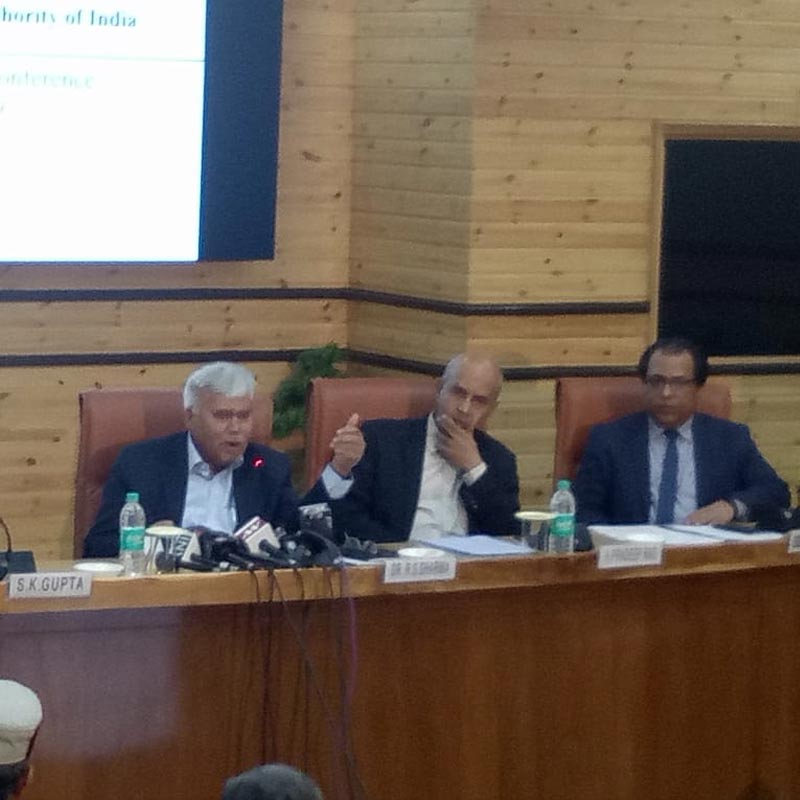
    Amid several ongoing speculations on the change in NTO, TRAI chairman RS Sharma recently clarified that the regulatory body does not have any plan to revise the pricing framework. He also added that it is only trying to fine-tune it due to certain issues consumers are facing.

  • Broadcasters, DPOs misused new tariff order to throttle market discovery of channel prices: TRAI

    Broadcasters, DPOs misused new tariff order to throttle market discovery of channel prices: TRAI

    MUMBAI: Telecom Regulatory Authority of India (TRAI) on Friday issued a consultation paper on tariff related issues for Broadcasting and Cable services.

    The paper primarily discusses issues related to discounts given in the formation of the bouquets, ceiling price of channels for inclusion in bouquet, need for formation of bouquet by broadcasters and DPOs, variable NCF and discounts on long term plan.

    TRAI believes that the new regulatory framework has brought the transparency in TV channel pricing, harmonised business processes in the sector and reduced disputes among stakeholders. However, adequate choice to select TV channels has not been given to the consumers.

    “In all fairness, a lot was expected from broadcasters and DPOs to use flexibility given under new regulatory framework to address the concerns and aspirations of the consumers. However, given flexibility was misused to throttle market discovery of TV channel prices by giving huge discounts on the bouquets. It has been observed from the tariff declared by broadcasters under new regulatory framework that they are offering bouquets at a discount of up to 70 per cent of the sum of a-la-carte rates of pay channels constituting those bouquets,” reads TRAI’s latest notification.

    “It indicates that in absence of any restriction on the discount on the offering of bouquets, broadcasters are making prices of a-la-carte channels illusory thereby impacting the a-la-carte choice of channels by consumers. Further, no restriction on number of channels has created another problem wherein broadcasters and DPOs are offering too many bouquets,” the note further states.

    TRAI has observed that too many bouquets are formed by the broadcasters/DPOs and many of them contain very similar set of channels, with very few changes. This, according to the sector regulator, is not only creating confusion among consumers but also becoming a hurdle in choosing the channels.

    With too many bouquets of broadcasters and DPOs, consumers get confused and as a result are forced to adopt some suggested packs of TV channels, killing the freedom given to consumers to choose desired TV channels, feels the sector regulator .

    TRAI had extensive interactions with  stakeholders including consumers and consumer organizations, at various forums, wherein stakeholders have also raised certain issues such as variable NCF for different regions, NCF for Multi TV home, discount on long term plan, DD channels as part of one hundred channels etc.

     In order to deliberate upon above issues that have come post implementation of the new regime, the latest consultation paper has been floated seeking stakeholders' views.