Tag: Tamil Nadu

  • Arasu cable threatens Star Sports to switch off

    Arasu cable threatens Star Sports to switch off

    MUMBAI: Tamil Nadu’s giant multi system operator (MSO) Arasu cable is flexing its muscles again. Last week, it issued a public notice against aggregator MediaPro for breach of letter of acceptance and non conclusion of price negotiation. Now it has gone ahead and issued a notice against Star Sports citing the same reason.


    The notice dated 28 December warns subscribers that after 21 days they won’t be able to view Star Sports channels on their Arasu cable connections but instead will be shown substitute channels.


    Issued under section 4.2 of the Telecom Regulatory Authority of India’s (TRAI) Telecommunications (Broadcasting and Cable Services) Interconnection Regulations 2004, the notice says that Star Sports 1, 2, 3 and 4 might be disconnected.


    A few days ago, the Madras High Court warned the TRAI not to take any coercive action against the MSO that has about six million subscribers in the state. The rumours doing the rounds are that Arasu has been arm twisting pay channels to pay high carriage fees in order to fill in the gap between revenue and payouts to pay channels of about 40 per cent.

  • South Indian GECs push fiction to include Saturday

    South Indian GECs push fiction to include Saturday

    Television viewing has always been about appointment viewing – catch up with your favourite shows on a particular day at a particular time.

    While airing fiction shows from Monday to Friday and comedy and movies over weekends has been somewhat the norm, a clutch of channels down South, particularly in Karnataka, has taken a shine to fiction shows spilling over to Saturdays as well.

    Asianet Suvarna, Star’s GEC channel in Karnataka, took this route about six months ago when it started airing fiction shows for six days a week.

    Star’s Malayalam GEC Asianet followed suit with a few prime-time fiction shows extended to Saturday.

    Recently, Sun TV, the Tamil GEC from the dominant Sun Network, joined the fray with its prime-time fiction shows replacing a movie and a game slot on Saturday.
    Not to be left behind, Sun Network’s Malayalam GEC Surya TV added Saturday to the telecast of the crime thriller Satyameva Jayate and its Kannada GEC Udaya TV also traversed the same path.

    So, what prompted these GECs to include Saturdays in their fiction line-up? Apparently, the channels believe airing soaps on a Saturday is more profitable as compared to airing movies, which they used to earlier. “Producing a half-an- hour fiction serial would mean investing about Rs 70,000 to Rs 80,000 whereas acquiring a movie would mean spending at least Rs 2-5 crore depending on the movie,” says Asianet Suvarna business head Anup Chandrashekaran.

    Another factor is that while Tamil Nadu is probably and arguably the best movie market in the south, the Karnataka film industry isn’t prospering too much, according to many channel executives. Hence, neither advertisers nor the revenue from Kannada movies is consistent as compared to that from shows. Again, movie repeats depend on the premiere performance. A good movie can fetch anywhere between Rs 40 lakh to Rs 60 lakh  as ad revenues from its first telecast. This means that for recovery it has to be telecast several times but repeats don’t get the same value.

    It also states that the number of films certified from Karnataka has dropped from 162 in 2008 to 128 in 2012. Whereas, the number of films certified from Tamil Nadu has grown from 175 to 262 in the same time span.

    A month ago, Zee Kannada too joined this elite club with fiction shows between 6:00 pm and 8:00 pm extended to Saturday. “Production of Kannada films has come down and for a movie to premiere on TV takes nearly a year unlike Bollywood where the gap between the theatre premiere and TV premiere is just two or three months,” says Zee Kannada nonfiction programming AVP Balaraj S.

    Balaraj says that Tamil Nadu and Andhra Pradesh are better off since movies do well there

    The Deloitte report also stated that though Tamil and Telugu films are adopting better technology to match Hollywood standards, the same is lacking in the other two markets.

    It also highlighted that since the beginning of this year, broadcasters in Karnataka and Kerala have become selective in acquiring rights of small budget movies due to the use of low quality digital cameras resulting in poor visual appeal on TV.

    ETV Kannada, which was the first GEC to extend its afternoon and evening fiction shows to Saturdays nearly two years ago, has seen better viewership since because most people are at home over the weekend.

    “It is a cost effective way of managing your Fixed Point Chart (FPC) or else you have to invest in movies or events. Fiction shows have appointment viewing and time spent on them is very high,” says Viacom 18 EVP and business head –Kannada, Bengali and Oriya- Ravish Kumar.

    For showcasing movies, the channel makes use of its existing bank rather than relying on new ones. Kumar believes that by the time the movie gets premiered on TV, the interest in it has already faded.

    Balaraj feels that the only good thing about premiering movies is a better sampling of viewers while Chandrasekharan says it is easier to get advertisers locked for six days rather than approach new ones every week for a Saturday.

    Ravish feels that having shows on Saturday gets more viewers due to it being a holiday for most

    So will this trend catch up with other states as well? Balaraj feels that it won’t affect Tamil Nadu and Andhra Pradesh since the film community there loves producing and audiences gorge on movies. New Generation Media Corporation CEO RBU Shyam Kumar, who heads newly-launched Tamil GEC Pudhu Yugam, feels it is too early to speculate. “A movie acquisition runs into crores of rupees and recovery time is long and most channels have a separate movie channel as well,” he says.

    While the Deloitte report said of the total revenue of Rs 2,680 crore from the South Indian film industry in FY 2013, the lowest was from Karnataka with just Rs 150 crore as compared to Rs 1,190 crore from Tamil Nadu and Rs 1150 crore from Andhra Pradesh, the silver lining is that the report also estimates that the Karnataka market is set to grow at a CAGR of 18 per cent by FY 2017 to reach Rs 250 crore, the highest of all four.

    TV advertising market in south India was pegged at Rs 4000 crore during FY 2013 with Karnataka contributing Rs 710 crore. So clearly, television stands at a better position than film.

    The media planners we spoke to feel that as long as serials get good viewership, brands won’t have any problem advertising for an extra day in the week and Saturday anyway gets better viewership since it is the beginning of the weekend.

    Be that as it may, the weekends look to have rung in the end of weak and expensive movies on TV in Karnataka, and the dawning of cheaper fiction shows. 

  • DAS: The Chennai conundrum

    DAS: The Chennai conundrum

    MUMBAI: The country may have entered the third and fourth phases of digitisation, but one of the major metros, Chennai, seems to be lagging behind in the digitisation process from phase one onwards. However, it is time for them to buck up as the Telecom Regulatory Authority of India (TRAI) may soon start cracking the whip on broadcasters, MSOs and LCOs in Chennai if they fail to comply with the digital addressable system (DAS) or digitisation norms, leading to severe repercussions.

    In a meeting organised on 9 December by the TRAI with the three stakeholders, the Regulator said that it has already notified the TV channels in Chennai that are still transmitting analogue signals. The deadline to implement DAS was 1 November 2012, but despite the entire framework such as interconnection, quality of service and consumer complaint redressal and tariff being in order, the stakeholders haven’t really followed the process,TRAI reiterated.

    One of the biggest hurdles in the implementation of digitisation is the dispute between the regulator, the information and broadcasting ministry and the Jayalalithaa-led Tamil Nadu government controlled Arasu Cable corporation that it should be given a DAS licence.

    Arasu Cable, that delivers cable TV services to almost half the subscribers in the city, was revived in 2011 and rapidly grew under the alleged patronage of the Jayalalithaa government.

    A TRAI consultation paper on monopoly in the cable TV sector released in June 2013 put it very aptly: “The Government of Tamil Nadu has incorporated Tamil Nadu Arasu Cable TV (TACTV) Corporation Ltd. on 02.09.2011 for distribution of cable TV in Tamil Nadu. It has taken over 27 Headends from the private MSOs. TACTV Corporation is providing cable TV services with most pay channels at a cost of Rs 70 per month to the public through local cable operators. Prior to this, another MSO, M/s KAL (Sumangali) Cable, which is a subsidiary of the Sun group, had dominance in the cable TV services in Tamil Nadu. However, KAL Cable continues to be dominant in Chennai city, where TACTV has not been registered as an MSO under DAS. Interestingly, channels of the Sun group, an integrated player providing both broadcasting and distribution services, were not available on the TACTV network for quite some time.”

    TRAI had then made it clear that Central and State government ministries, departments, companies and undertakings should not be allowed to enter into the business of broadcasting or distribution of television channels.

    The TRAI consultation paper had estimated that Tamil Nadu has 1.3 crore cable TV homes out of which 50 lakh are subscribers of Arasu. Other estimates are that Chennai has 38 lakh cable TV homes and seven lakh DTH homes. These estimates put Arasu’s subscriber base at 14 to 15 lakh.
    Recent reports claim that the dominant MSO had even ordered a large shipment of STBs in June this year, but has not gone ahead since it has not been issued a DAS licence. Since Arasu is still delivering analgoue signals, most other MSOs too have been tardy on switching over to DAS completely, fearing they would alienate their subscribers.

    In the meeting that the regulator had with the MSOs on 9 December, it ordered them to stop analogue signals and implement complete digitisation. It directed the MSOs to get the Subscriber Management System (SMS) in place with details of customers including their choice of channels.

    It also hurled another missive at broadcasters, clearly ordering them to provide their signals only to those MSOs that are registered for providing cable TV services through DAS. MSOs have been cautioned to ensure that only digital transmissions are provided through their network and Customer Application Forms (CAFs) are collected soon.

    TRAI has stated that it will closely monitor the progress of digitisation in the city and will also consider taking strict action against those who do not follow the protocol.
    Even customers have been advised to ensure that they receive cable TV connection only from operators supplying DAS signals or face a blackout of their TV screens.

    TRAI has also urged them to duly fill the CAFs at the earliest and submit them to their local operators. If they fail to do so, MSOs will be compelled to cut off transmission of those consumers, failing which they may will be in breach of law.

    In Chennai, out of the 38 lakh cable TV homes, only four lakh STBs have been seeded. This leaves nearly 34 lakh houses receiving analog signals.

    Will cable TV operators, broadcasters, and MSOs change the status quo and possibly face the ire of the state? They have not dared to challenge its might for the past year or so. On one side is the telecom regulator which is glaring down on them; on the other there is the state government has made its intentions clear when it asked the centre that Arasu be given a DAS licence. A conundrum if there ever was one.

    Will TRAI’s current warning turn out to be just what it is?

  • Chota Bheem store opens in Chennai

    Chota Bheem store opens in Chennai

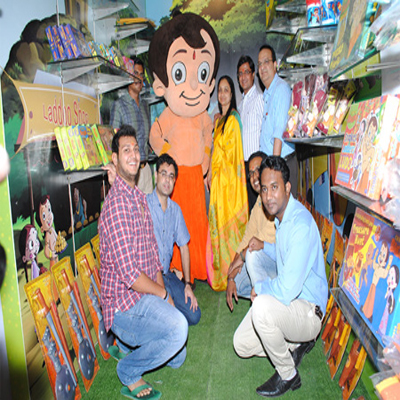
    MUMBAI: The kids in Chennai had reasons to rejoice this Children’s day as not only did it mark the official debut of India’s toon phenomenon, Chhota Bheem, Mighty Raju and their friends in Tamil Nadu, but also featured a grand celebration that saw the toon super heroes meeting and greeting their young fans live. It was the opening of Tamil Nadu’s first Green Gold Store, the merchandising arm of the company that created Chhota Bheem. With this, Green Gold has launched its 30th store in India.


    The launch of this store adds another feather to Green Gold’s cap. It is the only company to have so many stores across the country retailing merchandise inspired by one of the most popular toon series of India. Chhota Bheem has become a phenomenon with a viewership of over 40 million. A research by ‘Kids Observer’ has ranked Chhota Bheem as the number one choice of kids up to eight years old and amongst the top five for kids in the 9 to 14 years bracket.


    “We are excited to launch our store in Chennai on the occasion of Children’s Day. At Green Gold Store, our young patrons need not buy anything. They can simply spend time here and keep themselves entertained with the merchandises for as long as they like. We are looking at creating unrivaled experiences for the young ones at our stores,” says Green Gold Stores head Sudeesh Varma.


    “From clothing to comics, bedroom decor to accessories, movies to apparel, board-games to puzzles the store is a one stop destination for every Chhota Bheem fan. Green Gold Store houses all essential Chhota Bheem merchandises and offers a unique experience to his young fans. The store has recently introduced an exciting range of merchandise including a new line of apparel and exclusive range of Chhota Bheem – Avon bicycles”, says Green Gold executive director Samir Jain.

  • Miss India Earth 2013- Shobhita Dhulipala, supports the Unilever Pureit Protecting Lives Program

    Miss India Earth 2013- Shobhita Dhulipala, supports the Unilever Pureit Protecting Lives Program

    MUMBAI: Pureit, world’s largest selling water purifier brand from Hindustan Unilever Ltd has associated with Miss India Earth 2013, Shobhita Dhulipala to spread awareness about the importance of safe drinking water under its ‘Unilever Pureit Protecting Lives Program’. Integrated Village Development Program (IVDP) is Pureit’s key NGO partner in Tamil Nadu’s Krishnagiri district, where Shobhita spent a few days with the villagers to promote the cause of “Safe Drinking Water”. During her stay at Krishnagiri, Shobhita spoke to the villagers about the need for safe drinking water and also helped install Pureit water purifiers in many households in Thopdikupam village in Krishnagiri district.

    Commenting on the initiative, Shobhita said, “I feel proud to be associated with ‘Unilever Pureit Protecting Lives Program’, a unique initiative that provides Pureit water purifiers to the poor through micro-financing, making safe drinking water a reality to these villagers through small installments. Besides providing safe drinking water, the program also creates job opportunities for the locals. Winning the Miss Earth crown will give me a global platform to reach out to NGOs around the world and mobilize support for the cause of ‘Safe Drinking Water’. With this initiative, together we can eradicate water borne diseases and look forward to a safer and healthier Earth. Thanks to Pureit & IVDP, I was able to educate villagers about the significance of safe drinking water and convince them to invest in a water purifier.”

    Commenting on the impact of the Unilever Pureit Protecting Lives Program, IVDP Founder and Magsaysay Awardee- Mr. Kulandei Francis said, “United Nations had announced that everyone should get access to safe drinking water and that is when we decided to partner with Unilever Pureit to protect the lives of our people. Pureit is an ideal solution for us as it does not require electricity or running water; is extremely affordable and safe. Under this program, today over 95,000 households of IVDP members have access to safe drinking water through Pureit.”

    “Every year, 2 million children around the world die of water borne diseases with 400,000 of these deaths occurring in India alone. Providing safe drinking water can save these lives. We are pleased that Shobhita has joined hands with ‘Unilever Pureit Protecting Lives Program’ which aims at making safe drinking water accessible to one and all,” said Mr. Badri Narayanan, GM (Water) at Hindustan Unilever.

    Pureit has multiple variants in its portfolio namely: Pureit Intella (12 litres), Pureit Classic (14 litres), Pureit Classic (23 litres), Pureit Advanced (23 litres), Pureit Auto Fill (23 litres), Pureit Marvella OGT, Pureit Marvella UV and Pureit Marvella RO. Prices range from Rs.900 to 14,990. For more information, please visit www.pureitwater.com

  • Blood Brother opened the 20th Anniversary Ohio Independent Film Festival

    Blood Brother opened the 20th Anniversary Ohio Independent Film Festival

    NEW DELHI:  Award-winning documentary Blood Brother by Steve Hoover which is partly based in Tamil Nadu was the opening film on 7 November at the 20th Ohio Independent Film Festival.


    The film has earlier won both the Grand Jury Prize and Audience Award at the 2013 Sundance Festival in Park City as well as Audience Award at Hot Docs and Best Feature at Big Sky in Montana among other accolades.


    The film is about Rocky Braat a man from Pittsburgh who never really liked kids or hot weather but yet found himself immersed in the culture and heat of Tamil Nadu, caring for HIV/AIDS-afflicted orphans – and never wanting to return to the American life he once had.


    Hailed as “a truly beautiful film about the power of love” and as “Exuberant, heartbreaking and transcendent”, Blood Brother depicts Rocky’s devotion to the children and endurance in the face of difficulties most would never even imagine and will shake viewers.


    “’Blood Brother is a must-see,” said Therese Grida, Independent Pictures’ Board member and Selections Committee Chair. “The film was submitted to us in October, 2012 and has been working its way around the festival circuit since,” said Grida.

    Director Steve Hoover’s debut feature is independently-produced, which means that it was not financed by any big studio.  “This is the stuff we relish,” Grida said. Blood Brother is what independent filmmaking is all about.”


    The Ohio Filmfest started out as the Off-Hollywood Flick Fest in 1992 and held its first screenings in 1993 in a small store in front of Tremont. While the name eventually changed to the Ohio Independent Film Festival, twenty years later the submission process remains the same.


    Independent Pictures is also the proud parent of the Ohio Independent Screenplay Awards, the Film Production Training Program, the Director of Photography Workshop, Fiscal Agent Sponsorship Program and more. The mission of Independent Pictures supports emerging and independent filmmakers by giving a voice to those that might not otherwise be heard.  

    Independent Pictures and the Ohio Independent Film Festival are funded in part by grants from Cuyahoga Arts and Culture and Ohio Arts Council, and by Community Shares, a workplace giving organization that supports social justice issues.

  • Sun shines on kids

    Sun shines on kids

    The Sun TV Network – with its repertoire of 33 channels across genres including entertainment, music, movies, comedy, news and kids – is arguably a very big name in television (media), both in India and Asia.

    While the group debuted with its entertainment channel, Sun TV, back in 1993, children got their very own space on the network not before 2007. The Kids Cluster, as it came to be called, kick-started with Chutti TV (Tamil), followed soon by Kochu TV (Malayalam), Chintu TV (Kannada) and Kushi TV (Telugu).

    Of the four kids channels, Chutti and Kochu are extremely popular with a nearly 80 per cent reach in the states of Tamil Nadu and Kerala, respectively.

    Kavitha Jaubin knows that maintaining a kids channel is difficult but for Sun Network it has proved to be a good market

    The mainstay of the cluster, whose core target is kids in the age group of four to fourteen years, is cartoon acquisitions from numerous distributors and production houses like Sony Pictures, Warner Bros, Viacom18 and Scholastic. 80 per cent of the content is similar on all four channels while the remaining 20 per cent varies based on cultural preferences of the state in question.

    Says Sun TV Network Kids Cluster of Channels Head Kavitha Jaubin: “Till now, we’ve only been airing acquired content but we hope to own a few titles soon, considering how well we’ve understood our little audience’s interest patterns and what content they view the most.”

    The acquired content has to be dubbed by a skilled team in each state, which develops a script in the respective language. “The USP of our channel content is the nature of dubbing. It is extremely witty and is thoroughly enjoyed by our audience,” says Jaubin, adding that nearly a week goes into scripting and dubbing an episode.

    Yes, there is some amount of in-house content produced by the network’s 20-strong programming team, which includes game shows, chat shows, news segments, cookery shows and arts and crafts shows. For the purpose, they have studios in Chennai, Hyderabad and Bangalore.

    While a major portion of the content is international, the network is looking to change this trend by including more local content. Some of the popular shows include Geronimo Stilton from Moonscoop, Penguins of Madagascar, Avatar from Viacom18, Jackie Chan Adventures from Sony Pictures and Little Prince from DQ Entertainment. Recently, the network acquired Little Krishna from Viacom 18 for Janmashtami, and is looking to acquire more such as Barney and Friends.

    Since the cluster caters to kids, the channels take care to handpick the content and also censor it to suit the tiny tots.

    “There are a few things that we particularly avoid – violence, content that hurts the sentiments of any section of the population or forces parents to scrutinise it,” says Jaubin.


    The other thing the network does in terms of cartoons is placing them as per the time band and the age of the audience viewing them.

    The morning audience mainly comprises kids between eight and 10 years of age, which changes to pre-schoolers by afternoon. Whereas, evenings are when kids in the age group of 9-14 years watch these channels, often accompanied by parents. At this hour, the channel claims to focus on edutainment type of cartoons more than action.

    Speaking of cartoons, those among the Kids Cluster of Channels airing them seem to be doing well.

    Mudra Max Media south head Anil Sathiraju says that a channel which talks regional does better than the one which does not. “Chutti TV is doing very well and for a kids’ TG, it delivers fantastically,” he says.

    According to Sathiraju, the cartoon genre doesn’t face competition from regional channels, with only Chithiram TV from the Kalaignar Group doing fairly well in Tamil Nadu and none in Karnataka, Andhra Pradesh and Kerala.

    It’s mainly national channels like Pogo, Cartoon Network and Disney that are capable of giving the cluster channels a run for their money. “The effect Pogo gives is pan-India while a Chutti TV or a Chintu TV is only restricted to the state,” says Sathiraju.

    Advertising-wise, the ads aired on these channels are directed straight at the kids who’re watching. The prime time of 3:00 pm to 8:00 pm on weekdays and also weekends is when advertisers make the most out of their products. ITC, Surf Excel and Horlicks are some of the brands that advertise with these channels.

    Sun TV sources revealed all four channels in the cluster would be generating advertising revenue in the region of Rs 80 crore with Chutti and Kochu contributing a lion’s share.

    The channels are hardly visible on the digital front. The website has a game section which includes colouring and puzzles. A small section allows users to upload their childrens’ photos on their birthdays that will be displayed on the site. Show timings for the day can also be found out.

    Children dressed up for an event organised by Chintu TV

    Most of the marketing they do is for their shows through outdoor events. There are regular events and contests, the most recent one being on Janmashtami when kids were made to dress up as Lord Krishna and his consort Radha and click photographs.

    Other events include Chutti Premiere League on the lines of IPL, where a cartoon character heads a team and children vote for their favourite team; theme-based carnivals and so on. “This has definitely helped us gain visibility and intensify the already existing popularity,” says Jaubin.

    Is there room for more channels in the kids’ space? “It is a challenge to tailor programs that suit kids’ interests, and at the same time, sustain it,” says Jaubin.

    As things stand, the Kids Cluster seems to have made a place for itself in kids’ hearts although it continues to face stiff competition not from regional but national children’s channels.
  • Puthiya Thalaimurai organises six-town career guidance tour across Tamil Nadu Hundreds of Small town students to benefit from the Event

    Puthiya Thalaimurai organises six-town career guidance tour across Tamil Nadu Hundreds of Small town students to benefit from the Event

    MUMBAI: Puthiya Thalaimurai, the leading Tamil news channel, is organising a six-town tour across Tamil Nadu wherein their team of experts would be to offering career guidance to higher secondary students.

    With a rich legacy of organising socially relevant events like Tamizhan Awards, Young Scientist, students quiz, etc., this event named Kalvi Kadalin Kalangarai Vilakkam (KKKV) offers more than just counselling and information.

    At each town event will have stalls of colleges where students can interact face to face with leading universities. Q&A sessions and conferencing is also be part of the event. Student will get guidance on what subjects to choose from after higher secondary school, where to apply, which colleges offer the subjects of their choice etc.

    The beneficiaries of this event will be students who have finished their HSC +2, Students who are entering their HSC +2, Diploma & degree holders.

    Entry to the fair is free. The schedule for this six-town event is:

    Kumbakonam: May 8, 9, 10. Salem: May 17, 18, 19 . Dindigul: May 17, 18, 19. Chengalpet: May 23, 24, 25. Tirunelveli: May 24, 25, 26. Villupuram: May 31, June 1, 2 Shyam Kumar, the CEO of New Gen Media said , “Puthiya Thalaimurai is not just about news, it is an organisation that reaches out to people, helping them fulfil their aspirations, giving them a voice, harnessing their hidden potential. A bright and prosperous society is the result of what we do today. If PT can be a catalyst in bringing change and progress, then its role will be fully justified. I am sure this event will help students find their vocation and calling in life.”

    “Puthiya Thalaimurai channel is not about news alone. It believes in catering to the people and serving them, and guide students in their choices regarding education. We want to function as a lighthouse”, he added.

  • Kamal Haasan’s Vishwaroopam crosses Rs 1 bn mark

    Kamal Haasan’s Vishwaroopam crosses Rs 1 bn mark

    MUMBAI: Controversies pay in the film world. For Kamal Haasan, it must have been worth swallowing all the problems his movie Vishwaroopam generated over its proposed release on the direct-to-home (DTH) platform ahead of the theatrical debut. Even as Haasan had to concede to the powerful film exhibition community and defer the DTH release, his much talked about magnum opus action thriller has crossed the Rs one billion mark at the box office.

    Actor Rahul Bose tweeted the milestone achievement on the micro blogging website, “Just received figures of the all India box office collections of Vishwaroopam. 120 crores and counting. Superb! Vishwaroopam‘s the first film I‘ve been a part of that‘s made over 100 crores. Congratulations to the team and mr haasan especially!”

    Bose plays the antagonist in the film. Other stars include Pooja Kumar, Andrea Jeremiah and Shekhar Kapur.

    The movie has been marred with controversies even before its release. The first tangle it got itself into was when actor-director Hasaan decided to release the movie on DTH platform before its theatrical release. Just when the issue of Vishwaroopam‘s release was resolved, Muslim bodies in Tamil Nadu opposed the movie since it showed the community in bad light which resulted in the movie being banned from release in Tamil Nadu.

    The film released worldwide on 25 January but in Tamil Nadu it hit the theatres as late as 7 February. Despite the delays and controversies, the film seems to have caught the fancy of the audiences.

    The film was also released in Hindi by the name Vishwaroop. This version, though, has failed to attract audiences since it has managed to rake in just Rs 117.5 million in its first week.

  • Viswarooopam to be released in Tamil Nadu on 7 Feb

    Viswarooopam to be released in Tamil Nadu on 7 Feb

    NEW DELHI: Actor-filmmakar Kamal Haasan‘s Viswaroopam is being released in Tamil Nadu on 7 February following the lifting of the ban by the state government.

    In an announcement, Haasan thanked the Tamil Nadu government for all the help and moviegoers, fans and people in Tamil Nadu and all over India for supporting him.

    He said the cheques and money which his supporters sent to him would be returned.

    The film was first announced for release on January 11, after a premiere on three direct-to-home (DTH) platforms, but this was withdrawn after protests by the theatre owners’ organisation in the state, and the release was postponed to 25 January.

    Thereafter, the film was banned by the state government on 23 January which pointed out that the release of the movie would create law and order issues as a section of the Muslims had raised objections.