
Tag: TAM data

  • Three-way tussle in the English news channel arena

    Three-way tussle in the English news channel arena

    The English news channel market, unlike the situation existing in the Hindi arena, is not about cutthroat competition and a constant search for new and ever more outrageous attention grabbing news pegs. A three player fight for bragging rights as well as a more broadbased target audience allows for far greater ‘traditional news’ play among the channels.


    A detailed analysis of the English news channels using Tam data (All India, C&S 15+, all day parts) during the one-year period beginning January 2007 reveals that there is no clear leader in the genre.


    2007 has seen the number one position baton changing hands between the three – NDTV 24×7, CNN IBN and Times Now more than. Still, looking at average annual relative shares it is NDTV 24X7 that is ahead by a nose with 29.75 per cent. In second spot is CNN IBN with 28.5 per cent average annual relative share, just ahead of Times Now which at 27.25 per cent.


    Hovering in a range between 28 and 31 per cent, NDTV 24X7 was in the top position in the February to June period. In July-August, with 28 and 30 per cent respectively NDTV 24X7 lost the crowning position to CNN-IBN. Occupying 28 per cent in November, NDTV 24X7 had to give away the top place to Times Now. It rounded off the year sharing 29 per cent each with Times Now to be in the top place.


    On the other hand CNN IBN started the year in the top position with 31 per cent but handed over the reins to NDTV 24X7 thereafter. Picking up in the months of July and August with 32 per cent and 30 per cent respectively, the relative share of CNN IBN started falling drastically and hit 25 per cent in November and 28 per cent in December.


    CNN IBN editor-in-chief Rajdeep Sardesai said, “I feel that sometimes too much is inspected of the frills, but making the cake is the real challenge. That is my biggest worry: how do you relentlessly make quality news without getting into the ratings war.”


    In terms of market share, though Times Now has seen some highs and lows in the year, yet the English news channel has displayed the best progress overall of the three. In its second year since launch, Times Now has been able to break the two-channel shackle in the English news genre.


    It started the year with relative share as low as 22 per cent. It gained in February to April period to reach 31 per cent but started slipping down since then dabbling between 25 to 26 per cent. It hit 31 per cent in November and for the first time held the highest position. Even though it fell to 29 per cent in December, yet it retained its top place to end the year on a high note.


    Times Now editor-in-chief Arnab Goswami said: “Our idea was to get into the minds of the viewer which we successfully did in 11 months of launch in 2006, the year of our launch. The clear target was to become the default news habit of the country. And we closed 2007 as the unquestionable number 1 news channel in India not just in the English news channel space but even when putting Hindi and English news channels together. It is a good feeling. But what gives me satisfaction as a journalist is that we have set the modus operandi. We have broken 90 per cent some of the biggest stories of 2007.


    “Newshour at 9 PM is doing well. We are the clear number 1 in this segment. People watch news channels for news. So instead of having niche shows in an important band time, we have news at 6 pm, 9 pm.


    “We have our sports show at 8:30 pm. We do not place a show in a particular slot just to compete with others in the same slot. Only a confident channel can do that. I do not pass off as a sports show where two people sit in a studio and keep blabbering. The game is more dynamic,” he asserts.


    For Hindi News channel market leader Aaj Tak’s English sibling Headlines Today though, the story continues to be that of the straggler. With an average annual relative share of 11.6 per cent, it had managed its highest of 14 per cent in November. It gathered 13 per cent each in January, June and August. It has its lowest of 9 per cent in May.


    Meanwhile, international news channels BBC World and CNN have an average annual relative market share of 1.3 per cent and 1.5 per cent respectively.


    Still, as Sardesai correctly points out, the news channel battle is not just about eyeballs but perception. “The future battle will be of perceptions, of influence, or being thought leaders. In CNN IBN. That’s been our aim, to be thought leaders,” he avers.

  • Hindi news channels see tough Muqabala

    Hindi news channels see tough Muqabala

    Lights flashed, cameras rolled, news was created and records made. With no sure route to success, the tussle for bragging rights in the Hindi news space aggravated, with ever more bizarre stories being thrown up. In stark contrast, investigative, true journalism could not collect much by way of worthwhile brownie points on the ratings graph-o-meter. 2007 has indeed been an active year for news channels; sting operations, saas bahu stories, khatarnak baba, Nag Nagin Ki Shaadi, and the like ruling the roast.

    IBN7 managing editor Ashutosh says that this year has clearly shown how ratings and TRPs can affect content.

    NDTV Group director Narayan Rao says, “This was a year when the question was asked as to where the advertisers were putting their money: trash channels or genuine ones. From the limited perspective of a news channel, particularly Hindi news, I can see that a large number of them have gone the tabloid way: the sex-and-violence route.”

    Indiantelevision.com’s analysis of Hindi news channels using Tam data (HSM, C&S 15+, all day parts) during the one-year period beginning January 2007 throws up some interesting insights into the genre while the battle among the players intensifies.

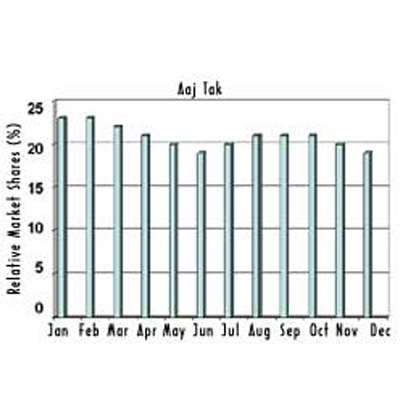
    Refusing to budge from the top position for the ‘golden’ year of Hindi News channels is India Today Group’s Aaj Tak, with an annual average of 20.83 per cent market share. Being the forerunner, it has been consistent in its performance as far as relative market share. Beginning the year with 23 per cent in January, it reached its lowest in the month of June and December with a market share of 19 per cent in both the months. In June it was neck to neck with Star News, but in the month of December it had to finally give way as Star News took over pole position.

    Aaj Tak’s sister concern Tez has also maintained its consistency with an almost constant share of 5 per cent of the market for eight months.

    Aaj Tak news director QW Naqvi says, “As for our channels, it is extremely satisfying that we have retained the number one position despite a virtual dogfight in the TV news market. We are proud to present balanced news content. Though this is a remarkable achievement for Aaj Tak, we are aware of the challenges ahead. A number of new channels coming in the fray and with a growing audience base, it will be our effort to retain our number one position – both in terms of content perfection and market share.”

    A huge attrition seen by Aaj Tak during the year however did not have any direct effect on the score card. Its top rung journalists have made tracks, either to upcoming Hindi news channels or already established ones. Aaj Tak lost its executive editor Punya Prasun Bajpai who switched sides to Samay (then Sahara Samay) as editor-in-chief. Bajpai took along with him a host of other Aaj Tak journalists including anchor and deputy editor Sanjay Bragta and crime bureau chief Nazim Naqvi.

    Aaj Tak executive editor and Mumbai bureau chief Shishir Joshi quit to join Mid Day Multimedia as group directorial editor. Aaj Tak also lost Ram Kripal and Rahul Kulshetra to Triveni Group. While Kripal joined as group editor for their upcoming news channels, Kulshetra will head technical operations.

    With an annual average of 18.08 per cent is News Corp backed Media Content and Communication Services (MCCS)’s Star News, which stands next to Aaj Tak in terms of market share. Star News began the year with 17 per cent market share in January. By mid-year it had picked up 19 per cent. It carved a share of 20 per cent each in the months of September, and October but could not surpass Aaj Tak in the numbers game. December, however, was a good month for Star News as it broke Aaj Tak’s monopoly by getting to the top place with 20 per cent of the market share in its kitty.

    Next in the rung is India TV with an annual average of 13.75 per cent. India TV had 11 per cent in January, but slipped down to 9 per cent in February. From May, India TV joined the race in high spirits with its highest grab of 16 per cent. What followed in the later months was consistence in terms of performance in market share, dabbling between 15 to 16 per cent in the last two quarters of the year.

  • Sony beefs up 10 to 11 band with new soaps

    Sony beefs up 10 to 11 band with new soaps

    MUMBAI: Two new shows Durgesh Nandini and Jeete Hain Jiske Liye from the Sony stable will hit the small screen starting 5 February. The two soaps have been clubbed in the 10 to 11 pm band and will air from Monday to Thursday.

    While Durgesh Nandini replaces the recently concluded reality television series Bigg Boss slotted from 10 to 10:30 pm. The 10:30 to 11 pm slot was reserved for repeats of various shows on the channel. This slot will now air Jeete Hain Jiske Liye.

    According to the recently released TAM data for the last six months (15 July ’06 to 13 Jan ’07) – Sony is facing a long, hard climb at number three with its relative channel share at 12 to 13 per cent compared to Star Plus now at 40 per cent relative share and Zee hovering around 23 (Hindi GEC / TG CS 4+/ HSM Market).

    The two shows have been positioned to compete with Star’s K-sagas, especially the predominant players Star’s Kahaani Ghar Ghar Ki and Kyunki Saas Bhi Bahu Thi that airs within the same time band.

    Sony Entertainment Television chief creative director Sandiip Sikcand said, “It’s clear that Indian audiences will watch shows that bring out their best emotions. So Durgesh Nandini has a subtle tone of humour while Jeete Hain Jiske Liye is more intense. But both are essentially stories of women with grit and determination.”

    While the channel claims that its immediate focus is to spruce up this band, it has also revealed that it is planning to beef up its 9 to 10 prime time slot with new programming. Without giving out details, the channel is all set to look at a sitcom and even a game show.

    Sony Entertainment Television COO NP Singh says, “Around March-April 2006, we decided to take stock of our programming and come up with a healthy mix of fiction and non fiction programming. Reality series like Fear Factor, Jhalak Dikhla Jaa and Bigg Boss were results of that. While a third season of Indian Idols is already on the cards, we also wanted to get back to daily soaps.”

    While Durgesh Nandini is a comedy/drama loosely based on Bankim Chandra Chatterjee’s novel, SET India CEO Kunal Dasgupta revealed that Jeete Hai Jiske Liye has been adapted from an international telenovella. Both of them have women as their main protagonists. No surprises there. But Jeete Hain Jiske Liye star cast includes Renuka Shahane who will make a return to television after a five-year gap. Her popularity among television viewers should prove to be a huge factor in roping viewership for the show.

    Talking about bringing back some of the old shows in an attempt to garner viewership Singh says, “We believe that old brands which we have invested in and have been successful should be revived and made best use of. We decided to go back to shows like Boogie Woogie, CID, Aahaat and now Karamchand.”

    Sony made cricket and entertainment synonymous and the network is all geared up for World Cup 2007. While Max, Sab and Pix will air matches and shows around it , the channel is determined to keep Set cricket free and provide more entertainment for those taking a break from the game.

  • Ratings: Star Movies tops English film genre despite absence in Mumbai

    Ratings: Star Movies tops English film genre despite absence in Mumbai

    MUMBAI: With Cas having come into the Metros, the niche channels will have a better fix on what the audience prefers. Tam data for the last six months paints an interesting picture of what the viewers are likely to go in for.

    Tam data c&s 15+ all India shows that in the English film genre Star Movies has a clear lead. In fact it has widened the gap between itself and arch rival HBO. This, one must note, is despite the fact that it is not present in Mumbai which each week contributes an average of 15 per cent to the viewing of this genre.

    ENGLISH
    MOVIES
    – TG: CS
    15 years
    15 JULY-15 AUG 15 AUG-15 SEP 15 SEP -15 OCT 15 OCT-15 NOV 15 NOV-15 DEC 15 DEC-30 DEC 01 JAN – 13 JAN 07
    Hallmark
    Channel
    0 0 0 0 0 0 1
    HBO 38 33 33 32 33 35 33
    PIX 9 10 8 9 8 9 9
    Star Movies 42 40 44 45 47 41 49
    Zee Studio 11 17 16 14 13 15 9

    For the period 15 July – 15 August 2006 Star Movies had a share of 42 per cent followed by HBO with a share of 38 per cent. Zee Studio has a share of 11 per cent and Pix which had recently launched had a share of nine per cent. For the period 1-13 January 2007 Star Movies boosted its share to 49 per cent compared to 41 per cent in the last two weeks of December.

    Star Movies’ gain in January is Zee Studio’s loss which shows that there is some overlap despite the fact that while the former focusses on blockbusters the latter focusses on niche films. In fact Zee Studio has recently been doing initiatives on world cinema. Zee Studio’s share fell from 15 per cent in the last fortnight of December to 9 per cent bringing it on level terms with Pix. HBO’s share fell by four to five percentage points in August but has since stayed steady at 33 per cent.

    Star India GM content Harsh Rohatgi gives the credit for Star Movies’ leadership position to the compelling movie library it has. “Even if you look at the Metro market to which Mumbai contributes 35 per cent viewership we are still ahead. We have done initiatives like a Bond festival, creature festival.

    “Mind you Star Movies in the past six months did not do anything special in terms of marketing besides on-air promotions. So the content sold itself. We are doing an Oscar festival at the moment. Our clients have supported us despite concern about Mumbai. We expect to be back on air within the next one week to 10 days.”

    As had been pointed out earlier, HBO’s main concern now is to ensure that it is in the priority list of channels in homes which are getting the set top box. So it ran a campaign last month educating people on what the channel is offering. Its message for this year is Bigger and Better.

    The challenge, Shruti Bajpai, country manager, HBO, notes, comes not only from more television competition but also from outside in the form of multiplexes, gaming etc. As Tam CEO L.V. Krishnan had pointed out in a recent interview, in the Elite group which comprise the bulk of the English film channels audience, the more technology options there are for entertainment like the DVD, the more their viewing of television drops.

    So there is all the more reason for this genre to be on its toes as its core audience will become even more choosy. Bajpai is counting on the strength of the HBO brand which has been built over the years to see it through this period of change. Going forward for this year it will try to build up the non primetime block through slots like It’s A Guy Thing for men. Last year HBO built on its thematic, festive blocks. So there was a full one month special for Diwali which had different themes depending on the daypart.

    This year HBO, Bajpai notes, has upped the marketing ante. A case in point is what was done with King Kong where there was radio, online and an outdoor presence. “It is not a question of having a huge budget. It is a question of optimising the different avenues which is what we have been able to do. The reason why we have not fallen in share despite not being present in Mumbai for a while is that the mini Metros are growing. They are hip and happening and you are getting viewership from a place where there was none earlier.”

    Media planners feel that each channel has its own USP. As Starcom’s Rahul Panchal points out, “Pix has its USP in that it targets an older set of viewers 25+. HBO on the other hand has a lot of teens tuning in which is why it has blocks for that set. Therefore there will be some difference in the brand profile.

    “Brand saliency is also what one looks at vis-a-vis just numbers. Pix and Zee Studio offer an environment that is less cluttered. They are also more flexible on the rates. Therefore though I put money on the two leaders (Star Movies and HBO) I would not ignore the other two players.”

    Panchal adds that Star Movies’ distribution in the small towns is probably better in terms of the frequency it is on. Clearly it’s gain there has more than offset the loss of Mumbai. One also has to consider the fact that with Cas coming in, putting in money will not be such a gray area.

    There will be better clarity also with Tam having launched its Elite Panel. Media planners also point out that in English films there is better stickiness compared to say, general entertainment. If someone likes a film he/she will stay with it. The question now is whether viewers will choose a channel like Pix when there are three competing channels.

    Pix business head Sunder Aaron says that Pix has carved a niche space which has been due to films being carefully chosen. “We have built up our programming by focussing on slots like 8 pm and 10 pm. Our stance has been that of telling a good story. Viewers who see value in this will, I am confident, choose us in their basket. To add variety we have also done original content like Framed, which saw director Aparna Sen being interviewed. We will be doing audience research this year to find out more in terms of preferences. We are doing a marketing campaign in Bangalore as we felt we needed to boost our visibility there.”

  • CNN-IBN asserts leadership in English News space

    CNN-IBN asserts leadership in English News space

    MUMBAI: CNN-IBN has claimed leadership in the English News market. As per the latest TAM data the channel, this week, has emerged as the leader in most TGs, including the crucial primetime TG.
    Market: All India, Period: Week 47

                                             All day

    CS AB 25+ MALE 38 per cent
    CS AB 25+ 38.5 per cent
    CS AB 15+ 33 per cent


                                      Weekdays Primetime

    CS AB 25+ MALE 41.2 per cent
    CS AB 25+ 39.4 per cent
    CS AB 15+ 39.5 per cent

    CNN-IBN and IBN 7 editor in chief Rajdeep Sardesai said, “These findings are yet another source of delight to our team, who have consistently worked hard to get this far. However, being a key player in today’s competitive media market means that we take such achievements in our stride and use them to motivate us to continue attaining new heights.”

    CNN-IBN and IBN 7 network sales head Sanjay Dua added, “CNN-IBN, by providing quality English News is able to create a confluence between the continuously increasing affluent Indian community and the discerning marketer.”

    Relative channel shares of English News channels:

    Channel

    Relative share percentage All Day

    Relative share percentage Weekday

    CNN IBN 33 39.5
    NDTV 24×7 33 30.2
    Times Now 17 14
    Headlines Today 11 7
    CNN  6 7
    BBC 0 2.3

    TG: CS AB 15 years + 
    Market: All India 
    Period: week 47 
    Source: TAM Peoplemeter System

  • Ratings: Star Movies maintains edge over HBO; Discovery gains ground

    Ratings: Star Movies maintains edge over HBO; Discovery gains ground

    MUMBAI: The English entertainment scene has been undergoing a few changes. Until recently HBO was off the air waves in Mumbai for several weeks. Arch rival Star Movies continues to be off air.

    Tam data SEC A,B 15+ has thrown up some interesting findings. The period is 1 September – 1 November 2006.

    At an all India level Tam data shows that Star Movies has seven of the top nine English films. Creature features and martial arts films not surprisingly continue to do well. King Kong and The Way Of The Dragon on Star Movies got TVRs of 0.34 and 0.31. Enter The Dragon on HBO got a TVR of 0.31.

    Data also shows that the blackout in Mumbai benefitted Pix and Zee Studio. When you just look at the six Metros Pix has two films in the top 10. At number three it has Bicentennial Man which got a TVR of 0.38. Men In Black rated 0.3. This shows two things. Firstly Mumbai is a very important market for English films. Secondly it lays some credence to Pix’s philosophy that if one has films with good stories no matter when they were made viewers will watch them. Interestingly none of the films in the top 10 whether one looks at the Metros or all India are premieres. Zee Studio also figures in the top 10 at the metro level. It got a TVR of 0.29 for Shaolin Temple.

    If you look at primetime shares 8-11 pm for all the English channels – movies, general entertainment, infotainment one sees that Star Movies and HBO’s shares have gone down partly due to the Mumbai blackout. Star Movies for the period last year had a share of 23. Now it has a share of 17 for all India and 16 for the six Metros. HBO’s share has gone down from 18 per cent to 13 per cent at an all India level. For six Metros there has been a fall from 17 per cent to 11 per cent.

    Pix though it launched recently is neck and neck with Zee Studio. Zee Studio it must be pointed out has doubled its share from three last year to six per cent. Pix does better than Zee Studio when one looks at the Metros. It has a share of eight. At an all India level it has a share of four per cent.

    The biggest gainer by far is Discovery. At the all India level it has a share of 18 per cent versus 14 per cent for the same period last year. This is the most for any channel. At a Metro level it has a share of 16 per cent versus 10 per cent last year. Discovery’s gain would appear to be arch rival National Geographic Channel’s (NGC) loss. Last year for the period NGC’s share was 14 per cent for the six Metros. This time it is eight per cent. Discovery Travel and Living’s (DTL) share has also gone down from seven per cent to five per cent. At the all India level the shares of NGC and DTL are flat at 13 per cent and four per cent respectively. Animal Planet’s share has also stayed the same at eight per cent for the Metros and 10 per cent for all India.

    The History Channel had undergone a repositioning. It is now an entertainment channel with the tagline Live The Story. It shows films, miniseries etc. However its share has only grown marginally from four per cent at an all India level to five per cent. In the Metros its share is flat at three per cent. Its share is comparable to Star World with whom it is now looking to compete for both ad revenues and viewership. Star World has a share of three per cent all India and five per cent in the metros.

    Zee Cafe has shown some improvement. Its share grew from one per cent last year to three per cent this year for the Metros and two per cent at an all India level. The English general entertainment channels all have some work to do to catch up with AXN. The action oriented broadcaster has held steady with shares of nine and 10 per cent at an all India and the six Metro level respectively. No doubt initiatives like the ongoing Amazing Race Asia help viewers to keep going back.