Tag: Symposium

  • Broadcast India Symposium: Digitising content is the future

    MUMBAI: Telcom companies have gone in for broadband on the wi-fi line as revenues from voice calls have fallen, said Shah Technologies’ Sujata Dev.

    Explaining this trend, Dev said this was because the market was maturing. She was speaking about the merits of digitising content at today’s Broadcast India Technical Symposium.

    The broadband roadmap, she noted, starts with infrastructure which VSNL, Tatas, Reliance provide and use. Then there are triple play ports which use ADSL 2+ technology. Then a content delivery network is needed. This consists of servers, routers, set top boxes. Service come in two forms – multi cast and unicast.

    In this convergence environment, the PC gets television functionality like films and interactive games. The television can get PC functions like email, internet and video on demand (VOD). The code to be used in VOD is still being debated upon. Right now MPEG 2 is used. Rich media is a must for IP service providers and it is important that compression technology matches it. For the content owner, protection of his offerings is important. There is a revenue sharing arrangement that exists between the content owner and the service provider.

    The challenges here are to increase the transmission rate while decreasing bandwidth requirement. There has always been a question: last minute bandwidth availability. ADSL 2+ transmits at the rate of 24mbps. It requires 2.2 mhz bandwidth One the mobile front, revenues in India are expected to reach $3 billion by 2009. One way in which mobile providers can differentiate themselves is through the kind of content that they have. So a creative repurposing of content is needed. The value chain is content aggregation, content repurposing and the customer.

    Speaking also about digital cinema, Dev said In India we are yet to see satellite-delivered movies. “This will help curb piracy and shorten the gap between a film’s release and its distribution,” she said.

    In digital cinema a film gets uplinked through a teleport. It is received at different locations. Each location has a Digital Light Processor which is a computer based system. Frame by frame processing happens and then binary bit streams go onto the screen. A system like this can also be used for an ATM operation and cyber gaming, Dev noted.

  • DSNG gaining popularity for Indian news channels

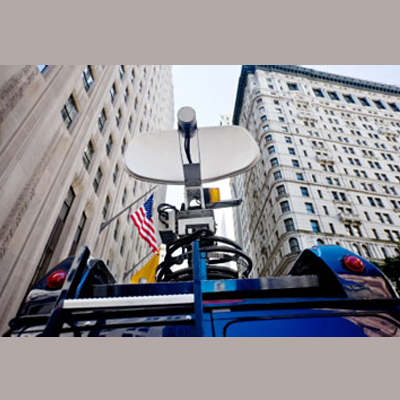
    DSNG gaining popularity for Indian news channels

    MUMBAI: Digital Satellite News Gathering (DSNG) is becoming popular for all the news channels in India as the competition is on to be the first to broadcast live.

    “Though it is an expensive solution, DSNG is catching on, even in India. The September 11 incident has particularly put news channels on the fast track,” said Digital Broadcast India director (technical) B Sitaram, while speaking at the Broadcast India 2004 Technical Symposium on Tuesday.

    There are other options like optical fibre and VSATs which are also being used. “Reliance Infocomm, Tata Indicom and BSNL have laid optic fibre which can be used as news gathering systems. But satellite news gathering is gaining popularity,” said Sitaram.

    The advent of efficient digital compression techniques makes it possible to reduce video data to a low volume (from 270 mbps to 1.5-50 mbps). Bandwidth requirement reduces, making it less expensive to gather news through satellite links. “This is the starting point for the popularity of DSNG,” said Sitaram.

    “Till a few years back, the transmission of TV signals through satellite was completely in analogue domain. Hence, bandwidth was an issue. Now we have efficient digital compression techniques,” said Sitaram.

    There are two frequency of operations in digital satellite news gathering – C-band and Ku-band. In India, the government permitted the use of Ku-band of frequencies for DSNG operations.

    “New technologies are evolving, providing cost-effective alternatives. The demand from news channels is also driving down costs,” said Sitaram.

  • Animation opportunities to be discussed at Broadcast India

    Animation opportunities to be discussed at Broadcast India

    MUMBAI: Yet another edition of the Broadcast India exhibition and symposium kicks off on 26 October 2004 at the World trade Centre.

    The symposium spread over two days will have 22 sessions. There will be a session on animation. Padmalaya, Zica’s Rajiv Sangari will enlighten listeners on the opportunities available in this field. Animation Bridge’s Bhiren Ghose talks about the potential of India to emerge as the number one animation production source..

    The symposium kicks off with Seagate Technology’s Sharad Srivastava talking about storage solutions for television and film. Another session will deal with digital satellite news gathering systems being used by the likes of CNN.

    With piracy showing little sign of slowing down delegates will not want to miss the last session on the first day 26 October. This deals with how content owners can make more money by understanding their intellectual property rights.

  • Sarvakar Visioninfinit symposium calls for ‘business of creativity’

    Sarvakar Visioninfinit symposium calls for ‘business of creativity’

    MUMBAI: The Sarvakar symposium on “Next gen cinema & TV: Digital all the way” held on 9 October addressed topics ranging from digitisation of media to the techniques of media convergence to the apt marketing of creativity. The symposium was attended by prominent media personalities.

    The symposium, a part of the ongoing nationwide Sarvakar knowledge event series, was conducted by Sarvakar Visioninfinit — a platform that helps media students, media trainees and media aspirants to horn their skills with the help of media experts.

    Speaking on the topic of “Image capturing: The story so far…”, Fuji Film general manager technical Ujwal N. Nirgudkar narrated the techniques where the traditional filmmaking technology can be converged with the digital filmmaking technology. He said though the resolution quality of digital prints is inferior to the normal film prints, both techologies could co-exist because of the changing scenario of filmmaking. During his session, Nirgudkar also explained the science of cinematography.

    Narendra Goel of Goel Films, speaking on “Television programming after soap opera”, invited the audience’ attention to other genres including talk shows, documentaries, sitcoms and current affairs programmes saying those genres also hold potential to replace soap operas. Goel expressed his concern at the kind of treatment being given to even award winning documentaries.

    Soumitra Ranade who directed the movie Jajantharam Mamantharam spoke on “Visualising stories in special effects”. Declaring that the days of idol-adoration are over, Ranade said new methods of storytelling should be attempted to attract the audience. Terming the Indian filmmakers’ contribution to animation films uptil now as “disappointing,” Ranade said animation films which can withstand 50 or 100 years could be made only when the independent filmmaker gets the convenience of using the technology at his will.

    “In the present scenario, you can’t do experimentation in stories when so much money is at stake. Once the independent filmmaker has the technology through PCs, he might be able to come up with better animation films,” offered Ranade. He said enterprising people were required for such experimentation.

    Music director Narayan Parasuram, speaking on “Music for film & television: The changing scene”, alleged that TV had been completely disrespectful to music. “The allocation of budget for music on television is absurdly low,” he pointed out. Parasuram who composed the music for Jajantharam Mamantharam and various TV shows commented the emergence of new digital technologies has made the music industry extremely democratic. “Though it is extremely tempting for music composers to use technological shortcuts, the bastardisation of the medium should be avoided,” said Parasuram.

    Prof. Ujjwal K. Chowdhury shared his expertise in the field of “Media education in convergence era”. Giving a detailed presentation of the subject, Chowdhury pointed out that we had been lagging in the field of packaging and marketing though we made great advancements in the fields of creativity and technology. He narrated various aspects of convergence in the fields of media consumption, media ownership and media skills. Chowdhury also dealt on the subjects of media education, digital cinema, convergence in marketing and corporisation of the film industry.

    Prof. Yogesh Mathur, a veteran film editor who had also headed the department editing – FTII Pune, spoke about the creative potential of editing while dealing with time and space. “Time and space manipulation through editing is a wonderful art,” he commented.

    Winding up the symposium Sarvakar Visioninfinit director Utpal Chowdhury stressed on the need for an increased participation in such workshops to have a better understanding of the future of media.