Tag: Sweden

  • Amagi’s Cloudport enables Horse & Country TV to go global

    Amagi’s Cloudport enables Horse & Country TV to go global

    MUMBAI: Horse & Country TV (H&C TV) has deployed Amagi’s Cloudport optimize the delivery of new channels around the world.


    The channel, which broadcasts exclusive sports event coverage, news, documentary, and personality-led programming, utilised Cloudport, which offers end-to-end broadcast workflow capabilities on the cloud. With this, H&C TV is now able to reach a wider global audience at a fraction of the cost of traditional satellite-based playout methods, while improving its transmission quality.


    “We transitioned to Amagi’s Cloudport platform in Benelux and Sweden in 2013 and then in the UK in 2014. We have since expanded into Australia and Germany. Amagi’s Cloudport platform resolves our challenge of reaching high-value, non-contiguous geographies, enabling us to launch new channels affordably and with a short time to market of just four weeks. With traditional satellite technologies that would never have been commercially viable and the lead times would have been longer,” said H&C TV CEO and chairman Heather Killen.


    The Bengaluru-based company’s Cloudport platform offers 99.99 per cent guaranteed broadcast SLAs, and can be deployed at the edge, at the teleport, or even at the data center to suit the broadcaster’s distribution requirements. 


    With Cloudport, H&C TV can support dynamic graphics as well as live sports content, while localising each channel via subtitles, additional language audio tracks, and channel logos in order to best address regional audience preferences. Furthermore, Cloudport gives H&C TV the flexibility to monetise new markets through targeted advertising.


    “H&C TV is a great example of an award-winning TV network that is best served by leveraging cloud-based channel playout technology versus satellite feeds,” added Amagi co-founder Srividhya Srinivasan. “Through Cloudport, H&C TV is able to perform hyper-localised and cost effective international distribution of its channels.”

  • Revolution wins the Green award at the 2nd Voices from the Waters

    Revolution wins the Green award at the 2nd Voices from the Waters

    NEW DELHI: Eminent British filmmaker Rob Stewart’s film Revolution has won the Green award at the 2nd Voices from the Waters held in Sweden.


    Commenting on the film which has already won more than 50 awards, the jury said: “The Green Award goes to Revolution, an inspiring film about humans’ destructive impact on the environment, which bereaves all life in the ocean a future. We get to follow Rob Stewart on his travel around the globe to try to find an answer on what that has to be done to save the planet. He meets environmental activists and visionaries and their fight is inspirational. Something has to be done and we have to engage our self in the ocean. Revolution is a strong story about an uncertain future, which with the tools of film, activates and moves us.”


    A true life adventure following director Rob Stewart in the follow up to his smash hit Sharkwater, Revolution is an epic adventure into the evolution of life on earth and the revolution to save us.


    Discovering that there is more in jeopardy than sharks, Stewart uncovers a grave secret threatening our own survival as a species, and embarks on a life-threatening adventure through four years and 15 countries into the greatest battle ever waged.


    The film brings some of the most incredible wildlife spectacles ever recorded and audiences are brought face to face with sharks and cuddly lemurs, into the microscopic world of the pygmy seahorse, and on the hunt with the deadly flamboyant cuttlefish. From the coral reefs in Papua New Guinea to the rainforests in Madagascar, Stewart reveals that all of our actions are interconnected.


    Through it all, Stewart’s journey of encouragement and hope meets activists and individuals all over the world that are winning the battle to save the ecosystems we depend on for survival.

    Presenting the most important information on human survival and inspiring people all over the world to fight for life, Revolution is essential viewing for everyone. Startling, beautiful, and provocative, Revolution inspires audiences across the globe to start a revolution and change the world forever.


    Revolution premiered at the Toronto International Film Festival and has already gone on to win numerous awards, including the audience award for best documentary at the Atlantic Film Festival, most popular environmental film award at the Vancouver International Film Festival, the audience award at the Victoria Film Festival and the social justice award at the Santa Barbara International Film Festival. 

  • ET NOW and Capgemini announce Season 3 of ‘Super Techies Show’

    ET NOW and Capgemini announce Season 3 of ‘Super Techies Show’

    MUMBAI: India’s no. 1 business news channel ET NOW and Capgemini, one of the world’s foremost providers of consulting, technology and outsourcing services, has announced the third season  of the Capgemini ‘Super Techies Show’- a global technology-based reality television show for Information Technology students and professionals. This year, participants from India, United Kingdom, United States of America, Netherlands, Sweden and France are being invited to battle it out and solve real business challenges faced by some of the largest enterprises across the globe.


    This year Capgemini Super Techies Show has broad-based its format to include university students with technology background from the 6 participating countries. The participants will get an opportunity to work on real life business challenges faced by some of the largest enterprises across the globe and interact with Capgemini experts and global technocrats across sectors. The winning team will be awarded with a cash prize of USD 25,000.


    “In today’s dynamic business environment, companies across the globe understand the need to identify the right talent that can leverage technology to support businesses on their digital transformation journey. The Capgemini Super Techies Show has always strived to be one such platform where young IT professionals have the opportunity to showcase their innovative skills in solving real-life business challenges put forth by global business leaders,” said Aruna Jayanthi, Chief Executive Officer, Capgemini India and member of Capgemini Group Executive Committee.


    “The tremendous response we received last year from Indian and North American IT professionals and the enthusiasm and pride that it generated within the Group, encouraged us to extend this platform to participants from other countries. The show had a social media reach of over seven million people. This year’s show will also be the first time where university students can participate and leverage the capabilities of digital tools to solve business challenges,” she added.


    Speaking about the announcement of the new season, Hemant Arora Business Head, Branded Content TIMES TELEVISION NETWORK said, “Capgemini ‘Super Techies Show’ has evolved over the period of last 2 years.  It is a one-of its-kind project in India in terms of scale, scalability, global production standards, and meticulous quality. It is the result of an integrated content and communication strategy that we have worked on with a collaborative spirit of partnership with Capgemini.  The previous seasons have met their objectives in terms of business impact as well as in offering a pool of distinct and differentiated content. We are eagerly looking forward to an equally exciting and engaging series this year, as the footprint increases to 6 countries and brings with it  the excitement and energy so far seen only in the entertainment genre of reality series.”


    Registrations for the show are open until 30th June ’14 and all eligible applicants can apply online at www.capgeminisupertechiesshow.com


    The show will be aired later this year on ET NOW and will also be broadcasted on Capgemini’s official YouTube channel for the global audience. This year, Abhimanyu Radhakrishnan, who has been anchoring the Capgemini Super Techies show from the very first season, will be joined by Ronette Chambers as a co-anchor.

  • MISO film heralds new Swedish production office with two new commissions

    MISO film heralds new Swedish production office with two new commissions

    MUMBAI: Danish production company, Miso Film, is to expand its Scandinavian footprint by opening a new office in Sweden to produce both feature films and TV-series for the Scandinavian and international market. Headed up by Sandra Harms, Miso Film Sweden already has a TV commission and feature film in the works.


    The company’s first TV-series is supported by Sweden’s TV4. Based on the novels of Norwegian thriller writer Anne Holt, VIK/STUBÖ will be a 8 x 45’ series, adapted for TV by three-times Emmy award-winning writers Peter Thorsboe and Mai Brostrom (Unit One, The Eagle, The Protectors). Shooting is expected to begin in Stockholm at the beginning of 2015.


    Miso Film Sweden has also optioned the rights for the book 438 DAYS by Johan Persson and Martin Schibbye, centred around the time the two journalists spent in an Ethiopian prison. The book was nominated for an August last year and is already a bestseller with over 100,000 copies sold in less than six months. Development of the project has already begun with the screenplay written by Peter Birro (Monica Z, How Soon Is Now?).


    Peter Bose, co-founder of Miso Film says: ”With a number of highly successful films and TV series in the Norwegian and Danish market, it was an obvious next step for us to move into Sweden. The move allows us to expand our footprint in Scandinavia and build on our experience of working in Sweden through titles like on BECK and WALLANDER.”


    Jonas Allen, co-founder Miso Film added: ”It’s really important to us for Miso Film Sweden to become a strong independent company in its own right and not just a Swedish mailbox for our Danish company. That’s why we’re delighted to have someone of Sandra Harms’ calibre on board. Over time, we’ll be looking to expand the production team and the home-grown talent further.”


    Sandra Harms joins the new company from Sonet Film/SF, with a string of feature films to her name, including Princess (Teresa Fabik), Bekas (Karzan Kader) and Us (Mani Maserrat). She adds: ”I’m delighted to be joining a company like Miso Film, which enjoys a reputation for quality at home and abroad. I’m very proud to be part of Peter and Jonas’ new venture and look forward to growing and developing the business in Sweden and maintaining the quality and calibre of the content that audiences come to expect of us.” 


    Founded in 2004 by Jonas Allen and Peter Bose, Miso Film has produced a number of successful TV-series including DICTE, THOSE WHO KILL, VEUM, which have been sold to over 40 international markets. This includes an American remake by Fox 21 & Imagine Television of THOSE WHO KILL, starring ChloëSevigny. Miso Film’s next major series, 1864, about the Schleswig War, will premiere in Autumn 2014 on DR in Denmark, followed by TV4 in Sweden.


    In 2013, FremantleMedia acquired a majority stake in the company, providing Miso Film with a strong international base from which to distribute its content, while also giving FremantleMedia an important foothold in Scandinavian scripted drama.

  • BBC World News survey reveals impact of mobile advertising on affluent consumers

    BBC World News survey reveals impact of mobile advertising on affluent consumers

    MUMBAI: BBC World News and BBC.com/news have today released the results of a global study – the first of its kind – examining the usage of mobile devices by consumers around the world.

    The study surveyed 6,000 smartphone owners in Australia, Germany, Sweden, India, Hong Kong and the US. It compared the habits of affluent consumers – the highest 20% income earners in each country – to those of the general population.

    The results reveal the increasing importance of smartphones to affluent consumers and demonstrate the extent to which mobile devices are integrated into their personal and, crucially, their business lives, as improved technology enables greater engagement with content. The study also provides clear evidence that affluent consumers, who make up a large proportion of the BBC World News and BBC.com/newsaudience, are significantly more receptive to mobile advertising than the general population.  


    Key findings include:

    •51% of affluent consumers use their mobile phone for business, compared to 40% of the general population

    •39% of affluent consumers access the internet via their mobile devices at least once an hour, which is 18% higher than the general population

    •Affluent consumers are 18% more likely to share their location to get relevant services than the general population

    •Affluent consumers are more likely to prefer mobile devices to desktop for news-related content than the general population.  The contrast is particularly notable for current affairs or breaking news, where the figure is15% higher for affluent consumers than the general population, and business/finance news, where it is28% higher

    •News apps are the most commonly used mobile phone apps for affluent consumers, whilst social network apps are favoured by the general population

    •A third of affluent consumers agree that, if a brand wants to be modern and dynamic, it needs to be on mobile – 15% higher than the general population

    •Mobile advertising is twice as effective as the already proven advertising medium desktop in driving key brand metrics such as awareness, favourability and purchase intent amongst the total population. This figure rises to four times as effective for affluent consumers

    •High income earners are as positive towards advertising on mobile (19%) as desktop (18%). The percentage who are happy to see ads on mobile websites rises to 41% for sites where the content is free.


    India

    •55% of affluent Indian consumers access the internet hourly in India on mobile devices vs. 39% of total affluent consumers

    •Affluent Indian consumers are far more likely to use their phone for business (79%) vs. 51% for total affluent consumers

    •Over half of affluent consumers in India agree that their smartphone is the primary tool for organising their personal life

    •58% of affluent consumers in India agree that an increasing amount of their work is being accomplished on their mobile device (compared to 35% all affluent consumers)

    •56% of affluent consumers in India prefer to use their mobile device to access news, rather than using a desktop (30% for all affluent consumers)

    •52% of affluent consumers in India are more likely to share stories on mobile rather than desktop (compared 31% for all affluent consumers).

    •56% of affluent Indian consumers agreed that to be seen as modern and dynamic a brand needs to be on mobile (compared to 30% all affluent consumers).

    The survey emphasises the growing trend for news consumption on mobile platforms and reflects the results of the BBC’s 2012 study of news consumption -http://www.bbc.co.uk/mediacentre/worldnews/news-consumption.html- in which 59% of affluent consumers expected to consume more news on their phones over the next five years.
     

    When asked which single device they prefer to use for news, the number of affluent consumers who name the mobile phone has risen by 15% since 2012 and tablet is up by 9%.In contrast, the amount of people who say they prefer desktop has decreased by 17%.

    Additionally, 2012’s survey found that news consumption on mobiles was mainly restricted to scanning news headlines. In comparison, 34% of new handset users* surveyed in the new study say they now dive deeper when consuming news and are likely to read additional articles connected the original piece. This is 42% higher than for those using older handsets. Owners of the latest handsets are also 10% more likely than the general population to watch news video or stream content on their mobile phones.

    Jim Egan, CEO of BBC Global News Ltd said: “The rapidly growing importance of mobile to our global audiences is one of the big themes for our industry and we are constantly working to create the best mobile browsing experience, be that with the introduction of our international BBC News and Sports apps, or on-going responsive design innovations. This new research reveals significant change in mobile consumption – people are delving deeper into stories on their mobiles, consuming more video and, significantly, growing accustomed to advertising on their mobiles. This large study provides compelling evidence that mobile advertising works with affluent mobile consumers in particular and that has big implications for publishers and advertisers alike.”

    Notes to editors

    *New/latest handsets defined as those released since September 2012. The study was conducted by Millward Brown. BBC World News and bbc.com/news are owned and operated by BBC Global News Ltd, a member of the BBC’s commercial group of companies.

    BBC World News is available in more than 200 countries and territories worldwide, and over 360 million households and 1.8 million hotel rooms. The channel’s content is also available on 175 cruise ships, 53 airlines and 22 mobile phone networks. For further information on how to receive BBC World News, download schedules or find out more about the channel, visit bbc.com/tvschedule, bbc.com is one of the most respected brands on the internet and complements BBC World News in its offering of high quality, up-to-the minute international news, business, sports, weather, lifestyle, technology content and in-depth analysis. Launched in November 2007, the site attracts 58 million unique visitors each month.

    BBC Advertising sells advertising and sponsorship solutions on behalf of BBC World News and bbc.com. For more information on BBC Advertising see http://advertising.bbcworldwide.com.


    Click here for the full release

  • Indias economic confidence revives says Ipsos study

    Indias economic confidence revives says Ipsos study

    MUMBAI: India’s economic confidence revived substantially due to healthy farm output, a sharp boost in exports and narrowing of current account deficit, according to a report by global research firm Ipsos.


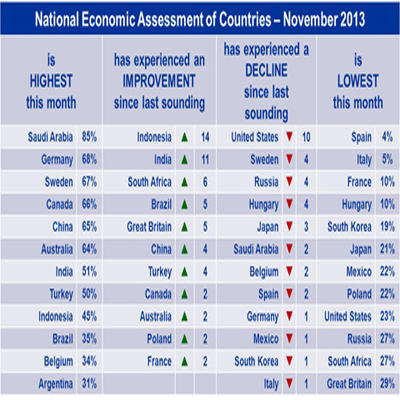
    According to the “Ipsos Economic Pulse of the World” study, India’s economic confidence jumped sharply by 11 points to 51 per cent in the month of November compared to the month of October 2013. India now stands as the seventh most economically confident country in the world after Saudi Arabia, Germany, Sweden, Canada, China, and Australia.


    Three in ten (32 per cent) Indians believe a health increase of five points. Indians are very hopeful about stability and growth in future with general election in the first half of 2014; four in ten (42 per cent) people expects that the economy in their local area will be stronger in next six months, a slender rise of one point.


    “Indian economy has bottomed out after a two-year slump and it is likely to see a positive growth trend from here on with positive indicators like narrowing CAD, revival of exports, growth of manufacturing sector and increasing investor confidence,” said Ipsos in India CEO Mick Gordon.


    “Good Monsoon resulted in bumper crop output, which in turn generated rural demand for goods such as tractors, motorcycles and consumer goods leading to growth of the manufacturing sector,” added Gordon.


    The online Ipsos Economic Pulse of the World survey was conducted in October 2013 among 18,083 people in 24 countries.


    After a significant decline last month, the average global economic assessment of national economies surveyed in 24 countries took a one-point turn for the better this month as 37 per cent of global citizens rate their national economies to be “good.”


    Saudi Arabia (85 per cent) continued to dominate the global ratings of national economies, followed in a distance by Germany (68 per cent), Sweden (67 per cent), Canada (66 per cent), China (65 per cent) and Australia (64 per cent). Once again, only a handful of those in Spain (four per cent) rate their national economies as ‘good’, followed by Italy (five per cent), Hungary (10 per cent), France (10 per cent), and South Korea (19 per cent).


    Countries with the greatest improvements in this wave were Indonesia (45 per cent, 14 points), India (51 per cent, 11 points), South Africa (27 per cent, six points), Brazil (35per cent, five points), Great Britain (29 per cent, five points) and China (65 per cent, four points).


    Those from Brazil (62 per cent), once again, hold the strongest future outlook for their local economy in the next six months. The other high-ranking countries, which followed at a distance, were: Saudi Arabia (48 per cent), India (42 per cent), China (39 per cent), Indonesia (37 per cent) and Argentina (37 per cent).

  • Internationals rock Asias boat at Hero Skills Challenge

    Internationals rock Asias boat at Hero Skills Challenge

    NEW DELHI: The seventh edition of the Hero Women’s Indian Open witnessed the ‘Rest of the World’ team beat ‘Asia’ 3-1 in the ‘Hero Skills Challenge’ at the par-72, Delhi Golf Club course here today.

    The Rest of the World team comprising Sophie Gustafson (Sweden), GwladysNocera (France), Holly Clyburn(England) and Maria Balikoeva (Russia) beat The Asian contingent of Sharmila Nicollet, Neha Tripathi, Vani Kapoor (all India) and Chung Ye Na (Korea) by a margin of 3-1. Rest of the World pocketed Rs 90,000 for their efforts while Team Asia had to settle for Rs 30,000. Each skills contest was worth a prize purse of Rs 30,000.

    The USD 300,000Hero Women’s Indian Open 2013 commences with thePro-Am on Wednesday 27th November, followed by the three-day main stroke-play tournament, from 28th to 30thNovember, 2013.The event is tri-sanctioned by the Ladies European Tour (LET), Ladies Asian Golf Tour (LAGT) and the Womens’ Golf Association of India (WGAI).

    The ‘Hero Skills Challenge’ teed-off with the ‘Longest Drive’ competition. Rest of the World beat Asia in this format after Ladies European Tour star Sophie Gustafson let loose a 283 yard drive on the tenth fairway. Asia’s best reply in this contest came in the form of a 265-yard effort by Sharmila Nicollet.

    Sharmila however pulled one back for team Asia in the ‘Closest to the Pin’ contest with her ball coming to rest 3.5 feet from the pin. The best the Rest of the World could manage in this category was a 12 feet 6 inch effortfrom Holly Clyburn of England.

    In the ‘Bunker Shot’ contest however, Russia’s Maria Balikoeva helped Rest of the World nudge ahead with a superb shot that saw her ball come to rest 1 foot six inches from the pin, far better than the 3 feet 8 inch effort from Korean Chung Ye Na.

    The Rest of the World drove the nail into the coffin in the ‘Putting Contest’ with Sophie Gustafson once again starring with a superb putt that fell just nine inches short of its target. In reply, the closest Asia could get, with Vani Kapoor’s effort was a 3 feet, three inches putt.

  • 80% people globally have TV access

    80% people globally have TV access

    NEW DELHI: Almost 80 per cent of households globally had access to television at the beginning of 2013, compared to 41 per cent of households with a computer and 37 per cent with internet access.


    The report shows that the number of households with internet access is increasing in all regions, but large differences persist, with penetration rates at the end of this year set to reach almost 80 per cent in the developed world, compared with 28 per cent in the developing world.


    An estimated 1.1 billion households worldwide are not yet connected to the internet, 90 per cent of which are in the developing world, according to the International Telegraphic Union’s flagship annual report Measuring the Information Society 2013.


    Internet users as a percentage of the population have been growing on average at double-digit rates over the past ten years. The percentage of the population online in the developed world will reach almost 77 per cent by end 2013, compared with 31 per cent in the developing world.


    Mobile broadband connections over 3G and 3G+ networks are growing at an average annual rate of 40 per cent, equating to 2.1 billion mobile-broadband subscriptions and a global penetration rate of almost 30 per cent.


    Almost 50 per cent of all people worldwide are now covered by a 3G network, the report said.


    By end of 2013 there will be 6.8 billion total mobile-cellular subscriptions – almost as many as there are people on the planet.


    An estimated 2.7 billion people will also be connected to the internet – though speeds and prices vary widely, both across and within regions.


    The Republic of Korea leads the world in terms of overall ICT development for the third consecutive year, followed closely by Sweden, Iceland, Denmark, Finland and Norway. The Netherlands, United Kingdom, Luxembourg and Hong Kong (China) also rank in the top 10, with the United Kingdom at the 11th position last year.


    The report identifies a group of most dynamic countries, which have recorded above-average improvements in their IDI rank or value over the past 12 months. These include (in order of most improved): United Arab Emirates, Lebanon, Barbados, Seychelles, Belarus, Costa Rica, Mongolia, Zambia, Australia, Bangladesh, Oman and Zimbabwe.


    In the four years between 2008-2012 fixed-broadband prices fell by 82 per cent from 115.1 per cent of average monthly income per capita (GNI p.c.) in 2008 to 22.1 per cent in 2012.


    The biggest drop occurred in developing countries, where fixed-broadband prices fell by 30 per cent year on year between 2008 and 2011.


    The average price per unit of speed (Mbps) also decreased significantly between 2008 and 2012, with a global median price of $19.50 per Mbps in 2012, almost a quarter of the price that was being charged in 2008.


    Austria has the world’s most affordable mobile broadband, while Sao Tomé and Principe, Zimbabwe and the Democratic Republic of the Congo have the least affordable, with service cost equal to or higher than average monthly gross national income (GNI) per capita. Other countries that rank well for mobile broadband affordability include Qatar, the United Kingdom, Germany, Kuwait and France.

  • Indias Economic Confidence Uncomfortably Uncertain: Ipsos Study

    Indias Economic Confidence Uncomfortably Uncertain: Ipsos Study

    MUMBAI: India’s economic confidence recovered marginally but it remains uncomfortably uncertain as food inflation remains sky high and economic growth dwindling, according to a report by global research firm Ipsos.


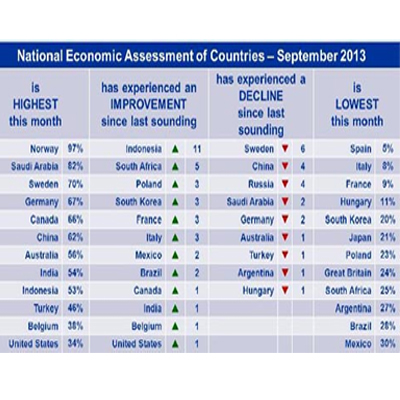
    According to the “Ipsos Economic Pulse of the World” survey, India’s economic confidence increased by only 1 points to 54 percent in the month of September compared to the month of August 2013, however its rating further got pulled down to eighth most economically confident country in the world, as sentiments in G8 and other developed countries improve.


    Thirty four percent Indian Citizen believe a further decline of 2 points. However, what is alarming is generally optimist Indians have turned pessimist, with only 40 per cent people expecting that the economy in their local area will be stronger in next six months, a drop of further 3 points.


    Mick Gordon, CEO, Ipsos in India said, “India’s sizable current-account deficit compared to its economic output, nearly double-digit inflation in consumer prices and dwindling economic growth is making India’s economic sentiments uncomfortably uncertain.”


    “Perhaps the crucial general election next year is limiting governments’ ability to make politically unappetizing economic decisions to implement drastic reforms to revive economic growth and to boost the weakening rupee,” added Gordon.


    The online Ipsos Economic Pulse of the World survey was conducted in August 2013 among 18,503 people in 25 countries.


    After a stagnant June/July, the average global economic assessment of national economies surveyed in 25 countries takes a turn for the better this month as 39% of global citizen’s rate their national economies to be ‘good.’ This shift largely reflects the inclusion of Norway in the global aggregate. Without Norway, the average is 37%, up one point from last sounding.


    Source: Ipsos
    A substantial margin continues to exist at the top of the global ratings between global leader Norway (97%), and runners-up Saudi Arabia (82%), Sweden (70%), Germany (67%), Canada (66%), China (63%), Australia (56%) and India (54%). Only a handful of those in Spain (5%) rate their national economies as ‘good’, followed by Italy (8%), France (9%), and Hungary (11%)


    Countries with the greatest improvements in this wave: Indonesia (53%, 11pts), South Africa (25%, 5pts), Poland (23%, 3pts), South Korea (20%, 3pts), France (9%, 3pts) and Italy (8%, 3pts).


    A strong majority of Brazilians (64%) continue to indicate they predict their local economies will be stronger in the next six months. A gap persists in between Brazilian ratings and the rest of the highest-ranking countries: Saudi Arabia (51%), Argentina (41%), India (40%), Indonesia (37%) and China (35%).