Tag: swastik productions

  • Captivating responsibility: Crafting a show that resonates with audiences: Neeraj Vyas

    Captivating responsibility: Crafting a show that resonates with audiences: Neeraj Vyas

    Mumbai: The journey has been long—27 years, and I’ve practically grown up here. It’s not just about Sony; I believe this is a crucial perspective for all broadcasters to appreciate. The significance of our broadcasting goals is paramount. Amidst the digital invasion, it’s equally important not to get carried away. We need to maintain faith that linear TV is here to stay, at least for the next five years. This collective belief is essential, and this year has been particularly affirming for all of us, whether considering ratings or other metrics. Despite our digital endeavours, we should collectively hold onto the conviction that linear TV is something we should continue to invest in for the next five years.

    Sony Television launched its new show ‘Shrimad Ramayan’, Poised to capture varied audience segments across the length and breadth of India, Sony Entertainment Television brings viewers Shrimad Ramayan, an epic that holds immense significance and narrates the life and teachings of Lord Ram in its purest form. Having introduced audiences to some of Indian television’s most memorable characters across clutter-breaking shows, the channel is now opening the doors for a new generation to experience the beauty and wisdom of Lord Ram’s journey and is committed to curating differentiated content that holds mass appeal with this saga.

    To bring Shrimad Ramayan to your television screens, Sony Entertainment Television has joined hands with Swastik Productions, well-known as one of the biggest storytellers in Indian television, which has consistently curated content with larger-than-life production values. Swastik has deep-dived into the very roots of Indian culture, history and legends, and will bring alive this story that chronicles the ultimate triumph of good over evil. The attention to detail in the costumes, a mega set design, and visual effects will further enhance the viewing experience, transporting the audience to the enchanting world of Ayodhya and Lanka.

    This sacred saga resonates deeply with the cultural fabric of India and its enduring appeal lies in the universal themes it explores—duty, sacrifice, love, and loyalty as well as the vices of greed, deceit, and ego. The show will go on air Shrimad Ramayan premieres on 1 January 2024, at 9 pm.

    Indiantelevison.com caught up with Sony Entertainment Television, Sony SAB, PAL, and Sony MAX Movie Cluster business head Neeraj Vyas for a chat on the television industry, his role in SET and the launch of the new show…

    Edited Excerpts:

    On how has the year been for Sony and Sony SAB

    For Sony Sab, this year has been focused on consolidation. Over the past three years, our journey to diversify content began with shows like Waghle Ki Duniya, Pushpa, and this year’s successful launch of Vanshij. Pashmina, a unique love story shot entirely in Kashmir over six months, stands out as the first TV unit to film in Kashmir in two decades. While not the typical genre for Sony Sab, this year has been about expanding our content variety while maintaining a delightful mix of shows catering to the broader family audience.

    As for Sony, my tenure began just 5 ½ months ago, marking early days for me. We’ve taken a fresh approach to KBC, launching it this year as a product that resonates with the new, progressive, and emerging India. The creative for KBC was carefully curated to align with this vision. Additionally, we reintroduced ‘Jhalak dhikla Jha on Sony after a significant hiatus, ventured into the thriller genre with Dabangi, featuring a child as the protagonist, and embarked on the ambitious project of bringing Ramayana to the audience, with many more exciting projects in the pipeline for the coming months.

    Personally, it has been an exhausting yet incredibly fulfilling and valuable experience. From a content perspective, I have never worked harder or attended more meetings in my life. Handling different channels has given me insight into the world of nonfiction content, a new and enriching dimension for me.

    With Indian Idol, our focus is on infusing purity into the singing competition. Bringing back Shreya Ghoshal as a judge adds significant value to the show. We are actively breaking moulds and challenging established patterns within the channel. While we haven’t altered the format of KBC, we’ve introduced a few dimensions to make it even faster and more inclusive. Small experiments, like the family week and a simplified participant selection process, aim to reach a broader audience. Notably, this year featured a children’s special, with a young contestant winning a crore, marking a positive step forward in terms of content diversity.

    On launching Shrimad Ramayan now

    In today’s landscape, there exists an audience for relatable content across diverse genres. From my perspective, it’s essential to acknowledge that 96% of households in India are single TV households—a reality that often gets overlooked when we view things through the lens of metropolitan living. Within approximately 30 to 40 kilometres outside every major city, there exists a different India, a new India, where lifestyles and realities differ significantly. People in these areas live distinctly, with varying disposable incomes, purchasing power, and perspectives on life. In these places, television is not just an appliance; it’s a family member. With one TV per household, families gather to watch content together, presenting a tremendous opportunity for us.

    While shows like KBC appeal to a specific audience interested in quizzes and somewhat elitist content, the reach of television extends beyond this demographic. Ramayan, for instance, is more than pure storytelling; it’s an emotion that binds a significant portion of the country. Importantly, it transcends the Hindi-speaking markets. Even in southern cities like Bangalore and Hyderabad, where Hindi is spoken and understood, there is a connection with Hindi films. This presents a substantial opportunity for us to expand our reach into a vast audience that Sony may not have tapped into for years. Historically urban-centric with somewhat elitist content, we now have a chance to connect with a broader, more diverse audience.

    On urban household’s chord cutting and the surge of OTT, how has linear TV especially GEC performed

    When we examine cricket ratings in our country, the reverence it receives is comparable to the worship of Lord Rama. Personally, I’m delighted with the cricket ratings, which have provided a significant boost. These ratings were achieved in an environment where digital access had just become widespread. The IPL and ICC World Cup, two of the largest cricket tournaments, were made available for free on digital platforms for the first time. Despite this, the television ratings were exceptional, emphasizing that television’s reach remains substantial.

    The success can be attributed to the quality of cricket presented during prime time in India, attracting millions of viewers to their TV screens. This underscores the point that television’s influence persists, and the key lies in creating compelling content. The approach of producing a single type of content for a specific target audience has limitations. Relying solely on rating-specific content is not sustainable. It’s crucial to step out of the comfort zone, diversify content, and create multiple touch points within families. This, in my view, presents an opportunity for us to broaden our content horizon and engage with a larger audience.

    On the marketing strategy and advertisers for the show

    We embarked on an intriguing initiative, something I had never done before personally. Knowing that KBC would conclude on the 28 and have the launch date for the new show set for 1 January, we took a unique approach. We released the first promo on the 14 August, strategically placed in the first break of the first episode of KBC. To my knowledge, such a move hadn’t been ventured beyond a certain extent.

    The announcement stated, “Shrimad Ramayan coming in January 2024,” initiating the first phase. Subsequently, we rolled out a series of three promos featuring ‘Shabari kar rahi hai intezar,’ ‘Bharat kar rahe hai intezar,’ and ‘Hanuman kar rahe hai prateeksha,’ showcasing three individuals eagerly awaiting Lord Rama. This marked the second phase of the campaign. About 15 – 20 days ago, we entered the third phase, revealing Lord Rama’s presence in various creative iterations, including ‘puri shrishti mein brahmand Ram’ and moments with Ram and Sita. This comprehensive approach, featuring six creatives, was a first for me, even surpassing my experiences with IPL. It has been an exhaustive process, meticulously staged to build anticipation and understanding.

    Interestingly, many might find it hard to believe, but it was purely coincidental that we had an inkling about the opening of the Ram Mandir in 2024. While we foresaw such an event, the specific timing in January wasn’t known when we announced our show’s date. This coincidence aligns well with the positive mood of the nation, providing an opportune environment for the show to thrive. This, in turn, places a significant responsibility on us to deliver a show that captivates and resonates with the audience.

    There are six sponsors we have locked in, unfortunately this a fiction show, in a non-fiction show you can do product placements. It is going to be a slow journey but the fact that we have closed these sponsors is a great.

    On Jhalak coming back to Sony

    During the initial three years on Sony, it was truly a spontaneous endeavour, a Sony product born out of instinct rather than a grand strategy or meticulous planning. We sensed an opportunity, had a vacant slot, and managed to put together the show within a swift 45 days.

    Although the ratings on Sony and Sab could be better, we’ve deliberately avoided getting deeply entangled in the rat race. We recognise that ratings can be a limiting factor, leading to a predictable pattern that isn’t conducive to the overall growth of television. I am cautious about falling into the trap of producing only a specific type of content that seems to work, limiting ourselves to a fixed number of shows adhering to a certain formula. While the temptation is there, I believe it’s essential to resist it for the sake of television’s evolution.

    Our network has earned respect from advertisers for our commitment to differentiation and the diverse range of content we offer. We are aware that we cater to a slightly more elite audience compared to others, and we are content with occupying that niche. It’s a space we’ve carved out for ourselves, and we are satisfied with the unique position we hold.

    On GEC shows having a finite ending

    It all began with “Pashminna,” which had a definite conclusion. Currently, we’re in the process of developing another show with a similar structure. The issue we face isn’t related to advertising; rather, it’s the cost that poses a challenge. The shorter the show, the more expensive it becomes due to amortization concerns.

    However, I believe that if we shy away from this approach and stick to the comfort of creating endless stories, we’re missing out on a critical shift in the industry. If we reflect on the past two years, it’s evident that the number of show launches has skyrocketed. Unfortunately, many of these shows have not succeeded. This surge in launches is likely because we are not embracing finite storytelling.

    We need to rewrite our approach without changing the fundamental context and tone. Finite narratives are essential, and by focusing on them, we can reshape the industry and break free from the pattern of launching numerous shows that ultimately fall short.
  • VidNet 2022: How can Indian OTTs reach 100 million subscriptions?

    VidNet 2022: How can Indian OTTs reach 100 million subscriptions?

    Mumbai: In 2021, OTT paid subscriptions in India touched the 70-80 million mark, according to the latest report by Boston Consulting Group. The subscriber numbers remain in flux with high levels of churn and potential marketing efforts are required to generate and acquire new users. The streaming giant Netflix has also reported a decline in its subscriptions for the first time in a decade. The company recently reported that it lost 0.2 million subscribers in the first quarter of 2022. In such a scenario, what can OTT platforms do to drive new subscriptions and reach the magic 100 million subscribers in India?

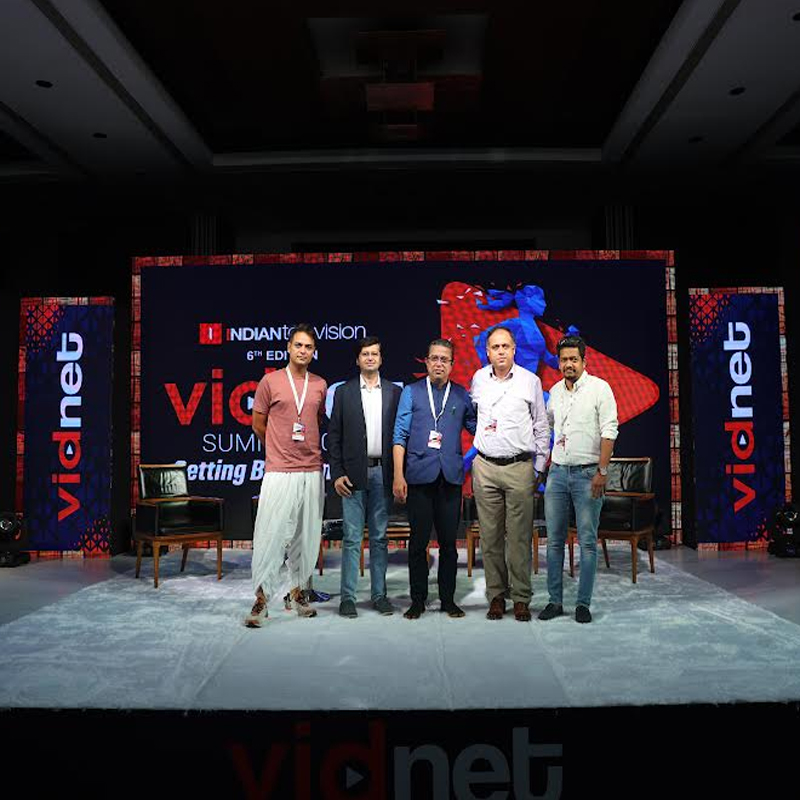
    That was the agenda for the panel discussion at IndianTelevision.com’s VidNet Summit 2022 held on Wednesday. The two-day summit was supported by technology partners Dell Technologies and Synamedia, summit partners Applause Entertainment and Viewlift, industry support partners Gupshup, Lionsgate Play and Pallycon, and community partners Screenwriters Association and Indian Film and Television Producers Council and gifting partner The Ayurveda Co.

    The conversation was joined by Endemol Shine India CEO Abhishek Rege; International Media Acquisition Corp chairman and CEO Shibashish Sarkar; Swastik Productions and One Life Studios founder and chief creative officer Siddharth Kumar Tewary and Mzaalo (Xfinite Global Plc) COO Vikram Tanna.

    Speaking in this context, Abhishek Rege pointed out that the 100 million is merely an arbitrary number and what OTTs should look at is the revenue model. To entice new customers OTT platforms are offering free trial subscriptions, non-paywalled content and lowering the price of subscription plans, which is eating into their bottom line.

    He gave the example of Amazon’s Kindle device and added, “There was a Kindle available for $79 that served ads and then you paid a little bit more to get the ad-free version. That’s the kind of space we need to look at as OTT players and content creators if we want to land up at better revenues.”

    Mzaalo’s Vikram Tanna observed that for a long time the consumption of media in India has always been subsidised by advertising. The trend continues today with devices like DD Free Dish that offer TV channels for free. “When you look at the mass audience the solution to the problem lies in technology. They are the future consumers for us all. I believe we need to figure out how to make free content profitable. Can you reward the community for consuming content and return a part of the revenue that you earn back to them?” he pointed out.

    Mzaalo is a part of Xfinite Global Plc, which is a decentralised entertainment ecosystem. They have a digital token called XET that is listed on the cryptocurrency exchange. Tanna stated, “We believe in equal distribution of value creation among stakeholders of the ecosystem. Since content drives commerce and we all remember moments rather than the entire content piece, we tried to figure out if you can buy, sell and resell NFTs of content. Of course, they will have multiple other utilities.”

    Tanna concluded his remarks by adding that to reach the magic 100 million target the two pillars that will drive the growth of OTTs will be content and technology.

    Speaking from a content standpoint, Swastik Productions’ Siddharth Kumar Tewary said, “We’re just at the tip of the iceberg of what’s going to happen in terms of content. Content is the biggest driver of subscribers on OTT platforms and he felt that one piece of content doesn’t necessarily reach 100 million people. Platforms need to give the audiences all varieties of content to consume, similar to TV. The only difference is that content consumption on TV was led by appointment viewing and now people can watch anytime they want.”

    He added, “Every platform is different and serves a different audience. While the numbers will come, whether it is SVOD or AVOD, not every platform may be necessarily targeting 100 million subscribers.” Sharing a metaphor, Tewary noted that there are brands that cater to the masses and brands that cater to the classes across categories and we don’t compare them purely by the numbers to understand how big they are. So why should we judge OTTs that way?

    Commenting on whether the growth of OTTs is being driven by content or distribution partnerships, Rege also stated, “The content that we have served to OTT audiences is scaled up and has succeeded not to an extent, though not as much as we’d like.”

    He added, “Content on OTT is certainly different from mainstream TV. Over time an audience that is used to TV needs to be slowly nudged to OTT with simpler content. For them, jumping into OTT content that is nuanced will not get absorbed quickly. However, there is a demand for different types of content on OTT platforms compared to TV.”

    International Media Acquisition Corp’s Shibashish Sarkar believes that compared to 100 years of print, more than 30 years of TV, OTT which is only six years old is still a nascent media and will continue to grow, defying expectations. He questions the way audiences are segmented and served content across platforms.

    “Historically, on TV, we like to segment the audiences as tier 2 and tier 3. These descriptions of audiences don’t hold anymore,” he affirmed. “Going back six months, three out of four blockbusters were South Indian dubbed films. They were attracting audiences in a small town in Rajasthan as well as in Nariman Point in Mumbai. Divisions like language barriers, genres and other content divisions have become redundant,” Sarkar added further.

  • TV show production efficiency impacted by Covid2019: Swastik Productions’ Rahul Kumar Tewary

    TV show production efficiency impacted by Covid2019: Swastik Productions’ Rahul Kumar Tewary

    MUMBAI: A month since TV production resumed, the ride has been bumpy. With sets rigorously sanitised, makeup and hair artists wearing PPE kits, it’s still better than no shoots at all. Swastik Productions producer Rahul Kumar Tewary says that it took a lot of planning to resume shooting.

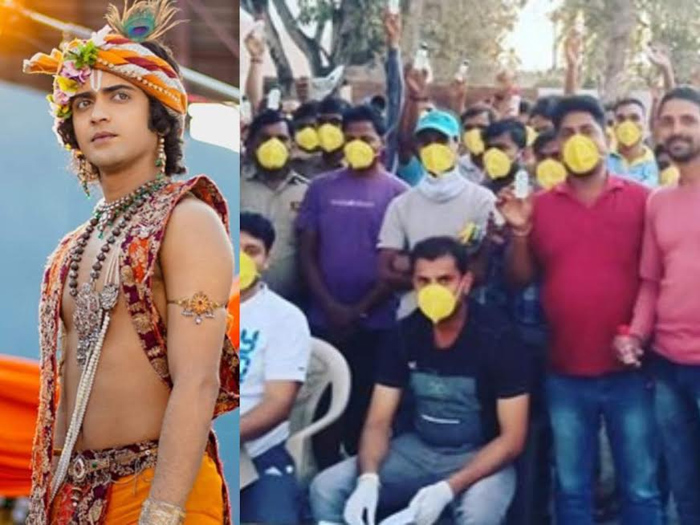
    “Before beginning the shoot, the cast and crew members of Devi Aadi Parashakti and RadhaKrishn reached Umbergaon, Gujarat, on 8 and 10 June where they were quarantined. There was regular check-up conducted within premises. The labours and crew members are living at the studio itself while artists are living at nearby apartments,” he shares.

    He highlights that the production has created a Covid2019 team that looks after sanitisation and fumigation of the entire set and the places where technicians, crew and artists are living. He clarifies that while shooting there is no contact from the outside world. There are multiple checkpoints on the set to ensure safety and security of people.

    To maintain the grandeur and bring larger-than-life feel in the episodes, Tewary is relying more on VFX than having real people on the set.

    Tewary elaborates, “It is a very difficult ride, the whole production planning, writing of episodes, consumes a lot of time. We are also focusing a lot on the VFX side to showcase more people in the story or a crowd scene. The script is written in a way that no body contact is involved. Massive sets are also avoided. So, all the departments, from the writers to creators, production, execution and technicians, are extremely careful.”

    The production house is using two camera setups and for proper lighting, the DOP is responsible for creating the entire set-up a day or a night prior to save time. Post that only actors are available for the shot sans technicians and camerapersons. This move is to ensure that at any given time there are a smaller number of people available on the set. However, this is making it difficult to get episodes out in time. The production efficiency has been compromised due to the SOP measures.

    Apart from that Tewary praises broadcasters for their constant support and encouragement. He says, “Broadcasters have been hugely impacted by this pandemic. The broadcasters worked hand in hand with producers to ensure we create a bank of episodes.”

    He adds that as the shows are on air, banks are the main thing that will drive momentum on the floor. Every show will initially have the capsule of kahani ab tak to engage audiences.

    The 12-hour shift timing remains the same as it was before the Covid2019. The studio also uses various tools to transmit data.

    Tewary notes that during the pandemic, digital mediums have gained traction. But, he says that the market audience for television and digital are completely different. Both the mediums may overlap to a certain extent, but in the end these are two different market segments. “I believe the digital is growing, but TV will also remain the same. I don’t think there will be too much of an impact on TV programming. There is a certain age group of consumers for the digital content; there is a trend that the youth of India is moving towards the digital side,” he shares.

    He is optimistic that as new content has started airing, TV audiences will be once again glued to the small screen.

  • Rapid fire questions with Swastik Productions’ Siddharth Kumar Tewary

    Rapid fire questions with Swastik Productions’ Siddharth Kumar Tewary

    MUMBAI: Story-teller, director and producer Siddharth Kumar Tewary is  now touted as the king of mythology (which he calls 'history') on television with shows like  Mahabharata, Suryaputra Karn, Shani, Mahakali, RadhaKrishn, Chandragupta Maurya and internationally famous Porus. In a virtual fireside chat with Indiantelevision.com founder, CEO and editor in chief Anil Wanvari, Swastik Productions and One Life Studios founder and chief creative officer Siddharth Kumar Tewary revealed his most favourites.

    Know your favourite person behind these successful shows in this tell-all interview.

    Edited excerpts:

    Which is your most favourite show?

    I am a very hard-core fan of Netflix Originals show Breaking Bad. I think the characterisation of Walter White, the way this show has been written is brilliant. They have done very good work from a direction and writing standpoint. So, yes that is my favourite series so far.

    Who is your favourite writer?

    In writing I have a lot of favourites, but I think Rajkumar Hirani is the best writer ever in India and in the Bollywood industry. His work is legendary, the kind of messaging he does through humour is very aspirational. In Bollywood his favourite movie is 3 Idiots and internally it is Brave Hearts which has had a huge impact on me. Apart from this my favourite animated movie is Finding Nemo.

    One thing that a programming head had done which made you upset?

    I think I am on the other side of the table, the person doesn’t have the intention to spoil the work. For instance, someone was making the series and I am a micro manager. I look after every small detailing right from your scripts to dialogue. And I have invested days and months understanding the work and if suddenly someone says you are not understanding the concept this is something that makes me a little upset. Because I have created the show, I have written the character, made 50 episodes and then someone just can’t say I don’t know the character. So, those kinds of things make me emotional. I am very sensitive about the work I do. I get very agitated when somebody pinpoints it. But even I have made lots of mistakes in this journey. I was quite a difficult person to handle as well so it is fine, I understand that their intention is not bad.

    A writer you hate to work with, but you had to work anyway.

    There is nobody I hate to work with and still go ahead and work, this is not possible. I don’t need to be forced to work with anyone because if you are forced to do something the outcome will never be good. I always believe in the creative field if you disconnect with somebody, then you should not work with that person. If you will work with that person the core objective of the work will go for a toss. It will no longer be a product you wished to create. There is nobody right or wrong, we are the biggest subjective field in the world. So, for me if you are not connected, then you are not on the same page.

    Are you a writer, director or a producer. Which is your favourite role?

    The reality is I am a writer, director and a producer. I started with being a producer, I was not a writer in the beginning. When I did Amber Dhara there were writers who were  working with me and creatively driving the show. Over the period of time I worked on myself, I used to write a story and not an episode. I became a writer in a course of time and then started directing. So, it has been an interesting journey for me. However, I am more close to direction and writing, your work is out in front of the people. I look forward to people saying well done to me for my shows, it gives me immense happiness. I have not come here to build a multi-million empire, I have come here to tell stories.

    When are you most inspired?

    I am most inspired when I see legends. I try to understand what goes behind creating these legendary people. So, the journey about what goes into being consistent in their life, and continuously delivering good work inspires me. Even after being in the industry for 50 years Amitabh Bachchan goes to film sets everyday and is still curious to learn. I am a huge fan of Roger Federar. At the age of 38 playing a Wimbledon final is not a joke. It is not like this is something he got lucky with, it requires a huge amount of work. I really admire sports people, they take them to another level. In tennis you retire at thirty two.  I think it takes a lot to retire at the age of thirty. I admire Boris Becker a lot.

    If you could switch professions, what would you become.

    I can only play sports; I only like sports apart from what I do. I would most probably play tennis. Infact, my elder brother Rahul and I are very competitive when it comes to playing tennis.

    What is the best thing that has ever happened to you professionally?

    When I was doing the show Amber Dhara I had no intention of becoming a producer. But the whole 'accidently turning into a production house' has been the best thing that has happened to me.

  • Will TV producers look at IP ownership in the post-Covid2019 world?

    Will TV producers look at IP ownership in the post-Covid2019 world?

    MUMBAI: When a nationwide lockdown was imposed to stem the tide of Covid2019, all film and TV shoots were suspended. Finally, the Maharashtra government gave a green signal for the resumption of film and television shootings in non-containment zones.

    As things are slowly getting back to normalcy it has become important for every production house to hold its intellectual property.

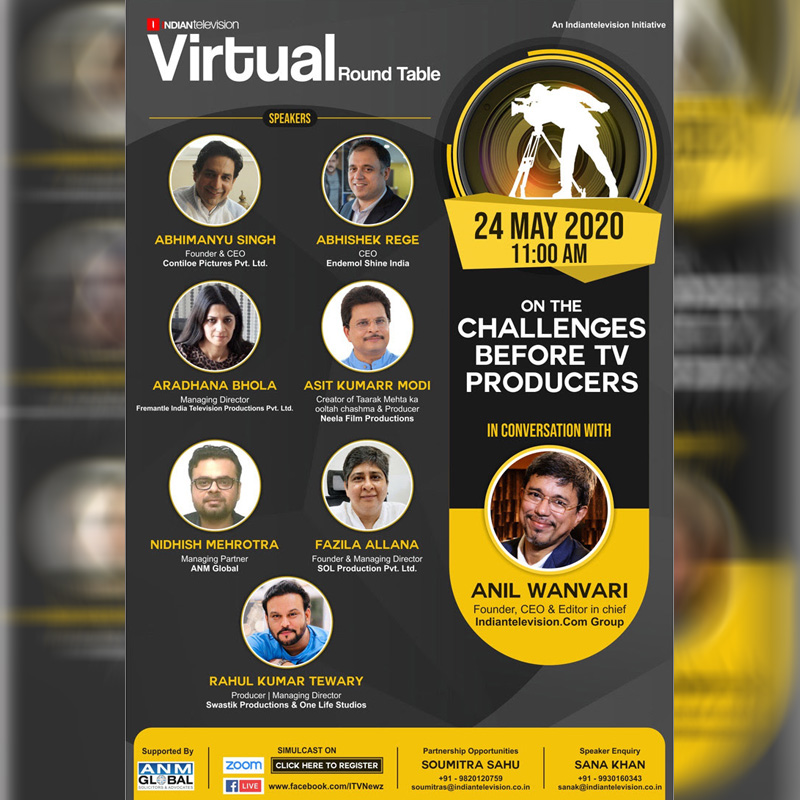
    This was the unanimous view of a virtual round table conference organised by Indiantelevision.com to discuss the challenges faced by TV producers. 

    The panel, moderated by indiantelevision.com founder, CEO and editor-in-chief Anil Wanvari, had Swastik Productions & One Life Studios producer & managing director Rahul Kumar Tewary, SOL Productions founder and managing director Fazila Allana, Contiloe Pictures founder and CEO Abhimanyu Singh, Endemol Shine India CEO Abhishek Rege, Fremantle India Television Productions managing director Aradhana Bhola, Taarak Mehta Ka Ooltah Chashmah producer and Neela Films owner Asit Kumarr Modi, and ANM Global managing partner Nidhish Mehrotra.

    With the whole pandemic situation, some television producers also have the fear of being kicked out of shows. This scenario has put a big question mark on broadcasters who own the intellectual property rights for most TV shows.

    Swastik Productions & One Life Studios producer & managing director Rahul Kumar Tewary says, “Currently broadcasters have been very supportive, but mostly it is discussion rather than action that has happened from broadcasters’ end. However, I am very hopeful that they will come forward and help. Ultimately, they are the owners of the IP.”

    He adds that this lockdown will create opportunities for producers who have trust in their content and IP. This situation will give producers some time to create different business models and IPs. Apart from this, there will be huge financial calculations also.

    Adding to Tewary’s point, Contiloe Pictures founder-CEO Abhimanyu Singh said, “It has been a long discussion among all producers. This is a time where the production community can work along with broadcasters with some co-investment in place to create IPs.”

    Taarak Mehta Ka Ooltah Chashmah producer and Neela Films owner Asit Kumarr Modi thinks it is very important for all producers to own their IPs. With the help of IPs producers can also sustain their business and become a long-time player.

    He adds, “If I don’t own an intellectual property then I am merely a production coordinator and not a producer. Post Covid2019 it will be interesting to see who owns IP. Repeat telecasts are seeing a huge consumption on digital media. IP has its own value, who will own what percentage that producers and broadcasters will have to mutually decide.”

    SOL Productions founder-MD Fazila Allana said: “Despite having our own IP there are certain formats which are created indigenously for the movie market which is not owned by them.”

    She adds that it is a continued struggle. It is more than ever now that the platforms and the channels do not want to give up IPs. Because even they have realised that in this situation, they need a bank to play and they don’t want to pay for it again.

    “The struggle is going to be tougher as everybody is now realising that there is a huge financial problem, so they are alright with producers sharing the cost and therefore own half IP. So, co-investing and co-owning could be a solution for this mid path. I don’t think the broadcasters or OTT players will give 100 per cent IP,” she further explains.

    Adding to what Fazilla Allana said, Fremantle India Television Productions MD Aradhana Bhola believes that OTT players have now realised that there is no boundary to create content. They can do dubbing and subtitling; and consumers are willing to see those contents.

    As we all know that a large part of Indian television comprises reality TV shows like Indian Idol, Bigg Boss, Dance Plus, etc.   While some producers are of the opinion that owning IP will incur them huge costs and financial burden, others think that it could be the way going forward.
     

  • Help each other to bring the industry back on its feet: TV producers

    Help each other to bring the industry back on its feet: TV producers

    MUMBAI: The television producers believe that helping each other to revive the business, as and when the state government allows production to resume, will help the industry get back on its feet. This was the unanimous view of a virtual round table conference organised by indiantelevision.com to discuss the challenges faced by TV producers.  

    The panel, moderated by indiantelevision.com founder, CEO and editor-in-chief Anil Wanvari, had Swastik Productions & One Life Studios producer & managing director Rahul Kumar Tewary, SOL Productions founder and managing director Fazila Allana, Contiloe Pictures founder and CEO Abhimanyu Singh, Endemol Shine India CEO Abhishek Rege, Fremantle India Television Productions managing director Aradhana Bhola, Taarak Mehta Ka Ooltah Chashmah producer Asit Kumarr Modi of Neela Films, and ANM Global managing partner Nidhish Mehrotra.

    It was a two-hour-long animated and insightful discussion that touched upon the issues which are afflicting the production community during this pandemic. Towards the end, there saw a question-and-answer session between the moderator and panellists.

    The majority of panellists agreed that the lockdown has prompted them to think about the future, watch enormous content. And the further extension of the lockdown is adding to their financial stress. The country has been under shutdown for over two months now, the total cases across the nation surpassing the one-lakh mark with around 4000 deaths due to the Covid2019.

    SOL Productions founder and managing director Fazila Allana says that the lockdown has been interesting so far, it gave the producers a time to plan for the future. They are in a wait-and-watch mode.

    Contrary to the Allana’s view, Taarak Mehta Ka Ooltah Chashmah producer Asit Kumarr Modi says: “We were expecting 10-15 days of lockdown, but the situation is getting grimmer with the extension. There is no positivity remaining and I don't have a happy mindset after two months of lockdown.”

    The producers expressed the view that they somehow tried to stretch the fresh content on TV until March, but with the beginning of April every other broadcasting network started showing re-runs of archives and are doing the same even today, except with some error-and-trial work from home shows.

    Many producers had predicted lockdown, shut their offices and stopped shooting before prime minister Narendra Modi announced the official lockdown on 24 March.

    Expressing his concern that prolonged lockdown is taking a toll on businesses, Swastik Productions & One Life Studios producer & MD Rahul Kumar Tewary says: “We can’t be in lockdown forever and the nation's economy needs to be revived. We need to have ways, initiatives, and measures as an alternative to start businesses. It's an evolution and a new way to do business. We need to evolve.”

    Sharing Tewary’s view, Fremantle India Television Productions managing director Aradhana Bhola says: “The lives of the people are important but we need to revive business and try different ways to find the solution. I think this is the time to reset, and need to find ways to do it collectively.” She doesn’t believe that the producers will have a typical set of doing a production from home; rather it will have a hybrid studio setup of producing content remotely.

    And in these testing times, to guide the panellists on the legal front, ANM Global managing partner Nidhish Mehrotra says that nobody had thought of adding pandemic as force majeure clause in the contract globally. He adds that if insurance talks about the pandemic in your contract then you're covered, but if it doesn't mention it, then you are not eligible for the same.

    With over-the-top media having taken the centre stage amid the pandemic, Modi says, “The audience’s behaviour will drastically change after post-Covid2019 situation. And, I am positive that producers will come with more creative shows. We need to create shows which make viewers happy. Both fiction and non-fiction will have their own challenges.”

    Listing out the challenges post-lifting of the lockdown, Contiloe Pictures founder and CEO Abhimanyu Singh explains: “All the stakeholders will have to understand each other’s problem. It has to be a healthy discussion, which helps us find a solution. We will face multiple challenges once the lockdown is lifted, and the budget cut is going to be a collective problem.”

    He adds, “Our biggest challenge as a producer is to ensure the continuity of the shoot. Once you have started the shoot, don’t stop it”. Singh is of the same view of Modi that the viewing patterns of television audiences may change. According to him, AVoD will co-exist with television and SVoD is here to stay as many OTT platforms have proved their mettle.

    The Maharashtra government has listened to the television fraternity’s concerns. Endemol Shine India CEO Abhishek Rege, who was one of the producers who attended the virtual meeting with the chief minister in this regard, said: “The state government has formed teams to do surveys at shooting locations and will also come up with final SOPs.” Rege hopes that by the first week of June the government should come out with a concrete plan and shooting would resume soon.

    The other challenges that were discussed by the producers were pay cuts and shooting locations. According to Rege, there is no specific regulatory body to monitor pay cuts; it’s an individual decision. Similarly, Modi highlights the fact that television producers don’t have a proper shooting infrastructure in India, and “it should be our next focus once the pandemic ends.”

    During this lockdown period, with no work to do, television producers are using their free time to either binge-watch some good content and/or planning the future course of actions or trying to find an alternative way to deal with this situation once the lockdown ends.

  • The accidental producer: Siddharth Kumar Tewary gets candid on his journey

    The accidental producer: Siddharth Kumar Tewary gets candid on his journey

    MUMBAI: Most popularly known for creating magnum-opus shows like Mahabharat, Karmaphal Daata Shani, Porus, Ram Siya Ke Luv Kush and RadhaKrishn Swastik Productions has successfully managed to win our hearts over the years.  In a virtual fireside chat with Indian Television Group founder, CEO and editor in chief Anil Wanvari, on ‘The evolution of a creator – The maker of the new Mahabharat,’, Swastik Productions and One Life Studios founder and chief creative officer Siddharth Kumar Tewary gets candid about his journey and much more.

    Tewary, who was born and raised in Kolkata, always had a dream of making it big in the city of dreams Mumbai. After quitting his job in advertising, he started working in the marketing department of Sony Entertainment Television. His sheer love for storytelling and writing unique stories inspired him to make Amber Dhara for Sony Entertainment Television. 

    About the idea behind creating Amber Dhara, Tewary said: “A news article about two conjoined twins gave me the idea to speak to Sony Entertainment who I thought believed in unique and progressive shows rather than daily soap operas. Amber means sky and Dhara means earth so they are two distinct characters. The story was about how they are the same but still think differently.”

    Tewary says that he never thought of becoming a producer. The initial idea was to create a story that will be backed by a production house. But later, after figuring out different ways, he and his previous partner Vikas Seth decided to do it themselves, and that gave birth to Swastik Productions in 2007.

    Amber Dhara was a show with a beautiful concept but failed to make money. So, after this show, Tewary went on to make Mata ki Chowki which was aired on Sahara One. The show became a huge success and created new avenues for Tewary. He didn’t have to look back after that; he created another show named Agle Janam Mohe Bitiya Hi Kijo, a story that showcased the issues prevailing in rural India. The show was quite successful. Since then, he has created more than 30 shows.

    On his most favourite television shows Amber Dhara and Mahabharat, Tewary says: “Amber Dhara will always remain close to my heart. We have not even created a set. Because I wanted to write a series where just like human lives you are not stuck in one place. It is a story of two characters that kept moving. My second most favourite will be Mahabharat. In 2009 Vivek Behl from Star Plus called me and said he liked my show Agle Janam Mohe Bitiya Hi Kijo and he wanted me to make a Mahabharat. It took me five years to make that show. Mahabharat has taught me a lot and it has changed me as a person. Porus was the first Indian show that was showcased on the digital platform Hulu in Japan. It taught me to invest more in what you are creating and going around the world to sell your content. We have sold it in more than 14 countries now.”

    Tewary is ecstatic about re-running his show Mahabharat which was made seven years back.

    On parting ways with long-time friend and Swastik Productions managing partner Vikas Seth, he said it was a difficult time. Due to Mahabharat they were in huge debt. But after Mahabharat was launched it did well. “Initially we decided to make 128 episodes, but I was unable to tell the story in those particular episodes so we decided to extend it. Because of the extension Mahabharat did well for us on all fronts. It helped us get back on our feet,” he explained.

    According to Tewary, the formula for being a successful production house is going ahead with your team who share similar ideology. “The sheer passion of the entire team at Swastik Productions kept us going despite the challenges. Me and my elder brother Rahul always dreamt of creating a set, how we will provide shooting facilities. So, slowly we started acquiring land, building set on our own properties. Today we have more than 25 shooting floors which are spread across 25 acres. We have a huge mythological setup in western India. One thing led to the other and we started on investing in infrastructure while we were doing a lot of work on the visual effect front. Where we can have control over the delivery of our own product. That is how One Life VFX came into existence.”

    Elaborating more on One Life, Tewary said that Swastik Productions is a parent company and One Life Studios is a subsidiary of that where they do most of the digital work, syndication, distribution and visual effect work.

    Tewary is currently working on the animation front, where he is busy making a few promos and developing some animation stories. In the near future he wishes to create characters that sustain for much more time. He is also focussing on syndication and distribution where he is taking Indian content overseas and similarly wishes to bring international content in India.

    He adds, “We have acquired some international series that we will be distributing to OTT platforms in India for them to stream. I am also working on an original series called Escape Life for Hostar. I finished the writing; we were about to begin the shoot but due to lockdown things are at halt.”

    He revealed that he has no plans to lay off workers in the wake of the Covid2019 pandemic. "We have deducted salary from April onwards. But there are no plans of furlough or layoffs. Infact, we are taking care of 250 people who are staying at our Umbergaon set in Gujarat," he said. 


  • Indian content owners, creators don’t value own content

    Indian content owners, creators don’t value own content

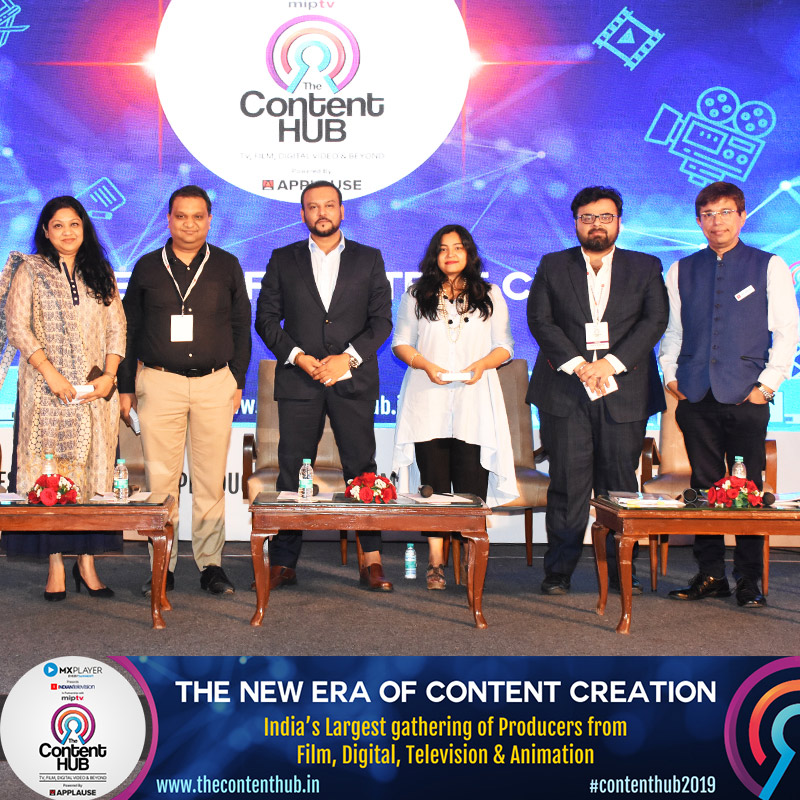
    MUMBAI: The third edition of Indiatelevision.com’s The Content Hub had an insightful panel on the global syndication market. The panel consisted of Go Quest Media ventures MD Vivek Lath, Swastik Productions and One Life Studios MD Rahul Kumar Tewary, MX Player head-content acquisition Mansi Shrivastav, Sony head networks – licencing Malvika Prabhu and ANM Global co-founder partner Nidhish Mehrotra and moderated by Indiantelevision.com founder, CEO and editor-in-chief Anil Wanvari.

    Go Quest Media ventures MD Vivek Lath said that a lot of countries are now doing indigenous production. “But what they lack is the kind of creative maturity and evolution India has gone through. That’s where we see much larger opportunity going forward.”

    Swastik Productions and One Life Studios MD Rahul Kumar Tewary said that the demand for Indian content has reduced over time. “But what we need to understand is what kind of content we are creating. Does it resonate with the international audience or are we only catering to the Indian market? In the end, it is a business and we only cater to the Indian market. But if we really want our content to travel the world, I guess we need to re-look at what kind of content we are creating,” he said.

    Another issue syndication faces is that, according to Lath, Indian content creators don’t value their content as people from Korea, Turkey and China do because of which it is underpriced. Tewary agreed with Lath and said, “Turkish, Chinese and Korean dramas have got a standard market price. No one brings the market price down. So they value their content. Unfortunately, we are the cheapest. You can sell it for $50-70.”

    Much of Indian content travels to Southeast Asia because it has a similar market. In India, shows are telecast for 5-6 days a week which is 260-312 episodes a year. It becomes difficult to sell so many episodes across the world because the appetite for such viewing is lacking. With Thailand emerging as a new market in the last two years, it helped cushion the impact from the other markets. Latin America is also a promising area but tough to crack which Tewary feels will open up soon.

    The genres that are doing well currently are animation, fantasy, mythology and the modern drama series. Experts also foresee a future demand for Indian horror thrillers on OTT platforms, because of their high production quality. Lath believes that GEC dramas are the fastest moving in the international markets across 60-odd countries.

    The deciding factor for content buying is the platform. MX Player head-content acquisition Mansi Shrivastav said, “I think for OTT there is more flexibility because there is an ability to programme for an individual customised experience. When you are buying for linear TV, you have to keep the overall target audience in mind and there is only one kind of programming."

    For OTT, there is still limited data available on usage and behaviour patterns. But sometimes, you follow your gut and take a risk. MX Player has just bought 100,000 hours of content which varies from two-minute videos to long-form series. “Movies in each language are important to us because there is a lot of traction for that. But we are buying across top ten languages; we are giving a lot of importance to regional markets including Tamil, Telugu, Kannada, etc. and Hindi, of course, is a key language,” Shrivastav added.

    According to experts, the Indian content export business excluding movies is around Rs 400 crore as the syndication of Indian content started only from 2007 onwards. “I think in the future, animation is something which is going to add on a lot of export to India in the next 5-10 years,” Tewary concluded.   

  • Yeh Mohalla hai Navrangi Re!

    Yeh Mohalla hai Navrangi Re!

    Most of the times, we don’t #GiveAShit about shit. But starting February 2, 2019, we won’t be able to ignore it any more, as a one-of-a-kind drama series is coming to our living rooms to make us laugh, cry, wonder, question and fall in love. In an industry first, Viacom18 has partnered with the world’s largest philanthropic organization Bill & Melinda Gates Foundation, and development communications specialists, BBC Media Action to create a Hindi general entertainment fiction series called Navrangi Re!with an underlying behaviour change message on sanitation.Laced with high drama, wit and satire, Navrangi Re! is a finite series that will make us all sit up, take responsibility and #GiveAShit this New Year.

    Produced by Swastik Productions, Navrangi Re! is the story of a lively mohalla (a neighbourhood) in a town in Northern India full of quirky and endearing characters. Navrangi Re! has a gamut of colourful characters- from a talking wall to a rich and ruthless diva to a spoilt brat to a strong female lead that refuses to give in, and an underlyingmonster that’s growing underground. It is the laugh-a-minute story of a community living on the edge, teetering from one crisis to another and then deciding to take control of their lives. Vishwaas, the hero of this 26-episode television drama series, played by actor Aamir Ali, is a struggling TV journalist always looking for career-defining ‘breaking news’. In this hunt for one story, he discovers something bigger- the gateway to bring about change in his mohalla!It is entertainment all the way using an ensemble cast made up of thespian actors such as Susmita Mukherjee and Raju Kher, and promising new talent like Vaishnavi Dhanraj, Manmohan Tiwari and others.

    Sudhanshu Vats, Group CEO & MD, Viacom18, said “Today, 70% of urban India’s sewage is left untreated and it’s an issue that needs immediate attention. As a media and entertainment company we have realized that you connect with the viewers better when you marry social messaging with an interesting narrative.  Viewers identify and resonate with such content very well and we have seen this with our film, Toilet: EkPrem Katha. Navrangi Re! therefore is not a PSA but a 13 weeks’ series which aims to showcase the various challenges faced in a community due to lack of proper sanitation facilities. Along with BMGF and BBC Media Action this is our humble effort to spread awareness and lead to behaviour change.”

    Nina ElaviaJaipuria, Head- Hindi Mass Entertainment & Kids TV Network, Viacom18, elaborates, “At Viacom18, we are storytellers, and we believe in harnessing the power of stories to bring about change. Navrangi Re! is a product of that philosophy. It is a powerful story narrated entertainingly with the idea to mainstream a topic as important and nuanced as Faecal Sludge Management. Given the wide audience we are targeting through this social impact programming, Navrangi Re! is an apt fitment as the first ever Rishtey Original.”

    Devika Bahl, Creative Producer, BBC Media Action, adds, "It's quite tricky to engage viewers with an issue like faecal sludge management. The challenge is to convert technical information into full-blown entertainment – a story that's full of romance, drama humour and aspirations. Navrangi Re! is an attempt to achieve that balance."

    This finite series promises to make you laugh while raising critical questions around ‘flush kebaadkikahaani’, thus making it a challenging experience because how does one make shit prime-time and fun? Siddharth Kumar Tewary, Founder, Producer, Creative Director, Swastik Productions agrees, “Sanitation is a serious issue and the challenge for us was to merge this topic with entertainment and create a light-hearted show which 

    entertains yet gets a strong message across to our viewers. The partnership of the Bill & Melinda Gates Foundation, BBC and Viacom18 and Swastik is a great step on Indian Television as we bring forth content on a mass medium which shall have viewers laughing and learning simultaneously.”

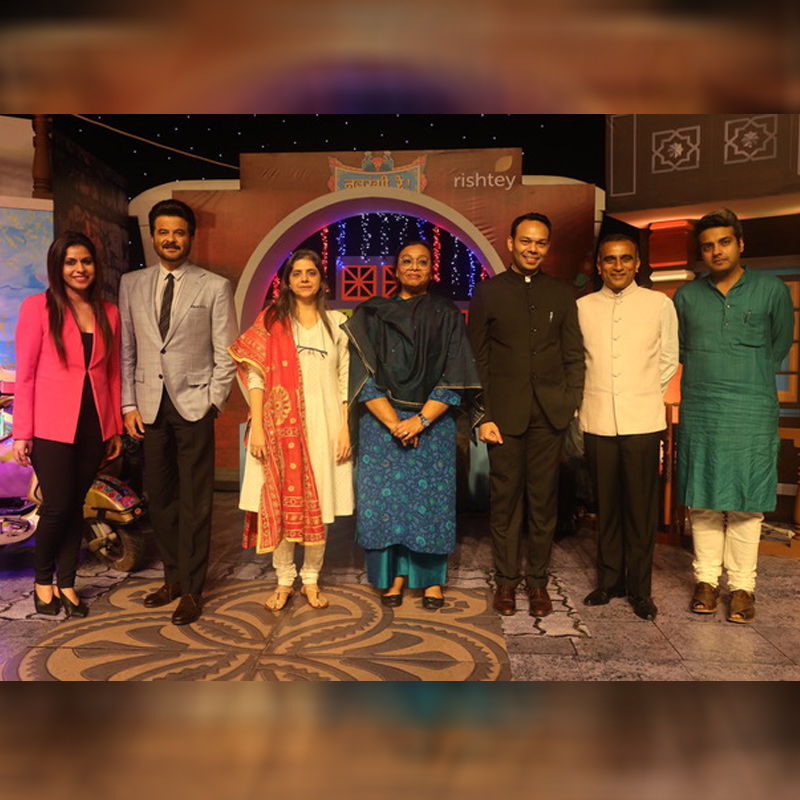
    But the USP of the show doesn’t end here! There is a special guest who joins the Mohalla one day as well, and it’s none other than Anil Kapoor, the superstar himself, who is known to take roles he truly believes in. But what made him do a cameo on TV? Says Anil Kapoor, “Most people believe that talking about the cause of sanitation is boring. But Viacom18, being the powerful storytellers that they are, took it upon themselves to add a quirky twist to a seemingly mundane topic and made it funny. The cause is aligned with Sri Narendra Modi ji’s vision of Swacch Bharat Abhiyan, and also very close to my heart. I agreed to do a cameo, because I believe every small step brings change.”

    Aamir Ali as Vishwaas said “I couldn't have asked for a better start to the year. Navrangi Re! is very close to my heart because the character of Vishwas is very relatable. He is fun and games yes, but he also has this hunger of doing something for the betterment of the society.”

    Vaishnavi Dhanraj as Chitralekha said, “Navrangi Re! urges you to #GiveAShit and take responsibility. It's actually my New Year resolution as well.  I think everyone who watches this show will enjoy it,and take a message at the end of it. I couldn't have asked for anything better.”

    Susmita Mukherjee as Rajrani said “I've been part of many TV shows in my career, but this one will always be close to my heart. It's a finite series for once, something I've never done before, which means we have the added challenge of establishing our character in a shorter period of time. Also, the character is very “Navrangi” herself.”

    Raju Kher as Gajraj Singh said, “Navrangi Re! gives me the opportunity to explore lots of emotions while passing on the message of sanitation. It's a very creative concept, with a host of actors that are balls of energy themselves. Every day at the sets is unique and rejuvenating. I can't wait for the audience to feel the same love for Navrangi Re! that we have felt while acting in it.”

    Navrangi Re! will launch on February 2nd, 2019 and will be telecaston Saturday and Sunday at 9:30 pm on Rishtey.It will also air on COLORS Gujarati and COLORS Odia at 6:30 p.m. on Saturdays and Sundays starting February 9th. Viewers can also watch it anytime on VOOT.