Tag: sustainability

  • Hyundai joins forces with BBC Future for more sustainable world

    Hyundai joins forces with BBC Future for more sustainable world

    Mumbai: South Korean automotive major The Hyundai Motor Company will be the exclusive sponsor of BBC Future Planet throughout the month of August. With the sponsorship, the carmaker aims to reach global audiences looking to create a more sustainable world. Launched in February 2020, BBC Future Planet is an online publication with a sole focus on climate change.

    As part of the sponsorship, BBC StoryWorks – the commercial content studio of BBC Global News – created a documentary-style film highlighting Hyundai’s partnership with the ocean conservation organisation, Healthy Seas, to combat ocean pollution, nurture sustainable marine ecosystems, and support a circular economy. The film tells the story of how an abandoned fish farm on the coast of Greek island, Ithaca, has now become the solution to Hyundai’s sustainable car interiors.

    Hyundai Motor – Europe, president and CEO, Michael Cole said that beyond providing zero-emission mobility solutions on land, the company also cares about protecting fragile ecosystems at sea and that is why they have partnered with Healthy Seas throughout this project. “With the BBC we were able to win an important partner to tell our story. Together, we have successfully overcome the tremendous logistical challenges to make this vision become a reality,” Cole added.

    As cleaning up and preventing marine pollution aligns with Hyundai’s global strategy, the branded content was produced sustainably, by driving electrified vehicles from London to Greece instead of flying, choosing to consume vegan meals, and using solar power to charge equipment, the company said in a statement.

    “Sustainable brands looking to communicate their green practices have long been commercial partners of BBC Global News due to our relevant and engaging content, our global and affluent audience, and our own commitment to being carbon neutral,” said BBC Global News, EVP of international ad sales, Sean O’Hara. “Since the launch of BBC Future Planet, we have consistently offered audiences immersive, solutions-based content, and traffic to the site has increased exponentially over the past 12 months. We’re pleased brands like Hyundai want to be part of this success; to stay top-of-mind, and for the BBC’s expert storytellers to help them engage with audiences through creative and emotive brand campaigns.”

    BBC Global News, acting regional director of ad sales – Europe and Eurasia, Sibel Boner added, “We are excited to enter this commercial partnership with Hyundai, to communicate their story around the Healthy Seas project, a reflection of the trust and expertise the BBC has in producing immersive, engaging content that reaches global audiences.”
  • Dentsu joins the World Business Council for Sustainable Development (WBCSD)

    Mumbai: Dentsu Group Inc. announced on Wednesday that the company and its group companies have become the newest member of the World Business Council for Sustainable Development (WBCSD) – a CEO-led organisation of 200 international companies working on a variety of issues related to sustainable development.

    “Dentsu’s strategy and understanding of sustainability challenges are well aligned with WBCSD’s new membership criteria and Vision 2050: Time to Transform, which sets a shared vision of a world in which more than nine billion people are able to live well, within planetary boundaries, by 2050,” said the company on Wednesday.

    As dentsu joins WBCSD, it will leverage its expertise and network in the Japanese market to advise and help position Vision 2050 and the work of WBCSD in Japan among the wider business community.

    Operating in over 145 countries, Dentsu Group has recently committed to procuring 100 per cent renewable electricity and reducing absolute emissions by 46 per cent by 2030. Its international operations are already powered by 100 per cent renewable electricity. In addition to this, it has committed to helping one billion people make more sustainable choices in collaboration with its clients and partners.

    Meanwhile, Dentsu’s 2030 sustainability strategy has already set out the areas in which the company aims to make the biggest difference, which includes decarbonizing the digital economy by achieving Net Zero emissions by 2030, building a fair and open society by creating a diverse and inclusive workforce and society, and realising the positive potential of digital by closing the digital divide through empowering the next generation with the skills they need to thrive.

    It has also launched dentsu Sustainable Business Solutions (dSBS), a commercial strategy to support business growth while integrating sustainability across campaigns.  “Dentsu’s strength in integrated communication is based on a deep understanding of consumers and society, creativity, and an ecosystem of co-creation with clients and partners. The Group will incorporate this dSBS perspective into all of its businesses both within and outside of Japan,” it said on Wednesday.

    Dentsu Group Inc. director and executive officer, Dentsu International Global CEO and WBCSD council member Wendy Clark said the case for sustainability has never been greater and dentsu is committed to a focused agenda of Growth FROM Good. “As a global leader in media and advertising, we have a unique opportunity and responsibility to help guide our clients through this transition and in parallel use our insight into human behaviour to inspire people all over the world to a better and more sustainable way of living. By joining WBCSD we bring this purpose and capability to a network of like-minded global companies, committed to accelerating the transition to a more sustainable, restorative and inclusive economy,” he added.

  • Guest column: Brands have to re-strategise for impactful engagement with consumers

    Guest column: Brands have to re-strategise for impactful engagement with consumers

    MUMBAI: 2020 has been a year of hard lessons that will leave an impact across industries and societies for decades to come. The year of the pandemic made us change the way we conduct business, and rethink our strategies, compelling us to adapt to the changing realities of the times. We’ve already witnessed a fundamental shift in how companies approach their marketing. However, one thing is clear to all of us: the pre-Covid2019 world is gone for good and 2021 is going to be about how brands amend and adjust their strategies for the new normal. We don't know yet if schools will open anytime soon. We don't know about the functions of vaccines, however, we have to re-evaluate, gear up and think of a way forward for 2021 and beyond.

    1. Digital expansion

    When the dust from the Covid2019 crisis finally settles, it will be clear that we’ve dramatically accelerated the adoption of digital technology into our lives. The pandemic has shown us how this digital transformation has made many aspects of our home and work continue almost as normal, despite the abnormal circumstances. Agile marketing and a presence on both online and offline platforms is the need of the hour. Our online presence and digital engagement have always been high and we would also be focusing on how our brand can work on making the digital community stronger.

    2. Reconnecting with the normal world and fostering human connection

    As we’re navigating a new way, we know that many of those activities we took for granted have transformed. From going to the grocery store to children attending school, our lives have changed for good. For many of us, work has also shifted from full time work in an office to work from home. This has impacted the ways we humans interact with each other and we’re transitioning to virtual relationships. Now that we all are getting to grips with the new normal, it’s never been more important to stay connected to the people and embrace flexibility. Brands will have to re-target and re-strategise to engage with consumers in newer and more impactful ways.

    3. Ease of purchase

    As the pandemic has compelled consumers and us to adopt e-commerce/door-to-door services and dependency on digital means at a rapid pace, 2021 will see brands working further to improve product accessibility for consumers as India's digital revolution gathers pace after a subdued economic year overall.

    4. Climate change and sustainability

    Even though it might not be obviously clear, the Covid2019 pandemic has highlighted the fragility of human existence itself, and that in turn has forced consumers to prioritise sustainability and climate change issues that might have been overlooked five years ago. The rising penetration of social media in every aspect of lives has also compelled consumers to signal to their peers that they care about the planet. Caring for the planet and sustainable ecosystems along with proselytisation of veganism have become key virtue-signalling elements in our thought process. Brands across the world have responded to this change and even fossil fuel conglomerates are presenting “Green, sustainability” funds to mitigate the effects of climate change. The world is witnessing the power of mass behaviour change and everyone is remembering the importance of leading with purpose. Consumers prefer to connect with brands that display a sense of sustainability ethic.

    In 2020, Faber-Castell launched its recycled range of paper pencils, made with recycled and repurposed paper. The rainbow shavings in this product underlined the brand’s priority to promote inclusivity. Added to this, the water-soluble seeds found at the bottom of the product emphasized its eco-friendly quality. Through this one product, we are forwarding our goals of sustainability as well as inclusivity. This is not to say that we are resting on our accomplishments. Through advanced research and product development, we are constantly attempting to further improve our sustainability score through innovation in our packaging and products. The consumers have always positively responded to this and we hope that we will continue to be appreciated for it.

    (The author is marketing director of Faber-Castell India. Indiantelevision.com may not subscriber to her views.) 

  • Liva partners with FDCI to showcase India’s first Green Heart Fashion Show

    Liva partners with FDCI to showcase India’s first Green Heart Fashion Show

    MUMBAI: Liva, the ingredient consumer brand of the Aditya Birla Group, has announced its partnership with Fashion Design Council of India’s (FDCI) to showcase India’s first Green Heart Fashion Show with a thought leading initiative to promote the concept of sustainability through their collection and products. This initiative by Aditya Birla was the reflection of its commitment towards breaking the myth about eco-friendly materials and also educates the users about the need for utilisation of sustainable materials to avoid environmental hazards in future.

    In order to enhance and promote sustainable development Green Heart Fashion Show showcased collections by well-known designers: Rina Dhaka, Sahil Kochhar, Shalini James, and Samant Chauhan who created fluid garments using Liva eco. The show reconciled sustainability with the fashion industry, ethics and responsibility with beauty, luxury and comfort with style and elegance. The collection shattered the myth of sustainable clothing being boxy, stylishly textured, and fashionable while highly breathable.

    “The mission was to showcase a series of collection  featuring designers championing sustainability and eco-friendly fashion practices. Liva has taken this step of associating with FDCI to support responsible fashion across the value chain,” said Birla Cellulose global chief sales and marketing officer Rajeev Gopal on Liva’s association with FDCI. “With textiles consumptions increasing by the hour and the emergence of fast fashion, the industry at large must realise the need for sustainability to save the future” he further added.

    “FDCI is forging ahead to take fashion on a greener path with a generation of new-age eco-warriors. We believe sustainability and conscious consumption is the need of the hour. Thus, we are extremely proud to begin this new chapter with LIVA as our associate sponsor, as we share a common ideology,” says FDCI president Sunil Sethi.

  • HUL joins twitter to reach out to its consumers

    HUL joins twitter to reach out to its consumers

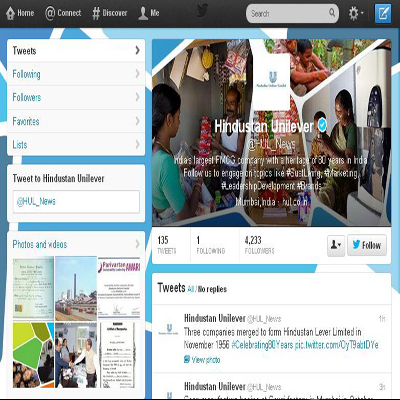
    MUMBAI: Hindustan Unilever Limited (HUL), the market leader in consumer products in the country, has joined twitter recently.


    The company which has presence in over 20 consumer categories such as soaps, tea, detergents and shampoos amongst others with over 700 million Indian consumers using its products joined the social media site with the handle @HUL­_News with a tweet saying “HUL, India’s largest FMCG company is now on Twitter. Join the conversation with us on topics like #Sustainability, Marketing & #Leadership.”


    When asked why did the company as a corporate brand chose to join twitter, the HUL spokesperson said: “Social media provides us an opportunity to reach out to our consumers and other stakeholders in an ongoing and engaging manner.”


    And with 4,233 followers already on the site in a short span is proof enough what the brand means to the country.


    Not to forget that HUL has been on social media for several years now through its various brands like Sunsilk, Surf Excel, Dove which the company boasts of having led digital marketing in India with some path-breaking work and innovations.