MUMBAI: Brands often boast about the number of “likes”, “followers” and “tweets” they garner, but are these measures of brand advocacy too crude? Are people that “like” and “follow” everything true brand promoters?
As companies grapple with the meaning and impact of social media on brands, Social@Ogilvy and SurveyMonkey join forces for a second year to study how to transform supporters into real, long-lasting advocates, who carry on the brand voice and promote it to others.
Just as last year’s study showed that brands producing high quality content is critical to engage with social media users, this year’s global, 11-country online survey of more than 5,000 social media users shows that just because people are saying positive things about your brand, doesn’t mean they are real brand advocates. But, if one uses the right approach and techniques, they can be, and this global research sheds light on how.
“Sharers”, “followers” and “retweets” are crude measures of true brand advocacy
Majority of users are actively noticing and engaging with brands via social media, with the research showing that 84 per cent of respondents across the 11 markets say they had “liked” or “followed” a brand, product or service. Of those that have “liked” or “followed” a brand, 58 per cent have interacted directly with a brand and 79 per cent received a response back (shout out to social media managers everywhere!).
The research did not observe any shortage of “social sharers” who not only follow a brand, but who proactively share their experiences: 58 per cent of respondents have communicated either positive or negative opinions about a brand with others.
These social addicts, who typically stay glued to the likes of Facebook, YouTube and Twitter on a daily basis, exhibit similar behaviors but there are still key differences and steps to transforming “sharers” into brand promoters – those respondents who self-identified as being extremely likely to recommend brands and products to friends.
While 58 per cent respondents are “sharers”, only 19 per cent are true brand promoters
Authentic brand promoters are far more rare and influential than sharers, with the global research revealing notable differences to watch out for between them when looking to identify the profile of a promoter.
How do promoters interact via social media?
. They are intrinsically more active followers: 66 per cent follow brands on a regular basis, compared to only 52 per cent of sharers.
. Promoters follow brands in order to interact directly with them. 42 per cent of sharers do this compared to 52 per cent of promoters.
Why do promoters interact with brands?
. A prime reason they follow brands is to be associated with them which 39 per cent do, versus only 28 per cent of sharers
. 46 per cent also believe a brand’s reputation is important, compared to only 36 per cent of sharers
. They prefer to link a brand to their own personal identity, with 45 per cent saying they feel better about themselves after using a brand; only 35 per cent of sharers say the same
What action do they evoke?
. The friends of promoters talk about brands much more: 59 per cent of promoters see their networks regularly mention brands and products, while only 47 per cent of sharers do the same
. They are much more likely to respond to their friends’ interaction with brands; 35 per cent would purchase a product if it was mentioned by a friend, compared to just 24 per cent of sharers
Globally, these promoters share broadly similar characteristics
True promoters have similar reasons for liking or following a brand, for example: 77 per cent want to hear about products, offers, or news, followed closely by 53 per cent who want to give direct feedback and 52 per cent who want to interact directly with an organisation. Promoters tend to surround themselves by like minds when it comes to their attitude towards brand interaction on social media: 91 per cent say their friends’ mentions of brands are largely positive.
Quality is paramount with virtually everyone (91 per cent) saying this is why they would be extremely likely to recommend a particular brand or product to friends or colleagues. And, it’s the main reason why 61 per cent promoters would not recommend a brand or product.
What brands should be careful of
While both sharers and promoters have posted about a great brand experience on social media, 71 per cent of sharers and 60 per cent of promoters have also discussed terrible brand experiences online.
Emerging economies breed a higher percentage of promoters
Countries with the highest percentage of promoters live in emerging economies, like Brazil and India, where 42 per cent and 33 per cent respectively, fall into this category. Japan revealed the smallest percentage by far with just 1 per cent of promoters, followed by Germany and France (14 per cent each), and UK, Indonesia and Australia (15 per cent each).
However, important cultural nuances are likely to be at play. For instance, Indonesia has a low number of promoters despite 70 per cent of respondents saying they’ve shared great brand experiences on social media. This could suggest that the more passive approach of advocacy via social sharing may be more popular in Asian countries. Equally, a low number of Japanese promoters could be attributed to the formal, more private culture – making them less willing to make personal recommendations online. To that effect, the majority of Japanese respondents (43 per cent) report in-person brand or product recommendations are most trustworthy.
While it is clear people are more connected than ever – demonstrated by the sheer breadth of networks available to us – the research from SurveyMonkey and Ogilvy shows that it is the depth of connections that change our lives and the world around us.
Ultimately, brands need to build relevance and trust through content and connections if they wish to use social media to transform their brand, business and reputation.
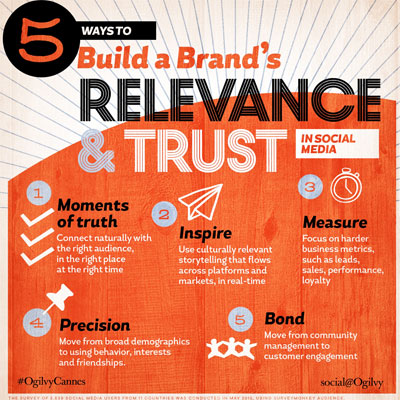
5 steps that the research insists to garner brand relevance and trust in social media
1 . Precision: Move from broad demographics to using behaviour, interests and friendships
2. Moments of truth: Connect naturally with the right audience, in the right place at the right time
3. Inspire: Use culturally relevant storytelling that flows across platforms and markets, in real-time
4. Bond: Move from community management to customer engagement
5. Measure: Focus on harder business metrics, such as leads, sales, performance, loyalty
“Companies need to move beyond collecting likes and retweets with meaningless content. Through genuine interaction and content designed to connect with true advocates, companies can drive forward their brand, business and reputation in ways not possible before this era of social media,” said Social@Ogilvy global managing director Thomas Crampton.
“Social media addicts may look like your most engaged consumers, but marketers need to stop looking at their data in silos to find their true advocates, By applying the Net Promoter Score methodology to social media users across the globe, we better understand the profile of a brand promoters: those who are extremely likely to recommend brands to friends and colleagues. To appeal to promoters, brands need to not only focus on quality but also reputation among friends or colleagues and that sense of worth that comes from being associated with a brand,” added SurveyMonkey vice president of marketing communications Bennett Porter.