Tag: Survey

  • Amul, Parle amidst global brands liked by Indians

    Amul, Parle amidst global brands liked by Indians

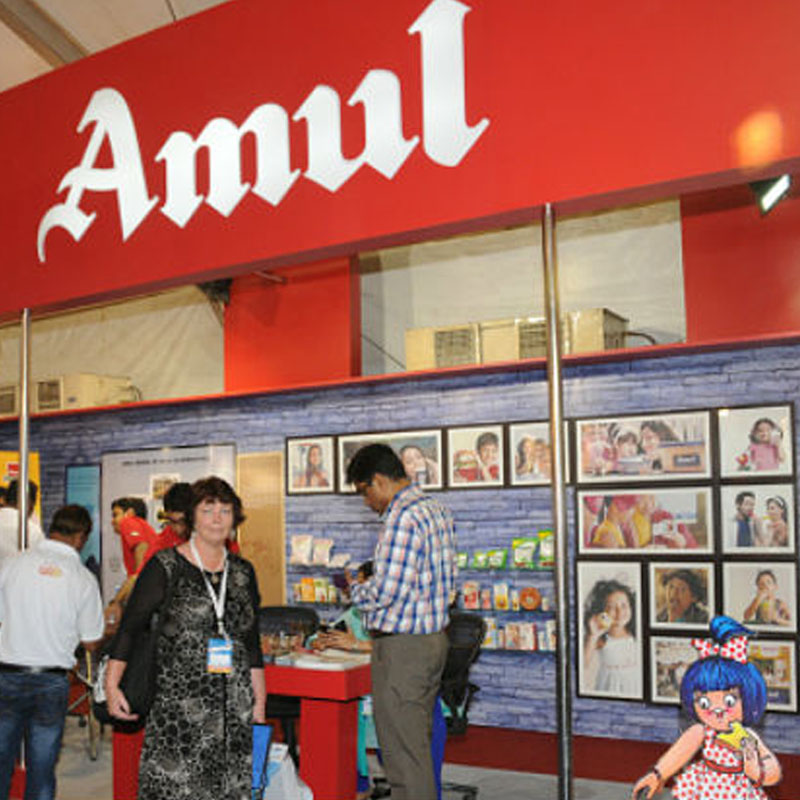
    MUMBAI: Domestic brands such as Amul, Parle, Big Bazaar and Dabur are liked and revered by Indian consumers at par with international brands like Samsung and Coca-Cola, a Nikkei BP-Market Xcel Data Matrix survey has revealed.

    The top 10 brands featured in the survey are a mix of technology, FMCG and retail brands.

    According to the Brand Asia Survey 2017, Samsung has emerged as the most popular brand in terms of consumer brand relationship, followed by food and drinks brand Amul and mobile brand Nokia.

    “Amul, the food and drinks brand, has scored second place this year beating Coca-Cola (rank 10) and Pepsi (rank 15),” Ashwani Arora, Senior VP Research, Director on Board, Market Xcel, told IANS.

    “Nokia is one brand which is revered by Indians and has a high connect and past equity. The brand was once a household name in India. The relaunch of the brand in India has refurbished the emotional connect with consumers as is evident in the survey,” Arora said.

    Samsung mobiles and fast-moving consumer goods (FMCG) company Parle ranked fourth and fifth in terms of the most popular brands in India.

    “Parle — a brand from the pre independence era — goes on to prove the love people have for it still. It has ranked fifth this year and its win is solely dedicated to the wide variety of its biscuits which has satiated consumer palettes since ages,” said Arora.

    “Hence, Indian brands are equally liked and revered by consumers,” he added.

    The survey revealed that Future Group-owned retail business Big Bazaar was the only retail brand to mark a place in the top 10 popular brands at rank six.

    According to Arora, the kirana shops are unable to provide the choice, ambience, service and discounts which Big Bazaar offers leading to its popularity among customers.

    “The (Big Bazaar) brand has many firsts to its credit. The only national competitor to the brand being Reliance Retail,” he added.

    The rest of the brands in the top ten category included toothpaste brand Colgate, messaging platform WhatsApp, FMCG brand Dabur and beverages company Coca-Cola.

    A total of 200 brands were surveyed in 13 countries across Asia with a mix of national and international brands.

    The categorisation of nominated brands was from FMCG, food and drinks, clothing/fashion, automaker, IT/home electronics, telecom, media/entertainment, finance, retail, restaurants (QSRs), sporting goods, transportation/logistic, aviation, finance and social media (internet).
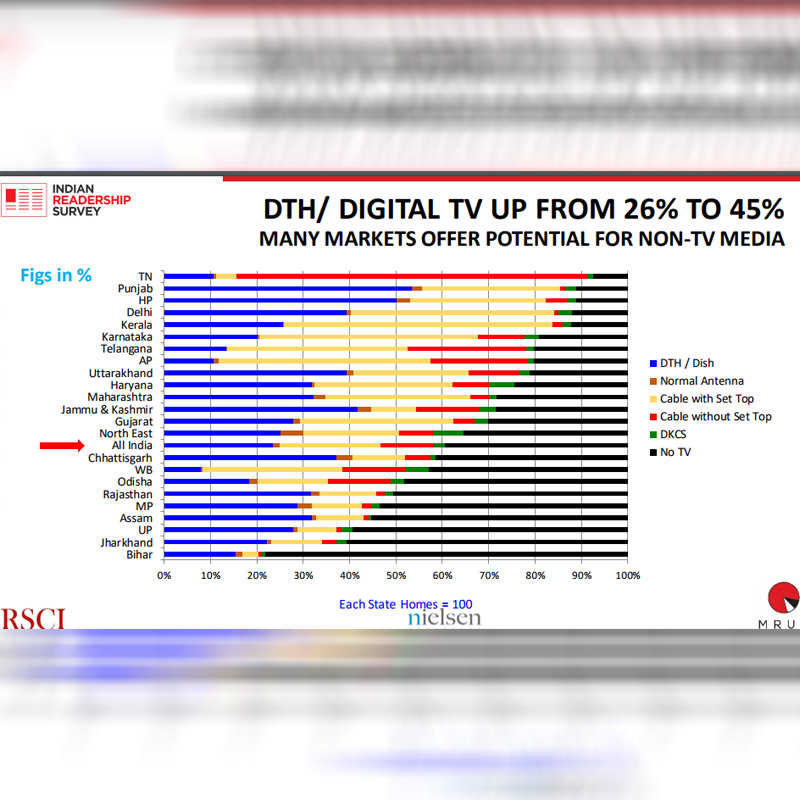

  • TV ownership increased by 14% in 2017: IRS

    TV ownership increased by 14% in 2017: IRS

    MUMBAI: After a gap of four years, the Indian Readership Survey (IRS), which documents the growth of the media industry, has been released for 2017. The survey methodology was criticised in 2014 and, therefore, was halted for an upgrade. This time, the sample size has been increased by 34 per cent to 3.2 lakh households. The entire process was audited by E&Y.

    The study found that there has been an overall 14 per cent increase in TV ownership in Indian households. TV ownership, according to the 2011 census, stood at 47 per cent but the IRS study found it to be 61 per cent in 2017. Tamil Nadu had the highest TV penetration with 93 per cent followed by Kerala at 90 per cent. Punjab and the National Capital Region of Delhi tied at third position with 88 per cent. The census numbers for these states were 87 per cent, 77 per cent, 83 per cent and 88 per cent, respectively. The lowest reach, as per the IRS, was of Bihar with 22 per cent and 15 per cent as per census.  TV ownership was lowest in Tamil Nadu with less than 10 per cent. The number of no TV homes was highest in Bihar with more than 75 per cent.

    The percentage reach for TV in the last one month in the age group of 12 + (L1M) was 75 per cent, 10 per cent higher than IRS’ 2014 study. In this, urban reach was 88 per cent, 3 per cent higher than 2014 and rural reach was 68 per cent, 14 per cent higher.

    The DTH or digital TV market was up from 26 per cent to 45 per cent. Punjab leads with close to 55 per cent homes with DTH followed by Himachal Pradesh with 50 per cent.

    Colour TV ownership stood at 61 per cent in 2017 up from 55 per cent in 2014.

    Also Read:

    BARC sets a deadline for IRS

    BARC gets IRS data, to start installation of peoplemeters soon

  • Media and marketing professionals most vacation deprived: Expedia Report 2017

    Media and marketing professionals most vacation deprived: Expedia Report 2017

    MUMBAI: Majority of media and marketing professionals are sleep-starved, according to Expedia’s new edition of Vacation Deprivation Report 2017, stating that they cannot afford to take a holiday. 

    The study was conducted online between 4 September and 15 September 2017 on behalf of Expedia by Northstar Research Partners. The company surveyed 15,081 working adults across 30 countries.

    The report states that 66 per cent respondents of those surveyed from the media and marketing sectors said they don’t take vacations because they cannot afford a holiday or get out of work.

    Millennials are the most vacation-deprived age group and also receive the least vacation time. At 53 per cent, they are also the most likely to shorten their trips due to impending workload.

    Professionals in the government and education sectors are found to be the least vacation deprived.

    The study revealed that after media and marketing sector professionals, about 62 per cent of those in the food and beverage sector said they don’t have enough holidays, followed by agriculture with 56 per cent, transportation and travel with 56 per cent, business and consulting around 55 per cent, and finance and legal at 55 per cent.

    Furthermore, the study said that professionals in government, health, transportation and travel, real estate, business and consulting and manufacturing and technology sectors have not taken a holiday in the last six months.

    Moreover, 35 per cent of professionals in sectors like agriculture, media and marketing, food and beverage, retail and education said they are vacation deprived mainly because they cannot afford to take a holiday. In sectors like finance and legal, however, 28 per cent professionals attribute it to not getting time off from work. 

    Also read: 

    Air India, Jet and Indigo’s oops moment!

    Budget ’17: Rural net will facilitate travel bookings

  • 82% Indians say IPL not a drag: Ipsos Survey

    82% Indians say IPL not a drag: Ipsos Survey

    MUMBAI: —Ipsos IPL survey shows that 82% Indians polled view the IPL as an extravaganza for cricket buffs and are fine with the tournament stretching to 7 weeks, given our high interest in the game; 12% respondents however find the duration of the tournament too long leaving little time for other things; though 7% respondents desisted from voicing their opinion.

    “Weariness from watching too much IPL is unthinkable for a cricket crazy nation like ours. IPL does hijack complete attention of cricket enthusiasts,” said Amit Adarkar, Managing Director – India, Ipsos.

    Given the popularity of the IPL, we’d asked respondents to name star batsman of the IPL who would notch up the highest runs. 46% named Virat Kohli and other batsmen chosen were: MS Dhoni (21%); Chris Gayle (9%); Rohit Sharma (7%); AB De Villiers (6%); Suresh Raina (5%); Brendon McCullum (2%); David Miller (2%); Steven Smith (1%) and Glen Maxwell (1%).

    Interestingly, the Orange Cap Holders, batsmen with highest run tally in pecking order so far are: Virat Kohli (RCB), DA Warner (SH), AB de Villiers (RCB), RG Sharma (MI), AM Rahane (RPS), G Gambhir (KKR), S Dhawan (SH), M Vijay (KXIP), Q de Kock (DD) and SK Raina (GL).

    We’d also asked respondents to name bowlers who would take most wickets. Star bowlers chosen were: Ravichandran Ashvin (21%), Sunil Narine (19%), Zaheer Khan (14%), Umesh Yadav (12%), Mitchell Johnson (9%), Lasith Malinga (8%), Dale Steyn (6%), Jasprit Burmah (5%); Mitchell Star (4%) and Tim Southee (3%) .

    In IPL 9, Purple Cap Holders (bowlers bagging maximum wickets) are: YS Chahal (RCB), B Kumar (SH), MJ McClenaghan (MI), Mustafizur Rahman (SH), SR Watson (RCB), AD Russel (KKR), Sandeep Sharma (KXIP), JJ Burmah (MI), DJ Bravo (GL) and DS Kulkarni (GL).

    “A lot of dark horses have created new benchmarks in their career in this season of the IPL,” said Adarkar.

    Virat Kohli, skipper Royal Challengers Bangalore (RCB) has kept the momentum going and has notched up the highest run tally in the IPL Season 9 and had recently displayed a scintillating performance at the ICC T20 World Cup as well. Comparing Kohli with Tendulkar has been rife for some time; we asked respondents if Virat Kohli was a legend in making a la Sachin Tendulkar? 51% respondents agreed that Kohli is a legend in making and inching towards being next Tendulkar; 28% however felt that Kohli was a legend in making but far from being the next Tendulkar; 11% felt that Kohli still has to play some more good cricket to either be a legend league or be the next Tendulkar. 10% had no views.

    With all the hoopla around the IPL, our survey asked which team would lift the trophy. Overall we got, divided views: 26% voted for Mumbai Indian (MI); 23% for the Kolkata Knight Riders (KKR); 20% chose the Royal Challengers Bangalore (RCB); 14% voted for the Delhi DareDevils (DD); 6% for Sunrisers Hyderabad; (SH) 4% for Kings Eleven Punjab (KXIP); 4% for Rising Pune Supergiants (RPS) and 3% for Gujarat Lions (GL).

    Adarkar is all praise for Gujarat Lions: “Debutants have notched up highest points when we look at the matches-won-tally (this is likely to change as more matches are played). Underdogs have zipped past the rest.”

    Point wise pecking order, till now was: Gujarat Lions is leading and at the top, followed by RCB, SH, KKR, MI, DD, RPS and KXIP.

    Interestingly, our survey shows allegiance by most cities for their state team, barring a few exceptions: Delhiites feel DD will bag the coveted IPL Trophy (56%); Mumbaikars say MI (75%); Chennai chooses MI (44%) and DD (21%); Kolkata sure about KKR (80%); Ahmedabad torn between KKR (48%) and RCB (38%); Bangalore for RCB (58%); Hyderabad for SH (40%) and RCB (26%); Lucknow fan following is split between RCB (30%), KKR (29%) and MI (21%).

    “This season we have seen the two debutante teams of Gujarat Lions and Rising Pune Supergiants. It will be interesting to see whether defending champions Mumbai Indians lift the trophy or will it be the Gujarat Lions, Delhi Devils or Kolkata Knight Riders. Still a lot more action on the anvil; and frenzy among fans will only increase as the final matches draw close,” adds Adarkar

  • 82% Indians say IPL not a drag: Ipsos Survey

    82% Indians say IPL not a drag: Ipsos Survey

    MUMBAI: —Ipsos IPL survey shows that 82% Indians polled view the IPL as an extravaganza for cricket buffs and are fine with the tournament stretching to 7 weeks, given our high interest in the game; 12% respondents however find the duration of the tournament too long leaving little time for other things; though 7% respondents desisted from voicing their opinion.

    “Weariness from watching too much IPL is unthinkable for a cricket crazy nation like ours. IPL does hijack complete attention of cricket enthusiasts,” said Amit Adarkar, Managing Director – India, Ipsos.

    Given the popularity of the IPL, we’d asked respondents to name star batsman of the IPL who would notch up the highest runs. 46% named Virat Kohli and other batsmen chosen were: MS Dhoni (21%); Chris Gayle (9%); Rohit Sharma (7%); AB De Villiers (6%); Suresh Raina (5%); Brendon McCullum (2%); David Miller (2%); Steven Smith (1%) and Glen Maxwell (1%).

    Interestingly, the Orange Cap Holders, batsmen with highest run tally in pecking order so far are: Virat Kohli (RCB), DA Warner (SH), AB de Villiers (RCB), RG Sharma (MI), AM Rahane (RPS), G Gambhir (KKR), S Dhawan (SH), M Vijay (KXIP), Q de Kock (DD) and SK Raina (GL).

    We’d also asked respondents to name bowlers who would take most wickets. Star bowlers chosen were: Ravichandran Ashvin (21%), Sunil Narine (19%), Zaheer Khan (14%), Umesh Yadav (12%), Mitchell Johnson (9%), Lasith Malinga (8%), Dale Steyn (6%), Jasprit Burmah (5%); Mitchell Star (4%) and Tim Southee (3%) .

    In IPL 9, Purple Cap Holders (bowlers bagging maximum wickets) are: YS Chahal (RCB), B Kumar (SH), MJ McClenaghan (MI), Mustafizur Rahman (SH), SR Watson (RCB), AD Russel (KKR), Sandeep Sharma (KXIP), JJ Burmah (MI), DJ Bravo (GL) and DS Kulkarni (GL).

    “A lot of dark horses have created new benchmarks in their career in this season of the IPL,” said Adarkar.

    Virat Kohli, skipper Royal Challengers Bangalore (RCB) has kept the momentum going and has notched up the highest run tally in the IPL Season 9 and had recently displayed a scintillating performance at the ICC T20 World Cup as well. Comparing Kohli with Tendulkar has been rife for some time; we asked respondents if Virat Kohli was a legend in making a la Sachin Tendulkar? 51% respondents agreed that Kohli is a legend in making and inching towards being next Tendulkar; 28% however felt that Kohli was a legend in making but far from being the next Tendulkar; 11% felt that Kohli still has to play some more good cricket to either be a legend league or be the next Tendulkar. 10% had no views.

    With all the hoopla around the IPL, our survey asked which team would lift the trophy. Overall we got, divided views: 26% voted for Mumbai Indian (MI); 23% for the Kolkata Knight Riders (KKR); 20% chose the Royal Challengers Bangalore (RCB); 14% voted for the Delhi DareDevils (DD); 6% for Sunrisers Hyderabad; (SH) 4% for Kings Eleven Punjab (KXIP); 4% for Rising Pune Supergiants (RPS) and 3% for Gujarat Lions (GL).

    Adarkar is all praise for Gujarat Lions: “Debutants have notched up highest points when we look at the matches-won-tally (this is likely to change as more matches are played). Underdogs have zipped past the rest.”

    Point wise pecking order, till now was: Gujarat Lions is leading and at the top, followed by RCB, SH, KKR, MI, DD, RPS and KXIP.

    Interestingly, our survey shows allegiance by most cities for their state team, barring a few exceptions: Delhiites feel DD will bag the coveted IPL Trophy (56%); Mumbaikars say MI (75%); Chennai chooses MI (44%) and DD (21%); Kolkata sure about KKR (80%); Ahmedabad torn between KKR (48%) and RCB (38%); Bangalore for RCB (58%); Hyderabad for SH (40%) and RCB (26%); Lucknow fan following is split between RCB (30%), KKR (29%) and MI (21%).

    “This season we have seen the two debutante teams of Gujarat Lions and Rising Pune Supergiants. It will be interesting to see whether defending champions Mumbai Indians lift the trophy or will it be the Gujarat Lions, Delhi Devils or Kolkata Knight Riders. Still a lot more action on the anvil; and frenzy among fans will only increase as the final matches draw close,” adds Adarkar

  • 43% data service users unhappy with telecom operators: survey

    43% data service users unhappy with telecom operators: survey

    KOLKATA: The recently concluded spectrum auction for the telecom industry saw 19 days of fierce bidding and telecom companies competing for spectrum to strengthen mobile data services. However a community poll conducted by a social networking platform LocalCircles, revealed that around 43 per cent of phone users in India are dissatisfied with the quality of data services while another 43 per cent have rated it as average.


    According to the study, around 53 per cent of the surveyed people said the quality of network coverage was average, while 27 per cent expressed discontent with the coverage.


    Another 53 per cent felt that the tariffs charged by the operators were expensive, while 38 per cent voted it as a “value for money” proposition.


    Of the people surveyed, 53 per cent put faith on the accuracy of data billing and other services charged by the operators, while 32 per cent did not vote in its favour.


    “Immediate efforts are needed by the telecom regulators and the operators to improve the voice and data service quality by reducing call drops, improving coverage and quality,” LocalCircles said.


    As per the study, a whopping 77 per cent of respondents said the central government and telecom regulatory authorities have “not done enough” to address issues faced by consumers and another 77 per cent said they want operators to bill them based on usage and the services opted for instead of generalised packages.


    “Net neutrality is something that a majority of citizens support and want the telecom regulator to ensure consumer interest is protected at all costs,” it added.


    The company also said that the telecom regulatory body’s regulations are “loose” and the Department of Telecom’s monitoring of compliance on licensing requirements are falling short of expectations.


    The survey was conducted across India with 20,000 citizens responding to six poll questions followed by a “detailed structured discussion.”

  • India fourth most economically confident country: Ipsos Study

    India fourth most economically confident country: Ipsos Study

    MUMBAI: Little did anyone know that the Modi sarkar that had vowed to boost growth, control inflation and restore investor confidence will actually work wonders at such a short span.


    According to the study conducted by Ipsos, India’s economic confidence has got a major boost primarily due to a landslide victory of the business-friendly government led by Narendra Modi.


    ‘Ipsos Economic Pulse of the World’ survey reports that the country’s economic confidence shot up by six points to 66 per cent in May 2014 compared to April 2014, making it the fourth most economically confident country in the world after Saudi Arabia, Germany and China.


    Indians are the most optimistic people in the world and are very confident of good time coming soon. For the very first time India (60 per cent) tops the list of countries whose citizens expect that its economy will be stronger in next half year. Marginally less than a half of Indian citizens (43 per cent) believe their local economy which impacts their personal finance is good, a significant rise of five points.


    “All the data points in the Ipsos report indicate that India’s economic confidence has shot up substantially, which is also corroborated by the fact that India’s current account deficit has significantly eased, the currency has stabilised, inflation has substantially pulled back, stock market had a dream run so far and corporate earnings are improving,” said Ipsos CEO Mick Gordon in India.


    “However, recent high food inflation, conflict in oil-producing Iraq and the fear of a below normal monsoon is big challenge for the new government,” added Gordon.


    The online ‘Ipsos Economic Pulse of the World’ survey was conducted in May 2014 among 19,242 people in 25 countries. For the results of the survey herein, a total sample of 19,242 adults aged 18-64 in US and Canada, and aged 16-64 in all other countries, were interviewed between 1 and 15 April 2014.


    For a second month in a row, the average global economic assessment of national economies surveyed in 25 countries remains unchanged as 39 per cent of global citizens rate their national economies to be good.


    Although down two points since last round, Saudi Arabia (87 per cent) is in the lead once again, with Germany (75 per cent), China (66 per cent), India (66 per cent), Canada (65 per cent), Sweden (64 per cent) and Indonesia (59 per cent) following behind. European countries dominate the bottom of the global average: France (9 per cent), Italy (9 per cent), Spain (10 per cent), Romania (10 per cent), Hungary (18 per cent) and Argentina (18 per cent).


    Countries with the greatest improvements in this wave: South Africa (28 per cent, 10points), Indonesia (59 per cent, 9 points), Russia (58 per cent, 8points), India (66 per cent, 6points), Great Britain (43 per cent, 6points), Poland (31 per cent, 6points) and Belgium (42 per cent, 2points).


    Countries with the greatest declines: Australia (53 per cent, -7pts), Hungary (18 per cent, -6pts), Brazil (20 per cent, -6pts), South Korea (19 per cent, -4pts), Sweden (64 per cent, -2pts), Saudi Arabia (87 per cent, -2pts) and China (66 per cent, -2pts).


    Up three points since last sounding, Saudi Arabia (67 per cent) leads the local economy assessment which impacts their personal finance, followed by Germany (55 per cent), Sweden (51 per cent), China (48 per cent), India (43 per cent), Canada (42 per cent), and Indonesia (39 per cent). Ranked the lowest in this measure this month is Italy (9 per cent), followed by Spain (11 per cent), Romania (12 per cent), Hungary (13 per cent), France (13 per cent), Japan (14 per cent) and Argentina (15 per cent).


    New leader emerges, as for the first time India (60 per cent) tops the list of countries that predict their local economies will be stronger in the next six months. The rest of the highest-ranking countries are: Brazil (56 per cent), Saudi Arabia (53 per cent), Indonesia (50 per cent), China (39 per cent), Mexico (31 per cent) and Argentina (31 per cent). Only 6 per cent of those in France expect their future local economies will be “stronger” in the next half year, followed by South Africa (11 per cent), South Korea (13 per cent), Hungary (14 per cent) and Japan (14 per cent).

  • Some newspaper groups content with IRS 2013 findings

    Some newspaper groups content with IRS 2013 findings

    NEW DELHI/MUMBAI: The findings of the Indian Readership Survey 2013 may ultimately not be rejected outright. A substantial number of publishers of newspapers and magazines may not have found the readership findings worth rubbishing.


    A group of 18 publication groups including The Times of India and The Hindu are very vocal in their complete rejection of IRS 2013 findings and have got to the extent of withdrawing from the IRS.


    But the group’s attempts at having the IRS 2013 annulled could face resistance.


    According to industry sources publication groups like The Hindustan Times, Rajasthan Patrika, Haribhoomi and Daily Thanthi have expressed satisfaction at the results of IRS 2013 and have accepted them.


    These publication groups may decide not to follow an advisory issued by the Indian Newspaper Society on Tuesday for boycott of the IRS 2013 findings or not to use them for advertising sales.


    The advisory was issued after the Media Research Users Council on Tuesday said it cannot decide on the ultimatum given by the INS for withdrawal of the IRS 2013 findings.


    The advisory by INS suggested its members convey in writing to MRUC that they are withdrawing from any association with the IRS and urge MRUC, Readership Survey Council of India and Nielsen India, the conductors of the readership survey, to immediately cease and desist from using for the purpose of the survey the mastheads of their publications.


    MRUC has said a meeting would be held with RSCI on 19 February to take a final view on INS demand.


    MRUC has said all aspects of the study will be placed before the RSCI for helping the broader community of stakeholders convince themselves about the robustness and integrity of the IRS 2013 findings.


    Meanwhile, INS expressed hope that the advisory issued by it would be acceptable to all its member publishers.


    A senior INS office-bearer, who did not want to be named, denied that the INS advisory had been issued at the behest of the Times of India Group or was being followed only by that group.


    INS sources told indiantelevision.com that the issue of whether the newspaper body or individual newspapers will take legal recourse against MRUC over the IRS 2013 findings was still not decided.


    Responding to the INS advisory and notices in newspapers belonging to the group of 18 publishers, IRS Technical Committee chairman Paritosh Joshi said MRUC has already asked individual publishers to send in their complaints to MRUC directly and the council will individually respond to each of them. “So far, we have sent out six explanations and clarifications to the complaints sent to us by publishers individually. And will continue to welcome more (queries).”


    The 18 publishing groups, in a joint statement, said, “The survey is riddled with shocking anomalies, which defy logic and commonsense. They also grossly contradict audited circulation figures (ABC) of longstanding.”


    The 18 publishers are Jagran, Bhaskar, India Today, Ananda Bazar Patrika, Lokmat, Outlook, Daily News and Analysis (DNA), Sakshi, The Hindu, The Times of India, Amar Ujala, The Tribune, Bartaman Patrika, Aaj Samaj, The Statesman, Mid Day, Nai Duniya and Dinakaran.

  • MRUC puts the ball in RSCI court; INS sticks to its 24-hour ultimatum

    MRUC puts the ball in RSCI court; INS sticks to its 24-hour ultimatum

    MUMBAI/NEW DELHI: The last couple of days have been a nail-biting one for everyone having an interest in the Indian Readership Survey. From the time the IRS 2013 was made public, publishers of newspapers and magazines have gone through a lot of turmoil because of the data provided.


    As claimed by many, IRS 2013 has a lot of anomalies and hence, after a meeting on Monday, the Indian Newspaper Society (INS) gave an ultimatum to Media Research Users Council (MRUC) to withdraw IRS 2013 within 24 hours or else face its rejection by publishers.


    MRUC today held an emergency meeting to decide on how to respond to the ultimatum by INS. After the meeting, MRUC issued a statement saying it cannot unilaterally decide on the withdrawal the latest readership survey.


    The Readership Studies Council of India (RSCI), a joint body of MRUC and the Audit Bureau of Circulation (ABC), has called for a meeting on 19 February before any further decision is taken.


    “Unlike three years ago, MRUC no longer can take a decision on its own. RSCI will take a final call now,” says IRS Technical Committee Chairman Paritosh Joshi.


    The members of MRUC unanimously voiced their opinion on the findings. They said decided aspects of the study will be placed before the RSCI to help the broader community of stakeholders convince themselves about the study’s robustness and integrity. The IRS 2013 was contracted to Nielsen.


    Joshi feels that a new methodology was used for IRS 2013, which could have caused some confusion amongst the stakeholders and that they will need time to understand not only the findings but also the methodology which has gone into it.


    The MRUC statement said IRS 2013 cannot be compared with past readership surveys and that the findings are based on the latest census data. It also goes on to say that the study design includes a margin of error.


    INS continues to stick to its 24-hour ultimatum given on Monday, 3 January, according to INS newsprint committee chairman Mohit Jain.


    Jain told indiantelevision.com, “The report submitted by MRUC (today) has been considered in-depth and the members (of INS) have taken a decision to collectively to reject it.”


    INS members were still in a meeting on the issue at the time of filing the story.


    Click here to read MRUC’s statement

  • INS gives ultimatum; MRUC to meet tomorrow

    INS gives ultimatum; MRUC to meet tomorrow

    NEW DELHI/MUMBAI: The revamped Indian Readership Survey (IRS) was supposed to create a new paradigm, but has instead turned out to be a nightmare for Media Research Users Council (MRUC).


    The Indian Newspaper Society (INS) today issued an ultimatum to MRUC, a not-for-profit body of advertisers, advertising agencies, publishers and broadcasters, to withdraw IRS 2013 within 24 hours or face total rejection of the findings of the survey by the publishers.


    Indiantelevision.com had reported earlier that the INS representatives would be meeting officials from MRUC today to discuss issues raised by publishers. Today’s meeting was held in two rounds: the first meeting had print publishers discuss the future course of action while the second one delivered the ultimatum to MRUC.


    The INS is unwilling to climb down from its demand for complete withdrawal of the survey within 24 hours, the contract for which was given to Nielsen.


    The INS representatives attending the meeting were unanimous in their demand for complete withdrawal of the IRS 2013 survey as the first corrective step. The publishers raised several questions regarding the methodology and mechanism based on which the survey findings were arrived at.


    To decide on what should be MRUC’s next course of action, its officials will have a meeting with the Readership Studies Council of India (RSCI), a joint body of MRUC and Audit Bureau of Circulation (ABC). INS Newspaper Society Chairman Mohit Jain confirmed the news and said: “We have also asked MRUC to conduct an extraordinary meeting tomorrow at 11.30 am and decide about today’s discussions.”


    “What happens next will be decided tomorrow by the RSCI,” says IRS Technical Committee Chairman Paritosh Joshi, who is personally saddened by the way things are taking shape.


    Sources say if MRUC fails to take action, INS may issue an advisory to its members asking them not to subscribe to IRS in the future and also not to use the mast heads of their newspapers in future surveys, and may consider supporting some newspapers going to court against the findings to get a stay order on the use of the latest IRS numbers by media planners and advertisers.


    A group of 18 publishers, which include The Times of India, Dainik Jagran, Bhaskar, India Today, Ananda Bazar Patrika, Lokmat, Outlook, Daily News and Analysis (DNA), Sakshi, The Hindu, Amar Ujala, The Tribune, Bartaman Patrika, Aaj Samaj, The Statesman, Mid Day, Nai Duniya and Dinakaran, have been vocal about their dismay with the numbers.


    The publishers felt that there was arbitrary decline in aggregate readership of certain publications. A majority of the publications are negatively affected by the 2013 survey which is based on a new methodology.


    Sources from the print industry shared the data, which shows how particular publications lost their Average Issue Readership (AIR) in a drastic way in some states.