Tag: Supreme Court

  • Prasar Bharati CEO Shashi Shekhar Vempati on SC verdict, pushing DD Sports and DTT

    Prasar Bharati CEO Shashi Shekhar Vempati on SC verdict, pushing DD Sports and DTT

    Shashi Shekhar Vempati is probably one of the youngest CEOs to occupy the Prasar Bharati hotseat.  Additionally, he is the first private sector executive to have got the job. So, media observers expect a lot from him, especially considering his background in Infosys, one of India’s most respected infotech companies.

    And, it is during his watch last month that the Supreme Court issued a verdict upholding the Delhi High Court order which disallowed the pubcaster from sharing with cable operators through Doordarshan (DD) channels the live feed of cricket matches of which private broadcasters ESPN and Star had the exclusive rights. The bench had said under the provision of the Sports Act, the live feed received by Prasar Bharati from content rights owners was only for the purpose of retransmission of signals on its own terrestrial and direct-to-home (DTH) networks and not to cable operators.

    Many would have considered that a loss. But, not Shashi Shekhar Vempati. Clarity and optimism is something you can credit him with. He terms that loss as an opportunity. Read on to get some Vempati-speak as he talks to indiantelevision.com.

    How do you view the verdict of the Supreme Court preventing you from airing sports feeds to private cable TV operators and DTH operators which you share with private sports rights holders?

    The verdict of the Supreme Court on the sports side on the face of it looked like  a setback. And, if you go by the reactions of the viewers to them it was available by default  on Doordarshan. Several matches are not available now.

    But, in reality it was an opportunity.  Many decisions that we just postponed or did not aggressively move on.  Now, there is a real reason to do that. First is on  DD Sports. All along cricket was on DD National. The only sports channel of DD had no purpose or identity, it was just drifting.

    Now we have a reason to make DD Sports the go-to destination for cricket and other sporting events of national importance because of the manner in which the verdict forces us to operate. It creates an avenue  to make DD Sports the place for cricket.

    You cannot air cricket because of the verdict right?

    We will air it. The way the verdict on the act will be operationalised is: the signal sharing for games of national importance is meant for DD’s FreeDish and DD terrestrial. So, we will carry future matches on DD Sports, as a channel available on FreeDish and on terrestrial through DTT.

    Analogue where we have one or two transmitters where we either show DD National or News, there we will ensure that the feed is sports so that one of the transmitters will show the match on analog wherever it is available.

    For the private guys, cable and DTH operators today what are they doing? They are blanking out our screen then they are putting their own commercials, their own promotion. What we are saying is — we will have a separate feed in the future so that they don’t blank out DD National.

    It is atrocious that you can blank out a must-carry channel and put in a commercial message saying “go buy my sports pack.” That we will straightaway address.

    Now because cricket is available on DD Sports, the channel gets a facelift.  Its branding improves – brand recognition goes up. People will have a reason to periodically  tune into DD Sports. So that just takes that channel up. We have enough content on DD National.


    Which of the matches will you show?

    Well, the act,…the government has to notify what are the games of national importance.  And a that list is periodically reviewed. As of now it is all home games of India for one day and T20, then the big tournaments like the World Cup, the challenger and ICC trophy and so on.  Then certain tennis matches, certain soccer matches.

    The big thing is the FIFA under-17. The entire 52  or 56 matches we will show. The  government sees it as a big way of promoting soccer.  For the first time they are holding an international event. And if you look at the generation that we want to attract – which is what I have been talking about. Today, there is no mindshare for Doordarshan in the youth as this generation did not grow up with it. They have no memories of Doordarshan, they don’t relate to it.

    Now with FIFA Under-17 being available this soccer crazy young crowd (chuckling) have an avenue to go and see soccer on FreeDish and DD Terrestrial. DD Sports gets a facelift and it gets a mindshare in this demographic  that we have always wanted to attract and bond with.

    Second thing that I get out of this whole thing is that for all those people who think today I cannot watch those matches on DD on either my private cable or DTH…now I have an avenue to go and promote FreeDish and my digital terrestrial which is just languishing in 19 cities which are the main population centres of India.

    Now I am going to tell them you don’t have to buy that Rs 60 or Rs 120 package. Forget about all that, many of your TVs have an inbuilt digital tuner. There are certain models of Sony, LG and Samsung which have them.

    We will educate people that if you have one of these models, you already have a digital terrestrial tuner, all you need to do is turn it on.  And if you don’t have it, here is an app which you can download. And if your mobile is one of these models, using this app and the DVB-T2 dongle, which is available on Flipkart and other ecommerce platforms you can watch the matches.

    Then, there are certain makes of mobile phones where there is an inbuilt DVB chip available in the marketplace.

    The fourth innovation and I have seen certain products, there are some startups working on it: you need to plug in this hotspot, into the wall, it will get the DVB signal, it will create the wifi – and on all your devices at home you can watch it as a TV channel. We will say these products can support your app.

    How will you monetise the DTT signal?

    When we do the rights sharing under the act , the rights holder and DD both bid on who gets to market the inventory. The highest bidder then gets the rights to sell the entire FCT for the matches on DD DTT and DTH. But the sharing is 75:25.

    Now DTT becomes a new viewership base. So, for the advertisers it is a new way of connecting to the consumers. To me it is new medium to be clipped to the viewership and it’s something where we have a traditional strength because nobody else has terrestrial. We will see how that goes.

    How do you see FreeDish progressing?

    The biggest challenge with FreeDish was that STBs were not  addressable and the signals were not encrypted.  Now for a long time we have had this project to move to MPEG4…the infrastructure is in place, but it required a new STB. That spec was tendered out, iCAS was brought in. Now those boxes are getting ready and soon they will be rolling out. The biggest challenge was what was the motivation for a customer who has an MPEG 2 FreeDish STB to switch to MPEG 4. Now there is a reason, because we can go to the audience and tell them that if you want to watch cricket or any of the sports which you don’t want to pay for your Tata Sky or Dish TV or Videocon or whatever, here is a new iCAS box, it gives you all of these features. That’s another promotional avenue for me. So I am getting two promotional avenues and I am getting to rebrand and relaunch my DD Sports. So in a sense what was a setback in one aspect has opened up opportunity for me.

    One interesting thing that the TRAI is now pushing is the open STB standard with a return path. I think the return path is going to be interesting. It is going to be important for several reasons: for audience measurement, and we would all want interactivity.  Through the regulator’s efforts, and maybe a common standard – and if everyone supports that, it can bring now the price point.

    DD Kids is something which was to be launched?

    There are several ideas. And we will look at each one of them in time.

    What other steps are you taking?

    We have taken some measures following the board meeting recently. It was a long pending board meeting. A lot of decisions were taken. One of the decisions was analog.  We will start sunsetting analog. And that frees up resources. Frees up manpower. Frees up certain operating funds. Those can be put to use in areas where we definitely need a lot of things to be done.

    Information technology being a long pending area where we have not invested. Digital is another area. Then there is the sheer creativity in programming which has come down. The quality of in-house programming has come down drastically. So that requires us to invest in the right talent so we can bring it back in-house.

    DD is the largest network, it has 30,000 people and above… but it has the largest network. We have challenges that nobody else has.

    I chanced upon this report. There was a committee set up in early 2000, late nineties, led by Mr Narayana Murthy which looked at Prasar Bharati (one of the many reports). And, very interestingly, they had a chapter on engineering: they looked at the number of engineers to transmitter ratio, they said this is the highest in any country. That means there is very little automation.

    So, clearly there is a lot of opportunity to get this great talent out and put them to problems which require real attention – be it IT, be it digital, be it reskilling them and repurposing our workforce.
  • Adi, your DishTV virtual tech-assistant, joins today

    Adi, your DishTV virtual tech-assistant, joins today

    NEW DELHI: Zee Group’s Dish TV, which has sprung into action over the past few weeks to protect its status as Asia’s largest direct-to-home platform, has now launched an Advanced DishTV interface’ (ADI). ADI world’s first AI-enabled pay-tv chatbot to enhance customer experience and offer a user-friendly interface.

    The move comes even as the ministry of information and broadcasting is insisting on complaint redressal system following a Supreme Court judgment earlier this year.

    Built for redressal and service lifecycle management, ADI provides a virtual interface that acts as a one stop solution window to subscribers, and guides them instantly to address their queries. It is an Omni-channel interface with customer experience as a core tenet, strengthening DishTV’s position as an innovator in the DTH space. It can enable quick recharges and answer millions of customer queries across multiple channels instantly.

    It is designed to process user requests, powered by deep analytics and its artificial intelligence engine. It enhances customer service through personalized and immediate answers that are available 24×7 and are constantly evolving to become more relevant and accurate for the users. Users converse with ADI in a personal setting, just like they would with family/friends.

    According to Dish TV, it provides a landscape to move from personalization to individualization at massive scale, harnessing the power of big data.

    Dish TV group CEO Anil Dua said, “Relevance in the digital age requires connecting with customers across multiple channels while maintaining the information accuracy along with ease of interaction. With the launch of ‘ADI’, customers can get information on our products and services instantaneously and will be able to recharge, troubleshoot or order a connection on the go. ADI will also encourage those customers who may not be very comfortable navigating the traditional web space. With digital platforms gaining popularity across industries, ADI will enable us to reach out to a wide spectrum of customers, and serve them better with both speed and accuracy.”

    ADI appears as a pop-up feature on the website and introduces itself as “Adi, your DishTV virtual assistant.” One can initiate a conversation by simply entering a message that transforms into rich personalized experience, delivering real-time responses, timely and pertinent to one’s DishTV account. It gives solutions to problems concerning recharge offers, current balance, add-on service upgrades, or any other glitches like unsubscribed channel or lost signals or Smart Card related issues. All the subscriber needs is an 11-digit VC number or one’s registered mobile number, and the rest will be taken care of.”

    ADI is available on desktop and mobile platforms currently and would soon be available on other platforms like Facebook and Twitter. It is a step towards true engagement with customers that goes beyond mere “clicks”, and helps them cut through the clutter to view offerings relevant to them. It also relieves the customers from the effort of calling the customer care or visiting the dealer stores for recharges.

  • TRAI QoS implementation stayed by Delhi HC awaiting Madras HC verdict

    TRAI QoS implementation stayed by Delhi HC awaiting Madras HC verdict

    MUMBAI: The Delhi High Court has stayed TRAI’s QoS regulations till the time the Madras High Court gives its judgement in TRAI tariff order case.

    Earlier, joining issues with a petition being heard by the Supreme Court on a similar matter, the Madras High Court had, three weeks ago, directed the federal government to clarify on the existing regulatory setup governing contents aired by television channels in India. The Supreme Court is hearing a similar case and has enquired from the central government whether it had a proper mechanism in place to regulate TV content.

    Prior to that, the Madras HC had, on 31 July, reserved orders on the Star India-Vijay TV challenge to the jurisdiction of TRAI to issue tariff orders.  The court received a compliance report from its registry that all parties had filed their written submissions.

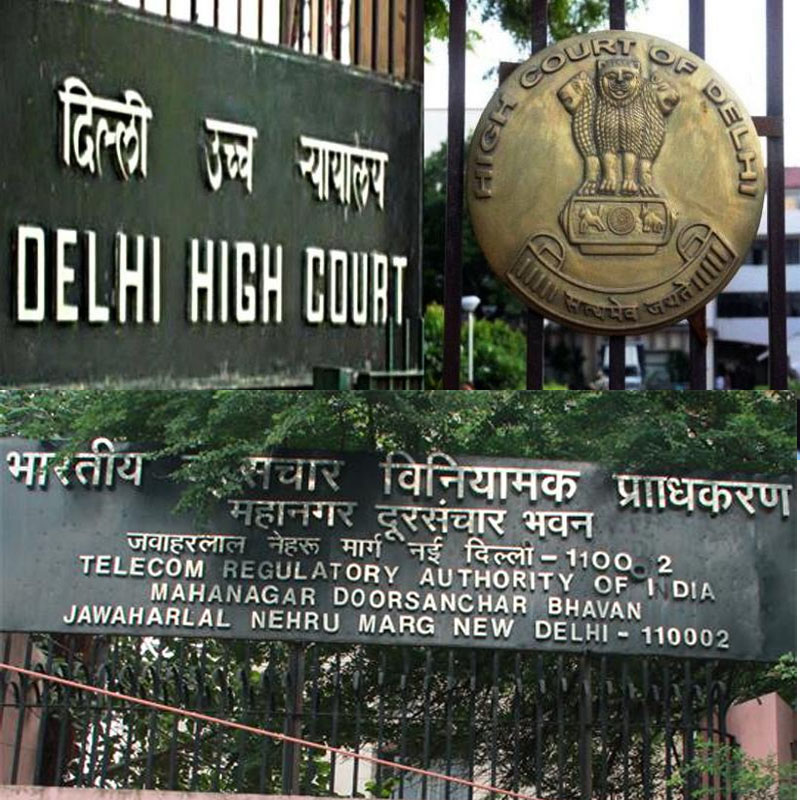
    In the most recent development, the Delhi High Court bench, comprising acting chief justice Gita Mittal and justice C Hari Shankar, stated that it would wait for the verdict of the Madras High Court in relation to the tariff order dispute before deciding on the prayers of Tata Sky and Bharti Telemedia. Till that time, the implementation of TRAI tariff order, interconnect regulations and QoS (quality of service) and  consumer protection regulations would not be effected.

    The two companies had questioned the validity of the QoS.

    ALSO READ :

    Star India-TRAI jurisdiction case to come up in Madras HC today

    Govt rules out TV channel categorisation (updated)

    TRAI can only regulate transmission, not broadcast material: Star tells Mds HC

    SC stays new TRAI tariff, asks Madras HC to complete hearing in four weeks

  • Supreme Court stays order on entertainment tax by LCOs

    NEW DELHI: The Supreme Court today stayed an order of the Entertainment Department of Delhi Government that entertainment tax should be paid by local cable operators with effect from 1 April 2013.

    The division bench of Justice Ranjan Gogoi and Justice Navin Sinha issued notice to multi-system operators and the Delhi Government to file their replies and listed the matter to come up on 1 September 2017.

    It was alleged by some associations of local cable operators – All Local Cable Operators Assciation, All Delhi Local Cable Operator Association, Cable Operators Welfare Association and Walled City Cable Operators Association — that they had earlier been paying entertainment tax to the MSOs but this had not been deposited with the Delhi Government.

    Meanwhile, some MSOs had approached the Delhi High Court challenging a directive of the Government of 17 December 2012 relating to DAS. In its ex-parte order, the Court on 9 March this year said that MSOs who had subscribers directly linked to them would pay the tax while the LCOs would pay for the subscribers linked to them.

    Consequently the Delhi Government had issued notices to the LCOs to deposit the tax from 1 April 2013 onwards.

    The LCOs thus alleged that this amounted to double taxation as they had already paid the entertainment tax to some of the MSOs who allegedly did not pay to the Government.

    Until 1997, the LCOs had been paying the tax but later this was passed on to MSOs to be paid. Later the Aam Aadmi Party government had doubled the tax from Rs 20 to Rs 40 in 2014.

  • Star India case questioning TRAI jurisdiction over content postponed

    MUMBAI: Unmindful of the Supreme Court directive to dispose of the case in four weeks, the hearing of the dispute between Star India and the Telecom Regulatory Authority of India (TRAI) in the Madras High Court has been postponed to 27 June.

    It has been learnt that court will not be sitting around this time and the judges would not be able to give time to the case before the new date.

    Although, the matter was scheduled to be heard on 12 June, arguments and judgement in the dispute concerning the constitutionality of TRAI’s orders will now witness further delay.

    The Supreme Court had earlier granted a stay on TRAI’s new tariff orders. The apex court had asked the Madras High Court to complete the hearing within four weeks. The case was scheduled to be heard on a day-to-day basis from 12 June.

    The broadcasters had challenged the order of TRAI on the grounds that it had no jurisdiction over content, and that actually came under Copyright Act, which is not administered by TRAI.

  • MSOs prepared for new regime, AIDCF stresses on ‘a la carte’ offers from 1 Sept

    MUMBAI: All-India Digital Cable Federation (AIDCF), the apex body of Digital Multi System Operator’s (MSOs), has urged all its members to gear up for the new tariff regime. 

    In its meeting held on Monday, the members were advised to gear up to meet the requirement under the new regulation and prepare their backend to handle dynamic offerings including offering channels on à la carte basis. While the broadcasters and MSOs are free to form their own bouquets, the ultimate “right to choose” to end-consumers will happen by giving them the ability to choose channels on à la carte basis.

    This step has been taken to stream-line MSOs services so that the end-consumer does not face any hiccup when the new regime kick-in on 1 September 2017. It should be noted that the members of the apex body are fully committed to migrate to the new tariff and interconnect regime.

    AIDCF would also like to put on record that the new tariff regime will bring in more transparency and fuel growth by regulating the broadcast distribution system. It will also help in creating a more synergetic environment unlike the current unfettered one and will give the end-consumers, the freedom to choose what they want to watch and provide safeguard to ensure that the channels are being offered with fair trade margin, thus harmonising the entire eco-system.

    The Federation also welcomed the Supreme Court judgment as it will be an ideal scenario if all the legal procedures are put to rest before the new regime kicks in. This way there will be no ambiguity and application of the new regime will be smooth and seamless.

    AIDCF president TS Panesar said, “We are happy to note that the Supreme Court has requested the  Madras High Court to hear this matter on a daily basis beginning 12 June 2017  and come out with the judgement in 30 days. This does not affect the 1 September implementation deadline and we are hopeful that it will be implemented on time.”

    Also Read:

    MSOs upload channel capacity & RIO, AIDCF requests b’casters too

    Upload channel capacity & RIO immediately, AIDCF urges MSOs

    Furnish details of cable connections, Delhi Govt asks operators, MSOs wary of cascading effect

  • ‘Inappropriate content’ on TV & radio to be regulated

    MUMBAI: The Indian Government plans to establish a body to regulate the content broadcast on television and radio channels.

    In the backdrop of escalating concern of over-regulating and gagging of free speech by the Central Government, the government is now considering regulation of television and radio channels against what is being termed as ‘inappropriate content’.

    The Central Government has decided to establish a grievance redressal mechanism against objectionable content that is broadcast on TV news and entertainment channels, and FM and community radio, the Asian Age reported.

    This would mean that radio stations and television channel which were following a self-regulatory mechanism could now be held liable for complaints against their content filed by the public.

    If a member of the public has a complaint regarding certain content broadcast over radio or television, s/he can lodge a complaint with the district magistrate (DM) or the police commissioner (chairmen of the district-level monitoring committee), according to a government directive accessed by the paper.

    People are free to register their complaints online at pgportal.gov.in, or directly send their grievances to the union information and broadcasting ministry.

    In January 2017, the Supreme Court had directed the government to establish a mechanism for redressal of complaints against “contents of private TV channels and radio stations and accord due publicity to the measures to enable citizens approach it with their grievances.”

    The Programme and Advertising Code of the government prohibits the broadcasting of certain type of content, including anything that “offends and is against ‘decency’, contains criticism of friendly countries, contains attacks on religion or communities, is obscene or defamatory, encourages or incites violence, encourages superstition, denigrates women or affects the integrity of the nation.”

    It was reported in February 2017 that action was taken in 52 cases of television and two of radio in the past three years for violation of the Code. The minister of state for information and broadcasting Rajyavardhan Rathore had said the action in most cases was limited to apology scrolls, or switching off channels for a brief period.

    Rathore had said the Supreme Court had, on 12 January 2017, advised the Government to formalise the complaint redressal mechanism including the period of limitation within which a complaint can be filed. The court also said the concerned statutory authority which shall adjudicate upon the same including the appellate and other redressal mechanisms, leading to a final conclusive determination.

    As and when there is a prima facie case of violation by private satellite TV channels and private FM channels regarding content aired by them, the matter is placed before the IMC for its consideration/recommendations. Thus, IMC functions in a recommendatory capacity.

    Apart from this, the Ministry had earlier issued directions to States to set up District level and State level Monitoring Committees to regulate content telecast of local TV channels carried on Cable TV Networks.

    AlsO Read :

    Press regulation not called for, says Modi

    SC to MIB: Get mechanism to deal with complaints on TV, radio shows

    Govt warning to TV channels on b’cast norms breach

    Govt admits centralised content monitoring of TV and Radio ‘non-workable’

  • Madras HC: Arguments to continue in Star-TRAI tariff case on Thursday

    NEW DELHI: Arguments will to continue tomorrow on the application by Star India and Vijay TV seeking a stay of the tariff orders issued by the regulator last month and slated to become effective 2 May 2017. It is expected that the arguments will conclude on Thursday and the order announced thereafter on the stay application.

    The broadcasters, who have challenged the jurisdiction of the Telecom Regulatory Authority of India in issuing relating to TV content in Madras High Court, had on 28 March decided not to press for stay after the Court was informed by the regulator that it had decided to defer implementation of its tariff orders to 2 May instead of 2 April.

    TRAI had issued the tariff order, Quality of Service, and Reference Interconnect Agreement orders after getting clearance on 3 March from the Supreme Court, which had then directed the High Court to conclude the matter within sixty days.
     
    The case by the two broadcasters challenging the jurisdiction of the Telecom Regulatory Authority of India on the plea that content fell under Copyright Act and did not come in the regulator’s purview had come up for hearing earlier this week in a bench headed by Madras High Court Chief Justice Indira Banerjee.

    Hearing on the petition, which has had a chequered history with three judges recusing themselves, commenced anew as it had gone before a new bench with the Chief Justice and Justice M Sundar.
    However, the matter was listed for tomorrow after a brief hearing when the Star India counsel commenced speaking as the court had other matters to conclude.

    After counsel for the broadcasters, counsel for TRAI, Union of India, and the intervener All India Digital Cable Federation will be heard.

    Though it was not clear, it appeared that the judges Justice S Nagamuthu, Justice Anita Sumanth and later Justice Govind Rajan had received letters which prompted them to withdraw from the case.

    The fresh petition became necessary as the matter is being heard afresh by the Chief Justice and Justice M Sundar. 

    Apart from the Tariff order which had originally been issued on 10 October last year, the regulator also issued the DAS Interconnect Regulations which had been issued on 14 October last year, and the Standards of Quality of Service and Consumer Protection (Digital Addressable Systems) Regulations which had been issued on 10 October last year. 

    The orders can be seen at:
    http://trai.gov.in/sites/default/files/Tariff_Order_English_3%20March_20…
    http://www.trai.gov.in/sites/default/files/QOS_Regulation_03_03_2017.pdf
    http://www.trai.gov.in/sites/default/files/Interconnection_Regulation_03…

    Following these regulations, the broadcasters had filed an amended petition and TRAI had also replied to the same last week. Concluding his arguments for the broadcasters, senior counsel P Chidambaram argued that TRAI’s action of fixing tariff for TV content was in violation of the Copyright Act. He also submitted that TRAI did not have the jurisdiction to fix tariff since the exploitation of IPR was part of the Copyright Act.

    Also Read:

    Hearing of Star – TRAI case begins before MHC chief justice

  • Govt admits centralised content monitoring of TV and Radio ‘non-workable’

    NEW DELHI: A Parliamentary Committee has said that it is “unable to comprehend whether the proposal of centralized content monitoring of television and radio is really a non-workable proposition as claimed by the Information and Broadcasting Ministry” or because it failed to get tenders.

    In fact, the Parliamentary Standing Committee on Information Technology which also examines issues relating to Information and Broadcasting Ministry has implied that the Ministry has come to this conclusion as the Broadcast Engineering Consultants (India) Ltd (BECIL) which is handling the project “did not receive any valid response to their tenders.

    The Ministry has admitted to the Committee that “real time transition of content from FM and community radio stations to a centralized monitoring facility is challenging in terms of technology and IT infrastructure.”

    The Ministry is therefore in the process of formalizing the complaints redressal mechanism by giving it a statutory status according to the Supreme Court Order of 12 January 2017 which has acknowledged self-regulatory mechanism in addition to complaint based processes.

    BECIL, which is handling the project on turnkey basis, had invited tenders for the setting up of monitoring facility for private FM and CRS which did not receive any valid response. Real time transmission of content from FM and CRS stations across the length and breadth of the country to a centralized monitoring facility is challenging in terms of technology and IT infrastructure in remote areas. The Ministry admitted that the efficacy of such a system is “doubtful due to the information overload”.

    In view of the fact that the Electronic Media Monitoring Centre (EMMC) has so far configured 729 TV channels though it has content acquisition facility for 900 channels. On being asked about the physical targets set under the Scheme for the year 2016-17, the Ministry stated that EMMC aims to configure the remaining 78 TV channels in the existing software set up. The configuration requires technical parameters for Free to Air (FTA) channels while in case of Pay channels it requires broadcasters to provide necessary equipments for downloading and decryption of the content/signal.

    The Committee has been informed that the EMMC and BECIL are coordinating with the industry to obtain technical parameters for configuration of remaining channels.

    The Ministry have said that though the initial target was to achieve monitoring of 1500 channels since 892 channels had been given license till 31st December 2016, the monitoring facility at EMMC is in tune with the number of channels which have been granted permission and the facility would be scaled up if required.

    The Committee note that the budgetary allocation for the Scheme of Strengthening of EMMC was Rs 120 million which was marginally reduced to Rs 116 million at revised estimates stage during the year 2016-17, out of which the Ministry have been able to expend only Rs 74.2 million.

    Explaining this shortfall, the Ministry stated that in order to stagger the deployment of resources commensurate with the likely additional channels that may be approved for uplinking/downlinking, an amount of Rs 20 million was being surrendered.

    While the Committee left “the matter to the wisdom of the Ministry:, it desired that necessary steps are taken in the right direction so that the content monitoring for FM channels and CRS does not suffer and Rs 120 million allocated for the purpose for the financial year 2017-18 is utilized judiciously.

  • DAVP needs more funds to publicise govt schemes

    NEW DELHI:  An allocation of Rs. 1.232 billion has been made at the budget estimate stage for the Directorate of Advertising and Visual Publicity (DAVP) despite its requirement of Rs 1.8 billion for broad themes like financial inclusion, skilling India for youth led development, Swachh Bharat, welfare of farmers etc.

    Noting this, the Parliamentary Standing Committee on Information Technology which also examines issues relating to Information and Broadcasting Ministry recommended that the Ministry should seek adequate funds for the Scheme so that the objectives of this Scheme are met effectively to adequately publicize the broad themes.

    The DAVP was also asked to make “vigorous efforts” to recover the outstanding dues with the Ministries/Departments and asked the Ministry to give priority to local newspapers/periodicals in all its publicity campaigns/advertisements so that vernacular dialect can help local people better understand the important Schemes of the Government.

    DAVP had sought and obtained increased funding for two of its Plan Schemes – “People’s Empowerment through Development Communication” implemented through the DCID Scheme; and “Media Infrastructure Development Programme”.

    Under the Scheme of People’s Empowerment through Development Communication, an allocation of Rs 1.256 billion was made at BE 2016-17, which increased to Rs 1.6968 billion at revised estimates stage. However, only Rs 1.1883 billion was utilized during 2016-17, as the additional funds of Rs 440.9 million had been made available in January 2017 after RE was approved.

    The Committee noted the Government had revised the Print Media Advertisement Policy 2016 with effect from 7 June last year in order to incentivise those newspapers which get their circulation verification from ABC/RNI, have their own printing presses, adopt welfare measures by subscribing their employees to EPF and have better professional standing; and to bring about better transparency and accountability in release of advertisement.

    The Ministry had constituted a three-member Committee on 6 April 2016 to oversee the implementation of Supreme Court guidelines on all forms of Government advertisements released by Central Government, State Governments and UTs.
     
    The Committee stressed that the Ministry should continue with this exercise of weeding out of irregular Newspapers/Magazines in quick interval so that appreciable savings are accrued to the exchequer.

    Media wise expenditure for Financial Years 2014-15 and 2015-16 in r/o Advertisement of various Ministries/Departments routed through DAVP
    (Rs in billion – bn – or million – mn)

    Financial Year
    Print Media
    Audio-Visual
    Printed Publicity
    Outdoor Publicity
    Exhibition
    2014-15
    4.2484 bn
    4.7367 bn
    128 mn
    812.7 mn
    57.6 mn
    2015-16
    5.0822 bn
    5.3160 bn
    157.6 mn
    1.2034 bn
    12.93 mn

     Also Read :

    DD invites short films on Govt schemes, ‘DAVP producers’ preferred

    Give more funds to DAVP for empowering people: Parliamentary Committee