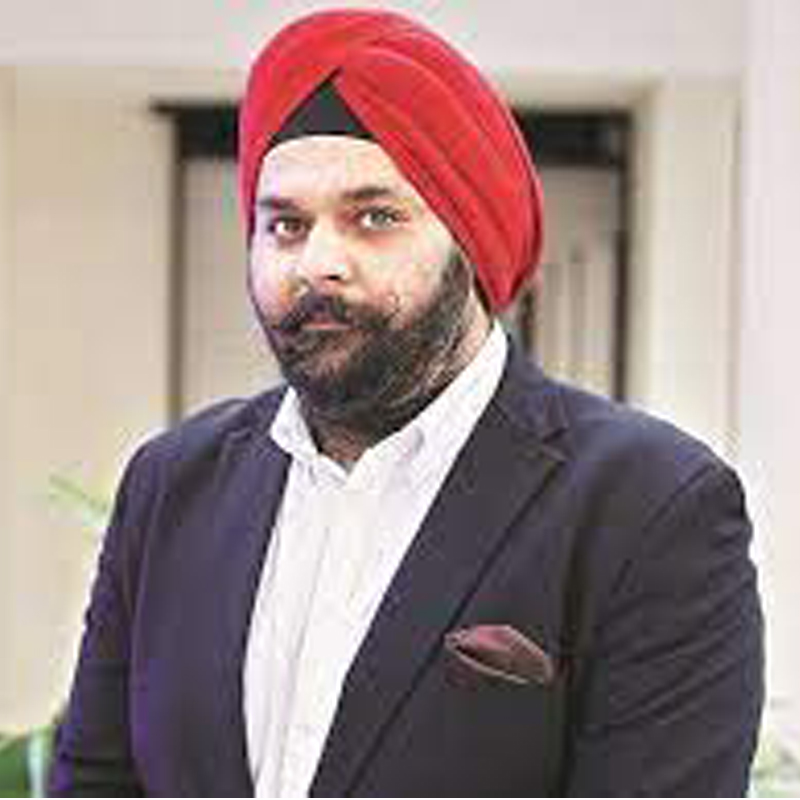
When the second-generation entrepreneur, Avneet Singh Marwah took over the reins of the company, it was still known for manufacturing plastic injection moulds which it started in the 1970s and 80’s. He slowly steered it into what it is today – one of the country’s largest TV manufacturing firms and the exclusive India licensee of global brands such as Kodak, Thomson televisions. It has recently also tied up with the German consumer electronics brand Blaupunkt.
He started his journey in the company as an assistant manager and made his way through, before taking over the reins of the company from his father, Amarjeet Singh Marwah, the founder chairman of the company. “I worked in almost all divisions – from moulding to assembly line to service, accounting, finance, and sales. I worked on the field itself and spent three to four months in each department,” Avneet said, “In those six-seven years I never had any office or anything.”
From thereon, there was no looking back for Marwah who went on to change the game and turn the fortunes for Super Plastronics Pvt Ltd (SPPL). Under his leadership, SPPL has now become one of the leading smart TV and home appliance manufacturers, selling top-of-the-charts global brands in India’s booming e-commerce market, via Flipkart and Amazon. Under the brand’s aegis, the European consumer technology brand, Thomson is currently among the ‘Top Five selling online smart TV brands’ in India.
IndianTelevision’s Anupama Sajeet had an in-depth conversation with SPPL, CEO Avneet Singh Marwah on the brand’s journey from plastic moulding to being India’s largest contract manufacturing firm & the exclusive licensee of four renowned international television brands. He also spoke about spotting opportunities amid the pandemic gloom, and talked about what it means to be an online exclusive brand, and future plans.
Edited excerpts:
On the origins Super Plastronics and the journey so far
It’s been 30-years since we forayed into black & white CRT, colour, LCD & now LED televisions. Before that, our work was limited to plastic moulding for television. Currently, we have a couple of LCD brands in our portfolio, about 550 service centres, 24 pan India offices, and 28 warehouses across India. There are three manufacturing plants located in Noida, Una, and Jammu. By the end of the year, we will be shifting to our new fully automated TV manufacturing plant in Hapur, Uttar Pradesh where the target set is 1.5 billion units a year. In fact, we have the second-largest manufacturing plant in India, after LG.
We began with Kodak in 2016 and offered ‘global technology at competitive prices. In 2018, we launched the French consumer electronic brand Thomson. Now, we have four international brands on board, including the German consumer electronics brand Blaupunkt. SPPL has complete rights to these brands from manufacturing to sales to marketing. There are two parts to it – the first is providing the most affordable TV sets in India and the second category is premium TV sets.
On what led to the brand’s expansion plans amid the pandemic gloom
The pandemic actually presented a big opportunity to all the manufacturing units in India. Firstly, the government banned the import of LED televisions’ CBUs (complete build units) last year, which led to a huge spike in the market in terms of the television industry. Earlier, there were a lot of imports happening in televisions. With the decision to ban it, one had to manufacture and assemble them in India. Plus, globally everyone’s looking for an alternative to China. We see this as a great opportunity for us with the government taking a decision on manufacturing all appliances in India. So, apart from television, we are foraying into appliances.
On the brand’s focus on e-commerce and its region-specific growth
We are an online-exclusive brand to Flipkart and it’s one of the largest retailers of TV sets in India, with an approximate market share of 44 per cent currently. When we started out about three years back, we had a strong online presence in tier 1 and tier 2 cities, but now we see a huge surge of growth in tier 3 and 4 towns, as well. In fact, in the last one year the maximum growth has happened in tier 2 and 3 regions.
To be region-specific, the online sales have grown in Tamil Nadu, Karnataka, Andhra Pradesh, Telangana, Delhi NCR and Uttar Pradesh. In the West, Gujarat and Maharashtra, where the latter is among the best-selling states with maximum consumerism in India. In the East, West Bengal is seeing a spike; Assam and Odisha again have a bright future for online sales.
The advantage of being online-exclusive currently is that we are seeing a 100% YoY (year-on-year) growth for Thomson. Pandemic has led people to move from offline to online even for buying appliances and electronics.
On SPPL’s marketing strategy to reach out to consumers
We are primarily marketing through the digital platform- that has really worked for us. At first, we targeted the online customers where the intent of buying is high based on their searches, so the conversion to sales is high. Now, we have started focusing on the customers, who were buying offline to encourage them to buy online and we have seen a lot of first-time e-buyers in the last eight months. We get lots of traction from influencer marketing, social media, google ad words- we have a 360-degree ecosystem in digital marketing.
Apart from that, our strategic partner is Flipkart and whenever there’s any ATL/ BTLs or TV campaigns during festive season periods they include the SPPL brand name as well – only on those particular days do we target TV. That includes print campaigns too, but the print is in the decline stage right now and we don’t get too many eye-balls via it; this was more so true during the pandemic when sales of newspapers took a hit.
On the impact on brand growth and revenue during the pandemic
We have been an online exclusive brand for Flipkart since 2018. We have seen a 100 per cent year-on-year growth phase. Last year after the first lockdown there was a huge pent-up demand and the whole world was hooked to their screens due to WFH, online classes, and people shifting to OTT platforms due to lack of fresh content on the TV – all of which led to record sales for us. But after the hard-hitting second wave, because of low disposable income, people had reservations about spending on high-value items and electronics. But, there is a huge inflationary demand for televisions in the country that will continue. As soon as the consumer sentiment improves, we will again find a growth pattern.
On the plans to be an online exclusive brand for high-value items like TV and washing machines, post pandemic
We have seen once the customer starts buying online it becomes very difficult for him to come out of it, because of various factors- there are offers that run exclusively online. Both Amazon and Flipkart are creating an ecosystem around it. Plus, there’s a limitation of shelf space when one goes to buy offline, thus one will not find the complete product catalogue in one place, unlike online where you’ll find the complete package in terms of variety. Hence, I don’t believe it will be affected once the lockdowns and restrictions cease.
We are covering almost every town and city pan India, and now all set to foray into the rural markets too. With regards to product diversification, right now we have introduced air-coolers, before that it was washing machines. We are working on a couple of more product categories that need to be finalised before they can be announced.
On what sets the brand apart from other local players?
There are very few brands in India which have a network of more than 550 service centres. In the next few years, we plan to take that number to 800, which will be one of the highest for any television brand in India. Thus, we have a well-established network, which we have developed over the last three years, which is a challenging task for any new brand or an existing Chinese smartphone brand. We cater to 2,300 cities and towns that contribute to over 85 per cent of sales.
Additionally, we have about 28 warehouses across India, with a door-to-door service which is a huge factor when it comes to spare parts replacement. The delivery period is also drastically cut down when there’s local warehousing with spares, and this gives a huge advantage to customers. Plus, we are one of the few brands which have the capability of doing replacement of TVs from the customer doorstep- even in tier 3, tier 4 towns which most other brands struggle to do.