
Tag: Sunder Raju

  • ACT reveals new brand identity, claims largest non-telecom ISP in India with 5 lakh subscribers

    ACT reveals new brand identity, claims largest non-telecom ISP in India with 5 lakh subscribers

    BENGALURU: ACT (Atria Convergent Technologies) Broadband claims that it is now the largest non-telecom ISP and the fourth largest ISP in the wired broadband category in India with its subscriber base of five lakh that it crossed last month.  Only public sector telecom companies BSNL and MTNL and the private sector communications giant Airtel are ahead of ACT, the company claims.


    ACT is a triple play service provider which claims a subscriber base of 10 lakh of Fibernet (Internet over fiber optics), digital TV and IPTV consumers. The company is headquartered in Bengaluru and its services are spread over towns and cities of Karnataka, Andhra Pradesh and Tamil Nadu.


    The company also announced a strategic move in the industry – the launch of its new broadband brand ACT Fibernet.  ACT says that its new brand underscores its continued commitment to offer fastest, most consistent and unparalleled internet experience through the scalable technology of fiber optics. The company announced the fastest speed currently provided by any service provider to the retail segment of 60 mbps.


    What is remarkable about ACT’s achievement is that, while the top three players and most of the other ISPs in the country have a pan-India presence, ACT has  achieved its milestones in Karnataka and Andhra Pradesh, with Chennai coming under its footprint only last year.


    “Over the next two years, we are confident of doubling the broadband subscriber base to 10 lakh,” said ACT managing director Sunder Raju.


    “We have been setting benchmarks in the industry since we began six years ago – when the industry in India considered 256 kpbs as broadband, our benchmark was 512 mbps, our new bench mark is going to be 5 mbps to the industry’s 1 mbps,” says ACT Group CEO Bala Malladi. “Right from the beginning, we have been laying fiber optic wires up to the last mile and hence scaling up to 1 gbps with small changes to the existing infrastructure should not be a problem for us in the future,” added Malladi.


    “There is ample scope for us to double our subscriber base within our current catchment area, but we will definitely look at bringing other towns and cities under our footprint,” said Malladi.


    The company has announced a high decibel marketing campaign with the tagline ‘Incredibly fast’ across print, outdoor, digital, newspaper inserts, handbills, bus shelters, metro pillars, kites, parking boards etc., over the next three months within their catchment areas. Minimum spend is on Television advertising. Company sources revealed that the campaign costs would be in the range of Rs 10 crore. RK Swamy BBDO is the creative agency and RK Swamy Hansa group handles the media buying duties and Madison PR handles public relations.


    The company has received funding from India Value Fund Advisers (IVFA) which would be used for doubling the subscriber base, an industry source reveals to www.indiantelevision.com that ACT had invested around Rs 600 crore in the current phase, of which IVFA funding was between Rs 350 crore to Rs 400 crore.  Last year, the company had raised privately placed non-convertible debenture (NCD) funding of Rs 180 crore.


    “ACT would need funding to the extent of around Rs 500 crore for further expansion. This should not be a problem, considering the fact that ACT has crossed Rs 500 crore in revenue a couple of years ago and has seen operating profits in recent years as compared to many other companies that have been bleeding. The company should be reporting profits in the next two or three years,” says an industry source who works for an MSO and who did not want to be named.


    Keeping its current consumers in mind, the brand has upgraded its entire subscriber base in Bengaluru to new fast plans at no extra cost starting 24 July. An ACT broadband consumer confirmed that his fair usage policy has been upgraded to 50 GB from the 40 GB that he enjoyed earlier.
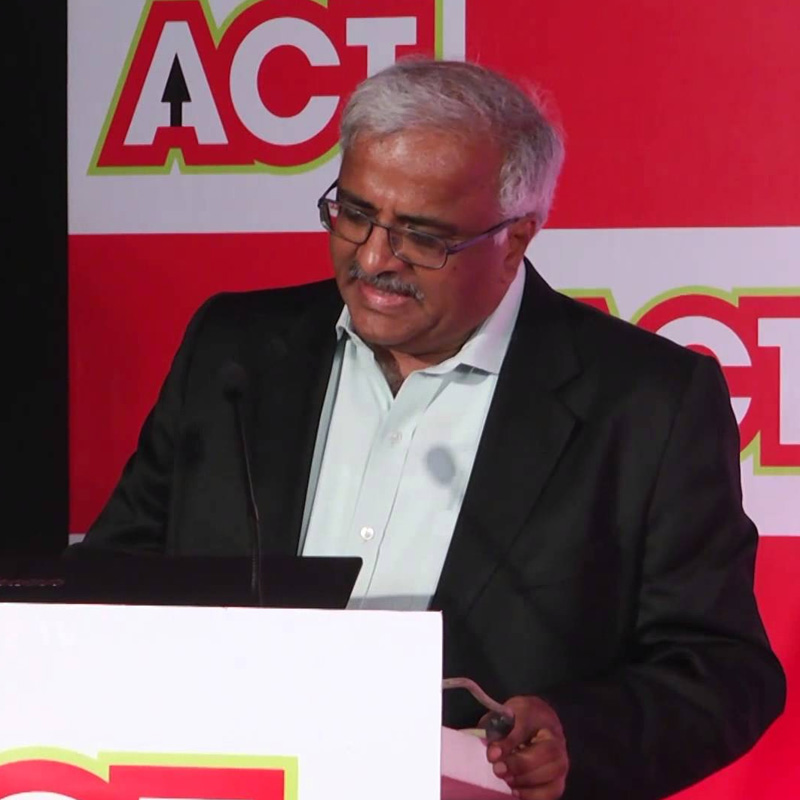
  • 2009 a dynamic year for Indian cable industry – By ACT Television MD Sunder Raju

    2009 a dynamic year for Indian cable industry – By ACT Television MD Sunder Raju

    The year 2009 has been a dynamic one for the Indian cable industry. Several developments and key decisions that took place hint towards a very promising 2010 for the industry as a whole and, of course, the consumer. Continuing its boom, the cable industry is all set to ensure that the TV is not an ‘idiot box‘ anymore!

    Problems faced by Southern operators

    Cable business is spreading its wings all over India. In urban Karnataka and Madhya Pradesh, it has also undergone a massive change in the last couple of years as the industry, from being extremely fragmented earlier, has now become more systematic and corporatised. With a growing market share in these states, digital cable is becoming a larger chunk of the pie and is on its way to give DTH a run for its money.

    However, there are still some pertinent challenges that lie in the path, especially for Southern operators. One of the challenges faced by them is that vis-?-vis digital, DTH has a larger geographical presence. Despite DTH being much more expensive than cable, it has higher penetration because digital runs through a cable network, and that limits any player‘s footprint to the area already cabled by them.

    Also, though the cable industry has changed massively, it is still fragmented. Hence, any operator going national needs to accommodate a number of industry-specific issues, such as adjusting to rapid technological change, working and accommodating with different workforce demographics, changing and restructuring the entire face of the organisation.

    Another challenge lies in the fact that since a large part of the cable industry is still unorganised, the corporate players within the industry at times face content related challenges. Large corporate players, as a policy, do not relay illegal films unlike the small players that telecast all kinds of content in order to get a higher viewership.

    Also there is an oversupply of service providers in the Indian market, with various small players present everywhere. This is also because starting an analogue business requires small investments. In addition to this, with growing inflation, there is less advertising to support the services. Domestic regulations limit advertising to just 10 minutes per hour.

    Last but not the least, with DTH penetrating in every corner of the country, analogue service providers are now facing a major roadblock where profitability is concerned. Consolidation is the way of the future and will bail them out.

    An eventful 2009

    Cable industry has seen a major shift in the last couple of years when more and more organised players have entered the market. This shift in the industry has not only improved customers‘ TV viewing experience with better picture quality, consistent network and improved content on local channels, but it has also drastically improved the quality of overall customer service. For example, ACT Television not only offers a call centre service but also offers instant personalized customer service through its professionally trained cable operators.

    In my opinion, a very important development of 2009 that will make 2010 a smooth year for corporate players is that legal action would be initiated against small cable television operators showing unauthorized and prohibited programmes including obscene films. Moreover, if the programmes televised by the channel create resentment among a particular community, the affected persons can also lodge their complaint with the district administration.

    Towards the end of 2009, HITS (Headend-in-the-Sky) was approved. HITS will allow use of satellites to distribute cable signals instead of the traditional cables that operators use. This is similar to the DTH system – the only difference being that in this case, cable operators will download signals for further distribution in homes.

    As far as the HITS policy is concerned, while the government has taken a major step in addressing the challenges of digitising the country‘s television homes, the work is only half done. They also have to set a timetable for the pay channels to go exclusively digital. Without this step all that has been done is a policy statement without teeth in the area of encouraging enforcement. Ideally both announcements should have come together but a quick decision soon on compulsory digitalisation for pay channels will ensure that the advantage of digital would be experienced by the customer.

    Parts of India have recently been exposed to the Internet Protocol Television (IPTV) services. Companies offering IPTV are mostly conducting pilots in bigger cities of India, such as Delhi, Mumbai, Bangalore.

    A promising 2010

    With 111 million Television Homes and 85 million C&S Homes, India is bound to see many changes in the coming year and years ahead. Indian cable TV industry has a huge potential and that is being recognized by people.

    More and more customers are demanding better picture quality, more channels and better customer service – all at affordable prices. Hence, digitalisation is inevitable and seems to be the only way forward for analog service Providers. Also the need of the hour is clearly training and a reminder that “the customer is King.”

    Also, cable TV offers many other benefits such as city specific channels, that provide complete city related information throughout the day to viewers. This gives viewers a pulse on the city and keeps them updated on events and happenings in their immediate surroundings. Often something that impacts life in the city is covered first by the local city channels and they are surely becoming indispensible.

    Not only this, cable TV has become a great platform for providing, entertainment, information and also education. This is rapidly changing the TV viewing habits in our country which has close to 51 million urban households and 60 million rural households.

    Strategic partnerships with various content houses will determine how any service provider progresses. This will also put an end in the near future to broadcast of pirated content.

    Building a robust subscription income, digitising rapidly and developing broadband as a revenue stream seems to be the business model all the leading multi-system operators (MSOs) are going to chase after having spread their tentacles across the country. Apart from this ‘Value Added Services‘ are a definite means to generating revenues. Services like education on TV, web browsing, gaming and ticket booking have a huge potential in the Indian market.