Tag: Sun

  • Media tome throws light on the biz growth pre and post pandemic

    Media tome throws light on the biz growth pre and post pandemic

    Mumbai: The Indian media business is estimated to be a $19 billion industry in 2021 (EY estimates), said veteran business journalist Vanita Kohli-Khandekar. She observed that the media industry had doubled in the period between 2013 to 2019. But what’s remarkable is not only the change in size but also the composition of the industry.

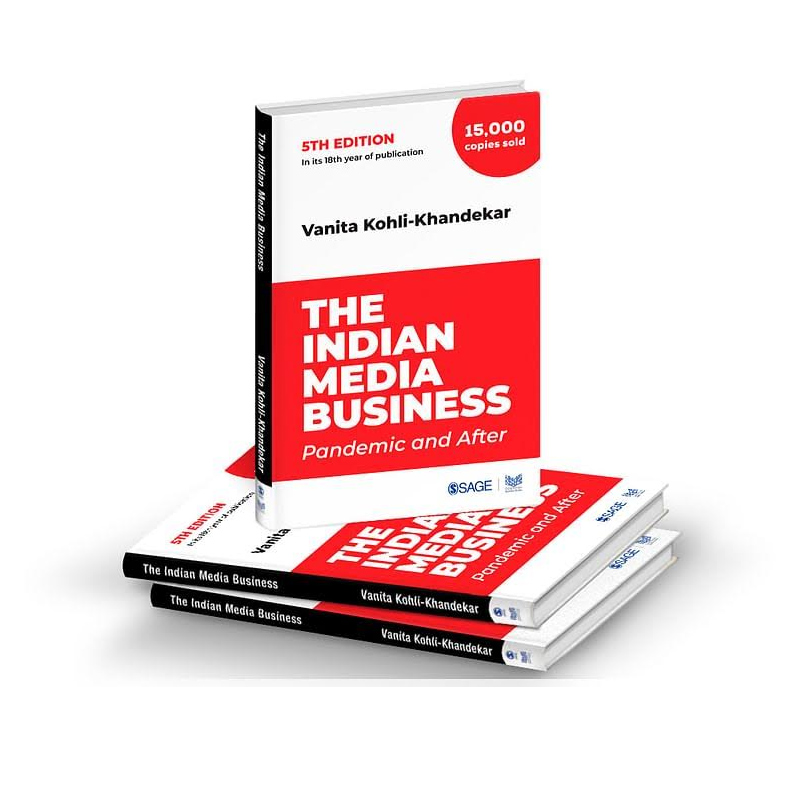
    Khandekar was speaking at the launch of the latest edition of her book- ‘The Indian Media Business: Pandemic and After’ on Wednesday. The fifth edition of the book published by Sage Publications India was unveiled at a virtual event attended by noted industry leaders.

    To highlight the transformation that the industry has undergone in recent times, she opened the discussion with an intriguing question “What is a media company?”.

    Unlike in the past where media companies used to compete for consumers’ leisure time, today media consumption is no longer only about leisure and entertainment but has permeated every aspect of the consumers’ lives. “The pandemic imprisoned audiences in their homes and access to media via their smartphones, TVs and other devices were the only way they were connected to the world,” she said.

    In FY 2010, the top 10 media companies comprised Times Group (Rs 5000 crore), Zee Group (Rs 4,000 crore), Star India (Rs 3,500 crore), Airtel (Rs 2,900 crore), HT Media (Rs 1,500 crore), Sun (Rs 1,400 crore), Network18 (Rs 1,300 crore), Sony (Rs 1,300 crore), DB Corp (1,100 crore) and Jagran (Rs 900 crore). There isn’t a single digital media company in the top 10 list which is dominated entirely by linear broadcast media organisations.

    Fast forward to FY 2019 where the composition of the media landscape changed significantly. The top 10 companies were Zee Group (Rs 16,300 crore), Star India (Rs 13,500 crore), Times Group (Rs 10,000 crore), Google India (Rs 9,400 crore), Sony (Rs 6,300 crore), Tata Sky (Rs 6,200 crore), Network18 (Rs 5,100 crore), Airtel TV (Rs 4,100 crore), Sun Network (Rs 4,000 crore) and PVR Cinemas (Rs 3,100 crore).

    The pandemic reshuffled the top 10 companies once again but the composition remained largely unchanged. Disney-Star (Rs 14,350 crore), Zee Group (Rs 13,300 crore), Google India (Rs 13,000 crore), Times Group (Rs 10,000 crore), Sony (Rs 5,900 crore), Tata Sky (Rs 5,700 crore), Network18 (4,700 crore), Sun Network (Rs 3,800 crore), Airtel TV (Rs 3,100 crore) and Netflix (Rs 1,500 crore).

    Netflix breaking into the top 10 bracket in FY21 with only Rs 1,500 crore in revenues is indicative of how badly the pandemic impacted the industry on the whole. A leading cinema exhibition chain saw revenues drop from Rs 3,500 crores to effectively zero and a burn rate of Rs 100 crores a month in 2020. Khandekar observed that the opening of theatres and return of film exhibition business is a key indicator that the ecosystem has come back to health. Films are the Gangotri of the media business, she remarked.

    “A key trend during the pandemic was the explosion of audiences without the ability to monetise them,” said Khandekar. “Apart from digital media companies which saw a marginal increase in revenues, most media companies were not able to successfully monetise the growth in audiences during the pandemic.” According to her, Indian media companies have been successful at driving penetration of their business, however, post-pandemic they have realised the need to focus on effective monetisation.

    Khandekar observed that even though there is no import quota on entertainment in India, 90 per cent of the market is watching local content. “We don’t celebrate this industry enough,” she said, adding that the Indian media business is the highest tax-paying industry and could easily contribute five to seven per cent to the country’s GDP. Countries like the US and the UK nurture their media companies but in India, the TV broadcast ecosystem is caught in a regulatory mess and the entire industry is reeling from the pandemic. The media industry that employs over three million people is one of the best markers of India’s soft power,” she concluded.

    Some of the media industry leaders who attended the event included PVR Cinemas chairman and managing director Ajay Bijli, India Today Group vice-chairperson Kalli Purie, director of University of Oxford’s Reuters Institute for the study of journalism and professor of political communication Rasmus Kleis Nielsen and director of YouTube content partnerships at YouTube India Satya Raghavan.

  • Star leads TV network sweepstakes

    Star leads TV network sweepstakes

    MUMBAI: Which is the ruling television network in India? Which of them has  raced ahead in the viewership stake post the opening up of the lockdowns? Which network’s content is resonating better with viewer cooped up in homes?

    Well, the Broadcast Audience Research Council (BARC) has released data for four weeks from week 32 to week 35 for All India 2+ audiences to give us its take. And the winner, according to that is the Star network with a share of 22 per cent. Clearly, Uday Shankar, K. Madhavan, and team are doing something right.

    And very close behind it is the Zee network with its 21 per cent slice. Clearly, CEO Punit Goenka is living up to his commitment that he is going to put his best foot forward and help the network regain its leadership position.

     Network18, it looks, like has a lot of catching up to do with a 11 per cent piece.

    The Sun network, which was once ruling is at fourth position with its share of 11 per cent while Sony brings up the rear with a nine per cent piece.

    BARC has clarified that the Star network includes Star, Disney, Asianet, and NGC. Zee, Zee Media ancd Zee Akash have been considered as part of the  Zee network . Network18 includes Viacom18, AETN18, TV18, IBMN Lokmat.

  • Star India urges Airtel Digital subscribers to switch

    Star India urges Airtel Digital subscribers to switch

    MUMBAI: The slugfests were bound to happen in TV distribution. The time for agreement renewal is nigh between distribution platform operators and broadcasters with content contracts coming to an end. The Telecom Regulatory Authority of India’s (TRAI) proposed  tariff  and interconnection agreements are being passed  around from the High Court of Chennai to the Supreme Court and back without any resolution.

    Earlier this month, the Star Network issued a disconnection notice to one of India’s better-managed DTH operators Airtel Digital in an announcement that made waves in TV distribution circles.  Now, with the spat between the two continuing, India’s leading TV network has taken the fight to Airtel’s camp.

    It has started a digital campaign-for now at least-asking the DTH player’s subscribers to switch to other distribution platforms. Says the network on its Twitter handle: “Attention Airtel Digital  subscribers! Star has not increased channel tariffs. Airtel Digital TV  is misleading you and unilaterally increasing the prices of Star channels. To continue watching high quality Star entertainment switch to new DTH/cable operator now.”

     The digital  video,  which is doing the rounds on social media, has a voiceover that states: “You used to pay Rs 200 for the HD pack on Airtel. Now why are you being charged Rs 1,000? You can still get the same price for the same HD channels at around Rs 200! Change to another service provider. To get Star channels in a packet, make the switch.

    The video then lists operators like DEN, Fastway, SUN, Hathway, GTPL and Tata Sky that Airtel subscribers can opt for.

    We will have to wait and watch how Airtel responds to this direct attack. Will it buckle and give into the rates that Star India is asking for? Or will it hold firm and wait to see if the broadcaster will blink first?

    After all, Star has a lot at stake with the IPL coming up in the next fortnight. And it has to recover the humungous amounts it is pumping into the most prized cricketing property globally!

    Keep reading indiantelevision.com for further updates!

    Also Read:

    Airtel Digital TV disconnects Star India channels

    TDSAT tells Airtel DTH, Star to negotiate

    Tata Sky woos new customers with free Star Sports channels


  • Sun given option to disconnect signals of Hyderabad MSO on non-payment of dues

    Sun given option to disconnect signals of Hyderabad MSO on non-payment of dues

    NEW DELHI: Sun Distribution Services Pvt. Ltd has been given the option of disconnecting the signals to multisystem operator Lifestyle Communication of Hyderabad for not clearing its dues.


    The Telecom Disputes Settlement and Appellate Tribunal said that it was satisfied that the MSO did not deserve any more indulgence as it had failed to make the payments as directed by the Tribunal. The Tribunal therefore recalled its restraint direction to Sun Distribution issued on 6 May and 4 September when time was given to the MSO against the petitioner. 


    However, the Tribunal said Sun Distribution must restore the supply of its signal to the MSO as soon as it receives the payment of the last installment in terms of the order passed on 6 May and also on clearance of the dues of licence fees for the current months.   


    The order came on a recovery petition filed by Sun Distribution for realization of its dues of licence fee. 


    Since a substantial amount of dues was admitted, the Tribunal had said on 6 May that the MSO will make an on-account payment to Sun of the sum of Rs One crore towards arrears for the analogue GHMC area for the period April 2014 to March 2015. “The payment shall be made in six equal monthly installments and shall also carry interest at the rate of 14 percent per annum. The interest will be computed from the dates, the payments became due till the dates of actual payment. In addition, the respondent shall also pay to the petitioner, monthly subscription fee for the aforesaid area at the rate of Rs 7 lakh per month”. 


    The Tribunal had been informed that the last installment payable by 31 October has fallen in default.   Sun Counsel Abhishek Malhotra said the MSO had also defaulted in making payment of the monthly licence fees and the licence fees for the months of October and November had not been paid.

  • Six broadcasters, content aggregators directed to provide signals to AP MSO

    Six broadcasters, content aggregators directed to provide signals to AP MSO

    NEW DELHI: The Telecom Disputes Settlement and Arbitration Tribunal (TDSAT), on 22 April, directed six broadcasters and content aggregators to enter into agreements with the Andhra Pradesh based multi-system operator Wiretel Digital Networks.


    In the judgement pronounced on Tuesday, the TDSAT bench comprising chairman Aftab Alam and member Kuldeep Singh said the agreements will be based on reference interconnect offer.


     The broadcasters/aggregators are ESPN, MediaPro, MSM Discovery, Sun, Ma TV and ETV.


     The petitioner, who holds a digital addressable system licence, had approached TDSAT in February 2013 after the respondents delayed/refused to provide signals to it on DAS mode.


     The bench for the first time also interpreted the DAS Regulations with regard to mandatory provisioning of signals on DAS mode – ‘the must provide’ obligation.

  • Decks cleared for JAINHITS to get TV signals of MSM Discovery, ESPN and SUN channels

    Decks cleared for JAINHITS to get TV signals of MSM Discovery, ESPN and SUN channels

    NEW DELHI: In less than two months since Media Pro Enterprises India was given directions to supply the channels it distributes to JAINHITS, the country’s only headend-in-the-sky (HITS) platform, the Telecom Disputes Settlement and Appellate Tribunal (TDSAT) today directed Sun, Sony (MSMD) and ESPN to provide their television channel signals to the platform by this evening.

    The three channel aggregators between them provide more than fifty prominent channels, but had been delaying giving their channels to Noida Software Technology Park Ltd (NSTPL) – which manages JAINHITS – which had approached the authorised content aggregator for these channels owned by Sony, Sun and ESPN.

    TDSAT Chairman Justice Aftab Alam and member Kuldip Singh were not impressed by the argument that all operators had created fresh Reference Interconnect Offer for HITS which was yet to get the clearance of the Telecom Regulatory Authority of India (TRAI). They asked the counsel for respondents whether this did not amount to breach of violation of section 3.2 of the Digital Access System (DAS) regulations of the cable interconnect agreement.

    With this, JAINHITS will now be able to transmit over 250 channels to consumers all over the country. The 12 September order relating to Media Pro had brought a total of around 75 channels into the JAINHITS fold.

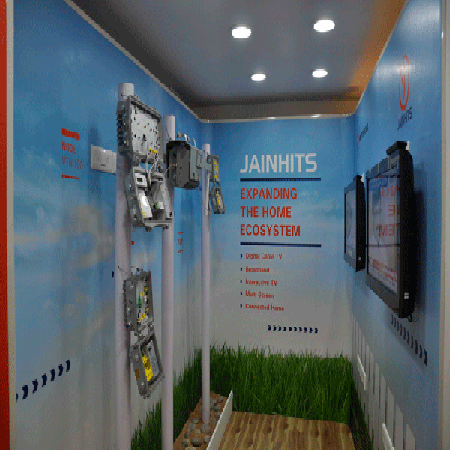
    The only satellite-based platform for the distribution of digital TV channels, NSTPL is currently the only distribution platform of TV channels that is providing advanced HITS services to consumers through local cable operators.

    NSTPL founder and chairman of Jain TV Group Dr. J.K. Jain said, “The mission of JAINHITS is to build and operate digital highways in collaboration with cable network owners. We thank TDSAT for the ruling as this is an important announcement not only for the 60,000 cable operators across the country but also to the consumers. Without proper digitisation, government is losing huge revenue.”

    Senior counsel for NSTPL Vivek Chib told indiantelevision.com that this order would not only be in the larger interest of the government’s digitisation policy, but would ultimately benefit the end-user with greater choice and better quality.

    NSTPL had filed the petition under sections 14 and 14A of the TRAI Act 1997 seeking directions to enter into the Interconnect Agreement on mutually agreed terms or in case the two sides are unable to come to any mutually agreed terms, as per the respondent’s Reference Interconnect Offer (RIO) and to provide to it the content/TV channels under the latter’s control.

    NSTPL obtained from the Information and Broadcasting Ministry in 2003 the licence to establish, install, operate and maintain “headends in the sky” system to provide digital cable services in India. Apparently, the licence was granted even before provisions were made for accommodation of the HITS operator in the regulatory framework. Suitable provisions were made in the regulations to accommodate the HITS operators.

    NSTPL claimed that it had even got its system checked by the Broadcast Engineering Consultants (India) Ltd.  

  • Sun, Raj TV reach out-of-court settlement on 66 movie telecast rights

    Sun, Raj TV reach out-of-court settlement on 66 movie telecast rights

    MUMBAI: Sun TV Ltd and Raj TV Network have reached an out-of-court settlement over disputes on 66 Tamil films valued at around Rs 19 million.

    According to the agreement, both the networks can screen these movies on their channels. The titles include blockbusters such as Dalapathy, Nayakan and Kaathal Kottai. “We recently arrived at an out-of-court settlement. Both the networks can show these movies,” a source close to Raj TV Network said.

    Claiming to have the perpetual rights to these 66 movies, Raj TV had moved the Chennai High Court against Sun TV.

    Sun TV has also made a similar statement in its initial public offering (IPO) document. “We are party to 15 civil suits with Raj TV, either filed by us or by Raj TV, in relation to alleged infringement of copyright in respect of 66 Tamil films. Raj TV and we have reached an agreement to settle all the aforesaid civil suits. Under the terms of the agreement, Raj TV and us have agreed to withdraw these cases upon each of them being listed,” the company said.

    Tamil and Malayalam combined, Sun owns a movie library of around 2,650 films. Raj TV owns about 2000 to 2500 Tamil movie titles.