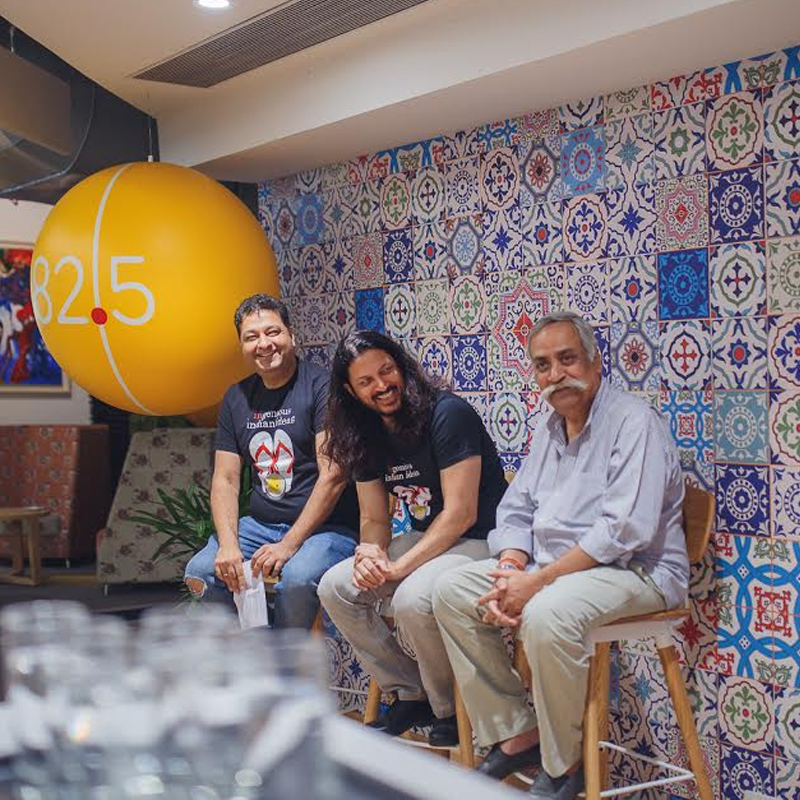
Tag: Sumonto Chattopadhyay

  • 82.5 Communications makes a mark in year one

    82.5 Communications makes a mark in year one

    MUMBAI: It’s a toddler and it is already boasting of achievements attributable to the big boys in advertising. Mumbai-hqed creative boutique Eight Two Point Five ( 82.5) Communications is the agency we are referring to. It came into existence just a year ago (26 January), as a reincarnation of Ogilvy agency Soho Square, with a sharp focus on providing communications services to India-specific brands. And it has managed to net nine new clients out of a total of 11 pitches it made, since then. A very good run, and a very high rate – something not many newborns in advertising can boast.

    Its new client roster looks impressive: mandates from Nestle Milo, a few dairy projects with the multinational, IDBI Bank, Haldirams North, Hero Lectro, brands from the RSPL group (the maker of Ghari detergent), Campus Shoes, Pearson Education and Jeeru a Mumbai-based carbonated drink. Of course, 82.5 inherited some existing business from Soho Square as well: ACC, Tata Motors, Bisleri, Havells, Himalaya Herbals, ITC Goldflake.

    “We are a bit selective about what we do,” says 82.5 Communications co-chairman & CEO Kapil Arora, adding that there is a clear understanding of where and why to pitch and because of that, the company even refused some clients early on. “On the basis of the conversations that we bring to the table, clients get comfortable and say we want to work with you,” he explains.

    Arora reveals that the coming few months will be about consolidating what it has picked up in 2019 and the agency will get into growth mode only from March.

    Has the rebranding exercise from Soho Square to 82.5, and labelling itself as an India-centric agency paid dividends?

    “We have built a profile of interesting India-first businesses that resonate with our positioning, “ highlights Arora.  “Ninety per cent of our client mix is comprised of India-first clients. But there are global brands like Milo, which wanted a Tamil Nadu insight reflected. So, they too see value in our India-first expertise and approach.”

    Ogilvy India chairman and CCO Worldwide Piyush Pandey too believes it has. “This was a slot that was vacant,” he says. “82.5 has filled it well.”

    And proof of that is the rewards it has got. 82.5 Communications’ edgy work last year with its quirky Samajhdar Jante hai campaign for Bisleri featuring camels got it the Grand Effie in January 2020.

    The agency has not stayed still, rejigging the way it functions, when it felt it was needed. When it started it kept brand custodianship, strategy and content expertise in-house while outsourcing services like media, social, PR retail and activation to partners. It kept that circle open wide. Now it has tightened that ring of allies restricting Itself to WPP group outfits.

    “As a small outfit it made absolute sense to work with partners to offer allied services,” says Arora. “ In implementing that model, we had a few learnings and we reduced that circle. This helps us retain better quality control and ownership for our clients and a move like the WPP campus really aids us in that regard.”

    Arora was brought in as CEO from Ogilvy North in June 2019 when the then CEO VS Srikanth – who joined  82.5 from Bates CHI & Partners – decided to part ways to set up his own venture in the tourism sector.

    Since then, he along with chairman & CCO Sumanto Chattopadhyay, have been working on hiring talent to continue offer clients classy service and the creatively edgy work it is getting known for.  In September, Arora roped in Rishabha Nayyar national strategy lead reporting to him directly. Last month, the agency recruited creative veteran Preeta Mathur as head of its Delhi creative.

    The agency has four branches Delhi, Mumbai, Bengaluru and Kolkata, with Delhi growing the fastest, hence the hiring of Mathur.  More recruitment is likely to happen in the coming few months.

    Chattopadhyay and Arora are also focusing on building language-thinking skills within the agency. Arora highlights that they have managed to get it right with Bengali, Tamil and Marathi – and of course Hindi and English. “This repertoire will continue to increase through a mix of in-house talent and a circle of friends from the local film and theatre circuit,”  he elaborates.

    Arora believes that 82.5 is a work in progress agency. “We will continue to evolve,” he says. “We have laid a strong foundation. As long as we pivot, change and stay relevant in terms of what clients require from us, in these trying economic times, we have a strong future. We are very bullish.”

    Which is what Pandey is banking on. Remember, it was he who was the prime architect of the initiative to build a second agency within the Ogilvy network in India.

  • Post Ola Micro and Amazon.in, industry opinions on social media backlash

    Post Ola Micro and Amazon.in, industry opinions on social media backlash

    MUMBAI:  The digital marketing era warrants brands, advertisers and creatives churn out advertisements that go viral. But they better toe the line very carefully in the process. The recently released campaign by Ola for its new super cheap Ola Micro service certainly had people talking online – but they weren’t talking about the things the company wanted to hear. Netizens by the thousands took to Twitter and Facebook to express how disgruntled they were with the TV spot which they found ‘sexist’. So much so, that the company had to take off the spot from TV.  A similar situation occurred in Kerala where a public hoarding by eCommerce giant Amazon.in spurred an angry agitation on the social networks.

    While it isn’t the first time that people have expressed their displeasure over an ad film, seldom has public reaction gotten such a quick and effective response from the brands. The question these incidents raise is how are brands, creative agencies and planners to handle this new breed of trigger happy consumers who are armed with social media?
    People have always discussed campaigns that leave a mark on them, while there were some that were praised, there were also a few that were criticised. With social media coming into the picture, the issue isn’t that people are expressing their view; more often these views are a knee jerk reaction rather than a well-considered opinion. “Everything has become like an instant poll if you ask me. An individual having an opinion over something can immediately share that, and several others with a similar voice can add to that. People have suddenly discovered that their voice too has power and they want to put it out in the public domain as much as they can. Sometimes it can be justified, but sometimes it is not,” opined Ogilvy and Mather creative director Sumanto Chattopadhyay. He however stressed the fact that brand communications have to be sensitive to consumers, “At the end of the day advertising exists to appeal a broad spectrum of people. So one has to take cognizance of that, especially now that people’s opinion is a part of the public domain almost instantaneously,” he expressed.

    When asked, as a creative what his reaction would be if one of his own works was pulled down, Chattopadhyay quipped. “As a creative person when I do a piece of work I obviously believe in it, I stand by it. There is no negative intent in it. But I have to also keep in mind that as an agency, we work for a brand, so sometimes we have to respect public opinion and go with the call the brand is taking so that the brand doesn’t suffer.”

    J. Walter Thompson Delhi managing partner and head Sanjeev Bhargava also advised creatives and agencies to tread carefully when it came to public opinion. “We are becoming a reasonably trigger happy nation when it comes to protesting now that we have the tools in our hand.  It started off with a political thing but now it’s transcending into the corporate world as well. At the same time, brands are getting increasingly sensitive about the chatter online as they have the measuring tools that gauge the impact of such negative comments online”.  

    While Bhargava suggested that brands, advertisers and agencies be extra careful so as not to ruffle any feathers he admitted that this would affect the creative process to a certain extent. “It is hard to be politically correct and have the freedom of expression in creating something. There is a fine line between meaning well based on consumer insights etc., and at the same time hurt sentiments. For example in the case of Amazon’s #WeIndians campaign, things might not have triggered this way had Amazon not been a foreign company. So it’s hard to say what will offend someone or not. In this increasingly wired world, industry needs to be careful till this frenzy wears off.”

    Bhargava cited an example of an old Naukri.com advertisement to add perspective, “Years back when Naukri’s Hari Sadu campaign came out, someone with the same name had filed a defamation case against the brand in court, saying his employees thought him to be a bad boss because of the ad. He lost the case. But in today’s day and age, that same person could make it go viral, as virality does not follow predictable metrics. He wouldn’t have needed a court of law.”

    Since public backlash is easy to create in today’s day and age, how does an industry body, tasked to self-regulate and monitor such offensive ads, react to such the public opinion? ASCI’s secretary general Shweta Purandare said, “I agree that social media is a very powerful tool. In fact, ASCI has consistently paid heed to it and followed the chatter by being active on social networks. If there is a negative chatter about brands or a particular campaign, many times, unaware that ASCI exists, they vent their feelings on social media. One is if an advertiser listens to that and takes action on its own, and another is that we guide such consumers to register a complaint and then take it up as per ASCI’s policies”.

    But there are also situations when a simple opinion may blow out of proportion and affect the brand. “Without taking any brand’s name, I would mention that there was a case when a brand came under fire on the social media, but when the complaint was taken up in ASCI, it was found that the advertisement was not against the ASCI code. Apart from taking voluntary calls to pull down ads, which the brands are free to do, if brands want a fair hearing of their argument they can approach ASCI for a proper analysis,” Purandare asserted.

    Whether it is right to target a brand over a cause or not, the fact remains that social media metrics matter to brands, and playing with public opinion is like playing with fire for them. And sometimes that means to bow down to public opinion and take off the ad at the cost of brand value.

    Not to mention the fact that creatives are also taking risks with edgier brand communication to draw more eyeballs to themselves.  “We are seeing a positive move from a mundane to more strategic insightful work in the creative industry.  In process they work around the delicate edge of safe versus edgy communication. Sometimes with such creative push things do go haywire. But these few instances must not hinder the positive moment in creativity.  So, brands have to do what was expected – self-censor and self-discipline.  It is their responsibility that the ad does not discriminate or offend any sensitivities,” explained Intradia world, brand and marketing advisor, Sanjeev Kotnala.

    “Brands always have two choices. If they feel they have really gone beyond the edge, they must withdraw. And they must do that gracefully with due apologies. If this is the strategic action, then it must be swift. The other option is they can stand by their communication and let the social media movement fizzle out,” he added.

    Kotnala also advised that while finding a fine balance between edgy and offensive content maybe like walking on a tightrope. Brands and creatives can be on the safer side if they do a concept research to determine if the ad is offending.  “Surprisingly and unfortunately many forget to do so. It may then be possible to shoot or create an alternative flow which can be integrated as a part of the campaign to kill a reaction without compromising on communication.”

    After all, brand value is created over time but it can be destroyed very fast. It can be protected with a swift response rather than silence, advises Kotnala in parting.

  • Post Ola Micro and Amazon.in, industry opinions on social media backlash

    Post Ola Micro and Amazon.in, industry opinions on social media backlash

    MUMBAI:  The digital marketing era warrants brands, advertisers and creatives churn out advertisements that go viral. But they better toe the line very carefully in the process. The recently released campaign by Ola for its new super cheap Ola Micro service certainly had people talking online – but they weren’t talking about the things the company wanted to hear. Netizens by the thousands took to Twitter and Facebook to express how disgruntled they were with the TV spot which they found ‘sexist’. So much so, that the company had to take off the spot from TV.  A similar situation occurred in Kerala where a public hoarding by eCommerce giant Amazon.in spurred an angry agitation on the social networks.

    While it isn’t the first time that people have expressed their displeasure over an ad film, seldom has public reaction gotten such a quick and effective response from the brands. The question these incidents raise is how are brands, creative agencies and planners to handle this new breed of trigger happy consumers who are armed with social media?
    People have always discussed campaigns that leave a mark on them, while there were some that were praised, there were also a few that were criticised. With social media coming into the picture, the issue isn’t that people are expressing their view; more often these views are a knee jerk reaction rather than a well-considered opinion. “Everything has become like an instant poll if you ask me. An individual having an opinion over something can immediately share that, and several others with a similar voice can add to that. People have suddenly discovered that their voice too has power and they want to put it out in the public domain as much as they can. Sometimes it can be justified, but sometimes it is not,” opined Ogilvy and Mather creative director Sumanto Chattopadhyay. He however stressed the fact that brand communications have to be sensitive to consumers, “At the end of the day advertising exists to appeal a broad spectrum of people. So one has to take cognizance of that, especially now that people’s opinion is a part of the public domain almost instantaneously,” he expressed.

    When asked, as a creative what his reaction would be if one of his own works was pulled down, Chattopadhyay quipped. “As a creative person when I do a piece of work I obviously believe in it, I stand by it. There is no negative intent in it. But I have to also keep in mind that as an agency, we work for a brand, so sometimes we have to respect public opinion and go with the call the brand is taking so that the brand doesn’t suffer.”

    J. Walter Thompson Delhi managing partner and head Sanjeev Bhargava also advised creatives and agencies to tread carefully when it came to public opinion. “We are becoming a reasonably trigger happy nation when it comes to protesting now that we have the tools in our hand.  It started off with a political thing but now it’s transcending into the corporate world as well. At the same time, brands are getting increasingly sensitive about the chatter online as they have the measuring tools that gauge the impact of such negative comments online”.  

    While Bhargava suggested that brands, advertisers and agencies be extra careful so as not to ruffle any feathers he admitted that this would affect the creative process to a certain extent. “It is hard to be politically correct and have the freedom of expression in creating something. There is a fine line between meaning well based on consumer insights etc., and at the same time hurt sentiments. For example in the case of Amazon’s #WeIndians campaign, things might not have triggered this way had Amazon not been a foreign company. So it’s hard to say what will offend someone or not. In this increasingly wired world, industry needs to be careful till this frenzy wears off.”

    Bhargava cited an example of an old Naukri.com advertisement to add perspective, “Years back when Naukri’s Hari Sadu campaign came out, someone with the same name had filed a defamation case against the brand in court, saying his employees thought him to be a bad boss because of the ad. He lost the case. But in today’s day and age, that same person could make it go viral, as virality does not follow predictable metrics. He wouldn’t have needed a court of law.”

    Since public backlash is easy to create in today’s day and age, how does an industry body, tasked to self-regulate and monitor such offensive ads, react to such the public opinion? ASCI’s secretary general Shweta Purandare said, “I agree that social media is a very powerful tool. In fact, ASCI has consistently paid heed to it and followed the chatter by being active on social networks. If there is a negative chatter about brands or a particular campaign, many times, unaware that ASCI exists, they vent their feelings on social media. One is if an advertiser listens to that and takes action on its own, and another is that we guide such consumers to register a complaint and then take it up as per ASCI’s policies”.

    But there are also situations when a simple opinion may blow out of proportion and affect the brand. “Without taking any brand’s name, I would mention that there was a case when a brand came under fire on the social media, but when the complaint was taken up in ASCI, it was found that the advertisement was not against the ASCI code. Apart from taking voluntary calls to pull down ads, which the brands are free to do, if brands want a fair hearing of their argument they can approach ASCI for a proper analysis,” Purandare asserted.

    Whether it is right to target a brand over a cause or not, the fact remains that social media metrics matter to brands, and playing with public opinion is like playing with fire for them. And sometimes that means to bow down to public opinion and take off the ad at the cost of brand value.

    Not to mention the fact that creatives are also taking risks with edgier brand communication to draw more eyeballs to themselves.  “We are seeing a positive move from a mundane to more strategic insightful work in the creative industry.  In process they work around the delicate edge of safe versus edgy communication. Sometimes with such creative push things do go haywire. But these few instances must not hinder the positive moment in creativity.  So, brands have to do what was expected – self-censor and self-discipline.  It is their responsibility that the ad does not discriminate or offend any sensitivities,” explained Intradia world, brand and marketing advisor, Sanjeev Kotnala.

    “Brands always have two choices. If they feel they have really gone beyond the edge, they must withdraw. And they must do that gracefully with due apologies. If this is the strategic action, then it must be swift. The other option is they can stand by their communication and let the social media movement fizzle out,” he added.

    Kotnala also advised that while finding a fine balance between edgy and offensive content maybe like walking on a tightrope. Brands and creatives can be on the safer side if they do a concept research to determine if the ad is offending.  “Surprisingly and unfortunately many forget to do so. It may then be possible to shoot or create an alternative flow which can be integrated as a part of the campaign to kill a reaction without compromising on communication.”

    After all, brand value is created over time but it can be destroyed very fast. It can be protected with a swift response rather than silence, advises Kotnala in parting.