Tag: Sudhanshu Vats

  • MTV Nishedh: International family & sexual health series’ Indian version starts in ’18

    MUMBAI: Viacom18 and MTV Staying Alive Foundation are bringing MTV Shuga with localised Indian content in 2018. The announcement was made in London at the Family Planning Summit 2020.

    At the Family Planning 2020 summit in London, Viacom18 announced its intention to launch MTV Nishedh , a localized format of the critically and commercially acclaimed drama series MTV Shuga, in India. The summit, which was co-hosted by UK Dept. for International Development and UN Population Fund, in association with USAID and Global Affairs Canada, saw Viacom International Media Networks (VIMN) announce its plans to expand MTV Shuga with two new localized versions in India and Egypt by 2020.

    At the heart of it, MTV Nishedh will be the centrepiece of a MTV Shuga styled mass media behaviour change campaign in India, aimed at increasing knowledge and generating positive attitude towards contraceptive use, gender violence, HIV prevention and child abuse. MTV Staying Alive Foundation had pioneered MTV Shuga, its most successful behaviour change campaign till date, in Nairobi, Kenya in 2009 with a long-running drama TV series and multimedia campaign that follows the lives of young people on the African continent.

    “Education and awareness must form the backbone of liberation – be it economic or sexual. With just 15% of the total youth population having being exposed to any form of sex education, as a society we have allowed social stigma to overpower our responsibility to educate and empower our future.”

    Observed Viacom18 Group CEO Sudhanshu Vats: “‘Entertainment’ is our business, ‘engaging’ consumers, our strength and ‘enriching’ their lives, a responsibility. These 3 E’s together form our legacy, that of a network with a humane purpose. With MTV being the country’s most resonant youth brand, we are optimally poised to dial up the reach of sex education in our country, through MTV Nishedh.”

    “We know that storytelling has the power to catalyse positive social change, and have seen that first-hand in Africa with series like MTV Shuga,” said MTV Staying Alive Foundation ED & MTV International SVP – social responsibility Georgia Arnold.

    “By bringing this format to new countries and new continents, we are committed to challenging misconceptions and inspiring our audiences to talk openly and honestly about their sexual health, encouraging more young people to protect themselves.”

    With a drama series at its core, MTV Nishedh will take a 360 ‘edutainment’ approach that incorporates multiple touchpoints for promoting sexual and reproductive health beyond the TV screen — including content on digital and social media platforms to reach an estimated audience of more than 281 million young people.

  • Viacom18 working with MCGM to instal art-inspired mobile toilets

    MUMBAI: In a bid to support the Municipal Corporation of Greater Mumbai (MCGM) make Mumbai open defecation-free, Viacom18 has flagged off the second phase of its Chakachak Mumbai campaign in Bandra. As a part of this initiative, aesthetically designed mobile community toilets are being used as canvases and installed across 13 locations in the city, in an innovative bid to synergize infrastructural enhancement with behavioral change.

    The toilets were instated in the presence of Poonam Mahajan, Member of Parliament, Mumbai North Central; Ashish Shelar, Member of Legislative Assembly, Vandre West; Ajoy Mehta, Municipal Commissioner, MCGM; and Sudhanshu Vats, Group CEO – Viacom18.

    Speaking about the project, Poonam Mahajan, Member of Parliament, Mumbai North Central said: “Under Prime Minister Narendra Modi’s vision for Swachh Bharat Abhiyaan, India is gearing up towards becoming open defecation free. In such a scenario, it is highly encouraging to see corporates like Viacom18 take up the cause and use their capabilities as storytellers to not only artistically design toilets that induce hygienic behavior but also educate people through their behavioral change campaign. This is our Hon’ble Prime Minister’s dream, this is Viacom18’s dream and this is every Indian’s dream.”

    Shelar said: “Keeping our communities clean is the basis of prosperity. We have taken initiatives to make Mumbai open defecation free and we hope that projects such as Viacom18’s Chakachak Mumbai will help us achieve this target. Viacom18 has innovatively used pre-fabricated mobile toilets that can help solve Mumbai’s open defecation problem as they are easier to build and faster to install.”

    The first phase of Chakachak Mumbai focused on renovating and reconstructing over 200 toilets across 4 slums in Andheri East. Furthermore, underlining the importance of instigating a change in people’s mindset at the ground level, the network had roped in Ramon Magsaysay award winner Jockin Arputham and underprivileged women’s self-help collective Mahila Milan, to undertake an intensive behaviour change communication programme.

    Vats said, “A very simple philosophy drives Chakachak Mumbai – that we as businesses have a responsibility to give back to the society that helps us grow. As the country’s fastest growing media and entertainment network and as the country’s foremost storytellers we have both the expertise and the reach to act as a catalyst of dialing up socially inclusive change messaging. In this second phase of Chakachak Mumbai, we are working with the MCGM to rapidly scale up the infrastructural community enhancements to help make Mumbai ODF. And while doing it, we incorporated the Viacom18 ethos of marrying art to drive behavior change by using the toilet walls into art work canvases. I’m thankful to the state government and the city administration for working with us to facilitate this story of a Swachh and Chakachak Mumbai.”

    The mobile toilet blocks are state-of-the art and are reflective of Mumbai’s spirit. The toilets are designed on themes such as Mumbai’s lifeline local trains, Bollywood, Koli community, etc. that aim to invoke a sense of pride in the communities and encourage more people to use them.

    “Being an urban area, we understand the impact that behaviour change communication can make in adoption of toilet usage. Simply constructing toilets is not enough, generating awareness and educating people as well as maintaining these toilets with electricity and water are essential. We are therefore, happy to partner with Viacom18 and their flagship Chakachak Mumbai program to help further the Swachh Bharat Abhiyaan as they have successfully used positive reinforcement amongst the community to help make the city open defecation free,” said Mehta.

  • Viacom18 distribution among IBC finalists as Voot sees 77% visitor-to-video hike

    MUMBAI: IBC has announced the shortlist for the IBC2017 Innovation Awards. Demonstrating a breadth of innovation in the electronic media, entertainment and technology industry, the international judging panel reviewed an array of compelling entries, settling on 11 finalists from around the world, all offering very different solutions.

    The shortlist covers everything from a major football final to e-sports; from virtual studios to channel marketing; from mobile OTT on a massive scale to seamless content delivery on high speed trains. Taking to the stage during IBC Awards Ceremony on Sunday 17 September will be representatives from Toronto to Singapore, the UK to India, and Spain to the USA.

    For 2017, IBC’s 50th anniversary year, categories in the Innovation Awards were updated to reflect and respond to the shifting industry landscape. Three awards will be presented for the most innovative projects in Content Creation, Content Distribution and Content Everywhere. What has not changed is the emphasis on collaborative work to tackle a real challenge, and the trophies are taken home not by the technology partners but by the broadcasters, media enterprises and service providers who commissioned the project.

    “I was astounded by the quantity, and most important the quality, of entries this year,” said Michael Lumley, chair of the judging panel. “It took a lot of intense discussion to get down to 11 finalists – it was a very tough task and there were many excellent projects which did not make the shortlist, often by a very fine margin.”

    “The international spread of 2017 finalists reflects the global reach of IBC, and the global significance of these most highly-coveted awards,” Lumley added. “I look forward to congratulating all the finalists and hearing the winners announced on Sunday night at IBC.”

    Content Creation – three finalists

    ITV in the UK has been shortlisted for its Project Phoenix. The broadcaster needed to develop a system which managed the production of promos and trailers from commissioning to transmission. The result creates more than 1,000 marketing assets every month, with almost all versioning carried out automatically. Technology partners alongside ITV were 100 Shapes, Cantemo, Codemill, NMR, Pixel Power and Vidispine.

    Leading broadcaster Mediacorp made the shortlist for implementing a service-oriented architecture to break down silos across its global campuses and create a seamless production and delivery environment. Its new centre includes a 3,000 square metre newsroom producing online, television and radio news in four languages, together with six studios and a large theatre, more than 100 edit suites and OTT and broadcast delivery. Systems integrator Qvest Media brought in an enormous number of technology partners, including Actus, Adobe, ATCI, Autoscript, Avid, Axon, Baton, Blackmagic Design, Cisco, Dalet, DHD audio, EVS, Fairlight, Grass Valley, Harmonic, Hitachi, HP, IBM, Ihse, Lawo, Lund Halsey, Netia, Octopus, Oracle, Raritan, RCS, SAM, Scheduall, Shotoku, Sony, ST Electronics, Telestream, TriplePlay, TSL and Vizrt.

    Groupe Média TFO has transformed itself from a small, French language broadcaster in Ontario, Canada, into a major online presence producing much-loved children’s programming. Its Laboratoire d’univers virtuels, or LUV, took a fresh approach to virtual sets, using the power and cost-effectiveness of the Unreal games engine from Epic Games. Today TFO produces as many as 40 short videos, in real time, each day, from a single studio. As well as Epic, technology partners were CEV, stYpe and Zero Density.

    Content Distribution – four finalists

    Arena Television is a UK-based outside broadcast provider, and led the industry in Europe with its first all-IP truck. It is regularly used to originate BT Sport’s 4k Ultra HD coverage of the English Premier League. Technology partners for this pioneering truck (and a second which is now also in service) were Cisco, Grass Valley, Lawo and Videlio Video Solutions.

    Dutch media company DMC has migrated from broadcast playout centre to comprehensive media logistics service. As part of this it has migrated to a fully virtualised private broadcast cloud that provides DMC’s clients with the asset management, publishing and distribution services they need, linking international content owners with 700 million European viewers. The new platform was developed with Cisco, Equinix, Pebble Beach Systems, Red Hat, Super Micro and VMware.

    Sinclair Broadcast Group operates 233 television stations in 108 US markets. As part of its programme to provide a common platform for on air and online services, it has developed a revolutionary approach to terrestrial transmission. The usual American model is “high tower, high power”: a single mast and transmitter. The new approach – developed by TeamCast and ONE Media for Sinclair – takes a cellular approach, using mini-transmitters just where they are needed in a large single frequency network.

    Viacom 18 is a joint venture in India between media giant Viacom and local service provider Network 18, running a multi-channel OTT network called Voot. Faced with the prospect of delivering content to the 300 million smartphones in India, across networks which are often crowded and at high data costs, it took a fresh approach, developing a progressive web service that delivered high performance without taking valuable memory space. Within just a few days Voot saw a 77% increase in conversion from visitor to video viewer and a 39% increase in session time per user. Google provided technology support.

    Content Everywhere – four finalists

    BT Sport was host broadcaster for the 2017 Champions League Final in Cardiff, Wales, and went all in to engage with as many people as possible, in as many ways as possible. Separate trucks covered the game in HD and in 4k Ultra HD with Dolby Atmos sound – using the Arena truck nominated for the content distribution award. A unique 12 camera VR operation provided a rich 360˚ feed, including in-vision graphics, live replays and a separate commentary. The content was available online to all platforms as well as broadcast. Technology partners included Dolby, Ericsson, Moov, SAM, Sony, Telegenic and Timeline.

    ESL, the Electronic Sports League, is an eSports company that organises gaming competitions worldwide. For the finals of the 2017 Intel Extreme Masters tournament, held in Poland, it needed to find a delivery partner that could deliver live feeds to 13 broadcasters in multiple regions, with additional OTT and digital cinema delivery to some territories. ESL partnered with Deluxe to enable the delivery of live ESL broadcast feeds over the public internet. The eSports tournament reached more than 46 million viewers.

    For a decade Google Earth has given us the ability to explore the world using just the internet. Now we can immerse ourselves in its wonders using Google Earth VR. The new app uses touch, sight and sound to engage the viewer and to receive control feedback. New techniques render imagery smoothly, maintaining the immersion without confusion or motion sickness. Technology partners were Ant Food, Even/Odd, Joshua Moshier and Richard Devine.

    The final project on this year’s shortlist is a real content everywhere application – ensuring consistent media delivery on trains travelling in excess of 300km an hour. Renfe, Spain’s national railway operator, worked with Telefonica to ensure its 19 million high speed rail passengers can access premium content and live sports on trains and at stations as if they were at home. The project was led by Telefonica, with technology partners including Accedo, Cires21, Cisco, Hispasat, Iecisa, Indra, Nagra, Signiant and Teldat.

    The winners of these three awards will be announced during the IBC2017 Awards Ceremony, on 17 September. Special guest host for the evening is scientist and broadcaster Dr Helen Czerski. As well as the Innovation Awards, the ceremony will see the announcement of the Judges’ Prize, also in the gift of the same panel of international editors and consultants who have judged the Innovation Awards. Other awards to be presented during the ceremony include the IBC International Honour for Excellence, IBC’s highest award.
  • LCN issue: Viacom18’s Sudhanshu Vats lauds TRAI, validates trust in BARC

    MUMBAI: Industry observers were quite puzzled as to why India’s TV viewership monitoring agency – Broadcast Audience Research Council (BARC) – kept relatively mum during the entire multiple-LCN- placement-generating-unnatural-ratings fight between the English news channels and debutant the Arnab Goswami backed Republic TV. A couple of the English news channels went to court, hauled BARC, Telecom Regulatory Authority (TRAI) and the newcomer before the judge, and even stripped their signals of the viewership monitoring audio watermark.

    Each of them sent out a flurry of private messages to all and sundry, stating their point. BARC sent out only one official statement, during the entire spat.

    Was it shirking its responsibility?

    “No,” stated BARC executives in private conversation. “Our job is to simply monitor television viewing and report honestly with what we have. No matter what each player does on the distribution front. The regulator has to take action.”

    And the regulator TRAI did take action a few days ago by sending out a note warning distribution platforms against going the multiple LCN way for any channel, and ensuring that genre placement is adhered to.

    The move has drawn plaudits from BARC chairman Sudhanshu Vats (he is also the vice-president of the Indian Broadcasting Foundation and Group CEO of Viacom 18).

    “The recent note from TRAI on the LCN issue (titled ‘Listing of TV Channels on Electronic Programme Guide) is a welcome step in the right direction,” says Vats. “It provides all market players with much-needed clarity and clearly spells out the regulator’s view on the issue. Once again TRAI has taken the ‘consumer lens’ and ensured that she remains at the center of the discourse.”

    The BARC chairman further says: “As the dust settles on the matter, three key truths have been proven. The first pertains to BARC and its methods to measure what India watches. In that context, it is safe to say that watermarking is a modern, robust technology that has held the industry in good stead. In record time, BARC has earned a fair share of its currency of trust and all its stakeholders are committed to its mission, including the IBF which backs it in entirety. To be frank, it was wrong to drag BARC into the issue in the first place. The second truth requires us to introspect as an industry.

    It is unfortunate that some members have taken issue with the use of multiple LCNs when many have themselves set the precedent for it – either as a promotional or as a defensive tactic. While this should now abate given the recent direction from TRAI, moving forward, all market players must create consensus internally rather than squander away the valuable time of the courts.”

    He further cautions that the industry should work together to ensure that its shared credibility should not be dented, especially by the players’ own actions. He further explained that the multiscreen future is going to bring up its own challenges and everyone needs to prepare for it.

    “Total Audience Measurement’ (i.e. measurement of content consumption across devices including handheld, desktop, TV etc.) will become the norm. In such an environment, all content players will look at innovative ways to increase their reach and sampling while focusing on delivering winning content. This is the new normal that we all need to prepare for, ” says Vats. “I’ve always thought of our industry as a large family with members who often quarrel but eventually come together. This time will be no different.”

  • Viacom18 elevates Raj Nayak as COO, restructures leadership team

    MUMBAI: As it steps into the 10th year of its existence, Viacom18, one of India’s fastest growing media and entertainment companies, has announced an organisational rejig that aims to dial up synergies across the multiplatform network that houses iconic brands.

    Led by the elevation of Raj Nayak to Chief Operating Officer, Viacom18, the restructuring exercise is aimed at making the organisation future-ready as it enters its next growth phase. With this move Viacom18 has consolidated its national brands aimed at youth and adult audiences viz. Hindi, Youth, Music and English Entertainment offerings under the leadership of Raj.

    The role of Ferzad Palia, Head – Youth, Music & English Entertainment has been further expanded, to include two new businesses as the network dials up its content & music offerings. ‘Brand Studio’ will create branded content and white label solutions for partners, along with original commissioned content. ‘MTV Music Project’, will nurture an ecosystem of new and established artistes and create original music content. This is in addition to Ferzad’s existing portfolio that includes MTV, MTV Beats, COLORS Infinity, Comedy Central & Vh1.

    With a clear focus on strengthening its rural presence, Viacom18 has also elevated Anuj Poddar from his current role at COLORS Marathi and COLORS Gujarati to lead the rural expansion as Head – Rural Business, including Rishtey Cineplex.

    Saugato Bhowmik, Head – Viacom18 Consumer Products & Integrated Network Solutions, will continue to drive the efforts towards building homegrown experiential IPs and a robust consumer products business.

    Ferzad, Anuj and Saugato will report to Raj Nayak.

    Underlining its belief in the growth potential of regional broadcast entertainment, Viacom18 has entrusted the responsibility of its existing regional channels (COLORS Kannada, COLORS Super, COLORS Marathi, COLORS Bangla, COLORS Odia, COLORS Gujarati) and the soon to be launched COLORS Tamil with Ravish Kumar, Head – Regional Entertainment, Viacom18, thereby combining all its regional offerings under one roof to ensure greater focus.

    Viacom18 is the leader in the kids entertainment category with the No.1 Kids entertainment channel Nickelodeon and a strong portfolio comprising Sonic, Nick Jr and Nick HD+. Under the leadership of Nina Elavia Jaipuria, Head – Kids Cluster, Viacom18, the network will be growing its presence in the ‘kids ecosystem’ as it plans to enhance its repertoire of homegrown content and drive up its consumer connect with live events, experiential touchpoints and learning initiatives.

    Viacom18 Digital Ventures, with Gaurav Gandhi at its helm as COO, will be leading the network’s digital foray with its flagship VoD service, VOOT. In its second year of operations, VOOT will look to grow its portfolio, bolster its content catalogue, collaborate with like-minded partners and launch segmented offerings.

    The network’s film studio, Viacom18 Motion Pictures, led by its COO, Ajit Andhare, will continue to create content-driven cinema, while ramping up its regional play, in line with the network’s enhanced focus on regional entertainment.

    Raj, Ravish, Nina, Gaurav and Ajit will continue to report to Sudhanshu Vats, Group CEO, Viacom18.

    “Viacom18’s DNA has enabled it to pre-empt market shifts and adopt unconventional approaches to address conventional business challenges. Since inception, our topline has grown 40x and channel count has grown over 12x while being PAT profitable. Today, Viacom18 has 5 diverse lines of business – in addition to a core broadcast offering it now has a strong presence in digital, filmed and live entertainment along with a fast-growing licensing and merchandising operation. None of this would have been possible without our most valuable asset – our team. Our endevaour has always been to build a future ready organisation with distinct capabilities and a distinctive culture with an emphasis on developing internal talent. This new structure will power us as we enter our next growth phase,” said Sudhanshu Vats, Group CEO, Viacom18.

    While congratulating Raj Nayak on his new role, he said, “Raj is one of those rare leaders in our industry who possess a sharp business acumen coupled with a nuanced understanding of what makes brands iconic. I am confident that he will be able to take this portfolio of brands to even greater heights as he leverages deeper synergies in his new role.”

    Viacom18 has announced that the new leadership structure will be operational with immediate effect.

  • Viacom18 widens regional reach, to launch Colors Tamil in Q4

    MUMBAI: Viacom18, one of India’s fastest growing media and entertainment networks, today announced the upcoming launch of its 7th Regional General Entertainment brand – Colors Tamil. Viacom18 successfully operates GECs in the Kannada, Marathi, Gujarati, Odia and Bangla markets.

    The network has been bullish on the future prospect of regional entertainment and had launched a second GEC – Colors Super – in the Kannada market, in July, 2016.

    Commenting on the impending launch of Colors Tamil, Sudhanshu Vats, Group CEO, Viacom18, said, “Driving Regional aggressively is one of our foremost strategic thrusts. Given that almost 60% of our country speaks in regional languages and this market is under-indexed on television, it is imperative that this segment will continue to grow rapidly in the years ahead. While Colors Super was aimed at deepening our presence in the Kannada genre where Colors Kannada is an undisputed leader, the launch of Colors Tamil is a step towards widening our reach in regional markets by entering the largest regional market in the country.”

    “The Tamil content market is highly competitive and well-primed for disruption, making this the opportune time for our entry. We look forward to delighting the Tamil content aficionado with the latest offering from the house of Viacom18,” Vats added.

    Viacom18 owns some of the country’s biggest reality and fiction shows. Original innovative content has been developed for each region under the brand Colors. The company is also renowned for creating marquee on-ground properties, that is televised on the respective channels, both at national and regional levels.

  • Viacom18 chief: Indian media sector can create 10 mn jobs over next decade

    NEW DELHI: Making a strong case for the Indian media and entertainment (M&E) sector as a major employment generator in the country and which can blunt job automation up to an extent, Viacom18 group CEO Sudhanshu Vats said that it, along with ancillary sectors, has the potential to “create at least 10 million” jobs over the next decade.

    “I say this because in other sectors also the skills needed in our sector will be the same ones needed to ensure that the workforce remains competitive. Therefore, in a future where jobs are going to get automated, our sector (M&E) is part of the (employment) solution,” Vats said while delivering a keynote address at the CII-organised Global Exhibition on Services 2017 at Greater Noida, on the outskirts of Delhi.

    Pointing out that in a future where jobs are going to get automated and India’s M&E sector can lend a helping hand, Vats exhorted on Tuesday policymakers present from India and abroad at the event that they must do everything in their power to “grow” the M&E sector over the next decade. “For my industry colleagues from different parts of the world, no matter which country or sub-sector of our industry you represent, I’m going to explain to you why the singular stereotype of ‘Indian content’ is a myth and why you need to help our industry shatter this myth as you take our message to the world,” he added.

    In an address, given in the presence of Indian and foreign dignitaries, including Minister of State for Information & Broadcasting Rajyavardhan Rathore, Vats went beyond clichés and said, “World over the economic narrative is moving from simply GDP growth and wealth-creation to ‘job creation’. And this is important, because as societies evolve, it is extremely important for the growth to be equitable and productive.”

    According to Vats, discussions in India have focused around the importance of India’s services sector in exports, job creation and GDP growth or the need for India to build the M&E sector as the next IT sector given the ‘creativity endowment’ or “slightly more nuanced” themes such as inter-linkages between manufacturing and services policy measures that can unleash the country’s true potential.

    “However, I am going to take a different two-pronged approach. An approach that is both critical and interesting. Most of you here will agree with me when I say that in the new world of media where OTT platforms have become mainstream and digital audiences are much sought after, it’s important to tailor-make messages that are relevant to the audience,” Vats said in an address that mixed practical economics with policy-making, adding he had two distinct messages for “two distinct sets of stakeholders” that have gathered at the GES 2017.

    “If you look at the pace at which jobs are changing, you’ll be surprised. If my 18-year-old daughter told me 10 years back that she wanted to be an ‘app designer’ I wouldn’t have understood what she meant. Ten years back the first I-phone was launched and Android came much later. India has a workforce that’s anywhere in the 460-480 million range and 10-15 million Indians are being added to the workforce each year. This is likely to continue for another 10 years at least,” Vats said highlighting the USP of India — growing workforce.

    And, then he went on to explain his theory why India’s M&E sector was an important clog in the country’s overall economic growth: “Automation won’t make all jobs across a sector or two redundant but certain ‘kinds of jobs’ (especially ‘routine ones’) across several sectors redundant. If you break down jobs performed by us in the M&E sector, a large bulk of them is actually non-routine. This is because of the importance of creativity in everything that we do and the need to create content that will appeal to human beings, making our sector a key creator of high-value-added jobs that will be relatively ‘automation-proof’ in the future.”

    Dwelling on the versatile content with universal appeal that India generates annually, which should be taken advantage of globally, Vats told the audience, “The versatility of our content is mind-boggling. We have created a mega-property out of a local sport; we have regional language content on a wide variety of themes (mythological, super natural, comedy, drama, action, mystery, animation, etc.); we have our own non-scripted formats; we have a wide variety of films in different languages – our spectrum of content is endless. All you need to do is to find the right partner and make the right effort in taking these stories to your part of the world.”

    Vats message to the audience and Indian policy-makers was simple, yet clear: over the next decade, India’s growth, coupled with the government’s measures, might be able to absorb some of the growing job-seekers, but closer to 2027, it is likely to find itself in a spot where even if the supply of jobs matched the demand, the skill sets needed might not match those available with job-seekers as a “robot can perform those jobs better”. Hence, M&E sector with its vast opportunities could be a savior.

  • Free Colors HD on Sky in UK from 14 Feb

    MUMBAI: IndiaCast, a joint venture of Viacom18 and TV18, announced the launch of the high-definition (HD) feed for Colors UK on leading DTH platform, Sky. Available on the same EPG number as the SD feed (No. 786), Colors UK HD will adapt to the HD set top box and will be available to viewers starting 14 February 2017.

    Launched in the UK in January 2010, Colors UK SD feed offers variety content from the Colors bouquet of offerings. Its HD feed, to be available to Sky subscribers across Europe, will feature shows including Devanshi, Dil Se Dil Tak, Ek Shringaar…Swabhimaan, Shakti…Astitva Ke Ehsaas Kii, Udann, Karmphal Data Shani, and many more. The channel will also feature well-appreciated weekend content including Naagin 2, Rising Star, upcoming proposition Chhote Miyan, and blockbuster films.

    Commenting on launch, Viacom18 Group CEO Sudhanshu Vats said, “We started out by increasing the footprint of our content offering, across general entertainment and Indian movies, through our channels in the UK. We now want to dial up the experience for our discerning viewers and the launch of Colors HD is a step in that direction.”

    Speaking about this development, Viacom18 CEO – Hindi entertainment Raj Nayak said, “Colors has been the leading entertainment provider to the audience not only in India, but also in international markets. We continue to push the envelope as far as our offering to the South Asian diaspora is concerned. The announcement of the launch of the HD feed for Colors UK will go a long way in enhancing the viewing experience, bringing the audience a slice of home, with better visual clarity, in the comforts of their living rooms.”

    Commenting on the launch, IndiaCast Group CEO Anuj Gandhi said, “Colors UK has been an unprecedented audience entertainer which has provided diverse options for the South Asian audience for over seven years. We are committed towards showcasing top-notch content on our channels and are glad to join hands with Sky to bring HD quality content to viewers in the region, thereby making Colors UK HD the preferred entertainment destination for the audience. We are also in talks with other service providers and distributors in Europe to launch our HD service.”

    Adding further, IndiaCast SVP & business head – UK Govind Shahi said, “As one of the top entertainment brand for the South Asian diaspora, Colors is constantly innovating and this free offering of Colors HD on Sky works on the smart swap technology which enables the HD feed to be available on the same EPG as before. To ensure that no viewer is left out, we continue to provide the SD feed as well. This launch of Colors in HD coincides with the launch of all-new exciting shows as well as the new 9-10pm slot.

    To promote the Colors UK HD feed, IndiaCast has devised a high-intensity marketing campaign with “We are coming closer to you” as its core messaging. The campaign will be delivered via cross-network promotions on Rishtey Cineplex and Rishtey Europe as well as spots across radio stations. In terms of off-air promotions, Colors UK HD communique will be highlighted through innovative print and outdoor mediums.

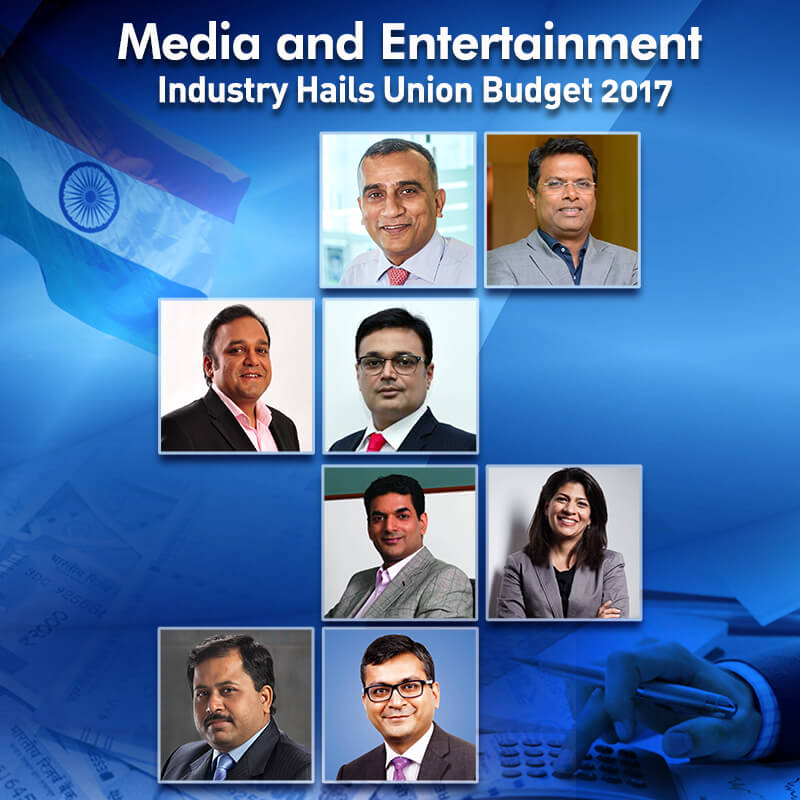
  • Media and entertainment industry hails Union Budget 2017

    Media and entertainment industry hails Union Budget 2017

    MUMBAI: On 1 February, the finance minister Arun Jaitley made significant announcements during the presentation of the Union Budget 2017. Although, there was no specific mention of measures for the media and entertainment industry, certain steps which have been taken to boost the economy have been appreciated by the industry, but it also disappointed some.

    The budget 2017 mainly focused on boosting the infrastructure and lifting rural income besides bringing in reforms in the financial sector such as the abolition of the Foreign Investment Promotion Board (FIPB) so as to facilitate a new policy for foreign direct investment (FDI). The budget also focused on digitisation — allocating Rs 10, 000 crore to boost the rural fibre optics network, which came as a great news for many in the media and broadcast industry.

    Indiantelevision.com reached out to several industry stalwarts to find out how they interpreted the Union Budget 2017. Here’s what they had to say:

    Viacom18 group CEO and CII Media and Entertainment Committee chairman Sudhanshu Vats said, “Much had been speculated about the economic slowdown post demonetisation. With this budget, the government has taken important steps to boost the economy in a structured manner, building on the promise of transparent growth. Steps to liberalise the FDI regime further coupled with the abolishing of FIPB and tax reforms for MSMEs are bound to have impact in the foreseeable future. This budget has seen some positive solutions to tackle poverty in our country including one of the highest allocation of funds to MNREGA and rationalisation of rate for the lower personal tax slabs. I am particularly enthused by the strong reforms push for digitization and look forward to digital transactions increasing in the country. This also augurs well for digital consumption of video content. The move to cap political donations in cash at Rs 2000 and all-cash transactions at Rs 300,000 are also much-needed, bold steps that are in line with the government’s commitment to uprooting corruption. With Swaach Bharat being close to our hearts, the budget has built further on this theme in a welcome move. I’ve said this before and will say it again: as the M&E sector we have a lot to gain from buoyance in the economy at the aggregate level and I believe this Budget has delivered on that front.”

    Zee Entertainment Enterprises Limited (ZEEL) MD and CEO Punit Goenka stated, “Budget 2017 speaks a lot about the government’s positive and committed approach towards creating a stronger and balanced economy. Being directionally right and focused on spending in growth-centric areas, it clearly reassures the fact that remonetisation is in.”

    Times Network MD and CEO M K Anand said, “After the recent massive policy implementation of demonetisation, my expectation was of some radical reforms. I was a bit disappointed on that count. However, enhanced provision for MNREGA and allocations for rural, agriculture and allied sector and a clear push for the affordable housing sectors is the silver lining. Agriculture and real estate are the most important employment generating sectors in India. This should improve the rural situation which is still recovering from demonetisation. Hopefully, that will have a ripple effect on spending and the larger economy.”

    Says ABP COO Avinash Pandey, “The Union Budget 2017 was disappointing as far as the expected incentive for the broadcast business is concerned. Service tax remains the same. Most importantly, there is no parity with the print sector. The ‘wow’ factor was missing (in the budget) as far as the business is concerned. Disposable income is going to increase, and hence the quantum of spending. Economy may revive after the implementation of the budget.”

    Network 18 president revenue and Forbes India CEO Joy Chakraborthy is hopeful, saying, “We are seeing it as a positive budget. The budget is going to help consumption. Significant measures to improve electrification is eventually going to help the television industry. The general sentiment is that it is, overall a positive budget. Once people start spending money, consumption will be there and subsequently advertising too will follow.”

    Says, BBC Worldwide – ‎BBC Worldwide India South East Asia and South Asia SVP and GM Myleeta Aga, “Overall a positive popular budget with personal income tax changes in line with the government’s declared intention to collect more taxes from the rich and reduce the tax burden on the middle income group.”

    She added, “I was particularly encouraged to hear that the GST roll out will not be delayed. Operationally, for the production business, this will complicate working across states but this disruption should be temporary. Continued emphasis on the digital economy and increasing digital transactions will boost growth of e-commerce.”

    SAB group CEO Manav Dhanda said, “Overall, there has been positives for the media and entertainment sector post the Union Budget. As digitization is the next big thing now, the end of March 2018 will see a great growth for digital video consumption across OTT. The youth can now have great opportunities laid for them by initiating the skill India mission that aims to start 100 India International centres. Also, since digitization is on a high, setting up high speed internet in 1.50 Lakh Gram Panchayat is a good move and will give a boost to internet penetration in India. There is no increase service tax by the government and is a positive outcome particularly for the M&E sector, a stable and positive fiscal situation is good for the economy which will also give an impetus to our advertising sales projections. Increased public spending through various schemes and focus on infrastructure investments should further help to accelerate economic growth. The economy seems to have being slowing down since demonetisation, impacting almost all sectors and one hopes this budget to act as a catalyst to propel the growth in the media sector as well.”

    KPMG India partner tax Naveen Aggarwal said, “The Budget was based on broad themes of curbing black money, boosting individual spending, ensuring transparency and providing much needed impetus to agricultural and rural sector, infrastructure and digital economy.”

    He added, “While the announcement to abolish FIPB in light of successful e-governance was surprising, further liberalisation in FDI policy will be keenly watched in context of M&E industry. Lastly, the FM provided much needed assurance on roll-out of GST as per schedule, confirming GST council finalising majority of its recommendations.”

    He further added, “Similar to last two years, the Budget did not bring much respite or specific announcements benefiting M&E industry. While the expectation of overall reduction in corporate tax rate and abolition of MAT was given a miss, the proposal to reduce corporate tax rate for MSMEs to 25% (having turnover up to Rs 50 crore) and increasing the MAT credit entitlement (from 10 to 15 years) is a welcome move and will benefit medium scale service companies in M&E sector.”

  • Media and entertainment industry hails Union Budget 2017

    Media and entertainment industry hails Union Budget 2017

    MUMBAI: On 1 February, the finance minister Arun Jaitley made significant announcements during the presentation of the Union Budget 2017. Although, there was no specific mention of measures for the media and entertainment industry, certain steps which have been taken to boost the economy have been appreciated by the industry, but it also disappointed some.

    The budget 2017 mainly focused on boosting the infrastructure and lifting rural income besides bringing in reforms in the financial sector such as the abolition of the Foreign Investment Promotion Board (FIPB) so as to facilitate a new policy for foreign direct investment (FDI). The budget also focused on digitisation — allocating Rs 10, 000 crore to boost the rural fibre optics network, which came as a great news for many in the media and broadcast industry.

    Indiantelevision.com reached out to several industry stalwarts to find out how they interpreted the Union Budget 2017. Here’s what they had to say:

    Viacom18 group CEO and CII Media and Entertainment Committee chairman Sudhanshu Vats said, “Much had been speculated about the economic slowdown post demonetisation. With this budget, the government has taken important steps to boost the economy in a structured manner, building on the promise of transparent growth. Steps to liberalise the FDI regime further coupled with the abolishing of FIPB and tax reforms for MSMEs are bound to have impact in the foreseeable future. This budget has seen some positive solutions to tackle poverty in our country including one of the highest allocation of funds to MNREGA and rationalisation of rate for the lower personal tax slabs. I am particularly enthused by the strong reforms push for digitization and look forward to digital transactions increasing in the country. This also augurs well for digital consumption of video content. The move to cap political donations in cash at Rs 2000 and all-cash transactions at Rs 300,000 are also much-needed, bold steps that are in line with the government’s commitment to uprooting corruption. With Swaach Bharat being close to our hearts, the budget has built further on this theme in a welcome move. I’ve said this before and will say it again: as the M&E sector we have a lot to gain from buoyance in the economy at the aggregate level and I believe this Budget has delivered on that front.”

    Zee Entertainment Enterprises Limited (ZEEL) MD and CEO Punit Goenka stated, “Budget 2017 speaks a lot about the government’s positive and committed approach towards creating a stronger and balanced economy. Being directionally right and focused on spending in growth-centric areas, it clearly reassures the fact that remonetisation is in.”

    Times Network MD and CEO M K Anand said, “After the recent massive policy implementation of demonetisation, my expectation was of some radical reforms. I was a bit disappointed on that count. However, enhanced provision for MNREGA and allocations for rural, agriculture and allied sector and a clear push for the affordable housing sectors is the silver lining. Agriculture and real estate are the most important employment generating sectors in India. This should improve the rural situation which is still recovering from demonetisation. Hopefully, that will have a ripple effect on spending and the larger economy.”

    Says ABP COO Avinash Pandey, “The Union Budget 2017 was disappointing as far as the expected incentive for the broadcast business is concerned. Service tax remains the same. Most importantly, there is no parity with the print sector. The ‘wow’ factor was missing (in the budget) as far as the business is concerned. Disposable income is going to increase, and hence the quantum of spending. Economy may revive after the implementation of the budget.”

    Network 18 president revenue and Forbes India CEO Joy Chakraborthy is hopeful, saying, “We are seeing it as a positive budget. The budget is going to help consumption. Significant measures to improve electrification is eventually going to help the television industry. The general sentiment is that it is, overall a positive budget. Once people start spending money, consumption will be there and subsequently advertising too will follow.”

    Says, BBC Worldwide – ‎BBC Worldwide India South East Asia and South Asia SVP and GM Myleeta Aga, “Overall a positive popular budget with personal income tax changes in line with the government’s declared intention to collect more taxes from the rich and reduce the tax burden on the middle income group.”

    She added, “I was particularly encouraged to hear that the GST roll out will not be delayed. Operationally, for the production business, this will complicate working across states but this disruption should be temporary. Continued emphasis on the digital economy and increasing digital transactions will boost growth of e-commerce.”

    SAB group CEO Manav Dhanda said, “Overall, there has been positives for the media and entertainment sector post the Union Budget. As digitization is the next big thing now, the end of March 2018 will see a great growth for digital video consumption across OTT. The youth can now have great opportunities laid for them by initiating the skill India mission that aims to start 100 India International centres. Also, since digitization is on a high, setting up high speed internet in 1.50 Lakh Gram Panchayat is a good move and will give a boost to internet penetration in India. There is no increase service tax by the government and is a positive outcome particularly for the M&E sector, a stable and positive fiscal situation is good for the economy which will also give an impetus to our advertising sales projections. Increased public spending through various schemes and focus on infrastructure investments should further help to accelerate economic growth. The economy seems to have being slowing down since demonetisation, impacting almost all sectors and one hopes this budget to act as a catalyst to propel the growth in the media sector as well.”

    KPMG India partner tax Naveen Aggarwal said, “The Budget was based on broad themes of curbing black money, boosting individual spending, ensuring transparency and providing much needed impetus to agricultural and rural sector, infrastructure and digital economy.”

    He added, “While the announcement to abolish FIPB in light of successful e-governance was surprising, further liberalisation in FDI policy will be keenly watched in context of M&E industry. Lastly, the FM provided much needed assurance on roll-out of GST as per schedule, confirming GST council finalising majority of its recommendations.”

    He further added, “Similar to last two years, the Budget did not bring much respite or specific announcements benefiting M&E industry. While the expectation of overall reduction in corporate tax rate and abolition of MAT was given a miss, the proposal to reduce corporate tax rate for MSMEs to 25% (having turnover up to Rs 50 crore) and increasing the MAT credit entitlement (from 10 to 15 years) is a welcome move and will benefit medium scale service companies in M&E sector.”