Tag: Sudhanshu Vats

  • Celebrating 100 years of Bengali cinema, Viacom18 and Film Heritage Foundation bring the 4th Film Preservation & Restoration Workshop to Kolkata

    Celebrating 100 years of Bengali cinema, Viacom18 and Film Heritage Foundation bring the 4th Film Preservation & Restoration Workshop to Kolkata

    Kolkata: In line with the centenary celebration of the Bengali Film Industry, and with a purpose to encourage and give an impetus to film preservation and restoration, the 4th edition of Film Preservation & Restoration Workshop India (FPRWI) 2018 was today inaugurated at Kolkata’s Rabindra Sadan. Supported by Viacom18, this initiative of Film Heritage Foundation (FHF) and International Federation of Film Archives (FIAF) is being held in association with the Kolkata International Film Festival. The workshop will be held from 15th to 22nd, November 2018 at ICCR Kolkata. 

    With this edition of the workshop, a program to restore 100 Bengali films such as Tapan Sinha’s Kabuliwala, P.C. Barua’s Devdas and Ajoy Kar’s Saat Paake Bandha, amongst others will be initiated. Eminent actor Shri Soumitra Chatterjee, who was the Chief Guest, inaugurated the workshop in the presence of Shri Aroop Biswas, Hon’ble Minister, Public Works Dept., Sports & Youth Dept. and Chairman, West Bengal Film Academy; Shri Indranil Sen, Hon’ble Minister of State, Information and Culture Dept. & Tourism Dept., Govt. of West Bengal; and esteemed members of the film fraternity such as Smt. Madhabi Mukherjee, Shri. Buddhadeb Dasgupta, Shri Goutam Ghose, Shri Prosenjit Chatterjee, Smt. Rituparna Sengupta, and Shri. Jawahar Sircar. Also present at the inauguration were Sudhandhu Vats, Group CEO and Managing Director Designate, Viacom18 and Shivendra Singh Dungarpur, Founder & Director of Film Heritage Foundation and David Walsh, Training and Outreach Coordinator, FIAF.

    Speaking at the occasion, Sudhanshu Vats, Group CEO and MD Designate, Viacom18, said, “At Viacom18 we believe in the power of synergies and the way our association has shaped up over the past three years is an apt example of harnessing the ability of the collective for the greater good. With collaboration of Government bodies, film fraternity, the international community of film restoration experts and cinema enthusiasts, we have been able to create an ecosystem that understands the importance of cinema as a cultural relic and is equipped to preserve and archive it, for future generations. With the past three editions of the workshop in Mumbai, Pune and Chennai, we are proud to now have created a pool of about 200 individuals who are aware and equipped to preserve films across India.”

    The week-long intensive program will train a total of 58 students from Sri Lanka, Myanmar and India in preservation and restoration techniques for celluloid film and photographic material like posters, lobby cards, song booklets and photographs. FPRWI covers every aspect of film preservation making it one of the most comprehensive workshops for preservation and restoration across the world. Global experts like David Walsh – FIAF, Camille Blot-Wellens – FIAF, Kieron Webb – British Film Institute, Marianna de Sanctis  –  L’Immagine Ritrovata, Dawn Jaros – Academy of Motion Picture, Dana Hemmenway – Centre for Creative Photography, among others, are a part of the esteemed faculty. The 4th edition of the workshop introduces a new format allowing students to select a specialization of their interest. The program will also have practical sessions for scanning archival films with the latest and world class ARRISCAN XT scanner.

    Shivendra Singh Dungarpur, Founder & Director, Film Heritage Foundation, further added, “Film preservation is a highly specialized field that requires trained archivists. The goal of these annual intensive workshops has been to create awareness about the urgent need to save our film heritage as well as to create a resource of trained archivists who can take this forward. After the success of the first three editions, we are thankful to the Government of West Bengal for their support towards bringing FPRWI to the Kolkata and we are encouraged by their decision to make the preservation of their film heritage a priority.”

    On inaugurating the 4th Film Preservation & Restoration Workshop India 2018, legendary actor and Chairman of KIFF, Prosenjit Chatterjee said, “Saving and showcasing Bengali cinema is of utmost importance and we are glad that such concerted efforts are being made to ensure that our cinematic heritage is being preserved. I am grateful to Viacom18 and the Film Heritage Foundation for bringing the FPRWI workshop to Kolkata.” 

    At the opening ceremony of the workshop, Veteran actor Shri Soumitra Chatterjee said, “Bengali cinema has got international accolades to India and we are in dire of need of saving this heritage. Works of these legendary actors, directors, musicians and cinematographers need to be saved and hence, I am glad that we are today taking an initiative that will inspire the youth to preserve Bengali cinema.”

    FPRWI 2018 is supported by globally renowned industry bodies like The Film Foundation’s World Cinema Project, The Academy of Motion Picture, Arts & Sciences, L’Immagine Ritrovata, Fondazione Cineteca di Bologna, British Film Institute, The Criterion Collection, the Irish Film Institute, the Austrian Film Museum, Eye Film museum, Bundesarchiv (German Federal Archives), the Indiana University Libraries Moving Image Archive, Centre for Creative Photography, University of Arizona, ARRI and Media Inventions.  Previous editions of the workshops have been conducted in Mumbai in 2015, Pune in 2016 and in Chennai in 2017.

  • IBF rejigs board; appoints VPs to steer key objectives

    IBF rejigs board; appoints VPs to steer key objectives

    MUMBAI: The board of directors of the Indian Broadcasting Foundation (IBF) has unanimously appointed Siddharth Jain, Rajat Sharma, Sudhanshu Vats and K Madhavan as the vice-presidents to broadbase and liaise with the government and other stakeholders for the sectoral growth.

    Turner International India Pvt Ltd South Asia SVP and MD Siddharth Jain will be the VP for distribution. India TV chairman and editor-in-chief Rajat Sharma shall oversee government affairs in his role as the VP of the foundation. Viacom18 group CEO Sudhanshu Vats would be VP—audience measurement and Asianet communications MD K Madhavan will be spearheading the regional affairs portfolio.

    India Today Group chairman and editor-in-chief Aroon Purie shall continue as the treasurer of the foundation till the next AGM.

    In the 19th annual general meeting of IBF held on 31 August 2018, the members unanimously elected Prasar Bharati CEO Shashi S Vempati to the board of directors of IBF. His inclusion in the board will strengthen the foundation technologically considering his prior experience in the IT sector.

    With the inclusion of ABP News Networks COO Avinash Pandey, The Walt Disney Co- South Asia EVP and MD Mahesh Samat, Malayalam Communications Ltd MD and editor-in-chief John Brittas as co-opted directors on the board of the foundation, IBF is geared up to meet the sectoral challenges.

  • Viacom18 rejigs top deck as it gears up for the next growth phase

    Viacom18 rejigs top deck as it gears up for the next growth phase

    MUMBAI: Viacom18 today announced a management restructuring aimed to consolidate its growing portfolio play as it prepares to further enhance performance through focused content innovation and collaboration across brands.

    Manisha Sharma, who has been the force behind the continued success of Colors, has now been elevated to chief content officer, Hindi mass entertainment. In her new role, she will be heading content for the entire HME cluster including Colors and Rishtey. Manisha will now report directly to Viacom18 group CEO and managing director designate Sudhanshu Vats.

    In a first for the organization, Viacom18 has unified all revenue across the network under the leadership of chief operating officer Raj Nayak.

    Nina Elavia Jaipuria’s role has been expanded to head – Hindi and kids TV network. Her mandate now includes channels across kids and Hindi mass entertainment clusters.
    Head of the regional TV network Ravish Kumar will be leading the network’s foray into regional broadcast entertainment across languages and genres.

    Ferzad Palia will continue leading the network’s efforts in strengthening Viacom18’s command on youth, music and English entertainment while creating content and experiences for Viacom18’s young audience.

    Ajit Andhare will now take on the expanded role of Viacom18 Studios chief operating officer to drive Viacom18 Motion Pictures’ forays into national and regional cinema and build Tipping Point as a brand for digital content production.

    Saugato Bhowmik will continue to lead Integrated Network Solutions, building homegrown IPs in experiential entertainment and driving the licensing business under Viacom18 Consumer Products.

     All the above will report into Sudhanshu Vats.

    “The first decade of Viacom18 marked the hyper-growth phase for us with  50X growth in topline. In order to make Viacom18 future-ready and dial up growth across different lines of business, it is imperative to drive synergies, leverage scale and build content capabilities across screens. As we step into our next phase, it is important that we shape an organizational structure that allows us to retain the garage-nimbleness that got us here while enabling Viacom18’s independent business lines to leverage the synergies that consolidation brings. Integrating our revenues  and building content engines to cater to multiple screens across India, under the above leaders, is an important step towards a forward-looking organization,” said Vats.

    These organizational changes will be operationalised with immediate effect. 

  • A ‘Colors’ful decade

    A ‘Colors’ful decade

    MUMBAI: It seems just like yesterday. How oft we have heard that phrase being spoken. So much so that it appears banal. However, in the case of Colors – the general entertainment channel from the now Reliance Industries majority-owned Viacom18 – it is so apt. 10 years have gone by since it started.

    Twitterland has been buzzing with tweets from Viacom18 COO Raj Nayak, Colors itself, and nominated managing director Sudhanshu Vats celebrating the achievement of the landmark.

    And why not? It seems not so long ago that Colors was flagged off under the baton of programming head Ashvini Yardi and the then CEO Rajesh Kamat. The former today is a successful producer and Bollywood icon Akshay Kumar’s production partner. The latter manages funds and is invested in the media space.

    Colors disrupted the status quo – and how. At launch stage, expensive loss leaders like Khatron Ke Khiladi hosted by Akshay Kumar, accompanied by path breaking rural subject shows like Na Aana Is Des Laado, Balika Vadhu and Uttaran delivered a breath of fresh air to audiences, who stayed glued to the channel. This gave it unprecedented viewership ratings and made existing leaders Star Plus, Zee TV and Sony Entertainment raise their eyebrows in surprise, and later creased their brows with worry. It succeeded at a time when two other efforts, NDTV Imagine and Real Broadcasting, flopped and folded up. Both had big money backing them. And, no one expected Colors to be any different. The name itself was pretty oddball.

    However, fully charged up distribution, sales and marketing teams – led by Kamat, then promoters Raghav Bahl, and then group CEO Haresh Chawla – worked day and night to make it a success.  Ambition ran pretty deep. With failure not an option, there was only one path to beat, that of victory over India’s audiences.

    Colors shot up the viewership charts dislodging leaders Star and Zee from their perches and carved out its place in the top 3 GEC sweepstakes. Of course, money had been burnt during startup as investment, and the cash burn continued. But the advertising and marketing community caught on quick and started ploughing media spends into the channel.

    The Colors rosy tale continued until both Kamat and Ashvini departed, leaving a vacuum. And, like earlier, a surprise candidate was plonked in the drivers’ seat: Raj Nayak – a professional with experience of selling Star Sports and ESPN, then Star Plus in its early humungous success days, later NDTV and then with his own venture Aidem. Quizzical looks went around relating to the selection.

    But Raj adapted quickly to the creative demands and brought in a former Sony programming head Manisha Sharma to help and fine-tune the selection of fictional and non –fiction shows. He continued to bet big on shows such as Bigg Boss, invested oodles of money on the Anil Kapoor-starrer 24, and went the mythological, fantasy and superstition way with shows such as Shani, Naagin, Chandrakanta, Chakravartin Ashoka Samrat and formats like Rising Star, Jhalak Dikhhla Jaa, India’s Got Talent, the superhit comedy show Comedy Nights with Kapil etc. . Most of Raj’s gambles worked. Shows like 24 and detective series Dev got him plaudits galore for investing in good and edgy content, while the others got the channel  eyeballs.

    And in Colors’ tenth year, it looks like there’s no stopping Raj and the colourful team.  Firmly entrenched as a serious contender in the GEC leadership sweepstakes, Colors has spawned extensions in different languages, replicating the Hindi GEC’s success. A change of management twice – once when Raghav sold out to Mukesh Ambani’s Reliance and recently when in joint venture Viacom18 American giant Viacom ceded majority to Reliance – has not dampened any spirits. It has only buoyed Raj, Sudhanshu and their merry men (and women).

    More so when Ambani at a Viacom18 event in Mumbai late last year, told Sudhanshu — and over hundred guests present — that having invested time and money in the telecom venture Jio, it was time to devote some time to the TV venture, comprising GECs and news channels.

    As the celebrations for a decade of existence continue, we at indiantelevision.com doff our hats to the Colors team and wish it success after success.

  • IAA kick starts mentorship plan for women

    IAA kick starts mentorship plan for women

    MUMBAI: International Advertising Association (IAA) brings up a specialised mentorship program for women which will help them to progress and also empower them to climb the corporate ladder by giving them the right guidance and mentorship by industry leaders.

    The mentorship program is designed to train and encourage women who are talented and have had work experience of 8-10 years. It got a unanimous cheer from the industry when it was launched early this year.

    The IAA committee, which consist of Lodestar UM CEO Nandini Dias, Zirca Digital Solutions CEO Neena Dasgupta, IAA President Ramesh Narayan, chief operating officer BTVI- Business Television India took time out to carefully analyse and handpick women who will now get a chance to meet, engage and receive mentorship via four sessions from industry leaders over the next six months.

    IAA President Ramesh Narayan shares, “We have been working on this programme around the clock and are very happy with the way it is shaping up. We have finished the selection process and will now roll out the phase I of the activity. It is a long-term plan and we are glad to get it started.”

    The mentorship programme is the brainchild of IAA vice president (chief operating officer BTVI- Business Television India) Megha Tata who is also driving the initiative. She said, “The idea of encouraging someone to achieve their true potential is a very fulfilling thought and that is exactly what this programme achieves to do. We have shortlisted 23 women who will be receiving mentorship from some of the leading industry experts. We are sure this exchange will be valuable and will empower women leaders over a period in time.”

    The IAA has roped in 23 amazing mentors which include Viacom18 COO Raj Nayak, South Asia Dentsu Aegis chairman and CEO Ashish Bhasin, Viacom18 Media Pvt Ltd  Group CEO Sudhanshu Vats, Star India managing director Sanjay Gupta, ZEE Entertainment Enterprises Ltd CEO Punit Misra, Farm Equipment Sector president Rajesh Jejurikar, Member of the Group Executive Board, Mahindra and Mahindra Ltd, Dainik Bhaskar executive president Bhaskar Das, Dainik Bhaskar non executive director Girish Agarwal, The Times of India Group  president revenue Sivakumar Sundaram to name in few.

  • Sudhanshu Vats appointed MD Viacom18; Rahul Joshi is MD Network18 and TV18

    Sudhanshu Vats appointed MD Viacom18; Rahul Joshi is MD Network18 and TV18

    MUMBAI: It’s promotion time at the Reliance Industries-owned news firm TV18 Broadcast and Network18 Media and entertainment broadcasting major Viacom18. The boards of the three companies have upped their respective CEOs to managing director (MD). Sudhanshu Vats who was earlier group CEO, Viacom18 has now been designated as MD even as Rahul Joshi  has been given the same designation at both Network18 Media and TV18 Broadcast. Joshi’s position is for a term of three years with effect from 9 July 2018, while  Vats’s redesignation awaits the receipt of necessary regulatory approvals.

    Vats has been associated with Viacom18 from last six years, while Joshi has worked at Network18 Group since September 2015 and is CEO news and group editor in chief.

    Adil Zainulbhai, chairman of Network18 and TV18 said “Both the appointees have tremendous skill and experience and will continue to drive our news and entertainment businesses towards leadership, as we continue to invest in these areas.”

    Joshi has done his masters in management studies from Narsee Monjee Institute of Management Studies (NMIMS), Mumbai University. 

    Prior to joining the Network18 group, he worked for more than two decades with The Economic Times, where he rose through ranks to quickly become one of India’s youngest editors, and has also worked as its editorial director. He also launched ET Now and helped shape the digital coverage of ET Online. 

    Joshi was also employed with The Indian Express in the past. He is also on the board of News Broadcasters Association (NBA). 

    Vats is a management graduate from the Indian Institute of Management – Ahmedabad. Prior to joining Viacom18, he spent about 20 years in Hindustan Unilever (Unilever India) where he worked in sales & marketing and general management roles across categories and shaped many popular household brands. Vats is also chairman of the national media & entertainment committee of CII (Confederation of Indian Industry), VP of IBF (Indian Broadcasting Foundation) and director of BARC (Broadcast Audience Research Council). 

  • M&E to add 1 mn jobs in 5 years: Sudhanshu Vats

    M&E to add 1 mn jobs in 5 years: Sudhanshu Vats

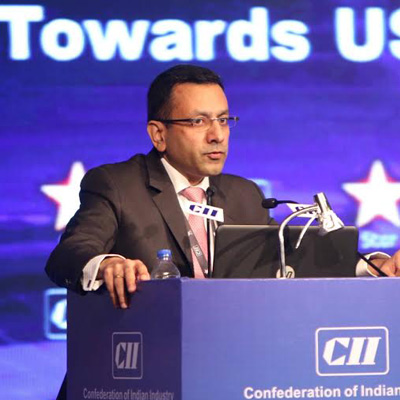
    MUMBAI: The Indian media and entertainment (M&E) sector is likely to be worth $1.7 billion in terms of service exports. The figure was estimated by Viacom18 group CEO Sudhanshu Vats while speaking at a CII inauguration.

    India’s services exports were $163 billion which is likely to hit $320-330 billion in five years. The M&E sector is a $21 billion industry with eight per cent being exports. By 2022, the M&E sector will contribute $8.5 billion worth of export revenue. In the overall pie of service exports across industries, M&E makes up one per cent and is likely to hit three per cent by 2022.

    Vats went on to state what makes the M&E sector apt to become the next big thing after IT in the country. With job creation being a government priority, the M&E industry directly employs 1.1-1.2 million people and with indirect employment that will be 3.5-4 million jobs. India’s current total employment is about 480 million and 10-15 million being added every year. The M&E industry will easily add one million direct jobs in five years and though the number may be small, they will be quality jobs that will be future proof.

    For other sectors, added factors build onto export cost such as the cost of product development/customisation, packaging, logistics, maintaining overseas offices etc. But in M&E, this is negligible. The only costs will be QC, subtitling, bandwidth, etc. “ Overnight, I can’t start making a drama that will be loved by say the citizens of Papua New Guinea – but I can make good dramas for Indian audiences – that might resonate in Papua New Guinea as well! This has an important corollary – while it holds true for other industries as well, it holds even more true for our sector where every almost output is a tradeable item – any domestic public policy aimed at making us competitive in India, will make us competitive across the world,” he said.

    The sector has an ability of a multiplier effect on other industries such as tourism, travel, healthcare, etc., the effects of which cannot be ignored. “We have all that it takes to ensure that India takes her rightful place with the next industrial revolution – one that will make human capital, creativity and cognitive ability even more important. From one per cent of our services exports today to about three per cent by 2022 – and significant, disproportionate upside from the standpoint of India’s labour markets, social policy, economic growth and global standing – that is the promise we hold,” he concluded.

    Also Read :

    Sudhanshu Vats on Viacom18’s growth strategy and why data analytics is key

    We are becoming more platform and screen agnostic: Sudhanshu Vats

  • We are becoming more platform and screen agnostic: Sudhanshu Vats

    We are becoming more platform and screen agnostic: Sudhanshu Vats

    He heads the youngest Indian network engaged in general entertainment television. Sudhanshu Vats, group CEO, has, over the past six years, steered Viacom18 India into launching a clutch of new channels catering to the different regions of India as well as niche segments. He has built a rock-solid leadership team to run the services, which have been growing at a rapid clip.

    Vats, a former long-serving Hindustan Lever (Unilever India) executive, has also seen the company transition from being a joint venture with global media major Viacom to one which is now majority owned by Mukesh Ambani’s Reliance Industries.

    A thought leader in the industry, he is constantly propagating the message that India is rich with media and entertainment potential at both domestic and international confabs. Vats was at the Media Partners Asia-run APOS in Bali late last month. On stage having a conversation with Vivek Couto, Vats spoke freely on a range of topics right from Viacom18, the Reliance ownership, Voot and the pay TV ecosystem in India. Excerpts from the interview.

    Your views on the pay TV ecosystem in India?

    At one level, the pay TV ecosystem is not developing as well as it should. Partly, all of us, as part of the ecosystem, are to blame. There is lack of addressability. There is lack of customer centricity and customer service attitude with the distribution partners. India being a poor country there will also be a pressure on free to air up to a particular stage.

    My view of the country is that it will be a hybrid ecosystem of both pay and free to air. And, in my opinion, both can exist. But for pay to exist, pay will have to earn its right. And as content players, we are concerned because it’s not going the way we would like it to.

    Free to air is growing and will grow and we need to find models, largely advertising-led models, to make that happen–that piece is okay. But the pay subscription growths are not commensurate–the addressability is not there. Recognition of change of viewership; change of pattern is not there today.

    And I think no better than us, we have leading channels in almost all genres; but our ability to get subscription income is very little. Because it is all dependent on this. Pick up a genre and we have a leading channel. We are not recognising the changes; we are not addressing the customer and not being customer specific.

    How is the Indian television ecosystem faring overall?

    There were two events in India in the last couple of years—GST and demonetisation. They affected ad sales in my opinion. But the good news is that in the last two or three months, it is coming back. We are clearly seeing certain sectors performing very well—FMCG is back and very strongly. Automobile is back in a reasonably big way. Consolidation in telecom will lead to more telecom spends. Handsets are there, they have always been there. Rural economy is also doing quite well. We are seeing a surge in the regional rural pieces quite a lot within our portfolio.

    If you look at Viacom18 per se – I think we have had a pretty good year in FY18, which we closed. We delivered 20 per cent top line growth led by our performance in films as well with Toilet ek Prem Katha. But even in ad sales, we have delivered a mid-teen growth for the year.

    And interestingly this has come at a time when our leading channel Colors was slightly muted because of the impact properties on Colors that came in. It’s the portfolio, which we built that has helped us—its regional, it’s FTA, it’s niche. I personally feel, moving forward, the ad sales will rebound to the levels that India has been used to seeing.

    The ad market will go to mid-teens and some of the better companies may look at doing even high teens.

    How has the change of majority ownership impacted the organisation you head?

    The advantage for us with the consolidation with Reliance is two-fold. Ambition and the things we can do is one big thing today. The second big thing is the resources that can come in which could be of a different level. Because, as a joint venture, we were balancing some of those pieces. Now perhaps we can take concurrent bets as we go forward. So that’s fantastic news for Viacom18. We need to continue to motor on what we have built as a culture that is critical for us. So, if we retain that culture and we bring in that ambition and resources, it’s good news.

    Your digital piece, Voot, how is that faring?

    Voot has been primarily advertising led. The good news here is that we have been growing quite rapidly. We exited March of 2018 at 3X the number we were at March of 2017 on almost all parameters.  So, today, according to App Annie, we are number two in everything which you see after Hotstar. We are number two in downloads; we are number two in active users. We are actually number one sometimes in time spent. We are between one and two in time spent. We have about 35-40 million monthly actives and close to about 45 minutes of watch time.

    The Voot service is doing very well. Interestingly, there is a lot of work which we are doing which is tailored for it. If you look at our content: the breakup of our viewership – if I were to give you an order of magnitude – would be about 60 odd per cent of what you have on television – that’s catchup maybe 60 to 65 per cent. About 20-odd per cent or sometimes 20-22 or 25 per cent is what we call Voot exclusives or content around content. So it is content which is running on television, that is the theme is running on TV – especially non-fiction – and there is a lot of content which is not on television which is shown here. That’s gaining a lot of traction. And finally there are originals and kids. That stacks up the full piece.

    What plans do you have for Voot?

    Our thinking moving forward is that this is just the beginning. It’s an AVOD piece, again advertising is coming in reasonably well from a very small base – we are doubling every year. But what we also do is we’ve built in a freemium layer, for people who are at the higher end where we offer them an ad free environment, maybe additional services—that is the thinking that is there.

    The second thinking that is there is that we are going to do something for Voot Kids. That’s a space we are very bullish on. We want to go well beyond video, we want to well beyond watch, we will go into spaces of watch, learn, play and all that. We are looking at the edutainment piece. You will come into it for entertainment, but you will have light gaming, some number of e-books, some amount of learning or options available to you particularly at the pre-school stage. We are not getting into pedagogy or hard-core education. That’s not the space we want to be in.

    We are looking four to five million daily active users currently. The kind of data you are seeing now is pretty rich. And we are just about beginning to learn to mine that data.
    On the original front, it has been part of our journey. This year you will see us going into overdrive or at least accelerate our originals. You will see a lot more of them in Hindi, you will see them in regional. And as we speak, there is work happening on many of them. We may use some of them to go behind our freemium service as well.

    You seem to have changed your mind on sports as a piece of content? Will Viacom18 drive deeper into sports?

    We have dabbled a bit in sports. We piloted a few things. We actually did the Nidahas Trophy on our channel. We are looking to see if there is a way of putting sports together that may not have cricket. Cricket, as you may know, is with Uday now. We are continuously looking at areas that might be of interest to us.


  • Viacom18 and Film Heritage foundation host power packed evening with Christopher Nolan and Tacita Dean

    Viacom18 and Film Heritage foundation host power packed evening with Christopher Nolan and Tacita Dean

    MUMBAI: A one of a kind crowd gathered at Mumbai’s Taj Mahal Palace yesterday to celebrate, encourage and save the art of film-making on celluloid. Acclaimed Director Christopher Nolan and award-winning visual artist Tacita Dean are in the city for the 4th edition of Reframing the Future of Film. Hosted by India’s youngest full-play media network Viacom18, in association with the Film Heritage Foundation, in attendance for the dinner were a motley of top business leaders, film-makers and media industry personalities such as Kamal Haasan, A.R. Rahman, Huma Qureshi, Anurag Kashyap, Siddharth Roy Kapur, Rajkumar Hirani, Santosh Sivan, Shyam Benegal, Ashish Bhasin, Vikram Sakhuja, and Prasoon Joshi amongst others in attendance. 

    Speaking at this exclusive dinner party, host for the evening Viacom18, Group CEO, Sudhanshu Vats said: “Films in India have traditionally been shot on celluloid, an art that is fast being replaced by digital filming. Christopher Nolan is one of the world’s most eminent film-makers who still shoots on film and is a strong proponent of saving celluloid filming. As supporters of film preservation and restoration initiatives in the Indian subcontinent for 4 years now, we understand the importance of saving cinema in every medium, be it digital or analogue i.e. celluloid. Having Christopher and Tacita in the city is a great opportunity for raising awareness and I would urge corporations, media, partners and the entertainment industry of the country to support this cause.”

    Christopher Nolan and Tacita Dean have been raising awareness amongst the international film fraternity towards the cause of saving celluloid. After three editions in London, Los Angeles and Mexico, this time they’re in India, the second largest film making nation in the world. Film Heritage Foundation, which works towards the saving and restoring the film heritage of India and neighbouring countries has partnered with Nolan and Dean to raise awareness in India about film being a working medium, with unique intrinsic qualities that artists and filmmakers need.

    Speaking about his visit to India Christopher Nolan said: “It’s been wonderful meeting so many of you. Here’s to learning more from you guys, to looking forward to events over the next couple of days, and learning more about the amazing film culture that exists in India.”

    Film Heritage Foundation, Founder Director, Shivendra Singh Dungarpur said, “Partnering with stalwarts of film-making such as Christopher Nolan and Tacita Dean bring about awareness and attention that is most lacking in the cause of film preservation and restoration. Most of our cinematic heritage is in celluloid and therefore, its preservation will help not only save films but also film-making on film.”

    ‘Reframing the Future of Film’ – a conversation between renowned visual artist Tacita Dean, celebrated filmmaker Christopher Nolan (Dunkirk, Interstellar) and award-winning filmmaker and archivist, Shivendra Singh Dungarpur will be held at NCPA theatre Mumbai on 1st April 2018.

  • M&E stakeholders need to collaborate for growth: Sudhanshu Vats

    M&E stakeholders need to collaborate for growth: Sudhanshu Vats

    MUMBAI: If the Indian media and entertainment (M&E) sector, poised to be Rs 2 trillion industry by 2020, is to be a force multiplier and up the present growth trajectory, then all the stakeholders, including the government, need to collaborate sinking differences, according to Viacom18 Group CEO Sudhanshu Vats

    “We need to learn to collaborate as an industry. We need to collaborate with competitors at times so collaboration and competition can coexist. The scale of industry is such that innovation and disruption is bigger than what any single one of us can achieve. It is only when we form partnerships [and] collaborate that we can achieve greater heights,” Vats on Monday said delivering a keynote address, themed ‘Media and Entertainment: The Force Multiplier At The Heart Of Society’, at the ongoing FICCI-Frames 2018 here.

    Pointing out that the M&E sector has deep links with other sectors of the economy, Vats asked and answered, “Where is it that you first heard about the mobile phone in your hands? Why do you even use it? How did you come across the shampoo you used this morning? What did you do in the car while driving to this conference? Well for most of you, the answer will be some form of media, be it print, or digital or electronic.”

    Deconstructing his observations in terms of numbers, Vats explained that the M&E sector has added over Rs 50,000 crore in output in the last five years, has a revenue size of Rs 130,000-135,000 crore and the direct or indirect induced benefits to the economy of the total industry size is Rs 450,000 crore with a contribution of 2.8 per cent to the country’s GDP. This apart, the industry also employed, across both formal and informal sectors, 1-1.2 million people, contributing significantly to India’s job creation.

    Having excited the audience with some hard data, Vats added, “Did you know that by several estimates, video streaming accounts for over 50 per cent of total mobile internet usage in India? This is expected to touch 75 per cent over the next three years. Today itself, the contribution of data to telco revenue stands at 20-25 per cent. Imagine what will happen when virtual reality (VR) becomes a commonplace phenomenon?”

    According to Vats, while presently the media sector employed around 1.5 million people directly and indirectly, it has the potential to add another million over the next five years, which might seem a small number —  given the total workforce of 460 million — but these are jobs that were non-routine, least likely to be automated and, more importantly, most of these jobs will need ‘on-the-job training’ — meaning that these jobs don’t need to wait for the country’s education infrastructure to catch up.

    But, given the M&E industry’s role as a force multiplier, how much steam is left? Because if the engine starts to weaken, it is obvious that its role as a force too will reduce. Vats thinks the answer to the question need not be a pessimistic one. Why?

    Vats listed the reasons for growth opportunities: (i) M&E industry’s ad-spend to GDP ratio was still 0.4 per cent compared to 1 per cent in developed economies (ii) the total sector is one per cent of GDP compared to 2.5 per cent or so in developed economies and (iii) while Indian TV audience (780 million) is bigger than that of the total population of Europe (745 million), India has only 64 per cent penetration with 183 million TV households. “With electrification progressing at a blistering pace, imagine future growth,” he reasoned.

    Though the opportunities are there, can the M&E industry pull it off? Certainly yes, if all the stakeholders sunk their differences and learnt to collaborate without being skeptical of newer techs and data-driven findings instead of always asking the government and regulator for help, which they must provide being facilitators and further adding to ease of doing business, Vats said exhorting the industry to rise to the challenges as one.

    “We need to become comfortable with data because we need to bring in more transparency, authenticity and objectivity to our data. If a new-age entrepreneur comes to us, we are skeptical of his idea or technology. If someone approaches us with a new way of measuring, say, our audiences, we are dismissive. We need to change this attitude. We need to change this mindset,” Vats reasoned, adding that Viacom18 was doing its own little bits, including starting a pan-network engagement programme with startups where the company partners with validation. The initiative is called Vstep or the Viacom18 Startup Engagement Programme.

    Urging the Indian society to loosen up a bit — learning to “laugh at ourselves” — Vats signed off saying: “Let us, the media and entertainment industry, be the force multiplier for growth, the force multiplier for change, the force multiplier for jobs and, above all, the force multiplier for the good of society.”

    Also Read :

    M&E to cross Rs 2 trillion by 2020: FICCI-EY reportFicci

    Frames 2018: Smriti Irani for highlighting M&E’s economic importance