Tag: Subscription

  • GTPL Hathway posts Rs 599.1 crore revenue for Q4

    GTPL Hathway posts Rs 599.1 crore revenue for Q4

    KOLKATA: On the back of strong performance in the fourth quarter of FY21, GTPL Hathway has posted Rs 599.1 crore revenue, up 29 per cent year-on-year. The pan-India multi system operator (MSO)’s revenue from operations for the last fiscal has gone up 22 per cent year-on-year to reach Rs 2148.4 crore. It has netted Rs 57.1 crore profit in Q4 compared to 13.8 crore loss in the corresponding period of FY20.

    EBITDA stood at Rs 101.16 crore for the quarter ended 31 March 2021, up 32.32 per cent from Rs 76.45 crore in the same quarter a year ago.

    GTPL’s cable TV subscription revenue stands at Rs 266.5 crore for the quarter compared to Rs 271.8 crore in Q3. However, CATV subscription revenue has grown by four per cent for FY21, reaching 1071.2 crore.

    On the other hand, its broadband revenue has grown five per cent quarter-on-quarter basis to reach Rs 81.7 crore in Q4. While CATV subscription revenue saw only one per cent year-on-year growth for the quarter, broadband business has seen a huge turnaround registering 77 per cent year-on-year spike.

    Significantly, the MSO’s overall subscriber base for pay TV universe has remained the same at eight million in FY21 but active broadband subscriber base has increased by 1.5X to reach overall 635K users. Average Revenue Per User (ARPU) has also gone up by 5.5 per cent and stands at Rs 445 at the end of FY 21. The company has added 540K new home passes in the year. In the last quarter, it has added 70K home pass and added 45K broadband subscribers.

    “GTPL Hathway consistently delivered on key KPIs, despite lockdown and restrictions in FY21. The highlight of FY21 was the growth in subscription revenues for both CATV and broadband business, strong profitability, net-debt free status, geographical expansion, healthy balance sheet and improved return ratios,” GTPL Hathway managing director Anirudhsinh Jadeja said.

    “We have reduced our gross debt by Rs 693 million in FY21. Additionally, the company’s board has recommended to increase the dividend to Rs 4 per share in FY21. The company associated with Boman Irani as its brand ambassador during Q4FY21. GTPL is gearing up to launch new products and services in FY22, thereby propelling its value-proposition in existing and new markets,” he added further.

    (All numbers stated here are on consolidated basis unless stated otherwise)

  • M&E sector witnessed 24% degrowth in 2020: FICCI & EY report

    M&E sector witnessed 24% degrowth in 2020: FICCI & EY report

    KOLKATA: Following a pandemic hit year, the Indian media and entertainment (M&E) sector declined by 24 per cent to Rs 1.38 trillion in 2020, compared to Rs 1.82 trillion in 2019. However, the allied sector is already seeing recovery with improvement in revenues for most segments in the last quarter of 2020. It is expected to recover 25 per cent to reach Rs 1.73 trillion in 2021, touching almost pre-Covid level scale, according to a report by FICCI and E&Y.

    The report titled ‘Playing by New Rules: India’s M&E sector reboots in 2020’ states digital and online gaming were the only segments which grew in 2020, adding an aggregate of Rs 26 billion and consequently, their contribution to the M&E sector increased from 16 per cent in 2019 to 23 per cent in 2020.

    Other segments dropped by an aggregate of Rs 465 billion. Largest absolute contributors to the fall were the filmed entertainment segment (Rs 119 billion), print (Rs 106 billion) and television (Rs 102 billion). The share of traditional media (television, print, filmed entertainment, OOH, radio, music) stood at 72 per cent of M&E sector revenues in 2020.

    However, television stood as the largest sector despite a 22 per cent downturn in advertising revenues on account of highly discounted ad rates during the lockdown months. Moreover, the sector also witnessed a seven per cent fall in subscription income, led by the continued growth of free television, reverse migration and a reduction in ARPUs due to part implementation of NTO 2.0.

    On the other side, digital advertising did not see much impact, led by increased allocation from traditional advertisers who accelerated their investments in digital sales channels. SME advertisers continued to spend on the medium and experimented more with e-commerce platforms like Amazon and Flipkart.

    For the first time ever, OTT subscriptions surpassed the 50 million mark. From 28 million paid subscriptions, it went up to 53 million in 2020 leading to a 49 per cent growth in digital subscription revenues. Growth has been attributed largely to Disney+ Hotstar, which put the IPL behind a paywall during the year. Increased content investments by Netflix and Amazon Prime Video and launch of several regional language products also catalysed the growth, the report added.

    Online gaming crossed all the marks with 18 per cent growth helped by work from home, school from home and increased trial of online multi-player games during the lockdown. Online gamers grew 20 per cent to reach 360 million in 2020.

    Among the pandemic hit sectors, print’s revenue declines were led by a 41 per cent fall in advertising and a 24 per cent fall in circulation revenues. Theatrical revenues plummeted to less than a quarter of their 2019 levels, partly offset by direct-to-digital releases.

    “While the M&E sector usually grows faster than GDP, it also falls more than GDP degrowth, given the discretionary nature of advertising. In 2020, when the GDP fell by eight per cent advertising fell over 25 per cent while the sector overall fell by 24 per cent,” the report read.

    The M&E sector is expected to rebound in 2021 and double to around Rs 2.68 trillion by 2025, the recovery of various segments will vary albeit. TV, film, music will take one to two years, animation and VFX will take two to three years; print, radio, OOH will take the longest time, even more than three years.

  • Online video surpasses 1 billion subscriber mark globally

    Online video surpasses 1 billion subscriber mark globally

    KOLKATA: For the first time ever, online video services have surpassed the one billion subscriber mark globally. In the pandemic hit year 2020, the overall subscriber base has reached 1.1 billion, recording a 26 per cent year-on-year growth, according to a report from Motion Picture Association.

    The global home/mobile entertainment market has raked in $68.8 billion in revenue, marking a 23 per cent increase over 2019. In the United States, subscriptions have crossed 308.6 million, representing a 32 per cent growth from 2019, and the home/mobile market increased 21 per cent, reaching $30 billion.

    While the global market for theatrical and home/mobile entertainment distribution fell 18 per cent to $80.8 billion, the surge in the digital entertainment market has helped partially offset the decrease in the global box office caused by theatre closures during the pandemic.

    “Despite the challenges to the global economy brought on by the Covid2019 pandemic, the film television, and streaming industry has once again risen to the occasion,” said Motion Picture Association chairman and CEO Charles Rivkin.

    “Streaming experienced another huge boom, with new entrants into the market and more than one billion subscriptions worldwide for the first time ever. We kept audiences connected and entertained wherever they were and whenever they desired. Theatrical and home entertainment remain two essential parts of this dynamic and iconic industry, and I am confident that movie theatres will experience a great comeback in the months ahead,” he added.

    However, cable TV revenue is still larger than the online video market. Cable revenues for global industry stood at $116 billion.

    55 per cent of US adults reported that their viewing of movies or shows/series through an online subscription service increased, while 46 per cent reported that their viewing via pay TV increased. More than 85 per cent of children and over 55 per cent of adults watch movies or shows/series on mobile devices.

    Daily viewers of movies or shows/series on mobile devices skew more heavily towards the 18-24 and 25-39 year-old age groups, as well as the Hispanic/Latino and African-American/Black ethnicity groups.

    The global box office market for all films around the world was $12 billion in 2020; Within that number, the US/Canada box office market was $2.2 billion. The top three box office markets outside the US and Canada were China ($3 billion), Japan ($1.3 billion ), and France ($500 million ).

  • Lionsgate Play enters Indian streaming arena with SVoD model

    Lionsgate Play enters Indian streaming arena with SVoD model

    KOLKATA: Another global player makes its official foray in India with the rollout of Lionsgate Play. After running on partnerships for more than a year, Lionsgate has now introduced its independent streaming service. Along with international premium content, it will also deliver high-budget Indian originals. Like other global streaming services, Lionsgate Play will also run on subscription model.

    The service has two pricing points – Rs 99 per month, and Rs 699 per year, which is very competitive compared to other OTT services in India. The app will be available to download across a broad array of platforms and devices including Google Play store, Apple app store and Amazon firestick.

    The platform anticipates continued strong growth in the Indian OTT ecosystem and is capitalising on this opportunity by bringing a host of “new, provocative, and edgy movies and web series”  to the country.

    Starz (a subsidiary of Lionsagte) president and chief executive officer Jeffrey A Hirsch said, “India has always been a key market for us. The large and diverse population, increased data usage in urban and rural markets, and adoption of OTT across all demographics created an exciting opportunity for us to launch Lionsgate Play. We’re confident that our unique, exclusive and exceptionally curated content will generate a great response from Indian audiences.”

    Lionsgate South Asia managing director Rohit Jain added, “We are thrilled to launch the much-awaited Lionsgate Play app in India. We want to provide the finest, never seen before content that will captivate our audiences with bespoke entertainment drawing on the most exciting current releases and our premium library.”

    Talking about content slot, Jain added that it will  be launching Indian originals in the coming months, featuring untold edgy urban stories from some of the best creative minds in the Indian film industry. Jain mentioned that it tied up with the famous B-Town faces like  Anil Kapoor, Mukesh Bhatt, Kunal Kohli and studios such as Endemol Shine, Jar Pictures.

    Starz first launched internationally with its Starzplay international premium streaming platform in 2018. This month it will expand  its global footprint into 55 countries throughout Europe, Latin America, Canada, Japan and India, aiming to become one of the most widely distributed and fastest growing premium OTT services worldwide while entertaining millions of users with bold and curated content.

    The Lionsgate Play app features a broad portfolio of content ranging from the best of original feature film and television dramas, romances, comedies, thrillers and action favourites and premieres, bringing world cinema and television series directly to Indian audiences.

  • Times Network’s MK Anand prioritises subscription over advertising model

    Times Network’s MK Anand prioritises subscription over advertising model

    NEW DELHI: On day one of the News Television Summit  2020, Times Network MD and CEO MK Anand had a few words of caution to offer: monetisation by ad sales is a huge steroid that the news business is running on and which it needs to get out of. Instead, he advocated subscription.

    “When you go the subscription route, there is no need to be ratings-led. The current subscription numbers are 10x of what they were in 2014, when I joined Times. We have to benchmark ourselves on net distribution income (NDI). When it comes to NDI, a news channel should look at the top of the population pyramid more,” he said during a virtual fireside chat with Indiantelevision.com founder, CEO and editor-in-chief Anil Wanvari.

    For instance, Times Network focuses on the top of the pyramid as it believes this is something the organisation needs to cater to, not because of a single-minded determination to chase numbers. “We are numbers-sensitive in the sense that we believe our ratings, our reach, our penetration has to be high. But I absolutely do not consider time-spent (TSV) as a driving factor at all,” he claimed.

    Reach is a good driver, said Anand, adding that Times went from 300 headends when he joined the group to 3,000 plus in just two years.

    Anand went on to reveal that 54 per cent of the Times Network’s revenue in FY21 is going to come from subscriptions. “The total ratings-led business in our topline is less than 25 per cent. Earlier it used to be 90 per cent. Back then we didn’t have branded content or premium-led ground or digital business. Now 14 per cent is from digital while 14-15 per cent is branded content. Specifically, Times Now’s TRP-led business is less than 11 per cent of the total.”

    Wanvari quickly asked Anand if there’s a scenario where the Times Network converts its business model to 90 per cent subscription-led? Anand disagreed with that train of thought for the reason that the network’s audience is hot property for advertisers.

    “Our audiences are premium and our reach management is very aggressive. For advertisers, 40-45 per cent of the top-end audience can only be met through Times Network’s English movies or English news channels. We may not depend on them for survival but that’s a very solid audience for us to monetise and one advertisers can’t do without,” he explained.

    He went on to qualify that the ratio of ad sales (including digital) to subscription will settle at 40:60.

    Anand also upheld rival channel CNBC as a solid example of a subscription-based brand, adding that when it comes to business news channels there isn’t a high degree of dependency on advertising.

    “For niche channels, ratings do not matter. At Times, I have never, ever called up my editors and asked them why the ratings were up or down in any given week. I don’t believe that ratings are the be-all and end-all of right content,” he said.

    Touching upon the television ratings measurement mechanism, Anand asserted that he genuinely believes in the process – it’s only certain unscrupulous players who are trying to manipulate the system and they must be dealt with.

    “Whether it was Tam or BARC, I agree with the statistical and sampling processes. Lapses can happen anywhere but 99 per cent of the time it works. I don’t have a problem with the process. But content sensibilities are very different going down the population pyramid and it’s so much easier to get great numbers by continuously lowering the focus from the top of the pyramid to the bottom,” he added.

  • Hoichoi achieves a subscriber base of 13 million

    Hoichoi achieves a subscriber base of 13 million

    KOLKATA: The leading Bengali OTT platform, Hoichoi, has completed three years in the industry with its grand launch in 2017. It has achieved a subscriber base of 13 million with 40 per cent of its revenue coming from international customers. It has also doubled its revenue in the past year.

    With the vision of "entertaining people in their local language” and having over 60 Originals and 50 World Digital Premieres, Hoichoi has unveiled a fresh slate of 25 new Originals, two first day first show films and multiple world digital premieres for the upcoming year.

    As a Hoichoi subscriber spends 50 minutes a day on the platform, the OTT player is always keen on bringing the best of technology for its customers. It has revealed a sneak peek into its new UI/UX (user interface/user experience) built which is seamless and easy to use for the customers.

    Read more news on Hoichoi

    A parental control feature will soon be added, which comes with Hoichoi being among the top 15 OTT platforms of India who have signed up for a unified self-regulation process with IAMAI for classification and demarcation of content available on all video-on-demand apps and websites in India. 

    Having customers over 100 countries including places like Japan, Sweden, Argentina, Iceland and more, Hoichoi has also announced Carrier Billing. It is an affordable way to consume content in the form of sache pricing and to buy a weekly or monthly subscription by paying with their mobile balance. This will be soon available for users in Bangladesh and Middle East. There’s also, subscription bundling, specifically for customers in India with JioFibre and Bangladesh with its top telecommunication network. 

  • Tata Sky offers emergency credit facility, free access to interactive services

    Tata Sky offers emergency credit facility, free access to interactive services

    MUMBAI: Leading content distribution and Pay TV platform Tata Sky has announced emergency credit facility for subscribers who have been unable to recharge their account due to various reasons, inability to find a dealer to do it for them being one of them. 

    This is aimed at ensuring that all subscribers have access to uninterrupted entertainment round the clock while staying at home during the nation-wide lockdown period.

    The step has been taken largely to ease out the lives of the non-tech savvy viewers who constitute a considerable size of the subscriber base.

    In addition to this, 10 of Tata Sky’s interactive content services have been made free to encourage the consumers to remain fruitfully engaged, learn and do something new in the safety of their homes during this period of public health scare.

    The emergency credit facility will provide subscribers a balance loan for a specified time period. The credited amount will be debited from the user's account as soon as he re-activates his service without any interest.

    Meanwhile, free access to content will include value-added services for the entire family, targeted towards a variety of age groups. Tata Sky Fun Learn, Smart Manager, Vedic Maths, Cooking, Classroom, Dance Studio, Beauty and Fitness count amongst the most popular services that will be available at a time when it is imperative for people to join the drive to stay at home. The credit facility can be easily accessed by giving a free missed call. The free interactive services can easily be accessed on the set top box or on the Tata Sky Mobile App.

    To spread the word on these initiatives, Tata Sky has created a unique TVC to celebrate the spirit of Stay Home, Stay Jingalala. The creative idea – “Chalo Ghar baithe baithe kuch naya seekhein”- has been conceptualised by Ogilvy India for Tata Sky. The TVC was shot and directed remotely by real people on their phone cameras in seven different cities – Kolkata, Mumbai, Delhi, Gurgaon, Lucknow, Chennai and Jodhpur. Not a single person stepped out of their homes for the production which was executed in a period of just two days.

    Talking about the campaign, Ogilvy India Chief Creative Officer  Sukesh Nayak said, “In times like these, it’s important that brands contribute to help its consumers in their own way. By deciding to free up services, Tata sky is doing their bit to entertain and engage its subscribers while they stay at home.”

  • Over 10 mn paid for OTT video subscriptions in 2019: FICCI-EY report

    Over 10 mn paid for OTT video subscriptions in 2019: FICCI-EY report

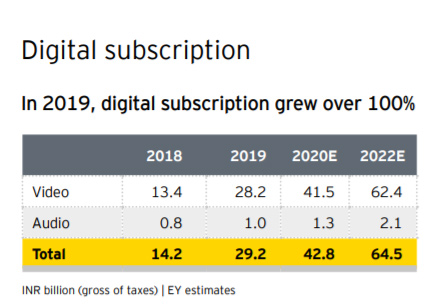
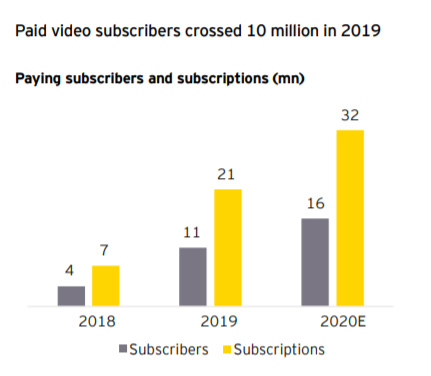
    MUMBAI: The Indian media and entertainment industry has moved beyond the era where consumers are not willing to pay for premium content online. Although the number of paying consumers remains low compared to overall users, the growth is visible, according to FICCI-EY 2020 report. In 2019, over 10 million subscribers paid for 21 million OTT video subscriptions for the first time. Overall digital subscription also grew over 100 per cent to reach Rs 29.2 billion.  

    Video subscription revenues grew 111 per cent in 2019 as premium content – originals and sports – went behind the paywall and amounts paid by telcos on behalf of their customers to content owners increased significantly. Audio subscription grew comparatively slower at 18 per cent in 2019 as platforms are still in the customer acquisition phase and several free products are available. However, the percentage of paying subscribers to total OTT consumers remained less than five per cent and one per cent for video and audio, respectively.

    One of the key drivers for the growth of video subscription is a cricket-heavy 2019, with Hotstar creating an annual sports pack at Re 1 per day. The report also mentioned that increased television subscription prices due to the implementation of the NTO in February 2019 led to certain viewers, mainly English content viewers, preferring to subscribe to relatively more affordable OTT services. Moreover, over 1600 hours of original content were created for OTT platforms across films and episodic content, which led to increased demand.

    There were several moderations in subscription packages also. Free/trial access to leading OTT platforms was provided by telcos and MSOs, bundled with data or television subscriptions, of between one and six months. Major players including Netflix introduced several sachet packs.

    The entry of Spotify, Apple Music, YouTube Music, etc. boosted the growth of audio streaming subscription during 2019 along with increasing smartphone penetration in India. The number of music streamers has increased to 180-200 million from 150 million in 2018.  However, paid subscribers remained below per cent, due to the prevalence of free options across all the large streaming platforms as well as music availability on YouTube. 

    The report predicts that overall digital subscriptions will grow at a CAGR of 30 per cent until 2022. 

  • Hathway back on growth trajectory, reports consolidated profit of Rs 68 cr in Q3

    Hathway back on growth trajectory, reports consolidated profit of Rs 68 cr in Q3

    MUMBAI: After facing consecutive losses, Hathway Cable and Datacom has reported a consolidated profit of Rs 68.18 crore in the third quarter of the financial year 2019-20. The multi-system operator (MSO) had posted consolidated loss of Rs 57.87 crore in the corresponding quarter of the last financial year.

    The cable network improved his revenue from operations by 12.3 per cent to Rs 450.82 crore in Q3 of FY20 as compared to Rs 401.43 crore in a corresponding quarter of last year.

    Whereas, the consolidated total income for the December-ended quarter rose by 23.2 per cent to Rs 512.61 crore compared to Rs 416.07 crore in the corresponding quarter of the last financial year.

    The company reported consolidated EBITDA of Rs 128.8 crore up by 52 per cent against Rs 84.5 crore in the corresponding quarter last financial year. Meanwhile, the EBITDA margin grew by 29 per cent against 8 per cent in the same quarter of FY19.

    In the segment revenue, the broadband business grew by 2.8 per cent to Rs 143.2 crore and cable television grew by 15.4 per cent to Rs 307.62 crore in the December-ended quarter of FY20.

    The subscription revenue grew by 18 per cent to 354.8 crore against Rs 300.8 cr whereas activation revenue shrunk by 8 per cent to Rs 14.7 crore compared to Rs 16 crore and placement revenue also slumped by 6 per cent to Rs 74.7 crore versus Rs 79.1 crore in Q3 last financial year.

  • Network18 subscription revenue sees 43% YoY growth in Q2 FY20

    Network18 subscription revenue sees 43% YoY growth in Q2 FY20

    MUMBAI: Network18 Media and Investment has posted 43 per cent YoY growth in subscription revenue in Q2 2020, continuing the 48 per cent growth YoY witnessed in Q1. The company’s digital revenues grew by 10 per cent YoY to Rs 46 crore. Sharp display advertising growth in News18.com (especially vernacular) boosted revenues even amidst a tepid environment.

    TV18’s Q2 viewership share in news increased further to 10.9 per cent, up from 10.1 per cent in Q1 consolidating its leadership. As election tailwinds witnessed in Q1 tapered off, Q2 operating revenue for News declined 2 per cent YoY. Weakness in financial markets, lack of government ad-spending and limited international advertising compared with last year dragged growth.

    The company also informed that the new tariff order (NTO) has created a transparent and non-discriminatory B2C regime and flux around the NTO has largely settled, though the cable segment continues to face some billing and reporting issues.

    It said, “Our domestic yields have improved, led by the strength of our bouquet as demonstrated by consumer choice for our channels and packs. Improved distribution tie-ups give our channel portfolio unparalleled reach across TV & digital. The advertising environment continued to remain tepid during much of the past quarter. Weak macro-economic trends has dragged down consumer spends and depressed broader corporate appetite for above-the-line marketing activity.”

    “However, certain categories of new-economy advertisers were bright spots, and tailwinds in regional and digital consumption continued to attract attention. Ad-spends began to rise led by the advent of the festive season late in the quarter, and big-ticket programmes and events planned around the same. We are hopeful that Government policies aimed at stimulating demand shall aid the recovery as we head into H2,” the company opined.

    Macro-weakness and shift of channels from DD Freedish to pay ecosystem continues to drag ad-revenues of GECs for the entire industry. Pushing of some high-end content vs last year for better monetization (i.e. planned delay in the launch of Bigg Boss, shifting of IIFA awards to Q3, etc) makes the base not fully comparable.

    The company’s strategy of sharp pullback in broadcast costs through optimisations raised EBITDA margins to 11.4 per cent vs 9.9 per cent in Q2FY19. “This is despite investments to the tune of Rs 13 crore in regional movie channels (Kannada and Q2FY20 Q2FY19 Growth H1FY20 H1FY19 Growth Gujarati Cinema) and paid-offerings (VOOT Kids & international). Excluding these, BAU margins improved to 12.9 per cent. BAU margins include the impact of initiatives launched more than a year ago but are still in gestation, including Voot and Colors Tamil.”

    With regards to its digital platform, the company informed, “We have witnessed robust uptake for the subscription product MoneyControl Pro launched in Q1. The product underscores the impact of a strong brand and superior features at a class-leading price-point. Voot, the primary OTT VOD platform for the group, shall soon be launching its freemium version with offerings like digital exclusive and digital-first broadcast content as well as original content behind a pay-wall. Kids edutainment product Voot Kids was soft-launched in Q1 with a niche and highly differentiated offering, and shall be progressing to commercial operations behind a pay-wall in this fiscal.”

    Network18 Chairman Adil Zainulbhai said, “Network18 successfully encapsulates news and entertainment content, across national and regional platforms, in both TV and digital mediums. We are fully geared for a digital world, with differentiated content available on integrated platforms on a pipe-agnostic basis. Impetus on seeding new business models and germinating fresh ideas are the hallmarks of our digital business, which is backed by a TV content backbone that we continue to invest in.”

    CNBC TV18 maintained #1 rank in the English Business News genre with 54 per cent market share in Q2 FY20. During market hours (Weekdays, 8 AM to 4 PM) CNBC TV18 maintained an even higher share of 59 per cent. CNBC Awaaz continued its clear leadership in the Hindi Business News genre with 64.8 per cent market share.

    News18 India garnered a 12.2 per cent market share in HSM. Its performance in mega-cities was even better, with a genre-share of 13.2 per cent, ranking #3. CNN News18 garnered 13.8 per cent market share & ranked #3 in Q2 FY20.

    Regional News cluster has the highest reach (434 million viewers in Q2) and viewership in the country amongst regional news peers. News18 Rajasthan maintained its clear leadership with 46 per cent share. News18 Bihar and UP/Uttarakhand continued their #2 rank in their respective regions, while News18 MP/Chattisgarh rose to #2 position.

    Flagship GEC Colors has a 15.1 per cent urban viewership share. Viewership share across all GECs in Urban+Rural was 12 per cent . The channel ranked #2 in weekend primetime. Season 13 of tentpole Bigg Boss was launched in late Sep-19, boosting the channel’s rank to #2 in pay-GECs in Week 40.

    Colors Cineplex launched on 1 Mar 2019 after shifting FTA channel Rishtey Cineplex from Freedish, as a full-fledged premium pay Hindi movie channel. The channel is under ramp-up and viewership share has risen to 4.1 per cent .

    Nick continues to reign as #1 in the Kids genre, with an increased 20 per cent share of genre viewership. Sonic also rose to #2, with an 11.1 per cent share. Between Nick, Sonic and Nick Jr, our Kids portfolio commanded a 34.5 per cent market- share, clearly much ahead of peers.

    In English entertainment genre, Viacom18 channels continue to occupy the top positions, with their combined viewership shares at 48.5 per cent. Comedy Central and VH1 rank #2 (22 per cent) and #1 (22 per cent) respectively; while Colors Infinity has a ~4 per cent share.

    Voot, Viacom18’s Over The Top (OTT) exclusive digital video destination has seen gross downloads rise to ~170 million. It has an average daily viewership of 45+ minutes that is the highest amongst broadcaster-OTT apps.

    The quarter also witnessed the launched of ‘Colors Telugu’ on Voot as a digital-first channel and released original show ‘Feet Up with the Stars Telugu’. Bigg Boss S13 garnered 78 million views in just 10 days on Voot.  Voot Kids, a multi-faceted watch-play-and-learn destination aimed at Kids, was soft-launched in June’19.

    Company’s Kannada GEC portfolio was #2 in the region with 32 per cent viewership share (Colors Kannada 23 per cent + Colors Super 9 per cent ). Colors Kannada Cinema was launched in late-Q2 and is #2 with 22 per cent share in Kannada movie genre.

    Colors Marathi maintained its strong #2 rank in the genre, with viewership share at 22 per cent. Bigg Boss Marathi S2 has garnered around 45 per cent higher viewership as compared to the previous season. Colors Tamil is ramping up programming during the year, as it steadily overcomes distribution challenges which have kept its viewership share <5 per cent.