Tag: Subrata Roy

  • Made in Bharat goes global as HiTech Animation powers a mythic leap

    Made in Bharat goes global as HiTech Animation powers a mythic leap

    MUMBAI: Once upon a timeline not in Hastinapur, but in Kolkata, a creative revolution took root. What began as a modest dream inside a small studio in 2012 has today turned into one of India’s most compelling success stories in animation. HiTech Animation Studios, the homegrown powerhouse behind Kurukshetra, is showing the world that the next wave of visual storytelling is proudly Made in Bharat.

    From the land known for art, music and literature, HiTech emerged with a clear vision to create world-class animation from India, for the world. Over the past decade, the studio has worked with some of the biggest names in entertainment, including Sony Yay, Nickelodeon, Byju’s, Cartoon Network, and Pogo. Each project honed its craft, blending technical precision with creative flair, and proved that Indian animators could hold their own against global giants.

    The studio’s crowning glory arrived this year with Kurukshetra, a two-part animated epic that reimagines the Mahabharata through the eyes of 18 warriors. Released on Netflix on 10 October and 24 October 2025, and produced in collaboration with Tipping Point, the digital arm of JioStar, the series took three years and over 250 artists and technicians to create.

    Rendered in cutting-edge 3D animation, motion capture, and photorealistic visual design, the 18-episode series is available in 34 global languages and streaming in 190 countries. For Indian storytelling, Kurukshetra is more than a milestone, it’s a declaration of creative intent, proving that homegrown myth and modern technology can together craft a cinematic spectacle with universal appeal.

    “Our focus has been on building an integrated ecosystem, where talent development, technology, and production excellence work in sync to deliver content that creates impact beyond borders,” said HiTech Animation managing director and founder Subrata Roy. “We’ve always approached animation as both a creative pursuit and a scalable industry.”

    HiTech’s rise mirrors a larger cultural moment India’s transformation from a content service hub into a storytelling powerhouse. By combining state-of-the-art infrastructure with its own in-house training programmes, the studio not only creates premium content but also shapes the next generation of animators powering India’s creative economy.

    Roy believes that the foundation for this artistic growth lies deep within India’s culture itself. “Art and craft have always been integral to our education and identity. Combine that with our socio-cultural diversity, and we have the stories and the talent to captivate audiences across countries and cultures something the global success of Kurukshetra clearly shows,” he said.

    From a single floor in Kolkata to the world’s biggest streaming platform, HiTech Animation’s journey is a story of vision meeting velocity, of tradition reimagined through technology. As Kurukshetra takes Indian mythology to millions of screens worldwide, one truth stands tall when Bharat dreams in pixels, the world watches in awe.

  • Positive national developments will be showcased on revamped Sahara news channels

    Positive national developments will be showcased on revamped Sahara news channels

    While channels are opting for virtual reality journalism in the backdrop of generally declining news viewership and questionable methods of garnering eyeballs, Subrata Roy’s embattled Sahara media group, with an eye on a digital future, is recasting its programming and packaging its Hindi, Urdu and four other regional news channels.

    Sahara India Media (SIM) has re-employed the veteran journalist Arup Ghosh as the CEO & editor-in-chief of its media division who, it says, will maintain the standards of the media with “old-style, factual and non-noisy journalism.”

    Samay News Network, with seven editions of the Hindi daily Rashtriya Sahara and nine editions of Urdu daily Roznama Rashtriya Sahara, is now set to foster an entrepreneurial digital culture, although the new editor’s social media profiles (till Sunday evening) were antique and stayed un-updated, giving no hint of plans in the offing.

    Ghosh says he was aiming to take Samay News Network & Rashtriya Sahara (Hindi & Urdu) to the next level by introducing differentiated content, maximizing content monetisation through synergised operations between TV, print  and digital verticals.

    The new CEO, who denied knowledge of Sahara’s January 2017 Project Storm to reportedly hand over editorial control to Kolkata-based media baron Kaustuv Ray, mentioned more than once that he is reporting in to the out-on-bail Sahara group chairman Subrata Roy. And, even as Sahara sources say that Ray is still consulting with the group’s news channels, the latter refused to speak further on Project Storm when Indiantelevision.com called him up. However, industry sources pointed out that  the proposal did not materialise.

    Management of the Sahara news division aside, Arup says he is in charge now and he is excited to be back and rejuvenating it. Among the first things he has done is launch two shows – one is a live 30-minute ad-free Editor’s Choice, and a three-minute short-format show focused on the hourly news called AG’s Take. The idea is provide agenda-setting news shows that, it says, would cut through the corporatisation and trivialisation of news.

    Ghosh chatted with Indiantelevision.com’s Parvinder Sandhu on his plans. Excerpts from the interview:

    Could you tell us whether Kaustuv Ray and company are running Sahara news operations?

    I am not aware of what happened in the past. I came here when ‘Saharashri’ (Subrata Roy) called me. I was here earlier — between 2001 and 2004, when the (Sahara group) chairman had asked us to launch a bouquet of channels. We worked on the content to put up a national news channel and regional channels. Then, in April this year, I came back as there was an opportunity to revamp the channels with a lot of focus on the digital content.

    So, what is the plan, and how are going about executing it?

    We have been working on creating a digital footprint for the last five months. The salient features are: there are two expert teams working on a digital platform each for television and print.The  process would complete in the next three months. Samay News Network will have a strong digital presence — which we will monetise and create good branding. We want to take the modern route — the newspapers, for example, will have a strong e-presence — e-papers would be launched on these platforms. The television arm will also have a robust and rare digital presence.

    The second part of the story is that the content of Samay will be visible and interactive on most of the popular social media platforms — which was a little behind schedule. That process is now in top gear and moving very fast.

    For Sahara’s six television channels, we are in the process of hiring some middle-level people — anchors and others. Content rejig is currently under way. Between now and December 2017, a total technical revamp is on the cards as approved by the chairman (Subrata Roy).

    His vision is that the media wing must be strong and robust — nothing negative or anti-India, for example, should go into the content. A lot of positive national developments that have happened should be showcased in the right spirit — we are working on that plan.

    How are the channels doing, what are your recent observations?

    On most of the regional networks, I have seen, the time spent has shot up quite a bit, which is really a function of content.

    What are the new plans?

    The distribution is being beefed up — gradually. The plan is to work in phases and restrengthen the regional network and devise a new plan for the national channel. The studios etc will have to get a completely new makeover.

    I am launching a programme at 9 pm on 28 August from our modern studio of international standards. I am also launching a small digital capsule called “My Take” — within three minutes or less, I will give an update on the current topic of the day; it will keep playing on the network and also on the digital platforms. We are trying to keep things brief, we are trying to break through the madness and the clutter that has taken place in the last two to three years.

    The 9 pm break-free show would showcase two to three  top stories of the day — it will have adequate information on why something has happened. It will have one or two informed voices and a brief chat. Somebody who wants to see facts-based news that used to be telecast earlier but has ceased of late.

    This is an attempt to restore some clarity in news — to look at news the way it should be. We would rather bring in informed opinion but in a way that guests are allowed to speak, and not cut down as it happens nowadays. We also plan to bring in editors who are specialists of their respective subjects and explain the real reason behind an incident or an event that has happened — there is huge gap there that I have studied closely over a period of time, what works online and what goes viral as far as news is concerned.

    People are hungry to have an informed opinion. They may or may not agree — that’s a different issue, but there is respect and need to know why something has happened. Our new structure and news format would be rather simple. There won’t be cacophony, people shouting at and gunning for each other. It is attempt to bring sanity to news proceedings, and that is what I am working on.

    Would you explain the reasons behind this total revamp, which includes branding and content?

    We had some great shows in our earlier avatar which had received tremendous response. It was now the wish of the chairman that we should build our media brand — it is something very global and achievable. It needs a certain strategy going forward. He had shared his vision with me and I am trying to implement it.

    In the hyper-competitive Indian news market, how is Sahara looking to occupy a position — as a views channel, a news-views channel or simply an old-fashioned news outlet giving domestic and global news without views?

    I would say when somebody tunes in to a Sahara news channel, the viewer would know exactly what is happening — in a very reasonable way, some of that is old-fashioned — which got left out. People would want to know why something has happened, for which we have a strong research team.

    For example, the Ram-Rahim incident that has happened.  Our research team has studied some American cults and exploitation of women by the babas there. Our team also studied the babas of Punjab and Haryana to understand what was the need gap and why they had such a huge following. Ours will be basically factual reportage and unlike the format where people shout at the top of their voices and politicians gunning for each other. To answer your question specifically, it will be more quieter rather than old-fashioned with a lot of research and views added in. It is going back to what news used to be.

    A lot of people told me that they tune in to Doordarshan when they needed to know today’s happenings and facts. Other channels, they said, are into mindless entertainment and shouting under the garb of news.

    Have the product’s positioning and branding been thought through?

    Yes. It will take a couple of months more to implement it. We are working with a marketing and a branding team and we are doing a lot of brainstorming. Our channel heads are pretty experienced and a couple of good guys with enormous experience have joined us. The plan is to work it out and keep unravelling those processes.

    Would you be expanding the number of bureaus you have or you will depend on news agencies primarily to feed you news? How many bureau do you have at present?

    I can’t recall the exact number of bureaus, but we are there in most of the state capitals. Some of the bureaus would be expanded. We will relaunching some channels to cover Rajasthan, Haryana, Himachal Pradesh and Punjab. Some of these bureaus will be beefed up.

    There are some gaps where we did not have people, so that is being planned now. For example, coverage from the north-eastern states was less. We have recently hired some people in Odisha, and more will be employed. We have planned special coverage for Jammu and Kashmir. Studios and facilities have been built in Gurgaon to cover Haryana and in Jammu as well as in Srinagar to cover the hill state. Subsequently, a  small studio is being planned in Jaipur and one in Chandigarh to cover the Punjab and Himachal belt.

    With state elections on the cards, we would concentrating on that. We would like to go back to serious news reporting and on understanding how political elections are fought in India. Now, we have an experienced team in place. We want to move away from the dirty business of hidden cameras and stings to bring in numbers (viewership). A couple of channels tried it for a while and may be they succeeded for a while but ultimately they had to back.

    A number of news organisations such as NDTV are also experimenting with MoJo (mobile journalism) as cost-cutting measures and also being truly digital. What are your views on such initiatives and would Sahara products too employ some such measures?

    Our digital plans are already under way, and a separate team is being groomed to do digital work. I had serious discussions with the chairman as well as our media and corporate communications expert Abhijeet Sarkar.

    We understand the need for MoJo. We will be experimenting with it to a certain extent and we’ll see how far we must go with it. We would definitely like to run a profitable enterprise, which will take a while and that is the way forward. We plan to create a lot of synergies between print, digital and television wings. There is also a combined team which will ensure constant integration.

    How will the TV channels and the digital products be different or will the digital only help play out linear TV’s offerings?

    The content that television is generating will be curated; it will be customised for digital. There will be shorter and packaged stories for digital as compared to television for which editors would also go live interacting and engaging with people and adding their opinions. A website would be separately launched for that curated content.

    Rebranding and programming revamps costs money. How much is Sahara looking at investing in this part of the operation?

    I will have to check with the top management before sharing any figures.

    Will such measures help shore up the bottomline? What is Sahara TV’s annual revenues at present? Could you share the annual revenue figure?

    I don’t want to get into all that. Sahara’s media wing in the last two to three years has gone through difficult times. But, now, our revenues are shoring up. It will take us a while, we have to ensure that the digital wing is launched quickly. There are certain projections which are being made and a marketing strategy drawn up. We are also hiring a full-time sales head who will be doing things professionally.

    What are your views on TRPs for Sahara News? And, what would be the present BARC ratings that Sahara news gets?

    The ratings were low as we were lacking in distribution. The channel is now releasing funds and we are available on most of the platforms. Of course, ratings do matter. The beauty of regional channels is a lot of people like our brand. Sahara is not a new brand — it’s a well-known and respected brand, which is being represented and refurbished and pitched as a completely different channel. With more energy and better content, the stickiness is increasing. We’ll need some time and we’ll get there.

    Please name the distribution platforms that Sahara news channels are available on?

    We are available on different networks such as Den Networks, Hathway  Cable & Datacom, DIGI cable Network India, Hathway CCN entertainment (India),CCN Digital Network,Darsh  Digital Network,S R Digital Media, A C N   Digital, Digina Projects, Lucknow 9 Cable Network, Blue Sky Network, Uttranchal Cable Network, Haldwani, Rajasthan Infotech Services and Radiant Digitek.

    Amidst the revamp, are you also looking at streamlining the operations and costs? How and where?

    We want to ensure that ‘less is more’. We want to work with committed professionals and we want to ensure people who are hired are delivering, and there is accountability. We want to make optimum use of manpower and resources. We are aware that a number of large-sized broadcast networks have shut shop. Ours is a very tight operation — we just have to ensure that we are able to convert.

    How many new brand sponsors Sahara news channels have netted?

    There are a couple of names which I will mail you. (No mail was received till the time of publication this morning; the interview was conducted yesterday telephonically).

    Would you like to comment on the recent controversies surrounding multiple LCNs and alleged buying of landing pages?

    I am aware of that. This race has taken an ugly turn. A couple of new channels had a bitter fight with the older brands who say that it is humanly not possible for a channel with limited resources to zoom to the top of the chart, and then slip and then flatten. These incidents are very unfortunate. As far as our brand is concerned, we would like to stay clear of those things.

  • Sahara asset attracts Rs 150 crore bids; SC turns into auction room

    Sahara asset attracts Rs 150 crore bids; SC turns into auction room

    MUMBAI: Sahara Group’s press and television business have taken a hit. Not just this, the group’s 45 acre property in Gorakhpur, Uttar Pradesh, has been entangled in a courtroom bidding war, with the Supreme Court turning into an auction room.


    Samriddhi Developers and Gorakhpur Real Estate Developers are the two companies that are vying for the property.


    While Samriddhi Developers had initially put an offer of Rs 64 crore, the amount rose to Rs 150 crore by the end of the bidding.


    According to an Economic Times report, the group needs to raise Rs 1,800 crore by way of cash as part of a Rs 5,000-crore payment it needs to make to free chairman Subrata Roy on bail. Aside from this, the Supreme Court has also asked for a Rs 5,000-crore bank guarantee in a case involving refunds to investors. 


    What is notable is that while Samriddhi and Sahara had signed an initial memorandum of understanding (MOU) for the sale of the plot at Rs 64 crore, the scenario changed after Gorakhpur Real Estate Developers made an offer of Rs 110 crore for the plot.


    Samriddhi Developers, senior advocate Paras Kuhad took instructions from one of the partners present in the court, and jacked the bid to Rs 125 crore. Later, the rival took it up to Rs 140 crore, adding another Rs 5 crore, before finally settling at Rs 150 crore.


    The bench has now asked both parties to show their bonafides by depositing 25 per cent of the amount by 31 July in the Sebi-Sahara account. The rest needs to be arranged in three equal installments by 31 October. If either of them fail to meet the deadline, the amount deposited will be forfeited.  


    The money generated from the sale of the Gorakhpur property will be added to the amount already deposited by the Sahara Group in the Sebi-Sahara account and go towards securing Roy’s release. 


    Complying with the July order, Gorakhpur Real Estate Developers has already deposited Rs 11 crore with the Supreme Court Registry to establish its bonafides. Samriddhi too has placed a letter and a cheque from its bankers to show its bonafides.


    The bench has now posted the matter for hearing on 3 August. 

  • Jaico Publishing earmarks over twice the marketing spend for ‘Sahara: The Untold Story’

    Jaico Publishing earmarks over twice the marketing spend for ‘Sahara: The Untold Story’

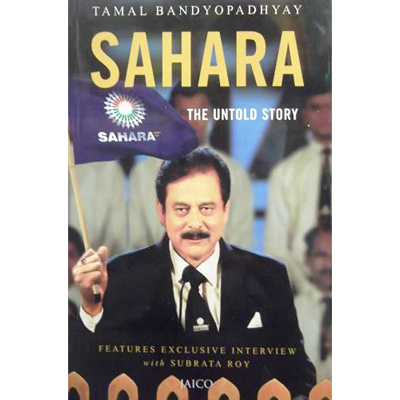
    KOLKATA: It isn’t often that a publishing house sets aside over two times its marketing expenditure for a book. Unless of course, the book in question is ‘Sahara: The Untold Story’ by eminent journalist and deputy managing editor of The Mint, Tamal Bandopadhyay. Jaico Publishing House has done just that.


    Not surprisingly, the Facebook page dedicated to the tome has garnered more than 8,300 likes within weeks of its appearance. Plans are underway to upload videos of the book launch apart from advertising on national television channels like CNBC and CNN IBN and in flyers and newspaper inserts in cities where the book will be launched next including Pune, Lucknow and Ahmedabad.


    On why Jaico has earmarked so much moolah, ‘Sahara: The Untold Story’ publisher Akash A Shah told indiantelevision.com, “We are looking at selling around 20,000 copies in a few weeks of the launch and this book has the potential to sell 50,000-60,000 copies in the next two to three months. We are targeting serious readership.”


    Shah spoke to this website on the sidelines of the book’s launch in Kolkata. “Seeing the potential of the book as compared to others, we are spending more on it, that is, around two times as compared to other books,” he added. The launch itself proved innovative with Bandopadhyay doing a mock interview with Sahara’s Subrata Roy as portrayed by Bengali actor Kaushik.


    Ever since being published, the book has been at the centre of much controversy, what with Jaico and Bandopadhyay dragged to court along with a stay order on the book and a Rs 200-crore defamation suit filed. Especially after the suit, people have been even more curious about the book. The ban was lifted after Sahara withdrew its legal suit against the publisher, with the condition that the book would carry a disclaimer by Sahara Group.


    Painstaking research has gone into demystifying the country’s most enigmatic and largely unlisted conglomerate, the Sahara India Pariwar, in a book that goes behind the curtains of every good, bad and ugly event that occurred in the past 30 years of the Sahara dynasty. ‘Sahara: The Untold Story’ also delves into the group’s ongoing legal battle with market regulator SEBI.


    “The issue discussed in the book is set to garner attention from the financial fraternity as well as regulators and academia. Though it essentially is a tussle between the regulator and the company, it will also be viewed as a game. Hence, the publisher is seen using the gimmick of marketing to ensure that the book reaches all those concerned with the subject using all aspects of the media,” said a city-based expert.

  • Subrato Roy arrested

    Subrato Roy arrested

    MUMBAI: Subrata Roy, head of Sahara group, was arrested in Lucknow today by the Uttar Pradesh police following the Supreme Court’s non-bailable warrant against him for failing to appear in the court on Wednesday.


    The Sahara group businesses include Sahara One Media & Entertainment and real estate development.


    In New Delhi, Roy’s lawyer Ram Jethmalani informed the Supreme Court that Roy has surrendered in Lucknow.


    Police had visited Roy’s residence on Thursday but did not find him at home. Before surrendering, Roy issued a statement saying he was not absconding and was ready to “unconditionally follow” any Supreme Court directions.


    The Supreme Court is hearing a case against Roy for non-compliance with its directive to refund money back to investors in the Sahara’s group financial services company.

  • Sahara Samay NCR rebrands to Samay Rajasthan

    Sahara Samay NCR rebrands to Samay Rajasthan

    MUMBAI: Recently, quite a few television channels have been in the news for sending their employees packing home. However, Subrata Roy’s Sahara Network seems to be hitting the headlines for anything but.

    Indiantelevision.com has it from reliable sources that the Sahara Samay Network (regional channels) has had a makeover of sorts. Possibly driven by the realisation that stagnancy impacts viewership adversely, one of the network’s channels, Sahara Samay NCR – which hitherto served the states of Delhi, Haryana and Rajasthan – has rebranded itself as Samay Rajasthan, and will henceforth cater exclusively to Rajasthan.

    On 18 September at 8:00 pm, the logo of Sahara Samay NCR changed to the new logo of Samay Rajasthan. The transformation was assisted by a show with eight anchors sporting traditional Rajasthani wear. An election show was aired between 8:30 pm and 9:30 pm to inaugurate the rebranded channel.

    Apparently, the decision to go state-specific was taken after a careful analysis of the channel’s content and need. “We felt that Rajasthan needed exclusive dedication and by being in three different states, we weren’t giving them justice,” says Sahara Samay Editor (Network Operations) and News Co-ordination Sanjay Banerjee.

    It was five to six months ago that the idea took seed. A strategy was adopted to try and be creative with the content of the rebranded channel. A decision to include soft news too was taken, keeping in mind the cultural heritage of the state. Airing only political news wouldn’t have been conducive with the channel’s objective to attract all types of audiences.

    With ads being displayed through hoardings, newspapers and FM channels, “People in Rajasthan were already aware about the channel so we didn’t have to put in much effort,” says Banerjee.

    Speaking about the rebranded channel, it will continue to be a 24-hour Hindi news channel. For now, it will be available only on cable (analog and digital) and internet, lagging behind in D2H.

    Earlier on, only one bureau existed in Jaipur whereas seven more have now been added in strategic locations like Jodhpur, Udaipur, Bikaner, Kota, Alwar and Bharatpur. To impart a local flavour to the news, reporters and cameramen have been hired from local places while basic resources such as graphics and stock footage are shared within the network.  Ravi Parashar has been appointed editor of the channel.

    With Rajasthan already having a clutch of Hindi news channels, the latest addition being Zee Rajasthan Plus, how will Samay Rajasthan fare? Well, Banerjee is confident it will lead other newbies at least in terms of content.

    Then again, the decision to revamp has two sides: Haryana has lost out on a channel while Rajasthan has gained one with focused coverage. The question now is will Rajasthan change its viewing patterns?

  • Sahara India asked to file reply in two weeks on SEBI Ad case

    NEW DELHI: The Lucknow bench of the Allahabad High Court has asked Sahara India and Subrata Roy Sahara to file within two weeks its reply to the public interest litigation alleging that a full page advertisement dated 17 March 2013 by Sahara India Parivar alleged to be against the provisions of law.

    Justice Uma Nath Singh and Justice Dr Satish Chandra passed the order on the PIL filed by IPS officer Amitabh Thakur and social activist Nutan Thakur which says that a private person and a private organisation have openly denigrated and accused Sebi, which is a statutory body established to safeguard the interests of investors and to act as the market regulator.

    The ad has also allegedly criticised Justice B N Agarwal’s conduct while both Sebi and Justice Agarwal are only performing their official duty. The matter is still sub-judice before the Supreme Court and hence these people could have presented their grievance there.

    This act of criticising Sebi through an ad prima-facie is alleged to be a criminal misconduct under sections 186 and 189 IPC and provisions of Companies Act 1956.

    The petitioners’ counsel Ashok Pande sought a complete ban on all advertisements where any constitutional or statutory body is criticised. He also asked for enquiry into the issue and necessary subsequent legal actions against Sahara India Parivar and Subrata Roy.

  • Sanjeev Srivastava to head Sahara’s media biz

    Sanjeev Srivastava to head Sahara’s media biz

    MUMBAI: Sahara India Pariwar has appointed Sanjeev Srivastava as CEO and editor-in-chief, heading all media related activities of the Group.

    Srivastava, currently India editor at BBC, will take up this new role starting January. He comes with over 25 years of experience in journalism with various media organisations including the Times of India and Indian Express. Working for 16 years with the BBC, he most recently led the entire BBC Hindi output generated from India across all platforms of delivery, including FM, short wave and online.

    Sahara has also appointed Upendra Rai as editor and news director. Both Srivastava and Rai will be reporting directly to Sahara Group chairman Subrata Roy.

    Meanwhile, Rai is coming back to Sahara from Star News where he was senior editor. Rai started his career as a journalist with the Sahara group for over 12 years ago.

    Roy says: “Sahara enjoys a loyal base of audiences across print and electronic media, but we realise that we cannot afford to be complacent. I am confident that Srivastava, with his experience and vision, will strengthen and streamline our offering across the entire media spectrum. Rai’s skill and expertise will complement this endeavour and together they will lead Sahara’s media offerings to scale greater heights. Their appointment is part of Sahara’s strategy to secure a rightful place in a highly competitive environment.”