Tag: Subin Subaiah

  • BARC EKAM: Learning online behaviour & ROI from specific campaigns will be easier, industry says

    MUMBAI: BARC India has announced the phased roll-out of its much-awaited digital measurement service. The digital products will be launched under the brand name EKAM (Sanskrit for “One”). The EKAM suite of products will include: EKAM Pulse, EKAM Beam, EKAM Stream, EKAM Ad-Scan and EKAM Integra.

    EKAM Pulse will measure video ad campaigns and will be the first digital offering to be rolled out by BARC India. EKAM Beam, the next product lined up for release, will measure linear broadcast that is viewed on a Digital device. EKAM Stream, will measure both non-linear and pure play digital video content. BARCIndia will also provide industry with EKAM Ad-Scan – which will be a global first-of-its-kind product.

    EKAM Integra – will help industry with common, robust and independent audience numbers that will give more accurate incremental reach figures. To do this,BARC India’s TV data will be tied with Digital Video data with the help of Single-Source and Digital Booster panels on top of the census measurement and big data.

    www.indiantelevision.com spoke to a cross-section of the industry on the new yardstick. Here are the views of Spuul Global CEO Subin Subaiah and Vertoz CEO Ashish Shah.

    Was it eagerly awaited? How do you see it?

    Subin: Its early days , but here are my thoughts. We’re a media – tech company, and any innovations with regards to technology are always welcome. We have been looking forward to the introduction of a tool that would be a standard in measuring viewership and consumption, since currently different service providers have their own methods of measurement, and everyone’s parameters for a successful campaign are defined differently.

    Which are the other methods you have been using?

    Subin: Currently, we use tools developed internally by our data and R&D teams. It’s been a foolproof system so far, and we rely heavily on this when we schedule our content and advertisements. Having said that, we’re looking forward to standardise the way online impressions are measured.

    How would BARC’s EKAM help? What would be you suggestions?

    Subin: We see EKAM creating a standard of sorts, especially when service providers are in the midst of negotiations with regards to content, or even advertising real estate. We know the value of our content, the value of our real estate, and we would like to know whether the placement of advertisements affect overall viewership or not, and how, and this will help advertisers get on board too. If the parameters are the same across the industry, it leaves no room for doubt with regards to value of real estate, or advertising malpractices.

    How would it give a fillip to the ecosystem?

    Subin: The most important, and most challenging aspect of our business today is knowing our consumer. There is always so much that we do not know about the person we’re trying to provide entertainment for. With EKAM coming in, learning the habits, online behaviour, and other viewership trends of our consumers will become far easier, thereby helping us create a better, more user friendly product, one that the consumer has been looking for.

    Leading programmatic company Vertoz founder & CEO Ashish Shah says: Since 2015, consumption of video content has increased tenfold. This year internet is being consumed maximum for online videos, news, live streaming shows & events, etc. Advertisers are leveraging this change in user behavior to increase brand awareness and brand engagement. As the internet has become much faster compared to a decade ago, advertisers are rolling out video ads more and surprisingly consumers/users are responding positively to these ads by engaging more with these ads compared to image display ads. Video display ads, in-video ads and other engaging video ad formats are very popular among advertisers as CTR and engagement rate is high.

    Current issue – The vital factor of any video advertising campaign is granular reporting. Almost all video advertising platforms give in-depth reports like number of video views, geos, average video watched time, video percentage watch, etc. Sometimes it is difficult to manage multiple platforms as all platforms might be targeting similar audience set, but as a marketer, there is no way to find out or know who has seen the ad from which platform as there is no provision to sync all these platforms together. A major issue for marketers is not online video platforms, but television. Marketers spend 15 to 20 times more on television ads as it is a main ATL medium to reach large audiences at a much lesser time.

    A number of video broadcasting companies are focusing on their platform and audience but EKAM by BARC will help significantly in the growth of the video industry as it focuses on measuring the industrywide trends and industry-specific needs.

    EKAM by BARC will help to measure linear broadcast as well as non-linear broadcast. The suite of products will help marketers to calculate the ROI from specific video campaigns as both linear and non-linear video broadcasting will be measurable now. It will help, not only advertisers but also video content creators to understand the success of their video content. This platform can give insights about audience, geo, reach and frequency which will be a great deal for publisher/content providers.

  • CASBAA India OTT Forum: Asian players in search of a winning formula

    MUMBAI: Catering to regional choices, reasonable pricing coupled with fabulous viewing experience, good user interface (UI) and worthwhile user engagement through membership and social media connect seemed to the gist of “the Asian experience” conversation CASBAA chief executive Christopher Slaughter had with Hooq managing director Salil Kapoor, Spuul chief executive Subin Subaiah and NBA India managing director Yannick Colaco.

    Spuul and Hooq are Asian in nature and are willing to adapt according to every market they enter, including India. NBA (National Basketball Association) too is learning to be a player to contend with in a complex market like India.

    Kapoor admitted that, though Hooq has done well in Philippines and Indonesia and, in a small way, in Singapore, the India story is yet to happen after 18 months of presence in the country. “In the Philippines, for example,” Kapoor said, “We garnered good traction with the strategy of best of Hollywood and local content.”

    However, he added, in India, the audience is wide — different regional languages, dialects, content preferences, classes and masses — and a definite strategy is yet to evolve. Kapoor and others were speaking at the CASBAA India OTT Forum in Mumbai on 3 March 2017.

    NBA entered India with its own content. “Small players who seek a bigger premium have less fan growth,” Colaco observed. “If we want to control the destiny of our brand NBA, we need to be more nimble,” he added. “Our growth will depend on how we engage with the users,” the NBA executive said. Colaco elaborated how NBA, as part of user engagement, had put a reasonably-priced league pass behind a pay wall. “Content users, who bought the passes, have access to 1400 live games, archives, four different angles of game viewing and three types of commentaries,” he said.

    With various tie-ups OTT players are reaching out to maximum audience. Broadcasters, sometimes, Colaco felt, may limit content-providers’ engagement with the users. “But, through our association with Sony 6,” Colaco said, “we bring 14 live games to our audience every week.” Reiterating NBA’s aim to control the “destiny of their users”, the NBA man said they have managed to garner around seven million fans on Facebook and were exploring more efficient ways of engagement.

    Subaiah, who sees Spuul as the company’s livelihood in the sense it being a pure play OTT company with no other agenda, said that they were gathering metrics. “We have experimented and ruled out several content formats such as short form,” he added, pointing out that at times the consumer is challenged to find good content.

    Prodded by Slaughter on revenue in the broadcast versus pure play game, Kapoor said that different players may have experimented with SVoD and AVoDs, but the industry in India seems to be dominated by a couple of large players. He finds TVoDs to be an exciting challenge. He opined weekly passes or sachet pricing may work, but not AVoD.

    Colaco recommended that one needs to grow its fan base for the sake of content. Since the audience is the young generation, content makers/aggregators too need to evolve constantly. Many a broadcaster, he felt, was not always equipped to evolve constantly. Also, he observed, several content formats were inefficient for mobile platform: “We (NBA) shoot at least seven games a week only for the mobile (landscape) audience.”

    When pointed out that audio too was important for sports content, Colaco agreed, and said that they were actively looking at going regional. “We are already having the audio for 600 games in Chinese,” he stressed, adding in three months, NBA planned to have its games commentary in Hindi as well. Supporting the idea, Subaiah said that Tamil content dubbed in Hindi on Spuul was doing well.

    So who’s going to be ahead in the arms race? The Hooq executive felt that, although Bollywood was important, regional content seemed to be critical too. If one (player) is something in everything, there is an apprehension of being rendered irrelevant, Kapoor said, since the raw material (content) is becoming expensive by the day. And then, there is the new girl in town — originals. “How can we leave her alone?” he asked.

    So, there is original versus ‘freemium’ versus regional content. But, Subaiah believes that content, if not backed with worthwhile distribution and sufficient marketing, is of no use no matter how good it might be. The jury seemed to be out on a blend of original and regional coupled with high-decibel marketing.

    Who cuts the ice for this kind of cocktail? All OTT players in India seem to be testing the market and learning and evolving for the last 24 months. But, for how long? And, is it affordable too?

    Kapoor, having also done a successful stint at Dish TV selling satellite connections, however, did make an apt point on freebies being thrown at consumers. “An e-commerce giant is giving away good content almost free (Amazon), a telco (Reliance Jio) is giving data almost complimentary and a broadcaster (Star) is giving most of the content for free,” Kapoor said throwing up his hands, adding that there was a need to stop with such freebies that don’t make much business sense and “consolidate” as India has seen 17 telcom players playing the game initially, but now reduced to just four or five major and serious players.

    But, the NBA India chief was confident that the India code could be cracked. Pointing out that most MNCs believed in the power of India where 500 million people were under the age of 25, Colaco said as his parting shot, “There is an opportunity to reach out to the millenials. Let’s build on the opportunity — it’s tremendous.”

  • OTT/VOD disrupted traditional ‘appointment viewing’ in India: Spuul’s Subin Subaiah

    OTT/VOD disrupted traditional ‘appointment viewing’ in India: Spuul’s Subin Subaiah

    The global OTT video market is poised for nearly exponential growth, a report by Digital TV Research states. It forecasts that global revenues will climb to US$ 65 billion by 2021 covering 100 countries. By 2020, AVOD’s revenues of US$ 15.4 billion are expected to surpass SVOD revenues of US$ 14.6 billion. As per Frost & Sullivan, the video market is anticipated to expand at a CAGR of over 80 per cent till 2020.

    By 2019, Cisco research states, almost 80 per cent of the global Internet consumption will be video content, OTT streaming will fuel growth, traffic from wireless and mobile devices will rise to 66 per cent in 2019, and Internet video to TV will increase fourfold by 2019.

    Competition in the OTT segment is increasing owing to companies seeking to expand their user bases in other countries.

    Indiantelevision.com’s Parvinder Sandhu caught up with Subin Subaiah, the global CEO and director of Spuul, a Singapore-based aggregator, which has a catalogue of 1000 movies, over 10,000 hours of programming and 18 million downloads to date. Co-founded by Subaiah, Sudesh Iyer, and S Mohan, Spuul (inspired from spool) has reduced the lead time between movie premieres in theaters to its availability on its platform to just two weeks and has established tiny downloads of less than 70mb for viewers in low bandwidth areas.

    A banker who held senior positions at leading global financial institutions, Subin, mixing grit and persistence with patience and respect, set up Spuul in 2012 based on his absolute conviction that on-line streaming is the pre-cursor to the world of virtual cinema.

    Excerpts from an interview:

    How will you define Spuul? A start-up or a mature media company?

    Start-ups are a buzzword these days. But, for how many years, a company can be called a start-up, and why? Start-ups need growth funding and capital support till they become self-sustaining corporates with independent and massive marketing budgets and eventual taxpayers. We are a mature start-up, which will be cash-flow positive in 18-24 months. Start-ups are nurtured till an inflection point comes in the industry.

    How do you see Spuul in the Indian OTT eco-syestem?

    In India, the OTT and VOD eco-system is still evolving and it may take 12-24 months to mature. Internet penetration here is quite low and the data cost is high, unlike in the US, China, or the UK. However, in India, the OTT/VOD eco-system is interdependent on a lot of stakeholders such as telcos, content owners, broadcasters, fibre-to-home entities, DTH players, IPTV, the OEMs and the device industry. Almost all the OTT/VOD players are struggling to find the right approach to the consumer and to understand the ideal user experience.

    Spuul is a pure play and dedicated OTT player without an agenda. We are a disciplined ship — a premium solution for the common man. Spuul is seeking to partner various industry outfits and is seeking content deals. We have already made our presence felt and are neither anxious nor feel threatened about competition. We use our own metrics to figure out ways to serve consumers.

    Considering what you said about success’ interdependence on other factors, how would you describe the Indian market?

    India is a complex market, no doubt. In India, one needs to see who is able to pay how much and what kind of value for money the consumer is seeking. We continuously address the consumer’s issues and expectations. No doubt, one would need growth capital, but the timing is important. It’s not primarily about money, but more about who we can partner with. This is a deep-pocket business. In the OTT/VOD business, there has been an escalation in

    i)    content cost;

    (ii)  customer acquisition cost;

    (iii) BTL cost (cost of e-commerce is exorbitant) and

    (iv)  ability to hire and retain talent.

    Though Reliance Jio, for example, is giving ESOPs, it does not work well in India since employees here expect cash today and not (notional money) for the future.

    What are your expectations from the Indian market?

    We expect Internet penetration in India to be sufficiently better in 12-24 months time. By that time, Internet, hopefully, would have enabled around 100-200 million people with easy access and affordable Internet. The arrival of Reliance Jio will hopefully change the scenario as it’s not just about good penetration, but affordable price points and quality (of service) that are also significant. When these converge, digital consumption would be much better.

    The market dynamics keep changing. Now, after demonetisation, many players like us had to integrate with payment wallets. So, we had many balls in the air — we may catch some and drop some. But, it’s okay.

    What , according to you, is making OTT/VOD services mushroom all over despite Indian challenges? Has there been some major shift in viewing trends?

    With the arrival of OTT/VOD, ‘viewing by appointment’ has been tossed out of the window. But, another big challenge for the OTT/VOD players is how they deliver the same content (that had been delivered till now or is still being done so via legacy platforms) on whichever device the consumer has. The scene has shifted from the broadcaster to the consumer.

    Consumer in India needs to be first educated about the difference between paid and free content platforms. Second, they also need to be made aware of legal and pirated content. Education will lead consumers to understand the rewards and penalty for making the right or wrong choices. As of now, the consumer has made soft choices.

    The industry too needs to understand some of the issues: how to provide hassle-free content? How much content is being consumed? Which type of content is being used? When is the content consumed?

    How is Spuul trying to address some of the issues in the Indian market?

    Spuul is non-discriminatory and sees every consumer as a potential client. Spuul enables downloads, consumption (rendition) of content in accordance with the device  — whether it’s running on an Android or Windows-based or some other platform, the size of the screen (large, medium or small), whether it’s a mobile phone or a tablet and similar such issues. It’s a technical game and we pride ourselves as being the best at it. The problems of easy content delivery are something that forces companies such as Spuul to find solutions on a bumpy road.

    Would you enumerate some of the initiatives of Spuul in this  technical game?

    We are the pioneers of  Progressive Download (the process wherein a user downloads his/her favourite show for offline/low bandwidth viewing). Wi-Fi needs to significantly grow for a smoother user-experience in India. Other OTT/VOD companies soon caught up with Progressive Download technology as there’s hardly anything proprietary in such technologies. As OTT/VOD is a big execution game, technology, marketing and agility to adapt to changing landscape is as important as having good content.

    In the OTT/ VOD realm, there are primarily two kinds of people who need to be taken care of:

    1.Content consumer (all his likes/dislikes need to be kept in mind and served accordingly) and

    2.Content owner who expects content to be showcased properly. We also need to take care of the licencing rights and that  best exposure is given to content for the satisfaction of the owner as well.

    As content-owners strike different deals these days to multiply its monetisation, how do companies like Spuul take care of sensitivities, including IPR issues, while rolling out services?

    Sometimes, content owners are reluctant to part with their content. What if we were to licence a top media/production house content and show it alongside C-grade movies? That’s simply not done. At Spuul, we maintain that image of the content-owner and ours is as important. As we need to have a working model that is sustainable and long-term, we need to have a degree of decorum and a certain premium-ness attached to our product.

    Relationships with the studios are important. In a corporate world, we all need to be careful about transparency in our deals and need to be aware about fighting piracy. Pirated Hindi movies that were available online lose more than half the revenue that they may have earned legitimately if online pirates had not milked their products. Spuul has created some rules around its content. Hindi movies are digitised with sub-titles. A-grade and B-grade movies are made available to discerning customers. For example, Spuul is also careful in choosing its content when it comes to markets such as the Middle East. For the sake of offering some select C-grade movies, one cannot risk jeopardising the whole franchise. We must eliminate that risk  entirely.

    We do offer some regular content like Bollywood and regional films. Racy and edgy content is a major attraction and is loved by people in the 18-35 years age-group. Except Eros, we have a tie-up with almost all producers and major content-owners. We are also in the process of moving from Hindi to Punjabi and South Indian movies and, subsequently, decent Bhojpuri movies. The inspiration for south Indian content came from a Delhi incident where we overheard a taxi-driver and his friend discussing action and VFX-laden movies from south India.

    However, Spuul is not rushing in to provide original content. We are a technology company, and not a creative organisation. Big studios can afford to have, say, 10 originals of which three may fail. It still works out to be reasonably profitable. If I were to get two million users who are spending say US$ 5 a month, for example, I can break even for my US$ 10 million investment.

    The market trends and consumer choices need to be tracked, so it seems?

    Absolutely. We do keep abreast of the market trends in terms of price points, recency of content (how soon it is available after being released in theatres) and originals. But, India is a low-yield market  compared to the Middle East, North America and New Zealand. Those markets are more remunerative with bigger payments and higher churn rates. In India, against 60 per cent consumption, the revenue is 20 per cent. However, in the rest of the world, revenue is 80 per cent against 40 per cent consumption.

    (60 per cent of Spuul content is consumed in India and the remainder by the Indian and sub-continental diaspora, across the world. In India, almost 90 per cent content of Spuul content is consumed on mobile devices.)

    public://url.jpg

    How different is the Indian consumer from those elsewhere for Spuul?

    In India, the consumption patterns are different. There is an involuntary churn since consumers switch from one telecom service-provider to another. After the switch, one needs to re-acquire the consumer, which entails a reasonably high cost. The country is a different ballgame altogether. Users here would want to watch selective content, but privately. It is not the same as content on cable TV, for example, where it is watched by the entire family. A majority of women in India do not leave their homes, lest they miss on their favourite TV programme.

    In the OTT/ VOD world, one needs to constantly empower and engage with the user. A consumer needs to be prompted to download the OTT/VOD app, which he may or may not, depending on his mood, availability of memory/space on his devise, Internet speed, cash balance and finally his willingness to spend. We may need to have all his co-ordinates to reach out to him – his email IDs, FB account IDs, his mobile number, etc. The environment is totally different from the cable TV business.

    (Spuul India CEO Rajiv Vaidya held forth on certain marketing aspects. He said that Spuul’s sachet pricing was applicable only in the India market. The sachet pricing is marketed through the telecom operator. A user is offered an entertainment pack of various duration ranging from a day to a week to a fortnight, depending on the consumer’s financial capability. The fee is automatically deducted from his prepaid mobile balance once he chooses to take a service. In India, almost 90-95 per cent mobile voice and data subscribers are pre-paid consumers.)

    You said Spuul has tie-ups with content owners. Does that strategy also include broadcasting companies?

    Spuul had taken a conscious decision to offer primarily movies and that’s why we do tie-ups with content-owners. But, I agree it would have been better if we too had a content supply chain as it happens when the OTT/VOD platform is a (brand) extension of a broadcasting company or a production house (Hotstar, Voot and Balaji’s ALT readily come to mind). A production factory is always valuable and movie studios are our production factory.

    Still, Spuul has partnerships with several broadcasters, especially the GECs, which are primarily looking at marketing their content to the Indian and sub-continental diaspora abroad

    How would a Spuul service be different from others and other delivery platforms such as cable and DTH?

    Spuul  has tie-ups in place where it gets a week-long or a 10-day exclusive window before new movies are aired on television  via DTH or cable TV services. We need to market and leverage that window correctly through digital and targeted marketing. We need to study users’ browsing habits and aim properly at targeted customers. We also need to engage directly (through in-app notifications). Text messages or SMSes are expensive in India. But, in the Middle East, we have tie-ups with telcos through whom we do SMS blasts to thousands of customers together.

    How does Spuul view the arrival of big daddies such as Amazon Prime and Netflix in India?

    The likes of Amazon Prime Video and Netflix would help expand the OTT/VOD market and all new players are welcome. They have educated the Indian consumer that one needs to pay to watch good content at a convenient time and place. They all have helped in enlightening people that one can’t rely on pirated content and, thus, have helped the ecosystem grow. Everybody here is learning and nobody is an expert on content.  All companies have their advantages and limitations. Some are in the OTT/VOD business alright, but their primary aim is to grow e-commerce revenues.

    Will AVoD be a success?

    AVoD is not expected to succeed because potential advertisers expect certain million downloads before they take a call on putting their money. Also, content owners generally are not happy when their creations are available for free. They expect it to be put behind a pay-wall.

    What are Spuul’s targets?

    Of the 23 million global consumers, 60-65 per cent users have downloaded the Spuul app. Of the Spuul subscribers, around 60 per cent are in India and the remainder in the U.S, U.K, Australia and New Zealand. We are growing 30-40 per cent month on month. Of the projected 700-800 million global OTT/VOD subscribers by 2020, we are targeting approximately 200 million or roughly 25 per cent to be on the Spuul platform.

    By 2020, owing to the sheer numbers and the status of being the second-largest penetrated market, India’s OTT/VOD subscribers should leapfrog ahead of the U.S but remain below China where the growth trajectory is similar. The opportunity in India is huge.

  • OTT/VOD disrupted traditional ‘appointment viewing’ in India: Spuul’s Subin Subaiah

    OTT/VOD disrupted traditional ‘appointment viewing’ in India: Spuul’s Subin Subaiah

    The global OTT video market is poised for nearly exponential growth, a report by Digital TV Research states. It forecasts that global revenues will climb to US$ 65 billion by 2021 covering 100 countries. By 2020, AVOD’s revenues of US$ 15.4 billion are expected to surpass SVOD revenues of US$ 14.6 billion. As per Frost & Sullivan, the video market is anticipated to expand at a CAGR of over 80 per cent till 2020.

    By 2019, Cisco research states, almost 80 per cent of the global Internet consumption will be video content, OTT streaming will fuel growth, traffic from wireless and mobile devices will rise to 66 per cent in 2019, and Internet video to TV will increase fourfold by 2019.

    Competition in the OTT segment is increasing owing to companies seeking to expand their user bases in other countries.

    Indiantelevision.com’s Parvinder Sandhu caught up with Subin Subaiah, the global CEO and director of Spuul, a Singapore-based aggregator, which has a catalogue of 1000 movies, over 10,000 hours of programming and 18 million downloads to date. Co-founded by Subaiah, Sudesh Iyer, and S Mohan, Spuul (inspired from spool) has reduced the lead time between movie premieres in theaters to its availability on its platform to just two weeks and has established tiny downloads of less than 70mb for viewers in low bandwidth areas.

    A banker who held senior positions at leading global financial institutions, Subin, mixing grit and persistence with patience and respect, set up Spuul in 2012 based on his absolute conviction that on-line streaming is the pre-cursor to the world of virtual cinema.

    Excerpts from an interview:

    How will you define Spuul? A start-up or a mature media company?

    Start-ups are a buzzword these days. But, for how many years, a company can be called a start-up, and why? Start-ups need growth funding and capital support till they become self-sustaining corporates with independent and massive marketing budgets and eventual taxpayers. We are a mature start-up, which will be cash-flow positive in 18-24 months. Start-ups are nurtured till an inflection point comes in the industry.

    How do you see Spuul in the Indian OTT eco-syestem?

    In India, the OTT and VOD eco-system is still evolving and it may take 12-24 months to mature. Internet penetration here is quite low and the data cost is high, unlike in the US, China, or the UK. However, in India, the OTT/VOD eco-system is interdependent on a lot of stakeholders such as telcos, content owners, broadcasters, fibre-to-home entities, DTH players, IPTV, the OEMs and the device industry. Almost all the OTT/VOD players are struggling to find the right approach to the consumer and to understand the ideal user experience.

    Spuul is a pure play and dedicated OTT player without an agenda. We are a disciplined ship — a premium solution for the common man. Spuul is seeking to partner various industry outfits and is seeking content deals. We have already made our presence felt and are neither anxious nor feel threatened about competition. We use our own metrics to figure out ways to serve consumers.

    Considering what you said about success’ interdependence on other factors, how would you describe the Indian market?

    India is a complex market, no doubt. In India, one needs to see who is able to pay how much and what kind of value for money the consumer is seeking. We continuously address the consumer’s issues and expectations. No doubt, one would need growth capital, but the timing is important. It’s not primarily about money, but more about who we can partner with. This is a deep-pocket business. In the OTT/VOD business, there has been an escalation in

    i)    content cost;

    (ii)  customer acquisition cost;

    (iii) BTL cost (cost of e-commerce is exorbitant) and

    (iv)  ability to hire and retain talent.

    Though Reliance Jio, for example, is giving ESOPs, it does not work well in India since employees here expect cash today and not (notional money) for the future.

    What are your expectations from the Indian market?

    We expect Internet penetration in India to be sufficiently better in 12-24 months time. By that time, Internet, hopefully, would have enabled around 100-200 million people with easy access and affordable Internet. The arrival of Reliance Jio will hopefully change the scenario as it’s not just about good penetration, but affordable price points and quality (of service) that are also significant. When these converge, digital consumption would be much better.

    The market dynamics keep changing. Now, after demonetisation, many players like us had to integrate with payment wallets. So, we had many balls in the air — we may catch some and drop some. But, it’s okay.

    What , according to you, is making OTT/VOD services mushroom all over despite Indian challenges? Has there been some major shift in viewing trends?

    With the arrival of OTT/VOD, ‘viewing by appointment’ has been tossed out of the window. But, another big challenge for the OTT/VOD players is how they deliver the same content (that had been delivered till now or is still being done so via legacy platforms) on whichever device the consumer has. The scene has shifted from the broadcaster to the consumer.

    Consumer in India needs to be first educated about the difference between paid and free content platforms. Second, they also need to be made aware of legal and pirated content. Education will lead consumers to understand the rewards and penalty for making the right or wrong choices. As of now, the consumer has made soft choices.

    The industry too needs to understand some of the issues: how to provide hassle-free content? How much content is being consumed? Which type of content is being used? When is the content consumed?

    How is Spuul trying to address some of the issues in the Indian market?

    Spuul is non-discriminatory and sees every consumer as a potential client. Spuul enables downloads, consumption (rendition) of content in accordance with the device  — whether it’s running on an Android or Windows-based or some other platform, the size of the screen (large, medium or small), whether it’s a mobile phone or a tablet and similar such issues. It’s a technical game and we pride ourselves as being the best at it. The problems of easy content delivery are something that forces companies such as Spuul to find solutions on a bumpy road.

    Would you enumerate some of the initiatives of Spuul in this  technical game?

    We are the pioneers of  Progressive Download (the process wherein a user downloads his/her favourite show for offline/low bandwidth viewing). Wi-Fi needs to significantly grow for a smoother user-experience in India. Other OTT/VOD companies soon caught up with Progressive Download technology as there’s hardly anything proprietary in such technologies. As OTT/VOD is a big execution game, technology, marketing and agility to adapt to changing landscape is as important as having good content.

    In the OTT/ VOD realm, there are primarily two kinds of people who need to be taken care of:

    1.Content consumer (all his likes/dislikes need to be kept in mind and served accordingly) and

    2.Content owner who expects content to be showcased properly. We also need to take care of the licencing rights and that  best exposure is given to content for the satisfaction of the owner as well.

    As content-owners strike different deals these days to multiply its monetisation, how do companies like Spuul take care of sensitivities, including IPR issues, while rolling out services?

    Sometimes, content owners are reluctant to part with their content. What if we were to licence a top media/production house content and show it alongside C-grade movies? That’s simply not done. At Spuul, we maintain that image of the content-owner and ours is as important. As we need to have a working model that is sustainable and long-term, we need to have a degree of decorum and a certain premium-ness attached to our product.

    Relationships with the studios are important. In a corporate world, we all need to be careful about transparency in our deals and need to be aware about fighting piracy. Pirated Hindi movies that were available online lose more than half the revenue that they may have earned legitimately if online pirates had not milked their products. Spuul has created some rules around its content. Hindi movies are digitised with sub-titles. A-grade and B-grade movies are made available to discerning customers. For example, Spuul is also careful in choosing its content when it comes to markets such as the Middle East. For the sake of offering some select C-grade movies, one cannot risk jeopardising the whole franchise. We must eliminate that risk  entirely.

    We do offer some regular content like Bollywood and regional films. Racy and edgy content is a major attraction and is loved by people in the 18-35 years age-group. Except Eros, we have a tie-up with almost all producers and major content-owners. We are also in the process of moving from Hindi to Punjabi and South Indian movies and, subsequently, decent Bhojpuri movies. The inspiration for south Indian content came from a Delhi incident where we overheard a taxi-driver and his friend discussing action and VFX-laden movies from south India.

    However, Spuul is not rushing in to provide original content. We are a technology company, and not a creative organisation. Big studios can afford to have, say, 10 originals of which three may fail. It still works out to be reasonably profitable. If I were to get two million users who are spending say US$ 5 a month, for example, I can break even for my US$ 10 million investment.

    The market trends and consumer choices need to be tracked, so it seems?

    Absolutely. We do keep abreast of the market trends in terms of price points, recency of content (how soon it is available after being released in theatres) and originals. But, India is a low-yield market  compared to the Middle East, North America and New Zealand. Those markets are more remunerative with bigger payments and higher churn rates. In India, against 60 per cent consumption, the revenue is 20 per cent. However, in the rest of the world, revenue is 80 per cent against 40 per cent consumption.

    (60 per cent of Spuul content is consumed in India and the remainder by the Indian and sub-continental diaspora, across the world. In India, almost 90 per cent content of Spuul content is consumed on mobile devices.)

    public://url.jpg

    How different is the Indian consumer from those elsewhere for Spuul?

    In India, the consumption patterns are different. There is an involuntary churn since consumers switch from one telecom service-provider to another. After the switch, one needs to re-acquire the consumer, which entails a reasonably high cost. The country is a different ballgame altogether. Users here would want to watch selective content, but privately. It is not the same as content on cable TV, for example, where it is watched by the entire family. A majority of women in India do not leave their homes, lest they miss on their favourite TV programme.

    In the OTT/ VOD world, one needs to constantly empower and engage with the user. A consumer needs to be prompted to download the OTT/VOD app, which he may or may not, depending on his mood, availability of memory/space on his devise, Internet speed, cash balance and finally his willingness to spend. We may need to have all his co-ordinates to reach out to him – his email IDs, FB account IDs, his mobile number, etc. The environment is totally different from the cable TV business.

    (Spuul India CEO Rajiv Vaidya held forth on certain marketing aspects. He said that Spuul’s sachet pricing was applicable only in the India market. The sachet pricing is marketed through the telecom operator. A user is offered an entertainment pack of various duration ranging from a day to a week to a fortnight, depending on the consumer’s financial capability. The fee is automatically deducted from his prepaid mobile balance once he chooses to take a service. In India, almost 90-95 per cent mobile voice and data subscribers are pre-paid consumers.)

    You said Spuul has tie-ups with content owners. Does that strategy also include broadcasting companies?

    Spuul had taken a conscious decision to offer primarily movies and that’s why we do tie-ups with content-owners. But, I agree it would have been better if we too had a content supply chain as it happens when the OTT/VOD platform is a (brand) extension of a broadcasting company or a production house (Hotstar, Voot and Balaji’s ALT readily come to mind). A production factory is always valuable and movie studios are our production factory.

    Still, Spuul has partnerships with several broadcasters, especially the GECs, which are primarily looking at marketing their content to the Indian and sub-continental diaspora abroad

    How would a Spuul service be different from others and other delivery platforms such as cable and DTH?

    Spuul  has tie-ups in place where it gets a week-long or a 10-day exclusive window before new movies are aired on television  via DTH or cable TV services. We need to market and leverage that window correctly through digital and targeted marketing. We need to study users’ browsing habits and aim properly at targeted customers. We also need to engage directly (through in-app notifications). Text messages or SMSes are expensive in India. But, in the Middle East, we have tie-ups with telcos through whom we do SMS blasts to thousands of customers together.

    How does Spuul view the arrival of big daddies such as Amazon Prime and Netflix in India?

    The likes of Amazon Prime Video and Netflix would help expand the OTT/VOD market and all new players are welcome. They have educated the Indian consumer that one needs to pay to watch good content at a convenient time and place. They all have helped in enlightening people that one can’t rely on pirated content and, thus, have helped the ecosystem grow. Everybody here is learning and nobody is an expert on content.  All companies have their advantages and limitations. Some are in the OTT/VOD business alright, but their primary aim is to grow e-commerce revenues.

    Will AVoD be a success?

    AVoD is not expected to succeed because potential advertisers expect certain million downloads before they take a call on putting their money. Also, content owners generally are not happy when their creations are available for free. They expect it to be put behind a pay-wall.

    What are Spuul’s targets?

    Of the 23 million global consumers, 60-65 per cent users have downloaded the Spuul app. Of the Spuul subscribers, around 60 per cent are in India and the remainder in the U.S, U.K, Australia and New Zealand. We are growing 30-40 per cent month on month. Of the projected 700-800 million global OTT/VOD subscribers by 2020, we are targeting approximately 200 million or roughly 25 per cent to be on the Spuul platform.

    By 2020, owing to the sheer numbers and the status of being the second-largest penetrated market, India’s OTT/VOD subscribers should leapfrog ahead of the U.S but remain below China where the growth trajectory is similar. The opportunity in India is huge.

  • Buddha in a Traffic Jam premieres on Spuul

    Buddha in a Traffic Jam premieres on Spuul

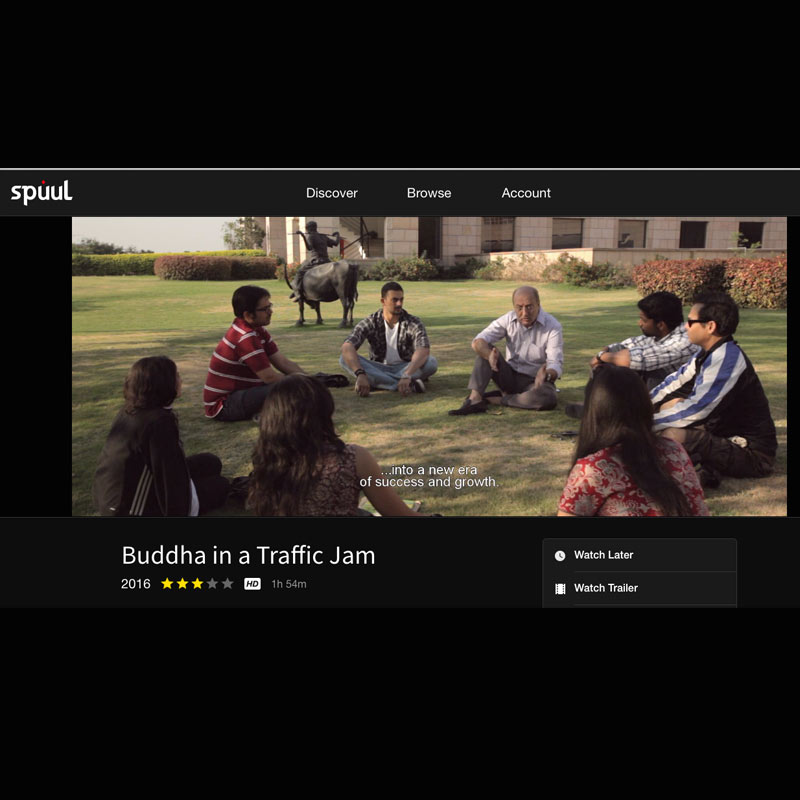
    MUMBAI: Spuul brings Vivek Agnihotri’s ‘Buddha In A Traffic Jam’ to its catalogue of films. This movie will be available across devices like web, mobile (iOS, Android), Amazon Fire TV, Android TV & Apple TV along with Airplay on iOS, and Chromecast on Android. The film is available to all of Spuul’s premium subscribers across the world.

    Buddha in a Traffic Jam is one of the most controversial films of the year, released just a month back in May, with protests against the movie in many parts of India for alleged propaganda. The film depicts various themes ranging from corruption in the country to campus politics, moral policing, crony socialism and the fight against injustice. It stars Arunoday Singh, Anupam Kher, Pallavi Joshi and Mahie Gill.

    Speaking on this development Spuul Global CEO Subin Subaiah said, “We’re happy to bring a film like ‘Buddha In A Traffic Jam’ to our viewers. Our platform has always strived to provide shelf space to bold filmmakers to reach their audiences. This is just a step further in bringing fresh content to our 12 million viewers.

    Commenting on this association, Vivek Agnihotri, Director, Buddha in A Traffic Jam, said, “Spuul is one of the oldest video streaming services today, and we’re happy to be associated with them for the internet premiere of Buddha In A Traffic Jam. It is a story that needed to be told, and we hope this association with Spuul helps us spread the word far and wide.”

  • Buddha in a Traffic Jam premieres on Spuul

    Buddha in a Traffic Jam premieres on Spuul

    MUMBAI: Spuul brings Vivek Agnihotri’s ‘Buddha In A Traffic Jam’ to its catalogue of films. This movie will be available across devices like web, mobile (iOS, Android), Amazon Fire TV, Android TV & Apple TV along with Airplay on iOS, and Chromecast on Android. The film is available to all of Spuul’s premium subscribers across the world.

    Buddha in a Traffic Jam is one of the most controversial films of the year, released just a month back in May, with protests against the movie in many parts of India for alleged propaganda. The film depicts various themes ranging from corruption in the country to campus politics, moral policing, crony socialism and the fight against injustice. It stars Arunoday Singh, Anupam Kher, Pallavi Joshi and Mahie Gill.

    Speaking on this development Spuul Global CEO Subin Subaiah said, “We’re happy to bring a film like ‘Buddha In A Traffic Jam’ to our viewers. Our platform has always strived to provide shelf space to bold filmmakers to reach their audiences. This is just a step further in bringing fresh content to our 12 million viewers.

    Commenting on this association, Vivek Agnihotri, Director, Buddha in A Traffic Jam, said, “Spuul is one of the oldest video streaming services today, and we’re happy to be associated with them for the internet premiere of Buddha In A Traffic Jam. It is a story that needed to be told, and we hope this association with Spuul helps us spread the word far and wide.”

  • Spuul is now available on Amazon Fire TV and Android TV

    Spuul is now available on Amazon Fire TV and Android TV

    MUMBAI: The VOD platform for Indian and regional content Spuul will now be available on Amazon’s Fire TV and Android TV as an application. The app can be downloaded from the Amazon store and Android Play stores. lt will also be available on other devices such as Kindle, Fire Stick and Fire Phone.

    “With multiple devices and multiple platforms, it’s getting increasingly difficult for consumers to maintain different accounts on different applications and different devices. The Amazon Fire TV and Android TV apps are a step further in make streaming content a smooth, seamless experience for our viewers. Spuul lets you browse through a variety of movies on your phone, tablet, laptop, e-reader or TV wherever you go”, says Spuul Global CEO Subin Subaiah.

    Viewers can link their existing Spuul account with the Amazon Fire TV app and Android TV app whereas new users can sign up on using their existing Facebook account.

    While the interface of both the apps looks simplified and user friendly, it has been designed keeping in mind the appearance of channels on a television set top box. To further enhance the experience, the apps are also entirely remote controlled. While Android TV users can log in with either their Facebook or Google accounts, Amazon users are free to use their gaming controllers as remotes for the Fire TV app too.

    The apps are designed with built-in features such as regular updates of latest Hindi, Tamil, Punjabi and other Indian regional language titles. Through this app, Spuul’s 12 million (1.2 crore) viewers across India, Pakistan, UK, US, Australia, New Zealand and Middle East will now enjoy fresh Indian content anytime and anywhere.

  • Spuul is now available on Amazon Fire TV and Android TV

    Spuul is now available on Amazon Fire TV and Android TV

    MUMBAI: The VOD platform for Indian and regional content Spuul will now be available on Amazon’s Fire TV and Android TV as an application. The app can be downloaded from the Amazon store and Android Play stores. lt will also be available on other devices such as Kindle, Fire Stick and Fire Phone.

    “With multiple devices and multiple platforms, it’s getting increasingly difficult for consumers to maintain different accounts on different applications and different devices. The Amazon Fire TV and Android TV apps are a step further in make streaming content a smooth, seamless experience for our viewers. Spuul lets you browse through a variety of movies on your phone, tablet, laptop, e-reader or TV wherever you go”, says Spuul Global CEO Subin Subaiah.

    Viewers can link their existing Spuul account with the Amazon Fire TV app and Android TV app whereas new users can sign up on using their existing Facebook account.

    While the interface of both the apps looks simplified and user friendly, it has been designed keeping in mind the appearance of channels on a television set top box. To further enhance the experience, the apps are also entirely remote controlled. While Android TV users can log in with either their Facebook or Google accounts, Amazon users are free to use their gaming controllers as remotes for the Fire TV app too.

    The apps are designed with built-in features such as regular updates of latest Hindi, Tamil, Punjabi and other Indian regional language titles. Through this app, Spuul’s 12 million (1.2 crore) viewers across India, Pakistan, UK, US, Australia, New Zealand and Middle East will now enjoy fresh Indian content anytime and anywhere.

  • Spuul premieres Aishwarya Rai starrer ‘Jazbaa’

    Spuul premieres Aishwarya Rai starrer ‘Jazbaa’

    MUMBAI: Spuul has added Aishwarya Rai Bachchan’s comeback thriller Jazbaa to its library. 


    This movie will be available for viewers across the world via premium subscription services. This will be a digital premiere for Spuul.


    Jazbaa is a thriller drama, which sees Aishwarya Rai Bachchan portraying the role of a prominent criminal lawyer, who is trying to protect her daughter from the clutches of a kidnaper. This movie also stars Irrfan Khan, Shabana Azmi, Atul Kulkarni and others. 


    Jazbaa will be available on Spuul across platforms such as web, mobile, smart TVs and Chromecast.


    Spuul Global CEO Subin Subaiah said, “We have added Jazbaa after two months of its theatrical release. It is our aim to continue our efforts and keep updating our library. We will continue to solicit engagements with content partners to provide the best and fresh content to our viewers.”

  • Spuul adds ‘Dum Laga Ke Haisha’

    Spuul adds ‘Dum Laga Ke Haisha’

    MUMBAI: Spuul the popular online streaming service for Indian cinema and television has added Yash Raj Films’ ‘Dum Laga Ke Haisha’ on pay-per-view to their extensive movie catalogue.


    ‘Dum Laga Ke Haisha’ is a light-hearted romantic comedy starring Ayushmann Khurrana and Bhumi Pednekar in lead roles. It released in early 2015 and is produced by Yash Raj Films and directed by Sharat Katariya. The album of the film has been composed by Anu Malik and background score has been given by Italian composer Andrea Guerra. An unusual love story set in the 90s, ‘Dum Laga Ke Haisha’ breaks the stereotypes on several fronts.


    Speaking on this development, Subin Subaiah, CEO, Spuul Global, said, “We have added ‘Dum Laga Ke Haisha’ after two months of its theatrical release. We endeavour to provide our viewers with the latest and the best content. It is our aim to continue our efforts and keep updating our library.


    “A digital distribution platform like Spuul provides us a window to connect with all YRF movie lovers and enables access of our film catalogue by allowing a real movie watching experience anytime and anywhere, as per our viewer’s convenience.” said Anand Gurnani, Vice President – Digital, Yash Raj Films Pvt. Ltd.


    Spuul users worldwide can watch this contemporary slice of life story on all second screen devices including web, mobile, smart TVs, etc.


    Spuul, standing by its promise of being consistent with content innovation and a diverse library has added new – age movies like Mary Kom, Ankhon Dekhi, Queen and Dedh Ishqiya. Spuul is working behind the scenes to bring you the best in Indian entertainment so stay tuned for more!