Tag: Subhash Chandra

  • Star Group Q3 revenue up 14% to $123 mn

    Star Group Q3 revenue up 14% to $123 mn

    NEW DELHI: The Rupert Murdoch-controlled News Corp.’s pan-Asian venture, Star Group, operating income grew 28 per cent year-on-year to reach almost $30 million, propelled by ad revenue growth largely emanating from India.

    While the Hong Kong-based Star Group turnover grew 14 per cent to reach $123 million for the third quarter ended march 2006, parent News Corp. continued to maintain strong operating momentum with its Q3 FY 06 (March 2006 quarter) result with an increase in operating income to $889 million.

    According to the Hong Kong-based media research firm Media Partners Asia (MPA), Star Group’s Indian operations grew on the back of weekend programming initiatives at Star Plus and Star One.

    However, MPA states that Star’s revenue growth of 14 per cent in Q3 was below previous quarters (20 per cent – 30 per cent in Q1 and Q2) due to an earlier-than-expected-closure on Star Plus of the second season of the Amitabh Bachchan-hosted Kaun Banega Crorepati (KBC), which is an Indianised version of Who Wants To Be A Millionaire.

    KBC had to be taken off the air earlier this year after its star host, Bachchan, fell ill midway into the second season and expressed his inability to continue shooting for the television programme, which was showing signs of capturing the fancy of the nation once again.

    For nine-month FY 06, Star Group’s turnover tracked up 22 per cent to approximately $400 million, while operating income climbed 16 per cent $86 million with margins down a notch to 22 per cent (versus 23 per cent in 9M FY 05) due to higher investments in programming, marketing and distribution largely in India.

    MPA forecasts indicate that Star could see $141 million in operating income by the end of the present financial year in June 2006 with total revenue at $551 mil. (+24 per cent Y/Y).

    Going forward, Star will be heavily focused on its July 2006 launch of DTH services in India via its 20 per cent-owned $500 million joint venture with the Tatas (80 per cent shareholder) along with a ramp up of programming at its 20 per cent-owned Indonesian terrestrial broadcaster ANTV.

    Tata Sky aims to add up to one million pay-TV subs per annum as it looks to drive digital-led addressability in the Indian market.

    As of March 2006, India’s first DTH pay-TV provider Dish TV (owned by Zee Telefilms boss Subhash Chandra) had close to a million subscribers.

  • Subhash Chandra meets US senators on Capitol Hill

    Subhash Chandra meets US senators on Capitol Hill

    MUMBAI: Zee Telefilms chairman Subhash Chandra has said that, the passing of the US-India civil nuclear deal is pivotal to sustain India’s burgeoning economy and its special energy needs.

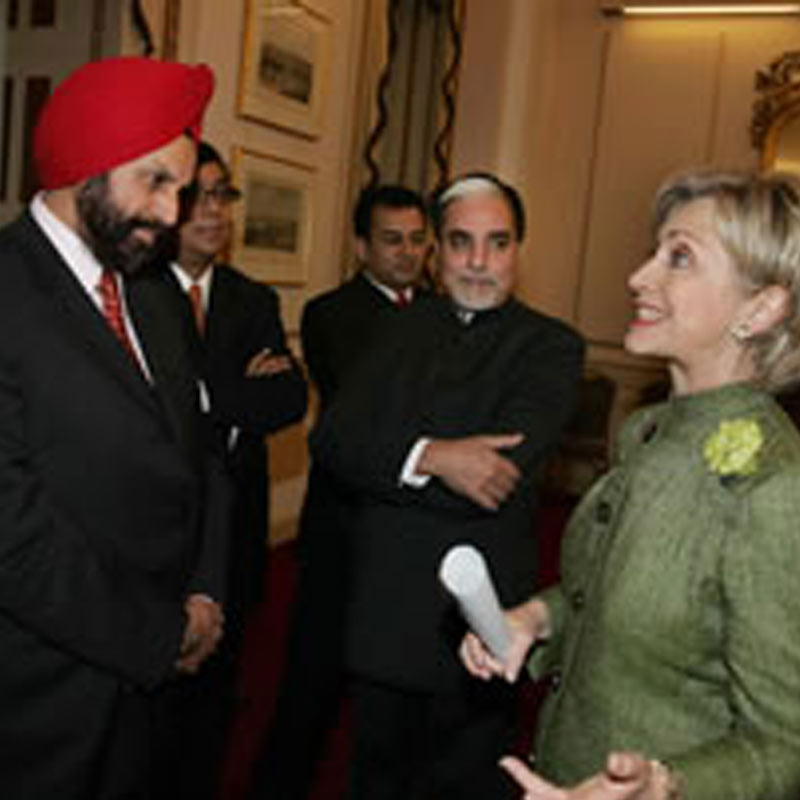
    Addressing lawmakers from both houses of the US Congress at a reception held on the Capitol Hill, Chandra made a “compelling” case as to why the nuclear deal was important in the larger economic interests of both the countries and to furthering bilateral relations.

    The reception, hosted by New York hotelier Sant Singh Chatwal, was held on 17 May. The guest list included Hillary Clinton and Atlanta hotelier Mike Patel.

    According to an official release from Zee, Chandra pointed out that if India continues to consume traditional energy resources at current pace, it could soon adversely impact international oil and energy prices and cripple the economies of many developing countries. Such a scenario could hit the US economy as well global economic growth and result in the US having to spend an additional $500 billion annually in sustaining higher energy costs. The US-India civil nuclear deal, he said, would also spawn many business opportunities in India for several US energy companies.

    While the presence of large numbers of senators and representatives reaffirmed wide bi-partisan support for the civil nuclear deal in both houses of the Congress, the lobbying efforts are far from over. Some lawmakers said they were watching the developments closely and hoped whatever reservations they had about the deal would be dealt with positively during such interactions with business leaders from both countries and their colleagues on the Capitol, adds the release.

    The lawmakers made their points in support of the deal and largely acknowledged that the civil nuclear deal will help both India and the US prosper, sustaining the global economy its growth. They called on their colleagues, many of whom have traveled to India on several occasions before and after President Bush’s historic India visit, to support the nuclear cooperation agreement.

    Among the notable senators at the reception were: John Kerry, Joe Biden, Charles Schumer, Hillary Clinton, John Cornyn and Lamar Alexander. The House of Representatives was represented, among others, by Joseph Crowley, Joe Wilson, Roy Blunt Nancy Pelosi, Steny Hoyer and many more.

  • Chandra to pump in Rs 7.5 billion into WWIL, Dish

    Chandra to pump in Rs 7.5 billion into WWIL, Dish

    MUMBAI: Subhash Chandra has big investment plans for the two de-merged entities of Zee Telefilms Ltd (ZTL). Wire and Wireless (India) Ltd. and Dish TV, engaged in the cable TV and direct-to-home (DTH) businesses respectively, will together be pumping in Rs 7.5 billion to fund their expansion plans.

    WWIL will have an investment requirement of Rs 5 billion over the next three years to give a big push to digitisation of cable TV, broadband and voice services. The cable company also expects to rope in an investor. “WWIL has a business plan which would take in an investment of Rs 5 billion over three years. The strategic thrust will be on rollout of digital cable. We are also looking at triple play offerings. We have a network which can be made available to telecom operators for voice,” Essel Group chief executive officer of corporate strategy and finance Rajiv Garg tells indiantelevision.com.

    WWIL is looking at a debt-equity ratio of 1:1. “The net worth of the company currently is not that strong to support that sort of debt. We would like a 1:1 debt-equity ratio,” Garg says.

    Operating revenues from ZTL’s cable line of business stood at Rs 1.5 billion for the fiscal ended 31 March 2006 while net profit was at Rs 7 million.

    For Dish TV, the DTH outfit, there is a Rs 2.5 billion investmen plan over the next two years. The net expenses for DTH operations thus far is Rs 3.8 billion, says Garg. “We project a gross revenue of Rs 3.2 billion from our DTH business in FY07. We aim to have 2.4 million DTH subscribers in the fiscal while the average revenue per user (ARPU) should go up from Rs 190 to Rs 250 a month because of the launch of value-added services,” he adds.

    The operating revenues for the DTH business stood at Rs 818 million in FY06. On the back of subsidies and marketing expenses, the DTH operations incurred a loss of Rs 790 million during this period.

    The de-merged DTH and cable companies are likely to opt for an initial dilution of up to 26 per cent to investors. They are open to both private equity and strategic investors.

  • Dish moves court against Star

    Dish moves court against Star

    NEW DELHI: Court cases are buzzing all over the place in the media sector as deadlines for various guidelines, including adhering to downlink norms, near.

    In its first direct salvo against the Hong Kong-based Star Group, the Subhash Chandra-promoted ASC Enterprises, owners of the Dish TV DTH service in India, has moved the disputes tribunal against the former’s reluctance to make available Star channels to its platform.

    “It is respectfully submitted that the present petition has been filed due to the refusal on the part of the respondent (Star Group through Star India) to supply its bouquet one channels to the petitioner on reasonable and non-discriminatory terms,” the petition states.

    Filed today at the Telecom Disputes Redressal and Settlement Tribunal (TDSAT), the ASC petition adds, “The unreasonableness on the part of the respondent is evident from the fact that the respondent has laid down impracticable and unreasonable terms and conditions for supply of its bouquet one channels.”

    Contacted by indiantelevision.com, a Star India spokesperson said, “Negotiations are on with Dish TV. Beyond that we cannot comment as we have not heard from TDSAT yet.”

    The petition has been filed as Telecom Regulatory Authority of India (TRAI) in an order has mandated that all content should be made available to all delivery platforms on a non-discriminatory basis.

    Justifying its action of approaching the TDSAT, the petition seeks “appropriate directions against the acts of omission and commission” of Star, including its failure to provide on request the signals of the channels of its first bouquet “on reasonable and non-discriminatory terms.”

    Bouquet one of Star consists of channels like Star Plus, Star Movies, Star News, Star World, Star Gold, Channel [V], National Geographic Channel, The History Channel and Vijay TV.

    The second bouquet — the formation of which was necessitated owing to certain directions from the sector regulator in an effort to control cable TV prices — comprises Star One, Hungama, The Disney Channel and Toon Disney.

    What is interesting is that the Chandra company has decided to take on one time ally-turned-competitor with a vengeance.

    The petition not only states that discussions with Star were initiated by Dish TV in December 2005, but also insinuates that the delay in concluding a commercial agreement is deliberate as the respondent is a joint venture partner in another DTH service, Tata Sky, proposing to start operations later this year.

    Interestingly, Dish TV has won a favourable direction from TDSAT in a similar case involving MTV.

    Discovery-Sony distribution joint venture One Alliance, which comprises MTV and sibling channel Nick, is said to be close to striking a deal with Dish TV for its channels that include the likes of SET, MAX, Discovery and AXN.

  • Dish moves TDSAT against Star

    Dish moves TDSAT against Star

    NEW DELHI: Court cases are buzzing all over the place in the media sector as deadlines for various guidelines, including adhering to downlink norms, near.

    In its first direct salvo against the Hong Kong-based Star Group, the Subhash Chandra-promoted ASC Enterprises, owners of the Dish TV DTH service in India, has moved the disputes tribunal against the former’s reluctance to make available Star channels to its platform.

    “It is respectfully submitted that the present petition has been filed due to the refusal on the part of the respondent (Star Group through Star India) to supply its bouquet one channels to the petitioner on reasonable and non-discriminatory terms,” the petition states.

    Filed today at the Telecom Disputes Redressal and Settlement Tribunal (TDSAT), the ASC petition adds, “The unreasonableness on the part of the respondent is evident from the fact that the respondent has laid down impracticable and unreasonable terms and conditions for supply of its bouquet one channels.”

    Contacted by indiantelevision.com, a Star India spokesperson said, “Negotiations are on with Dish TV. Beyond that we cannot comment as we have not heard from TDSAT yet.”

    The petition has been filed as Telecom Regulatory Authority of India (TRAI) in an order has mandated that all content should be made available to all delivery platforms on a non-discriminatory basis.

    Justifying its action of approaching the TDSAT, the petition seeks “appropriate directions against the acts of omission and commission” of Star, including its failure to provide on request the signals of the channels of its first bouquet “on reasonable and non-discriminatory terms.”

    Bouquet one of Star consists of channels like Star Plus, Star Movies, Star News, Star World, Star Gold, Channel [V], National Geographic Channel, The History Channel and Vijay TV.

    The second bouquet — the formation of which was necessitated owing to certain directions from the sector regulator in an effort to control cable TV prices — comprises Star One, Hungama, The Disney Channel and Toon Disney.

    What is interesting is that the Chandra company has decided to take on one time ally-turned-competitor with a vengeance.

    The petition not only states that discussions with Star were initiated by Dish TV in December 2005, but also insinuates that the delay in concluding a commercial agreement is deliberate as the respondent is a joint venture partner in another DTH service, Tata Sky, proposing to start operations later this year.

    Interestingly, Dish TV has won a favourable direction from TDSAT in a similar case involving MTV.

    Discovery-Sony distribution joint venture One Alliance, which comprises MTV and sibling channel Nick, is said to be close to striking a deal with Dish TV for its channels that include the likes of SET, MAX, Discovery and AXN.

  • Zee consolidated net skids 30% at Rs 2.21 billion in FY06

    Zee consolidated net skids 30% at Rs 2.21 billion in FY06

    MUMBAI: Zee Telefilms has posted a 30 per cent fall in consolidated net profit at Rs 2.21 billion for the fiscal ended 31 March 2006, as against Rs 3.17 billion a year ago.

    Total income, however, rose to Rs 14.87 billion, up from Rs 13.3 billion.
    For the last quarter of the fiscal, the company has reported a 27.2 per cent decline in consolidated net profit to Rs 675.5 million, as compared to Rs 925.7 million in the corresponding period of the previous year.

    Total income, however, rose 10 per cent to Rs 4.1 billion, up from Rs 3.8 billion. The operating profit stood at Rs 761 million, after expensing of initial investments in new activities viz. Zee Telugu, Zee Smile, Zee Sports and others, amounting to Rs 525 million (13.2 per cent of consolidated revenues). As a result, consolidated operating profits of continuing businesses were Rs 1.28 billion. These are higher by 4.8 per cent as compared to the corresponding quarter last year. “The growth rate is subdued mainly due to investments in marketing focused on long-term buildup of mainline channels,” Zee said in an official release.
    On a standalone basis, Zee Telefilms has posted a 54.39 per cent fall in net profit to Rs 740.00 million for the year ended 31 March 2006 as compared to Rs 1.62 billion a year ago. Total Income has increased to Rs 8.84 billion, up from Rs 6.93 billion.

    For the quarter ended 31 March 2006, the company reported a net loss of Rs 132.5 million as compared to a net profit of Rs 370.40 million a year ago. Total income, though, has increased to Rs 2.66 billion, up from Rs 1.75 billion during the period.

    “The business of Zee Sports channel started on 8 June 2005. Zee Sports Ltd is re-organised in ZTL during current quarter and content gathering and space selling activity is retained in Zee Sports through an agency arrangement. Hence the standalone results of the company for current quarter and year are not comparable, said the company.

    Commenting on the results, ZTL chairman Subhash Chandra said, ““We are pleased to report the continuing uptrend in advertising revenues and the strong recovery in our market position. You are aware of the hike in advertisement rates announced by Zee Network, which we are confident would start reflecting in FY2007 revenues.”

    “The Board has also given approval for the hiving off of Zee’s direct consumer business. All DishTV operations would now be under a single corporate entity, bringing strategic clarity to this high growth business. This shall complete the restructuring agenda we had set for ourselves to create four focused, pure play, listed companies ready to exploit the vast emerging opportunities in each line of business. Subject to necessary approvals, this would result in streamlined operations in each area to build long-term shareholder value. It would also clear the ground for acquisitions and strategic or financial partners in the de-merged businesses, apart from unlocking shareholder value,” said Chandra.

    Commenting on the results, ZTL CEO Pradeep Guha said, “While general entertainment (GE) as a genre has posted a 5 per cent decline in time spent, Zee TV has increased its viewership share from 16 per cent to 22 per cent along with a significant growth in time spent. Even within prime time Zee TV is the only channel to have grown, by 21 per cent, while its main competitors have dipped between 7 per cent and 12 per cent. Zee TV now conclusively occupies the second place in the pecking order of GE channels. With an average of 180 GRPs, we are fully 30 per cent higher than the number three GE channel, which continues to be behind Zee Cinema as well.”

    “The cinema space has shown a decline except however for Zee Cinema, which has grown 7 per cent, with a channel share of 37 per cent. Recently we won the BCCI Cricket Rights for the one-day internationals to be held in non-ICC countries.This further strengthens the long term business prospects of the company,” Guha added.

    The Board of Directors in its meeting held today, has taken on record the unaudited consolidated financial results of Zee Telefilms Limited and its subsidiaries for the quarter ended 31 March, 2006.

    REVENUE STREAMS:
    Zee’s advertising revenues increased to Rs 1.96 billion, a 11.7 per cent growth as compared to the corresponding quarter last fiscal. “This growth in advertising revenues was a result of higher average rates on most of the network channels,” the company said.

    Overall subscription revenues at Rs 1.76 billion registered an increase of 5 per cent over the corresponding quarter last fiscal. Domestic pay revenues stood at Rs 717 million. Other sales and services grew to Rs 253 million. “From 2Q FY2006, we are recording the net income component of the trading of set top boxes as part of other income”, the company said in the release.

    EXPENDITURE:
    Overall, the cost of goods and operations went up 44.8 per cent compared to a year-ago period, mainly due to investments made in new channels like Zee Sports, Zee Smile, Zee Telugu and Zee Jagran.

    Personnel costs were 6.5 per cent higher than corresponding period last year. Other costs, particularly marketing expenses have increased by 24.4 per cent. As a result, total expenses were higher by 35 per cent.

    From FY2006, the Company has accelerated its investments in the development and expansion of its network. “This has taken two directions. One, substantial marketing and content improvement initiatives have been put through and second, a number of new channels have been launched, to fill out our content offerings,” states the company.

    “As a result, Zee is in a phase in which the initial investments have been made and expensed fully, while the corresponding revenue build-up is to be realized in the next several quarters. The immediate impact is lowering of operating profits, which we hope to recover in successive quarters through increasing revenues and progressive reduction in costs,” the company adds.

    Zee’s Q4 segment-wise revenues are indicated in the table below:

    OTHER HIGHLIGHTS

    Cable Network
    Zee is looking forward to reinvention of its cable TV business and augmenting revenues. “The cable business is poised to pursue new technology opportunities with renewed focus including ‘triple play’ offerings, digitisation of cable, broadband and other similar initiatives that form the frontiers of cable today. Firm business plans are being given shape and field launch is due to commence shortly. There is more visibility now on the path of transition in the cable business towards digitalization. The recent regulatory and legal developments look set to lead to a roadmap for digitisation initially in the metros,” the company said.

    Direct Consumer Services business
    The DTH subscriber numbers have crossed 900,000 and are growing at the rate of about 2,500 per day. “We are poised to execute market expansion strategies which would lead to a ramp up of subscription from the urban markets, based on value added services not presently available on cable,” the company said.

    At the Bombay Stock Exchange today, the Zee scrip opened at Rs 241.50 and closed at Rs 246.65, after touching a high of Rs 253 and a low of Rs 242.50.

     

  • Zee fixes share swap ratio for Dish TV

    Zee fixes share swap ratio for Dish TV

    MUMBAI: Zee Telefilms Ltd. (ZTL) today said its shareholders will get 23 shares of ASC Enterprises Ltd (ASCE) for every 10 shares held.

    The ZTL board has also approved a demerger scheme for spinning off its direct consumer business into ASCE, a company promoted by Subhash Chandra’s Essel Group for direct-to-home (DTH) business. Siticable (without its cable business) and its wholly owned subsidiary New Era Entertainment Network Ltd. (NEENL) will merge with ASCE, integrating all DishTV operations under this company.

    In the first stage, Siticable will, thus, hive off its cable TV business into Wire and Wireless India Ltd (WWIL). The residual Siticable and NEENL, which handles marketing and distribution of the DTH business, will then merge with ASCE.

    The paid-up equity capital of ASCE will increase to Rs 1.66 billion after merger, up from the current base of around Rs 411 million. The company plans to bring back the capital base to the pre-merger level by cancelling three of every four shares held in ASCE. “As a result of the merger, ASCE’s capital base will get bloated. We want to compress the base,” said Essel Group CEO, corporate strategy and finance. Rajiv Garg.

    The share exchange ratio is based on the recommendation of independent valuers M/s Deloitte Haskin & Sells.
    ZTL shareholders will receive shares on a proportionate basis in ASCE as consideration. As per the independent valuation, ZTL shareholders will get 230 shares of ASCE of Re 1 each for every 100 shares in ZTL. This would result in a 57 per cent shareholding in ASCE for the shareholders of ZTL,” the company said in a release. The appointed date for the Scheme of Arrangement will be with retrospective effect from 1 April.

    The scheme of arrangement will require approval of the Stock Exchange, shareholders and creditors of Zee and from Bombay High Court. ASCEL will be listed on all stock exchanges where ZTL is listed, the release added

    Commenting on the board’s decision to hive off Zee’s direct consumer business, ZTL chairman Subhash Chandra said, “All Dish TV operations would now be under a single corporate entity, bringing strategic clarity to this high growth business. This shall complete the restructuring agenda we had set for ourselves to create four focused, pure play, listed companies ready to exploit the vast emerging opportunities in each line of business. Subject to necessary approvals, this would result in streamlined operations in each area to build long-term shareholder value. It would also clear the ground for acquisitions and strategic or financial partners in the de-merged businesses, apart from unlocking shareholder value.”

    Zee has sent an application to the Stock Exchange on the restructuring plans for the news, content and cable business. “An application will soon be made to the High Court,” the release said.

  • Zee Telefilms to be named Zee Entertainment Enterprises; ASC Enterprises becomes Dish TV

    Zee Telefilms to be named Zee Entertainment Enterprises; ASC Enterprises becomes Dish TV

    MUMBAI: One part of the process set in motion late last month by the Subhash Chandra promoted Zee Telefilms board to split its broadcasting business into three entities — news operations, broadcast & content creation, and Siti Cable — has been completed with the nomenclature of the new entities finalised.

    Zee Telefilms will henceforth be named as Zee Entertainment Enterprises Ltd (Zeel). Included under its ambit are flagship Zee TV, Zee Cinema, Zee Cafe, Zee Studio, Zee Trendz, Zee Sports and Zee Smile.

    On the other hand, ASC Enterprises Ltd, under which comes the group’s direct-to-home (DTH) businesses, will now be renamed as Dish TV Ltd. ASC Enterprise’s DTH service is marketed under the brand name Dish TV.

    Last month, the company’s board had approved of splitting of its broadcasting business into three entities — news operations, broadcast and content creation, and Siti Cable.

    There is no change of name for the news operations company which remains Zee News Ltd. Under Zee News comes not just the news channels but the regional channels as well.

    The reason for including the regional channels into Zee News Ltd is because of the heavy news component that forms an intrinsic part of all these channels. It was in order to comply with the news uplinking guidelines that effective October 2005, newsgathering activities of ZTL were transferred to Zee News Limited.

    The news channels include Zee News, Zee Biz and the recently launched Bangla news channel Chobbees Ghanta. The regional channels are Zee Marathi, Zee Bangla, Zee Punjabi, Zee Gujarati, with the newest addition being Zee Telugu. Expected to launch next month is the sixth regional channel in the stable Zee Kannada.

    As regards the restructuring on the cable side, it has already been announced that the cable business of Siti Cable, a 100 per cent subsidiary of ZTL (now Zeel), and the cable related business of ZTL would be de-merged into Wire and Wireless (India) Limited (WWIL), a new company incorporated for the purpose.

  • Zee wins ‘neutral venue’ media rights for $ 219.15 million

    Zee wins ‘neutral venue’ media rights for $ 219.15 million

    NEW DELHI: The numbers are going beyond believable as far as India cricket is concerned. Subhash Chandra’s Zee Telefilms has secured the rights for the latest money-mopping plan the Board of Control for Cricket in India (BCCI) has pulled out of its cupboard — for matches played by India at neutral venues (non-ICC member countries) over the next five years.

    And the winning bid: a whopping $219.15 million (average of $ 8.77 million per match) for 25 matches spread over the next five years.
    The 25 matches will involve mainly Pakistan as the opposition, but will also include top cricket countries like Australia, England and West Indies. With this, the minimum bid guarantee of the BCCI has crossed the $1 billion mark all told.

    Zee Telefilms also becomes the rights holder for radio and broadband in non ICC member countries where matches may be played. It would also negotiate with pubcaster Doordarshan independently for a terrestrial feed.

    “This cricket property puts us on a strong wicket and would help us in our growth,” Zee Sports business head Himanshu Mody told Indiantelevision.com, adding that “the loss of India cricket rights have been more than made up”.

    The other bidders in the fray for the overseas rights were ESPN Star Sports (disqualified for bidding below the floor price), Nimbus and Sahara One Media & Entertainment.

    The media rights for this latest piece of the India cricket pie will be inaugurated with the two-match Indo-Pakistan limited over series that will be held in Abu Dhabi later this month. The presenting sponsor is Indian real estate major DLF and the ground rights for this series was secured by PDM International for $ 3.61 million.

    Pointing out that Rs 900 million are expected to be generated from these two matches, BCCI vice-president Lalit Modi said 50 per cent of the proceeds will go to Pakistan for earthquake relief fund, while the rest will be donated to the Indian Prime Minister’s relief Fund.

    Pakistan Cricket Board’s director cricket operations Salim Altaf, who was present during the opening of the financial bids as an independent observer, also exchanged documents with BCCI secretary Niranjan Shah, signifying an understanding between the two countries for playing matches under a bi-lateral agreement.

    The 25 matches are to be played in places like Abu Dhabi, Dubai, Sharjah, Holland, Lords, Oval and Birmingham in England, Toronto, New York, Tristate Area, Houston, Chicago, Palo Alto, Singapore, Hong Kong and Kuala Lumpur.

    According to BCCI’s Modi, negotiations are on with the respective countries for venues. All the matches will also be recognized by the International Cricket Council and form part of India’s playing calendar.

    HOW THE DIFFERENT BIDS STACKED UP

    While Zee is likely to end up paying a total of at least $ 219.15 million over a period of five years on an average price of $ 8.77 million per match, the break-up of payment year-wise varies.

    According to documents circulated by the BCCI today at a press conference here, Zee bid $ 5.04 million for the first year, $ 6.03 million for the second year, $ 6.66 million for the third year, $ 8.10 million for the fourth year and $ 18 million for the last year.

    Similarly, the other bidders too had bid separately for every year. ESS had bid $ 2.86 million for each of the five years.

    Nimbus bid $ 5 million for the first year, $ 6 million for the second year, $ 7 million for the third year, $ 8 million for the fourth year and $ 14 million for the fifth year with an average of $ 8 million per match.

    Sahara’s bids were $ 5.32 million, $ 5.41 million, $ 6.40 million, $ 7.21 million and $ 10.90 million for each of the five years where on an average per match was costing $ 7.048 million.

    On being asked how does it feel to be on the losing side, Nimbus’ chairman Harish Thawani shot back, “Seeing the winner’s bids, I feel we got the rights to India cricket cheap. I wish Zee all the best.”

    Nimbus had bagged the four-year rights of Indian cricket for a whopping $ 612 million, beating the likes of Zee Telefilms ($ 513 million and ESS.

    DRAMA BEFORE THE ANNOUNCEMENT

    Can anything related to cricket and BCCI be bereft of drama? Probably not.

    Before the media was apprised of the transparent way in which the BCCI conducts its affairs, especially those relating to bidding, journalists were kept waiting at a five-star hotel here as a closed-door meeting of cricket officials and representatives of bidding companies took place.

    Reportedly, there were two adjournments when frantic calls were made by some of those present in the meeting to their bosses.

    It seems there was some confusion regarding the way prices of every one year of the five-year contract period were to be quoted and calculated.

    When that got sorted out, discussions took place on the formal protests lodged by Zee Telefilms and Nimbus relating to the submission of financial bids by Sahara yesterday in Mumbai.

    While Modi reiterated that there were “no irregularities” in the Sahara bid, Zee Sports’ Mody smiled away questions on yesterday’s protests. “We don¡’t have any issue now,” he said, while sharing the dais with BCCI officials.

    While making a grand exit from the press conference, BCCI’s Modi said, ‘These rights will ensure coverage of matches played by India in non-ICC member countries as well. Professionalizing this aspect of Indian cricket management will make the sport, especially the Indian game, accessible to Indian communities across the globe, including the non ICC member countries.”

  • Zee Sports can break even in 18 months time: channel head

    Zee Sports can break even in 18 months time: channel head

    NEW DELHI: Zee Sports, the youngest of the sports channel beaming into Indian cable homes, could breakeven within 12 to 18 months time, according to a senior channel executive.

    “These are early days, but the channel can possibly breakeven in 12 to 18 months time as its revenues increase. Especially now that cricket will be aired,” Zee Sports business head Himanshu Mody told Indiantelevision.com today.

    Part of the Subhash Chandra-promoted Zee Telefilms, Zee Sports believes it has struck gold after bagging the telecast rights of one-day cricket that India will play against Pakistan, Australia, England and West Indies over the next five years on neutral venues.

    Zee has invested approximately Rs 300 million in its sports channel started over a year back.

    Zee Telefilms bagged the telecast rights for approximately $ 219 million, beating the likes of ESPN Star Sports, Sahara One Media & Entertainment and Nimbus.

    According to Mody, a cricket property like this is definitely going to drive up the subscription revenues and could be leveraged in different ways on various platforms over the five year contract period till 2011.

    “In the months to come by, Zee Sports will be a power to reckon with,” Mody said with glee after this victory, having failed twice earlier to bag big ticket cricket properties, which included the domestic Indian rights for four years that was snared by Nimbus for $ 612 million.

    Asked whether the investments could be recovered as there’s an overdose of cricket all round on television, Mody said the present rights for 25 one-day matches were different from other rights and had its advantages.

    “What we have bagged is one-day cricket, which has more value (in terms of viewership) than five-day Test cricket. Moreover, India-Pakistan clashes mostly go down very well with viewers and advertisers alike,” Mody explained.

    Zee Sports is also keen to share the terrestrial telecast with the Indian pubcaster Doordarshan and doesn’t think such simulcast would hit its revenues — advertising or subscription.

    “We are keen to share cricket with DD and will offer the best deal possible,” Mody said.