Tag: streaming

  • Travelxp bets big on OTT content, launches new platform Travelxp RED

    Travelxp bets big on OTT content, launches new platform Travelxp RED

    New Delhi: The OTT boom has taken the world by storm over the last few years and India remains one of its fastest growing markets. The latest entrant is India’s global travel channel, Travelxp, which has now joined the race and announced its new streaming platform- Travelxp Watch.

    Travelxp is available on the App Store and the Google Play Store and is planning to add TV Apps by the end of this month. More than 250 original travel stories, of which 50 per cent are shot in 4K HDR, will be available in English, Hindi as well as in two regional Indian languages – Tamil and Bengali, it said on Wednesday.

    It will be streaming more than 150+ hours of original travel content and hopes to increase the library strength to 1000+ hours of content by the end of FY 2022.

    “We launched the world’s first 4K HDR Channel in 2016, and now the world’s first 4K HDR Travel OTT Platform, with Travelxp Watch. We are delighted to bring the power of 4K HDR to our Indian fanbase,” said Travelxp 4K| HD, founder CEO Prashant Chothani. “The project has been in the works for nearly two years now, we wanted to get it right with regards to the entire customer experience. In a period where travel is going to see a big resurgence, Travelxp is going to be at the heart of supporting the travel recovery with the power of content.”

    The entire product was built by an inhouse team through the entire Covid lockdown.

    “The passion of the team in creating a platform that resembles the simplicity and joy of travel has seen us shoot up to the Top 50 Apps in India for the Travel Category in less than a week since launch, and we have more than 30,000+ Monthly Active Users already,” said Tanay Chothani, who joined Travelxp two years ago to lead all Digital Projects, a major part of which constituted the OTT Platform.

    Chothani highlighted that the content driven commerce model is going to be a big part of Travelxp’s strategy going forward. “The power of video is unparalleled in driving demand and also giving viewers more decision making power. While we showcase the world in the beautiful 4K HDR quality we are known for, we are also going a step further and allowing our users to book and plan their travels, right from the same app,” he added.

    Travelxp’s OTT Platform is available at www.travelxp.com.

  • Disney Plus to premiere Star Wars: Visions on 22 September

    Disney Plus to premiere Star Wars: Visions on 22 September

    New Delhi: Streaming platform Disney Plus is all set to premiere its new anime anthology series Star Wars: Visions on 22 September. The platform and Lucasfilm unveiled the first look of the much-anticipated anime series on Sunday.

    The OTT platform also announced the names of the seven Japanese anime studios that are behind the nine short films in the series during the Anime Expo Lite event. The studios are Kamikaze Douga, Geno Studio (Twin Engine), Studio Colorido (Twin Engine), Trigger, Kinema Citrus, Science Saru, and Production IG.

    According to Variety, each anime studio will use their signature animation and storytelling styles to deliver their visions of George Lucas’ Star Wars universe.

    “From the beginning, stories told in the Star Wars galaxy have counted Japanese mythology and the films of Akira Kurosawa among their many influences, and these new visions will further explore that cultural heritage through the unique animation style and perspective of each anime studio,” stated Disney Plus in a press release.

    Jacqui Lopez, James Waugh, and Josh Rimes of Lucasfilm are executive producing the show along with Qubic Pictures’ Justin Leach. Kanako Shirasaki is producing.

    Apart from the names of each studio and episode, Disney Plus also gave fans a sneak peek into the creation of `Star Wars: Visions` with a three-minute teaser video shared on YouTube.

  • Guest Column: The great streaming transformation

    Guest Column: The great streaming transformation

    New Delhi: It’s one of the great truths that some of the most significant events in human history have left a lasting legacy of unanticipated and permanent societal change. Last year the global pandemic caused the world to enter a long, dark tunnel from which it is yet to emerge. We don’t know yet what its permanent legacy will be, but in media and entertainment, streaming has catapulted to the forefront as the fastest-growing segment for content consumption.

    It’s true, the global content viewing revolution had already begun with the birth of global SVOD players like Netflix and Amazon in the last decade, but in 2020 digital transformation was supercharged. In the FICCI-EY report ‘Playing by new rules’ (March 2021), 37 per cent of surveyed Indian consumers said they are more likely to consume their media via OTT after the pandemic. For home entertainment, the digital age has well and truly arrived.

    OTT (over-the-top) streaming services thrive by offering low-cost, high utility alternatives to traditional television and make money by mining the margin previously enjoyed by pay and FTA broadcasters who have much higher infrastructure costs. Their algorithm-directed content picks take the place of human-driven programming selections and deliver the customer a sense of personalisation and “endless choice”, which sometimes belies the actual quantity of programmes available. These services’ responsiveness to consumer behaviour, with their ability to serve up just enough of the right content to maximise subscription and to reduce churn, also sets them apart. If they can find their niche in a crowded market they can be incredibly successful.

    The global OTT market is huge and growing fast – estimated by Research Dive to grow at a CAGR of over 19 per cent out to 2026 becoming then worth over US$400 billion globally. This surging growth, never stronger in a single year than in 2020, has led to the mass uptake of a huge range of existing and new local and global platforms and services. Many of these services were accessed for the first time by individuals and families who were living through months of economic and social lockdowns.

    In the Asia Pacific, more broadly, according to PWC, the regional OTT market will surpass that of the United States sometime in 2021.

    Last year, everyone was talking about the most popular streaming shows. If it wasn’t The Crown, it was The Queen’s Gambit or Criminal Justice: Behind Closed Doors on Disney+ Hotstar, produced by BBC Studios India. In India, there are now more than 40 OTT providers in a crowded market challenging for a share of the valuable streaming wallet.

    Our content sales business has been able to benefit from this growth. In India last year BBC Studios struck a deal with Lionsgate Play to showcase premium dramas Brexit, Pure, Class, Les Miserables and SS-GB. The ever-popular Doctor Who reached its audience on Disney+ Hotstar and Amazon Prime Video. Celebrated BBC pre-school content appeared on Voot Kids, providing entertaining and educational content for young families stuck at home. Sony BBC Earth also had a strong year.

    How are producer-distributors to continue to respond to this challenge and yet potentially huge opportunity? One thing that has become apparent is the vital importance of the ownership of intellectual property. This realisation was the driving force behind the 2018 spin-off of the BBC’s in-house production arm and consolidation with distribution company BBC Worldwide, to create a producer-distributor powerhouse, BBC Studios. And no doubt, ownership of content and IP has become even more important since then.

    As an owner, BBC Studios extracts value at all points in the IP’s lifecycle, from initial production to distribution to licensing and merchandising. But it doesn’t end there. Running a true IP ecosystem also requires participation in the OTT market itself. The development of authenticated VOD service – BBC Player in Singapore and Malaysia and the partnership with ITV in streaming service BritBox, which is enjoying huge success in the US, Canada, and Australia are evidence of this.

    In the US, many of the big studios executed gigantic mid-course pivots to streaming, involving consolidation, big money investments, channel closures, and painful restructuring. Last year, Warner Brothers stunned the market by announcing that they planned to release their entire 2021 film slate on HBO Max simultaneously with movie theatres in the US.

    Recently we learned that Disney will take the unprecedented step of closing 18 of their linear channels in South East Asia and Hong Kong to concentrate on their OTT business. Both seem incredibly bold but understandable moves given the state of the market, the pace of change, and the growing size of the streaming prize.

    Linear channels will continue, albeit on a slow decline in some markets. MPA recently forecast that total pay-TV industry revenues will actually grow at a CAGR of 3 per cent between 2020-25, driven by India, China, and Korea. However, those still in the linear business must continue with the modernisation of their services, building digital extensions, and increasing their cost efficiency while preparing to participate in a primarily digital future.

    The advent of OTT streaming delivers a stark choice for IP owners – either stay on the sidelines and risk having their primary business model eroded, or take the plunge and transform their business model to take advantage of the age of streaming.

    (Jon Penn is the executive vice president for BBC Studios APAC. The views expressed in the column are personal and Indiantelevision.com may not subscribe to them.)


  • YuppTV re-launches Zee channels in US

    New Delhi: Streaming platform for South-Asian content, YuppTV has re-launched Zee Network channels in the US and Canada.

    YuppTV viewers will now be able to catch a wide mix of relatable fiction, high voltage non-fiction, marquee events, and blockbuster movies in Hindi & regional languages from Zee channels, announced the platform on Wednesday.

    ‘’We are delighted to once again join hands with Zee Entertainment, to bring back its premium entertainment channels to the US and Canada markets,” said Yupp TV founder, and CEO, Uday Reddy. “The US market has been at the forefront of digitization, not only in access but also in Ad Sales. With our platform now, Zee can offer its advertisers not only the incremental HHs but also structure deals based on delivery (impressions) both at a national or local level, an advantage that no other platform offers to its programmers. Every Ad on Yupp can be measured to the last dot and that is a game-changer for the South Asian Advertisers in the US”. 

    Be it captivating family dramas such as Kumkum Bhagya, the family comedy BhabhiJi Ghar Par Hai, or the reality show ‘Indian Pro Music League’, YuppTV users can access the Zee channels offerings through its platform. The users will also get access to channels such as Zee TV, & TV and Zee Cinema as well as various regional channels such as Zee Telugu, Zee Tamil, Zee Kannada, Zee Keralam, Zee Punjabi, Zee Marathi, and Zee Bangla

  • Content spending to top $250 billion by year-end, amid soaring demand

    New Delhi: Despite a year of uncertainty and production hiatuses due to the global pandemic, streaming platforms have set the global film and TV industry on a trajectory of accelerated growth with no imminent ceiling in sight. According to a latest assessment by London-based fin-tech platform, Purely Streamonomics, audience demand, production spending, and TV budgets reached all-time highs during the pandemic.

    While the actual number of films that went into production dropped last year, and TV series experienced shooting delays, more cash than ever was committed to content, reflecting continually rising production budgets and greater rights-buying activity.

    Production spending to top $250 billion by year-end

    Based on current trend lines, Purely expects production spending to top $250 billion by year-end, and then keep rising beyond that, especially as media mergers: Warner Bros Discovery, Amazon-MGM and Televisa-Univision start to flex their combined muscles around the planet.

    “What is remarkable about these record numbers is that the industry’s spending has yet to bump up against any natural ceiling. Every year there is talk of the industry being on the cusp of ‘peak television’ and yet it is clear from our own business dealings that the streaming of films and TV shows is only now starting to reach escape velocity,” said Purely, founder and CEO, Wayne Marc Godfrey, “Streaming is not just displacing traditional sources of entertainment revenue such as pay-TV and linear broadcasting, it is actually expanding the global marketplace for video.”

    The research shows that gross cash amount spent producing and licensing new entertainment content (excluding sports) soared by 16.4 per cent in 2020 to reach $220.2 billion, setting yet another milestone that is on track to be surpassed again this year. “But this is only the start of what’s to come. Even more spending growth is on the short-term horizon as a new wave of ad-supported platforms start gaining a stronger foothold around the world, alongside the subscription-funded services that have been driving the streaming marketplace until now,” says the report by the London-based fin-tech platform.

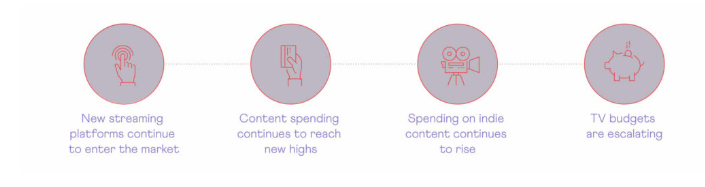
    Four emerging trends:

    Deluge of new streaming platforms:

    Since 2019, the number of global customers subscribing to streaming video platforms (has grown from 642 million to more than 1.1 billion, a 71 per cent leap that has been turbo-charged by months of enforced lockdowns at home. The pandemic not only drove rampant growth on existing platforms, it also accelerated the acceptance of powerful new global competitors including Disney Plus, Apple TV Plus, HBO Max, Peacock, Discovery Plus, Paramount Plus and Star. Joining these global platforms in the hunt for monthly customers are several regional Champions. Total number of subscribers is expected to reach at least 1.6 billion by 2025—representing about a fifth of the planet’s total projected population by then.

    Content Spending Reaches a New High

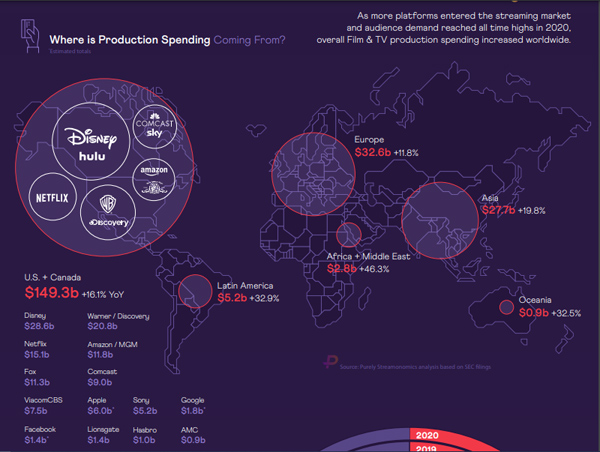
    As more platforms entered the streaming market and audience demand reached all-time highs in 2020, overall Film & TV production spending increased worldwide.

    According to the research, The Walt Disney Co remains the biggest single spender on content, with a grossed-up total of $28.6 billion for 2020 – which is more than spend across the whole of Asia ($27.7 billion) last year, followed by recently formed Warner Bros. Discovery and Netflix. Once Amazon completes its own acquisition of MGM, that combined entity would rank as the fourth largest North American production. On that basis these top four companies alone, with combined spending of $75.3 billion, almost equates to the entire worldwide spending outside of North America ($77.3)

    Spending On Indie Content Surges

    As much as Netflix and the five major Hollywood studios spend producing their own content, independently made and acquired content accounts for twice as much money globally. According to Purely Streamonomics’ global research, indie content spending jumped by 25.3 per cent year-on-year in 2020 and now accounts for 65.5 per cent of the world’s film and TV production activity.

    Budgets Are Soaring for TV shows

    As audiences continue to grow, and more competition enters the market, the stakes keep getting higher. In order to stay competitive, producers face pressure to up their production spending. As a result, budgets have risen in recent years, especially for TV shows. According to the research, average budgets across all new series in the US– scripted, unscripted, daytime and kids – was on the rise, up 16.5 per cent in 2020. The cost of introducing and monitoring COVID protocols in 2020 also added 20-30 per cent to production budgets.

    The findings of the research were presented in the form of infographics by Purely Streamonomics and created by digital publisher Visual Capitalist. The data is based on SEC filings by U.S. media conglomerates and tech giants, as well as reports published by national film and TV data-gathering organisations around the world.

  • GUEST COLUMN: How Telegram is fuelling streaming piracy

    New Delhi: The popular messaging app, Telegram, is fast becoming the leading source of pirated content throughout Asia – and the cause of substantial revenue loss for content providers and operators.

    Users of the platform, which provides end-to-end encryption, can conceal their identity to share texts, videos, or other files relating to copyrighted content. Given that Telegram is popular with millions of active users, intuitive, and offers its users privacy, it is no surprise that streaming pirates exploit Telegram.

    The latest Telegram statistics reveal that in January 2021 it had over 500 million monthly active users – 38 per cent from Asia – and it was also the most downloaded app across both the App Store and Google Play globally with more than 63 million downloads. According to App Annie, it is the most popular social networking app in Malaysia and ranks third in India.

    Telegram appeals to pirates because it allows them to disseminate information easily and speedily to huge, encrypted private chat groups – as large as 200,000 people – and its channels can attract millions of subscribers. Video and movie channels are amongst the most popular with pirate sites like Hindi HD Movies attracting well over two million followers.

    From newly released movies and popular live sporting events to lesser-known, critically acclaimed documentaries with subtitles, pirates have circulated, exchanged, and sold illegal copies and video clips on Telegram. The scale of this for-profit piracy is siphoning off billions of dollars that rightfully belong to content and streaming providers and rights holders. Analyst firm Nera Consulting places the global TV industry’s revenue losses from digital piracy at between $39.3 to $95.4 billion per year while a recent global study conducted by Ampere Analysis for Synamedia found that sports streaming piracy alone is worth over $28 billion.

    Synamedia has been fighting TV and video piracy for decades, providing services and technology to protect $70 billion in operator revenue every year. By adopting an intelligence-first security model, marrying the very best human intelligence with

    cutting-edge cybersecurity and AI technologies, we have disrupted pirate services and brought many criminals to the attention of law enforcement officials.

    Gaming the system

    Tackling Telegram streaming pirates is a 24×7 battle, requiring continuous monitoring and intelligence gathering not just within Telegram but across all social media platforms to profile rogue players and detect connections and cross-platform relationships. Armed with these insights, Synamedia employs AI-based content recognition crawlers to infiltrate Telegram channels, tracking and identifying specific pirate streams by combining the metadata of a target video – and/or live feeds via platform APIs – with advanced deep machine learning models.

    Here, we can share some of our observations about how streaming pirates exploit Telegram:

    Prized Piracy Booty:

    Hotly anticipated Bollywood blockbusters, newly-released content, and live events – particularly sports fixtures stolen from legitimate streaming sites – are the main attractions. One live sports event can spawn several hundreds of pirated channels with links to watch the illegal streams. But older VOD content is still valuable, as we witnessed during lockdowns when live events were on hold.

    Masters of Disguise:

    With no embedded player inside the platform, pirates use Telegram channels and groups to distribute text and M3U links to consumers and to upload videos for free to Telegram’s hosted cloud services. To maximise appeal, pirates even include subtitles in different languages and use legitimate payment systems like PayPal and Bitcoin. Pirates hide keywords relating to the event they are stealing or use code words to weave a web of intrigue by embedding references to new private pirate channels inside their messages.

    Masters of Strategy:

    Pirates act fast, in real-time. Minutes ahead of a live sporting fixture, for example, they will proliferate new channels on Telegram with new links to illegitimate content. They have backup channels ready to switch up at a moment’s notice – sometimes pre-warning consumers which channel to use should the first pirated live stream be removed. They even have their own virtual crow’s nest or ‘lookouts’ for monitoring during an event. We saw a case where a streaming pirate changed the name of the video midstream due to a tip-off from others in the chat group.

    Jumping Ship:

    Pirates will flaunt that a Telegram channel has been disrupted due to copyright and distribute guidance on how to follow a new one. They also encourage consumers to jump ship to other platforms and pirate sites, providing links to the open web or links to other platforms with players.

    Stealing the stream:

    Not satisfied with stealing streams of live or on-demand content, pirates also offer OTT subscribers’ stolen credentials, pirated APKs, and hacked IPTV emulator channels which give consumers a link to live channels without the need for a set-top box.

    Anti-piracy game-changer

    Fighting streaming piracy requires solutions that demotivate pirates at every point along the video distribution chain. That’s why Synamedia’s anti-piracy monitoring solutions extend far beyond social media platforms to the outer reaches of the openw web– as well as closed subscription-based IPTV networks.

    Building an anti-piracy strategy requires a painstaking, forensic, intelligence-led approach to map out the increasingly intricate and sophisticated pirate ecosystem in multiple layers to cross-reference data, spot piracy behavioural patterns, unravel approaches, and understand trends. And to win against the pirates, the media and entertainment industry needs to collaborate not just with tech providers but also with governments, regulators, and law enforcement bodies. It requires governments across the globe to mandate the use of technologies such as watermarking and introduce tougher legal penalties.

    Streaming piracy is an existential threat. In light of the eye-watering amounts of money spent on producing content and purchasing sports rights, providers have a right to be confident that they are covering their costs and bringing in enough revenue to build sustainable business models because revenue leakage due to piracy is simply not viable in the long term.

    As well as deterring and disrupting piracy, using a model that offers incentives encouraging viewers of pirate streams to move back to legitimate services is often overlooked but equally important. With an appealing mix of access and payment models, content providers, and operators can turn the tables on the pirates and play the system to their advantage, encouraging consumers to pay for legitimate services instead.

    (Avigail Gutman is the vice-president of Intelligence & Security Operations at Synamedia. The views expressed in the column are personal and Indiantelevision.com may not subscribe to them.)

  • ZEE5 to launch new series ‘Dhoop Ki Deewar’ on 25 June

    New Delhi: The countdown to the launch of Zindagi’s third original web series ‘Dhoop Ki Deewar’ has begun. The new series will be launched on 25 June and its episodes will premiere every Friday at 12 noon, ZEE5 announced on Wednesday.

    ‘Dhoop Ki Deewar’ revolves around the void that war leaves behind for the martyrs’ families on both sides of the border. ZEE5 has decided to stream the finale episodes on the Independence Day weekend – a historic day for people on both sides of the Indo-Pak border and South-Asian diaspora globally.

    ZEE5 India, chief business officer, Manish Kalra said, “An opportunity to tell such a powerful yet touching story does not come by easily. Through ‘Dhoop Ki Deewar’, we want to touch as many lives as we can and start a conversation about ‘heart over hate’. At ZEE5, we believe in innovating constantly and look forward to seeing greater success with weekly episodic releases of the show and a renewed launch time of 12 noon.”

    ZEE Entertainment Enterprises Ltd, chief creative officer, special projects Shailja Kejriwal said, “This show is a sincere effort to demonstrate the collateral damage caused by war and a call to viewers from both sides of the border and across the world to introspect the need for peace. We hope the viewers will connect to the show and would love to hear their response as we release fresh episodes week on week.”

    Produced by Motion Content Group and Hamdan Films, written by Umera Ahmed, and directed by Haseeb Hasan, Zindagi’s upcoming original ‘Dhoop Ki Deewar’ is a tale of family and loss with real-life couple Sajal Aly and Ahad Raza Mir in the lead.

  • MX Player deploys H.266, slashes video streaming data usage by half

    KOLKATA: Online video consumption in India has grown exponentially, accounting for 80 per cent of consumer internet traffic. However, the user experience remains highly dependent on data usage and network speed.

    Now, MX Player has upgraded its video encoding & compression technology to H.266 (Versatile Video Coding), cutting down data usage for streaming videos by more than 50 per cent. MX Player as well as MX TakaTak users will be the first in the world to experience the benefits of H.266, enabling them to consume higher quality HD video streams with significantly less data consumption.

    With H.266, MX Player users will be able to stream more content with less data and network bandwidth – video streams will load faster and buffer less since they require only half (or less) the data it would need otherwise. H.266/VVC is the world’s most advanced video codec designed to succeed H.264/AVC and H.265/HEVC, used by most streaming video services worldwide today. Unlike its competitors, the H.266 upgrade makes MX Player the first OTT platform in the world to deploy this technology.

    MX Player and MX TakaTak CEO Karan Bedi said, “Video consumption dominates internet usage wherever you go across India, but the quality of experience deteriorates in areas with inconsistent data networks. The new standard is an opportunity for MX Player to give millions of users, regardless of where they are, an exceptional streaming experience that allows them to consume content the way content creators intended: faster loading, buffering-free, and true-to-life HD quality.”

    MX Player SVP Product Sidd Mantri further added, “At MX Player, the future is now. We relentlessly focus on raising the customer experience bar for Indian users. We were amongst the 1st few OTTs to deploy AV1 that reduced data consumption by 20-30 per cent compared to H.265. With H.266, we are taking it to the next level. H.266 offers the most advanced video compression standard available in the world and reduces data usage by more than 50 per cent. Many users in India live on daily data consumption caps, so with H.266 they can watch more as well as watch better on MX Player.”

  • How television can increase time spent viewing with interactivity

    MUMBAI: With streaming video services like Netflix, Amazon, Disney+Hotstar, and Zee5 grabbing a majority of the headlines, and becoming the flavor of the moment, many believe that linear television in India is losing its moxie. Yes, broadcasting companies are indeed responding aggressively to Netflix and Amazon’s invasions into what was once solely their territory by acquiring, merging, and launching their own OTT platforms. Not just in the US, but almost every nation, including India.

    Yes, it’s true that India alone has around 70-80 streaming platforms – if you include those with dubious titillating content, and which are available on the google play store. Yes, it’s true that almost every trade and business publication has raised the alarm that streaming video platforms are going to steal viewers and pull the rug from under television’s feet.

    But the fact is that the reality is as far from this fear-mongering, as is mount Everest from Mumbai. Television is only on the rise in India. That is quite evident from the television data the Broadcast Audience Research Council (BARC) reported recently. The number of Indian television households grew to 210 million by the end of 2020. Some 13 million homes were added to the TV universe since the last BARC study in 2018; of this rural India accounted for nine million. TV viewership also rose to 892 million individuals from 836 million. Add to that the fact that more than 90 million households have yet to own a TV set.

    Now if you compare those figures with the OTT universe: the biggest OTT platforms in India – Disney+Hotstar and Zee5 – have monthly active users which are around one-third of TV’s viewing population and other streamers have significantly lower numbers. Subscribers to the premium OTT services are also only in the single and double-digit million range. Revenues too are not comparable; the free ad-supported television streaming platforms are dwarfed by the ad revenues that Indian television –both pay and free to air channels are mopping up.

    Clearly, broadcast television has long legs and will continue to stride ahead of streaming services. What can help it proliferate even more is if interactivity can be built into it; with viewers being able to interact with it live from their homes. Just like it is possible with the streaming video which is delivered over internet protocol or the internet as is the case with OTT platforms. Sports fans have been fascinated by what has been playing out on their mobile phones wherein they can make comments while watching the IPL action on their smartphones on Disney+ Hotstar. They can engage with the video on their phones. Fans have also been quite taken up with being involved in Kaun Banega Crorepati with the play-along option available on their smartphones. That has probably added to SonyLiv’s stickiness.

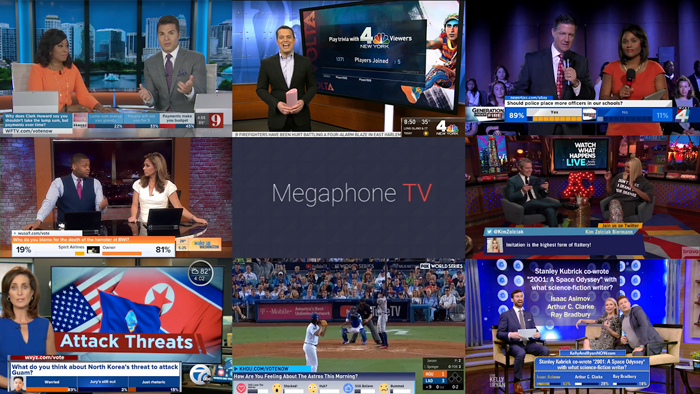
    But today technology is available which can bring similar – if not better – interactivity to television too. One of the best products available today is MegaphoneTV which allows viewers to interact with their programmes from the comforts of their sofas in their homes. It enables them to take part in opinion polls, trivia, social interaction, quizzes, express their fan love, expound their views on what’s going with the storylines and characters of their favourite TV shows – and their responses and names are transmitted to hundreds of millions of viewers all over India simultaneously immediately with a lag of fewer than 200 milliseconds. All they need is a smartphone. Megaphone TV allows TV to transform itself from being a dead one-way device to one with which viewers can correspond, that too without any latency.

    More than 160 channels globally are using Megaphone TV – from US broadcasters ABC, CBS, NBC, Bravo TV, CNN, Sky TV in the UK, and RTL in Germany. And they have benefited immensely from this tool with response rates and engagement with TV viewers going up exponentially.  

    Channels- both entertainment and news – globally have used MegaphoneTV to build loyalty by giving out rewards to loyal participants of the interactivity, thus increasing stickiness and spiking time spent viewing by TV viewers.

    New York-based Megaphone TV founder & CEO Dan Albritton points out that integrating the tool with the channel’s backend is extremely simple, adding that all that is needed are internet connectivity, two computers – one in the playout hub of the broadcaster, and one in the hands of a junior programming executive wherever he is located. He explains: “Being a white-label service, it takes on the channel’s packaging, branding, and look with no indication of Megaphone branding anywhere. The interactivity questions, polls, and quizzes can be entered to appear on-air on a TV channel on the fly by the junior executive after strategizing with the programming team. “

    Brands can be roped in by the channels ad sales team to sponsor the interactivity. And TV commercials by brands can also be created which encourage viewer responses live, thus in the process helping build sales funnels and consumer data, to which the broadcaster’s data teams and marketers have free access. “The American TV industry has recognized the value we are offering through Megaphone TV. We have won an Emmy Award for it, and have been nominated twice for some of the interactivity around other TV programmes,” says Albritton.

    In India, TV channel executives are just about getting exposed to Megaphone TV, he points out.

    “Two channels have been licensed to use this engagement driving tool. They will be coming out with their offerings soon. Some leading media agencies have seen it in action too, and are excited about the possibilities Megaphone TV offers,” he says. “I can visualize a time in the not too distant future when Megaphone TV will become ubiquitous in the very exciting Indian television ecosystem.”

  • Amit Malhotra appointed managing director for HBO Max in Southeast Asia, India

    Amit Malhotra appointed managing director for HBO Max in Southeast Asia, India

    New Delhi: WarnerMedia on Friday announced the appointment of Amit Malhotra as managing director for HBO Max in Southeast Asia and India. 

    Malhotra most recently served as regional lead for Disney+ in Southeast Asia, where he was responsible for overseeing the launch and operations of Disney’s streaming services in the region, including Disney+, Disney+ Hotstar and Hotstar.

    He will join WarnerMedia later this month and report to HBO Max International head, Johannes Larcher. Malhotra will be responsible for the rollout and management of WarnerMedia’s direct-to-consumer platform in Southeast Asia. He will immediately assume responsibility for the management of HBO GO, WarnerMedia’s existing OTT streaming service available in eight territories across Southeast Asia. In the future, he will spearhead the introduction of HBO Max in these territories and will lead WarnerMedia’s exploration of future opportunities to launch the streaming platform in additional markets, as well as a potential future launch in India, said the company on Friday.

    At Disney, Malhotra also led the content sales and distribution division as part of The Walt Disney Company’s Direct-to Consumer & International (DTCI) business in South APAC and Middle East, pivoting Disney’s linear business in the region to streaming by working closely with local telcos and MVPDs, creating localized payment strategies and developing deep content studio relationships throughout Southeast Asia. 

    Johannes Larcher said, “With our upcoming launch across Latin America on 29 June and our plans for Europe on the horizon, we turn our sights toward Asia, where we have an incredible opportunity to bring HBO Max to millions of new fans who are just as excited about streaming as our audiences in the U.S. Amit’s experience launching streaming services in both mature and emerging markets across Southeast Asia and the surrounding region make him the ideal leader to plan and oversee the rollout of HBO Max and its expanded content offering and platform experience.” 

    David Simonsen, who has played an important role in the growth of HBO GO in Southeast Asia to date, will continue to make a significant contribution to WarnerMedia’s direct-to-consumer efforts in the region, and will work closely with Amit as part of his executive leadership team.

    Amit Malhotra said, “I am delighted to be part of the incredible team at WarnerMedia in Asia as we look at bringing HBO Max to this region. WarnerMedia’s brands including DC Universe, HBO and Cartoon Network are extremely popular with passionate fans and audiences across this region. With a focus on consumers our goal will be to bring all of these brands and content together in an exciting new world class streaming experience as we move into the future with HBO Max.” 

    Under Malhotra’s leadership, WarnerMedia expects to launch HBO Max in Hong Kong, Indonesia, Malaysia, the Philippines, Singapore, Taiwan, Thailand, and Vietnam in the future, including an expanded content offering for the entire family and a premium new platform that would be hosted on HBO Max’s tech stack, providing a more stable and consistent streaming experience than HBO GO. Malhotra will also be responsible for exploring possible opportunities to launch HBO Max in new and fast-growing Asian streaming markets such as India.

    HBO Max has witnessed significant success since launching in May last year, adding 11.1 million HBO/HBO Max subscribers in the U.S. as of the end of Q1 2021. The platform will roll out in 39 territories across Latin America and the Caribbean on 29 June, and HBO’s existing OTT services in Europe are scheduled to be upgraded to HBO Max later this year. By the end of 2021, HBO Max is expected to be available in 61 global markets, said the company.