Tag: streaming video

  • 2020 and the debate of TV vs digital video

    2020 and the debate of TV vs digital video

    MUMBAI: It’s been two decades since I have been listening, participating and speaking about the great inflection point in digital in India. Every five years with some growth in consumer usage of the internet, adoption of platforms and growing online shopping, the claim used to only add fuel. Further to tons of VC money going into start-ups, every third person used to say “Digital Inflection Point” has truly arrived in India.

    So, I am kind of tired of this whole story, but wait… 2020 has been that year when the digital inflection point truly arrived. I say it with total conviction, data points and authority as a media agency head, based on what I am seeing on the ground and how clients have responded to the turning landscape and massive consumer behavior changes happening around us.

    VCs invest in ideas for the future and 90 per cent of them fail but the ones that stick, address the growing need when the inflection point arrives, solving a problem and making the business viable because the business has a purpose. Purpose of disseminating information or spreading joy through entertainment or enabling healthcare in remote places or bringing education to people’s homes or even making financial transactions simpler.

    This would not be possible without the technology that could back the high-speed internet required for addressing any of the purposes I have mentioned above. India as a country still has affordability issues. So,  when the high-speed internet became affordable, consumer intent naturally swayed towards cheaper options, making viewability of content agnostic in nature.

    That is the only true reason why I believe that the inflection point has arrived and it’s here to not just stay but grow exponentially. Now how does that translate to comparing digital video to TV?

    TV is known as the idiot box and it will continue to be one. Mobile will be known as an idiot brick, but these idiotic products are the only mediums that enable communication with the latter being a two-way mechanism of communication at the highest levels.

    Indians have consumed AV since the early fifties  through movies, which was later followed by terrestrial TV, then the VCR wave settled in with cable TV from early nineties. Indians are emotional and therefore anything that brings in emotional highs has always worked, which is why entertainment as an industry is so large in India. Naturally, the progression would be towards affordable consumption, and high-speed internet did just that. It enabled consumption of the ever-growing content from emotional to comedy to dramatic to romantic to edgy to sexual to the next level. Add to that social media, where you could be a star with millions of followers generating income for the content you create, made the medium even more adoptable for creators and stickier for the consumers.

    We haven’t even spoken about cricket here!

    Add to that the pandemic in 2020, every aspect of consumption soared, and India’s favorite pastime now made its entry into the idiot bricks or what we call mobile phones. Everything changed and I am going to quickly explain how the growth of mobile internet actually grew the market and did not take away the share from TV.

    I recently met an MD of a very large financial institution with my team and we started talking about how OTT is taking away the share from TV in terms of reach and I begged to differ with him because the data that I am narrating shows that not only has TV grown in size and consumption, but digital video has also in fact created newer audiences, thereby breaking the myth of OTT taking over TV in the future.

    India is the second largest television market in the world with 195 Million households of which 80 per cent are paid C&S channels, which makes it a subscription market for TV at around 156 million as per Statista. As per BARC, TV viewership grew by 10 per cent  in 2020 over 2019 (consolidated – urban + rural, Jan – Nov). India is looking at a projected revenue generation of $3 billion  from TV as an industry through advertising in FY 21.

    Despite the growth in C&S, digital advertising is going to overtake TV advertising in FY 21 with a projected revenue of $3.5 billion. As per KPMG, the 20 per cent drop from projections is largely the dismal economic situation due to the Covid 19 pandemic but what that did was to enable the massive adoption of OTT and grew the whole base of paid subscribers which will cross 40 million in FY 21 fueling the growth of digital advertising northwards.

    There are standing examples of these claims with the release of movies on OTT and its subsequent adoption, IPL on Hotstar which saw unprecedented growth reaching over 300 million handheld devices and the ever-growing connected TV story, for which Samsung is gearing up to provide solutions on advertising in the near future.

    With an average of $10 in subscriptions, we are estimating  paid subscription revenue on OTT to be around $400M which clearly indicates that consumers are willing to pay to consume more and more video content. Players to watch out for in 2021 will be YouTube, Hotstar, Instagram Reels, Netflix, Amazon Prime, Zee5, SonyLiv, MX Player, Ullu, Hoichoi and SunNext.

    If TikTok makes a comeback then it will see tremendous adoption but there are players like Josh who are taking that space up quickly, so while OTT consumption will continue to grow, social video sharing apps are also now part of the same mix when it comes to content consumption if it has to be classified as digital video.

    So, my humble submission therefore is, “inflection point” has truly arrived in 2020 and was accelerated by the pandemic, which is why in FY 21, digital advertising will overtake television advertising and while TV is seeing growth in viewership, it is declining in revenues due to the drop of 20 per cent  in advertising spends again due to the pandemic that impacted our economy on the whole. TV and OTT are parts of the same coin as heads and tails are. Hence, while we see OTT adoption is growing at a rapid pace, it will necessarily not replace TV anytime soon. OTT behavior is in silos except when on connected TVs  and television viewing is typically family driven, again a big difference in consumer behavior thus making a niche for both these mediums which is why I continue to believe that OTT as disruption has increased the overall size of audience and not taken away share from TV. Therefore, both these mediums will co-exist in India for some time to come, period!

    (The author is managing partner at DDB Mudra Group and is responsible for the media business. )

  • AVIA announces governance framework for online curated content services

    AVIA announces governance framework for online curated content services

    KOLKATA: The Asia Video Industry Association (AVIA) has announced the publication of the governance framework for online curated content (OCC) services (hereafter referred to as the “Governance Framework”). The governance framework delivers concrete commitments and standards in order to deepen discussions with APAC regulators and empower consumers in the region.

    OCC services are online video streaming services, which offer a fully curated content catalogue. Their unique characteristics distinguish them from other online video services, such as social media and user-generated content, as well as pay TV and broadcast TV. OCC services are operated by professional media companies and have suitable technology at their disposal to more effectively ensure controls and take responsibility for the content they distribute. These services stand ready and available for dialogue with governments, to help build a positive and growing content ecosystem.

    OCC services are transforming the way that content is created and consumed in Asia and around the world, expanding markets and options for creators and empowering consumers to safely view the professional content they select whenever, wherever and on whichever device they choose.

    A recent YouGov survey of consumers in five Asian markets found that there is a high expectation (62 per cent) that OCC service providers curate their content well with ratings and advisories, but an even higher expectation (77 per cent) that final content control is put in consumers’ hands. A large preponderance of consumers (77 per cent) also believed parental controls or content filters are an important attribute of OCC services.

    The new governance framework is designed to meet those expectations. Within its provisions, the framework proposes various industry actions that include robust systems of control by way of parental control features, program ratings, advisories, and consumer feedback mechanisms. It also proposes a notification process overseen by the regulator to ensure accountability, and formal industry-regulator consultations to continue to improve the framework.

    Importantly, the survey found that viewers have high expectations for access to the content they seek. The survey found that in reaction to government censorship, 80 per cent of streaming viewer customers would revert to piracy, cancellation or reduction of their use of legal services.

    An effective governance framework, rather than heavy regulation, is therefore critical for this dynamic sector providing an accountable framework for legal content consumption. It is designed to encourage growth of the OCC sector, and ensure the progressive adoption of higher standards by a greater number of curated service operators.

    AVIA CEO Louis Boswell said, “OCC industry leaders have already demonstrated their commitment to responsibility and ensuring accountability. This framework will help guide our members, and hopefully governments, to act in good faith and closely collaborate as this nascent sector continues to evolve. And, more importantly, it will give consumers confidence in the content provided by the OCC sector without the need for burdensome regulation on top.”

    The concept for the governance framework grew from initial discussions at the ASEAN Telecom Regulators Council dialogue, held in Bangkok in September 2017. This forum brought together both regulators as well as industry in dialogue, to create pan-ASEAN solutions. The initial output from this was the subscription video-on-demand industry content code for ASEAN. Similar content codes have also been released in India and Taiwan, creating room for a region-wide framework that puts forward guiding principles for the industry.

    AVIA has put these principles forward in the spirit of continued dialogue and engagement between industry, government, civil society and consumer groups. AVIA members look forward to discussing with governments how policy and regulation can be developed to benefit consumers across the Asia-Pacific region and help grow the region’s creative industries.

  • Nielsen’s consumer attitude insights on streaming video

    Nielsen’s consumer attitude insights on streaming video

    MUMBAI: Streaming video is becoming increasingly crucial for Indian legacy broadcasters, as GenZ continues to spend an increasing amount of time on video apps, watching their favourite shows. But the business is not easy, burning away ginormous amounts of capital. Customer acquisition is expensive, and keeping them engaged even more so. Viu is one of the first casualties in this space, having exited from its India play.

    Hence, any user studies – no matter from which part of the world – are useful to get some insights into how the customer is reacting to the plethora of choices on offer. Recently, US-based research agency launched Streaming Wars – a special edition of its Nielsen Total Audience Report. 

    The report revealed that US consumers in OTT-capable homes are spending 19 per cent (nearly one fifth) of their TV time streaming content, be it through ad-supported or paid subscription models.

    “That’s a hefty amount of the already large media diet of audiences today, especially considering that the medium has only existed for a relatively short period of time. Not to mention, it’s a prime opportunity to easily reach consumers in the digital age, using interfaces that feel familiar and comfortable to them,” the report has advised.

    Nielsen has also noted that 60 per cent of Americans subscribe to more than one subscription video on demand service and 93 per cent of them have stated that they will increase or keep their existing streaming service.

    American consumers like the rest of the world, lay a great emphasis on price; in fact, it is the single most important attribute for a quality streaming service, Nielsen’s report highlights. In fact, when asked about what made them cancel a paid video subscription service, 42 per cent said they didn’t use it enough to justify the cost.

    User-friendly interactivity plays a key role for streaming services and ranked second in consumer importance. Frustrating user experiences or hard to navigate interfaces may not bode well when it comes to subscriber retention, especially when the internet has cultivated a culture of convenience and consumers have a bevvy of other media choices available to them. Of course, content is also of major importance for consumers, as the variety and availability of it placed in the top three of video streaming attributes, Nielsen reported.

    While there are myriad attributes that make a streaming service attractive to users, the content is what ultimately gets them to type out their credit card number and hit “Enter.” The top four reasons as to why survey participants decided to subscribe to additional streaming services were all content-based, with the top reason being to expand the content that they had available. 

    Content has always been king, but with the growth of streaming, content creators and rights owners are effectively given more power. Platforms must be able to maintain the programs that audiences want while offering compelling new ones to keep them interested. Wherever good content goes, subscribers will follow. When that content runs out, don’t be surprised when some of the subscribers do too: 20 per cent of consumers said they cancelled a service after watching all the content that they were interested in.

    The Nielsen report revealed that Netflix is the numero uno in the streaming space, with it accounting for 31 per cent of American consumers, YouTube was number two with 21 per cent, Hulu no three, with 12 per cent, Amazon No 4, with eight per cent. The remaining 28 per cent was accounted for by the rest of the streaming services.

  • ZyXEL Launches 802.11ac Adapter Line to Deliver Enhanced Speed and Range to Desktops, Laptops, and Mobile Devices

    ZyXEL Launches 802.11ac Adapter Line to Deliver Enhanced Speed and Range to Desktops, Laptops, and Mobile Devices

    NEW DELHI– ZyXEL Communications, a world-class broadband networkingcompany providing a wide-ranging portfolio of Internet-enabled wired and wireless solutions, has introduced its NWD6505 and NWD6605 802.11ac Dual-Band Wireless USB adapters. The inconspicuous little devices enable home users and travelers to upgrade their desktops, laptops 

    and portable devices to the latest 802.11ac Wi-Fi technology, greatly improving media streaming and online communications.

    The ZyXEL NWD6605 Dual-Band Wireless AC1200 USB Adapter delivers data transfer rates of up to 300 Mbps on the 2.4 GHz channel or 867 Mbps on the 5 GHz channel . It features two antennas, enabling it to deliver wider coverage and provide better wireless performance. It’s ideal for HD video streaming, online gaming, multiple downloading, and sharing multiple large files simultaneously.

    The NWD6605 also uses a USB 3.0 interface for the fastest networking experience. USB 3.0 interface is 10 times faster than USB 2.0 with transfer data rates of up to 5 Gigabit per second.

    ZyXEL’s NWD6505 Dual-Band Wireless AC600 USB Adapter delivers data transfer rates of up to 150 Mbps at 2.4 GHz or 433 Mbps at 5 GHz1. Both the NWD6505 and NWD6605 Dual-Band Wireless USB Adapters take advantage of the latest 802.11ac technology. The accelerated throughput of 802.11ac over the less congested 5-GHz frequency band offers optimal, lag-free experience with streaming video, audio, VoIP, gaming, web browsing, and other entertainment and communication applications. Each is fully backward compatible with 802.11a/b/g/n wireless networks.

    The NWD6505 and NWD6605 adapters are geared for desktop and laptop users who require a dual-band wireless AC network connection for faster HD video, media streaming and online gaming. The compact, stylish, and lightweight design of the ZyXEL NWD6505 and NWD6605 also offers excellent portability for road warriors, vacationers, students, and others on the move.
    The units are Microsoft Windows 8 certified, so users may use them with the latest systems. With the included WPS (Wi-Fi Protected Setup), it offers a fast and simple secured connection at the touch of a button.

  • Broadcasting and video equipment to show sizable increase in 2013

    Broadcasting and video equipment to show sizable increase in 2013

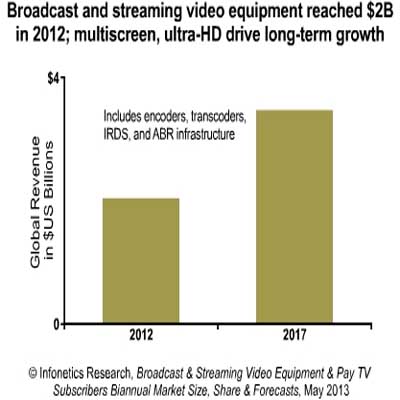
    NEW DELHI: Broadcast and streaming video equipment market is likely to grow 12 per cent in 2013 from two billion dollars in 2012.


    According to Infonetics Research, the market is projected to grow by more than 1/3 by 2017, and adaptive bitrate (ABR) origin and packaging servers are key components in the efficient delivery of over-the-top (OTT) content, especially as more pay-TV providers and content delivery networks move to ABR streaming.


    More and more, transcoders are being used to prepare linear broadcast and file-based content for distribution directly to subscribers.


    Telco IPTV subscribers have the highest 2012-2017 CAGR (17 per cent) of any pay-TV subscriber segment.


    With competition and content heating up, pay-TV providers are transitioning their traditional, broadcast-focused video processing environments to ones that can ingest, process, deliver, and decode video content from multiple sources.


    Jeff Heynen, principal analyst for broadband access and pay TV at Infonetics Research, said: “Content owners and studios are also adjusting their workflow and video output to support multiscreen and streaming services.”


    Infonetics Research noted that the net result of these transitions is steady investment in the platforms necessary to optimise video streams for a growing list of end devices and formats.