
Tag: Steve Collar

  • Jio Platforms, SES form JV for satellite-based broadband services in India

    Jio Platforms, SES form JV for satellite-based broadband services in India

    Mumbai: Indian digital service provider Jio Platforms Ltd (JPL) and SES, a Luxembourg-headquartered global satellite-based content connectivity solutions provider on Monday announced the formation of a joint venture – Jio Space Technology – to deliver the next generation scalable and affordable broadband services in India leveraging satellite technology. JPL and SES will own 51 per cent and 49 per cent equity stake in the joint venture, respectively. 

    “The joint venture will use multi-orbit space networks that are a combination of geostationary (GEO) and medium earth orbit (MEO) satellite constellations, capable of delivering multi-gigabit links and capacity to enterprises, mobile backhaul, and retail customers across the length and breadth of India and neighbouring regions,” said the statement.

    The joint venture will be the vehicle for providing SES’s satellite data and connectivity services in India, except for certain international aeronautical and maritime customers who may be served by SES. It will have availability of up to 100 Gbps capacity from SES and will leverage Jio’s premiere position and sales reach in India to unlock this market opportunity, the statement further said.

    As part of the investment plan, the joint venture will develop extensive gateway infrastructure in India to provide services within the country. Jio, as an anchor customer of the joint venture, has entered into a multi-year capacity purchase agreement, based on certain milestones along with gateways and equipment purchases with a total contract value of circa $100 million.

    “While we continue to expand our fibre-based connectivity and FTTH business and invest in 5G, this new joint venture with SES will further accelerate the growth of multigigabit broadband,” said Jio director Akash Ambani. “With additional coverage and capacity offered by satellite communications services, Jio will be able to connect the remotest towns and villages, enterprises, government establishments, and consumers to the new ‘Digital India’. We are excited about this new journey combining our massive reach and customer base with SES’s innovative leadership and expertise in the satellite industry.”

    The joint venture will leverage SES-12, SES’s high-throughput GEO satellite serving India and O3b mPOWER, SES’s next-generation MEO constellation to extend and complement Jio’s terrestrial network, thereby increasing access to digital services and applications. Jio will offer managed services and gateway infrastructure operations services to the joint venture.

    As Covid-19 has demonstrated, access to broadband is imperative for full participation in the new digital economy. This joint venture will be a catalyst for connecting the unconnected areas within India and the region to the full range of digital services, offering access to remote health, government services, and distance learning opportunities.

    “This joint venture with JPL is a great example of how SES can complement even the most extensive terrestrial networks to deliver high-quality connectivity, and positively affect the lives of hundreds of millions of people. We look forward to this joint venture whereby we can play a role in promoting digital inclusion in India,” stated SES CEO Steve Collar.

    The joint venture also aligns with the prime minister’s ‘Gati Shakti: National Master Plan for Multi-modal Connectivity’ initiative to provide integrated and seamless connectivity by implementing diverse infrastructure. It will also accelerate the achievement of the ‘Connect India’ goals in the 2018 National Digital Communications Policy as well as the Digital India programme by expanding broadband connectivity to Indian citizens across Indian geography.

  • Innovation is key in this age of constant change and disruption

    Innovation is key in this age of constant change and disruption

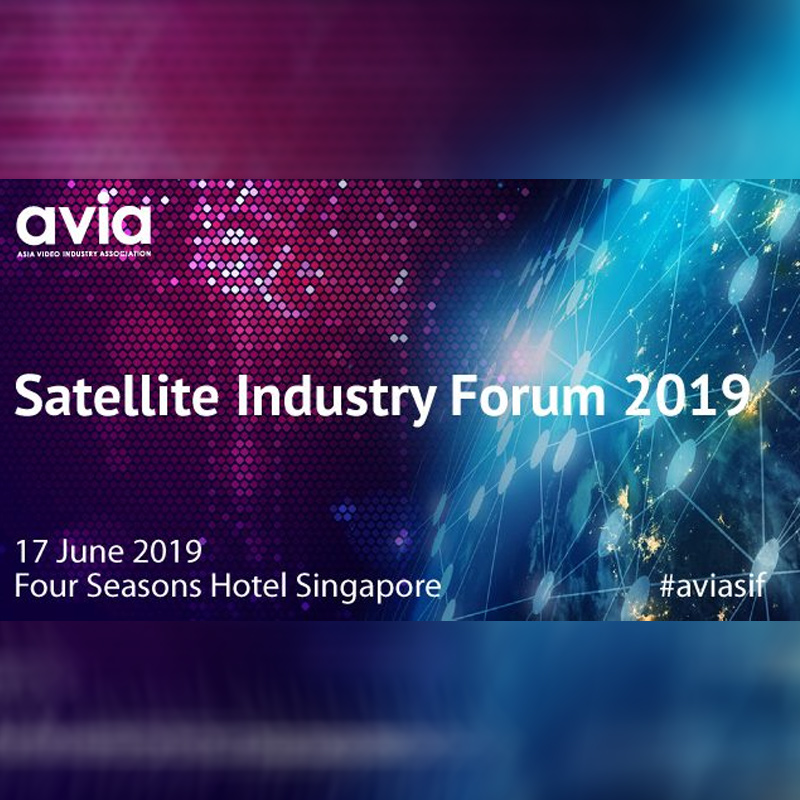
    MUMBAI: The Asia Video Industry Association (AVIA) welcomedover 180 delegates to the first Satellite Industry Forum (SIF) in Singapore since its rebrand from Casbaa in August 2018. On Monday, CEO Louis Boswell reiterated the importance of AVIA’s continued focus and support of the satellite industry in this period of great change and disruption, particularly in the areas of policy and regulation.

    SIFbrought togethermany of the mostinfluential leaders of the industry this year to discuss critical issues including regulatory discussions at WRC19, the raging spectrum wars among satellite operators, pricing, demand & supply, and the latest in “Newspace” activities.

    The need for innovation in order to stay relevant was a main point for keynote speaker, Steve Collar, CEO of SES. In his opening address, Steve said that“customers demand high quality video everywhere, anytime and on any screen. Satellite operators can play key roles in the digital era especially in integrating satellite with the Cloud andsupporting applications that will create more experience and value for the customers.”

    Pricing is still a challenge for the industry with overcapacity and increasing pressure on costs and this therefore increases the pressing need for innovation.  MitsutoshiAkao, Group President of Global Business Group of SKY Perfect JSAT noted that the “Asia region is a very tough market, so in order to survive, we need more cost-effective satellitesand that is one of the reasons we have launched a newhigh-throughput satellite.”

    The other prominent discussion of the day centred around spectrum wars. “Spectrum should be allocated to services that make highest and best use of it”, said Steve Collar. Chen Xun, EVP of APT Satellite added that a “C-band frequency war is inevitable. The industry has to fight harder to protect it especially in Asia where C-band is most viable.”  

    In the closing C-Suite panel,Lon Levin, President & CEO of GEOsharepredicted that “5G and the Internet of Things will happen faster than we are planning for.  This will be a great opportunity for satellite operators, many of which are already seeing an increase in data transmission business.  To take full advantage of the future flood of 5G needs, the satellite industry must develop ground segments that facilitate the transmission of 5G such that the choice between terrestrial and satellite becomes irrelevant.”

    Jim Simpson, CEO of Saturn Satellite Networks, advised that “in this era of dynamic change, the satellite industry needs to evaluate what it does best – delivering large amounts of capacity into areas without substantial terrestrial infrastructure, leveraging commercial electronics and taking advantage of economics and advancements, and focusing on market needs.”

    The Satellite Industry Forum was supported byAsiaSat, China Satellite Communications, Eutelsat, GEOshare, Hughes Network Systems, ILS, Integrasys, Marsh, Maxar, Newtec, NorthTelecom, Saturn Satellite Networks, SES, SpaceBridge, SKY Perfect JSAT Corporation and SpaceX.
     

  • Casbaa Satellite Industry Forum 2016: Seizing new growth opportunities amidst technological and economic changes

    Casbaa Satellite Industry Forum 2016: Seizing new growth opportunities amidst technological and economic changes

    MUMBAI:  The emergence of new technologies in the satellite industry, including the arrival of HTS GSO and NGSO systems, is prompting the industry to embrace a substantial shift – from offering one-size-fits-all capacity to creating value propositions better tailored to customers’ fast-growing, diverse demand and the price pressures in dynamic economic circumstances.

    This was a key focus at CASBAA Satellite Industry Forum 2016, attended by close to 200 industry leaders yesterday at Pan Pacific Singapore. Nine high-level panels discussed a wide range of topics – from the latest strategies in the challenging market landscape, the rise in NGSO systems, to developments in the launch market and perspectives on airline communications, broadband and enterprise solutions.

    Demand for superior value proposition

    In the Asia Pacific Satellite Leadership Roundtable, key industry leaders agreed that despite cyclical downturns in industries like oil and gas, there is still immense market potential in Asia. “These are cyclical forces that don’t fundamentally lead to long-term decline in demand,” said Mr. Jean-François Fenech, CEO of Eutelsat Asia. “Usage in data is continuing to pick up.”

    Panellists highlighted long-term fundamentals for sustained growth in video and broadband data connectivity, which lead to continued investments in growth across the region. These are manifested in initiatives to enhance satellite efficiency and launch new ones to expand capacity.

    Amidst intense competition in the industry, the second panel “Is the NGSO Revolution Coming?” discusses the arrival of the NGSO systems as a new alternative for delivering the optimal experience in the most cost-effective manner. Mr Mark Rigolle, CEO of LeoSat Enterprises, said: “Satellites are now better than terrestrial solutions. Our focus is to be the fastest, most secure network, do it better than fibre and do it better than what satellites have so far been able to do.”

    However, beyond debates on seemingly competing technologies – between NGSO and GSO, Ku and Ka bands, terrestrial and satellite – the discussion called for the industry to take a more customer-focused approach. “You want to offer end-to-end services; you don’t want to merely sell bandwidth and MHz. Ultimately, what your customers care about are the end benefits,” said Mr. Stéphane Chenard, Senior Associate Consultant, Euroconsult.

    Featuring updates from leaders in the launch market, the third panel underlined the need to focus on the economic calculus of satellite launches and not just the technology. Mr Jacques Breton, Senior Vice President, Sales & Business Development, Arianespace, said half of the company’s backlog comprises NGSO, but also added: “We are agnostic on any orbit; for us, it’s about providing the appropriate vehicles and solutions at the appropriate cost.”

    The discussion on cost is especially pertinent with the advent of new innovations that claim to offer greater efficiency and lower costs, unlocking industry-disrupting possibilities that make space more accessible.

    “We have been successful in changing the cost paradigm,” said Mr. Jonathan Hofeller, Vice President of Commercial Sales, SpaceX. “We will continue to see smaller satellites and newer constellations come online that couldn’t afford to previously. For small satellites, we have tapped on third party ride-share missions.”

    In addition, the panel cited reusability and automation as measures that are being adopted for enhancing efficiency.

    Aeronautical applications in ongoing evolution

    The fourth panel featured an exciting discussion on whether satellite applications in aeronautics and in-flight connectivity are merely a flash in the pan, especially given the challenges in monetising this service proposition. Panellists agreed that there is no singular model, as airlines integrate connectivity in different ways – from ‘freemium’ offering to pay-as-you-go amongst low-cost carriers.

    The panel also highlighted the fact that besides passenger and consumer connectivity, the aeronautics sector generates demand for satellite applications in aircraft operations. Even as antenna and satellite technology evolves, airlines are demanding options that are readily available to support their capabilities.

    Towards World Radiocommunication Conference (WRC) ’19

    In a rallying call, Mr. Gonzalo de Dios, Associate General Counsel, Intelsat emphasised that in the aftermath of WRC ’15, the industry needs to advocate for a vision of the critical role that satellite will play in an ever-connected world through close coordination between service providers, end users, and customers at domestic and regional levels. “This is about connectivity on a global level and the imperative to serve underrepresented areas.”

    Continued optimism amidst price pressures

    While demand for satellite capacity is rapidly increasing, pricing remains low. Panellists in the “The Customer is Always Right – Sometimes” discussion tackled growing customer expectations by advocating for more aggressive business models to attract and retain customers. They also identified video as an emerging opportunity for huge growth potential.  

    Mr. Vaibhav Magow, Regional Director, Asia-Pacific, Hughes Network Systems, LLC, said: “The industry is opening up many market segments that were not available to us in the past. With new technological developments, we are now starting to gain back a space in the traditional telecommunications world and fight back through innovation. That’s a really strong reason to be optimistic.”

    Meanwhile, panellists on the “CEO Panel – The Sharp End” responded to falling transponder prices by stressing the need for businesses to increase flexibility and quality of their services to remain competitive in the market. Mr Steve Collar, CEO of O3b Networks, said falling prices offer opportunities for the industry to innovate and deliver solutions that are more relevant to customers, and urged the satellite business to transform from a scarce, niche industry into a more accessible one.

    Indonesia as a growth market

    At the session “Focus on Indonesia”, panellists said weak economic fundamentals and the gap between rising operational costs and consumers’ ability to pay are key challenges for the satellite industry in Indonesia. Nevertheless, the fragmented archipelago heavily relies on satellite services, and demand for bandwidth in Indonesia has quadrupled in the last five years, said Mr. Henry Mulya, Sales Director, Asia Pacific, SES.

    The way forward for the satellite industry

    To close, CEOs of leading satellite businesses discussed the way forward for the satellite industry and the challenges it currently faces. Acknowledging the harsh stock market perceptions of the industry, the key business leaders emphasized that the business realities point towards long-term growth that can be accomplished through continuous innovation.

    Summing up the day’s discussions, Mr. Paul Brown-Kenyon, Chairman, CASBAA Satellite Industry Committee and CEO of MEASAT said: “We are at an important transformational place, and the world is changing dramatically. The amount of money we pay for data today is the same as five years ago, but the data we consume is ten times more. I think our business would change, and the role we play in the communications sector would change.”

  • Casbaa Satellite Industry Forum 2016: Seizing new growth opportunities amidst technological and economic changes

    Casbaa Satellite Industry Forum 2016: Seizing new growth opportunities amidst technological and economic changes

    MUMBAI:  The emergence of new technologies in the satellite industry, including the arrival of HTS GSO and NGSO systems, is prompting the industry to embrace a substantial shift – from offering one-size-fits-all capacity to creating value propositions better tailored to customers’ fast-growing, diverse demand and the price pressures in dynamic economic circumstances.

    This was a key focus at CASBAA Satellite Industry Forum 2016, attended by close to 200 industry leaders yesterday at Pan Pacific Singapore. Nine high-level panels discussed a wide range of topics – from the latest strategies in the challenging market landscape, the rise in NGSO systems, to developments in the launch market and perspectives on airline communications, broadband and enterprise solutions.

    Demand for superior value proposition

    In the Asia Pacific Satellite Leadership Roundtable, key industry leaders agreed that despite cyclical downturns in industries like oil and gas, there is still immense market potential in Asia. “These are cyclical forces that don’t fundamentally lead to long-term decline in demand,” said Mr. Jean-François Fenech, CEO of Eutelsat Asia. “Usage in data is continuing to pick up.”

    Panellists highlighted long-term fundamentals for sustained growth in video and broadband data connectivity, which lead to continued investments in growth across the region. These are manifested in initiatives to enhance satellite efficiency and launch new ones to expand capacity.

    Amidst intense competition in the industry, the second panel “Is the NGSO Revolution Coming?” discusses the arrival of the NGSO systems as a new alternative for delivering the optimal experience in the most cost-effective manner. Mr Mark Rigolle, CEO of LeoSat Enterprises, said: “Satellites are now better than terrestrial solutions. Our focus is to be the fastest, most secure network, do it better than fibre and do it better than what satellites have so far been able to do.”

    However, beyond debates on seemingly competing technologies – between NGSO and GSO, Ku and Ka bands, terrestrial and satellite – the discussion called for the industry to take a more customer-focused approach. “You want to offer end-to-end services; you don’t want to merely sell bandwidth and MHz. Ultimately, what your customers care about are the end benefits,” said Mr. Stéphane Chenard, Senior Associate Consultant, Euroconsult.

    Featuring updates from leaders in the launch market, the third panel underlined the need to focus on the economic calculus of satellite launches and not just the technology. Mr Jacques Breton, Senior Vice President, Sales & Business Development, Arianespace, said half of the company’s backlog comprises NGSO, but also added: “We are agnostic on any orbit; for us, it’s about providing the appropriate vehicles and solutions at the appropriate cost.”

    The discussion on cost is especially pertinent with the advent of new innovations that claim to offer greater efficiency and lower costs, unlocking industry-disrupting possibilities that make space more accessible.

    “We have been successful in changing the cost paradigm,” said Mr. Jonathan Hofeller, Vice President of Commercial Sales, SpaceX. “We will continue to see smaller satellites and newer constellations come online that couldn’t afford to previously. For small satellites, we have tapped on third party ride-share missions.”

    In addition, the panel cited reusability and automation as measures that are being adopted for enhancing efficiency.

    Aeronautical applications in ongoing evolution

    The fourth panel featured an exciting discussion on whether satellite applications in aeronautics and in-flight connectivity are merely a flash in the pan, especially given the challenges in monetising this service proposition. Panellists agreed that there is no singular model, as airlines integrate connectivity in different ways – from ‘freemium’ offering to pay-as-you-go amongst low-cost carriers.

    The panel also highlighted the fact that besides passenger and consumer connectivity, the aeronautics sector generates demand for satellite applications in aircraft operations. Even as antenna and satellite technology evolves, airlines are demanding options that are readily available to support their capabilities.

    Towards World Radiocommunication Conference (WRC) ’19

    In a rallying call, Mr. Gonzalo de Dios, Associate General Counsel, Intelsat emphasised that in the aftermath of WRC ’15, the industry needs to advocate for a vision of the critical role that satellite will play in an ever-connected world through close coordination between service providers, end users, and customers at domestic and regional levels. “This is about connectivity on a global level and the imperative to serve underrepresented areas.”

    Continued optimism amidst price pressures

    While demand for satellite capacity is rapidly increasing, pricing remains low. Panellists in the “The Customer is Always Right – Sometimes” discussion tackled growing customer expectations by advocating for more aggressive business models to attract and retain customers. They also identified video as an emerging opportunity for huge growth potential.  

    Mr. Vaibhav Magow, Regional Director, Asia-Pacific, Hughes Network Systems, LLC, said: “The industry is opening up many market segments that were not available to us in the past. With new technological developments, we are now starting to gain back a space in the traditional telecommunications world and fight back through innovation. That’s a really strong reason to be optimistic.”

    Meanwhile, panellists on the “CEO Panel – The Sharp End” responded to falling transponder prices by stressing the need for businesses to increase flexibility and quality of their services to remain competitive in the market. Mr Steve Collar, CEO of O3b Networks, said falling prices offer opportunities for the industry to innovate and deliver solutions that are more relevant to customers, and urged the satellite business to transform from a scarce, niche industry into a more accessible one.

    Indonesia as a growth market

    At the session “Focus on Indonesia”, panellists said weak economic fundamentals and the gap between rising operational costs and consumers’ ability to pay are key challenges for the satellite industry in Indonesia. Nevertheless, the fragmented archipelago heavily relies on satellite services, and demand for bandwidth in Indonesia has quadrupled in the last five years, said Mr. Henry Mulya, Sales Director, Asia Pacific, SES.

    The way forward for the satellite industry

    To close, CEOs of leading satellite businesses discussed the way forward for the satellite industry and the challenges it currently faces. Acknowledging the harsh stock market perceptions of the industry, the key business leaders emphasized that the business realities point towards long-term growth that can be accomplished through continuous innovation.

    Summing up the day’s discussions, Mr. Paul Brown-Kenyon, Chairman, CASBAA Satellite Industry Committee and CEO of MEASAT said: “We are at an important transformational place, and the world is changing dramatically. The amount of money we pay for data today is the same as five years ago, but the data we consume is ten times more. I think our business would change, and the role we play in the communications sector would change.”

  • O3b Networks bags ‘Satellite Operator of the Year’ award at Sattellite 2016

    O3b Networks bags ‘Satellite Operator of the Year’ award at Sattellite 2016

    MUMBAI: Satellite services provider O3b Networks has been recognized as “Satellite Operator of the Year” for 2015 at the Via Satellite Excellence Awards during Satellite 2016.

    “@O3bSatellites was recognized as “Satellite Operator of the Year” during #SatShow”, a short message said.

    The Via Satellite Excellence Awards recognize innovative companies, technologies, campaigns, and people who shape the success of the global satellite industry.

    O3b Networks has dramatically broadened the satellite market, providing modern high-performance connectivity to areas that had previously thought such service was only possible with terrestrial fibre. To date, the company has 12 satellites in orbit that provide services to more than 40 customers in 31 countries. Recently, O3b ordered eight more satellites to support growing demand.

    The ultra-low latency, high throughput network facilitated by O3b’s Medium Earth Orbit (MEO) satellite constellation provides connectivity to Mobile Network Operators (MNOs) to expand 3G and 4G/LTE services, enables Internet Service Providers (ISPs) to provide broadband internet to subscribers in remote locations, brings high-speed mobile and data connections to ships at sea, and allows Oil and Gas companies to reduce costs and improve efficiencies on deep water installations.

    “Today, access to the internet is fundamentally important, and we are proud to support our customers in providing the core connectivity that is driving social and economic development around the globe,” said O3b Networks CEO Steve Collar.

    “As a company, O3b has been fiercely dedicated to providing the best solutions for reliable connectivity in areas of the world that are beyond the reach of fiber. We are honored to be named Operator of the Year, and thank Via Satellite for this distinction.”

  • O3b Networks bags ‘Satellite Operator of the Year’ award at Sattellite 2016

    O3b Networks bags ‘Satellite Operator of the Year’ award at Sattellite 2016

    MUMBAI: Satellite services provider O3b Networks has been recognized as “Satellite Operator of the Year” for 2015 at the Via Satellite Excellence Awards during Satellite 2016.

    “@O3bSatellites was recognized as “Satellite Operator of the Year” during #SatShow”, a short message said.

    The Via Satellite Excellence Awards recognize innovative companies, technologies, campaigns, and people who shape the success of the global satellite industry.

    O3b Networks has dramatically broadened the satellite market, providing modern high-performance connectivity to areas that had previously thought such service was only possible with terrestrial fibre. To date, the company has 12 satellites in orbit that provide services to more than 40 customers in 31 countries. Recently, O3b ordered eight more satellites to support growing demand.

    The ultra-low latency, high throughput network facilitated by O3b’s Medium Earth Orbit (MEO) satellite constellation provides connectivity to Mobile Network Operators (MNOs) to expand 3G and 4G/LTE services, enables Internet Service Providers (ISPs) to provide broadband internet to subscribers in remote locations, brings high-speed mobile and data connections to ships at sea, and allows Oil and Gas companies to reduce costs and improve efficiencies on deep water installations.

    “Today, access to the internet is fundamentally important, and we are proud to support our customers in providing the core connectivity that is driving social and economic development around the globe,” said O3b Networks CEO Steve Collar.

    “As a company, O3b has been fiercely dedicated to providing the best solutions for reliable connectivity in areas of the world that are beyond the reach of fiber. We are honored to be named Operator of the Year, and thank Via Satellite for this distinction.”