Tag: STB

  • ‘Trai has come up with the correct CAS economics’ : K Jayaraman – Hathway Cable & Datacom MD & CEO

    ‘Trai has come up with the correct CAS economics’ : K Jayaraman – Hathway Cable & Datacom MD & CEO

    The Telecom Regulatory Authority of India (Trai) has laid out a fertile ground for digital cable TV take off. The formula is simple: price everything low and large volumes will create a viable market dynamics.

    India has seen it in mobile phones. The lessons will repeat itself in the television industry. Despite the initial blip, the industry will correct itself and grow as at the centre of this pull of gravity rests the consumers.

    Broadcasters are not in tune with this logic. Their programming costs are rising. So why not let them have the freedom of pricing their products?

    The cable operators, along with the consumers, are in love with the a la carte pricing of pay chanels at a maximum of Rs 5. The multi-system operators (MSOs) feel that a new business model is being set.

    In an interview with indiantelevision.com‘s Sibabrata Das, Hathway Cable & Datacom managing director and CEO K Jayaraman argues how every stakeholder will eventually stand to gain. The a la carte pricing will make digital cable popular while the revenue share across the value chain has been “very accommodative.”

    Excerpts:

    Do you agree with what the Telecom Regulatory Authority of India (Trai) has fixed as the price and revenue share under conditional access system (Cas)?
    The regulator has come up with the correct economics. Consumers will have choice and at a real affordable cost. The a la carte pricing of channels at a maximum of Rs 5 in Cas areas will increase the penetration of set-top boxes (STBs) and drive in volumes. The revenue share allocation across the value chain is also very accommodative. Broadcasters will get 45 per cent share and have access to advertising revenues as well. While multi-system operators (MSOs) will have 30 per cent and carriage fee, local cable operators are also given a fair share with full revenue on the free-to-air (FTA) package and a 25 per cent share on pay channel revenues. Also, the government will get more tax revenues.

    Broadcasters complain that the maximum price of Rs 5 per channel is too low and doesn‘t take into account their high programming costs.
    When subscription becomes transparent, the rate has to be low. For digital technology to take off, we need such a price regulation. Let us face the reality: these are the consequences of a new environment and a change in business model. Besides, the price regulation is only for one year. Free market will prevail and price will be discovered eventually.

    With a la carte pricing, cable bills are expected to drop. How will falling ARPUs (average revenue per user) affect the cable companies?
    Nothing can be worse than the current model. But under Cas, we will, at least, have a legally sanctioned revenue, albeit lower. No doubt we will get a Hindu rate of return. But we will not have under-reporting of subscribers. We are happy that a proper business model is being set. Revenues Will grow once the business model settles. Everybody will be on the move. As consumers have choice, broadcasters will have to worry about pricing their channels correctly within a maximum of Rs 5. If they do that, then MSOs can also make money. We will have to focus on providing quality cable TV service. If we don‘t do that, we have competition from direct-to-home (DTH) service and will face threat of being wiped out.

    Cable companies will also have to subsidise the boxes. Do they have the resources to absorb subsidy costs and still scale up?
    All of us will have to be in investment mode because the business model is changing. The initial subsidy on each box will work out to Rs 1,500. This is the price we have to pay for a change in the business model. But this can be squared off once it settles down. The price of STBs will fall by 15-20 per cent with a surge in volumes. Cable companies will have to raise resources, either through debt or equity. For those who can‘t, survival will be tough. The telcos like Reliance Infocomm are waiting to step in. We should be prepared for a high volume, low margin game. Distribution, initially, is a volume business.

    Won‘t your traditional business from non CAS areas be a support?
    Yes, we will have other businesses to run: internet, non CAS placement fee, ad revenues from local cable channels. We will also have carriage fee from FTA channels in a CAS system. For cable companies to cover up their overhead and variable costs (STBs), they will have to do other related businesses.

    A la carte pricing will drive down our ARPUs. But we are happy that a proper business model is being set

    Like having a well-rounded revenue stream?
    If you are a composite cable company, you will survive. We will have to provide video, voice and data through a common pipe. Standalone players will have a tough time. We, for instance, are preparing to launch voice over internet protocol (VoIP) services by the last quarter of this year. Test runs are currently on. We are also be aggressively pushing digital cable TV in non CAS markets. We recently launched in Jalandhar, having rolled out our digital services earlier in New Delhi, Mumbai, Pune, Bangalore, and Hyderabad.

    Do you see DTH having a perceptional advantage over cable?
    DTH platform providers are well capitalised and have a more long term vision. Their ARPUs can also settle higher as they better their products. But they have a huge variable cost in occupying transponder space. Cable companies, in contrast, have already made the investments and have low operating costs. Of course, now they will have a variable cost towards procurement of boxes. But they have an existing relationship with customers and cable is two-way enabled. Digital cable can also offer more channels. Composite cable companies with focus on multiple revenue streams can effectively fight DTH.

    How are you planning to infuse capital to fund digitisation?
    We will raise Rs 1 billion as debt to fund the first phase of CAS The bulk of the investments will be towards subsidising the STBs. Funding will also be required in setting up VoIP and expanding broadband infrastructure.

    Is it a good time to acquire last mile operators?
    If cable companies have the resources, acquisition of last mile will make sense. In the CAS areas where you have an administered price regime for one year, the payback period will be longer. But once the price is market-based, then recovery will be faster as more channels come under the pay system and people start subscribing to them. Even in non CAS areas, acquisition will provide size upon which a digital platform can be built later. But in case of Hathway where we have limited resources, we would rather put the money in placing more STBs.

    Will Valuations of cable companies go up under CAS?
    CAS will bring some semblance of order into the business. But it is a long term roll out and needs cash flow. What is more important is that cable companies will attract capital, whether in the form of equity, debt or convertible bonds.

    Will there be a consolidation in the industry?
    Consolidation will happen wherever digitisation is required because of new technology and service requirements.

    Zee network‘s Wire & Wireless India Ltd (WWIL) is planning to launch a headend-in-the-sky (Hits) platform and has expressed intent to make inroads into south and western suburbs of Mumbai. Do you see territorial warfare among MSOs returning?
    Hits is right now viewed more as a fashion statement. We are delivering digital without having Hits. If it is necessary, then everybody will do it. As far as poaching of operators go, it is an open ground. Cable companies who focus on good service and have capital to create capacity will turn out winners. Competition is not a one-way street.

  • Hathway plans Rs 1 billion debt for CAS; VoIP launch by year-end

    Hathway plans Rs 1 billion debt for CAS; VoIP launch by year-end

    MUMBAI: Rajan Raheja-promoted Hathway Cable & Datacom plans to raise Rs 1 billion as debt to fund the first phase of conditional access system (CAS). The multi-system operator (MSO) is also preparing to launch voice over internet protocol (VoIP) services by the last quarter of the year.

    “We will require an investment of Rs 1 billion for which we will be raising debt,” says Hathway Cable & Datacom CEO K Jayaraman.

    The bulk of the investments will be towards subsidising the digital set-top boxes (STBs). Funding will also be required in setting up VoIP and expanding broadband infrastructure. The company has tied up with telecom major Bharti for VoIP.

    “We are conducting test runs and expect to launch VoIP services by the year-end. MSOs will have to infuse capital in the changing business environment. On each STB, the subsidy works out to Rs 1,500,” says Jayaraman.

    The Telecom Regulatory Authority of India (Trai) has fixed the pricing of the boxes in the CAS areas. Cable TV service providers will have to offer digital STBs on a monthly rental scheme of Rs 30 and a refundable security deposit of Rs 999. There will be no payment for installation, activation charges, smart card/viewing card, repair and maintenance cost.

    The cost of the STBs including the smart card is around Rs 3,500. “Once we drive in volumes, the price of procuring these STBs should fall by 15-20 per cent,” says Jayaraman.

    Hathway will also be aggressively pushing digital cable TV in non CAS markets. The MSO launched its digital services in Jalandhar a few days back, having rolled it out earlier in New Delhi, Mumbai, Pune, Bangalore, and Hyderabad.

    “Starting with Jalandhar, we plan to roll out our digital services across Punjab over six months. In the first phase, 16 cities of Punjab will be connected by the end of this year,” Jayaraman says.

    The a la carte pricing of channels will increase the penetration of STBs in CAS areas, Jayaraman believes. “We expect a 80 per cent penetration if the broadcasters get the pricing right within a maximum of Rs 5 per channel,” he says.

  • STMicroelectronics and China’s Dahua Technology develop Cable/IP dual-mode STB

    STMicroelectronics and China’s Dahua Technology develop Cable/IP dual-mode STB

    MUMBAI: The Geneva-headquartered STMicroelectronics, the supplier of silicon chips for set-top boxes (STBs), and Dahua Technology Ltd, China’s cable and IPTV dual-mode STB provider, have announced that they have successfully designed and manufactured a highly integrated digital-cable and IP set-top box, making ST the first silicon supplier to provide single-chip dual-mode digital set-top-box solutions for the China market.

    The box, which begins deployment in Hangzhou Province in August 2006, will enable consumers to enjoy a new three-in-one digital media experience including digital-cable TV, video-on-demand, and web browsing for a wider choice of information services and broadcast programs, informs an official release.

    At the heart of Dahua’s design is a dedicated chip belonging to ST’s STi7100 family of Advanced Video Codecs (AVC). This system-on-chip (SoC) solution integrates support for advanced high-definition H.264/MPEG4 AVC and MPEG4 P2 standard definition (SD) in addition to MPEG2 encoded video signals. These innovative single-chip HD/SD devices are the industry’s first to enable the next generation consumer video systems and broadcast services.

    The STi7100’s integration combines all STB functions and multi-standard decoding circuitry onto a single piece of silicon minimizing both design and production costs for STB makers. Produced using ST’s state-of-the-art 90nm process technology, the STi7100 family devices provides a more cost-optimized HD/SD Cable/IP dual-mode interactive box in a single-chip design, paving the way for support of H.264 HD/SD streams with advanced codecs, the release adds.

    Compared with traditional TV delivery, IP set-top boxes provide an exciting interactive experience including VoD (Video on Demand) services that puts the audience in charge of selecting their favorite content according to their preferences, regardless of the program schedule. With Dahua’s STBs, consumers enjoy a wide variety of services including interactive games, SMS, e-commerce, VoIP, and video phone calls.

    “Leveraging its experience in this sector, ST will continue to offer a wide range of products that provide high flexibility, faster time-to-market, low cost, and high-quality solutions to our partners,” says Robert Krysiak, STMicroelectronics’ Corporate VP and GM for Greater China. “The cooperation with Dahua is the first volume deployment in China of our latest H.264 single chip, which is capable of both MPEG4 and MPEG 2 decoding, and it will further enhance Dahua’s competitive advantage in the rapidly growing new Cable and IPTV market where Dahua is a leader right now.”

    Dahua’s chairman and GM Zhu Giang Ming says, “ST’s cost- optimized single-chip solution, which includes a reference design with software kit coupled to their dedicated engineering support, have given us a unique solution and faster time-to-market.”

    Dahua is China’s major volume Cable and IP dual-mode STB provider for operators that provide VoD service for MPEG4 video and audio content. Operators will provide content through deployment of its dual-mode (Cable and IPTV) STBs enabled by the chip from ST.

    So far 360 million households boast TV sets in China, where target audiences exceed 1.1 billion, including 114.7 million cable subscribers. The number of customers is also exploding in both broadband and wireless markets, giving China a huge potential market for IPTV. With further extension of its broadband IP network and continuous improvement in communication technology, China is expected to become the largest IPTV market worldwide over the next few years, the release further adds.

  • Trai issues regulations on quality of cable TV service

    Trai issues regulations on quality of cable TV service

    NEW DELHI: Cable TV consumers are in for a pleasant surprise as cable operators will now be put under stringent monitoring relating to quality of service.

    India’s broadcast regulator today issued detailed regulations prescribing standards of quality of service to be observed by the cable operators and multi system operators in CAS notified areas of Mumbai, Kolkata, Delhi and Chennai.

    The Telecom Regulatory Authority of India (Trai) said the regulations would come into effect from 1 October, 2006.

    The regulations have been drawn keeping in view the facts that the industry would be subject to prescription of quality of service standards for the first time and, therefore, would need time to adjust on various quality of service aspects.

    The issues addressed in the regulations broadly cover the following areas:

    (i) Connection, disconnection, transfer and shifting of cable services
    (ii) Complaint handling and redressal in respect of cable services
    (iii) Billing Procedure and billing related complaints
    (iv) Set-top box related issues and complaints
    (v) Positioning of channels / taking the channel off air

    A snapshot of the major features of these regulations categorized under the above-mentioned broad areas are indicated below:

    Application for connection/disconnection/transfer/shifting
    * Application for pay channel or request for basic service tier to be responded within five working days.
    * Cable Service connection/reconnection to be provided within 2 working days on completion of all formalities by the subscribers.
    Complaint handling and redressal
    *Multi System Operator/Cable Operator to maintain customer service center/help desk center for 24 hours, 7 days a week including facility for automatic recording of complaints.
    *All complaints received in the day to be attended/responded within eight hours.

    Billing related issues
    * Billing to be done normally on monthly basis and entries to be itemized.
    *Subscribers required to ensure prompt payment of bills. Deterrents to discourage delayed payments
    *Redressal of complaints on billing within 7 days from the date of notice.

    Set Top Box (STB) related issues
    * MSO/Cable Operator to repair or replace within 24 hours of receipt of complaint of malfunctioning of set top box and refund of security deposit within seven days of return of set top box.

    *Rebate for delay in activation/reactivation of set top box beyond two working days @ Rs 15 per day for the first 5 days and @ Rs 10 per day for the subsequent period

    Positioning of channels/Taking the channel off air
    *No channel to be taken off the air, except for circumstances beyond the control of the operator, without prior notice of three weeks.

    The High Court of Delhi on 20 July 2006 had directed implementation of CAS in the three metros of Mumbai, Kolkata and Delhi by 31 December 2006.

    One of the areas identified in the implementation of CAS was prescription of quality of service standards by Trai, which has been now done after consultations with the industry stakeholders.

    A full text of the regulation along with the explanatory memorandum is available on Trai’s website, www.trai.gov.in.

  • MTNL in IPTV deals with Aksh Optifibre, IOL Broadband

    MTNL in IPTV deals with Aksh Optifibre, IOL Broadband

    MUMBAI: Mahanagar Telecom Nigam Ltd (MTNL) has signed content delivery network affiliation contracts with Aksh Optifibre Ltd and IOL Broadband Ltd, which would allow the state-owned telecom major to offer IPTV services to its subscribers.

    With this, MTNL has selected three franchisees for developing the content delivery platform. Time Broadband Services Pvt Ltd, India (TBSPL) was the first to have won the contract for both Delhi and Mumbai and has a seven-year non exclusive deal with MTNL.

    While MTNL has ensured a bank guarantee of Rs 5 million from Aksh Optifibre, IOL Broadband has guaranteed Rs 2.5 million. Aksh Optifibre has expressed intent to operate in Delhi and Mumbai while IOL’s interest is restricted to Mumbai at this stage.

    IOL Broadband plans to use US-based SeaChange for the IP video servers, storage and middleware, says a senior company executive. The digital set-top boxes (STBs) will be provided by UK-based Amino while the digital rights management solution will be from US-based Widevine.

    “We plan to invest $25 million in the early phase of the project. We have also an eye on extending to Delhi,” says the executive.

    Aksh Optifibre plans to use UTStarcom technology for its content delivery network, an MTNL official says. Bharti, which is conducting test runs in Gurgaon on the outskirts of Delhi with multiple vendors, had also used UTStarcom technology, including the headend and the digital STBs.

    “The idea of having multiple franchisees is to provide content flexibility to our subscribers,” says the MTNL official.

    Time Broadband, meanwhile, has tested 560 STBs and is ready for commercial launch. Says TBSPL managing director Sujata Dev, “We have already deployed 150 STBs in the subscriber homes. We are increasing the number of channels from 30 to 100 on the test run by the end of this month. Star and Zee have agreed to offer the pay channels for this as our content protection system in place.”

    Time Broadband, which has US-based Kasenna as its middleware vendor, while Verimatrix Inc is providing content protection solutions, has so far invested $3 million in the project.

    MTNL is employing ADSL 2+ technology for running its IPTV services. For the video part, the telecom giant will be using MPEG-4 compression technology.

  • Cable, DTH locked in ad war

    Cable, DTH locked in ad war

    MUMBAI: The ad war between direct-to-home (DTH) service providers and cable TV operators has started. Soon after Dish TV ran a full page campaign on print asking viewers to stop watching cable TV, operators have retaliated with the tagline “Cable TV – Service at your doorstep.”

    The most obvious attack is on pricing. Dish TV, the ad says, offers all channels without the Star bouquet at Rs 300 per month. After adding up the 10 per cent licence fee and taxes (entertainment and service), the monthly bill in Mumbai will work out to Rs 412. Then there is the hardware and rental cost for the set-top boxes (STBs) which have to be paid in advance. Besides, there are no discounts for multi-TV homes, the ad states.

    Cable prices in the conditional access system (CAS) areas, on the other hand, will begin from Rs 77 per month for the free-to-air (FTA) channels. The pricing for the pay channels is yet to be decided as broadcasters have to fix the rates. As for the set-top boxes, the early bird offer is Rs 2000. “With judicial intervention and government regulation now being brought in place, you too will reap benefits of CAS once it takes off from 1 January,” the ad says.

    Regarding service, cable TV has run even on days of calamities. Most of the consumer complaints are pricing related issues which are linked to pay channel hikes. “Cable networks also provide internet service. How come you never faced price related issues when dealing with the same cable network,” the ad states.

    The cable TV industry is “geared to usher in a new digital cable revolution with over 140 channels, radio services, games and on screen electronic programme guides.”

    The cablewallah may have finally woken up to the competition from alternate digital distribution platforms. The battle, as they say, is just beginning.

  • Tata Sky launches DTH service; STB price Rs 3999, basic subscription Rs 200

    Tata Sky launches DTH service; STB price Rs 3999, basic subscription Rs 200

    NEW DELHI/MUMBAI: Tata Sky Ltd, the $ 500 million joint venture between Tata Sons and the Rupert Murdoch-owned Star Group, today officially announced its arrival as India’s second DTH platform after Dish TV.

    Tata Sky is kicking of its service in 300 cities at an “introductory” monthly subscription of Rs 200 for the 55-odd channels it presently has on the platform.

    Price: hardware+installation Rs 3,999
    Monthly subscription: Rs 200
    No. of channels available: 55+
    Present area of service: 300 cities
    1st year target: 1 million subscribers
    Investments made till now: over Rs 25 billion
    Most critically, the Tata Sky set top box (supplied by News Corp owned NDS)
    has been priced at Rs 3,999 (inclusive of taxes). This includes installation
    and hardware cost and a full service warranty for one year.

    However, along with the monthly subscription of Rs 200, the Tata Sky offering will be more expensive than rival Dish TV’s package.

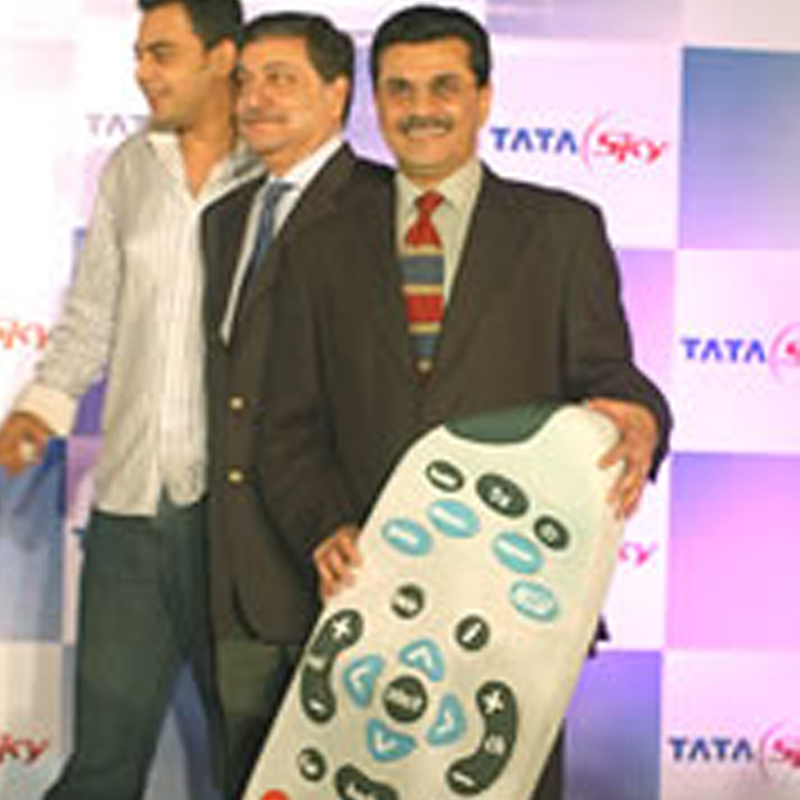
    Tata Sky CEO and MD Vikram Kaushik with Tata Sky chairman Ishaat Hussain
    Click here for a slideshow
    The Subhash Chandra-owned Dish TV is priced at Rs 3,290 (inclusive of taxes). This includes the cost of the STB as well as three months’ subscription. The monthly subscription for the basic Dish TV service of 75 channels is Rs 180.
    Announcing the launch at a glitzy event in Delhi where the likes of cricket commentator Harsha Bhogle rubbed shoulders with Mandira Bedi, Tata Sky MD and CEO Vikram Kaushik grandly proclaimed, “Entertainment will never be the same again.”

    Going on to harp on the state-of-the-art technology and finesse of the service, Kaushik added, “It’s a technological innovation that’ll bring the senses alive.”

    Apart from the many channels on the Tata Sky platform, a conspicuous absentee is the Zee Turner bouquet of over 20 channels as an agreement between Tata Sky and Zee Turner Ltd has not yet been concluded.

    Kaushik admitted that negotiations have not been concluded, but was hopeful that “things would get sorted out soon.”

    Another major absentee is the Sun Network, which dominates the South Indian markets. Tata Sky is, however, not alone in this, since Dish TV does not have access to the Sun channels either.

    “We are offering 55+ channels at the moment and with the passage of time the number of offerings would grow,” Kaushik said.

    The channels presently available on the non-tiered Tata Sky platform include all the channels from the Star (17), Sony Discovery One Alliance (14) bouquets as well as ESPN Star Sports and two channels of NDTV as its key offerings.

    It is worth noting here that it was only this morning that the deal for the carriage of the One Alliance channels by Tata Sky was signed and delivered.

    Confirming this to Indiantelevision.com, SET Discovery president Anuj Gandhi said the pricing terms was similar to the one signed recently with Dish TV.

    One Alliance is being paid around Rs 38 per subscriber by Dish for its channels. The deal is a five-year one that is extendable at the end of it, Gandhi revealed.

    Also available on the Tata Sky platform would be some Doordarshan channels as well the likes of Times Now, Aaj Tak, Headlines Today, etc. Some interactive and specially designed movie channels have also been thrown in as a sop.

    The Tata Sky service, Kaushik claimed in the presence of his company chairman Ishaat Hussain, has been designed to give subscribers “choice, control and convenience” in the way they want to watch television.

    A host of interactive services such as an on-screen programme guide, Actve Sports, Actve Star News, Actve Newsroom and Actve Khabar are also on offer.

    To offer maximum convenience to subscribers, Tata Sky has set up a pan-India distribution network of popular consumer electronic stores and mobile phone outlets for retailing its hardware and prepaid recharge vouchers.

    The pre-paid vouchers come in various denominations starting off with Rs 260.

    The company has also tied up with LG, ITC International Business Division and Indian Oil Corporation as part of its distribution drive.

    “We are looking at ramping up our activity and service over the next three months when the service should be covering the whole of India,” Tata Sky consumer marketing head Vikram Mehra said.

    The company has engaged a field force of approximately 3,000 people who will be complemented by a high-end 24×7 call centre, manned by multi-lingual customer service associates, trained to solve all customer problems.

    But Mehra was not forthcoming on the media campaign that’s about to break “soon”, except to say that it would be a 360 degree campaign using all normal media outlets.

    Tata Sky is an 80:20 DTH joint venture between the Tata Group and Hong Kong-based Star Group.

    The joint venture has invested over Rs 25 billion in the project till now, according to Kaushik, who added the target of 1 million subscribers in the first year is achievable.

    The unveiling of the Tata Sky service finally turns into reality a dream Murdoch has had since 1997 – of having a DTH platform in India
  • Trai proposes tariff rate on STBs

    Trai proposes tariff rate on STBs

    MUMBAI: The Telecom Regulatory Authority of India (Trai) has proposed that cable TV service providers in conditional access system (CAS) areas to offer digital set-top boxes (STBs) on a monthly rental scheme of Rs 30 and a refundable security deposit of Rs 999.

    Subscribers will also have the other option to take the permanent rental scheme with no security deposit. But the monthly rent in this case would be higher. They also have the choice of subscribing to analogue boxes.

    Under the first scheme, the regulator has said that subscribers would own the box after five years and no monthly rentals would have to be paid after that.

    In case of a period before five years, the multi system operator (MSO) or cable operator shall be entitled to make deductions from the refundable security deposit at the rate of Rs 12.50 for every month or part of the month for which the subscriber has used a STB taken on rent or lease. The deductions will be made upon the submission of the STB in working condition.

    Under the standard tariff package (STP), subscribers will have the second option of not paying any security deposit but the monthly rental will be higher at Rs 45 per STB. For analogue boxes, the rent will be Rs 23 per month per STB.

    “In both options, there will be no payment for installation, activation charges, smart card/viewing card, repair and maintenance cost. Stakeholders are also free to suggest any other option as a STP,” Trai said today in a release.

    “Since the Indian standards do permit analogue STBs, an option for these boxes has also been provided under the second category,” the regulator added.

    Trai’s draft of the tariff proposals for STBs has invited comments of the stakeholders. Stakeholders may comment on these alternatives as well as suggest any other options for Trai to consider.

    “It has been proposed that each service provider should at least offer one STP in addition to any other alternate tariff package. The rationale behind this proposal is that every consumer should have the choice of choosing from amongst various alternatives of which at least one should be a package that is approved by Trai,” today’s release said.

    Trai’s proposed draft tariff order for STB schemes in CAS areas follows the government’s notification on 31 July that CAS would be implemented in Delhi, Mumbai and Kolkata. Earlier, the division bench of the Delhi High Court had passed an order directing implementation of CAS with effect from 31 December in these three metros.

  • China Digital Media Corp completes digital TV migration for 200,000 households

    China Digital Media Corp completes digital TV migration for 200,000 households

    MUMBAI: China Digital Media Corporation, a provider of cable and digital television services and content in China, has announced that it has reached a record level of households that have installed digital set-top-boxes (STB). As of 30 June 2006, approximately 200,000 subscribers had installed over 220,000 digital STBs, with over 15 per cent subscribing for additional digital STBs, according to a media release issued.

    The company receives a portion of the subscription fees from each customer. It installed over 30,000 STBs in May 2006, the highest number of installations in a single month, and these newly installed STBs are equipped with Java platform and Ethernet port, the release adds.

    “This is a major milestone for the company, as it represents a significant source of revenue,” says China Digital Media Corporation chairman and CEO Daniel Ng. “The launch of our new IP based STB has generated incredible interest in Nanhai and surrounding cities. We intend to focus on promoting our value added services and pay TV services, and searching for new projects elsewhere that we believe will enhance revenue growth.”

  • Trai releases draft on quality of service norms for CAS Areas

    Trai releases draft on quality of service norms for CAS Areas

    NEW DELHI: The Telecom Regulatory Authority of India (Trai) today released a draft regulation on quality of service for CAS areas.

    The draft regulation covers areas like fresh connection, transfer and shifting of cable television service, complaint handling and redressal, billing procedure and complaints, STB-related issues and complaints, change in position of channels and taking channels off the air and technical standards.

    The industry can also send its feedback to the regualor on the draft regulation, which are aimed at streamlining norms for CAS and formualting a standardised agreements amongst industry stakeholders like broadcasters and MSOs and MSOs and cable operators.,