Tag: Star

  • Where is the ‘News’?

    News is back,” said Anurradha Prasad at the launch of B.A.G Films and Media‘s Hindi news channel News24. Now does that simply indicate that news channels in India are currently devoid of “news” in its truest and purest form? A content analysis reveals something more…

    India‘s experience with TV remains unique. It is the only country in the world with more than three dozen 24-hour TV channels broadcasting programmes on news and current affairs, barely a quarter-century after the world‘s first 24-hour TV news channel (CNN or Cable News Network) came up in 1980. Till 1991, television viewers in India could view only the channels broadcast by Doordarshan. That landscape significantly changed with the invasion of private satellite news channels.

    Hindi news channels have been consistently accused of invariably having less news and more entertainment. Litres of ink and loads of paper have been spent, arguing that news channels are no longer part of the anti-establishment group as they carry only those stories that fetch them gold.

    Agrees IBN7 managing editor Ashutosh: “Over the last few years, the concept of news has changed. Even for those who used to watch political news, it is no longer a good proposition, as there are no charismatic leaders. The UPA government has not thrown up any leader worth following as news. Even the newspapers‘ political coverage has changed. All this has happened mainly because it is now all about eyeball chasing, and it is getting from bad to worse.”

    While speaking to indiantelevision.com earlier, Aaj Tak news director QW Naqvi had said: “Talking of the year 2007, I feel the audience has changed its choice and appeal. Issues like corruption don‘t appeal to viewers anymore. Maybe, people have accepted it as an integral part of our society. Therefore, an exposé featuring corruption doesn‘t interest the audience, to a large extent.”

    Undoubtedly there has been a paradigm shift of news. While many argue that news in itself has shifted its meaning, others ask who defines news. For some, naag-naagin shaadi (marriage of snakes) is just as important as a barbaric killing in Singur or Nandigarm.

    To further quote Naqvi: “No doubt, television news industry has grown at such a frantic pace that it has created certain pitfalls. All-out efforts in the past year were made to grab viewership. In this mad race, at times content was compromised and true journalism took a back seat. Compounding this malady, mushrooming news channels tended to water down the impact of many meaningful news reports.”

    Says Media Content and Communications Services (MCCS) managing editor Shazi Zaman, “Central to our selection of news is the impact it will have on people and the interest that people have in the story. The last few years have seen new viewers added, many of whom have non-traditional preferences. The changes in the content of news channels are a reflection of this shift.”

    In the last one or two years, it seemed Hindi news channels took a cue from the Hindi film fraternity. Whatever was hit in the news space was seen as a formula and followed thereafter.

    First came a wave of family drama, matrimonial discord, violence and divorce. Once it reached its fatigue, the audience got bored and the news content searched for a different formula.

    Then came ghost stories. News channels vied with each other for showing horror stories. While this content was very short lived, it was also alleged that some of the news reports were concocted.

    After ghost stories, came the Baba wave, followed by amazing videos. This was a completely new phenomenon. In these videos, channels showed people performing crazy feats. But finally this, too, seems to be nearing its end.

    Says Zaman, “Experimentation is the result of a desire to reach out to more and more people and to cater to as many tastes as possible. In 2007, news became more encompassing than ever before. Thus, it was no coincidence that the year of experimentation was also the year that saw genre expansion.”

    A study by the Delhi-based Centre for Media Studies (CMS) says that the three C‘s of cricket, cinema and crime lord over politics in Hindi news channels. The study shows that news channels have undergone a radical transformation, whereby news has not only changed in its definition and content, but also in the manner in which it is presented.

    Hindi news channels have seen a rise in comedy and reality show content, the emergence and establishment of trivia in news, and most significantly, the end of political news dominance.

    According to the CMS Media Lab, the time spent on political news in the year 2007 has come down by more than 50 per cent. Political news coverage by Hindi news channels has dipped from 23.1 per cent in 2005 to 10.09 per cent in 2007.

    On the other hand, sports, entertainment, crime and human interest news have managed to almost double up from 27.9 per cent in 2005 to 53.1 per cent in 2007. At the same time, agriculture, education, health and environment-related news have not seen any net change; their coverage has been as insignificant in 2007 as earlier.

    Ashutosh reverts, “Careful studies show that it is not sports coverage that has gone up, but cricket. There is hardly any non-cricket sports news. For the past two years, there have been so many controversies, and cricket news is being covered even for other reasons like Sourav being dropped, Rahul Dravid becoming the captain, the entire Chappell controversy. Secondly, in cricket India has been doing exceedingly well. So far as crime reporting is concerned, there is a lot of drama, and it is just right for television.”

    “Besides, the entertainment industry has grown tremendously, and they have realised the power of news channels. They are marketing their products through news channels, and all the big films have media partners,” he adds.

    News broadcasters also feel that serious stories without any element of drama have a short life in the Hindi news space.

    Naqvi points out that “Operation Kalank” (the Aaj Tak-Tehelka exposé on the connivance of state administration in sheltering and helping the riot accused in 2002) in a normal news environment would have shaken the foundation of governance in both Ahmedabad and Delhi.

    “But the shelf life of this haunting exposé was hardly a few days. It did shake up the intelligentsia and society for a while, but it was not the topic of discussion in most drawing rooms after even a week. Not much changed either. Even though our channels kept the issue alive for a few days, the story did not really move forward. And this, I presume, is largely due to a variety of news being aired by a host of channels.”

    He says further that there was another good story on another channel, portraying a major scandal in UP. That exposé showed how police in UP has surpassed all levels of corruption. For as little as Rs 3,000, police officers were acting as contract killers and shooting down people in fake “encounters.” This was not an insignificant story. Rather, it was a crucial exposé showing the depths of corruption within the police force. Had this story appeared a few years ago, it would have made national headlines and would have been the talking point for a long time. But in today‘s circumstances, it vanished from the scene within days and could not even attract print media‘s attention.

    A few broadcasters also believe that in the last two years there has been a clutter in the Hindi news space with some addition to it, which subsequently had its toll on the quality and focus of the content.

    “This has to be attributed to the overcrowding in the TV news space, which has reduced the audience attention span. There are so many news items being dished out that your interest in something of importance vanishes swiftly. Rather, to retain audience interest many a time too many stories are being splashed, so that the audience doesn‘t move away,” added Naqvi.

    A general rundown of Tam‘s (television audience measurement) top five programmes on Hindi news channels cannot be hard to guess: wrestler Khali, stand-up comedian Raju Srivastav, Lord Ram have been a hot favourite with the Hindi news channels in the past few months.

    Star News‘ comedy capsules edited out from Star One‘s The Great Indian Laughter Challenge, which is hosted by an anchor in a virtual studio with good number of ad breaks, has figured highest in the top five programmes in the last few months as per the data provided by Tam.

    Cricket has been featured differently in Ye Cricket Kuch Kehta Hain (Aaj Tak), Nach Le Cricket (Aaj Tak), Disco Cricket (Star news) while Khali has seen a variety of presentations like Khali Ki Khalbali, Khali Karega Khatma and Khali Sae Bali. Gods blessed the news channels in shows like Zinda Hain Rawan, Sabko Mil Gaye Ram and Kaise Dekhe Ram.

    Star News claims that in the week 9 ending 1 March, 41 per cent of the content in its channel was news bulletin while the rest was religious, crime and cricket-centric stories. Religious stories were 8 per cent while sports reviews, comedies, business shows, crime and thriller were 7 per cent each. Cricket-based shows grabbed 10 per cent while film shows managed 1 per cent of the entire content pie.

    One of the senior editors of a Hindi news channel vehemently opposes the Tam rating system. He argues that content is mainly driven by the Tam ratings. Explaining further, he says that most of the time the editorial is forced to do stories which categorically caters to the places or states where the Tam Peoplemeters are placed.

    A man hit by a bull in the streets of Delhi will get more coverage and footage than five men killed in Darjeeling or Assam. The reason is only that peoplemeters are located in places of Delhi and not in the hill zones. For a Delhite, the former story is about the neighbouhood which compulsorily gets more hits in the peoplemeter.

    “The content is decided by the geographical placement of the peoplemeter to get spikes in the ratings chart. Hence, some parts of India (where peoplemeter is absent) and some stories are left untouched or given very little importance,” says the senior editor.

    Another complaint of the news broadcasters is the heavy distribution cost. Broadcasters say more than half of the outlay goes in the distribution cost, which cuts other costs like human resources. That is why a reporter cannot be placed in the interiors as it has its own costs. A virtual studio ultimately becomes the easy answer.

    Ashutosh says, “Distribution cost has gone up tremendously because of the clutter of channels. This is in fact affecting quality as a lot of money from a fixed budget goes into distribution, and channels have not learnt to be patient enough to give quality products. If only we could be patient, a lot of difference could come in.”

    All said and done, Hindi news content is still doubted of its news value. Instances like a sting operation on a Delhi school teacher gone horribly wrong by Live India have forced the Information and Broadcasting ministry to consider taking the editorial reigns in its hands by the Broadcast Bill. Until then it is a merry time for all.
  • ‘We have stepped up work on digitalization for Prasar Bharati’ : Baljit Singh Lalli – Prasar Bharati CEO

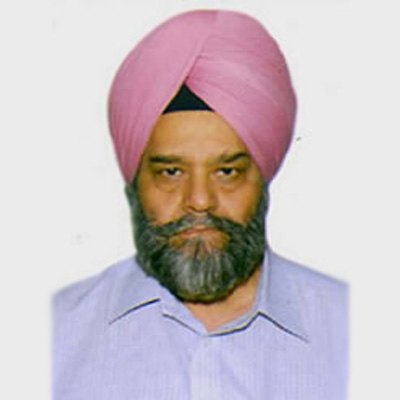
    ‘We have stepped up work on digitalization for Prasar Bharati’ : Baljit Singh Lalli – Prasar Bharati CEO

    Baljit Singh Lalli, who took charge as chief executive officer of Prasar Bharati at the end of December 2006, is an Indian Administrative Service officer of the 1971 batch from the Uttar Pradesh cadre with vast administrative and managerial experience spanning over three decades.


    In an interview to indiantelevision.com’s BB Nagpal, Lalli answered various questions relating to the falling revenue of Doordarshan, the cricket telecast rights controversies and other issues.


    Excerpts:

    Doordarshan’s gross revenue fell by about Rs 1300 million to RS 8,182.2 million in 2006-07, as compared to RS 9,469.6 million in 2005-06. But the gross revenue of All India Radio rose marginally by RS 148.2 million to RS 2,836.5 million in the same period. To what do you attribute these losses?
    As you know, Doordarshan has lost around RS 3400 million because it did not have the telecast rights for cricket. If you do not count what we lost because of cricket, the revenues of Doordarshan have actually gone up as far as other programmes go. But we have already made up RS 2 billion. On the other hand, AIR earned just under RS 96.4 million from the World Cup 2007.

    Why is it that Prasar Bharati wakes up so late to bid for the cricket telecast rights and then has to pass a mandatory sharing legislation?
    I cannot answer that because it happened before I joined. But you must understand that the amount for bidding for rights for up to five years is more than what a public broadcaster can afford. As far as the legislation is concerned, it is necessary to understand that the Uplinking and Downlinking Guidelines issued in November 2005 were clear on mandatory sharing of rights for terrestrial showing, but were being violated by the rights holders.

    For a long time, Prasar Bharati has been talking of strengthening its marketing strategy, but the results do not seem to be showing?
    That is not true. As I said, we have made up a lot of the losses caused because of not having telecast rights. We have now taken steps to streamline the marketing procedures. Also, the attempt is to bring in greater synergy between All India Radio and Doordarshan. We have set up a committee and sent out new proposals to our marketing people in Mumbai, Kolkata, Chennai, Guwahati and other places.


    AIR has already made more than five times the projected revenue from cricket. You should also not forget that Prasar Bharati is a public broadcaster and cannot resort to generating revenues the way some other channels can. At the same time, we are now having closer monitoring of the marketing activity, and are also recruiting professionals for the work.

    A Comptroller and Auditor General Report talks of losses on various counts, including arbitrary fixation of advertisement rates for feature films to favour certain filmmakers. How will you ensure proper checks and balances?
    I have not seen the report so far, and in any case it relates to 2004-05. We have now put a new system in place for acquiring films. We will now be able to get the best films at competitive rates, through a policy that will be completely transparent. The films will be selected in good time. The Grading Committee in Doordarshan will then categorise the films as specified in the policy. No individual producer or filmmaker will be shown favours of any kind.

    An Acquisition Policy announced by Doordarshan to acquire quality programmes has reportedly led to scams including submission of duplicate or blank tapes?
    Yes, I am aware of this case. The matter relates to October-November last year when new programmes were being acquired for the DD Urdu Channel. Our internal inquiry showed that around 250 blank tapes had been submitted along with other programmes. A committee of officers in Doordarshan is inquiring into the matter and would be able to identify those guilty and action would be taken, irrespective of whether it is only outside producers or someone within Doordarshan. As no money had been paid to any producers so far, there is no question of any loss of revenue on account of this. I am in principle opposed to acquiring old programmes, and this had been done under a policy announced before I joined.

    But this has already led to an order for transfer of senior officers in Doordarshan who have been in their posts for more than six years?
    That order has nothing to do with the tapes. In fact, I issued that general order separately for transfer at Supervisory levels. And all sections of employees have welcomed it. The section of employees most affected by this, the Programme Staff Association of AIR and DD, has sent me a letter welcoming this decision.

    You had announced earlier that Prasar Bharati would switchover to the Indian satellite Insat-4B by June. Is that work on schedule and how many transponders will you be using?
    Yes, we are shifting DD Direct, the Direct-to-Home service, to the Insat-4B from 1 June. We have been assured by the Indian Space Research Organisation that we will not face any shortage of transponders. We will initially be using five transponders but can ask for more whenever needed.


    The shift from the Netherlands-based NSS 6 will not only mean savings in foreign exchange, but also clarity in picture since the Indian satellite is better placed than the European satellite. Prasar Bharati pays NSS around RS 225 million annually. The initiative was motivated by patriotic instincts. Insat-4B is located in a geostationary orbit of 93.5 degrees East, which is closer to Indian than NSS 6, which is located at 95 degrees East.

    What about the commitment by Isro to Sun TV because of the loss of Insat-4C?
    I am aware of the reported commitment by Isro, but this will not affect DD’s requirement. The Insat-4B has 12 KU band and as many C band transponders for communication and broadcasting services. DD Direct will be able to beam up to 10 channels from each transponder. It presently beams around 32 channels of which 26 are its own, but this number is expected to go up to 50 with private FTA channels becoming available.

    What are you doing to effect a smooth transition to Insat-4B?
    We have held meetings with cable operators, hardware manufacturers and multi system operators to familiarize them with the changes that will have to be made to reach out to 4.8 million viewers of the free-to-air DD Direct. Doordarshan has circulated a four-page brochure to educate viewers and service providers about the changes to be made to their dish antennae and in the set top boxes. Though the service providers will make these changes, this can be done even by subscribers themselves. Each antenna has to be rotated (with the person standing behind the dish antenna) clockwise by 1.5 degrees to the right and tilted up by 1.5 degrees.


    DD’s DTH would be available across five transponders in the KU Band on Insat-4B, on the frequencies 10990, 11070, 11150, 11490 and 11570 MHz on vertical polarisation and a uniform symbol rate of 27500 ksps.

    We have now taken steps to streamline the marketing procedures. Also, the attempt is to bring in greater synergy between All India Radio and Doordarshan

    Will DD Direct continue to be Free-to-air?
    For the present, yes. We do not see it becoming encrypted in the near future.

    The Planning Commission’s Sub-Group on ‘Going Digital’ has recommended that Doordarshan should commence digital terrestrial transmission by the 2010 Commonwealth Games, and should have a phased approach for going digital covering all the seven mega cities by 2011 in the first phase and the rest of the country by 2013.
    Yes, the Report had also recommended a group chaired by me with some private broadcasters like Star, Zee, Sony, Eenadu etc. and their major MSOs to examine an 11-stage process. We will also consider introduction of HDTV in a phased manner starting from Delhi (2008-09), extending it to all the six mega cities to ensure coverage of Commonwealth Games in HDTV format in 2010.


    We have made some proposals which are with the Planning Commission. In fact, this is a major thrust area in the Eleventh Five-Year Plan. I personally met officials of the Planning Commission recently and gave a projection of RS 5000 crore (RS 50 billion).


    Has Prasar Bharati begun working on plans for optimum coverage of the Commonwealth Games?
    Yes. In fact, I have had one meeting with Mr Suresh Kalmadi, President of the Indian Olympic Association and Chairman of the Organising Committee for the Games, and told him we will need financial support for adequate coverage of the Games. I will be meeting him again shortly.

    A Technical Group had been set up to examine Encryption Mandate for DD signals, particularly for cricket telecasts. There appears to be a lot of disagreement among members of the Group on the issue. What is the position about this?
    Yes, the Ministry had set up a Group headed by AIR Director General Brajeshwar Singh to go into the issue. The report of the Group has already been submitted to the Information and Broadcasting Ministry, and perhaps you should be asking the question there. As far as I know, the report was unanimous.

    Prasar Bharati had announced a policy on telecasting series based on Indian Classics. What is the progress on that front?
    The work is going as planned. The Committee met recently and cleared twenty to twenty-five proposals related to Hindi, Punjabi, Bangla, Gujarati and Telugu classics. Filmmakers like MS Sathyu, Gulzar and Muzaffar Ali have been commissioned for some of the classics.

    The concerned Parliamentary Standing Committee has expressed its displeasure over the progress in Digitalisation and building of archives for Prasar Bharati?
    We have stepped up the work on digitalization. We will be able to work even after the Archives are shifted to the Central Production Centre Building in Sirifort Village. This will be done in the next two or three months after DD News shifts to the DD Building in the Mandi House area. Meanwhile, digitalization of broadcasting in the public broadcaster would be completed by 2017. Out of the 64 Doordarshan studio centers, 17 had been fully digitalized while another 30 were partly digitalized.

    DD India is available via Satellite all over the world, but there are few takers even in countries with large Indian population. DD has had to tie up with local cable operators in the United Kingdom recently. What are you doing to popularized Indian channels in other countries?
    Doordarshan has launched two channels DD India and DD News in the United Kingdom with the help of Rayat Television Enterprises Ltd. following an agreement with Prasar Bharati for the distribution of these channels in UK for a period of five years.


    DD India has seven Hindi and six English news bulletins daily, while DD News has 19 English and 24 Hindi news bulletins daily respectively. Although both these satellite channels are free to air and could be seen anywhere in the world, this is the second time that Prasar Bharati has entered into an agreement with a distributor to ensure the channels reach viewers’ homes.


    Prasar Bharati also has a similar arrangement in the United States with companies owned by persons of Indian origin. The aim will also be to reach out in the Middle East, Malaysia, the rest of Europe, Canada and so on, and the broadcaster has invited ‘Expressions of Interest’ from entrepreneurs in these countries.

    Prasar Bharati Act has provision for Broadcasting Council which never came into existence. Will this become redundant under the new Bill that provides for a Regulatory Authority?
    I think you should ask the Ministry to answer that question. I can only tell you that we have urged the Ministry to strengthen our hands, and have asked for extra funds to be invested in public service broadcasting.

    Doordarshan has launched the Digital Video Broadcasting – Handheld (DVB-H) as a Pilot Project in Delhi. What about other cities?
    The Pilot Project is aimed at reaching mobile phones within a radius of 12 kilometers of the Doordarshan television tower on Parliament Street in New Delhi. After watching the outcome of the launch of this service in Delhi, the system will be replicated in Mumbai, Kolkata, and Chennai. The service is initially free to air and the channels available are DD National (DD 1), DD News, DD Bharati, DD Sports, DD Urdu, DD Punjabi, DD Bangla and DD Podhigai. The scheme is ‘vendor neutral’ and any mobile provider with a compatible handset can download the signals and transmit them. I hope the number of channels would be raised to ten to 15 in the next few months.

    There have been promises for increasing a scientific temper in the country through the media. The private channels have not done much, and DD’s efforts in the initial years also appear to have come to a stop?
    That is not true. We recently launched Mike Pandey’s series at an appropriate time, and have commissioned the Bedi Brothers to make a new series. We have finalised an MoU with Vigyan Prasar of the Department of Science and Technology to encourage a scientific temper. Programmes have been made earlier also for Science Channel which is a joint venture of Isro and Vigyan Prasar under Department of Science and Technology (DST). Till August 2006, 60 episodes have been transmitted. The programmes are being transmitted on DD-1 as a 30-minute capsule, and programmes are aimed at children in the age group 12 to 18.

    What specific programmes are being telecast to mark 150 years of the freedom struggle?
    DD has identified a series of programmes from its own archives, like Bharat Ek Khoj by Shyam Benegal based on Jawaharlal Nehru’s The Discovery of India, Swaraj by Manju Singh, and Colours of Freedom by Buddhadeb Dasgupta. DD has also commenced telecast of Dr Girish Karnad’s series Swarajnama.

  • Watch ICC World Cup on Tata Sky with Hrithik Roshan

    MUMBAI: Tata Sky Ltd., the joint venture from TATA and STAR, today announced a special promotional offer across India. Consumers, who purchase Tata Sky by 15 th April, 2007 will get 3 months of free subscription on up to 4 televisions at their homes. In addition, 50 subscribers with their families will get a chance to watch the ICC Cricket World Cup 2007 Final with superstar Hrithik Roshan, on 28 th April, in Mumbai.


    Tata Sky’s ActveTM Sports makes watching cricket at home a unique experience. With this service, viewers can choose the camera angle from which they wish to watch their favourite cricketers. Highlights are also available on-demand, at any time during the match. Apart from this, ActveTM Sports offers viewers the option of listening to commentary in a language of their choice and the convenience of extracting player statistics and ball trajectory at the press of a button. Since Tata Sky is a satellite television service, viewers will be able to watch all matches in DVD quality picture and CD quality sound, enhancing the experience of watching cricket at home.

     

    Commenting on this promotional offer, Vikram Mehra, Head Consumer Marketing, Tata Sky Ltd. said, “In a country where cricket is nothing short of a religion, we are providing fans with a unique, economical and equally effective way of enjoying the stadium experience from the comfort of their homes. We expect phenomenal response during the World Cup which will further propel us to achieving our target of 1 million subscribers at the end of our first year of operations.”


    Tata Sky endeavours to become India’s largest entertainment platform by offering viewers a variety of programming choices and interactive features in DVD quality picture and CD quality sound. Tata Sky is already home to leading broadcasters in the country including STAR, Zee, Sony, Discovery, Disney, MTV, NDTV, ESPN STAR Sports, National Geographic, Eenadu, TV Today, Asianet and many more.

  • Indya.com gears up for cricket World Cup

    Indya.com gears up for cricket World Cup

    MUMBAI: Played with passion! Followed with obsession!

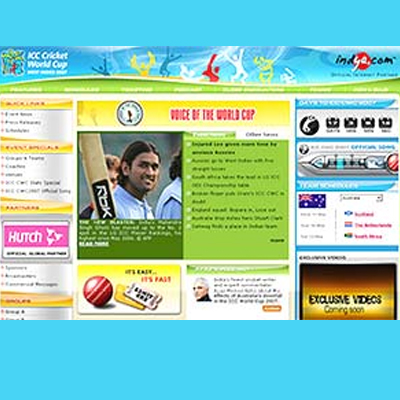
    With the cricket World Cup scheduled to kick off in less than a month’s time indya.com, which is running the official website www.cricketworldcup.com as the International Cricket Council’s (ICC) web partner, is starting to make a push.

    The site officially launches on Monday, 26 February.

    Information available with indiantelevision.com indicates that one presenting sponsor and four associate sponsors have been signed up so far for this year’s highlight cricket event.

    It was last year that Star inked a deal with the ICC to run its sites for the Champions Trophy and next month’s World Cup. Indya.com business head Sumant Kasliwal claims that its Champions Trophy site got three million unique users. In total there were over a billion hits, a lot of which, not surprisingly came from India. One million downloads took place and there were 100,000 registered users.

    For the Champions Trophy the site got 230 million page views. Kasliwal says that for the World Cup the site is expecting a billion page views during the event. “Our application Matchcast (which is a scorecard) has been expanded upon. It will be interactive. The aim is to give the consumer a complete experience. One can get match highlights, fall of wickets package, interactive contests. There will be live chat during the game. Users can comment on the state of the game. Our video content will include highlights from the previous World Cups. Other sites (as per the ICC diktat) are not allowed to show cricket videos.”

    Kasliwal also mentions another application – the Simulator. The visitor can view a graphical representation of what is happening ball by ball. He says that from a technological point of view it is a challenge. For each over two dozen parameters are taken into account. The recording takes place on the fly.

    There will also be expert analysis of each match. Prominent names are in the process of getting signed up. There will also be interviews with players and the captains. For the captains there is a section Captainspeak. Kasliwal says that it is in the process of tying up with speakers.

    It is also doing an interactive Voice Of the World Cup initiative. The contest kicks off next month. Here a clip of India’s match versus Pakistan in the previous World Cup is featured. Sachin basically hammers Shoaib. One can visit the section and provide a commentary recording. The winner who will be chosen by the public and a team of experts gets to do commentary for the semi finals and the final for the site.

    The site will also have a picture gallery courtesy gettyimages. For fun one can participate in games. One game that will shortly be launched is called Pick The Score. This is a prediction game and one has to guess scores. There will also be a fantasy game. Here one chooses a dream team for each match and one scores depending on how well the individual players are faring.

    The site will also have quizzes, an ICC contests suite. There will also be pages dedicated to teams and players, merchandise that can be ordered. In some countries like New Zealand, Hong Kong, Korea, Germany, France the site will offer for a fee live streaming of matches. In India highlights and the other earlier mentioned features will be given for free.

    GroupM COO South Asia Vikram Sakuja says that at first the agency was not sure how the product would turn out. However he is happy that for the Champions Trophy the site got a quarter of a billion page views. “I am glad that GroupM saw this potential and got some of our brands like Lufthansa to work with this exciting media offering.”
     

  • Moser Baer set to enter Kerala home video market with 101 Malayalam titles

    Moser Baer set to enter Kerala home video market with 101 Malayalam titles

    MUMBAI: Moser Baer Ltd is expanding its home video business. The company plans to come out with Malayalam films in the VCD and DVD formats.

    The entry into this market will be with Tiger which has Suresh Gopi, Murali and Gopika as star cast. This will be released in both VCD and DVD formats.

    “We plan to launch 100 other titles from our library of over 600 Malayalam titles, both from catalogue as new films. This is the first time that a launch of such an unprecedented scale of titles will take place in Kerala. While all the titles will be introduced in VCD format, 12 key titles are planned to be introduced in DVD format also,” the company said in a statement.

    Moser Baer has already lined up 26 distributors in Kerala and stocks shall be available immediately in around 5,000 outlets which will be scaled up in future. “We will be advertising the concept of low cost, original VCDs and DVDs in local TV channels and press starting from 1 February,” the company said.

    On 10 January, Moser Baer launched over 101 Tamil titles in Tamil Nadu. The company releases video content on DVD and Video CD formats using its proprietary and patented technology which it claims “enhances quality” and significantly reduces cost.

    Moser Baer is in final negotiations to acquire copyrights/exclusive license of more than 7000 titles in all major Indian languages. “This initiative in Kerala is poised to bring a paradigm change in the home video market. We believe this will lead to much higher consumption of content on home video, and encourage people to build libraries and eschew piracy. We have planned distribution to reach virtually every town where there is a movie loving family. Our rich library, world-class packaging and production, and unbeatable value propositions for customers will surely propel Moser Baer and this new venture into the top end of the market in a very short time,” said Moser Baer executive director Ratul Puri.

    The new initiative will release titles in Hindi, Tamil, Telugu, Malayalam, Kannada, Bhojpuri, Marathi, Bengali, Gujarati and Punjabi languages. “With 18 CFAs, 400 distributors and a dedicated sales force, this division will also set up owned and branded outlets at about 300 locations in addition to its alliances with large format stores. One such branded outlet was already inaugurated and isfunctioning at Pondicherry,” the company said.

  • Star to form JV with Balaji for Telugu channel

    Star to form JV with Balaji for Telugu channel

    MUMBAI: Television content production house Balaji Telefilms Ltd. will get into broadcasting through a joint venture with Star Group. The two companies will be launching a Telugu channel with Star as a majority partner.

    “We will be partnering with Balaji for the Telugu channel. We will have majority stake in the joint venture,” Star India advertising, sales and distribution president Paritosh Joshi tells Indiantelevision.com.

    For the Bengali general entertainment channel, Star will continue its joint venture arrangement with the Ananda Bazar Group (ABP) but the corporate structure has not been frozen yet. In Media Content & Communications Services India Pvt. Ltd (MCCS), the company which owns and operates Bengali news channel Star Ananda, Star has a 26 per cent stake while ABP holds the balance 74 per cent.

    A separate joint venture for the Bengali general entertainment channel is being considered. Star has the flexibility of holding a higher stake in the JV while in news uplinking regulation restricts it to have a maximum 26 per cent stake.

    “The shareholders have been under discussion but nothing has been finalised as yet regarding the corporate structure for the Bengali general entertainment channel,” says Joshi.

    A two-hour entertainment band in the afternoons on Star Ananda is likely to be introduced in June. “The process has got slightly delayed but we are aiming to come up with the two-hour band in June. We will monitor its success and a full fledged Bengali entertainment channel could come up towards the end of the calendar year,” says Joshi.

    The Telugu channel is expected to be launched in August-September. “We have started work on the content strategy and are in the process of formalising the joint venture for the Telugu channel,” says Joshi.

    Balaji has the option of partnering with Star in the southern-language channels. This formed part of the agreement when Star acquired a stake in Balaji Telefilms. But it excludes Vijay TV as Star bought out UTV’s stake in the Tamil channel before the deal with Balaji was struck.

    Balaji has had to weigh several factors like its existing business with Sun TV Ltd. where it gets healthy revenues. In the last two quarters ended 31 December 2006, Balaji had revenues of Rs 158 million from the Sun network channels.

  • Star announces Nair, Mukerjea’s exit

    Star announces Nair, Mukerjea’s exit

    MUMBAI: Lifting the lid off the worst kept secret in Indian media, Star has made it official that its two head honchos in India – Star Entertainment India CEO Sameer Nair and Star Group India CEO Peter Mukerjea – are out of the News Corp owned Pan Asian broadcaster.

    Star announced Sunday that Mukerjea would be leaving the company at the end of January while Nair will leave at the end of March. Star also announced that Star CEO designate Paul Aiello would for the present be the acting CEO of Star India.

    While Mukerjea has joined his wife Indrani’s global human resources company INX Services as chairman, the betting is on Nair’s teaming up with news major NDTV as head of its entertainment venture.

    Nair’s immediate mandate is clearly to manage the show and chaperone Kaun Banega Crorepati, which launches tonight at 9 pm with Bollywood badshah Shah Rukh Khan in the hot seat, through its 13-week run.

  • HC adjourns Sony case against Trai to 24 Jan

    HC adjourns Sony case against Trai to 24 Jan

    NEW DELHI: The Delhi High Court bench hearing the case on the issue of the Telecom Regulatory Authority of India’s (Trai) constitutional standing to be a regulator today heard arguments by Sony Entertainment Television’s counsel, before adjourning it again to 18 January.

    The crux of senior counsel Soli Sorabjee’s hour-long argument was around the previously stated position that broadcasters are not covered under the Telecom regulatory nor cable operator acts. Hence Trai is not in a position to eithwer fix tariff or issue any other regulations or orders.

    The court had last December fixed the day for hearing this matter while stating that there would be no impact of the continued hearing on implementing Cas from the designated date: 31 December, 2006.

    The petition by Sony is now the main petition being heard by the court. The earlier petitions by first Star (2005), and then Sony, are all being heard as part of this main petition.

    Star had filed the orginal case in 2005 challenging the constitutional validity of Trai as a regulatory authority for broadcasters.

    Since the very locus standi of Trai had been sought to be shown as unconstitutional by Star, automatically all its powers and orders were challenged, including the order of tariff freeze. Later, Sony had filed a seperate petition on the orders of 24 August and 31 August regarding Trai’s constitutional validity, its orders relating to price fixing under Cas regime at Rs 5 per pay channel, as well as its order on interconnection.

    Trai had issued an order saying that signals to a cable operator or MSO could not be disconnected, whatever be the reason, by a broadcaster unless 21 days prior notice is issued.

    On the price fixing at Rs 5, the court had asked Sony to appeal to TDSAT as that was a quantitative issue.

    HC at the moment is only hearing the constitutional issue, which will continue on 24 January.

  • Title sponsorship for Star’s ‘Antakshari’ goes to Colgate Maxfresh; Juhi Parmer to co-host

    Title sponsorship for Star’s ‘Antakshari’ goes to Colgate Maxfresh; Juhi Parmer to co-host

    MUMBAI: Star is poised to ramp up its offerings on sister channel Star One and has signed on Colgate Maxfresh as the title sponsor for it’s edition of the musical talent hunt show, Antakshari – The Great Challenge.

    The brain child behind Antakshari, producer Gajendrra Siingh has once again roped in Annu Kapur as host. In addition to this, the show has also selected Juhi Parmer to partner Kapur as co-host.

    A show that soon became a ‘fashion’ and ‘phenomenon’ on rival network Zee, Antakshari for the first time on Star promises to be “snazzier with new inclusions to the format and a reality aspect.” Geared to hit television in the second week of February, the first season will run for a 13 week period.

    Commenting on the association of Colgate Maxfresh with Antakshari, Star India advertising, sales and distribution Paritosh Joshi said, “Antakshari-The Great Challenge is a unique musical programme and is all set to add excitement to primetime viewing on Star One. With vibrant hosts and a lively and interactive format the viewers will be treated to a rich viewing experience each time. We are thrilled to be associated with a young brand like Colgate Maxfresh that will reach out to our audiences with innovative programming that is unique to Star One.” 

    On having initiated the partnership, Media Edge vice president Divya Radhakrishnan said, “Colgate Maxfresh is a brand targeting the youth. We have been constantly using platforms that engage this ever evasive TG beyond standard communication tools. In Antakshari, we saw an opportunity which was a good combination of a game show weaved in with a high entertainment quotient. This we believe will have a good appeal in our core TG.” 

    Four zonal auditions were conducted on the 12 and 14 January with guest judges including Ismail Durbaar at Indore, Abhijeet Bhattacharya in Kolkata and Annu Kapur in Delhi and Mumbai. 

    Following Gajendrra Siingh’s exit from Zee, the channel launched Antakshari last month with Titan as their main sponsor and Sunil Pal from the Laughter Challenge and Sa Re Ga Ma Pa 2005 champion Himani Kapoor as hosts. But with the original creator and host for the show propagating a fresh avatar for Antakshari on a new network – Star One, a fierce battle is yet to begin!

  • James Murdoch taking more hands on role at Star?

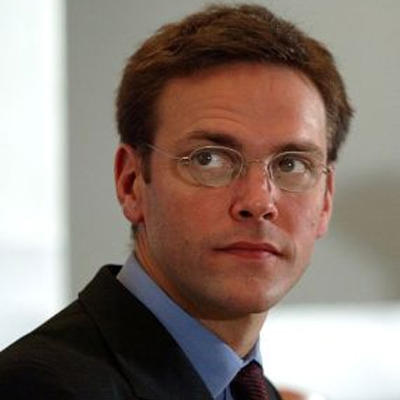
    James Murdoch taking more hands on role at Star?

    Truth will out. After months of rumour and speculation, the pieces of the puzzle as to what exactly has been going on behind the scenes at Rupert Murdoch’s Asian arm are falling in place (or so we believe).


    Conversations Indiantelevision.com has had with industry executives in India and Hong Kong aver that the countdown to yesterday’s announcement of Star CEO Michelle Guthrie’s departure had been set in motion months before. The first inklings of that came with the creation last March of a new executive structure within Star wherein Steve Askew was named president of Star Entertainment in addition to COO of Star; and the appointment less than a month later, of Paul Aiello as president of Star.

    Aiello’s was a newly created role that put him in charge of developing strategic and business directions for the pan Asian broadcaster while overseeing corporate functions including business development, strategy and implementation, Star Ventures, government affairs and corporate communications.


    Similarly, the schism that has riven Star India these past months also directly links back to events of March 2006 and the shake up in the Indian operations wherein two units were created – Star Group and Star Entertainment – with Peter Mukerjea made CEO of Star Group India and Sameer Nair promoted from COO Star India to CEO of Star Entertainment India. More on that later though.


    Back in Hong Kong, meanwhile, the next significant appointment was in September of David Butorac as president, Platforms. That announcement marked the return to the News Corp fold of a BSkyB veteran who was then COO of Malaysia’s Astro DTH operator.


    All these moves are said to have been orchestrated out of London by BSkyB CEO and now looking ever more likely heir to the Murdoch legacy, James Murdoch. That James would have a personal interest in the affairs of Star is not surprising since his three-year stint as chairman and CEO of Star marked his coming of age as an entrepreneur.


    When James joined Star in May 2000, Star was losing ?100 million a year. When he handed over charge to Guthrie in November 2003 Star’s India operations were extremely profitable and China was beginning to show profitability. Guthrie’s mandate was to drive the company further into these markets and steer it into DTH, and pure pay TV plays with higher subscription revenues.


    In both China (due to political reasons as much as anything) and India (the cycle of change?) there has been a deceleration but that doesn’t really tell the story. One could argue that it is also down to the advantages of being an owner but there is no getting away from the fact that during James’ reign there was clarity and simplicity in both executive chains of command as well as corporate structure and direction.


    To say that the executive command structure at Star today is convoluted would be putting it kindly. And nothing exemplifies this better than the India operations where there is a strategic/corporate CEO in Mukerjea, an operational CEO in Nair, and a president in Paritosh Joshi responsible for managing revenues. And there soon may even be a COO if reports of a move to India of long time Star Hong Kong hand Sanjay Das pan out as true. We’re surprised that the name of long-time Star loyalist and former India business development head Jagdish Kumar has not cropped up anywhere in the speculations.


    According to our reading of the events of the past few months, James has been preparing the ground for a return to the lean, mean management style that was in place earlier and this could more than likely see more executive churn right through the Star system. At the top of that list of potential near term departures is Askew, currently on four months’ sick leave.


    A possible offshoot of this could be that James will sooner rather than later have a far more role in running the affairs of Star, maybe take on a designation of chairman of Star or some such.direct


    And truth is that Star really means India, the rest of it being not much more than feeder operations. So James will perforce have to send out a clear message there. The present neither here nor there two-CEO proposition has proved an unmitigated disaster.


    If the head honchos at Star were convinced that Nair was the man to lead it into the new and uncertain digital future then they should have gone with him and let him do his job. The presence of a shadow CEO (Mukerjea) was a huge disservice to Nair and even more so to Mukerjea, who had helmed the fortunes of Star India in its period of greatest dominance.


    POSTSCRIPT: The reasons for Nair’s deciding to quit (informed sources say he put in his papers on 28 December) remain shrouded in mystery because his is after all the most high profile media chief executive’s job in the country (shadow CEO notwithstanding). If anyone could be said to have had reasons to quit it was Mukerjea, and by current reckonings, both have resigned. So there is certainly some serious damage control that newly inducted CEO Aiello has to deal with when he arrives in India on Monday.