Tag: Star Sports

  • Sportzworkz chosen by geo super to produce Pakistan vs Sri lanka &Afghanistan cricket series

    Sportzworkz chosen by geo super to produce Pakistan vs Sri lanka &Afghanistan cricket series

    MUMBAI: Sports production house Sportzworkz has bagged its another major international cricket tournament; with GEO Super choosing them to produce the Pakistan-Sri Lanka-Afghanistan cricket series to be played in the United Arab Emirates. The series will be played between December 082013 & January 202014. It features 2 T20s, 5 One Day Internationals and 3 Tests against Sri Lanka and the solitary T20 against Afghanistan.

    The series will be telecast live on Geo Sports in Pakistan, on SONY SIX in India, on OSN Cricket HD in the Middle East and on CSN in Sri Lanka.

    Sportzworkzhas previously been involved in international cricket with the telecast of the Sri Lanka Premier league in 2012. In addition they also provided the live telecast of the Jharkhand Premier League and the Punjab Premier league two domestic cricket events in India in 2010-11. Their first major international cricket event produced by Sportzworkzwas a cricket tri-series in Nairobi in 2004 that featured the A teams of India and Pakistan playing against Kenya. That series launched MS Dhoni into the Indian team.

    Sportzworkzhas over 800 hours of live programming to its credit. This includes prestigious events like the Hockey India league in 2013 for STAR Sports, the NDTV-Toyota University Cricket Championships for STAR Sports, the inaugural Super Fight League in 2011-12 on NEO Sports and the inaugural Golf Premier League 2012 on Sony SIX.

    Gaurav Bahal, Director, Sportzworkz said “we are thrilled to be chosen by Geo Sports as a production partner for this cricket series. Viewers in the sub-continent will get the same high quality telecast that we have previously provided for channels like STAR sports, Sony SIX and TEN Sports.”

  • DishTV to approach TRAI on Star Sports 2

    DishTV to approach TRAI on Star Sports 2

    MUMBAI: For quite some time India’s largest DTH platform Dish TV has wanted to carry Star’s new sports channel launched earlier this year, Star Sports 2 as part of its service. But this has not happened. 

    Dish TV says it has not signed the RIO as it has several terms it objected to. It moved the Telecom Disputes Settlement Appellate Tribunal (TDSAT) for grievance redressal. 

    The interim order on the case came out late today stating that the question of validity of the terms of an RIO need to be first examined by the Telecom Regulatory Authority of India (TRAI) under clause 13.3 of the Telecommunication (Broadcasting and Cable Services) Interconnect Regulations (2004).

    One of the terms that Dish TV has been disputing is regarding ‘Remote access (e.g. through dial up or otherwise) to the Affiliate’s DTH platform (information related to subscribers) shall be provided to the Company in order to permit the Company to verify the subscriber numbers.’

    As per this term, Star Sports wanted access to its subscribers’ details on Dish TV. To this, the tribunal stated that this term is contrary to a previous opinion of TRAI that was upheld by the TDSAT.

    After hearing this, the Star Sports counsel said that his client won’t insist on incorporating this term in its RIO but the TDSAT said in a similar situation had arose before and therefore this clause may not have found mention in the RIO.

    “In so far as the other disputed terms and conditions are concerned, it will be open to the petitioner to sign the interconnect agreement, including the disputed terms and conditions without prejudice to its rights and contentions and keeping its option open to seek its remedies,” reads the TDSAT order. 

    Dish now has two options before it – either sign the RIO, comply with the terms and take the channel or else not take the channel. Star Sports says that if it wants to take it to the TRAI, it has to sign the RIO including the above mentioned one. The TDSAT has requested the regulator to have its say on it within six weeks from the date of filing.

    According to Dish TV, there are about 10 to 12 such terms that they object to and will be writing to the TRAI about in the first half of next week. “We do expect the TRAI will issue a direction to the broadcaster to amend clauses in the RIO. If Star Sports still does not adhere to the TRAI’s directions we will certainly revert to the tribunal to point out the recalcitrance again,” says Dish TV CEO R C Venkateish.

    Star Sports officials, on the other hand, are also quite clear that Dish TV will have to sign the RIO if it wants the channel. “Despite the fact that the disputed terms in the RIO, this stand of the broadcaster that I have to sign the RIO before approaching the TRAI is indicative of their attitude towards the law of the land,” said Venkateish.

    It is up to the regulator now to decide whether the terms in the RIO fit with the regulations.

  • DDB MudraMax OOH refreshes brand Star Sports

    DDB MudraMax OOH refreshes brand Star Sports

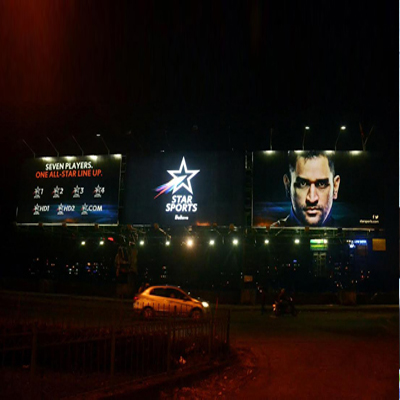
    MUMBAI: STAR India recently revamped the branding of the sports network and unveiled a new brand for Star Sports across six channels — Star Sports 1, 2, 3, 4, HD1 and HD2 and starsports.com.

    To create the awareness and buzz for the new brand identity and to communicate the new brand philosophy – Believe, Star Sports partnered with DDB MudraMax OOH.

    The campaign was rolled out when India tuned in to watch Sachin Tendulkar play the last series of his sports career. The massive OOH campaign was executed in Mumbai, Delhi and Kolkata as well as across major cities in Gujarat and UP. The campaign used multiple visuals of Mahendra Singh Dhoni as well as the brand logo as part of the campaign creative.

    On the campaign, STAR India executive vice president marketing & communications Gayatri Yadav said, “The work done by DDB MudraMax OOH for the brand refresh campaign has been outstanding. The DNA and essence of the brand refresh was well understood and reflected in the manner in which the planning and media selection was done by the agency. Especially the Star Sports zone and roadblocks conceptualized and executed at Mumbai and Delhi airports are noteworthy and have created a great impact and buzz for the refresh. We are very impressed with the positive reviews received for the campaign. DDB MudraMax has delivered on our expectations yet again.”

    Commenting on this, DDB MudraMax OOH retail and experiential president Mandeep Malhotra said, “Sport is very close to my heart and when the opportunity to associate with a brand standing tall to the passion came up, was really thrilled to create magic. The team did a wonderful job on picking up unusual formats of advertising. Various touch points were exploited and the new identity made it to top of mind recall with a smooth transition.”

    DDB MudraMax OOH VP Spencer Noronha added, “Star Sports aimed at starting a revolution in sports broadcasting and the media strategy was to amplify this sports revolution through an occasion that is relevant to all and thus inspire every Indian sports fan. This soul of this campaign was “premium and classy” and hence it was crucial that the media selection had to be in line with that imagery. We selected the most impactful, most premium and the largest of available media vehicles in each of the target cities to create a statement in the OOH space. The quality of the selected media reflected class and helped the campaign to quickly get noticed and talked about. The eye catching creatives amplified the impact and recall manifold. It’s definitely one of the most memorable OOH campaigns in 2013”

    DDB MudraMax OOH DGM Anurudha Pawar said, “OOH is a communication platform where the brand is racing against time to grab attention and communicate with the TG while he zooms past the media within a few seconds. This makes it all the more important for the brand to use the right media mix and deploy an optimized communication tailor made for the medium. We exactly did this for the refresh campaign. The media vehicles were meticulously handpicked to project class; and the creatives were kept ultra outdoor friendly to specifically communicate the grandeur of the brand. We took the innovative branding route by creating the Star Sports Zone, Stadium visibility corridors and airport roadblocks, to ensure each and every person exposed to the communication carried a positive image of the brand with him in this mind. I am sure we have succeeded doing that.”

    A multimedia approach was used for the campaign. Large format A+ grade billboards and Unipoles, Backlit Bus Shelters, Backlit Pole Kiosks, 4 Sided Backlit Pillars, Large Backlit Glow signs, Drape, Prominent Mall Facades, Digital Screens at airports and Gantries were meticulously selected at key touch points in each city. The creatives were optimized for each of the media formats used. DDB MudraMax also brought in a couple of significant planning and media innovations to help portray the grandeur of the brand refresh and garner high recall value for the campaign. Visual domination was the key.

  • ‘All parties need to come together to take home grown leagues to another level’

    ‘All parties need to come together to take home grown leagues to another level’

    Star Sports presented a unique series of Knowledge Sessions – the India Pro Leagues Forum 2013 in New Delhi. STAR India President – Sports Nitin Kukreja delivered an engaging and insightful keynote address at the inaugural session of the summit, elaborating on the growing appetite of the Indian sports fans and the enormous growth potential of sports in the country.

    Does ‘sport’ in India really begin and end with ‘Big Boys’ Cricket’? Or do we just see it that way? Across the length and breadth of India, there are strong communities and pockets of interest where people are passionately engaged with local sports and local players – football in Bengal, hockey in Punjab and Orissa, badminton in Hyderabad, basketball played in schools and table tennis played in clubs, colleges and offices across the country.

    But if a tourist landed in India and turned on the television or turned to the sports page of a newspaper, we could forgive him for thinking that India cares only about international cricket when Team India is playing.

    Why then, has this rich diversity of interest and talent not been harnessed? Why is it that in the media, on television and in the public mind-space, sport equals international cricket? How is it that the English Premier League enjoys such a phenomenal following within the UK when the English national football team has not won an international competition since 1966! Why is it that an average 18-year-old in South Delhi or Bandra is more emotionally connected to the fortunes of Manchester United or Chelsea than say the Mumbai Ranji side (40-time winner of Ranji trophy) or the Indian National Kabaddi team (winner of all 4 World Cups played so far)? You may argue that not many nations play Kabaddi other than India and Pakistan; well – you could say the same about Baseball! The US is the best example of a country that thrives on local sports and leagues – some of their sports are played in no other country – yet they call it “World Series Baseball” and Babe Ruth is an American hero and legend.

    When you watch a badminton match live, it is astounding to see the speed of the game and the agility of the players

    Americans follow their city and college teams with a passion – across baseball, American football, basketball and ice hockey; Italy, Spain, Turkey – all follow their local soccer teams with a fanaticism; tourists visiting Galatasaray are advised not to wear rival team colours while visiting! And note that all these nations consume their sport in their own respective languages.

    In the last 15 years in India, entertainment and movie channels have gone local with a vengeance; the number of regional channels has gone up from just a handful pre-2000 to over 300 today; while Hindi accounts for 55 per cent of TV viewership; regional language content accounts for 30 per cent of viewership share; and it’s not just about language; a Bengali, Marathi or Tamil show is rooted in the local culture and ethos with participation from the local creative fraternity.

    It is only the Sports genre in India that has remained aloof from localisation – until 2008 there was no IPL, and until 2012, telecast of cricket was limited to English, a language spoken by less than 10 per cent of India.

    In India then, how can we take local sports and leagues to the next level? Broadcasters have a big role to play in this but more importantly the entire ecosystem – the sports federations, the government and the news media and advertisers need to come together to ensure that our home grown leagues get the money, resources, infrastructure and coverage that they deserve.

    Look at the quality of television coverage for International Cricket over the years – the evolution has been amazing – the production quality, the camera work, the graphics, the slow-motion replays and the immensely talented people who narrate the action – all these elements really take the television viewer closer to the game; it is immersive, engaging and a pleasurable experience even for casual viewers who are not dyed-in-the-wool fans; television coverage has played a huge role in growing the fan base and support for Cricket; this is despite the fact that for all these years, all coverage was in English.

    But even in Cricket – the more local forms of the game – be it Ranji trophy, Irani Cup or university cricket have so far been treated as the poorer cousin – the benchmark for coverage that has been set for international cricket needs to be duplicated in the local forms of the game. The fact remains all the international heavy weights – from Tendulkar to Yuvraj Singh to Kohli – have cut their teeth on and emerged from these local level tournaments.

    The task is even greater for other sports – where even the national level game has not got the coverage it deserves. Consider the coverage that an average Hockey or Football match gets – you see some indifferently placed cameras and a disinterested narrative; there has been no attempt to make the viewer experience the thrills, the speed or the skill involved; when you watch a badminton match live, it is astounding to see the speed of the game and the agility of the players. The current standard of television coverage does not even begin to capture that excitement and skill.

    In a pre-digitised world with limited bandwidth, TV broadcasters were forced to follow a one-size-fits-all approach and therefore focused on only saleable national-level content at the expense of local content and language; but in a digital world the consumer has ability to access a variety of content in multiple languages and on multiple platforms; broadcasters would be doing a great disservice if they continued to use a cookie-cutter approach and did not use this opportunity to go deeper and serve the interest of all pockets of interests whether by sport, region or language.

    Great production values are not enough, the on-ground event also needs to be organised and mounted like a spectacle – this is where the sports federations have a key role to play. They must enable and nurture talent, and promote and market the game at least in the locales of affinity if not in the whole country. They must do their part to ensure that the Sports pagecarries interesting stories and coverage of the game and the players– and not only controversies! But most important, they need to partner with the other stakeholders in the ecosystem with the long term vision of growing the sport – without the spirit of partnership and the vision; the league or the sport will not grow.

    The government has a huge role to play – by allocating adequate monies, developing stadiums and infrastructure and putting in enabling policies in place. The government allocates around Rs 1000 crore to Sports (and Youth Affairs) which is the budget for the current year. That number is less than what we will be paying only for one tournament -the ICC T20 world cup – that number is less than the number that Star invests in sports each year. It means that Star is a bigger investor in sports in India than the government of India itself!

    It can be argued that Kabbadi is not popular because only few nations play the sport but the same can be said for Baseball as well

    The scale of magnitude of the government’s investment should be at least 10x of that number! Why do you ask? More than half of India’s population is below the age of 25 and 65 per cent below 35; Sports has a crucial role to play in youth development and can even be a huge generator of employment. IPL has opened up career options for 120 players; not just 15. Hockey players can now make up to 60 lakhs for one month of play in the HIL; Badminton players can make 50 lakhs for 3 weeks of work; not to mention the production, support and service staff that works on these leagues. When the hockey union went on strike in Canada a while ago, the prime minister of the country got involved because his fear was that a prolonged strike would have an adverse impact on the GDP of Canada! More than anything, it showed the power of sports and its ability to be a huge economic growth engine.

    Forget about investment, even simple hygiene factors such as easing procedures can go a long way – it cannot take 38 different permissions just to host a hockey match in a certain venue; increase venues and the number of permissions multiplies!

    It’s a vicious circle, since there is no investment, there is no growth and no popularity for local leagues and sports – therefore they attract no money! The common man (or woman) in India does not view “sport” as a viable career option or life choice; it remains a “hobby” to be pursued in free time;

    Star has thrown its weight behind building an enduring viewer proposition around local leagues and sports– and in the language of the people. Our tryst with these local sporting leagues has thrown up some interesting results: We partnered with Calcutta Football League, one of the oldest leagues in Asia and in the world with 157 Kolkata based clubs and units to air their league matches on our Bengali movie channel. In the core national male audience, the TV viewership is 4-5 times higher than your average EPL match! Even with the current quality of football and coverage, an East Bengal-Mohan Bagan match attracts crowds up to 70000 in the stadium!

    We also partnered with Hockey India League the first edition of which was held in January 2013. The excitement on grounds was to be seen to be believed. For e.g. grounds in Ranchi were completely packed to support their Ranchi Rhinos team which went on to win the league; there was a lathi-charge two days before the match when demand for tickets got out of hand and in fact when the match was on – even the neighbouring stadium that simply had a big screen projecting the match – was full! The excitement rivalled that seen in Wankhede stadium or Eden gardens during high-octane international cricket.

    University cricket is another great example – during the Jamia vs Bangalore’s Jain university match, stadium was so packed that it took 40 mins to enter; and the crowd was chanting – not “Sachin Sachin”, not “India India” but “Jamia Jamia”! The pockets of passion exist; it is on us collectively to harness and magnify them.

    There has been no attempt to make the viewer experience the thrills, the speed or the skill involved when you watch a Hockey match

    The IPL has shown the way in how to mount a successful local league; granted that it was built on an already popular sport – but all the stakeholders have done a great job in coming together to mount it like a spectacle – it is no longer a game but entertainment and a serious alternate to any other movie or television show. Clearly, a “manoranjan ka baap”.

    There is a lot more to be done and many challenges to overcome. It will take a spirit of partnership with federations and people with vision to get there – for the benefit of sports, for the benefit of the country and for a healthier and fitter society! I’ll leave you with a small snapshot of the passion of local sports; as I mentioned before, it is for us to build upon them.

     
  • “We will use the Indian jersey to promote all our brands” : STAR INDIA COO SANJAY GUPTA

    “We will use the Indian jersey to promote all our brands” : STAR INDIA COO SANJAY GUPTA

    Cricket – a game played on the greens with men in various colours battling it out with a bat and a cherry. And watched by billions of viewers worldwide. And the Rupert Murdoch-owned 21st Century Fox’s Indian arm Star India once again reaffirmed how much it is committed to  the game when the Board for Control of Cricket in India (BCCI) announced that it had agreed to become the title sponsor of the men in blue for the next four years.

    It already has the television, internet and mobile broadcasting rights to domestic cricket, it made a lucrative offer to become an associate sponsor of the IPL, and is investing in different language streams of commentary and channels for the game, and what have you. Clearly, apart from entertainment, sport is coursing through the management’s veins in India.

    Indiantelevision.com’s Seema Singh spoke to Star India COO Sanjay Gupta on the reasons behind the sports drive, the title sponsorship of team India, the challenges that lie ahead in monetising all its investments.

    Excerpts: 

    What was the need to take the title sponsorship of the Indian cricket team? How many days of cricket will be played from 2014 to 2017?

    It is a very important sponsorship for us. Cricket helps build awareness of brands and associations and we are seeking value coming from both. It is a serious value that we see as a business and hence this sponsorship.  Broadcast right gives us the opportunity to put TV ads on air. What the Title Sponsorship gives us is the name on the jersey, which is a very different asset. So now we can put an ad and also logo on the jersey. So in my mind, the way we are using it is that the jersey will be used to make the Star brand more salient in our viewer’s minds. Approximately 100 or more matches will be played in this period.

    Are you planning on any innovation as compared to Sahara, the previous title sponsor?

    We believe that sport is an asset that can be used for building and marketing brands in a very effective way. This hasn’t been exploited so far in India, as compared to sports globally.

    Our aim is to reinvent sports and we spoke about this when we said ‘refresh sports.’ We thought of adding non-live content and we wanted to do it in Hindi.

    We would be using Star brands, and it could be Star Sports, Star Plus or Life OK, which could find its presence on the Indian jersey once our sponsorship commences. We would like to build our brand in a very effective way using this association.

    When Sahara sponsored the Indian team, it never put any money on television. But, we believe that the combination of putting money on television and sponsoring the jersey could be a great innovation to build stronger brands. We will get a multiplier with television.

    When the jersey has a Star Plus logo, viewers will also be informed about Star Plus shows and what the channel stands for.

    Are you allowed to change the cricketing gear as part of the title sponsorship deal?  If yes, are you looking at changing the look of the jersey?

    The jersey’s look is the call of BCCI.  Since we are the title sponsor, the jersey will now have our brand name. We are looking at using multiple brands on the jersey depending on the need. So we could start with Star Plus, and after a year think of putting Life OK’s logo on the jersey.

    With Star India banking getting its hands so deeply embedded in cricketing, there is a perception of a monopolistic setup coming into the picture?  Your take on that.

    In my mind, if I look at cricket content, it is very equitably distributed amongst all the three sports channels. So, while we have the BCCI content, Sony runs the IPL, which is the biggest cricket tournament. Besides this, Ten Sports has the rights to South Africa, West Indies and the Sri Lanka series.

    All the three brands have strong cricket content. This makes it interesting, since having cricket on all platforms makes it reach larger audience base and in turn builds sports in the country.

    Many feel that cricket is overvalued, then why is Star investing so much on the sports?

    In my mind, cricket is undervalued. If you see all pieces of content: drama, sports, news, Bollywood, the content which has the biggest affinity and reaches the largest audience is cricket. 64 crore people watched the sport last year, which is higher than any piece of content and this cuts across all regions and languages. So cricket according to me is not at all overvalued.

    Sports help build brands, not locally, but nationally. And most people who today look at building brands are looking nationally and not only in select states. Anybody who feels that cricket is overvalued and doesn’t have power, needs to see its power through its reach and the impact it has on consumers.


    I personally feel that the sports content has been limited to English language and a few people. So taking sports deeper into regional market is essential and this hasn’t been done so far.

    The biggest heroes are the cricketers of the country. They are young talented people, performing well. Investment in sports and cricket is justified.

    You can never get enough of good quality sports and content; viewers  will always want more.

    Will you be backing other sports and diversifying your sports portfolio?

    Yes! We want to. We think cricket is the main stake, but we are not a single sports nation. There is a large followership of football. We are investing in football and hockey in a big way. We are going ahead and investing in Hockey India League. We have already shown our intent in badminton, by sponsoring the Indian Badminton League. We will invest money in all sports.

    Cricket was the one sport where we were not the partners. Now we have invested in that as well.

    With India losing on foreign grounds, do you see that as a problem for your investment and viewership?

    No, I don’t. I have high level of confidence that both sport in general and cricket in particular, will have its following and deeper engagement. We have opportunity to perform better even outside and it is not that we haven’t performed. In England we did well. We performed well across best teams and across best seaming pitches. It is a phase in any team.  But fundamentally, I feel that Indian team is performing dramatically. The game of cricket has got deeper in this country. All these new cricketers are from smaller towns. Even younger generation now feels they can be a part of team. The coming in of IPL has just deepened that desire of becoming a part of the team.

    What is needed to monetise your investments in sports? Do you think digitisation will help? Even if it is not proceeding as smoothly as you expect? 

    I personally feel that the sports content has been limited to English language and a few people. So taking sports deeper into regional market is essential and this hasn’t been done so far. So to fortify sports we want to reach out to different regions and into other sports, beyond cricket. We want to make sports big for every member of the family.

    Monetisation of sports is a challenge, given there is very limited transparency in terms of numbers given by analogue distribution system. I think, with digitisation we are seeing that changing over the next few years.

    Yes, there is a challenge with the MSO vs LCO tussle. But, I am an optimist and I feel there will be a better tomorrow than what is today. Also I think the overall content and media market is growing so much that every stakeholder has a potential to earn and earn reasonably and in a fair way.

    So, I see a very fair distribution of income and every stakeholder: MSO, LCO, Broadcaster will earn a fair amount.  The reality is that of the 140 million cable TV homes, already 70 million are digital between DTH and cable, which is a big leap in two years time. This market is large and is growing fast. Though there are hiccups, I am confident that things will be better.

    Digitisation will ensure that every household is well connected with a transparent set top box, a measurement system which is more transparent and fair money will exchange hands. I don’t know if it will happen in couple of months, but I am sure that in the next three to five years, life will be dramatically different.

    But the time is limited between the sponsorship, the broadcast rights and digitisation. What if there is a mismatch? How will you recover investments?

    Our sponsorship is a way to build our brand.  We have an opportunity to make our brands bigger.  As far as the broadcast rights are concerned, we will work towards resolving issues on the ground and related to monetisation as we move forward. Yes, I agree there is a risk, but we believe there is a reasonable risk and hence the investment. 

    Is your associate sponsorship continuing for the IPL?  Also would you take the broadcast rights once the rights for Sony expires in 2017?

    We had taken the rights for three years. So it will continue for two more years.
    As for the broadcast rights, there is nothing definite right now. We have invested a lot of money in sports already and we would like to see some returns first, before we make up our mind if we want to invest more. The big question for us today is how to ensure that the big investments we have made start reaping results.
    Our commitment made in rights is close to Rs 20,000 crore. It is a huge bet. We need to now unlock value and how do we take content deeper and also invest in more sports.

    Are you seeing an uptick in Star India’s ad revenues?

    Overall the mood in the economy is not very buoyant and I think everybody this year has been very careful on where they are investing. However, as we move forward, people will look at building their brands, so they will spend on advertising as it helps build strong brands. We will have bilateral discussions with brands. We are excited about the future.

    Growth rate in this country will not be less than 4.5 to 5 per cent in the next few quarters. And it may get better depending on the policies, with the party coming to power.

    Star India is seeing a very healthy growth rate, much ahead of what the market is seeing. I think the market will in the next seven to nine months grow at 10-12 per cent and we are significantly ahead of that in terms of numbers.

    Is there scope for sports viewership to grow in India and what is the advertising revenue earned through this reach?

    The sports channel viewership is approximately 4 per cent in India, while that globally is 15 per cent. We think there is a scope for growth and Hindi and other regional language commentary will help achieve that growth in reach.  Of the total advertising revenue, sports amounts to 10 per cent revenue share. 

  • Why telecasting cricket hurts DD

    Why telecasting cricket hurts DD

    MUMBAI: It has been six years that India’s public broadcaster Doordarshan (DD) started showing cricket matches to the Indian audience for free, allowing even the underprivileged viewers to watch their favourite sport.

    Apparently the public broadcaster has to pay a price for citizens of India to watch cricket matches for free. And if you think it hardly matters, it’s about time to correct it. Let’s first understand how the whole process actually works.

     In 2007, the Sports Broadcasting Act was passed that stated that live signals of all cricket matches (ODI and T20) of national importance that are played in India must be shared with the public broadcaster DD and AIR (All India Radio). Post the formation of this law, any commercial sports channel needs to share its signals with DD for all such matches. In a recent ruling, it directed Star Sports to provide feeds without advertisements since Star Sports is currently the right holder of these matches.

    Before a series, both the commercial broadcaster and DD get together and bid for the Revenue Management Control (RMC).The highest bidder becomes the RMC and gets the rights to market the advertisements for the match. According to the Act, 75 per cent of the revenue will be with the main channel and 25 per cent will be with DD. All the money is pooled into an escrow account to maintain transparency over the dealings and revenue earned. If DD makes more than the bidding amount, it profits, but if it doesn’t meet the target then it has to shell out money from its pocket to give the 75 per cent of the bid amount to the other party.

    Mukesh Sharma feels that it it the well wishes of people that works for DD in the end

    When DD telecasts these important matches, it loses out the revenue that it generates from its daily soaps on the national channel. At the same time, the regional channels have terrestrial support between 8: 00 pm to 11: 00 pm from the national channel. So, while a match is aired on one channel, shows from several DD channels are cut off for hours.

    “For DD, this is a loss making exercise but the government wants to show cricket to even those who cannot pay for the commercial channels,” says DD Sahyadri additional director general Mukesh Sharma.

    DD has always battled to have at least a 50:50 deal along with suitable changes in the law. The revenue that DD makes through its shows, which would have been telecast in place of the cricket match, is called as the opportunity cost (OC). In order for DD to gain its OC, it has to earn four times the revenue from the cricket match. For example, if the OC is Rs 5 crore, then DD needs to make Rs 20 crore (excluding tax) so that Rs 15 crore is given to the channel that holds the rights and DD recovers Rs 5 crore.

    However, the possibility of this happening is nearly zero because of the difference in advertisers on board with DD and the commercial channel. Factors such as opponent country, type of match, time of viewing, audience demographics come into the picture. For an India vs Pakistan match, the ad rates may be high, the bid would be high too as compared to an India vs Zimbabwe one. “During prime time, we suffer huge losses and there isn’t much money in the market that can help us recover our opportunity cost,” adds Sharma.

    Had test matches also been included in the Act, probably the pubcaster would have been constantly stitching holes in its pocket. In fact, a recent letter by the Prasar Bharati to the Ministry of Information & Broadcasting  (I&B), DD said that although it had wanted to telecast Sachin Tendulkar’s  final match, restrictions in the Act and the possibility of a huge financial loss thwarted it from doing so. The OC for the two test matches would be Rs 10 crore as compared to the advertising revenue of just Rs 1 crore. That signals a loss of Rs 9.25 crore for it.

    The letter also highlighted how it was a huge financial loss for DD when the money allotted to Prasar Bharati was cut down. Therefore, another request to amend the act has been put forth that lets the pubcaster choose the matches it wants to telecast and the channel on which it wants to show it.

    The Sports Broadcasting Act of 2007 says, “No content rights owner or holder and no television or radio broadcasting service provider shall carry a live television broadcast on any cable or Direct- to- Home network or radio commentary broadcast in India of sporting events of national importance, unless it simultaneously shares the live broadcasting signal, without its advertisements, with the Prasar Bharati to enable them to re-transmit the same on its terrestrial networks and Direct- to- Home networks in such manner and on such terms and conditions as may be specified.”

    Prasar Bharati has asked for it to be changed to “its terrestrial networks or Direct- to- Home networks” or “on its FTA networks available on various platforms” so that they have flexibility on the channel they want to show it. The OC on DD Sports is negligible.

    Prasar Bharati has been asking for the revenue sharing to be changed to 40:60 in its favour. Since the initiation of the Act, 43 such matches have been telecast (ODIs and T20) till November 2012. Out of them, in 18 matches the bid amount quoted was not enough to meet the OC while for 25 matches it suffered a loss even when the OC was not realised. The demand for changes in the act, it says, will be consistent with its aim to provide viewers free viewing of the matches without having to subscribe to pay channels.

    “It needs to be re-emphasised that carriage of sporting events of national importance on DD National results in disruption of normal programmes and loss of precious revenue. The proposed amendment will help Prasar Bharati in realising optimally its existing revenue potential and enhancing it further,” reads a letter dated 17 September 2013 by Prasar Bharati finance member B B Pandit to the I & B ministry additional secretary J S Mathur.

    Star Sports is currently the channel that has the rights to broadcast all such matches and has to share the feed with DD. The channel refused to comment on this story saying the matter is sub-judice. In October this year, the Delhi High Court directed Star Sports to provide signals devoid of advertisements to DD, which it had earlier said it cannot do as they come embedded with the feed.

    DD is a public broadcaster so its main sources of revenue are public funds and advertising revenue. “Well, even if we don’t get any money, we make do with the well wishes of the people,” says Sharma.

  • GTPL says Star Sports is simply acting tough

    GTPL says Star Sports is simply acting tough

    MUMBAI: Indiantelevision.com earlier today reported on Star Sports Network filing eight FIRs against GTPL Hathway in Maharashtra, Gujarat, Bihar and Jharkhand for illegal transmission of its channels during the recently concluded India-West Indies test series.


    But there’s actually a battle royale brewing between the sportscaster and the MSO, if sources are to be believed, and that there’s more to it than meets the eye.


    On its part, GTPL Hathway says it is unaware of any FIRs, and a senior executive has issued a rejoinder to Star Sports allegations and the notices it has been publishing since October.


    Says the GTPL Hathway executive: “We started switching off Star Sports channels in the areas which fall under DAS phase III from 16 October. It was after this that the channel put out a notice telling consumers that it will deactivate signals due to non-payment. The notice also stated that the consumers will be unable to watch Sachin play for the last time due to non-compliance by GTPL. It was just a way to malign our image and take awayconsumers. The channel started switching off signals from GTPL in the digitised areas in retaliation of our move to switch off signals in areas running on analogue signals.”


    GTPL says it is one of the first MSOs to implement digitisation in DAS phase III areas. “We have a large area to cover under digitisation and so we have already started the work. And it was due to this that we had to switch off some analogue channels to get more space for digital channels. The first option was Star Sports because the money that the network is asking is very high. Also in analogue, sport channels are carried on the last frequency and it is the last frequency that is required to be digitised first,” he informs.


    The legal notice is nothing but a retaliation to this, feels the GTPL Hathway executive. GTPL has a valid agreement with the network till March 2014.


    “The issues they have raised are frivolous. They are asking for subscriber reports, which is not relevant in our case, since we pay them the fixed amount for any number of subscribers,” he explains. “As far as the outstanding fee is concerned, we have had outstanding amounts in the past as well, but then we have always cleared the dues. We have had payment plans with Star Sports, which were agreed upon, but now they are going against it.”


    “It is just a move to get their channel started in the non-digital areas as well,” concludes the GTPL Hathway official.


    Will GTPL Hathway give in to the alleged pressure tactics?

  • Uday Shankar honours Sachin with Star Sports Believe trophy

    Uday Shankar honours Sachin with Star Sports Believe trophy

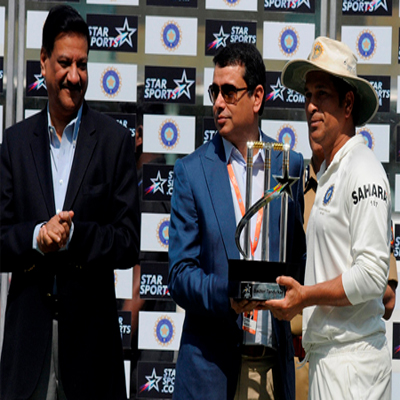
    MUMBAI: Star India CEO Uday Shankar presented the first Star Sports ‘Believe’ trophy to master blaster Sachin Tendulkar at the post presentation ceremony of India’s second test against West Indies in Mumbai.

    ee Coin’ on the top of stumps alongside bails. This is inspired by the real childhood story of Sachin Tendulkar who sparkled under the tutelage of coach Ramakant Achrekar. It is common knowledge that Achrekar used an interesting strategy to inspire Sachin- he would put a one-rupee coin on the top of the stumps when Sachin used to bat in the nets. Any bowler who dismissed him would be rewarded with the coin; however the coach would hand over this coin to Sachin himself if he passed the whole session without getting dismissed. This remarkable way of rewarding ensured that Sachin kept a very high prize on his wicket throughout his career.


    Uday Shankar presenting the first Star Sports Believe Trophy to Sachin Tendulkar


    Star Sports’ new network’s campaign urges India to ‘Believe’ with an aim to inspire the hero in each and every Indian.

  • Star Sports plays hard ball with Siti Cable

    Star Sports plays hard ball with Siti Cable

    MUMBAI: Star Sports has come out with a pan India notice against India’s Multisystem operator Siti Cable. The notice that was issued in select newspapers on 15 November as per the Telecom Regulatory Authority of India (TRAI) guidelines has hauled up the multiple system operator (MSO) on several grounds.


    “A huge outstanding and non-signing of agreement in both DAS as well as non-DAS markets are the two major reasons for this notice,” says Star Sports India COO Vijay Rajput.  “I would like to point out here that Siti Cable has not submitted subscriber reports for any of the DAS I and DAS II markets.  Also there have been instances of piracy. Earlier in October, we had filed an FIR against Siti Vision Digital, a joint venture unit of Siti Cable Network at Saifabad police station in Hyderabad, for illegal transmission of the Star Sports channels.”


     The sports network has come out heavily against Siti Cable for not playing with a straight bat.   “We have been following up with Siti Cable for all these issues but have not received a favorable response from its  officials. Therefore, as per the law of the land we have issued a 21 day public notice. We will avail all options available to us if in case Siti Cable fails to resolve the stated issues within the stipulated period,” adds Rajput.


     Star Sports had earlier played hardball with GTPL and yanked its channels off the cable network. Now it’s the turn of Siti Cable. Rajput says that he has been forced to take these steps. “These are the two specific cases that we are trying to address primarily due to non-payment and non-renewal of agreements.”


     So what is it that Siti Cable plans to do post this notice? Answers Siti Cable chief operating officer Anil Malhotra, “Well, this is a regular practice adopted by every broadcaster as per the TRAI regulation, when an agreement is about to end or has ended. The notice is a precursor to negotiation.”


     Malhotra claims that his cable network is already intalks with the sports channel for the renewal of contract. “We had signed the agreement last year in October-November. So the agreement is due for renewal and, so, this notice. We will amicably resolve the issue.”

    Star Sports says it is ready to revisit the matter if the MSO resolves the issues in the set deadline.

  • IMG Media hires former ESPN Star senior exec

    IMG Media hires former ESPN Star senior exec

    MUMBAI: From broadcasting to selling sports programming and event properties – that’s the path Former ESPN Star Sports business development & corporate communication (south Asia) director Rathindra Basu has taken. Recently, he hopped on IMG Media, which is amongst the world’s largest indpendent producers and distributors of sports programming, as vice-president and head of sales in the Indian sub-continent.


    In his role at IMG Media he will be looking after sports media content distribution and sales for the SAARC countries; covering all forms of media rights – including TV, audio, fixed media, in-flight and closed circuit, broadband and mobile. His responsibilities include developing key relationships with major sports broadcasters and other TV networks including the public broadcaster.


    Speaking to indiantelevision.com Basu says: “In my new role I will be looking at expanding our reach across the Indian subcontinent and reaching out to as many broadcasters for distribution and sales deals.”


    Basu will report to IMG Media Sr VP and head of sales Asia Pacific Chris Guinness, based in the London office and IMG Media Sr VP and head of sales Asia Pacific Leena Singarajah, based in Selangor, Malaysia.

    He will continue to be based out of New Delhi.


    IMG produces more than 21,000 hours of television and more than 30,000 hours of radio programming annually. It provides a seamless solution for both rights holders and broadcasters worldwide. Be it live or studio, in stadium or on the course, across the US or throughout South Africa, it claims to be a stop solution to handle all production needs.


    With over 200 clients and events, including Wimbledon, the Australian Open, the ATP Masters Series, the R&A (governing body and organiser of The Open Championship), International Rugby Board (IRB), MotoGP, the National Football League (NFL) and the International Volleyball Federation (FIVB). IMG operates from over 30 offices worldwide and has daily exchanges with over 4,000 key media contacts. It also maintains the world’s largest sports archive with more than 250,000 hours of footage.