Tag: Star Sports

  • 2015 Formula One Monaco Grand Prix to be aired live on Star Sports

    2015 Formula One Monaco Grand Prix to be aired live on Star Sports

    MUMBAI: Nico Rosberg will be aiming to complete a hat-trick of wins at the Monaco Grand Prix and make further inroads into Mercedes team-mate Lewis Hamilton’s championship lead, as Formula One takes to the streets of the glamorous Principality this weekend.

    Rosberg scored his first win of the season at the last race in Spain, cutting Hamilton’s lead in the standings to 20 points as he got his title challenge underway after a lackluster start to his campaign.

    He will be aiming to repeat that result and build momentum behind his title charge this weekend.

    Part of the triple crown of motor-racing, the Monaco Grand Prix presents a unique challenge to drivers and has been likened to riding a bicycle around one’s living room. Cars thread their way through the tight, twisting streets of the Principality, hemmed in by unforgiving barriers that leave absolutely no room for error.

    Rosberg has excelled in the narrow confines of Monaco, winning the race in the last two years. He is the only multiple winner of the race among the current crop of drivers, apart from Fernando Alonso, and could become only the fourth driver since Graham Hill, Alain Prost and Ayrton Senna to win the race three times in a row.

    Hamilton, Sebastian Vettel, Kimi Raikkonen and Jenson Button are the other drivers in the field to have won in Monaco.

    Given the relatively slower average speed per lap, the Monaco Grand Prix runs for the shortest distance of all races on the calendar. Drivers will lap the 3.34 km-long circuit a total of 78 times.

  • Star Sports India tops Twitter brand index for World Cup 2015

    Star Sports India tops Twitter brand index for World Cup 2015

    MUMBAI: Star India’s sports venture Star Sports sustained its reach on social media platform to gain the pole position on the Twitter brand index for Cricket World Cup 2015. Star Sports was followed by HDFC Life and Alto K10 in the second and third position respectively.


    Twitter brand index for ICC Cricket World Cup 2015


    Star Sports 


    Star Sports has consistently been featured amongst the top conversations on CWC15 with its popular video series that started with the India vs Pakistan group game. Every India victory in the competition meant a new video for the upcoming game. Using the viral hashtag #MaukaMauka that spawned its own memes and tribute versions, the campaign managed to capture the imagination of Indian cricket fans. Over and above this thematic campaign, Star Sports continued to connect with fans over its hashtag #WontGiveItBack – People could tweet to the handle with the hashtag and get the schedule of the matches in the cup.


    HDFC Life


    HDFC Life brought the Indian cricket fan together with the hashtag #MyTeamMyPride. Under the aegis of the hashtag the brand engaged with fans on predictions, contests and general comments around the game. Users loved the hashtag and used it as one of the top rallying cries this CWC15.


    Alto K10


    Alto K10 is one of the few car brands that used CWC15 to talk to its target group. With a creative spin on their brand tagline Chase Life, Alto has engaged the Indian cricket fan under its chase campaigns across the hashtags #ChaseCricket and #ChaseMaster. They ran a popular Sorry Sir contest where they invited people to tweet back to them with funny ideas for ways to skip college or office and watch India games. Using topical caricatures, contests and celebrating the team’s victory with fans Alto K10 got people to send them their selfies in blue to show support to the team – Chaselife. They were able to successfully take things that fans enjoy and blend their brand into that conversation.


    Nike Cricket


    A part of the #BleedBlue campaign – Nike created a chant (BleedBlue), which has been reverberating amongst supporters of the Indian cricket team since 2011. This has become the war cry of the Indian fan and this World Cup, Nike shared BleedBlue stories of fan and celebrities alike. As a part of the BleedBlue campaign, the official apparel manufacturer of the Indian cricket team also sent out personalised jerseys to sports stars, celebrities and other members of the sports fraternity. This helped the personalities show their loyalty using the hashtag BleedBlue. The most retweeted advertiser tweet of the CWC was the tweet that they sent out on the day of the semi-finals – asking people to show their support to the team by RT-ing the tweet.


    Lays India


    Lays climbed the chart by rallying the cricket fan on Twitter with the hashtags #LaysKePlays and #TicketKaGame contest. Winners of the contest were given the opportunity to watch the finals of the CWC15 live in Australia. They asked people to tweet with the hasthtag #TicketKaGame to reveal what the contest was going to be. The more the tweets, the faster was the reveal. #LaysKePlays asked users to tweet back to the handle with creative uses of cricket lingo and make it relevant to Lays.


    Lava Mobile


    Lava ran a prediction contest with goodies to be won. Technology brands and contests seemed to be a potent mix on Twitter and users loved it. They tied this in with a brand campaign around their X8 handset. The hashtag they used was #X8HighPerformer. It was a smart way to build the X8’s positioning on performance basis strong performances in the matches.


    Castrol Cricket


    Castrol followed, what in hindsight, seems like the winning model of a good hashtag, a contest and good content. They entered with the hashtag – #ClingOnToTheCup. Their biggest execution this CWC was when they asked people to tweet to them with their pictures and they would put those pictures up on the digital fence at the stadium during the game. Fans loved the idea of being able to become a part of the game in this manner.


    Axis Bank


    Axis Bank built engagement around cricketing rituals. Given the level of fanatical support for the game and the national team, people tweeted about how they do not take bath before games, drink water during games or leave their seats when a particular player is on a roll. Axis Bank used this insight to great effect by inviting people to share their rituals. They sustained engagement by continuing activity on Twitter beyond just match days to an Always On Strategy.


    Score With Data


    The Indian cricket fan loves data and statistics. IBM latched on to this insight and created this handle to share powerful data led insights through the CWC. People followed this account for live insights on players as the game progressed.


    Dairy Milk


    Dairy Milk was another brand that used contests very well. People joined in on the contest FansOfJoy where they were asked to WhatsApp their #FansOfJoy pics to grab their moment of fame in leading dailies. Apart from this there was a quiz where people stood to win Cadbury Dairy Milk hampers.


    Club Mahindra


    Club Mahindra was able to find creative ways to integrate stories from their resorts into the game. They put the Mandala from their logo to great use with tweets around the toss, when Virat Kohli was hitting 4s and 6s and when he reached his 100. When there was a great catch on the pitch they were ready with a tweet that showed someone catching a fish at one of their resorts and drew parallels of what a great catch looked like at Club Mahindra.


  • IPL is the largest reached sports event in 2014: FICCI KPMG Report

    IPL is the largest reached sports event in 2014: FICCI KPMG Report

    The global sports industry is estimated be worth of $600 – $700 billion. Revenue generated from the industry is estimated at $80 billion globally and is growing at Compound Annual Growth Rate (CAGR) of 6.5 per cent over 2009 to 2014, which includes revenues from media rights, sponsorships and ticketing.

    The market for advertising in sports in India was estimated at Rs 41 billion in 2013 growing at a CAGR of 14 per cent from Rs 21 billion in 2008. It consists of on ground advertising, team sponsorship, athlete sponsorship and media ad spends on sports. Licensing and merchandising contribute Rs 2 billion to the industry in India. Gate revenues make up another revenue stream but its contribution to the sports market in India is relatively low compared to media ad spends and sponsorship.

    Sporting events have been popular throughout history, and have gained greater viewership with bigger stadiums and TV broadcasting of domestic and global events. Annual sports viewership in India reached 276 million in 2014. But the sports genre accounts for only 2.4 per cent of total TV viewership and 4.3 per cent of AdEx (Advertisement Expenditure) revenue in the Indian TV industry, much smaller than the general entertainment genre.

    The median age in India is around 27 years and around 64 per cent of the population is expected to be in the working age group by 2020. This provides a large and growing target segment for sports in India. Moreover, an increase in percentage of middle class and rich households (households with annual income greater than Rs 2,00,000) from 6.1 per cent in 2001-02 to 14.5 per cent in 2009 -10 has increased the number of people with an appetite for sports consumption. The middle class alone is expected to increase to 41 per cent of the population by 2025. There has also been an increase in the average share of educational and recreational activities in the annual household consumption and it is estimated to increase from five per cent in 2005 to nine per cent by 2025.

    A good start to non cricket sports is one interesting to look at the growth of sports other than cricket in India. Many sports have grown well over the last half decade. A survey on the popularity of sports in the Indian online community reports that while 85 per cent of respondents followed cricket in some manner, an estimated 44 per cent followed tennis, 41 per cent followed football (soccer) and 32 per cent followed badminton. With economic development, sports viewership in a country usually moves from single sport to multi sport. Africa and the Indian subcontinent have been traditionally dominated by football and cricket respectively. However, with greater economic development, India is seeing a growth in other sports as well. 

    League formats have helped in increasing popularity of sports Globally

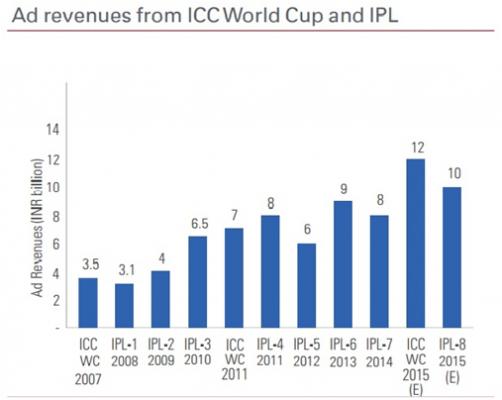
    The leagues system has served as an important way for companies to enter the sports sector. A sports league creates several opportunities for private companies in domains such as league management, franchisee, broadcasting and sports videos production houses, advertising, sports infrastructure such as multipurpose venues, player management, licensing and merchandising. One of India’s most successful leagues in terms of viewership and revenues has been the Indian Premier League (IPL), which is based on the English Premier League (EPL) format. The league was launched in 2008 by the Board of Control for Cricket in India (BCCI) with eight city franchisees. Though it is still small in comparison to some of the biggest leagues of the world, it has been able to achieve success in a short span of time, which other mature leagues could not manage to do. The evolution of IPL as a brand is an example of successful product innovation, which effectively combined entertainment and sports. The Twenty20 (T20) format of IPL has made the sport more popular and convenient to watch for cricket enthusiasts. The success of the IPL, which is estimated to have had a viewership of 191 million people and ad revenue of Rs 8 billion in 2014 has led to the creation of several other league-format sporting events, such as the Indian Badminton League, Hockey India League and the recently launched Pro-Kabaddi League. The inaugural season of football’s Indian Super League has been fairly successful as well. Cumulative reach of Pro Kabaddi League was 435 million compared to 560 million for IPL in 2014. Football’s Indian Super League was close with 410 million cumulative reach. The new domestic sports leagues however require significant management efforts over a period of time to get established and be successful. 

    Viewership refers to sum of weekly GVTs, which is a factor of number of viewers and frequency.

    IPL leads the cumulative reach chart amongst sporting events held in 2014
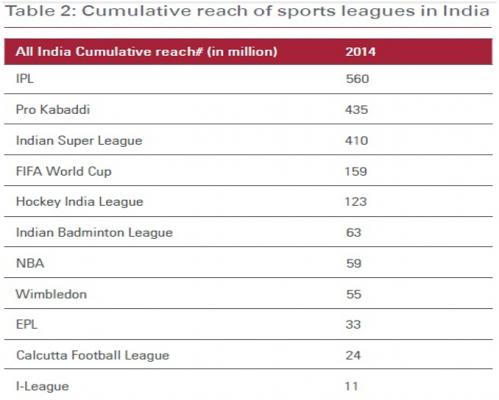
    Cumulative reach refers to the number of individuals within the target group who viewed the tournament over a certain period of time, including duplication.

    Ecosystem to support sports development in India

    However, in order to sustain the growth in sports and sports-related businesses, a flexible regulatory and policy framework that is able to realise synergies between various segments of sports needs to be developed. This in turn requires the sports ecosystem and its stakeholders to be recognised under the purview of a dedicated industry of sports which can provide impetus to an organised and professional business environment for sports in India.

    Sports Broadcasting in India

    There has been a surge in the number of sporting events broadcast in the past few years. These events include tournaments and leagues played at state, national and international levels. Several international tournaments and leagues played at the regional or global level are now telecast in India bringing in a larger and much diverse audience. Males form around 60 to 65 per cent of viewers and are expected to continue to be the main target segment. However, the number of female viewers has been increasing. About 57 per cent of the viewership of ISL and 53 per cent of the viewership of Pro – Kabaddi League was made up of women and children. Broadcasters are supplementing the sports with other entertaining and informative pieces to make the program more inclusive.

    Getting to the right content mix

    With the rise in number of sporting events, sports channels are covering several sporting events in their annual calendar. It consists of a mix of marquee events from domestic and international leagues, major tournaments along with minor domestic leagues and tournaments.

    Star Sports has revamped itself with uniformly branded eight channels to showcase a variety of domestic and international sports both cricket and non – cricket and in English as well as Hindi. While international cricket matches featuring India will make up 65 per cent of Star Sports 1, Ranji matches, university and women’s cricket and international cricket matches not featuring India will form 50 to 60 per cent of content on Star Sports 2. This will enable Star to nearly double its cricket content, which is the major revenue driver for sports channels in India. Star Sports 4 will feature other sports, which include international football (soccer), European soccer leagues, badminton, tennis and Formula-1 racing.

    The new Indian leagues, which include hockey, badminton and soccer, will be telecast on Star Sports 1 to 3 to reach a larger audience. Such a strategy enables Star Sports to increase its cricket content as well as broadcast non – cricket sports, which are seeing increasing traction. There is also an increasing trend towards multi-sports channels, as the viewership of different sports are increasing and sports channels are vying for TV rights across sports. Star has seen a shift from having a cricket specific channel in its cluster to multi-sports channels. It enables Star to broadcast both international and domestic cricket content simultaneously as well as gives it flexibility to show different sports across different channels. This can be attributed to the large investments made by Star to purchase rights for domestic and international cricket, football, tennis, badminton etc.

    On the other hand, Neo has rebranded its cricket specific Neo Cricket to Neo Prime on account of reduced live cricket properties and surge in volume of several sports.

    Ten however, has sports specific channels with Ten Cricket for cricket, Ten Action for football and Ten Golf for Golf broadcasting. Availability of sufficient single sport media rights and a definite viewership base for that particular sport drives the presence of sports specific channels. This helps advertisers to target a specific audience, for example luxury products have tied up with Ten Golf. Although, digitization and lower costs of distribution make single – sport channels more viable than before, it can take some time to evolve in India and reach the popularity of golf and tennis channels in some developed countries.

    Regional language boost to broadcasting

    Another strategy to target a specific audience is the language of telecast. Hindi and other regional languages increase the audience reach for sports as English has a limited audience. Star Sports 3 replicates Star Sports 1 in Hindi. In 2014, it telecast the domestic football league – Indian Super League in five languages. Its regional TV channels were used to telecast the league in Bengali, Kannada and Malayalam apart from English and Hindi broadcasts. During FIFA World Cup 2014, Bengal accounted for half the country’s viewership mainly because of regional language feed by Multi Screen Media (MSM) on its Bengali general entertainment and film channel Sony Aath. Hindi broadcast of the Pro Kabaddi League on Star Gold also helped take the cumulative reach to 435 million for the event. Other than using regional sister channels for feed in local languages, sports channels may spin off separate regional language sports channels if the demand picks up.

    Revenue and Profitability model

    Sports industry is still an ad driven revenue model. Media spends on sports, most of which is on TV, increased from Rs 11.5 billion to Rs 22.5 billion over 2008 to 2013 at a CAGR of 14 per cent. In mature markets, subscription is the main revenue driver for sports channels, contributing nearly 60 to 90 per cent of the revenues. However in India, advertisements still account for nearly 60 per cent of the revenues of sports channels, mainly driven by cricket, which is the largest revenue spinner and accounts for nearly 80 to 85 per cent of the total television sports media revenue. Non-cricket sports provide live sports content around the year, which gives advertisers a regular touch-point to their target segments. Revenues from advertisements in any year vary depending on the tournaments and series held during the year. Cricket mostly forms the peaks whereas the troughs are being evened out with non–cricket sports and non-live cricket content. In 2011, ad spends on TV for cricket was estimated to have crossed Rs 20 billion. In 2015, ad spends from the ICC World Cup and IPL 8 alone are expected to be around Rs 22 – 25 billion. Ad revenues for non-cricket sports are only a small fraction of cricket revenues. In 2013, ad revenues from Indian Badminton League and Hockey India League were Rs 0.9 billion and Rs 0.7 billion respectively.
    Key challenges facing the spurt of non-cricket leagues in India includes:

    • Poor investor confidence

    For instance the Indian Badminton League (IBL) suffered a loss of Rs 25 crore in the opening season in 2013 owing to investors pulling out casting doubt on the return of IBL with its second season. However, despite no play in 2014, the IBL is set to return in 2015.

    • Lack of industry status

    Provision of industry status could lead to an organized sports industry leading to higher available capital, newer sports businesses, additional revenue streams for stakeholders making leagues commercially viable ventures.

    • Lack of a culture for sports

    Sporting leagues in India are designed to last just a couple months every year. However, many major sporting league seasons in the world last for longer durations every year. Sporting leagues need to become year round (or at least three – four months a year) ventures. Apart from the benefit of a longer engagement with viewers (allowing the building of a larger fan base and culture for the game), this also touts the idea of sport becoming a year round profession furthering the advent of sports businesses.

    Revenue model in leagues

    Major sources of revenue for any league come from media rights, sponsorships and revenue from franchisees. Share of franchisee consideration in IPL has increased from 30 per cent in 2010 -11 to 37 per cent in 2012- 13 with a corresponding decrease in the revenues from sponsorship rights. Income from media rights and other sources have nearly the same share in 2012-13 as in 2010- 11.

    Major Sources of revenue for a League Franchisee

    Major sources of revenue for any league franchisee are share of the central revenues, local revenue and performance revenue.

    • Share of central revenue

    This includes a percentage of the revenue to the league from media rights and central sponsors like Pepsi in the IPL. In India, media rights are a major revenue sources both for the league and the franchisees. Channels are expected to further increase the subscription revenue for sports channels.

    • Local revenue

    Local revenue for a franchise entails revenue from match day ticket sales (gate revenue) and commercial revenue that includes funds from franchise sponsors, merchandise sales and revenue generated from membership with the franchise club if any. However, revenue from franchise sponsors makes for a majority of the commercial revenue. Sports merchandise sales is a fast growing segment with Rs 2 billion in retail sales in 2013. Moreover, contribution of gate revenue to overall revenue of franchises is low due to inexpensive ticket pricing, especially in non-cricket leagues. This is in contrast to leagues abroad where gate revenues are a significant contributor to a franchisee’s revenue.

    How can leagues be further popularised/ monetized?

    Some of the critical success factors of a league in India are identified below:

    • Players

    Involvement of top players of the world creates interest in the viewers and increases the quality of the game. The IPL is a successful example of the same. On the other hand, I-League is struggling to attract top players resulting in poor viewership.

    • Marketing

    An effective marketing campaign is another critical factor in making the league popular. Again, the involvement of various celebrities as brand ambassadors or owners in the IPL contributed to generating larger viewer interest in the league. In fact, the marriage of the Indian entertainment industry and cricket has aided in making IPL a commercial success.

    • Governance framework

     It is seen that leagues, which are run with the support of the approved federation have been able to sustain. The ICL failed due to lack of support from BCCI and World Series Hockey (WSH) is facing similar troubles due to non-recognition of the founding federation as the official national sports federation of hockey itself.

    • Stadium Infrastructure

    Quality of stadium infrastructure improves the viewing experience, hence increases the level of interest in the sport. It is important to create supporting infrastructure like restaurants, bars, fast-food chains, merchandise, stores, books and music stores, etc. to develop stadiums into popular entertainment spots for the family. Hike in ticket prices subsequent to rise in viewership, organizing multiple sporting events and entertainment shows wherever possible can help monetise stadium infrastructure.

    • Fan base

    An effective strategy to increase a franchisee fan base is engagement of respective franchises with local community. This helps generate greater TV viewership, increase attendance of matches and sale of merchandise. Performance of national team or players at international level increases the interest in the game, hence the league.

    League timing

    The tournament should be held at a time when there is no clash with international tournaments that could divert a significant section of the viewers, many players are available and weather is suitable for holding matches. The length of games and timing of matches (conducive for family viewing) are also important factors to consider, both having further helped significant viewership of the IPL. Other factors may include spectator friendly broadcasting such as better viewing angles and broadcasting in Hindi and English.

  • Is BARC all set for broadcasters and media agencies in Kolkata?

    Is BARC all set for broadcasters and media agencies in Kolkata?

    KOLKATA: While Broadcast Audience Research Council (BARC) seems all set to formally launch its much-awaited television audience measurement system in phase wise manner starting April, broadcasters and media agencies have begun to pull out from TAM India. If industry sources are to be believed, broadcasters like Star, Zee, Discovery, Star Sports, India TV and NDTV have already sent their termination notices to TAM.


    Regional media broadcasters specifically in West Bengal, however, have their own viewpoints. In Kolkata, broadcasters and media agencies expect to get a fair report with the introduction of BARC’s new TV ratings measurement system.


    At a time when agencies and broadcasters in Mumbai have already sent letters to TAM informing them that they are either not extending their subscription after 31 March, 2015 (in case their current subscription is expiring on that date) or terminating their subscription with the stipulated one-month notice period (in case their subscription runs till 31 December, 2015), Kolkata-based agencies and broadcasters have not yet got any detailed report on the pricing and policies of BARC.


    “BARC authorities came to Kolkata for one road show and with the lack of interest shown from people here and the absence of proper feedback, it hasn’t taken much initiative in Kolkata,” a city-based advertising agency executive said on condition of anonymity.


    Zee Entertainment Enterprises controlled 24×7 Bengali news channel 24 Ghanta will pull out from TAM along with the network’s others channels, said an executive from 24 Ghanta, adding that almost all channels in India are likely to do that. “With the arrival of BARC, it would make an even equation for all the stakeholders,” the channel executive added.


    When queried about the expectations from BARC, the executive said, “No tampering is possible as BARC will provide a wider audience reach. We also expect scientific and more detailed findings from untapped rural areas.”


    On the other hand, Aakash Aath director Eshita Surana said, “We have yet not decided, whether we will continue with TAM or no. We have not yet got the pricing policy from BARC.”


    However, Surana went on to add that the company has high hopes from BARC.


    On the initiatives being taken to establish strong communication, BARC CEO Partho Dasgupta said, “We have been constantly communicating through our newsletters, press interactions. website, twitter, roadshows and meetings. Pricing model details are on the website and all CEOs who watermarked the channels have been written to individually.”


    BARC, in the past three weeks, has been seeing an increasing rush from smaller broadcasters, both national and regional, who are now getting watermarked.  


    Speaking about expectation from BARC, a Kolkata-based GEC executive said that BARC’s report will at least not bring Kolkata TV’s teleshopping show in the top 20 programme list.


    Moreover, the number of peoplemeters that TAM had installed was 10,000 whereas BARC will be starting with 20,000 and then plans to gradually scale up the number by 10,000. “This will ensure more representation and data from these peoplemeters that will enable a more accurate understanding of stickiness, preference and even demography of every segment of viewers. BARC will even provide zip-code wise data on ratings, which will help advertisers in choosing the right TV channels to reach out to their TG,” brand and communications expert Mahul Brahma added.


    A media buying executive said that all stakeholders, including the media agencies, have invested in the new BARC system, and it is natural that all should move to this audience measurement system. “BARC is a joint industry body, and we are part of the industry. We believe that BARC will have a more accurate and better measurement. Our preference would be to go with the measurement which is more robust, transparent and accurate,” he said.

  • Star India ropes in new brands; hikes ad rates for World Cup

    Star India ropes in new brands; hikes ad rates for World Cup

    MUMBAI: As Dhoni and team prepare to face Australia and book a berth in the final of the biggest cricketing event, Uday Shankar and his team at Star India have roped in more brands as partners to make the ICC Cricket World Cup 2015 one of the biggest revenue generating sport event in India.


    Before the start of the semi final rounds, Star India roped in many new sponsors across categories like Amazon, Snapdeal, indiaproperty.com, OLX, Voltas, Dell, Panasonic and Toyota.   


    Sources in Star told Indiantelevision.com that the ad rates have also seen a substantial hike. “A 10 second slot during India VS Australia bout will cost around Rs 18 – 22 lakh and the later the brand comes in, the more it pays,” the source added.


    The cumulative reach of the tournament soared up to 576 million viewers and is expected to grow further if India qualifies for the finals. 


    In the other semi final, New Zealand face South Africa. While both teams played numerous semi finals, neither have managed to qualify to the final of the flagship tournament. A highly nail biting match is expected and hence the ad rates have been hiked to Rs 14 – 16 lakh for a 10 second slot.       


    Star had a slow start to the tournament as Indian performances prior to the tournament was below par and fans had low expectations from the team. However in a way, this did Star a big favor as circumspect brands endorsed till certain stage predicting limited progress of Indian team. “People thought India won’t qualify for the final stages and bought slots till certain rounds instead of the full tournament. Due to that, in the later stages there are slots available, which is enabling Star to rope in brands at such high pricing,” said a media buying and planning expert.


  • Star India’s ‘Mauka’ mania inspires creative videos

    Star India’s ‘Mauka’ mania inspires creative videos

    India qualified to the semi-finals of ICC Cricket World Cup 2015 in sublime fashion. In the semi-final, India will face host nation Australia and pundits predict an evenly poised match.


    The voyage of team India in this edition of ICC Cricket World Cup was well complimented by Star India’s creative innovation ‘Mauka’ and as India readies itself for the important bout against the Kangaroos, Indiantelevision.com lists various ‘Mauka’ moments that brought smile to thousands of faces.


    As is the trend nowadays, after every India match Star launches a ‘Mauka’ video, the world also partakes in the Mauka Mania and creates a piece of its own. We take this opportunity to scan through the non Star India ‘Mauka’ videos made during the course of the tournament.

    Take a look:


    Bangladesh indeed is flying high as they stunned England to secure their berth in the quarter finals of ICC World Cup 2015. But their opponent in the quarter final was none other than the defending champions: India, who is so far undisputed in the tournament.


    The video features a giant monster decimating representatives of nations, which Bangladesh has defeated so far in the championship while the Indian astronaut hides himself to escape the demolition. The humorous piece with Rise of Tigers slogan depicts Bangladesh’s emergence in the tournament.


    This video shows an India supporter witnessing disappointing moments during the India VS Bangladesh match in 2007 World Cup with crackers in his hand, which India had lost. 


    The renowned online netwrok “The Viral Fever” came up with its version of the ‘Mauka’ video.


    The video was launched before India Vs West Indies match. It depicts India’s formidable performance and claims “Is Baar Sab Ki Phodenge,” which implies that in this World Cup, team India will spoil every opponent’s celebration.   


    This video from ITV 2.0 Productions goes beneath the boughs to depict a different scenario. It showcases circumstances where India lost all of its group matches and the opponents are participating in a joint celebration. But unfortunately for them the celebration turns out to be a flop show because the crackers were too bad to burst, and while they anxiously try to find what is wrong with the fireworks, they discover they are a low quality China made products. In the next scene, the video shows PM Narendra Modi cracking a deal with his Chinese counterpart. The moral of the video is that while the entire world planned and plotted against India, India refuses to hold back and keeps prospering.


    The same group came up with another one of a kind, all girl ‘Mauka’ piece, right before the India Vs Bangladesh match. The video shows how every team that has qualified for the quarter finals is pampering Bangladesh. The moral of the video is that if Bangladesh knocks India out of the tournament, then other teams will escape the demolition India has been offering so far to opponents.

  • Star Sports-Sony spar over World Cup, IPL performances

    Star Sports-Sony spar over World Cup, IPL performances

    MUMBAI: Even as the national sides are battling it out on the pitches in Australia-New Zealand to decide who will take home the World Cup in the quarter final stage, a behind the scenes slugfest is taking place between two rival broadcasters, which have both laid big bets on the sport. We are referring to Star India and Multi Screen Media (which runs the Sony Entertainment Television network in India).

    The former is telecasting the World Cup and has the rights to India cricket internationally, while the latter is gearing up to telecast the cricket league – the Indian Premier League (IPL) in the next two months, apart from Euro 2016 qualifiers, FIFA International friendlies and various Fight sports. At stake is close to Rs 4,500 crore that is likely to be spent by advertisers on sports television this year. Of this ginormous pie, approximately Rs 2000-2,200 crore is estimated to be spent on the World Cup and IPL. It’s no wonder then that the two are resorting to sledging within the confines of advertisers’ and media agencies’ cabins and to journos.

    Star India began its World Cup innings just about three weeks ago – rather shakily. A Sony spokesperson reveals that the Star ad sales team had just about managed to raise Rs 100 -150 crore or so in ad and sponsorship deals before the once-in-four-years tourney began. “They were really desperate,” he says. “India were performing abysmally on their tour overseas.”

    The Star spokesperson is quick to respond, “In the first two weeks only, the advertiser as well as sponsor count for the 2015 ICC Cricket World Cup was 50 per cent higher than 2011 edition as well as the IPL.”

    The Sony spokesperson’s rejoinder to this is that India’s stupendous display against Pakistan in their opening encounter helped bail out Star Sports. Advertisers flocked to its doors, cash in hand ready to pay premium to air their TVCs. Estimates are that Star India will raise anywhere from Rs 800 – 900 crore from this year’s contest, which ends late in March.

    And even as Star has been screaming that this year’s edition has generated the highest ratings ever, and in its trail ad revenues, Sony’s spokesperson has been rubbishing the numbers. Says he: “The ratings in this edition have seen a substantial decline when compared to the 2011 edition. Moreover fans had to wait for a week to witness an India match; the decline is constant in the non-India matches too. Whereas in IPL, each and every match is entertaining and is showcased on prime time.”

    He adds, “After 31 matches, the bouts involving India are generating 6.1 TVRs, which was 10.3 during the 2011 edition and the decline is constant in non-India matches too wherein it has dropped from 3.6 TVRs to 1.3 TVR.”

    Terming those figures as absolute no-balls, the Star India spokesperson asserts, “The cumulative reach of the ongoing World Cup touched 534 million viewers after the first 29 matches (TAM data CS4+ extrapolated to the universe using a standard conversion factor). In terms of TVRs, the India vs Pakistan match garnered 14.9 TVR, India vs South Africa got 12.7 TVR, and India vs West Indies managed 13.1 TVR and the non-India match ratings are fluctuating from 2 to 2.5.”

    Media observers also point out to the fact that the reporting of the ratings has also changed since 2011. “In those days, LC1 towns were not factored into the ratings. Hence, a pure comparision is also not possible,” says a media expert. “It’s like comparing apples and oranges.”

    The Star India spokesperson in turn takes a dig at MSM’s telecast record of the IPL, saying the trend is clear. “The IPL reach has declined continuously since season one and sharply in the last three years. Post World Cup in 2011, the tournament suffered as both foot fall and engagement dropped.”

    Terming these allegations as “baseless,” the MSM official shared the cumulative reach of IPL since its inception.


    The official also added, “Not only in terms of cumulative reach every year but also in terms of ad revenue we witnessed an eight – 10 per cent increase.  IPL is an established entity and considering the fact that the tourney has survived through many ifs and buts in past years, the asset is now beyond question.”

    The Star spokesperson says that MSM has a major challenge on its hands over the next few weeks. It is going to telecast the IPL very soon after the World Cup ends; at a time when the sports ad spends appetites of some advertisers may have been satiated courtesy the World Cup. However, to MSM’s advantage is the fact that most big spenders are beginning new financial years (the year end for most large corporates in India is 31 March) and hence will have fat wallets. Nonetheless, Sony has to raise anywhere from Rs 900 to 1,200 crore to make this year’s IPL outing pay off.

    The Sony spokesperson quickly reverts that this is a given. “While we don’t comment on internal financial figures, we will meet and maybe even beat the revenue target we have set for this year’s IPL,” he says. “Advertiser interest is rising thanks to the excitement that is building around cricket.”

    Even as they are taking digs at each other’s performances, the fact remains that both broadcasters are well aware of the importance and valuation of the two flagship tournaments. Moreover the fact that Star’s Hotstar platform is the digital partner of IPL and Max was the destination of the World Cup not long back, proves that the two desire both the tournaments equally. Star India probably is hungry for growth in sports. Its CEO Uday Shankar has outlined the broadcast network’s intentions very clearly: it wants to pitch in a big way to grow the sports ecosystem in India. And in the process, also bring in mountains of revenues for his network.

    When the next bidding process for the IPL begins by next year or so, you can be sure Shankar and his team will be on the frontlines making a definitive attempt to acquire its rights. Of course MSM’s NP Singh will be up front too. The rivalry will continue.

  • Nike emerges as ‘Social Star’ during ICC World Cup: TO THE NEW

    Nike emerges as ‘Social Star’ during ICC World Cup: TO THE NEW

    MUMBAI: Events like the ongoing Cricket World Cup 2015 are becoming opportunities for brands to leverage the euphoria generated by cricket crazy fans.  A lot of these brands have launched innovative campaigns on social media channels, by spending oodles of money and engaging social users especially the millennials. 

    Digital analytics company TO THE NEW Digital has come up with an innovative framework that helps brand measure their “Social Impact Index” to gauge the effectiveness of their digital media campaigns. The report also mentions the social media strategies they can use to reinvent and recalibrate their campaigns to ensure a visceral brand connect with their target groups.

    The Social Impact Index of Brands has been calculated by plotting a bubble chart of social media mentions and social sentiment score of various campaigns run by 14 brands* across four categories namely FMCG, Consumer Electronics, Auto and Sports. It has considered only B2C brands in its sample study to facilitate a like to like comparison. (*If a brand is running more than one campaign then the consolidated numbers of those campaigns have been considered for the analysis.)

    For example, if Pepsico has a total of 33,024 social media mentions and **Net Sentiment of 18 per cent, then the Social Sentiment Score is 59,44,32. 

    **Net Sentiment = Positive Segment – Negative Segment

    -Some of the insights from the framework are as follows:

    Nike is a “Social Star” as it enjoys a huge number of social media mentions as well as a high net sentiment in those mentions. It recommends that Nike has everything going in the right direction for its campaign but it can work on further optimising its ROI from social media spends to maintain its status quo of a “Social Star.” 

    It further says that Star Sports and Pepsico are “Social Question Marks” as they have done fairly well on the social mentions front but their net sentiment is low. The recommendation for these two brands in this category is that they have done well but can invest in online reputation management exercise to converge from Social Question Marks to Social Stars. 

    A large number of brands like Cadbury, Castrol, Hyundai, Sony, Intel and MRF have been categorized as “Social Laggards” category as they enjoy a high net sentiment. It is recommended that these brands have done well but can invest in online reputation management exercise too, so that they converge from Social Laggards to Social Stars.

    Meanwhile a few players like LG, Reebok, Nestle and Dominoz have fizzled out in their social media campaigns and have been put into the category of “Social Duds” as they have low number of social media mentions as well as a low net sentiment.

    TO THE NEW CEO Deepak Mittal stated that brands in this category need to invest heavily in improving their outreach in the form of mentions by investing in paid campaigns and also engage in online reputation management exercise to improve their net sentiment. “They can also think about evaluating their campaign further and move to a new positioning for their brand on social media front,” he added.

    Category Scorecard

    Evaluation Framework- The Social Impact Index of all the 14 brands were plotted on a X-Y axis Bubble Chart. The average of Social Media Mentions of all the 14 brands has been used as a demarcation for High-Low social media mention score. Similarly the average of Social Media Sentiment of all the 14 brands has been used as a demarcation for High-Low social media sentiment score. Therefore a bubble chart is divided into four quadrants to evaluate the success of the campaigns run by these brands.

  • Team India’s winning run against the West Indies scores 13.1 TVR

    Team India’s winning run against the West Indies scores 13.1 TVR

    MUMBAI: Three weeks on and still in the league stage, the viewership for the ICC Cricket World Cup 2015 rose to over half a billion viewers. The cumulative reach of the ongoing World Cup touched 534 million viewers after the first 29 matches (TAM data CS4+ extrapolated to the universe using a standard conversion factor).  


    With the defending champions on a roll, the India versus West Indies game rated 13.1 TVR across the Star network and DD (TAM M15+ ABC). The match rated 10.9 TVR on Star network and 2.2 TVR on DD (TAM data M15+ ABC). Close to 262 million viewers (TAM data CS4+ extrapolated to the universe using a standard conversion factor) tuned in to watch team India chase down the West Indies’ total to register their fourth consecutive win in the ongoing ICC Cricket World Cup 2015. 


    Viewers across the country cheered for team India across multiple feeds with Hindi, English and Tamil emerging as the preferred languages. Hindi and regional language contribution continued to be high with 80 per cent of the viewership coming from the non-English feed. 


    Star extended the ‘Mauka’ campaign for the India West Indies game incorporating the festive celebrations on the occasion of Holi receiving overwhelming response from the fans. The India West Indies promo was watched by over 2.7 million fans as the campaign overall crossed over 17 million online views. 

  • India vs South Africa match engages 257 million viewers

    India vs South Africa match engages 257 million viewers

    MUMBAI: A whopping 257 million fans (TAM data CS4+ extrapolated to the universe using a standard conversion factor) tuned in to support Team India’s bid to retain cricket’s most coveted prize, as MS Dhoni and his men seized their ‘mauka’ opportunity and scored their first ever victory against South Africa in a World Cup match.


    The match rated 12.9 TVR across Star network including DD, with 10.5 TVR on Star network and 2.4 TVR on DD (All TAM data M15+ ABC).


    The joy of beating the Proteas was amplified for 76 per cent of the 257 million viewers as they tuned into the India South Africa game in their preferred language feed in Hindi, Tamil, Bengali, Malayalam and Kannada. The English feed contributed remaining 24 per cent of the total viewers for the game.


    Star India COO Sanjay Gupta said, “The viewership for India’s first two games of the ICC Cricket World Cup 2015 bears testimony to the cricket frenzy sweeping the nation. The fans, with their undiminished support for Team India, have been treated to some quality action and results of choice. The World Cup in regional language articulated by former India players has taken the viewer experience to the next level. Our efforts of bringing the fans closer to the world cup experience through a host of innovations have borne fruit and they continue to rally to Team India’s defence of its title.”


    The flagship ODI tournament has remained true to its billing of the most exciting cricket extravaganza drawing 473 million (TAM data CS4+ extrapolated to the universe using a standard conversion factor) fans to tune in to within the first two weeks of the tourney.


    The clash between two favorites for the ICC Cricket World Cup 2015 also sizzled across social media – with 175,000 unique authors driving 254,000 conversations – dominating the trends for the day. Star had extended its popular and disruptive ‘Mauka’ campaign to build anticipation ahead of the South Africa game, releasing a new promo under the fan passion theme, #maukepechauka, which was trending through the day in India.


    The viewership numbers for the India – South Africa game build on the record viewership for India’s tie against arch-rivals Pakistan. The blockbuster clash attracted 288 million viewers, making it the most watched television event in India since the finals of the ICC Cricket World Cup 2011.