Tag: Star Plus

  • Life OK and Sony the only gainers in week 16

    Life OK and Sony the only gainers in week 16

    MUMBAI: It was a ‘cold’ week for Hindi general entertainment channels (GECs) with most of the channels witnessing a drop in its viewership. In week 16 of TAM TV ratings, Life OK and Sony Entertainment Television (SET) were the only gainers.


    Life OK moves back to the fourth position with 288,556 GVTs, up from 287,837 GVTs. Despite a rise, Sony continues to stay put at the bottom position with 231,751 GVTs, up from 221,219 GVTs.


    Amongst the newbies, &TV too saw a significant growth and recorded 98,588 GVTs, up from 88,321 GVTs.


    Talking about the losers, Star Plus continued to lead the chart with 545,047 GVTs, down from 601,567 GVTs. Colors continued its stability at number two with 404,374 GVTs, down from 409,767 GVTs.


    Zee TV, at number three, registered 377,939 GVTs, down from 388,914 GVTs, whereas Sab stayed happy at number five with 271,638 GVTs, down from 295,542 GVTs.

  • Hit at the box office, flop on TV

    Hit at the box office, flop on TV

    From Anurag Kashyap’s Yudh for Sony Entertainment Television (SET), Ashutosh Gowariker’s Everest on Star Plus, Vipul Amrutlal Shah with Pukaar – Call For The Hero on Life OK, Anil Kapoor’s 24 to Sanjay Leela Bhansali’s Saraswatichandra on Star Plus, the small screen has always welcomed big filmmakers with open arms. However, it is a different story that not many of them have been able to make a mark on television.

    Despite having deep pockets, the crowned kings of weekend box office, somehow fail to rule weekdays on television. Moreover, these were not your “typical Indian daily soaps.” With oodles of star power and mammoth production budgets, these shows took programming on Indian television to a different level.

    Producers are now pumping in more money in daily soaps, be it for grander sets, better special effects or skilled writers and directors. For instance, each of these episodes costs upwards of Rs 1.25 crore as compared to the normal budget of Rs 6-8 lakh for 30 minutes of fiction.

    Moreover, these handful of shows are attempting to push the fiction envelope in the Rs 43,000-crore Indian television industry today.

    Unfortunately, the production cost incurred by these shows fails to justify the visibility the shows garner.

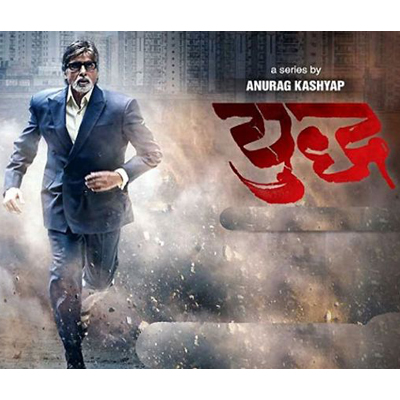
    Let’s start with Yudh. This was one of the most talked-about shows of 2014 with Bollywood megastar Amitabh Bachchan making his television fiction debut on Sony. The show ran for four weeks, with five episodes a week. The estimated cost of the show, per episode, was around Rs 3 crore. While the channel promoted the property extensively, the buzz hit the rocks when it clocked an average of 1,199 TVTs in its opening week. The industry termed it as ‘dark’ content for the 10 pm slot on Indian television. 

    Similarly, Bhansali’s Saraswatichandra spent close to Rs 12 lakh per episode, little higher than what a fiction daily soap would spend. Though it started on a good note with 5,730 TVTs, it later lost track and the numbers fell drastically.

     After Bhansali, Star Plus brought Bollywood filmmaker Gowariker back to the small screen with Everest. Touted as one of the most expensive fiction shows, it was shot at locations like Nepal, Uttarakhand and the Dokriani glacier. With technical equipments like GoPro cameras, 4K technology etc, the production cost per episode was around Rs 35 lakh. The channel had pinned high hopes on the show but it failed to generate ratings as expected. It registered 2,845 TVTs in its opening week.

    Another show with a different perspective titled Pukaar had men as the main protagonists. Based on a story with an army background, it saw filmmaker Vipul Shah making his debut on television. Close to Rs 13 lakh had been spent per episode on production. Needless to say that Pukaar failed to call in the audience.

    While more often than not they’re armed with a magic formula for success on the big screen, why do these filmmakers’ high-budget television stint fail to bring in viewers?

    Indiantelevision.com spoke to industry experts to know whether Bollywood biggies have simply lost their way or have audiences grown tired of their particular brand of filmmaking?

    Media planners feel that no matter how much money a maker puts in, if the content doesn’t reflect the taste and preferences of Indian viewers, the show is bound to flop.

    Helios Media managing director Divya Radhakrishnan opines that television and movies are very different mediums. “In a movie, you get two hours to tell your story and a maker knows how to build it section by section. Television is 22 minutes in and out. How you can link the 22 minutes and have a 24-hour gap before you come up with next 22 minutes is important. So, there is a different knack of doing television, which is very different from movies,” she says.

    Similarly, Radhakrishnan believes that television makers can’t do movies. “Look at the mindset, for instance, from a hijack sequence in Diya Aur Baati Hum to a wedding scene in Yeh Rishta Kya Kehlata Hai, a viewer’s mindset is changing constantly. Assuming that a person is watching Star Plus end-to-end, this is the kind of graph that goes on television. However when you are watching a movie, a viewer, right from the first minute to the end of the three hours, is fully in tune with the character. Movie format is very different from that of television.”

    Another observer feels that film producers are so oriented towards movie making that they have to re-orient themselves for television, which is very difficult for someone of creative caliber like Gowariker, Bhansali etc.

    “It’s not about a show doing well or not doing well, but when BARC rollout happens, the benchmarks are going to change. The mindset of a Baalika Vadhu viewer will be different from that of a Yudh viewer,” adds Radhakrishnan.

    Concurring with Radhakrishnan, a media analyst feels that the grammar of storytelling on television is different from films. “On the big screen, filmmakers have support of huge stars, which is one reason for the film doing well. On TV, big filmmakers will definitely have the money to pump in but no big stars, which can back them up with the content they deliver. Shooting at exotic locations and increasing production cost are not necessarily recipes of good content.”

    Argue that Yudh failed to make an impact on viewers despite having probably the biggest star there ever has been in Bachchan and the burden of failure immediately falls on the frail shoulders of content, which invariably is king.

    Another point to factor in here is the crew that works on the production. A media analyst feels that by getting the crew that works on films will not necessarily work on television. “The way creative people think for movies and television is way different. You can’t get the same set of film people to write or direct for television,” the analyst opined.

    From a purely demand and supply point of view, mainstream watchers do not look for intellectual content after a day full of hardship. “They just want entertainment, which Yudh failed to deliver,” opines a top executive of a production house. “After full day of work, who would want to watch ‘dark’ content? What one needs is good content, which can de-stress the mind.”

    Another observer believes that in the US, TV series form a substantial market for various studios, and it is taken quite seriously by all participants like studio, writers, producers, director, actors and the audience. “In India, the television industry is yet to achieve that status. For this to happen, the content and formats on Indian television needs to witness a sea change.”

    While one has caught a glimpse of this change wherein big-budget shows like 24, Bigg Boss, Satyamev Jayate and Mahabharat have worked, the fact remains that such shows are far and few. A media planner says, “Why is it that these high-budget shows worked on television? It is because the content directly clicked with the audiences as the makers understood what the audience of today wants.”

    Offering a different take, a Hindi general entertainment channel (GEC) executive says, “The target audience for most Indian TV shows is households that don’t prefer watching anything sophisticated but only the typical serials. For many years, saas-bahu serials, in which Ekta Kapoor thrived, ruled the roost. Over the years, many other themes opened up like dance, music competitions, historical serials etc. However, in all these the inherent style remains the same, just the setting changes.”

    How important is time slot for the success or failure of shows? To this, Radhakrishnan says, “People chase good content. For instance, last year Colors filled up the 9-10 pm slot with two shows Beintehaa and Rangrasiya, which did average in numbers and less in viewership. Why didn’t these shows work in the primetime slot? However, now the channel airs Ashoka Samrat in the same time slot. The show has a very strong base and so it’s doing well. At the end of the day, it’s all about having good content.”

    A trait that people lack today is patience. Radhakrishnan argues that people are not patient nowadays and will go wherever they find content that appeals to them. It boils down to the game of content and the appeal it brings to the table. “Otherwise Saath Nibhana Saathiya at 6.30 pm and Yeh Hai Mohabattein at 11 pm wouldn’t be the top rated programmes in the genre. Similarly, Diya Aur Baati Hum for a very long time was the top rated show on the TAM TV ratings chart. However, the last four weeks had a different story to tell when the numbers dropped drastically with the show losing its numero uno position. Thus, to get the audiences back, the show took a generation leap to bring it back on track. In the interim, KumKum Bhagya of Zee has become number one.”

    High production budget and big names don’t necessarily result in getting the eyeballs. So while Karan Johar may produce a show tomorrow starring Shah Rukh Khan and Katrina Kaif, if the content is not strong enough, be rest assured that the viewer is not going to lap it up.

  • TAM TV Ratings: Sab moves to fourth position as Life OK topples

    TAM TV Ratings: Sab moves to fourth position as Life OK topples

    MUMBAI: Amidst speculations of a ratings dark period, the weekly TAM TV ratings have been rolled out. While Star Plus continues to rule the ratings ladder in week 15 of TAM TV ratings, the channel has seen a significant drop in its ratings along with the others.


    Star Plus in week 15 of TAM TV ratings scored 601567 GVTs down from the 633437 GVTs it recorded in week 14.


    Colors continues its strong hold at number two, even though it fell by 6719 GVTs in week 15 recording 409767 GVTs. The channel had received 416486 GVTs in the previous week.


    Positioned third, Zee TV registered 388914 GVTS, down from 405532 GVTs in week 14.


    Multi Screen Media’s comedy channel Sab has seen an improvement, as it jumped to the fourth position in the rankings chart. The channel bagged 295542 GVTs, down from 325559 GVTs that it scored in week 14.


    Life OK, on the fifth position, recorded 287837 GVTs in week 15, down from 301685 GVTs in week 14.


    Sony Entertainment Television (SET), even with the new show launches has not been able to regain its position. The channel fell by 13918 GVTs managing 221219 GVTs in week 15 as compared to the 235137 GVTs in week 14.   


    Last, but not the least, the new entrant in the Hindi general entertainment space &TV saw a marginal dip in its ratings. The channel bagged 88321 GVTs in week 15 compared to the 92563 GVTs in the previous week.

  • Chrome Data: English Entertainment channel genre sees growth in OTS

    Chrome Data: English Entertainment channel genre sees growth in OTS

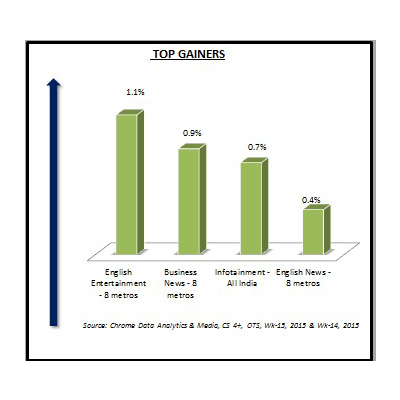
    MUMBAI: Week 15 of opportunity to see (OTS) collated by Chrome Data Analytics & Media, observed a spike in English Entertainment channels genre in the eight metros. With 1.1 per cent growth, the genre was topped by Comedy Central with 52.5 per cent OTS.


    This was followed by the Business News channels genre in the eight metros with 0.9 per cent growth and CNBC Awaaz led the category with 76.9 per cent OTS. Infotainment genre too witnessed a hike in all India with Discovery at number one spot with 82.1 per cent OTS.


    English News channels genre in the eight metros saw a growth of 0.4 per cent. Times Now topped the space with 73.7 per cent OTS.


    Talking about the losers this week, English Movies in the eight genre dropped by 1.4 per cent with Romedy Now being affected the most with 62.4 per cent OTS. 


    Hindi News in the Hindi Speaking Markets (HSM) observed a drop of 0.8 per cent. ABP News topped the category with 94.8 per cent OTS.


    Next in the list was Sports in all India, which saw a dip of 0.6 per cent. Last but not the least, Hindi general entertainment channels (GECs) in the HSM markets dropped by 0.2 per cent. Star Plus was affected the most with 96.9 per cent OTS.

  • ‘DID Super Moms 2’ clocks highest ever opening in week 13

    ‘DID Super Moms 2’ clocks highest ever opening in week 13

    MUMBAI: In week 13 of TAM TV ratings, it was Zee TV’s turn to ‘dance’ as one of its hot dancing property – DID Super Moms rated the highest ever opening episode since its inception. The show clocked around 9,441 TVTs and helped the channel boost its viewership from 394,303 GVTs to 411,915 GVTs. With this, Zee continued to hold its position on the third spot. 


    Sony was also the talking point this week, as it was the highest gainer with 221,802 GVTs, up from 200,620 GVTs. Though it continued to be at the bottom of the chart. On the other hand, Sab at number five grew from 275,000 GVTs to 282,000 GVTs in week 13.


    Talking about the losers of the week, Star Plus recorded 597,835 GVTs, down from 624,246 GVTs. Colors enjoyed its place at number two with 451,682 GVTs, down from 457,100 GVTs. Life OK at number four registered 289,000 GVTs, down from 302,000 GVTs. 


    Let’s take a look at the top 10 shows of the week – Zee TV’s Kumkum Bhagya turned out to be the highest rated show with 9,534 TVTs followed by DID Super Moms with 9,441 TVTs. 


    Moreover, Star Plus’ five shows made it to the top list chart. The channel’s Saathiya Saath at number third position clocked 9,140 TVTs followed by Diya Aut Baati Hum occupying the fourth position with 8,450 TVTs. At number five stood Star Plus’ Ye Hai Mohababtein with 8,128 TVTs followed by Yeh Rishta Kya Kehlata Hai at number six with 7,894 TVTs. 


    Colors’ Sasural Simar Ka garnered the seventh position with 7,513 TVTs followed by Sab’s Taarek Mehta with 6,289 TVTs at number eight. Zee TV’s Jamai Raja at number nine reported 6,229 TVTs followed by Star Plus’ Tu Mera Hero with 6,120 TVTs.

  • Star Plus wins big in week 12

    Star Plus wins big in week 12

    MUMBAI: In week 12 of TAM TV ratings, Star Plus and Colors were the only gainers. Further strengthening its viewership base, Star Plus recorded 624 GVMs, up from 592 GVMs.


    Colors, at number two, notched up and noted 457 GVMs, up from 428 GVMs last week. Zee TV, at number three, registered 394 GVMs, down from 407 GVMs.


    Life OK remained steady at number four with 302 GVMs, down from 307 GVMs. Sab too saw a dip in the viewership and stood at 275 GVMs, down from 288 GVMs. Sony Entertainment Television (SET) continued to remain at the bottom of the chart with 201 GVMs, down from 221 GVMs.


    The newly launched Hindi general entertainment channel (GEC) from the Zee stable, &TV too lost eyeballs as it noted 99 GVMs, down from 105 GVMs.


    Sony Pal witnessed a hike and scored 49 GVMs, up from 42 GVMs. Zindagi reported 21 GVMs, down from 23 GVMs.

  • “Broadcasters need to stop relying on advertisers for revenue”: Sameer Nair

    “Broadcasters need to stop relying on advertisers for revenue”: Sameer Nair

    MUMBAI: Broadcasters need to stop relying solely on advertisers as their main source of revenue. Moreover as digitisation reaches the third phase, it is imperative to for them to come up with new content strategies.


    A FICCI Frames session moderated by media analyst and columnist Vinita Kohli Khandekar saw an aggressive discussion by top level media and broadcast executives on the future of content creation keeping in mind the emergence of digital platforms.


    The panel comprised Balaji Group CEO Sameer Nair, Disney India VP and content head Vijay Subramanium, Reliance Broadcast CEO Tarun Katial, Zee TV business head Pradeep Hejmadi and Star Plus GM Gaurav Banerjee.


    There are approximately 815 channels, which places India amongst the top five video consumers of the world and it is crucial to have varied and captivating content, which caters to the need of the viewers. The biggest question that arises from the scenario is – What should be changed to make better content?


    A pertinent point raised by Nair was that channels need to cut down their dependence on advertisers as their main source of revenue and find alternate sources in order to dish out quality content.


    Nair asserted, “The content we have been producing is often termed as trash, which in reality is not because we all remember the content and no one remembers trash. We are a growing industry and content takes time to transit. We have to give it the necessary amount of time as a sudden transition may lead to confusion. Some years back there were 25 million TV homes and now we have 100 million homes. This proves that we are growing. Like every business, content is dominated by economics. We need to stop our heavy reliance on advertisers. Our need to earn high ratings is because of advertiser pressure and that is what is stopping us from aggressively experimenting with content. We need to start discovering other sources of revenue.”


    Talking about the necessities, Banerjee added, “A lot has changed from where we were a few years back. We are a lot more ambitious from what we used to be. The budget for a half an hour fiction show has risen from Rs 7 lakh– 8 lakh to Rs 15 lakh– 20 lakh and that speaks volumes. Television industry’s biggest power is its reach. We reach twice the audience of the biggest viewed film release and hence with the reach comes responsibility, which we should not forget, while making content. The need of the hour is devoting more time and money to research and development. We need to research in depth before putting up any content as it might have its repercussion and have socio-economic fabric of our nation..”


    During the course of the discussion, an issue that was constantly debated was whether films or TV shows make for better content. Firmly defending TV content over films, Banerjee said, “We should have a more distinguished measurement phenomenon when it comes to cinema and we should also not forget the fact that the number of screens is shrinking. There are a lot of opportunities to improve and no reason to rate films over TV content as of now.”


    Supporting Banarjee’s opinion, Katial added, “Films in recent times have lost their purpose and contribute very little in creating a social impact.”


    “What comes from the production house is just a one line concept and the channel gets into it and executes what is shown on TV. Another part that plays a vital role in improvising content is measurement, which comes from research because what TAM shows is post airing analyses and does not favour in deciding if the content is appropriate. So overall, while we are setting ourselves for the new era of TV content production we have to test, try and excel,” said Hejmadi.


    Now it remains to be seen if TV content makers raise the bar and produce quality content instead of jumping for  quantity and following herd mentality. More importantly, the need of the hour also is for broadcasters to discover alternate source of revenue for their business in order to make compelling content.

  • &TV gains big with 100 GVM mark; Colors reclaims second spot

    &TV gains big with 100 GVM mark; Colors reclaims second spot

    MUMBAI: Zee Entertainment Enterprises’ newest baby &TV is riding high on success. With a brilliant opening of 90.6 GVMs last week, the channel further went on to create a mark for itself in the Hindi general entertainment space. In week 11 of TAM TV ratings, the channel crossed 100 GVM mark with 105 GVMs.


    For the rest Hindi GECs, it was a ‘bad’ week as almost all of them witnessed a drop in viewership. Colors turned out to be the only winner in the week 11 of TAM TV ratings for two reasons. Firstly, it was the only channel to gain and secondly, it jumped back to number two spot with 428 GVMs, up from 424 GVMs.


    Zee TV slipped to number three with 407 GVMs, down from 427 GVMs. Star Plus observed a huge drop and reported 592 GVMs, down from 604 GVMs. Life OK continued to enjoy its stability at fourth position with 307 GVMs, down from 314 GVMs.


    Both the siblings from the MSM stable, Sab and Sony too discovered loss in ratings at number five and six positions respectively. Sab generated 288 GVMs, down from 312 GVMs and Sony registered 221 GVMs, down from 247 GVMs.


    Big Magic reported a marginal rise and noted 42 GVMs, down from 40 GVMs. It seems re-runs of old shows from the Sony stable is working wonders for Sony Pal. It stood at 42 GVMs, up from 38 GVMs. Zindagi scored 23 GVMs, up from 22 GVMs.

  • &TV opens big with 90.6 GTVMs

    &TV opens big with 90.6 GTVMs

    MUMBAI: With only five and half days in the opening week, the newly launched flagship Hindi general entertainment channel (GEC) &TV from the Zee Entertainment Enterprises Limited (ZEEL) stable has emerged as a major gainer in the ratings game.


    This is for the first time that a GEC as new as &TV has opened at 90.6 GTVMs creating waves in the Hindi GEC space. The high octane flagship shows saw both critics and audiences appreciating the progressive and relatable content of the channel.


    Be it &TV’s flagship show hosted by Shah Rukh Khan, India Poochega – Sabse Shaana Kaun? or the strong fiction line up with shows like Razia Sultan, Bhaghyalakshmi, Gangaa, Begusarai, Bhabi Ji Ghar Par Hai!, and the weekend offering with Killerr Karaoke and Tujhse Naaraaz Nahi Zindagi; the programming seems to have struck a chord with the audience.


    On the other hand, week 10 witnessed Sab emerging as the biggest gainer. At number five, it registered 312 GTVMs, up from 265 GTVMs. Moreover, the week also saw the channel competing closely with Star Plus’ sister channel Life OK, which reported 314 GTVMs, up from 312 GTVMs at number four.


    At number six, Sony Entertainment Television (SET) too observed a huge hike in viewership and noted 247 GTVMs, up from 235 GTVMs. 


    Amongst the first three leading players on the ratings chart, Star Plus saw a drop and garnered 604 GTVMs, down from 638 GTVMs. Despite a drop, Zee TV continued to secure number two position with 427 GTVMs, down from 442 GTVMs. Colors remained stable at number three with 424 GTVMs, up from 419 GTVMs. 

  • Zee TV clinches back second spot from Colors

    Zee TV clinches back second spot from Colors

    MUMBAI: It’s been a continuous game of tug-of-war between Zee TV and Colors, each vying for the second and third spot on the TAM TV ratings chart.


    Week nine saw Zee TV overtaking Colors and occupying the second spot. Zee TV gained the maximum viewership as it recorded 442 million GVTs, up from 418 million GVTs. On the other hand, Colors moved back to the third spot with a huge decline and noted 419 million GVTs, down from 444 million GVTs.


    Apart from Zee, the numero uno in the Hindi general entertainment space, Star Plus witnessed a growth in the viewership. It observed a marginal rise from 636 million GVTs to 638 million GVTs this week. 


    Talking about the losers this week, Life OK retained its number four position with 312 million GVTs, down from 316 million GVTs. Sab, at number five, stood at 265 million GVTs, down from 286 million GVTs. Sony Entertainment Television (SET), at the bottom of the chart scored 235 million GVTs, down from 254 million GVTs.


    Other players like Big Magic too lost some numbers and noted 40 million GVTs, down from 47 million GVTs.


    Sony Pal dropped from 39 million GVTs to 38 million GVTs this week, while Zindagi reported 20 million GVTs, down from 22 million GVTs.