Tag: Star Jalsha

  • Videocon d2h taps into the Star-MSO feud

    Videocon d2h taps into the Star-MSO feud

    MUMBAI: Star India’s incentives on its various channels on RIO has not gone down well with several MSOs in the country, who feel that this will actually raise consumer bills rather than make it easier, despite being on a-la-carte. However, the DTH industry sees a prized opportunity in the whole matter.


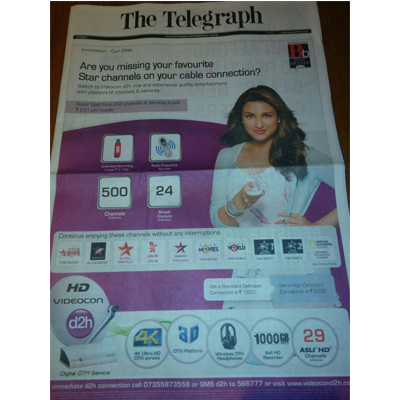
    Videocon d2h has taken out ads in several markets, concentrating in the east of the country, asking consumers to shift from cable to DTH. The ad asks consumers if they are ‘missing their favourite Star channels on your cable connection’ and if so then they should switch to Videocon d2h. The ad also lists the channels that the viewers can watch uninterrupted – Star Jalsha, Jalsha Movies, Star Plus, Life Ok, Star Sports, Star Gold, NGC, Star Movies, Star World etc.


    The ad also points out that viewers can avail 24 Bengali channels on the platform.


    Last week, Star India had come up with a new RIO agreement that it will be enforcing with MSOs across the country. According to Telecom Disputes Settlement Appellate Tribunal (TDSAT), the last date for undertaking the RIO will be 10 November after which the broadcaster can disconnect signals to MSOs.


    The network claims that up to now, nearly 33 per cent of independent MSOs have come forward to sign the RIO.


  • We are neither threatened by Hindi nor do we ignore it: Ravish Kumar

    We are neither threatened by Hindi nor do we ignore it: Ravish Kumar

    Certainly not his maiden stint at handling regional, Ravish Kumar was earlier with Star, managing Star Pravah and Star Jalsha for two years. While he originally got on-board Viacom 18 to head the network’s proposed movie channel which did not materialise for some reason, he quickly rose to the challenge of reviving three regional territories.

    Today, as Viacom 18 executive vice president and business head – regional channels, ETV Kannada, ETV Bangla and ETV Odiya, Kumar is close to completing three years with the network even as the regional market continues to grow from strength to strength.

    On any given day, Kumar is running from pillar to post, what with three different portfolios to handle. However, on a rare day that he was able to find some time, indiantelevision.com’s Vishaka Chakrapani sat him down to understand the business of regional channels. Excerpts…

    How has your experience been with working on regional channels?

    To take up these channels and turn them around is a huge task. Regional channels involve a lot of experimenting and risk-taking. These are vibrant channels in vibrant markets and are full of ideas.  We have started seeing results on some of the channels and on others we have built a solid foundation.

    What makes each market different from the other?

    All states are unique and have a varied cultural background, literature, heritage, theatre etc. This gives a tremendous canvas to paint from.  There is a strong sense of expectation and a strong sense of progressiveness from the people, which means there is a lot of place for us to introduce discontinuities in content.

    After the acquisition by Network 18, one of the first things you did was to get Bigg Boss on the Kannada and Bangla channels. How has it worked and how are the formats working for regional?

    In all three markets, we changed the primetime slot within one year and have reinvented the entire portfolio of fiction and non-fiction. We’ve experimented with established formats like Bigg Boss and Jhalak Dikhlaja and also created our own IP with a show called Indian.  The base of the show is that while you are a Kannadiga, do you understand the nuances of being an Indian. We took a team of 18 to 22 people and took them across the country, where they had to adapt to the local way of life. This is our own format, which gave us more or less the same ratings as Bigg Boss.

    We did Indian in Kannada last year and we intend to renew it but we are looking at reinventing as well. Season one is done and it is of no use to do it a second time. The IP is the fundamental guts of the show which takes you out of your comfort zone and gives you experiences that you haven’t had before to make you a more confident person.  We go for the emotional hook that makes you stronger and exposes you to a life as never seen before.

    So last year, we experimented with big-ticket formats and right now, we are doing a hybrid of Jhalak Dikhlaja called TakadhimithaDancing Stars in which we have licensed the version from BBC Productions and are producing it on our own. We have worked successfully in all three models. International formats, our own IPs, and a hybrid model.

    Adaptation is a misused word. You have to look at whether a show is relevant for the market. Whether the practice or the theme of the show is prevalent in that region.

    If you are doing a huge international format show like Bigg Boss or India’s Got Talent, the scale of production is huge. You have to pay format fee, licence fee that takes the cost to a different level. So there is a certain expectation with what you can do and what you cannot and there is an expectation that people also have which is hard to meet.

    But reinventing for a show every year is a difficult task. It is a challenge because it’s not easy to reinvent. But in a regional market, there is so much more to do. I can be as creative as I want. We don’t care about ratings; what we care about is making sure people like what we put there. We have upped the quality and variety of content in the three channels. So deliver a product and keep your faith in it.

    But big formats have not yet entered Odisha yet? What kind of a market is it?

    Odisha is a smaller market for us and not as well developed or monetised as the others.  There is a limit on the amount we can spend in this market. But what works here is dubbed shows. And we also have six to seven of our own shows. The weekend property is song and dance-based as opposed to big shows due to budget restrictions.

    In Odisha, we are in the process of adapting shows from Tamil and Telugu and from our sister channel, Colors, too. In terms of content, people want soaps, drama, aspirational and progressive shows. In the regional market, you also have the responsibility to educate people. For viewers such as housewives, television is their window to the world. Their ecosystem is very limited. When they watch a serial like Balika Vadhu, which is followed by a learning section, that is what they are really interested in.

    Colors manages to make money out of Bigg Boss by balancing its PnL and not by money earned through the show. Do you also work in a similar manner for regional adaptations of Bigg Boss?

    We are far more sensitive to PnL. There is a limit to the amount of money I can put, even though I want to do a big-ticket show. So that confines or prevents me from taking on more than I can chew. You need to be sensitive to costs in these markets because the cost Hindi can afford is not necessarily the cost we can work with in the regional space and we don’t want to compromise on quality.

    What are the kind of fiction shows that you have on your Kannada channel?

    We have done adaptations of Balika Vadhu and Madhubala called Puttagowri Maduve and Ashwini Nakshatra, respectively. We also have three of our own original shows: Agnisakshi, which is recently launched; Lakshmi Baramma and Charanadasi. Everything has worked for us. So we seek to provide quality and outstanding stories. Madhubala and Ashwini Nakshatra may have started out similarly but now, their stories are extremely divergent.

    How has the market evolved in these three states?

    I think regional continues to grow faster than Hindi. Earlier in Bangla and Kannada, you would pull in GRPs by pulling in people to watch. The market now has stabilised at a level and now you are taking share from each other. The TV penetration and coverage continues to grow. We are going to have a new method of looking at data, which might lead to some redefinition of universe. TV hasn’t reached saturation. We are now seeing increasing penetration of second TV households.

    ETV has a slightly older audience due to its long existence. How do you ensure your fiction shows reach out to the right TG, especially the youth?

    In fiction, our stories are very mainstream and we are giving newer talent a chance. We are supplementing it a lot with our non-fiction shows. Non-fiction is what draws the youth to the channel.  But we ensure that whatever we put out is not excluding any particular group. We are realising that great content works across the board. The definition that we have to tailor content to fit an age group is a myth.

    Would it have been possible for the ETV group to make such investments prior to acquisition by Network 18?

    These channels, according to my understanding, had been on the selling block for quite some time. So, they were managing bottom lines carefully and not looking at growth. They were actually managing for profit. Would they have actually turned around and put this kind of money in the shows? Probably not, but it is hard to answer.

    How do you manage competition with the Hindi market?

    Anyone who wants to watch Hindi is welcome to do that. We don’t fight Hindi.  We continue with our strategy, irrespective of what Hindi is doing. Let me put it this way – we are not threatened by them but we don’t even ignore them and if there is any learning to be had, we are constantly monitoring Hindi to see what we could be doing bigger and better. I have a canvas that is beautiful. It allows me to pick and choose from Hindi and international as well.

    What is your viewership share in each state?

    TAM data for the four-week average ending week 12, shows that in Kannada, we are 25 per cent; Udaya is 31 per cent; Suvarna is 22 per cent; and Zee Kannada is 12 per cent.  We used to be number four or five in this market and now we are a strong number two. In Odisha, Tarang has 40 per cent, Sarthak has 30 per cent and we are at 14 per cent. In Bangla, Star Jalsha is 49 per cent, Zee Bangla is 37 per cent, and we have 10 per cent.
  • Jalsha Movies to air ‘Vivel Filmfare Awards’ in April

    Jalsha Movies to air ‘Vivel Filmfare Awards’ in April

    KOLKATA: The city is all geared up to recognise the Bengali, Assamese and Oriya films as it hosts the ‘Vivel Filmfare Awards 2013’ today. Jalsha Movies, the broadcast partner for the awards will air the show in April.


    As per sources, veteran actor Jaya Bachchan is likely to fly to Kolkata to present the life time achievement award.


    The iconic ‘Black Lady’ will be given to winners in 21 categories for Bengali films and four each for the Oriya and Assamese movies.


    “The telecast of the award function will be done in April end. Jalsha Movies is synonymous with being home to the biggest blockbusters of Bengali cinema, hence it is our privilege to be associated with Filmfare,” said Star Jalsha and Jalsha Movies business head Kevin Vaz.


    The list of nominations for the ‘Vivel Filmfare Awards 2013’ (East) in the ‘Best Film’ category for Bengali movies include ‘Alik Sukh’, ‘Chander Pahar’, ‘Mishawr Rawhoshyo’, ‘Phoring’ and ‘Shobdo.’


    The nominees in the ‘Best Director’ category are: Aparna Sen for ‘Goynaar Baksho’, Indraneil Roy Chowdhary  for ‘Phoring’, Kamaleshwar Mukherjee for ‘Chander Pahar’, Kaushik Ganguly for ‘Shobdo’, and Shibprasad Mukhopadhyay and Nandita Roy for ‘Alik Sukh.’


    Celebrities like Bidyut Chakravarty, Rhituraj Dutta, Pulak Gogoi, Arup Manna, Kenny Basumatary and Manash Hazarika among others from the Assam cine world are likely to be a part of the award ceremony.


    That apart, representing the Oriya film industry are: Susant Mani, Anubhav Mohanty, Anubhav Mohanty, Archita Sahu and Barsha.


  • Star TV UK debuts on Skys on demand service

    Star TV UK debuts on Skys on demand service

    MUMBAI: The News Corp owned Star TV UK has got all its channels onto Sky Digital’s on demand service and has become the first Asian broadcaster to do so. With this, Star’s programmes will be available ‘on demand’ to Sky customers at no additional cost.


    More than 3.4 million homes have their set top boxes connected to the broadband to enjoy this catch up service.


    Four channels are available in the Star TV pack- Star Plus, Star Gold, Life Ok and Star Jalsha.

  • Star Jalsha Movies’ tricks for better audience engagement

    Star Jalsha Movies’ tricks for better audience engagement

    KOLKATA: Star Jalsha Movies which recently acquired broadcast rights for Calcutta Football League (CFL) is going extra miles to woo its audiences and develop a connect. The channel has deployed ten cameras including one each on both goal posts along with helicopter shot of stadium for better connect with around 80 lakh football lovers who are watching CFL live every evening.

    The channel has also put together a commentary team that boasts of two former India internationals Debjit Ghosh and Rajat Ghosh Dastidar and tollywood Diva Sayoni as star presenter.

    “Big lenses (tele-lenses) have been used, backed by crystal clear capturing of sound of players, crowd and even kicking of ball. All ten cameras have the capability to show replays,” said a city based sports analyst.

    Two characters of Phuchka and Goleda have been added to bring in the fun factor into the game, said the analyst.

  • Star Jalsha and Star Utsav launch on ATN Canada

    Star Jalsha and Star Utsav launch on ATN Canada

    MUMBAI: It’s Canada Ahoy for Star Jalsha and Star Utsav, two channels from the Star Network India stable. Asian Television Network (ATN), Canada‘s largest south Asian broadcaster, has signed licensing agreements under which it has been granted exclusive rights to the two channels. STAR Utsav will complement ATN‘s five Hindi general entertainment channels and STAR Jalsha will complete its four channel strong bouquet of Bangla language channels from India and Bangladesh.

    The Canadian premiere of these two channels commenced last week on Bell Fibe TV in Metro Toronto and Montreal. The two channels will have a free preview for 60 days. In addition to the existing subscriber base, with the launch of these new channels, ATN expects to gain new subscribers through cable, satellite and IPTV platforms across Canada.

    This will expand channel bouquet that ATN Canada delivers to South Asians across the land of the maple leaf to 39.

  • TalkTalk adds Star TV Boost pack to its offering

    TalkTalk adds Star TV Boost pack to its offering

    MUMBAI: TalkTalk has further extended its popular range of On Demand content with the addition of the Star TV Boost package comprising Star Plus, Star Gold, Life OK and Star Jalsha.

    The Star TV Boost is available to TV Plus customers via the TalkTalk Player on YouView on demand for just ?5.00 a month.

    Star Plus has also been added to TalkTalk‘s Entertainment Boost, alongside the likes of Sky 1, Sky Living and Comedy Central, at no additional cost.

    TalkTalk Commercial Director Tristia Clarke said, “We are delighted to offer more award winning entertainment from the number one Asian network as part of the diverse range of content available on the TalkTalk Player. Star TV already has a fantastic following amongst our customers so I‘m sure the addition of three new channels via a single boost will be a big hit.”

    Star UK and Europe SVP Yeshpal Sharma says, “We are delighted to team up with TalkTalk to make the best of Asian television available to our loyal and growing UK audiences. Star Plus is the first Asian television channel to be retailed in the TalkTalk Entertainment Boost and the launch of the Star TV Boost is testimony to the confidence that TalkTalk has on the channel‘s performance.”

  • Star Jalsha associates with Pashchim Banga Bigyan to promote show

    MUMBAI: Star India’s Bengali general entertainment channel (GEC) has tied up with Pashchim Banga Bigyan Mancha (West Bengal Science Forum) for the promotion of its anti-superstition show Bidhir Badhan. The tie up began as a launch initiative, has now turned into a mass movement.

    Bidhir Bidhan speaks against the evils of blind faith and superstition. Taking forward the “Cholo Paltai” initiative Star Jalsa reaches out to the masses spreading the message of anti-superstition. This reflects the changing times and brings home a very strong social message against superstition. The core content Bidhir Bidhan endeavours to portray the futility of believing in unscientific prejudices and superstitions. The show tries to unveil the acts of unscrupulous people who befool commoners in the name of religion taking advantage of their dire mental condition through acts of deceit.

    Hence Bidhir Bidhan associated itself with Paschim Banga Vigyan Mancha (West Bengal Science Forum), an autonomous body propagating the involvement of science in our day to day life, to educate the commoners against superstition and unscientific ideas. The platform of Vigyan Mancha’s Anti Superstition Programme has been used to promote ‘Bidhir Bidhan’ across localities and marketplaces. 70 locations in Kolkata and nine districts of Bengal have been identified to conduct the roadshows and directly reach out to the TG with the show message. Daily shows of 2-3 hours duration are being performed in multiple localities to spread the message of awareness.

    For the launch event of the show, Star Jalsha in collaboration with the Pashchim Banga Bigyan Mancha had showcased some instances of quack practices that often mislead people into believing the supernatural powers of some men thus turning them into demi-gods. Scientists along with the cast and crew of Bidhir Bidhan spoke about the importance of such a project. It is crucial that the perils of such superstitions be reflected in the popular television entertainment so it reaches out to the homes of millions of TV viewers.

    Paschim Banga Vigyan Mancha was formed in the year 1986 and is one of the largest People Science Movement organisations of India. For over 25 years the organisation has been working on programmes like ‘Anti-superstition Movement’ to educate the commoners against superstition and unscientific ideas.

    Bidhir Bidhan, a production of Grassroots Productions, owned by renowned Bengali actor Jeet, debuted in Star Jalsha from November 2012 and is aired Mon-Sat at 5:30pm.

  • Star Jalsha to wear a new ‘Diamond Star’ logo

    Star Jalsha to wear a new ‘Diamond Star’ logo

    MUMBAI: Star Jalsha will unveil on 17 June a “refreshed” identity with a new diamond Star logo.

    The logo will make its first appearance while airing the one-day fictionalised event, ‘Chalo Paltai‘ (Let’s bring a change). ‘Chalo
    Paltai‘ is also the brand philosophy of the channel.

    Star Jalsha said that this new identity refresh will be backed with programming that reflects and reinforces its brand philosophy to
    further deepen its bond with the viewers.

    The new logo shows the light and energy at the heart of the channel. It is also feminine yet powerful – a symbol of clarity and purity, denoting optimism and aspirations that every woman embraces as an inherent quality. The red swoosh signifies the strength and emotion that binds together. It is the colour of hope, desire, celebration, passion, love, and holiness.
    Star Jalsha, which was launched on 8 September 2008, is soon going to complete four years. Shortly after the launch, it climbed the ratings ladder and is leading the genre with significant lead since then.

    Star India president ad sales and Star Jalsha GM Kevin Vaz said, “Star Jalsha has become synonymous to Bengal with every step taken since its inception. It has embraced Bengal’s sentiments, aspirations, values and traditions in becoming a clear leader in the state’s entertainment scenario.”

    On the new look, Vaz said, “This is about another beginning, of reinventing concepts, stories treatment and packaging, to keep up with changing emotions, societal changes and a fresh take on life and relationships.”

    The brand refresh is being brought alive though a disruptive marketing strategy, both in terms of creativity and scale, covering an eclectic media mix of air, OOH, Print, Activation and Digital.

    Vaz added that it will be for the first time in the history of regional television brands in India that a refresh is happening in such depth of detail, permeating to the core of its business.

    “We have a huge outdoor plan. In a small state like West Bengal, we will have 500 hoardings. Apart from this, there will be branded trains, and all leading newspapers will have full page ads. The new look will also be promoted on the network channels,” he detailed.

    Star Jalsha claims that its key shows like ‘Ekhane Aakash Neel‘, ‘Durga‘ and ‘Bandhan‘ have presented viewers with a myriad range of emotions by presenting a fresh perspective on life and relationships, living up to the brand philosophy and celebrating ”Notun Bangali” (new Bengal).

    Meanwhile, the channel has also incorporated significant changes in the story lines of some of its shows including Maa, Ishtikutum and Tapur Tupur, to keep up with its tag line.

    Additionally, it is also launching two new shows: Aanchal, s story that weaves the tale of a simple village girl who takes life head on and decides to bring justice to her family, and Care Kori Na, a coming of age love story in the backdrop of campus/college life.

  • Star Jalsha to wear a new  ‘Diamond Star‘  logo

    Star Jalsha to wear a new ‘Diamond Star‘ logo

    MUMBAI: Star Jalsha will unveil on 17 June a “refreshed” identity with a new diamond Star logo.

    The logo will make its first appearance while airing the one-day fictionalised event, ‘Chalo Paltai‘ (Let’s bring a change). ‘Chalo Paltai‘ is also the brand philosophy of the channel.

    Star Jalsha said that this new identity refresh will be backed with programming that reflects and reinforces its brand philosophy to further deepen its bond with the viewers.

    The new logo shows the light and energy at the heart of the channel. It is also feminine yet powerful – a symbol of clarity and purity, denoting optimism and aspirations that every woman embraces as an inherent quality. The red swoosh signifies the strength and emotion that binds together. It is the colour of hope, desire, celebration, passion, love, and holiness.

    Star Jalsha, which was launched on 8 September 2008, is soon going to complete four years. Shortly after the launch, it climbed the ratings ladder and is leading the genre with significant lead since then.

    Star India president ad sales and Star Jalsha GM Kevin Vaz said, “Star Jalsha has become synonymous to Bengal with every step taken since its inception. It has embraced Bengal’s sentiments, aspirations, values and traditions in becoming a clear leader in the state’s entertainment scenario.”

    On the new look, Vaz said, “This is about another beginning, of reinventing concepts, stories treatment and packaging, to keep up with changing emotions, societal changes and a fresh take on life and relationships.”

    The brand refresh is being brought alive though a disruptive marketing strategy, both in terms of creativity and scale, covering an eclectic media mix of air, OOH, Print, Activation and Digital.

    Vaz added that it will be for the first time in the history of regional television brands in India that a refresh is happening in such depth of detail, permeating to the core of its business.

    “We have a huge outdoor plan. In a small state like West Bengal, we will have 500 hoardings. Apart from this, there will be branded trains, and all leading newspapers will have full page ads. The new look will also be promoted on the network channels,” he detailed.

    Star Jalsha claims that its key shows like ‘Ekhane Aakash Neel‘, ‘Durga‘ and ‘Bandhan‘ have presented viewers with a myriad range of emotions by presenting a fresh perspective on life and relationships, living up to the brand philosophy and celebrating ”Notun Bangali” (new Bengal).

    Meanwhile, the channel has also incorporated significant changes in the story lines of some of its shows including Maa, Ishtikutum and Tapur Tupur, to keep up with its tag line.

    Additionally, it is also launching two new shows: Aanchal, s story that weaves the tale of a simple village girl who takes life head on and decides to bring justice to her family, and Care Kori Na, a coming of age love story in the backdrop of campus/college life.