Tag: Star India

  • Hero Indian Super League ushers in football revolution

    Hero Indian Super League ushers in football revolution

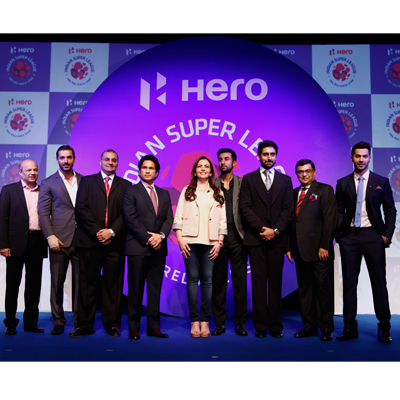
    MUMBAI: The most anxiously awaited Hero Indian Super League (ISL) finally unveiled its official emblem at a grand event attended by the organisers and franchise team owners. The league also saw the unveiling of its official line- ‘Let’s Football.’


    At the beginning, IMG Reliance chairperson Nita Ambani said, “ISL hopes to act as a foundation in creating an ecosystem to nurture talent and make our own national football heroes.” She also added that the Reliance Foundation plans to reach out to 10 lakh kids in India for the first year to help them play the game of football at the micro level.


    ‘Let’s Football’ – is an apt fit to its ambition in connecting with today’s youth and creating interest in millions to play the sport professionally. The emblem with hexagons combined to form a football symbolises collaboration of passion, energy and enthusiasm among its stakeholders. Colours chosen to represent the league conveys the values and emotions, with red signifying the energy, passion and action, while blue exudes confidence, trust and responsibility; both seamlessly combining to represent the league’s values.


    Star India COO Sanjay Gupta commented, “This is the birth of a footballing nation. This is something that has never been attempted before and marks a historic turning point for the future of football in India. What you will experience is a world class spectacle-in stadium, on television, on your mobile screen and across all digital devices.”


    “We plan to attract and nurture the best of Indian talent to play with marquee players selected from 20 countries, spanning five continents,” added Gupta.


    The event began with Nita Ambani leading the eight league partners to sign a pledge- committing to the vision of ISL, which is to bring a football revolution across the country.


    IMG football vice president Andy Knee said, “The potential for football in India is truly immense and the ambition for the league is to spark a revolution for the game so as to encourage teenagers, even hundreds of millions of Indians to start playing, following and watching the sport.”


    Bollywood actor Abhishek Bachchan was declared as the new team owner of the Chennai franchise. Joining him were other owners like Sachin Tendulkar, John Abraham, Ranbir Kapoor, Sameer Manchanda, Utsav Parekh, Kapil Wadhawan, Team Goa ambassador Varun Dhawan among others like AIFF president Praful Patel.


    Each of the teams said that they would help develop football at the grass root level, the announcements of which will be made in the weeks to come.


    Scheduled to kick off on 12 October 2014, the Hero Indian Super League will see some of the greatest players in action from the world of football.

  • Bringing home Lord Ganesha

    Bringing home Lord Ganesha

    He is the ‘Dukh Harta’ and the one who removes obstacles. So be it any new project, a new house or a new car, everything starts with his blessings. The western part of the country is now gearing to welcome home the most loved Lord Ganesha.  And starting 29 August, one will see huge pandals housing Ganapati at every nook and corner of Maharashtra.  His aura is such, that devotees while immersing the Lord, ask him to come back soon, as they chant, ‘Agle Varsh Jaldi Aa’.

    From Lalbaug Cha Raja, to the pandals in localities to households are all busy with the last minute preparations. Right from cleaning the house, to making modaks (his favourite sweet), to decorating the house, the stage is set to welcome him home.

    While it is a 11-day festival, immersions take place after one and a half days, three days, five days, seven days, nine days and the eleventh day. Host of activities are lined up in the pandals and even at homes for the duration. The day starts with morning aarti, it progresses with hawan, bhajans and then concludes with evening aarti. People, who bring him home, invite family and friends for darshan and treat the Lord like a guest, with morning and evening aarti.   

    On the occasion, we at indiantelevision.com ask the industry about their preparations for the 11 day festival and how they celebrate it.

    MCOF president, Arvind Prabhoo

    We have been bringing home Lord Ganesha for the last 45 years. While the celebrations were restricted only to my mother’s house, it was some 45 years ago, when my brother was some two to three years old, when he got fascinated towards the whole festival and we decided to also bring home the Lord. We bring the Lord home for five days.

    The preparations start almost one year in advance, as the order for the idol has to be made. We get an eco-friendly Ganapati. For the past 15 days, the entire family has been busy with cleaning the house, getting ingredients for the Prasad etc.

    On day one we have modaks for the Lord and also lunch arranged, on the third day we arrange for bhajan in Gujarati and Marathi, while on the fifth day, my mother makes close to 200 puran poli’s.

    We immerse the Lord in the municipal ground next to our house in Villeparle, where the municipality creates an artificial pond. 

    Star India SVP programming Ashish Golwalkar

    We have been getting Lord Ganesha for more than 20 years. Celebrations and preparations start in full swing almost a week or 10 days in advance. We get Ganapati for seven days. This year, the celebration is going to be on a larger scale as all the families will come under one roof and are celebrating this occasion. We get clay Ganapati and immerse the Lord in the nearby pond.


    Zee 24 Taas business head Bhushan Khot

    We have been celebrating Ganesh Chaturthi since the past 12 years at our home. We keep for one and a half days and the immersion takes place at an artificially created pond near our home so as to not pollute the water. We have been doing this from my childhood as a joint family and when we moved out to our own place, we continued the tradition.


    Zee Marathi business head Deepak Rajadhyaksha

    The occasion is very important because it is being celebrated at our home since the last 60 years. My father had started the tradition and we followed suit of bringing home Ganesha for one and a half days and immersion is done at the nearby pond. Along with it, we also prepare Lord Ganesha’s favourite modak and shrikhand and other such sweets.

  • Hathway delayed agreement on signals of Zee and Turner: Taj Television

    Hathway delayed agreement on signals of Zee and Turner: Taj Television

    NEW DELHI: In today’s hearing in the Telecom Disputes Settlement Appellate Tribunal (TDSAT), Taj Television counsel contended today and blamed Hathway Cable & Datacom for the delay in an agreement to Zee and Turner channels. She also claimed that Hathway had falsely written in its letter to Taj TV on 23 July that no negotiations were held and presented to TDSAT the dates on which meetings were held between the parties with regard to Zee TV signals.


    Counsel Pratibha Singh told the TDSAT today that Hathway had admitted that it had not paid for the Zee TV channels distributed between 1 April and 23 July.


    In the ongoing hearing before the Tribunal in the cases linked to Taj TV signals for Turner and Zee, Singh said three meetings had been held to sort out the issue, the last being on 16 June after which Taj TV had sent a copy of the agreement under the reference interconnection offer (RIO) to Hathway. A letter was also sent to Hathway in this connection on 26 June.


    Earlier, the Tribunal had fixed for final disposal from 25 August the ‘deep-rooted’ dispute between Hathway and Taj TV, noting that this would require interpretation of certain clauses of some of the statutory regulations.


    TDSAT chairman Aftab Alam and member Kuldip Singh had said: ‘unfortunately, the dispute between the two sides is playing out in highly aggressive way and one may add in a rather unpleasant manner. It seems to be affecting a large number of people in viewing their favourite TV channels. The disputants themselves are approaching the Tribunal on a weekly basis complaining against the actions of each other and seeking some interim directions of the Tribunal consuming a lot of time on arguments on miscellaneous applications.  It is, therefore, in the larger interest to finally dispose of these cases after hearing all sides at an early date.’


    The Tribunal noted that the dispute had arisen at a stage when the earlier fixed fee agreement between the parties has come to end and they are unable to come to agreed terms for a fresh agreement and under the circumstances the MSO has no option but to take the broadcasters’ channels on their RIO terms.


    When talks between the two parties failed, he said the RIO was forwarded on 25 January and was to be effective from February.


    Further arguments will continue tomorrow with counsel for Zee expected to conclude her arguments and Hathway responding to them.

  • TDSAT to hear IBF case on tariff in November

    TDSAT to hear IBF case on tariff in November

    MUMBAI: It has been a busy week for the courts. While on one hand, the Telecom Disputes Settlement Appellate Tribunal (TDSAT) on 21 August heard a case from the Indian Broadcasting Foundation (IBF), Viacom 18 and MSM India challenging the tariff order amendment of 16 July that was passed by the Telecom Regulatory Authority of India (TRAI). On the other, Star India’s case challenging the TRAI order dated 18 July was heard in the Delhi High Court.


    Taking into account the Delhi HC order for the Star India case which came out on 19 August, the TDSAT today postponed the next hearing date for 18 November.


    The Federation of Hotel and Restaurants Association of India (FHRAI) had asked for refund from broadcasters for deals signed before the order came into existence that will be applicable for the current duration. However the IBF counsel stated that the order only talks of deals taking place in the new regime and the deals for which the FHRAI is asking for refunds have been done in advance.


    Considering the Delhi HC order and also IBF’s proposition that in a 2012 judgment, the TDSAT had itself said that when an arrangement is ongoing between parties and a tariff order is issued, it is not applicable with retrospective effect unless mentioned in the order.


    Therefore, the current deals signed will be dormant but not terminated till the end of the case. It has asked both parties to ensure all their pleadings are in place by 28 October so that a final verdict can be given on 18 November.


    Star India’s case is set for its next hearing on 26 September where it has challenged the regulation itself to which Zee is also a party.


    Click here to read order

  • 1 pm weekend slot, the second primetime for English movie channels

    1 pm weekend slot, the second primetime for English movie channels

    MUMBAI: No one will disagree that at 1pm in the afternoon, the TV remote is controlled by housewives. But on weekends comes an added dilemma. Joining the fray for the remote are her children, husband and in laws all tuning in to watch their favourite movies or shows at the same time. In the ensuing melee are English movie channels that are all smiles as the 1 pm slot, particularly during the weekends has seen an increase in viewership.


    “The 1 pm slot today is the most important slot after the evening primetime as it garners the second highest viewership after the 9pm slot,” informs Romedy Now and Movies Now content head Mansi Shrivastav. The channel believes it is a potential target for repeats of previous night’s blockbuster movies. Earlier titles include X-Men: The Last Stand and Ghost Rider-The Spirit of Venegence.


    Similar thoughts are echoed by Star India English cluster general manager Kevin Vaz who says that the genre is heavily consumed at this time with Star Movies scraping a 21 per cent relative share. Knowing the slot’s potential, Star Movies had introduced it as a ‘one break movie time’ band to give the viewer a theatre like experience.


    Out of the entire day, the afternoon band contributes nearly 25 per cent of the viewership to the English movie genre, claims Sony Pix and AXN EVP and business head Saurabh Yagnik. “The 1pm slot is the second biggest day part for Sony Pix and majority of the viewership comes from younger demographics,” he says. This has come from premieres such as Skyfall, Hobbit, Captain Philips, Hobbit 2, Grown Ups 2 and MIB 3.


    Most channels show repeat telecast on weekdays while weekends are reserved for big  premieres.


    However, Turner International India English Entertainment south Asia senior director and network head Dhawal Katkar feels that weekday mornings and afternoons are emerging as the new favourite amongst youngsters for its two channels WB and HBO. Whereas, the genre itself has been witnessing a drop in primetime viewership for the entire week, he adds. HBO’s afternoon lineup includes GI Joe: Retaliation, The Hangover 3, Jack Reacher, The Great Gatsby and Star Trek: Into Darkness while WB’s premieres include Harry Potter and the Deathly Hallows Part 1, Due Date, Spiderman, Suckerpunch.


    However, channels strictly ensure that adult movies are not repeated in the afternoon. While a movie shown at night may have adult content, the same cannot be shown in the afternoon due to children being present in the viewing audience.


    According to media planners, a 10 second ad slot for the 1pm slot movie could command rates in the range of Rs 500 to Rs 4000 in the weekday with a 10 to 15 per cent rise on the weekends.


    Maxus managing partner north and east region Navin Khemka says, “Brands are keen to invest at this spot due to the increasing number of premieres and it draws kids and teenagers as well.” The weekend slot is heavy on content he adds.


    Another media planner quipped that the weekday spot is picked by women centric brands such as FMCGs and online shopping portals so this time should be more sharply targeted. However Madison Media COO Karthik Lakshminarayan informs, “1pm slot is not a high viewership slot, rather viewership starts picking up post 2pm.”


    While media planners vary on the role the 1pm weekend spot plays, they all agree that it helps garner added viewership in a very fragmented segment.

  • Commercial TV subscriber tariffs: Broadcasters, Star take battle to courts

    Commercial TV subscriber tariffs: Broadcasters, Star take battle to courts

    MUMBAI: It’s the battle of the bill – the commercial cable TV bill, that is. The Telecom Regulatory Authority of India (TRAI) on 16 July 2014 issued an amendment to its earlier 2004 broadcasting and cable TV tariff order. The amendment brought in new customer categories such as commercial establishments and commercial subscribers. And it also stated that as far as cable TV rates are concerned, there shouldn’t be any differentiation on an ordinary and commercial subscriber and charges for both should be on a per TV set basis.


    That amendment has not gone down well with the Indian broadcast community as they have been lobbying for differential rates for commercial subscribers for a long time and the global practice is that commercial establishment and subscribers pay more than common subscribers.


    Its representative body, the Indian Broadcasting Federation (IBF) decided to challenge the tariff order for non-digital addressable areas (DAS) in the Telecom Disputes Settlement Appellate Tribunal (TDSAT). And industry leader Star India decided to file a writ petition against the TRAI challenging the order for both non DAS and DAS and other addressable systems in the Delhi High Court.


    Coincidentally both the cases came up for hearing on the same day. While the HC declined to give a stay order on the 16 July 2014 tariff order amendment, it has served notices to both the TRAI and the Federation of Hotels and Restaurants Association of India (FHRAI).


    The matter has been posted for a full-fledged hearing on 26 September. Till then, the order is maintainable. Meanwhile, the TDSAT has said that it will wait till the HC decides on the case to take any further action.


    What Star India has challenged in the HC is that the 16 July 2014 amendment order denies broadcasters the right to directly deal with the hotels. Star India has also appealed that it will have to unnecessarily depend on distribution platform operators DPOs to strike content deals as for commercial establishments, which might be treated as ordinary subscribers unless they specifically charge customers for cable TV subscribers. The broadcaster can only give a differentiated rate to those hotels that categorically mention TV as one of the services, thereby being deeming it fit to be called a commercial subscriber.


    The TRAI and FHRAI have been asked to respond to notices by the next hearing.


    Click here for the High Court order

  • Dispute deepens between Star India and Hathway

    Dispute deepens between Star India and Hathway

    MUMBAI: The case is up for a long hearing, with no resolution coming out soon. Star India and Hathway Cable & Datacom have emerged from another round of the Telecom Disputes Settlement Appellate Tribunal (TDSAT) hearing with just another date in their hand.


    While the earlier interim order still applies, the broadcaster feels that there is an issue of under declaration of subscriber numbers. Earlier last week, Hathway had submitted to Star, its subscriber management system (SMS) report for April to July which according to sources is an average of 4.4 million.


    However, a Star India executive informs that it wasn’t satisfied with the declaration and had filed a clarification application regarding number of active subscribers. To this, Hathway responded today in TDSAT that the declared numbers were indeed active subscribers. The MSO had also responded to the application that it had already furnished the required SMS report, post which the broadcaster withdrew it.


    Hathway had paid Rs 26.5 crore for DAS I areas of Mumbai and Delhi, DAS areas of Kolkata and DAS II areas. However, the Star executive feels that the MSO has omitted the subscribers of its sports packs and the amount paid should be higher.


    “We have now given the details to our auditor to evaluate and then we will be raising invoices on the same,” says the executive.


    The case has now been postponed to another date.


  • “Reliance’s Big brand is focusing on  the localised content, local IP space:”  Tarun Katial

    “Reliance’s Big brand is focusing on the localised content, local IP space:” Tarun Katial

    He is amongst a select lot of advertising professionals who have pole-vaulted over the fence to the broadcast side – and stayed there. In fact, not many recollect that Tarun Katial began his career at Saatchi & Saatchi as a media trainee. More might remember him from his O&M days when he headed TV media buying for the Mumbai office. The then Star India CEO Peter Mukerjea picked him up to work in programming along with Sameer Nair, and the rest, as they say, is history.  From Star, he moved onto head Sony Entertainment programming, before heeding the call from the Anil Ambani-Amitabh Jhujunwala combine to help take the billionaire businessman’s  entertainment ambitions further under the umbrella of  Reliance Broadcast Network Limited (RBNL). 


    It has been quiet a journey. He heads what is considered as India’s most widely spread private FM radio network – Big FM 92.7 which has a footprint of 45 stations. Katial also handles a clutch of TV channels – Big Magic, Big Magic Bihar and Jharkhand, Big Thrill – the TV production wing Big Productions and the group’s activation arm. 


    Despite arriving late in the broadcast TV game, Katial managed to forge alliances with US major CBS and German media megalith RTL. He launched channels in partnership with them quickly from 2010 onwards with the clear intent of building a strong network. The CBS joint venture unravelled end-2013 while the RTL one got unstuck a couple of months ago. Katial – with a sanguine look in his eye says “things happen, then they don’t and the other way round too. But they are all a part of learning and experiences.”


    A firm believer of differentiation and localisation of content, Katial has been at the helm of one of India’s youngest media houses. It was this approach towards business that got him the ‘NewsCorp Achiever for Asia’ award and later led to him being included among the best in ‘India Today 30 on 30’ list. Katial’s much older today and his hair has greyed in parts, but the man has retained his hankering, his drive for innovation and challenges. He got into a conversation with Indiantelevision.com’s Seema Singh and Meghna Sharma, to talk about his experience, his good moments and not so good ones too, and also about his future…


    Excerpts


    How has the journey been so far? The company has seen a lot of ups and downs, what do you have to say about them?


    It has been an interesting journey. When we launched, all our competitors were at least five to seven years ahead of us, well established brands with not only equity, but also ad-consumer connect and legacy of their media house ownership.


    But, we were neither a media house nor a recognisable brand. To add to that, our parent brand Reliance did not allow us to use its brand name, since that is a part of our branding guidelines. We didn’t have any legacy knowledge in the system either. So it was all done from scratch. 


    The team has almost remained the same, since the time we launched. The executive board of the company is also still intact.  Right from deploying CAPEX to building a brand, an identity to positioning the brand, to winning small victories to larger wars, it has been an interesting journey to say the least. 


    In the last two years, the brand has really come of age, We realised that while we fought the marginal differentiation game, we had to be exponentially different to be able to succeed. 


    So we decided to position our brands to recreate every local market and that’s when we decided to go retro for our radio station in Mumbai and Delhi, regional in Bengaluru, melody in Chennai and largely Bengali with Hindi retro in Kolkata. 


    Today, I am quite proud to say that in most markets that we operate, we are either number one or number two, with a huge gap between us and our competitors. 


    You were a late entrant in the game, have you been able to deliver on the challenges? Which have been the areas that you have succeeded and areas which still remain to be tapped?


    The initial challenges were basic understanding of the business to building a consumer brand to building a differentiated positioning and differentiated offering, then to be able to consolidate and work around it. 


    In the brand’s journey you are sometimes able to take risks and sometimes not, sometimes you are able to expand and sometimes you have to consolidate. And in all of that, I think a new brand is not at the same place as an established brand. 


    Radio lacked measurement and we have worked with the industry to introduce RAM. 70-80 per cent of radio spends, today, are in measured markets and advertisers are able to measure the ROI they get from radio. The coming in of measurement rapidly increased the number of brands that had faith in radio. What it also did was, it helped radio move away from being just a frequency medium to being a rich range medium and classic advertisers like the FMCG category started to rely on radio for their communication needs, which has been very good for the category and very good for us. 


    Again in the television business we were laggards. Every business takes time to find its strategy. We started from the English space and then decided to venture in the local language proprietary content space. What we’ve been able to learn and reconcile with this is that we want to be in the local space like we are in the radio business. 


    Television is a much younger business than radio and I think the success we have seen in the TV space in the past six months has been very good. With our Big Magic Bihar and Jharkhand channel, we are clearly the leaders. Whether it’s Big MemsaabBig Bahuriya or Police Files, we have  great content. 


    Also we are the only ones with local production capabilities in Patna and we have been able to build a new community of technicians, actors and producers there.


    On the national front, while we started with Big Magic in UP, it was in April-May this year, with the launch of Akbar Birbal that we decided to take the channel national. 


    There are obviously challenges and we have a great distance to cover but I think the two month report card has been very healthy and positive. We have been able to launch a whole slew of content like:  Uff Yeh Nadaniyaan with Upasana Singh, Raavi Aur Magic Mobile and Ajab Gajab Ghar Jamai with Himani Shivpuri and Sumit Vats. 


    We are going block by block, building on that channel. While today we have about 2.5 hours of original content, we would probably take it up to 3-3.5 hours by the end of this quarter. 


    We believe that regional content is the way forward. It allows you to connect with the audiences and stay centric to consumer’s needs.  Also when you own the intellectual property, you can take it international, deploy it on digital and on various forms and fashions. So I think that’s really our strategy going forward in the television space.


    Why did you think of starting a production unit in Patna? 


    We started our Patna operations four months back, as we believed that local and regional channels should be run from where they belong and a lot of the Bihar channels tend to run from Delhi or Mumbai. But, according to me, this prevents you from building a local connect or local relevance. So we decided to do shows which are locally relevant. 


    Big Bahuriya is a show which surfaces latent issues between mother-in-laws and daughter-in-laws. It has done very well for us and it has all been shot in Bihar and Jharkhand and in the homes of people. Then, Big Memsaab, a studio based game show for women, is also based out of Patna. We built the studio and shot there, giving opportunity to local contestants, local people to come and take part. Similarly, Police Files is a very gritty, in-your-face crime show, where we work with real footage and real issues and crime scenes in Bihar and Jharkhand. 


    These programmes have been produced by local producers like Abhay Sinha, Amitabh Verma and Kamlesh Guthi Singh.  


    Are you looking at rebranding Big Magic Bihar and Jharkhand?


    Yes. We are looking to rebrand and probably call it Big Magic Ganga.  This should be done by mid August. We have already got the approvals for the same. When we rebrand, we will launch in a fairly big way. 


    Your business model earlier looked very lucrative, with TV, Radio, Production and Activation arm, how do you plan to keep up the whole chain to make it look more lucrative? How do you plan to synergize what is under you? What is your current business model?


    Actually we have strengthened our approach a lot now. We have a strong activation business called ‘Big Rural.’ We probably are the only ones who do intellectual property work in the rural space. We have built some very good brands, like ‘Big Disha’, where we do rural career counseling, partnering with Gillette.


    In fact a number of brands partner with us, through which we do hundreds and thousands of activations across schools and colleges. 


    We have also built a new brand called ‘Mele Ka Big Star’ and ‘Hindustan Ka Big Star’ where we cover large melas across UP, MP, Bihar and Jharkhand. Through this, we do a big talent hunt partnering with successful brands like Horlicks, Hero, Godrej and Emami among others.


    We have built a very big property with on-ground activation called Close Up Antakshari. Also on the production side, we have done a lot of proprietary work. Like the Big Star Entertainment Awards and now the monthly Life OK Now Awards.  We do different kinds of work under Big Productions. 


    So your business model still remains the same?


    Yes it continues to be the same. But one of the differences we brought about in the business model is that instead of focusing on client specific activation, events or productions, we are now doing more branded content activation which has attracted   a lot of clients. Through this, a lot of clients can partner and benefit rather than a single client carrying the cost. We have also built some single client properties. For instance, the Hajmola Chatpata No 1, which has a deep penetration in UP, was a success and we plan to do a follow up this year. In short, we have built some long standing properties rather than just activation.


    Are you creating activations for your television channels as well? When will we see the transformation of Thrill? Also will it continue to being male skewed? Will it be in English? 


    We are in no rush to do more in our television space until we attain a critical mass market for  Big Magic and Big Magic Bihar and Jharkhand. For us, the next big thing will be to Indianise Thrill and add local content on it as it is our second priority in the television space. We are currently in the consolidation space. And we also have the phase III of radio rights on our head. So, I think we need to see how much of bandwidth we have for television.


    Thrill will be rebranded by end of this year and while comedy will be on Magic, Thrill will continue to have action. The content on Thrill will be in Hindi only. The whole point of a buyout from RTL was to start doing local content. We are working with some key producers in the space.


    Are you looking at an English channel?


    We won’t do English for some time now. We believe we want to be in the local IP space. We want to have our own IP.


    Was this the reason that the joint ventures ended?


    Our strategy is to be in the local content, local IP space. We want to be centric to the consumer and move around according to the changing trends and tastes. We want to be able to take the channels to different platforms. But in the English space, you are under the rental model. What we do after the license period gets over? What is your legacy in the space?


    Why did you decide to launch the channel with international partners – CBS and RTL?


    You learn with every category you get into. I think when we got ourselves into the English space, there were fewer partners, less competition, but over the three years the space became fragmented and crazy. 


    What is happening with Big Magic and Big Magic Bihar and Jharkhand and Big Magic International, post the breaking of the JV?


    We now own all the content and that’s the reason we launched Big Magic internationally. We are now available in the US, Australia, Canada and are planning to launch in some countries, this year. UK is one of the targets and the talks are already on. 


    If you see the financial statement of this year, the company has done better as compared to 2013. But the network is still incurring certain losses. How are you looking at improving this – especially on the television side?


    RBNL is in its investment phase on TV and it’s on the return phase on radio and that’s how we are balancing it. You need to have some initial losses for any network to grow. You can’t cut the investment short because there are loses in the business, right?


    I will not define them as loses; they are investments. For any business to grow you need investments and we are happy to make investments in the TV business. We are happy to reap the benefits of the radio business. The radio business is close to Rs 200 crore plus, which is not a small number.


    So, will you be pushing radio more?

    Both are different businesses and have different sets of challenges; and we want to grow in both the businesses. And you have seen what we have done with Big Magic. We have been launching a new show almost every week if not every month and the kind of investment that is going behind content, marketing is quite incredible. Last week, we launched the new season of Uff Yeh Nadaniyaan. We have brought in new faces; we have upgraded the look of the show. So, at every step of the way we are investing in the content of the channel.


    What kind of management reshuffle will we be seeing. Are you getting in  more new people?


    We have brought in more people to strengthen the team. On the sales side, we have created a vertical approach, keeping the customer at the centre of it. So we have done a vertical for single customers, a vertical for government sector customers, a vertical for key accounts, a vertical for corporate accounts and new business developments. So, we have a customer centric approach and we have got sales directors on all these verticals. We have got Gurudutt Jakhmola for the government side, Ajit Singh has been roped in for single accounts, Rajesh Mishra for corporate account side and Vijay Koshy on the key account side.


    So, we have got four vertical heads. On the creative side, we have got Manisha Tripathi as the creative and programming head of radio.


    Are you looking at fresh investments coming in to the company?


    Obviously, we will make investments into our radio business as we go into phase III of licensing; we will definitely make investments in current licenses migrating into 15 years and acquiring new licenses.


    And what about television?


    Television is now at the cusp of breakeven, but we will continue investing in Magic.


    What about the licenses of channels like Love? Will you be giving them away? Can we expect more channels in the future?

    We will keep them. Currently, they are in the hibernation stage.  We will be working with our three channels for now. And as and when opportunities come, we will tap into it. 


    How do you plan to get cash flow in the company? Why did you plan to delist?

    For now, we are a delisted company and so we do not need to worry.


    We didn’t want to live quarter to quarter and the promoter believed that he had great value in the business and so he should go behind it and give it all the investment it requires to give it a long term run. 


    For a business in its early stage it is tough to live in a quarter to quarter manner. I can tell you, I have worked at News Corp in my early days at Star and if we were to live on a quarter to quarter basis, we would have never made the kind of investments we did. 


    Also, we didn’t list because we wanted to. We listed because we have a legacy of Adlabs being listed. Our licenses were in the erstwhile Adlabs which demerged into Reliance Media Works which then became Reliance Broadcast Network. We have actually never done an IPO. 


    According to you, which is the most ad revenue generating channel? 


    Big Magic is actually at a 100 per cent inventory fill and it is doing exceedingly well. But I think the one that has real big potential going forward is our Bihar channel. It’s a media dark region and a lot of advertisers want to penetrate that market. Also, it has one of the fastest GDP growth in India. 


    Are you looking at geo-targeting at any stage?


    We had some options at doing geo-targeting with Big Magic because it’s very big in UP. We keep toying with the idea. With a 50 sales offices in the country for our radio business, it will be an easy task.  But we haven’t really tapped into that yet.


    Is distribution a challenge? Is it getting expensive now?


    It’s not very expensive, it is actually getting cheaper. Digitisation has clearly made distribution democratised. Placement is still expensive but distribution is not. And if you have differentiated content then placement is not a key challenge. 


    In fact, we have had a reduction in our carriage fees dramatically over the years across the network and I can tell you that some of the DTH platforms have been very welcoming for our channels.

    What is your budget for marketing on a yearly basis? Does it keep increasing year on year?


     See, we have priority markets, where we invest heavily. Also, we have great advantage of having cross network between radio and TV. So, what people can’t buy, we can buy very easily. Most networks have to buy on radio networks like us, but for us that’s a very big advantage. So between network media and third party media, I think our budget will be close to 20-25 crore. 


    According to me as the channel gains popularity, its marketing spends reduces. 


    I can tell you, our radio market budget has come down substantially from the years we launched it. It’s a set brand. When we launched the show with Annu Kapoor we did not do any marketing because the content was strong. I think good content markets itself after a point. The word of mouth, the advocacy becomes so strong that you don’t have to knock on any ones door.


    What made you change your whole content from recent Bollywood tracks to retro on Big FM? How big is your research team for both television and radio?


    You have to give yourself some serious delta of differentiation, it can’t be marginal differentiation. And you have to take some risks and risks pay off eventually. 


    We have an intense research team, which comprises music experts and even university graduates who have done a post graduation in music. We won’t take such a risk without understanding the consumer’s likes, dislikes and choices. Even within the retro music we have serious segregation on timeless music and time-bound music. 


    Similarly for television, we work closely with Dragon Fly for a lot of research. 


    There seems to be a sudden rise of in-programme advertising? Do you also use this tool to advertise?


    We do a little bit of it, but more in Bihar and Jharkhand because we have a game show on the channel and also because there is a lot of good opportunity there. But I still believe that you can’t make good content into a teleshopping network.


    I think the consumer is becoming extremely discerning so you need to be smart about the way you do these things. What we did with Clinic All-Clear on one of our shows on Big Magic called Raavi was that we spoke about educating the girl child, while soft branding the product with the message.


    Are you looking at doing more events apart from the current slate? 


    I think they need to make sense from a consumer perspective. You can’t just do them because you want to do them. You have to do them because there’s an insight in them. We currently have a slate of 20-30 events, which I don’t think is little by any standard. 


    Does the network make any content for only digital  consumption?


    We are currently not making content for digital only, but we are re-purposing a lot of content for digital. Like we do short stories of Akbar Birbal, only for digital. We have our own YouTube channel, where we condense interesting episodes and put on that channel. The content is such that it can be watched in about nine minutes. 


    Where do you see the network three years down the line?


    The network will be very consumer centric, adapting to changes in consumer trends, very well differentiated and distinct, whether it’s the TV network or the radio network and building on insights continuously. For us consumer-centricity is the key and that’s what we are working on and that’s why we have done what we have done both in TV and in radio. You can’t win by duplicating anybody.
  • BCCI invites title sponsorship bids

    BCCI invites title sponsorship bids

    MUMBAI:  The Board of Control for Cricket in India (BCCI) has invited bids for sponsorship rights for both international and domestic matches.


    BCCI secretary Sanjay Patel through a statement has said that the marketing committee of the BCCI which met earlier has decided to finalise the ‘Invitation To Tender’ (ITT) for title sponsorship rights for both international and domestic matches for the period from September 2014 to 30 April 2015.


    During the stipulated period, India will be seen playing against West Indies for three tests, five one day internationals and one T20 International.


    The sponsorship rights will also extend to five domestic series like the Irani Cup, Ranji trophy, Duleep trophy, Vijay Hazare KO and Prof. D.B. Deodhar trophy.

    Available at the BCCI headquarters in Mumbai, the ITT will be available from 11 am to 5 pm from 6 August to 26 August 2014. The tender fee has been priced at Rs 2 lakh.


    Interested bidders will have to submit their bids by 11 am on 28 august 2014 after which the bids will be opened, evaluated and the tender be awarded in the presence of the bidders.


    During the last season, Star India had won the sponsorship rights from 0ctober 2013 to March 2014 wherein it had agreed to pay Rs 2 crore per match.

  • What’s in store for Life OK in the coming months?

    What’s in store for Life OK in the coming months?

    MUMBAI: It was in late 2011 when viewers were introduced to one more general entrainment channel (GEC) and who had thought that in a short span of three years, Star Network’s Life OK would challenge the established ones.


    After climbing to the third spot in the TAM TV ratings chart and staying there for long now, the channel has proved its might. It created a niche for itself because of its path breaking content like ‘Saubhagyavati Bhava’, ‘Savdhaan India’ and ‘Devon Ke Dev…Mahadev’.


    The man behind the success, the channel’s general manager Ajit Thakur is a humble man who believes in delivering results rather than talking about it.


    Thakur who took the path less taken, in an earlier interview to indiantelevision.com, had said that before 2014 ends the channel will have new offerings for its viewers.   


    And keeping to his words of giving viewers a never-before-seen experience, the channel has announced its newest property. A dance reality show, ‘Dance to Dance’ will see Akshay Kumar mentoring the contestants as well as hosting it.


    Thakur had earlier said in a statement expressed that he has no aversions in doing what other channels are already doing, be it dancing, singing or saas-bahu soaps, but his focus will be on how to do it differently.


    The reality programme will see the dancers perform in challenging venues rather than on a stage or a set. One would dance on a narrow wall or even under water. Kumar will first demonstrate the format to each contestant in the dance format with a commitment of a ‘first of its kind’ show.


    Produced by SOL Productions, it is open to trained dancers from across the globe rather than just celebrities. Thakur informed that around 30 per cent of the budget of the series will be spent on marketing. Since, there will be several foreign participants, apart from advertising on channels, newspaper, hoardings and radio announcements, social media will be used heavily to reach the viewers overseas.


    Apart from this, there are two more new fiction shows that will grace the small screen, soon. The channel is open to work with new producers and agencies and take the channel to the next level.


    It has already joined hands with Rajshri Productions, Balaji Telefilms and producer Vipul Amrutlal Shah. Sources close to the development reveal that all the shows are currently at the planning stage and will have clarity in the next two months.


    “The series will be on-air post Diwali,” adds the source.


    Thakur intends to maintain the momentum by continuing with non-traditional content on the channel. Ekta Kapoor’s programme tentatively titled – Bade Dhoke Hai Is Raah Mein Pyaar Ke marks the fiction debut of Sonali Bendre on television.


    Reported to be a story with a political backdrop, Bendre is supposed to play the protagonist, who will be forced to develop a career of her own after her husband would get caught in charges of corruption.


    Talking about the channel’s second upcoming property, Shah needs no introduction. The man who started off his career with the soap opera Ek Mahal Ho Sapno Ka has given the industry many successful movies in Aankhen, Namastey London, Singh Is Kingg, and many more. After the success of the game-changer show 24 on Colors, Shah’s show is touted to be another big success story.


    Tentatively titled Force, it will be an action-thriller series. It has also roped former Roadie Rannvijay Singh as the lead.


    Last but not the least, Rajshri Productions, which currently has ‘Pyaar Ka Dard Hai…’ on Star Plus, is set to narrate one more love story but in a different manner. The show that was tentatively titled Khel Khel Mein has got its final title in Mere Rang Mein Rangnewali.


    The serial stating true to Rajshri’s taste will see a joint family with three generations staying together. The show is touted to be a complete family drama with a ‘slice of life’ story about young love.


    “We have set a benchmark for new genres. We want to find more new stories and that as time goes by, will become the next level for Life OK. We have always taken pride in working with new people, both inside Life OK and the people we work with outside, our producers and agencies,” Thakur had said in an earlier statement.