Tag: Star India

  • Hathway expands role of Shirish Ruparel;  Star India’s NM Rao joins as head content & carriage

    Hathway expands role of Shirish Ruparel; Star India’s NM Rao joins as head content & carriage

    MUMBAI: Hathway is restructuring its content vertical by expanding the role of executive vice president- content & VAS Shirish Ruparel, with the growing demands of the business in a move to strengthen its content team and to diversify its revenue streams.

    While expanding Ruparel’s role, Hathway has also taken on-board N.M. Rao as head-content & carriage to handle all-India content and carriage with effect from 4 April, based at their corporate office in Mumbai, and he will report to Shirish Ruparel.

    Ruparel’s portfolio will now include content and carriage, ad sales, OTT service offerings and value added services as Hathway looks to create new revenue streams in the new digitization era. As part of his expanded role, Ruparel would now oversee content and carriage and Ad sales monetization while also develop Hathways’ in-house channel bouquet into a series of strong pan-India and regional channels and improve the content portfolio for in-house and regional channel base by working with leading production and content providers.

    Additionally, he will also be responsible for increasing the value pie of Hathway across new streams such as OTT (Over-the-top TV) services and offers and diversify the business into segments such as VAS (value-added services) including VOD (video-on demand), mobile streaming, EPG amongst other key monetization initiatives.

    In his expanded role, Ruparel will continue to report to president-video business T S Panesar.

    Rao joins Hathway from Star India where he was working as assistant vice president-affiliate sales looking after carriage and content for key MSO accounts as part of the broadcasters’ distribution set-up.

    Having experience of over 15 years, Rao has been a part of the media and broadcast industry for more than a decade having worked across both print and electronic media in the areas of affiliate sales with Star TV (content, carriage, trade marketing) and advertising sales with The Times of India (print & special projects). As part of his new role, Rao will be responsible for negotiation and management of all content deals with broadcasters, both for content and carriage.

    Commenting on this restructuring, Hathway Cable & Datacom CEO & MD Jagdish Kumar said, “In the digitization era, content will play an integral role for Hathway in defining and transforming customer experience and with this aim, we are bringing in a change in our content vertical composition. Shirish Ruparel has been one of the key members of the senior management and contributed immensely towards the building of our content team. We are expanding his role to utilize his vast experience and expertise in building wider content revenue streams in segments like OTT and VAS. We are also pleased to have N.M Rao on-board with us to look after content and carriage as we aim to create a strong vertical with multiple revenue streams that will set the business in the new fiscal. With his vast experience in distribution, content and carriage with Star, we are extremely confident that Rao will provide the right boost to our overall objectives and set new benchmarks.”

    In February, Hathway had hired Anand Kamani as vice president- advertising sales to handle its ad-sales business at an all-India level, also reporting into Shirish Ruparel. With the expansion of Ruparel’s role and Rao joining the team to focus on content and carriage, Hathway is looking at an aggressive roadmap to build its content portfolio to increase revenue generation at a time when digitization roll-out is underway in Phase- III and IV and is targeted to complete by end of this year.

    With DTH players also looking to offer additional value added services to its consumers, Hathway as one of the leading multi-system operators is also looking at the next level of customization by offering its subscribers products and solutions which will provide added entertainment and benefits to build better ARPUs.
  • TDSAT rejects IBF plea for more time to sign RIOs with NSTPL saying HITS players get equal status with pan-India MSOs

    TDSAT rejects IBF plea for more time to sign RIOs with NSTPL saying HITS players get equal status with pan-India MSOs

    NEW DELHI: An application by the Indian Broadcasting Foundation seeking extension of time for its members to sign reference interconnect offers agreements with the Noida Software Technology Park Ltd (NSTPL)  has been turned down by the Telecom Disputes Settlement and Appellate Tribunal.  

    In a landmark judgment expected to have far reaching consequences on the Indian broadcasting industry, TDSAT had on 7 December last said that headend-in-the-sky (HITS) players should be treated on the same level as pan-India multi-system operators (MSOs) for commercial purposes.

    In its judgment on a petition filed by the NSTPL against Media Pro and others, the tribunal said its judgment would come into effect from 31 March 2016 by which time it hoped that the relevant reference interconnect offers will be revised wherever necessary.

    Apart from the IBF, some television channels had also filed applications seeking an extension, and the tribunal had addressed certain questions to the Telecom Regulatory Authority of India in this connection.

    In its order, chairman Aftab Alam and members Kuldip Singh and B B Srivastava said after hearing TRAI counsel Saket Singh on the questions addressed to the authority, “We take it to mean that TRAI does not wish any extension of the suspension of the judgment”.

    Answering the main of the four questions, Singh had told the Tribunal that the consultation paper dated 29 January 2016 under the caption ‘Tariff issues relating to TV services’ was part of an ongoing process which is undertaken by TRAI from time to time based on its assessment of the relevant issues in the sector. The exercise is undertaken independently though it may cover some of the issues highlighted in the tribunal’s judgment dated 7 December.

    The tribunal also noted that though the IBF had made the application for extension, it was ‘apparent’ from the hearings that took place on the previous dates that some of the major broadcasters ‘have divergent views not only inter-se but also at variance with the position taken the foundation in as much as none of the broadcasters has asked for any extension of the period of suspension of the judgment.’ The extension of the suspension of the judgment was primarily sought on the plea that following the judgment, TRAI had issued a consultation paper that intends to review the regulatory framework for the broadcasting sector.

    Naming the broadcasters – Star India, Taj TV, IndiaCast, and MSM who are all members of IBF, the tribunal said” “it appears that at least on the issue of enforcement or further suspension of the judgment, the foundation is not in a position to represent the collective views of all its members. We, therefore, see no reason to entertain the application on behalf of the foundation for any further suspension of the judgment.The application is turned down.” The tribunal directed the remaining cases in the batch to come up on 8 April.

    Expectedly, the judgment will also help the Hinduja Group’s HITS platform NXT Digital, which entered into the fray earlier this year.

    In the judgment of 7 December, the Tribunal had directed both Star and Taj, as well as the other broadcasters who have joined the proceedings as intervenors to issue fresh RIOs in compliance with the Interconnect Regulations, as explained in the judgment within one month from the date this order becomes operational and effective. It had said it would be then open to NSTPL to execute fresh interconnect agreements with Star and Taj, and with any other broadcasters on the basis of their respective RIOs or on negotiated terms within the limits.

    The tribunal said: “It is difficult to see a HITS operator as different from a pan-India MSO and in our considered view a HITS operator, in regard to the commercial terms for an interconnect arrangement has to be taken at par with a pan-India MSO and must, therefore, receive the same treatment.”

    The tribunal had noted that Star and Taj will have to execute fresh interconnect agreements with the petitioner within two weeks from the date of issuance of their fresh RIOs. The agreement with Star would relate back to 30 October 2015 and with Taj to 30 June 2015. The issuance of the fresh RIOs by the broadcasters will also give right to other distributors of channels with whom the broadcasters may be in interconnect agreement to have their agreements modified in terms of clause 13.2A.7.

    NSTPL had executed an RIO based agreement with Media Pro. At that time, it did not complain before the tribunal that it was being forced into the RIO based agreement even though it had ample opportunity to do so as the Media Pro application was pending before the tribunal. Later on, after Media Pro ceased to be an agent of the broadcasters, NSTPL, even after filing the present petition, signed RIO based agreements with both Star and Taj. The agreement with Star was for the period upto 30 July, 2015 and the two agreements with Taj were upto 31 March, 2015.

    The Tribunal had also said that NSTPL must therefore be held bound by those agreements till the periods of those agreements and further, three months beyond that in terms of clause 8 of the Interconnect agreement. After those dates (29 October in case of Star and 30 June in case of Taj) the arrangement will be governed by the fresh agreements.

  • TDSAT rejects IBF plea for more time to sign RIOs with NSTPL saying HITS players get equal status with pan-India MSOs

    TDSAT rejects IBF plea for more time to sign RIOs with NSTPL saying HITS players get equal status with pan-India MSOs

    NEW DELHI: An application by the Indian Broadcasting Foundation seeking extension of time for its members to sign reference interconnect offers agreements with the Noida Software Technology Park Ltd (NSTPL)  has been turned down by the Telecom Disputes Settlement and Appellate Tribunal.  

    In a landmark judgment expected to have far reaching consequences on the Indian broadcasting industry, TDSAT had on 7 December last said that headend-in-the-sky (HITS) players should be treated on the same level as pan-India multi-system operators (MSOs) for commercial purposes.

    In its judgment on a petition filed by the NSTPL against Media Pro and others, the tribunal said its judgment would come into effect from 31 March 2016 by which time it hoped that the relevant reference interconnect offers will be revised wherever necessary.

    Apart from the IBF, some television channels had also filed applications seeking an extension, and the tribunal had addressed certain questions to the Telecom Regulatory Authority of India in this connection.

    In its order, chairman Aftab Alam and members Kuldip Singh and B B Srivastava said after hearing TRAI counsel Saket Singh on the questions addressed to the authority, “We take it to mean that TRAI does not wish any extension of the suspension of the judgment”.

    Answering the main of the four questions, Singh had told the Tribunal that the consultation paper dated 29 January 2016 under the caption ‘Tariff issues relating to TV services’ was part of an ongoing process which is undertaken by TRAI from time to time based on its assessment of the relevant issues in the sector. The exercise is undertaken independently though it may cover some of the issues highlighted in the tribunal’s judgment dated 7 December.

    The tribunal also noted that though the IBF had made the application for extension, it was ‘apparent’ from the hearings that took place on the previous dates that some of the major broadcasters ‘have divergent views not only inter-se but also at variance with the position taken the foundation in as much as none of the broadcasters has asked for any extension of the period of suspension of the judgment.’ The extension of the suspension of the judgment was primarily sought on the plea that following the judgment, TRAI had issued a consultation paper that intends to review the regulatory framework for the broadcasting sector.

    Naming the broadcasters – Star India, Taj TV, IndiaCast, and MSM who are all members of IBF, the tribunal said” “it appears that at least on the issue of enforcement or further suspension of the judgment, the foundation is not in a position to represent the collective views of all its members. We, therefore, see no reason to entertain the application on behalf of the foundation for any further suspension of the judgment.The application is turned down.” The tribunal directed the remaining cases in the batch to come up on 8 April.

    Expectedly, the judgment will also help the Hinduja Group’s HITS platform NXT Digital, which entered into the fray earlier this year.

    In the judgment of 7 December, the Tribunal had directed both Star and Taj, as well as the other broadcasters who have joined the proceedings as intervenors to issue fresh RIOs in compliance with the Interconnect Regulations, as explained in the judgment within one month from the date this order becomes operational and effective. It had said it would be then open to NSTPL to execute fresh interconnect agreements with Star and Taj, and with any other broadcasters on the basis of their respective RIOs or on negotiated terms within the limits.

    The tribunal said: “It is difficult to see a HITS operator as different from a pan-India MSO and in our considered view a HITS operator, in regard to the commercial terms for an interconnect arrangement has to be taken at par with a pan-India MSO and must, therefore, receive the same treatment.”

    The tribunal had noted that Star and Taj will have to execute fresh interconnect agreements with the petitioner within two weeks from the date of issuance of their fresh RIOs. The agreement with Star would relate back to 30 October 2015 and with Taj to 30 June 2015. The issuance of the fresh RIOs by the broadcasters will also give right to other distributors of channels with whom the broadcasters may be in interconnect agreement to have their agreements modified in terms of clause 13.2A.7.

    NSTPL had executed an RIO based agreement with Media Pro. At that time, it did not complain before the tribunal that it was being forced into the RIO based agreement even though it had ample opportunity to do so as the Media Pro application was pending before the tribunal. Later on, after Media Pro ceased to be an agent of the broadcasters, NSTPL, even after filing the present petition, signed RIO based agreements with both Star and Taj. The agreement with Star was for the period upto 30 July, 2015 and the two agreements with Taj were upto 31 March, 2015.

    The Tribunal had also said that NSTPL must therefore be held bound by those agreements till the periods of those agreements and further, three months beyond that in terms of clause 8 of the Interconnect agreement. After those dates (29 October in case of Star and 30 June in case of Taj) the arrangement will be governed by the fresh agreements.

  • Strong regulatory ecosystem vital for safeguarding IPR if M and E industry has to grow in the international market

    Strong regulatory ecosystem vital for safeguarding IPR if M and E industry has to grow in the international market

    MUMBAI: The subject of intellectual property rights and piracy keep coming up at the FICCI FRAMES year after year and appeals are made by creative artistes for stringent measures to check this.

    With digitization and if India is to become a media and entertainment hub, this gains urgency and is even more imperative that steps are taken for a strong legal and regulatory ecosystem safeguarding intellectual properties.

    Saving intellectual Property in a world without boundaries saw panelists and legal experts referring to global practices and emphasizing on the importance of IPR for the growth of the Indian media and entertainment sector.

    In fact, World Intellectual Property Organization Director General Francis Gurry stressed the need for stringent laws in an upcoming market like India where creativity was growing at such a speed. He also referred to how WIPO was helping member countries to deal with these problems.

    The session was moderated by Saikrishna & Associates partner Ameet Dutta. The panelists were Motion Picture Association of America Asia Pacific VP regional legal counsel Michael Schlesinger, Star India senior VP legal and regulatory Pulak Bagchi and Zee Network president legal and regulatory affairs Avnindra Mohan.

    Dutta said the focus of the context in digital India has shifted from copyrights to user rights. This underlines the challenges that intellectual property faces. The question that he posed before the panelists was where India stood on the world map in terms of economics.

    Schlesinger said: “India is a mine of creativity. This is evident with the number of features films, television channels or other platforms available in India. Our existence will depend on a surge of creativity and invention. India is maximizing its potential but has to find a place on the global map. For example, India showed total box office collection of $2.5 million in 2015 while China had $6.5 million and US had $11.1 million. These figures clearly show that just making products or content in India will not help until India can acquire international content as well. India has to maximize a lot of things like job creations, movie screenings etc.”

    Mohan shared the scenario about the regulatory environment in India. “For the broadcasting sector, there is no copyright at all since 2003. It is always user rights. In India, the content producers and broadcasters are same to the extent of 90 per cent unlike US. If a distributor comes to you, you have to provide content on non-discriminatory basis with equal prices irrespective of the size. This is the only sector where a broadcaster is asked to provide its content with prices frozen in 2003. I am forced to give my content to the distributors at a frozen price.”

    Bagchi generally agreed with Mohan and said with the challenges faced by the entire sector, the impact of regulatory laws on channels and the challenges faced by broadcasters cannot be neglected. “Consumers are our kings. I agree with Mohan about the prices being frozen since 2003. Imagine what would happen if the Indian government asks Bill Gates to sell all the Microsoft versions and its tools today on the prices that were relevant in 2003,” said Bagchi. He stressed that this was one reason why international parties hesitate on investing in Indian IPs, and the archaic guidelines and regulations prevent the growth of intellectual property.

    For a session that was aimed at how one can survive the digital divide, it ended with the panelists agreeing on the importance of having sectoral regulations in sync with the copyright laws. This will also retain the India IPR regime with the best practices in the field of intellectual property rights.

  • Strong regulatory ecosystem vital for safeguarding IPR if M and E industry has to grow in the international market

    Strong regulatory ecosystem vital for safeguarding IPR if M and E industry has to grow in the international market

    MUMBAI: The subject of intellectual property rights and piracy keep coming up at the FICCI FRAMES year after year and appeals are made by creative artistes for stringent measures to check this.

    With digitization and if India is to become a media and entertainment hub, this gains urgency and is even more imperative that steps are taken for a strong legal and regulatory ecosystem safeguarding intellectual properties.

    Saving intellectual Property in a world without boundaries saw panelists and legal experts referring to global practices and emphasizing on the importance of IPR for the growth of the Indian media and entertainment sector.

    In fact, World Intellectual Property Organization Director General Francis Gurry stressed the need for stringent laws in an upcoming market like India where creativity was growing at such a speed. He also referred to how WIPO was helping member countries to deal with these problems.

    The session was moderated by Saikrishna & Associates partner Ameet Dutta. The panelists were Motion Picture Association of America Asia Pacific VP regional legal counsel Michael Schlesinger, Star India senior VP legal and regulatory Pulak Bagchi and Zee Network president legal and regulatory affairs Avnindra Mohan.

    Dutta said the focus of the context in digital India has shifted from copyrights to user rights. This underlines the challenges that intellectual property faces. The question that he posed before the panelists was where India stood on the world map in terms of economics.

    Schlesinger said: “India is a mine of creativity. This is evident with the number of features films, television channels or other platforms available in India. Our existence will depend on a surge of creativity and invention. India is maximizing its potential but has to find a place on the global map. For example, India showed total box office collection of $2.5 million in 2015 while China had $6.5 million and US had $11.1 million. These figures clearly show that just making products or content in India will not help until India can acquire international content as well. India has to maximize a lot of things like job creations, movie screenings etc.”

    Mohan shared the scenario about the regulatory environment in India. “For the broadcasting sector, there is no copyright at all since 2003. It is always user rights. In India, the content producers and broadcasters are same to the extent of 90 per cent unlike US. If a distributor comes to you, you have to provide content on non-discriminatory basis with equal prices irrespective of the size. This is the only sector where a broadcaster is asked to provide its content with prices frozen in 2003. I am forced to give my content to the distributors at a frozen price.”

    Bagchi generally agreed with Mohan and said with the challenges faced by the entire sector, the impact of regulatory laws on channels and the challenges faced by broadcasters cannot be neglected. “Consumers are our kings. I agree with Mohan about the prices being frozen since 2003. Imagine what would happen if the Indian government asks Bill Gates to sell all the Microsoft versions and its tools today on the prices that were relevant in 2003,” said Bagchi. He stressed that this was one reason why international parties hesitate on investing in Indian IPs, and the archaic guidelines and regulations prevent the growth of intellectual property.

    For a session that was aimed at how one can survive the digital divide, it ended with the panelists agreeing on the importance of having sectoral regulations in sync with the copyright laws. This will also retain the India IPR regime with the best practices in the field of intellectual property rights.

  • Uday Shankar, Mukesh Ambani set the tone for FICCI FRAMES

    Uday Shankar, Mukesh Ambani set the tone for FICCI FRAMES

    MUMBAI: For a meet that is perhaps the largest in the country covering all all media and entertainment platforms, it was heartening to see the the universe of M & E industry gthered under one roof.

    FICCI Frames 2016 is up and rolling. ‘Change or Perish’ says the LED backdrop and that’s the theme of the 17th edition.

    And Communication and Information Technology Minister Ravi Shankar Prasad, Star India CEO Uday Shankar, Reliance Industries Ltd Chairman and MD Mukesh Ambani FICCI Entertainment wing Chairman Ramesh Sippy, Discovery President J B Perrete, and FICCI Secretary General Deedar Singh showed the way forward.  

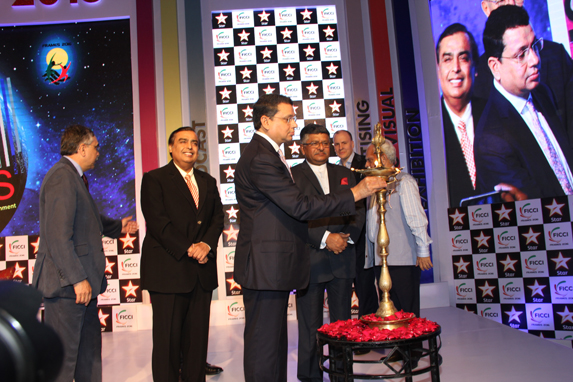
    Star India CEO Uday Shankar, FICCI Chairman Ramesh Sippy, Minister of Telecom and Information Teachnology, Discovery President JB Perrete, and  Deedar Singh secretary general FICCI were among the dignataries who lit the lamp to mark the beginning of the edition.

    “Cable TV continues to struggle, struggling to be relevant in the ever changing scenario. Digitization is still to taste success; and the content is becoming more and more redundant. Overall the M&E sector is the same as it was while the timelines have changed and changed again,”

    Those opening lines by Star India CEO Uday Shankar touched many raw nerves, welcomes by loud claps at the inaugural session of the FICCI FRAMES 2016.

    But he added that even as there are certain teething issues that the industry is facing, there are great happenings to talk about too. In his un-orthodox manner, he touched on these. “But at the same time there is a disruption happening, there are four young boys who made more headlines than any other content creators. They took on the biggest of the players be it Mark Zukkerberg’s Facebook when their friendly internet’s neutrality came under threat. They had the guts to keep a name that the news channels in India chose not to pronounce wholly. They call them AIB.”

    Uday Shankar Mukesh Ambani and Shri Ravishankar Prasad at Ficci Frames 2016

    Talking about his own network, he said “the biggest launch in the media and entertainment industry was not a newspaper, nor a TV channel  but an app. Hotstar drove the wave, 5crore times the app was downloaded, more people watched EPL on Hotstar than on TV and this is how India is changing.”

    He also spoke about the global success story: “Imagine where Netflix Facebook were 10 years back and see the empire they have made in such a short span. Also remember the best animators are no longer sitting in California, they can now be spotted in Goregaon. Priyanka Chopra is now a global star and now India needs to be a global leader.”

    Concluding his remarks, he said: “The whole country today is looking at what Mukesh Ambani is busy with, there is a wave of expectation and the expectation is from Ravi Shankar Prasad (C and IT Minister) too. They are the two stakeholders on whom the digital wave depends. Hope they do the best as that will be the best of media and the entertainment Industry.”

    Reliance Industries  Chairman and MD Mukesh Ambani said: “I was here in 2004 when the industry was 2 billion dollars strong, and today it is 18 billion dollars strong. It is a great success and but there are miles to go. I believe the industry will be a 100 billion dollar one in the next decade, which means we have a major task in our hands.”

    Referring to the theme of the annual meet, he said: “There could not be a better theme than Change or Perish. To my mind digitization is the key to the industry’s success and that’s why we have JIO which can be called as the world’s largest startup.”

    He was confident that with the launch of Jio, India will be among the top ten in the next few years from the current rank of 155 among the top countries using mobile data. “Jio will provide coverage, and wherever you are you will be able to access. Quality will be 40 to 80 times faster than at present. Quantity and capacity currently is 0.15 GB per annum, with capacity of over 10 GB per user per annum  We will be affordable to consumers, and I believe affordability is the key “

    India, he said, will leapfrog and be a leader in the digital world. The world is moving from "orality to visuality. Images and videos will rule the digital world. Human beings and our thinking are linear.  Technology is an exponential idea. Exponential changes will create large opportunities," he said.

    Sharing his analysis he said, “The world is graduating to a telemedia world. The focus will be on all from all. The telco will focus on content, the broadcaster will invest on technology and producers will have  new delivery platforms. We are all part of a telemedia world. Downloading has now become streaming, linear has become interactive.”

    Ambani drew light on the way forward. “Abundance will be a global trend. Data is the new oil of this industry, and intelligent data is the petrol. It is not about technology – it is about humanity, the true power of technology is in the evolution of humanity. All our efforts need to be to make India the leader in 21st century. Together we can make India the leader with more than one-sixth of humanity residing in India.”


  • Uday Shankar, Mukesh Ambani set the tone for FICCI FRAMES

    Uday Shankar, Mukesh Ambani set the tone for FICCI FRAMES

    MUMBAI: For a meet that is perhaps the largest in the country covering all all media and entertainment platforms, it was heartening to see the the universe of M & E industry gthered under one roof.

    FICCI Frames 2016 is up and rolling. ‘Change or Perish’ says the LED backdrop and that’s the theme of the 17th edition.

    And Communication and Information Technology Minister Ravi Shankar Prasad, Star India CEO Uday Shankar, Reliance Industries Ltd Chairman and MD Mukesh Ambani FICCI Entertainment wing Chairman Ramesh Sippy, Discovery President J B Perrete, and FICCI Secretary General Deedar Singh showed the way forward.  

    Star India CEO Uday Shankar, FICCI Chairman Ramesh Sippy, Minister of Telecom and Information Teachnology, Discovery President JB Perrete, and  Deedar Singh secretary general FICCI were among the dignataries who lit the lamp to mark the beginning of the edition.

    “Cable TV continues to struggle, struggling to be relevant in the ever changing scenario. Digitization is still to taste success; and the content is becoming more and more redundant. Overall the M&E sector is the same as it was while the timelines have changed and changed again,”

    Those opening lines by Star India CEO Uday Shankar touched many raw nerves, welcomes by loud claps at the inaugural session of the FICCI FRAMES 2016.

    But he added that even as there are certain teething issues that the industry is facing, there are great happenings to talk about too. In his un-orthodox manner, he touched on these. “But at the same time there is a disruption happening, there are four young boys who made more headlines than any other content creators. They took on the biggest of the players be it Mark Zukkerberg’s Facebook when their friendly internet’s neutrality came under threat. They had the guts to keep a name that the news channels in India chose not to pronounce wholly. They call them AIB.”

    Uday Shankar Mukesh Ambani and Shri Ravishankar Prasad at Ficci Frames 2016

    Talking about his own network, he said “the biggest launch in the media and entertainment industry was not a newspaper, nor a TV channel  but an app. Hotstar drove the wave, 5crore times the app was downloaded, more people watched EPL on Hotstar than on TV and this is how India is changing.”

    He also spoke about the global success story: “Imagine where Netflix Facebook were 10 years back and see the empire they have made in such a short span. Also remember the best animators are no longer sitting in California, they can now be spotted in Goregaon. Priyanka Chopra is now a global star and now India needs to be a global leader.”

    Concluding his remarks, he said: “The whole country today is looking at what Mukesh Ambani is busy with, there is a wave of expectation and the expectation is from Ravi Shankar Prasad (C and IT Minister) too. They are the two stakeholders on whom the digital wave depends. Hope they do the best as that will be the best of media and the entertainment Industry.”

    Reliance Industries  Chairman and MD Mukesh Ambani said: “I was here in 2004 when the industry was 2 billion dollars strong, and today it is 18 billion dollars strong. It is a great success and but there are miles to go. I believe the industry will be a 100 billion dollar one in the next decade, which means we have a major task in our hands.”

    Referring to the theme of the annual meet, he said: “There could not be a better theme than Change or Perish. To my mind digitization is the key to the industry’s success and that’s why we have JIO which can be called as the world’s largest startup.”

    He was confident that with the launch of Jio, India will be among the top ten in the next few years from the current rank of 155 among the top countries using mobile data. “Jio will provide coverage, and wherever you are you will be able to access. Quality will be 40 to 80 times faster than at present. Quantity and capacity currently is 0.15 GB per annum, with capacity of over 10 GB per user per annum  We will be affordable to consumers, and I believe affordability is the key “

    India, he said, will leapfrog and be a leader in the digital world. The world is moving from "orality to visuality. Images and videos will rule the digital world. Human beings and our thinking are linear.  Technology is an exponential idea. Exponential changes will create large opportunities," he said.

    Sharing his analysis he said, “The world is graduating to a telemedia world. The focus will be on all from all. The telco will focus on content, the broadcaster will invest on technology and producers will have  new delivery platforms. We are all part of a telemedia world. Downloading has now become streaming, linear has become interactive.”

    Ambani drew light on the way forward. “Abundance will be a global trend. Data is the new oil of this industry, and intelligent data is the petrol. It is not about technology – it is about humanity, the true power of technology is in the evolution of humanity. All our efforts need to be to make India the leader in 21st century. Together we can make India the leader with more than one-sixth of humanity residing in India.”


  • Four broadcasters to examine headend of MSO to ensure rectification of defect pointed out by BECIL

    Four broadcasters to examine headend of MSO to ensure rectification of defect pointed out by BECIL

    New Delhi: Multi Screen Media Pvt. Ltd, Star India, Taj Television, and Indiacast UTV Media Distribution Services Pvt. Ltd have been asked by the Telecom Disputes Settlement and Appellate Tribunal to constitute a joint team or may agree upon one of them getting the inspection done by its technical team of the headend of M.C. Transmissions for any defects.

    The Tribunal said: “Normally, we should have asked BECIL to revisit the petitioner’s head end and to give a supplementary report but that would saddle the petitioner with heavy costs. Hence, we think it proper to ask the four respondent broadcasters to have a joint inspection of the petitioner’s head end by their technical people.”

    Chairman Justice Aftab Alam and member B B Srivastava directed that the inspection should be completed within 15 days and listed the matter for 8 April.
     
    Earlier following the tribunal’s order of 24 February, the Broadcasting Consulting Engineers (India) Ltd had found one defect in the Digital Addressable System (CAS, SMS and STB) available and installed at M C Tansmissions’ headend as on 16 March which “does not fully meet” the TRAI minimum requirements.

    BECIL had found that “The system of MC Transmission has the provision for blacklisting the VC whereas the provision for blacklisting of STB is yet to be deployed.”

    However, MC Transmissions counsel Nittin Bhatia said the device for blacklisting STBs had also been installed and the lacuna pointed out in the report had been fully cured.


  • Four broadcasters to examine headend of MSO to ensure rectification of defect pointed out by BECIL

    Four broadcasters to examine headend of MSO to ensure rectification of defect pointed out by BECIL

    New Delhi: Multi Screen Media Pvt. Ltd, Star India, Taj Television, and Indiacast UTV Media Distribution Services Pvt. Ltd have been asked by the Telecom Disputes Settlement and Appellate Tribunal to constitute a joint team or may agree upon one of them getting the inspection done by its technical team of the headend of M.C. Transmissions for any defects.

    The Tribunal said: “Normally, we should have asked BECIL to revisit the petitioner’s head end and to give a supplementary report but that would saddle the petitioner with heavy costs. Hence, we think it proper to ask the four respondent broadcasters to have a joint inspection of the petitioner’s head end by their technical people.”

    Chairman Justice Aftab Alam and member B B Srivastava directed that the inspection should be completed within 15 days and listed the matter for 8 April.
     
    Earlier following the tribunal’s order of 24 February, the Broadcasting Consulting Engineers (India) Ltd had found one defect in the Digital Addressable System (CAS, SMS and STB) available and installed at M C Tansmissions’ headend as on 16 March which “does not fully meet” the TRAI minimum requirements.

    BECIL had found that “The system of MC Transmission has the provision for blacklisting the VC whereas the provision for blacklisting of STB is yet to be deployed.”

    However, MC Transmissions counsel Nittin Bhatia said the device for blacklisting STBs had also been installed and the lacuna pointed out in the report had been fully cured.


  • Hotstar.com’s Ajit Mohan targets 100 million digital viewers this IPL

    Hotstar.com’s Ajit Mohan targets 100 million digital viewers this IPL

    MUMBAI: Star India has long presented itself as undisputed disruptor when it comes to the Indian media and entertainment industry. The disruption wave does not look like settling down any too soon. Star India digital head and president Ajit Mohan is now chasing history: something that The Facebook achieved in early 2015 and India’s largest telco Airtel got to in 2009.

    “Our objective is to reach out to 100 million users this IPL for our digital streaming services,” says Mohan with a smile on his face.

    Star India started the online streaming of cash rich Indian Premier League (IPL) in 2014. The matches were streamed on Starsports.com and as per Mohan’s analysis over 21 million people logged on to watch the action on their hand held devices.

    A year later, Star India invested a whopping Rs 302.02 crore to outbid then Multi Screen Media or MSM (now Sony pictures Networks or SPN) and Times Internet (TI) bid to acquire the streaming rights for three more years.

     “The reach doubled and we got to over 42 million viewers. Not only that we also witnessed a significant traction when it came to time spent watching,” discloses Mohan.   

    Complementing Star’s unfettered digital disruption is the improving bandwidth condition in India. The affluent metro youth who are considered to be the biggest spenders and are always engaged with their hand held smart devices. It is these mobile natives that Hotstar is targeting this year.

    “The audience we cater to is what makes Hotstar an attractive platform for advertisers. The response we got so far for IPL is overwhelming and we are extremely happy with it. We are selling as per slots exactly how it happens on television,” avers Mohan.

    The digital innovation of Murdoch’s media conglomerate has roped in nine brands so far. Flipkart, Volini, Raymond, Axe have come on board as sponsors, while the other large advertisers include Lloyd, Hindware, Hero Fincorp, Airtel and Amazon.

    “The metro is either working or returning back by the time IPL matches start and hence the streaming service is the go-to for cricket lovers. Moreover, with 3G getting better and 4G coming in, the infrastructure is also looking good so the streaming service is becoming more useful,” explains Madhouse COO Milind Pathak.

    The growth of Hotstar continues unabated as per Mohan, especially its reach. It was at just two per cent of TV a year back. Today, Mohan, says it has multiplied manifold. “Hotstar has already reached 40 to 45 per cent of television audiences,” he points out. “I believe more than compete with TV, what we are doing is adding another screen and forming a consumer habit which is a great benefit for the industry.”

    The leapfrogging numbers are not only because of the sacks full of dollars being spent on content, but also on account of an aggressive marketing overdrive. Captain of the Indian cricket team M S Dhoni promotes the platform. And for IPL the media house signed on with ad creative power house Lowe Lintas to unleash a cutting edge campaign.

    “With our analysis we found out that affluent male youth in metros are the ones who spend most of the time on their mobile phones and our creative is targeted at them. Also there is a perception that Indian youth are selfish and stay by themselves which is not totally true and that’s why it has the tagline Screen Chota hai magar Dil bada,” says Mohan.   

    The promotional spots focuses on youth and their connection with community. It shows that although they are always in their own world, but whenever needed they become an active part of the society.

    Last year Starsports.com streamed the matches along with Hotstar, “This year also we will continue to stream the action on both the platforms. The rights that we have are for a five minute delayed stream; an addition that we have this year is the fact that both Hindi and English commentary will be available for audiences to enjoy,” reveals Mohan.

    Digital is still perceived as an ancillary consumption medium, mainly for snacking and for small pieces of content, not long form.  Mohan believes Hotstar is paving many a pioneering path. “We broke all such myths, we proved the perception wrong,” he says with a wide grin. “One more wrong notion that we tore apart was that India was not ready for a premium OTT platform. With the time spent on OTT that we witnessed in the past and the way it is increasing now, I must say that the platform is only going to get bigger.”