Tag: Star India

  • Race to acquire IPL rights commences

    Race to acquire IPL rights commences

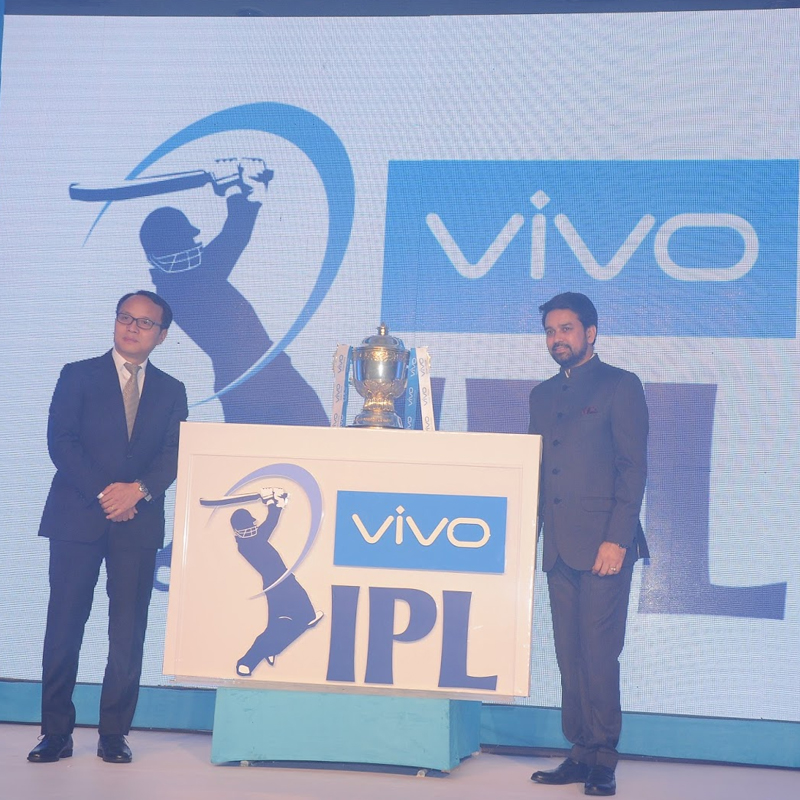
    MUMBAI: It’s the business of sports! The countdown to the media rights of what is arguably India’s most premium sports property, the Vivo IPL, has begun with the Board of Control for Cricket in India (BCCI) announcing the timeline of the bidding process. The BCCI has made the IPL rights an invitation tender process with the document being made available for purchase from today (19 September) at a purchase price of $10,000.

    Three bunches of media rights are being made available: domestic Indian subcontinent TV rights for all the 10 seasons (2018-2027), domestic digital telecast rights, and the rest of the world (RoW) rights — either as a whole package or as territory groupings – each for five seasons (2018-2022). Bidders have also been permitted to make their offers in any combination of the above three rights. The digital rights entail a five-minute delayed telecast.

    Non-news TV broadcasters will be in a position to bid for the TV rights. However, the field has been thrown open to broadcasters, mobile operators and internet operators for both the digital and RoW rights, with marketing agencies also being permitted to throw in the hat into the ring for the latter.

    The bids can be made singly or as a consortium, as long as the person doing is fit and proper, meets financial standing and BCCI suitability standards criteria, and has no litigation with the cricket body, the BCCI announced.

    At the press conference in Delhi, BCCI president Anurag Thakur said:
    “IPL is the fastest, most popular cricket league and also the sixth most popular sports league in the world. We want it to be a very transparent process. It is going to be bid- but a most historic. In the last nine years, what we have seen is that the world has recognized it has the top most league. BCCI has been proud to start the league which others have followed.”

    BCCI CEO Rahul Johri who made a presentation on the tender process said that it will be two tiered, based on eligibility and on the financial commitment. Bidders will have to make their submissions in two envelopes: Envelope A which will detail the eligibility and envelope B which will contain the financial bid and signed media rights agreement. Financial Bids of only compliant bids will be opened, Johri clarified. He added that the organization was under no obligation to accept the highest financial bid and that it could change the process at any time at its discretion.

    Johri pointed out that potential bidders will have an opportunity to seek clarifications till 4 October, with 18 October being the last date for purchasing the tender, and bid submissions will close at 9:30 am on 25 October. Financial bids of only compliant bids will be opened, Johri clarified. The BCCI is expected to announce the winners of the rights the same day.

    For the RoW, the BCCI has broken up the rights into territory groups, almost like the league it runs. Group A broadly consists of Asia, Australia, Canada, Caribbean, Central and south America, New Zealand, and Israel. Group B consists of middle east and north Africa while Group C covers the whole of South Africa. Group D includes sub-Saharan Africa, Group E covers the UK and Ireland and British territories and Group F, the whole of the US.

    Media observers expect a tough fight between current TV rights holder Sony Pictures Network (SPN) India – which recently acquired the Zee Network’s TEN Sports brand – and digital rights holder Star India for the rights.

    Other bidders who could be contenders include telcos like Reliance Jio and Airtel. The next 10 years rights of the IPL are expected to bring in anywhere between $2.5 billion to $3.5 billion for the BCCI.

  • BARC week 36: Sun TV continues to rule the roost by far across genres

    BARC week 36: Sun TV continues to rule the roost by far across genres

    BENGALURU: Except for a blip during the IPL weeks, the Tamil regional GEC Sun TV has held firm to its apex position in the top ten channels list based on ratings as per BARC data. While Hindi GECs’ dominated the top ten channels, taking seven of the spots, two other regional channels (besides Sun TV) have edged into the list over the past few months. Regional channels grabbed the numero uno, fifth and eighth spots in the list.

    Among the top ten channels in BARC week 36 of 2016 were three Star India Channels; two channels each from or associated with the Sun Network, the Essel Groups ZEEL, Network 18; and one from Sony Pictures Networks India Pvt Ltd.

    And so Sun TV continued to rule the roost in BARC in week 36 with 1069531 Weekly Impressions (000s) sum, followed by Star Plus, Zee TV and Colors from the Hindi GEC space at second, third and fourth positions respectively. Star Plus had 787960 Weekly Impressions (000s) sum, while Zee TV had 612813 Weekly Impressions (000s) sum, and Colors had 603413 Weekly Impressions (000s) sum

    On fifth position was another regional channel from the Sun Network – the Telugu GEC Gemini with 574960 Weekly Impressions (000s) sum. Zee Anmol and Sony Max followed at sixth and seventh spots with 488422 Weekly Impressions (000s) sum and 463425 Weekly Impressions (000s) sum. Another regional channel associated with the Network 18 stable – ETV Telugu come in at eighth place with 453836 Weekly Impressions (000s) sum. The last two spots were taken by Star India’s Star Utsav with 437286 Weekly Impressions (000s) sum and Life OK with 423635 Weekly Impressions (000s) sum at ninth and tenth place in that order.

  • BARC week 36: Sun TV continues to rule the roost by far across genres

    BARC week 36: Sun TV continues to rule the roost by far across genres

    BENGALURU: Except for a blip during the IPL weeks, the Tamil regional GEC Sun TV has held firm to its apex position in the top ten channels list based on ratings as per BARC data. While Hindi GECs’ dominated the top ten channels, taking seven of the spots, two other regional channels (besides Sun TV) have edged into the list over the past few months. Regional channels grabbed the numero uno, fifth and eighth spots in the list.

    Among the top ten channels in BARC week 36 of 2016 were three Star India Channels; two channels each from or associated with the Sun Network, the Essel Groups ZEEL, Network 18; and one from Sony Pictures Networks India Pvt Ltd.

    And so Sun TV continued to rule the roost in BARC in week 36 with 1069531 Weekly Impressions (000s) sum, followed by Star Plus, Zee TV and Colors from the Hindi GEC space at second, third and fourth positions respectively. Star Plus had 787960 Weekly Impressions (000s) sum, while Zee TV had 612813 Weekly Impressions (000s) sum, and Colors had 603413 Weekly Impressions (000s) sum

    On fifth position was another regional channel from the Sun Network – the Telugu GEC Gemini with 574960 Weekly Impressions (000s) sum. Zee Anmol and Sony Max followed at sixth and seventh spots with 488422 Weekly Impressions (000s) sum and 463425 Weekly Impressions (000s) sum. Another regional channel associated with the Network 18 stable – ETV Telugu come in at eighth place with 453836 Weekly Impressions (000s) sum. The last two spots were taken by Star India’s Star Utsav with 437286 Weekly Impressions (000s) sum and Life OK with 423635 Weekly Impressions (000s) sum at ninth and tenth place in that order.

  • SVod outpacing pay TV in W. Europe’s consumption trends: Report

    SVod outpacing pay TV in W. Europe’s consumption trends: Report

    MUMBAI: Subscription video on-demand (SVoD) content is increasing more and more as compared to Pay TV.

    Several discussions have taken place in India with the growing number of digital platforms. Broadcasters such as Star India, Viacom18, Zee Media and Sony Television, etc have entered this space with their own OTT/VOD platforms. Debates not just confined to the emergence of VOD platforms but also the entry of various global players have been raging since.

    The fact that digitisation is at a nascent phase in India only paved the way for the players to experiment various models. This also raised a few eyebrows on the existence of cable and satellite television.

    While most follow an advertising-led model or a ‘freemium model’, the countable ones have taken the challenge of following a subscription-based model. As print has survived after the entry of broadcast, analog and digital cable network will also co-exist with the emergence of various digital platforms. With the robust penetration of internet in the US, Pay TV has remained powerful.

    But is it the same everywhere else? Certainly not. The scenario is completely different in Western Europe. SVoD subscription has been outstripping Pay TV since 2012. The subscription net addition of Pay TV in 2016 is 2 million which is estimated to see a downfall by 2021 to 1 million.

    On the other hand, SVoD in 2016 is 9 million only and evaluated to come down to 3 million by 2021. Both the services are currently at its peak but are substantially going to see some disruption. This clearly shows that currently the viewers are ready to pay for good quality content.

    These were some of the findings presented in a report at IBC by Ampere Analysis, a London based analyst firm, at Amsterdam yesterday.

    According to the Ampere report, SVoD is growing as a significant segment not just in the USA but also in other countries such as Poland, France, the Netherlands, Spain, Italy, Germany, the UK, Sweden and Denmark. The average SVoD-only homes in the second quarter of 2015 has been 5 per cent while, in the current scenario, it has grown by 2 per cent for the first quarter.

    US specifically has seen a growth from 9 per cent to 13 per cent whereas the UK has seen an increase of 2 per cent from 8 per cent to 10 per cent in just a year.
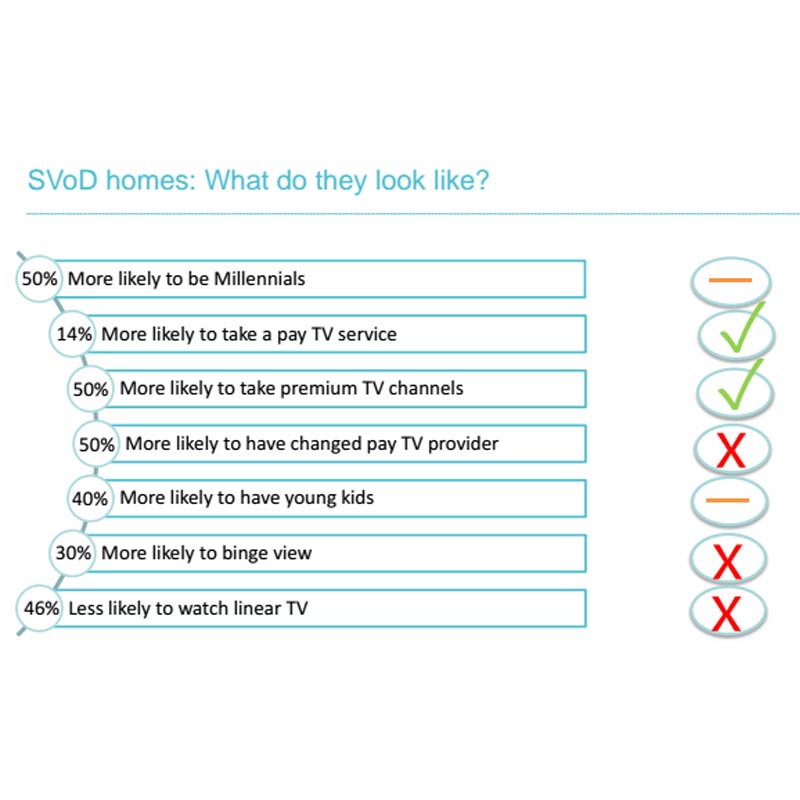
    So, what exactly do the SVoD homes constitute of? The three most relevant observations about who is consuming such massive content on digital platforms are — a big percentage comprise millennials, and the remainder people are more likely to take premium TV channels and some pertcentage have most likely changed their Pay TV provider.

    In all, 46 per cent are less likely to pay for linear TV, while 40 per cent of homes have kids. 30 per cent of the homes have shown an inclination to binge watching. Only 14 per cent of people have opted for a Pay TV service, according to Ampere.

    Business-wise, the concept of platform and channel is evolving though the producer and distributor remain unhampered. Earlier, content was distributed on platforms like Sky, Moviestar and Canalsat, etc which is now replaced by Facebook, Twitter, Snapchat, YouTube, etc. On the other hand, the channel from which content was ideally consumed has converted from Discovery, Fox, HBO, etc to digital platforms like Netflix, SeeSo, CuriosityStream, etc.

    Pay TV and new media products are segmenting, the report states.

    People with lower income are on-demand led whereas people with higher income are linear-led. Young millennials and teenagers can be appealed via services such as Whistle Sports, Soccer, Snapchat, Facebook,etc. Higher income traditional broadcast get pushed through Sky Q to protect high-end broadcast viewers. Direct To Consumers (DTC) cost to get a channel on air are considerably lower. So with a satellite you are going to take your yearly transponder, but with an OTT service you do not have that significant upfront cost. But, what you do have is a scaling cost, CDN delivery, that grows with your customer base.

    Ampere accepts that the latter factor makes OTT uneconomic for reaching very large audiences, estimating that for a single channel or service offering video in any definition from SD to UHD, a satellite feed works out cheaper beyond 10m viewers’ even if they watch on average just one minute of content per day. For a daily viewer base below 20,000, OTT always works out cheaper, even if all viewers watched five hours of content a day and all content was transmitted inUHD, Ampere found.

    With changing economics, channel groups are increasingly looking to Direct To Consumers (DTC) SVOD service. Viewers/advertising spends have shifted to online, operators are pushing back on channel carriage fee, content owners’ margins have squeezed and the DTC, SVoD launch have led to recoup margin. The millennials are already approaching two SVOD services per home. In the US, millennials have crossed the more than 2 number than the average. They are approaching to the number in Germany, Denmark, Poland and UK. Out of the 1002 sample survey, 255 are Netflix customers in UK which only means that the country is most likely to have more Netflix customers.

    It is not all about broadband penetration, because size is also important. And actually if we look at the size of the addressable market, emerging markets like Mexico, Brazil, Russia, China, Taiwan, Thailand, etc all have started to become interesting [DTC] markets when we talk about the total addressable size.

    Ampere’s research found that in the UK a Netflix customer is 1.5 times more likely than average to also take Sky’s Now TV OTT service; 1.8 times more likely to also take Amazon; 2.5 times more likely also to take Spotify’s streaming music services; and 1.5 times more likely to use the catch-up TV apps of the major broadcasters.

    To date, Netflix’s growth strategy has relied on geographic expansion. But, its set to run out of road by 2017. Central, South and Western Europe saw 6 customer additions on an average in 2015 which has reduced to 4 or 5 in 2017 further reducing in 2021. But in Asia Pacific region, the customer addition has gone up from 1 to 5 and is estimated to be 3. Even after this, the fact that Netflix has invested a huge amount of money on content cannot be ignored. Netflix is spending like a broadcast or premium channel group. It spends 60 per cent revenue on program followed by premium platforms contributing 40-70 per cent revenue. Pay multichannels are putting 30-40 per cent revenue on programs.

    Pay TV is still growing but OTT is growing faster – much faster. And that fact sums up both the threat and the opportunity that OTT video presents to platform operators. The survival of service providers depends on their ability to launch new services ahead of the competition.

  • SVod outpacing pay TV in W. Europe’s consumption trends: Report

    SVod outpacing pay TV in W. Europe’s consumption trends: Report

    MUMBAI: Subscription video on-demand (SVoD) content is increasing more and more as compared to Pay TV.

    Several discussions have taken place in India with the growing number of digital platforms. Broadcasters such as Star India, Viacom18, Zee Media and Sony Television, etc have entered this space with their own OTT/VOD platforms. Debates not just confined to the emergence of VOD platforms but also the entry of various global players have been raging since.

    The fact that digitisation is at a nascent phase in India only paved the way for the players to experiment various models. This also raised a few eyebrows on the existence of cable and satellite television.

    While most follow an advertising-led model or a ‘freemium model’, the countable ones have taken the challenge of following a subscription-based model. As print has survived after the entry of broadcast, analog and digital cable network will also co-exist with the emergence of various digital platforms. With the robust penetration of internet in the US, Pay TV has remained powerful.

    But is it the same everywhere else? Certainly not. The scenario is completely different in Western Europe. SVoD subscription has been outstripping Pay TV since 2012. The subscription net addition of Pay TV in 2016 is 2 million which is estimated to see a downfall by 2021 to 1 million.

    On the other hand, SVoD in 2016 is 9 million only and evaluated to come down to 3 million by 2021. Both the services are currently at its peak but are substantially going to see some disruption. This clearly shows that currently the viewers are ready to pay for good quality content.

    These were some of the findings presented in a report at IBC by Ampere Analysis, a London based analyst firm, at Amsterdam yesterday.

    According to the Ampere report, SVoD is growing as a significant segment not just in the USA but also in other countries such as Poland, France, the Netherlands, Spain, Italy, Germany, the UK, Sweden and Denmark. The average SVoD-only homes in the second quarter of 2015 has been 5 per cent while, in the current scenario, it has grown by 2 per cent for the first quarter.

    US specifically has seen a growth from 9 per cent to 13 per cent whereas the UK has seen an increase of 2 per cent from 8 per cent to 10 per cent in just a year.
    So, what exactly do the SVoD homes constitute of? The three most relevant observations about who is consuming such massive content on digital platforms are — a big percentage comprise millennials, and the remainder people are more likely to take premium TV channels and some pertcentage have most likely changed their Pay TV provider.

    In all, 46 per cent are less likely to pay for linear TV, while 40 per cent of homes have kids. 30 per cent of the homes have shown an inclination to binge watching. Only 14 per cent of people have opted for a Pay TV service, according to Ampere.

    Business-wise, the concept of platform and channel is evolving though the producer and distributor remain unhampered. Earlier, content was distributed on platforms like Sky, Moviestar and Canalsat, etc which is now replaced by Facebook, Twitter, Snapchat, YouTube, etc. On the other hand, the channel from which content was ideally consumed has converted from Discovery, Fox, HBO, etc to digital platforms like Netflix, SeeSo, CuriosityStream, etc.

    Pay TV and new media products are segmenting, the report states.

    People with lower income are on-demand led whereas people with higher income are linear-led. Young millennials and teenagers can be appealed via services such as Whistle Sports, Soccer, Snapchat, Facebook,etc. Higher income traditional broadcast get pushed through Sky Q to protect high-end broadcast viewers. Direct To Consumers (DTC) cost to get a channel on air are considerably lower. So with a satellite you are going to take your yearly transponder, but with an OTT service you do not have that significant upfront cost. But, what you do have is a scaling cost, CDN delivery, that grows with your customer base.

    Ampere accepts that the latter factor makes OTT uneconomic for reaching very large audiences, estimating that for a single channel or service offering video in any definition from SD to UHD, a satellite feed works out cheaper beyond 10m viewers’ even if they watch on average just one minute of content per day. For a daily viewer base below 20,000, OTT always works out cheaper, even if all viewers watched five hours of content a day and all content was transmitted inUHD, Ampere found.

    With changing economics, channel groups are increasingly looking to Direct To Consumers (DTC) SVOD service. Viewers/advertising spends have shifted to online, operators are pushing back on channel carriage fee, content owners’ margins have squeezed and the DTC, SVoD launch have led to recoup margin. The millennials are already approaching two SVOD services per home. In the US, millennials have crossed the more than 2 number than the average. They are approaching to the number in Germany, Denmark, Poland and UK. Out of the 1002 sample survey, 255 are Netflix customers in UK which only means that the country is most likely to have more Netflix customers.

    It is not all about broadband penetration, because size is also important. And actually if we look at the size of the addressable market, emerging markets like Mexico, Brazil, Russia, China, Taiwan, Thailand, etc all have started to become interesting [DTC] markets when we talk about the total addressable size.

    Ampere’s research found that in the UK a Netflix customer is 1.5 times more likely than average to also take Sky’s Now TV OTT service; 1.8 times more likely to also take Amazon; 2.5 times more likely also to take Spotify’s streaming music services; and 1.5 times more likely to use the catch-up TV apps of the major broadcasters.

    To date, Netflix’s growth strategy has relied on geographic expansion. But, its set to run out of road by 2017. Central, South and Western Europe saw 6 customer additions on an average in 2015 which has reduced to 4 or 5 in 2017 further reducing in 2021. But in Asia Pacific region, the customer addition has gone up from 1 to 5 and is estimated to be 3. Even after this, the fact that Netflix has invested a huge amount of money on content cannot be ignored. Netflix is spending like a broadcast or premium channel group. It spends 60 per cent revenue on program followed by premium platforms contributing 40-70 per cent revenue. Pay multichannels are putting 30-40 per cent revenue on programs.

    Pay TV is still growing but OTT is growing faster – much faster. And that fact sums up both the threat and the opportunity that OTT video presents to platform operators. The survival of service providers depends on their ability to launch new services ahead of the competition.

  • Star India to settle accounts with RVR Infrastructure, signals reconnected

    Star India to settle accounts with RVR Infrastructure, signals reconnected

    NEW DELHI: Following a direction of the Telecom Disputes Settlement and Appellate Tribunal, Star India has reconnected the signals to RVR Infrastructures Ltd after the MSO paid an amount of Rs five lakh as directed.

    Member B B Srivastava was informed on 29 August 2016 that the two parties had already met for one round to reconcile accounts and would be meeting again before the next date of hearing – 5 September.

    Earlier in the hearing on 24 August 2016 on the petition by the MSO challenging the disconnection of signals by the broadcaster, the Tribunal was told by RVR counsel Sharath Sampath that two cheques for Rs 2.5 lakh each dated 30 June 2016 had been lying with the broadcaster which had not beenencashed till date. However, Star India counsel Saurabh Shrivastava said this had not been done under instructions from RVR.

    According to RVR, the disconnection notice by Star India was for clearance of outstanding ofRs 8,51,635.

    The Tribunal noted that the dis.connection notice expired on 12 August 2016 and the signalswere disconnected on 23 August 2016.

    Under those circumstances, RVR and Star India had been directed to reconcile the amount andthe MSO had been asked to pay Rs five lakh through RTGS the same day (24 August 2016).

  • Star India to settle accounts with RVR Infrastructure, signals reconnected

    Star India to settle accounts with RVR Infrastructure, signals reconnected

    NEW DELHI: Following a direction of the Telecom Disputes Settlement and Appellate Tribunal, Star India has reconnected the signals to RVR Infrastructures Ltd after the MSO paid an amount of Rs five lakh as directed.

    Member B B Srivastava was informed on 29 August 2016 that the two parties had already met for one round to reconcile accounts and would be meeting again before the next date of hearing – 5 September.

    Earlier in the hearing on 24 August 2016 on the petition by the MSO challenging the disconnection of signals by the broadcaster, the Tribunal was told by RVR counsel Sharath Sampath that two cheques for Rs 2.5 lakh each dated 30 June 2016 had been lying with the broadcaster which had not beenencashed till date. However, Star India counsel Saurabh Shrivastava said this had not been done under instructions from RVR.

    According to RVR, the disconnection notice by Star India was for clearance of outstanding ofRs 8,51,635.

    The Tribunal noted that the dis.connection notice expired on 12 August 2016 and the signalswere disconnected on 23 August 2016.

    Under those circumstances, RVR and Star India had been directed to reconcile the amount andthe MSO had been asked to pay Rs five lakh through RTGS the same day (24 August 2016).

  • Prime Focus Tech gets funding from PE firm Ambit Pragma

    Prime Focus Tech gets funding from PE firm Ambit Pragma

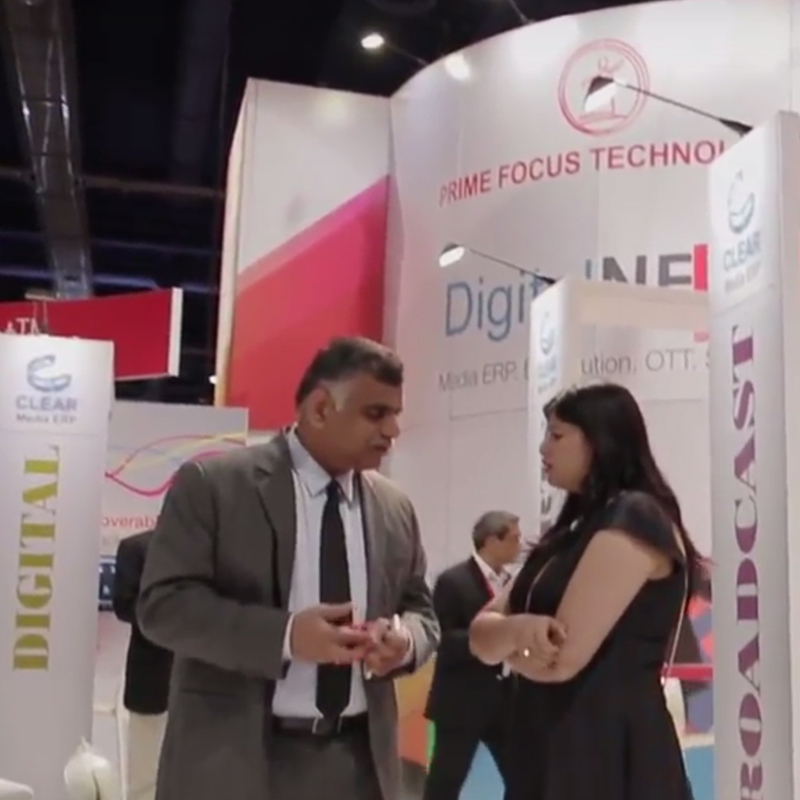
    MUMBAI: Prime Focus Technologies (PFT) – the technology offshoot of media services company Prime Focus – informed the Bombay stock exchange today that it had received its first round of funding from growth capital private equity fund Ambit Pragma.

    The amount or how much was being divested in favour of Ambit Pragma was not disclosed by PFT .

    It, however, elaborated that it proposes to use the investment for intensifying its development efforts of the software as a service (SaaS) products including its CLEAR Media ERPand gaining deeper penetration and growth in strategic markets such as North America and EMEA with increased sales and marketing efforts.

    PFT’s flagship product CLEAR Media ERP is targeted at M&E companies who increasingly adopt technology to tap the digital consumer landscape while enhancing efficiencies and lowering Total Cost of Ownership (TCO).

    CLEAR is the world’s first and most proven cloud based Media ERP Suite that virtualizes the content supply chain and builds a connected enterprise for M&E companies.

    PFT works with more than 300 clients in India and is the chosen technology partner for more than 100 clients globally including various leading broadcasters, studios, brands, sports and digital organizations.

    PFT’s award winning CLEAR Media ERP suite and Cloud Media Services have been successfully deployed for the last eight years in global M&E companies such as 21st Century Fox-owned Star India, Novi Digital, Hotstar, Miramax, Disney, Warner Bros, Global Eagle Entertainment, Cricket Australia, CBS Television Studios, 20th Century Fox Television Studios, FX Networks, Crown Media Holdings, Legendary Pictures, Starz Media, Lionsgate, A+E Networks, HBO, Mnet, CNBC Africa, SABC, IFC Films, HOOQ, Sony Music, Voot, Hearst Television, Showtime, BCCI, Indian Premier League and The Associated Press,among others.

    “Media ERP adoption in the global M&E industry has been growing steadily. With flat revenues and shrinking margins in traditional media, content enterprises especially broadcasters and studios have a tough time finding resources to invest in new monetization opportunities. M&E companies have to completely rethink technology investments and rejig their business model to survive in the new digital reality,” says PFT founder & CEO Ramki Sankaranarayanan.

    The investment by Ambit Pragma istremendous market validation of the business opportunity we serve and offers us growth capital to execute on our strategy for global leadership in the Media ERP space. We are delighted to have a like-minded partner in Ambit Pragma who appreciates the realities and opportunities within the M&E industry.”

    Adds Ambit Pragma CEO Rajeev Agrawal: “PFT is a global pioneer addressing the challenge s content enterprises are facing in this hyper digital market through their cutting-edge technology. The architectural road map of the product, its multiple use cases and their management’s thought leadership, represent a compelling opportunity for us to make the investment.”

  • Prime Focus Tech gets funding from PE firm Ambit Pragma

    Prime Focus Tech gets funding from PE firm Ambit Pragma

    MUMBAI: Prime Focus Technologies (PFT) – the technology offshoot of media services company Prime Focus – informed the Bombay stock exchange today that it had received its first round of funding from growth capital private equity fund Ambit Pragma.

    The amount or how much was being divested in favour of Ambit Pragma was not disclosed by PFT .

    It, however, elaborated that it proposes to use the investment for intensifying its development efforts of the software as a service (SaaS) products including its CLEAR Media ERPand gaining deeper penetration and growth in strategic markets such as North America and EMEA with increased sales and marketing efforts.

    PFT’s flagship product CLEAR Media ERP is targeted at M&E companies who increasingly adopt technology to tap the digital consumer landscape while enhancing efficiencies and lowering Total Cost of Ownership (TCO).

    CLEAR is the world’s first and most proven cloud based Media ERP Suite that virtualizes the content supply chain and builds a connected enterprise for M&E companies.

    PFT works with more than 300 clients in India and is the chosen technology partner for more than 100 clients globally including various leading broadcasters, studios, brands, sports and digital organizations.

    PFT’s award winning CLEAR Media ERP suite and Cloud Media Services have been successfully deployed for the last eight years in global M&E companies such as 21st Century Fox-owned Star India, Novi Digital, Hotstar, Miramax, Disney, Warner Bros, Global Eagle Entertainment, Cricket Australia, CBS Television Studios, 20th Century Fox Television Studios, FX Networks, Crown Media Holdings, Legendary Pictures, Starz Media, Lionsgate, A+E Networks, HBO, Mnet, CNBC Africa, SABC, IFC Films, HOOQ, Sony Music, Voot, Hearst Television, Showtime, BCCI, Indian Premier League and The Associated Press,among others.

    “Media ERP adoption in the global M&E industry has been growing steadily. With flat revenues and shrinking margins in traditional media, content enterprises especially broadcasters and studios have a tough time finding resources to invest in new monetization opportunities. M&E companies have to completely rethink technology investments and rejig their business model to survive in the new digital reality,” says PFT founder & CEO Ramki Sankaranarayanan.

    The investment by Ambit Pragma istremendous market validation of the business opportunity we serve and offers us growth capital to execute on our strategy for global leadership in the Media ERP space. We are delighted to have a like-minded partner in Ambit Pragma who appreciates the realities and opportunities within the M&E industry.”

    Adds Ambit Pragma CEO Rajeev Agrawal: “PFT is a global pioneer addressing the challenge s content enterprises are facing in this hyper digital market through their cutting-edge technology. The architectural road map of the product, its multiple use cases and their management’s thought leadership, represent a compelling opportunity for us to make the investment.”

  • Ooyala offers Indian broadcasters a quick OTT build service

    Ooyala offers Indian broadcasters a quick OTT build service

    MUMBAI: Come September and Indian broadcasters will have easy access to a quick OTT build solution. Australian telco Telstra subsidiary Ooyala is all set to roll out its AppStudio at the IBC convention in Amsttersam from 8-13 September 2016.

    Ooyala AppStudio, a press release from the company claims, mitigates the expensive custom development and integration costs typically associated with OTT market entry. An out-of-the-box solution, it ensures customers can deploy premium OTT experiences on time and on budget, with a simple, easy-to-use interface. As such, it does not require highly technical staff to build or manage services. Content providers can automate the build of OTT apps directly within the Ooyala AppStudio console for any device, supporting apps for Apple TV, Roku, Amazon Fire TV, and Chromecast as well as on iOS, Android and the web. No engineering is required, drastically reducing time-to-market as well as development and personnel-associated costs.

    Developed in partnership with Massive Interactive, Ooyala AppStudio is a comprehensive solution for companies to deploy, manage, track, analyze and monetize all components of a cloud-based OTT service. It supports revenue models including subscription vide-oon-demand (SVOD), advertising-supported video-on-demand (AVOD) or hybrid strategies. It also comes pre-integrated with a comprehensive set of best-in-breed technologies to ensure the experience is simple to use and seamless for the viewer, including:

    ● User registration, offer management, content scheduling as well as advanced user-interfaces (UIs) for device-tailored user experiences, powered by Massive Interactive’s technology, Massive HALO

    ● Video management and delivery, powered by Ooyala

    ● Content recommendation and personalization, powered by Ooyala Discovery

    ● Detailed analytics for video performance and audience engagement to help boost ad revenue or reduce subscriber churn, powered by Ooyala IQ

    ● Payment management, security and subscription billing, powered by Stripe

    ● Quality-of-experience (QoE) analytics, powered by Youbora from Nice People At Work

    ● Page-level behavior analytics in-app or on the web, powered by Google Analytics

    ● Support for any IAB VAST-compatible ad server including Ooyala Pulse

    Ooyala AppStudio, the company says, has an elegant interface for making changes to content layout, promoting high-performing video, adjusting seasonal promotions and content schedules, and optimizing the user experience for higher engagement. Customers can quickly apply offers and calls to action within the app experience, easily linking in¬-app images to promotional content either within the app or on an external website. These changes and updates are applied automatically with no need to rebuild or recertify the apps.

    “Media companies want to tap into the fast-growing opportunity OTT represents, but have been held back by slow pace and high cost of developing apps for the broad array of connected devices in the consumer market. Ooyala AppStudio changes that,” said Ooyala co-founder and senior vice president of roducts and olutions Belsasar Lepe. “There is tremendous growth in OTT demand particularly outside of the U.S., where broadband and 4G connectivity is improving, making offerings accessible to huge new audiences. For local content providers who want to hedge against larger OTT incumbents entering their market, Ooyala AppStudio is a perfect fit.”

    Ooyala has provided OTT solutions to companies such as Star India and Viacom18 in the past in India. And last month Ooyala CEO Ramesh Srinivasan announced that it was setting up an R&D facility in Chennai. “Our new office here will be instrumental in expanding the company’s global presence, providing another local team to support our growing Asia-Pacific customer base, and helping accelerate the rapid pace of innovation within the company,” he had told local media.