Tag: Star India

  • IPL 2018 gets a makeover with Star India

    IPL 2018 gets a makeover with Star India

    MUMBAI: IPL 2018 not only has a new destination channel but has changes that have been requested and accepted for the first time.

    It all started in September 2017 when Star India won the global IPL media rights for Rs 16,347 crore for the span of five years (2018-22). This is the first time when both the TV and digital rights are with a single broadcaster, which will result in the simulcast of the game without the groaning five-minute delay.

    For the first time, IPL will be live on 10 channels and Hotstar. On the digital platform, VR will be a key differentiator and will possibly help Hotstar to keep the fans glued on to it.

    For the previous seasons, Sony Pictures Network was airing IPL in two languages Hindi and English on Sony Six, Sony Max and their HD feeds. But Star is planning to telecast it in six different languages English, Hindi, Tamil, Telugu, Bengali and Kannada. The Kannada channel was still in the works some weeks ago.

    Star India recently managed to convince the IPL governing council (GC) to change the timings for the games of the league being held from 7 April to 27 May 2018. The 8 pm game will now begin at 7 pm while the 4 pm game has been pushed forward to 5:30 pm.

    Mumbai Indians co-owner Akash Ambani said that the time change will impact the team. “For us it is tough. Because people of Bombay work till 6:30-7 pm. It’s going to be impossible making it to a game at 7 pm. You are impacting the revenue. You are impacting the audience coming there. So we are objecting to that,” he said to Cricbuzz.com.

    IPL chairman Rajeev Shukla told Indiantelevision.com, “We have received the letter from Mumbai Indians. We haven’t taken any decision yet and it will be confirmed shortly.” But a week ago he confirmed to Indiantelevision.com that the timings have been changed.

    IPL 2018 will see mid-season transfer after seven games. The players who were not included in the playing 11 can opt for their mid-season transfer to other franchisees.

    The IPL GC announced that each IPL franchise can retain a maximum of five players from their respective current squads. Of the five players, a franchise can retain a maximum of three players through retention in lead up to the auction, and a maximum of three players through the right-to-match card during the auction. The other restrictions on player retention are: a maximum of three capped Indian players can be retained, and only two overseas players and two uncapped Indian players can be retained. For the first time, the player retention event was aired on TV and digital. The event was watched by 8.1 million people across the country.

    The salary cap for each team for the 2018 season has been increased from Rs 66 crore to Rs 80 crore (approximately $12.4 million). A franchise will be allowed to spend only Rs 33 crore on retentions ahead of the 2018 IPL auction, leaving it with just Rs 47 crore to spend at the auction.

    The Information and Broadcasting (I&B) Ministry is working on a proposal to make IPL available on Doordarshan and has asked the Sports Ministry to weigh in on the matter.

    The move will mean that Star India will have to share the live feed of the tournament with public broadcaster Prasar Bharati under the Sports Broadcasting Signals (Mandatory Sharing with Prasar Bharati) Act, 2007. Prasar Bharati runs Doordarshan and All India Radio. For this IPL will have to be categorised as a tournament of national importance at par with events like Olympics, Commonwealth Games and Wimbledon.

    Star India, for the first time, has also thought of starting international fan parks for the IPL and cricket lovers around the globe. Fan Parks were launched in 2015, initially in 16 cities. The 2017 edition of the Fan Park was held in 36 cities in 21 states, bringing fans across the length and breadth of India closer to their beloved sport. These included 14 new cities, like Bhubaneswar, Bareilly, Kochi, Ludhiana, Tumkur and Nagercoil which hosted the Fan Park for the first time.

    For the first time, fans were given a chance to vote for their favourite players on vivoiplelection.hotstar.com as a part of the ‘Election se Selection’ campaign on the network. The campaign, according to Star India MD Sanjay Gupta, received more than one lakh votes in less than 12 hours of its launch. Ajinkya Rahane and Krunal Pandya emerged as fan favourites after the final voting count before the auctions.

    Also read:

    Star ushers in IPL’s new era with a bang

    IPL auction: Gayle to play for KXIP, Unadkat most expensive Indian player

    Star India gets IPL to change match timings for 11th edition

  • Star Gold delivers the biggest bollywood premiere Golmaal Again with 12.1 million impressions

    Star Gold delivers the biggest bollywood premiere Golmaal Again with 12.1 million impressions

    After concluding 2017 by breaking TV records with the premiere of ‘Judwaa 2’, Star Gold attracts a whopping 12.1 million impressions (HSM, Urban 2+) for the World Television Premiere of Golmaal Again. Breaking its own record of 10.9 million impressions (HSM, Urban 2+) for the TV premiere of Judwaa 2, the Home of Blockbuster has delivered 12.1 million impressions on TV with Golmaal Again.

    Having previously premiered chartbusters like BajrangiBhaijaan, PremRatanDhanPaayo, Kick, Dishoom, Housefull 3 and now delivering back to back hits like Judwaa 2 and Golmaal Again, the channel has reinforced its position of being the ultimate destination on television for Bollywood premieres. In 2017 itself, the channel delivered 6 of the top 10 premieres shown on Hindi movie channels.

    Hindi Movie Business at Star India, General Manager and Executive Vice President, Hemal Jhaveri says, “In an industry like ours, it is vital to always up the notch year after year. The stupendous success of Golmaal Again on Star Gold authenticates the channel’s on-point content strategy. We are overwhelmed by the support. We will continue to bring the best of Bollywood to our viewers.”

  • Sky Sports retains IPL rights for UK, Ireland

    Sky Sports retains IPL rights for UK, Ireland

    MUMBAI: Sky Sports has signed a new multi-year deal to broadcast the Indian Premier League (IPL) in the UK and Ireland. The deal allows Sky to retain the IPL broadcast rights for the territory.

    In 2014, Sky had signed a three-year deal to broadcast the IPL for the first time in the UK and Ireland.

    Under the deal, Sky Sports will broadcast 60 IPL matches live each year in the UK and Ireland, starting with the 2018 edition. The 11th season of the IPL is slated to go on air from 7 April.

    The Sky-Star deal also includes digital rights. This means that Star’s video-on-demand (VoD) service Hotstar will not be streaming the T20 tournament in the UK.

    Star was planning to use the IPL to strengthen Hotstar’s presence in global markets like the US and the UK.

    Last year, Star India had acquired all IPL media rights for Rs 16,347.5 crore ($2.55 million) for a five-year (2018-2022) cycle.

    Also Read:

    IPL auction: Gayle to play for KXIP, Unadkat most expensive Indian player

    Star India gets IPL to change match timings for 11th edition
    Star ushers in IPL’s new era with a bang

  • Zee, Star, NBA oppose converged regulator for broadcast and telecoms

    Zee, Star, NBA oppose converged regulator for broadcast and telecoms

    MUMBAI: Two of India’s biggest broadcasters Star India and Zee Network and industry association News Broadcasters Association (NBA) have opposed the TRAI’s proposal to have a converged regulator, a concept being debated as part of a consultation paper floated by the regulatory body. 

    In its lengthy submission to the TRAI’s paper on formulation of National Telecoms Policy 2018, Star, while suggesting a “separate regulator” for broadcasting sector was unfeasible, has said, “With a converged regulator for ICT and broadcasting there is always the risk of ‘false equivalence’ being drawn between the two sectors.”

    Pointing out that convergence was an aid to make content available to consumers and increasing the opportunities for content producers/rights holders to maximise monetisation opportunities involving intellectual property rights over content, Star highlighted, “Creative eco-system being an entirely separate unique value chain from ICT, should always be treated with a view to uphold and protect IPs.”

    Echoing similar sentiments, Zee said the Ministry of Information and Broadcasting (MIB) was the nodal ministry for all broadcasting related issues and it would be “inappropriate” for the Department of Telecommunications (DoT) to propose a converged regulator in its policy document without making the MIB a part of the process.

    “It may also be pointed out that setting up a convergent regulator would also require a convergence bill (to be okayed by Parliament) outlining the very scope of convergent regulations and various issues associated with it,” Zee explained its stance.

    Subhash Chandra-controlled Zee network has gone ahead and questioned the TRAI’s various consultation papers on broadcasting industry-related issues that include the one on NTP 2018 and another one on uplinking and downlinking.
    “It is astounding that there is no correlation between the two consultation papers,” Zee has submitted, “If the comments (from the industry) provided against one consultation paper are accepted, these would be counter to the comments/ recommendations against the other consultation paper.”

    Both Star and Zee in their submissions have cited in the defence of their stance views of Parliament’s Standing Committee on Information Technology on broadcast regulation articulated in its latest report tabled few weeks back.
    In its report, the parliamentary panel observed that the broadcast sector has developed so much that it would be advisable for the government to explore a separate regulator and till that happens, powers of TRAI could be explored to be expanded as an interim measure.

    By trying to bring in the “convergence issue”, wherein broadcasting and telecom were “treated under the same umbrella” in a converged manner, the TRAI “would be acting contrary” to the views articulated by the parliamentary panel that had pushed for separate regulators for telecoms and broadcast sectors, both Star and Zee pointed out.

    NBA, which is an apex industry body comprising most of the TV (and digital) news ventures as its members, also joined in the issue with Star and Zee to observe the regulatory authority dealing with content issues must be different from the body dealing with other issues in the broadcasting sector.

    The TRAI regulates the carriage side of the broadcast industry that includes issues such as tariff, inter-connect and quality of service. It also holds sway over matters like OTT, broadband and net neutrality that straddle both segments of broadcast and telecoms services.

    Also Read :

    MIB reverts to earlier norms of seeking nod from ISRO on uplink/downlink of TV channels

    Government toying easing downlink norms

    The Communication Convergence Bill, 2001

  • Star India gets IPL to change match timings for 11th edition
    Star India gets IPL to change match timings for 11th edition

    MUMBAI: When Star India announced that it was coughing up a jaw dropping Rs 16,347.50 crore to acquire the all media rights of the prized IPL, it signaled an era of change. And more of that is coming. Star India  has managed to convince the The IPL governing council (GC) to change the timings for the games for the eleventh season of the league being held from 7 April to 27 May. The IPL opening ceremony will take place in Mumbai on 6 April.

    IPL chairman Rajeev Shukla confirmed to Indiantelevision.com that the 8 pm game will now begin at 7 pm while the 4 pm game was being pushed forward to 5:30 pm.

    “The broadcaster has requested for a change in timings. By and large, the GC has accepted it. It gets too late in the night if the game starts at 8 pm,” said IPL Chairman Rajeev Shukla after the GC meeting. “There will be an overlap but the broadcaster says it has enough channels to show the games simultaneously.”

    At the meeting, it was also decided that Kings XI Punjab will play four of their home games in Mohali and three in Indore.

    The home matches of Rajasthan Royals, who are returning to the IPL after serving a two-year ban, will be finalised after the Rajasthan High Court’s hearing on 24 January. Preference will be given to Jaipur if the stadium is ready and court clears RCA’s status.

    “If that doesn’t happen, the alternate venue will be Pune,” said Shukla. A total of 578 players including 360 Indians will go under the hammer at the IPL auction in Bengaluru on January 27 and 28.

    Also Read :

    Star ushers in IPL’s new era with a bang

    578 players to go under the hammer for IPL auction

    BCCI invites brands to acquire third-party rights for IPL

  • PKL season 6 and 7 dates announced

    PKL season 6 and 7 dates announced

    MUMBAI: The second most watched domestic league in India, Vivo Pro Kabaddi League owned by Mashal Sports and Star India announced the dates of sixth and seventh season.

    The sixth season will begin on 19 October 2018 while the seventh season will commence on 19 July 2019. Both the seasons will maintain the 13-week format, consistent with the format of the fifth season.

    In the last season, the league scaled unprecedented heights having expanded from eight to 12 teams and conducting 138 matches over a duration of 13 weeks. Withstanding intense competition, Patna Pirates, led by Pardeep Narwal, beat Gujarat Fortunegiants to clinch the championship title for the third consecutive time.

    Season five touched new highs in terms of viewership records too. It was viewed by a staggering 313 million viewers with a watch time of 100 billion minutes, with the finals becoming the most viewed non-cricket sporting event on Indian television.

    Vivo Pro Kabaddi League commissioner Anupam Goswami said, “The Vivo Pro Kabaddi season sixth window has been created to keep in mind adequate recovery time for the players post the Asian Games, and adequate preparatory time for Vivo Pro Kabaddi teams to achieve an ideal state of squad readiness for season six. The advance window for season seven will afford forward-looking preparation for squad formation and commercial strategy.”

    International Kabaddi Federation president Janardan Singh Gehlot said, “Mashal has taken India’s sport of Kabaddi from strength to strength with Vivo Pro Kabaddi. We welcome the long term approach which will take it to even greater heights.”

    In its fifth and most successful season till date, Vivo Pro Kabaddi league became the biggest domestic sports league and season six promises to be even more action-packed.

    Also Read:

    Star ushers in IPL’s new era with a bang

    Gautam Thakar new Star Sports CEO

  • Star ushers in IPL’s new era with a bang

    Star ushers in IPL’s new era with a bang

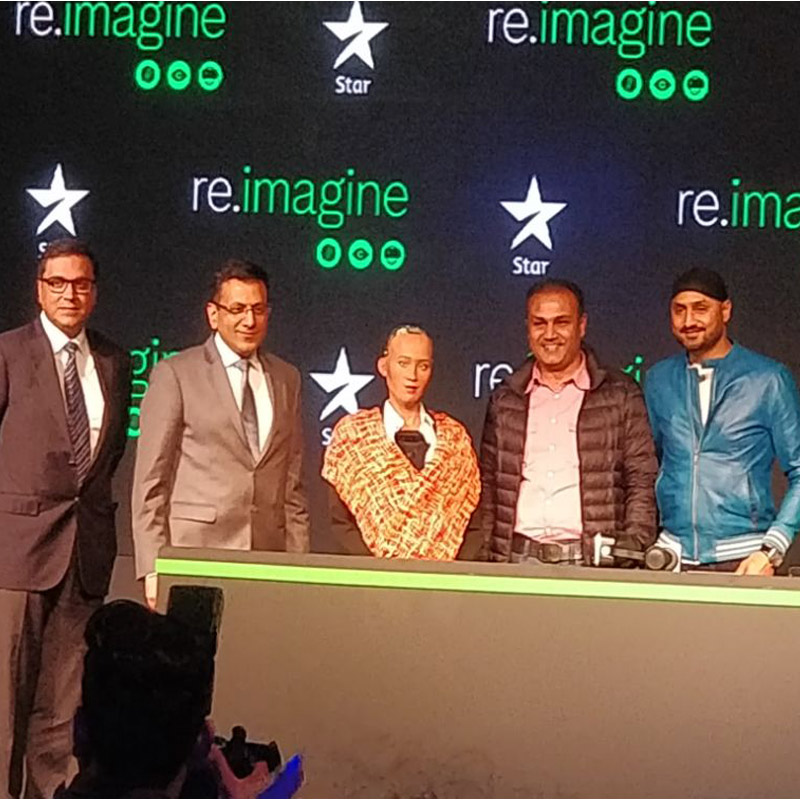
    NEW DELHI: Star India is all set to reinvent the Vivo Indian Premier League (IPL) 2018 by increasing viewer-engagement levels. In a sign of things to come, the broadcaster’s press conference in Delhi today started with a conversation between social humanoid robot Sophia and former India cricketer Virender Sehwag and Harbhajan Singh.

    In a bid to get closer to fans, Star India is using all its might to reach out to India’s vast regional audiences by tailoring coverage in six languages-Hindi, English, Bengali, Telugu, Kannada and Tamil. As a result, it is targetting 700 million fans across TV and digital. “We researched and found out that only 50 per cent of the potential fans consume IPL in Tamil Nadu because of the language barrier,” Star India MD Sanjay Gupta said.

    The auctions on 27 January 2018 are eagerly awaited. For the first time, fans can vote for their favourite players on vivoiplelection.hotstar.com as part of the ‘Election se Selection’ campaign on the network. The campaign, according to Gupta, has received more than one lakh votes in less than 12 hours of its launch.

    Gupta also confirmed that the TV and digital telecast will be in sync. “The feed on TV and digital will be aired live at the same time; there will be no five-minute delay,” Gupta confirmed to Indiantelevision.com. Additionally, for the first time ever, IPL will be streamed on Hotstar using virtual reality.

    BCCI CEO Rahul Johri said, “Despite the scale of its success, the sky remains the limit for the VIVO IPL 2018. The IPL, as a brand, is [worth] over $4 billion.”

    Star is actively seeking regional brands that cater to each of the six languages. “Star India is planning to multiply the number of brands compared to last season. The ad rates will be different for different channels based on their reach,” added Gupta.

    The Kannada channel, which was to replace Channel V on the airwaves, has, however, not yet seen the light of day. When asked about the launch of Star Sports Kannada, Gupta declined to comment and added that it was still at the planning stage.

    “Over its 10-year journey, the IPL has grown into the single biggest property by far on Indian television. And now that it is on the Star India network across both, television and digital, we are set to use the confluence of technology, consumer insight, and experience in cricket coverage, to broaden the outreach and experience even further,” Gupta concluded.

  • 2017 was a regulatory roller coaster and the ride continues

    2017 was a regulatory roller coaster and the ride continues

    NEW DELHI: The year 2017 for the media industry certainly couldn’t be called easy from the point of doing business despite efforts and claims by the federal government that significant progress had been made in the regard.

    The downside of demonetisation of high-value currency notes not only continued to be felt well into 2017, but the introduction of the GST (goods and services tax) in July and its compliance added to the woes as it increased paperwork and investment in human resources for the entire media sector. The cascading effect of the tax and monetary policies on the general economy of the country had a telling effect on the media and entertainment industry as companies, big and small, struggled to keep up with compliance (and sliding revenue) and changing guidelines owing to teething problems.

    2017 began with broadcast and telecoms regulator TRAI’s new set of guidelines relating to tariff, QoS and inter-connection, issued in the second half of 2016, being challenged by one of the biggest broadcasting companies (in terms of reach and revenue), Star India, and its ally Vijay TV in a Chennai court. Separately, two other DTH companies filed a similar challenge in a Delhi court.

    Over a year later, the regulator’s guidelines-touted to be an effort in creating fair ground rules for all stakeholders leaving them free to take commercial decisions-remain in suspended animation as the Chennai court is yet to deliver its final verdict till the time of writing this piece though the arguments and other legal processes have been completed.

    And, then Ministry of Information and Broadcasting (MIB) got in Smriti Irani as minister, a person with a background in the media and TV industry and as someone with strong views on issues. The sudden cancellation of a programming contract to Balaji Telefilms, awarded by pubcaster Doordarshan after a tendering process, could be cited as Irani’s aggressive stand on matters relating to her ministry and the media sector. Ditto for Doordarshan’s parent company Prasar Bharati deciding suddenly during the year not to renew contracts of some private sector TV channels that rode piggyback on DD’s free-to-air DTH platform Free Dish. The latter case is now being debated at the disputes tribunal.

    Over the 12 months in 2017, the MIB came out with a series of regulations, ranging from advisories on condom ads (the flip-flop was surprising) to a sharp hike in processing fees for clearances without clear definitions on some matters to the dos and don’ts of covering sensitive developments, all of which have left most industry players uneasy.

    A section of the industry also feels that the government has cleverly fired the gun, at times, keeping it on the shoulder of TRAI. Even while the regulator is in the process of wrapping up a consultation on various points of ease of doing business in the broadcast and cable sector, towards the fag end of the year, the MIB requested the regulator to examine whether TV channel permissions to beam into the 183-odd million TV homes in the country could be auctioned and the entry-level threshold increased-all aimed at arresting the spiralling number of applications seeking permissions to start a new channel. If legislated, it would be a sort of first where TV channel permissions, and not spectrum, would be auctioned.

    Another directive causing concerns for broadcasters is an MIB order making provision for processing fees on account of change of satellite, channel name/logo, language of channel, category of channel, mode of transmission, teleport, teleport location and change in the category of a channel from a GEC to a news channel for temporary uplink of a live event. The regulation stipulates that a processing fee of Rs 100,000 would have to be paid by a TV channel if seeking temporary uplink permission for, say, a cricket match. Nothing wrong in putting an amount to undertake processing.

    But what is troubling the TV channels is that the fee of Rs 100,000 is for each channel. So, for example, if a broadcaster having four sports channels proposes to telecast live a test cricket match for five days, then the amount for processing of temporary uplink permission by MIB would be Rs 100,000 each for five days for each of the four sports channels (100,000x5x4). That, stakeholders point out, is quite a large sum of money for a five-day match telecast in different languages over several TV channels.

    The MIB also, for the first time, introduced new categories of channels, namely regional and national. As per the extant uplinking and downlinking guidelines of 2011, however, all the licences, whether it is an Assamese or a Tamil language channel, are for pan-India channels and can be distributed throughout India. In fact, many broadcasters obtain multi-language permission for their channels to be able to run in multiple language feeds. The ministry later had to come out with clarifications defining what constitutes a national channel and what is a regional channel, which makes things a bit more complicated in sharp contrast to the federal government’s claim of having created a more conducive business environment in India, a senior executive of a broadcast company opined. What’s more, some experts pointed out, it was surprising that the MIB took the decision on re-classification of TV channels because such policy decisions would ideally need to be ratified by the federal cabinet of ministers.

    The TRAI, however, was banking on its ground rules for the broadcast and cable sectors to herald a new era that is not to be–not at least in 2017. But the regulator’s earnestness to hold a dialogue with stakeholders cannot be faulted despite questions being raised on some of its consultation papers; the one on STB inter-operability, for example. The TRAI should be lauded for upholding principles of net neutrality, in general, and giving thumbs down to content availability in a walled-garden environment, while in the US the FCC is preparing ground to dismantle net neutrality regulations that claimed to be protecting consumer interest.

    What comes out quite clearly in the year of disruptions and a clear change in the ways media, especially TV news, functions is that the thin line blurred between ethics and the dance-on-the-unethical-side-while-remaining- technically-correct.

    The all’s-fair-in-love-and-war thinking was written all over the audience measurement controversy that broke out involving a new news channel that debuted with a bang and the incumbents of the news genre in 2017. Accused by a section of news channels of using dual LCN or frequency strategy to increase sampling and snacking to up audience ratings, the new news channel hit back saying all other players too had sometime used the same strategy. Subesequently, the regulator had to step in directing stakeholders to desist from using practices that were not allowed in the TRAI’s books.

    Such instances-apart from the now-contested TRAI directive barring use of the `landing page’ by TV channels-highlight one thing: if the industry craves for a light-touch regulatory regime, restraint and maturity is needed from the industry, too. For example, despite the TRAI cracking the whip on dual LCNs, many TV channels, including the not-so-new-news-channel-on-the-block, were repeatedly accused by competition of continuing to use the dual LCN strategy throughout 2017.

    If the TRAI-and the government-hoped its guidelines and advisories would reduce litigation in the broadcast and cable sectors, the dream is yet to be fulfilled. The website of broadcast and telecoms disputes tribunal TDSAT states there are approximately 800 cases (in both sectors) still pending till 22 December 2017 if statistics from January 2017 were considered. The high pendency was despite the fact that TDSAT disposed of hundreds of other cases in 2017.

    The broadcast and cable industry would hope that 2018 would be less challenging, at least from the point of view of regulations. Some issues (like the consultation paper on uplink/downlink of TV channels, online video piracy and lack of any guideline for M&As for the media sector), however, continue to rankle even as we all enter 2018, not to mention that a proposal to review DTH guidelines, involving issues like rationalising revenue sharing with the government and renewing of licenses have been seemingly put in the cold storage by the government.

  • Sony Six rakes in ad rev from BBL despite slow start

    Sony Six rakes in ad rev from BBL despite slow start

    MUMBAI: The second most popular domestic T20 cricket tournament in the world after Indian Premier League (IPL) is Australia’s Big Bash League (BBL). The Cricket Australia rights, which were with Star India from 2011-12 to 2016-17, have now been acquired by Sony Pictures Network (SPN) India for the next six years till 2022-23.

    After losing the media rights of the Indian Premier League (IPL) to rival Star India, SPN has gone ahead and acquired the exclusive media rights of Cricket Australia–men’s international matches for the next six years, beginning with the Magellan Ashes series in November 2017. The network has also acquired the media rights for women’s international cricket played in Australia, the BBL and the Women’s BBL.

    According to All India BARC data, for the first 11 matches of the league on Star Sports 2, including the HD and the SD feeds, in the 2016-17 season, the channel got 6.4 million impressions. SPN India, however, garnered just 4.3 million impressions for the same number of matches, which were being telecast on Sony Six SD and HD.

    Collocation of channels plays an important role in attracting viewers. On most direct-to-home (DTH) platforms, the sports cluster begins with the Star Sports bouquet.

    Both networks in their first 11 matches had eight advertisers on board each but Star Sports (2016) had 2764 ad insertions compared to 3469 insertions on Sony (2017), an increase of 26 per cent according to BARC data.

    Though Cricket Australia considers Star India a favourite, it is learnt that after winning the IPL rights, the broadcaster was not very keen on paying a hefty sum for the Australia rights. SPN’s payout for the deal could not be ascertained till the filing of this report.

    Cricket Australia has been targeting $200 million per year from all the broadcasting deals. In Australia, Channel Ten paid $100 million for a five-year deal which expires at the end of the current season.

    Apart from Cricket Australia, SPN has five international cricket boards—South Africa, Sri Lanka, Pakistan, West Indies and Zimbabwe. The ongoing cricket series is the India tour of South Africa.

    Interestingly, fans seem to prefer Sony’s over-the-top (OTT) platform SonyLiv for sporting events despite the choice of entertainment shows it offers. At present, more than a third of SonyLiv’s traffic is garnered by its sporting properties.

    Also read:

    The BCCI India rights conundrum

    Star and BCCI pull out all stops to make the VIVO IPL 2018 Retention event – an unprecedented success


  • Star India gets aggressive with global programme syndication sales

    Star India gets aggressive with global programme syndication sales

    MUMBAI: Leading Indian media and entertainment major Star India is quite confident that its new catalogue of historical dramas and contemporary soaps and series will gain traction as it continues with its international syndication drive. In an interaction with World Screen, Star India president international business and domestic distribution Gurjeev Kapoor said: “Our new line-up of shows like Love Ka Hai Intezar (The Wait For Love), Dhhai Kilo Prem (Imperfect Love), Tu Suraj Mein Saanj Piyaji (Soulmates season two) and Nimki Mukhiya (The Accidental Mayor) are generating a lot of interest. These shows have already captured the attention of audiences in India and are now on their way to winning [over] audiences worldwide.”

    According to Kapoor, Star India’s shows have begun to get traction in almost every territory globally–right from the US to the UK to Europe and the CIS, Latin America and Southeast Asia. In some of these markets, partners or sales agents have been helping the broadcaster to find buyers; in some of them, Star India’s programme syndication team in Mumbai and other regions is driving the sales. In Latin America, the company has partnered Latin Media Corp, for Europe and CIS it has been working with Intellecta Srl while in Southeast Asia it has been selling directly.

    The efforts have yielded results. For instance, Saras & Kumud (Saraswatichandra) has done well in seven Latin American nations, including Chile and Peru. Then Yours Truly, Paakhi (Tumhari Paakhi) has got a favourable response in Peru. Kapoor told the magazine that this has enthused the company to invest in dubbing a few more of its top shows. 

    Kapoor pointed to out that Is Pyaar Ko Kya Naam Doon has been its most successful breakthrough and it made history by becoming the first-ever Indian drama series to air in Turkey. “It broke many viewership records by quadrupling the channel ratings in that slot for our partner Kanal 7. This paved the way for many more Indian series on local Turkish television and Turkey continues to be a big market for us.”

    Indonesia, Malaysia and Thailand are some of the Southeast nations that have been lapping up a lot of the content Star India has been dishing out. Among the shows that have done well in the region, Kapoor said, are Mahabharat, Diya Aur Baati Hum, Veera and Chandra Nandini.

    Kapoor is also looking at adding to its partnerships for selling its programme formats. Star India has a partnership with Eccho Rights for three or four of its shows and is in conversation with other partners in local markets.

    He believes that good storytelling can traverse borders and cultures and forms the core of Star India’s international business. “Programme sales have been a driver in expanding Star India’s content footprint across the world. This is an area where we were good but we want to grow exponentially,” Kapoor concluded.

    Amen to that!