NEW DELHI: Some members of the Parliamentary Standing Committee on IT and Telecom, which recently submitted its report on the Communication Convergence Bill 2001, have expressed their reservation on the formation of the Communications Commission of India (CCI) and questioned the effectiveness of the proposed super-regulator that will have jurisdiction over virtually every field of communication, including telecom, broadcasting, cable and IT.
Pointing out that due to its “vast responsibilities” the CCI can become a “monolith”, in a ‘precautionary note’ (included in the report of the parliamentary panel) two Members of Parliament have said, “Due its vast powers and establishment, the CCI can become a hindrance to rapid evolution and convergence of technologies and services.”
If Parliament takes note of the missive from the MPs, it could lead to the curtailing of the powers of the CCI. It has been further observed that the CCI can restrict freedom of information for consumers and freedom of action for service providers if its powers are “not used properly” and over-arching powers can be “misused through a tangle of rules, regulations, licences and registration requirements.”
Recently IT, telecom and parliamentary affairs minister Pramod Mahajan had told indiantelevision.com on the sidelines of a Delhi economic summit that “if need be another round of discussion can held on the Bill” considering wide ranging views which have been expressed through the Standing Committee’s report.
The note from the two MPs also caution on the control that the government of the day can have over the CCI.
“By controlling appointments, the government of the day can exercise too much remote control over the Commission. There can be a risk of excessive curbs over the independence and autonomy of the Commission as has happened, for instance, with Prasar Bharati,” the note points out with great accuracy.
If India manages to enact a piece of legislation to govern the convergence space, then it would be only the second country in the world, after Malaysia, till now to have such legislation.
Enumerating the several ways in which the government of the day and the CCI can “enhance authoritarian practices if not used prudently”, the note from the MPs state their assertions may be considered during the implementation of the provisions of the Bill.
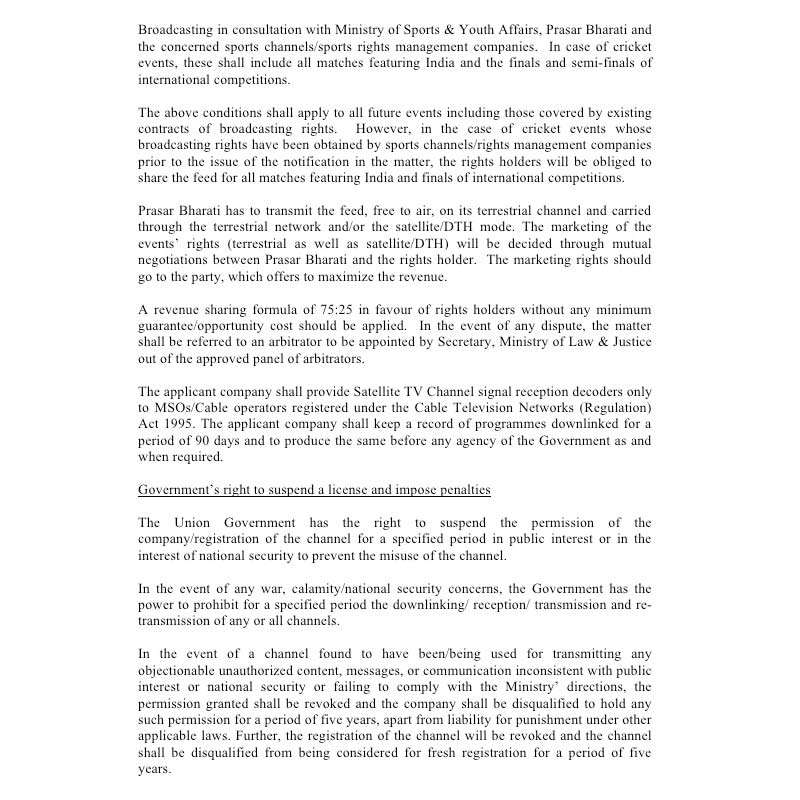
Meanwhile, one of the recommendations of the Standing Committee pours cold water over Prasar Bharati’s ambitions to have a monopoly over telecast rights, specially those relating to sports, of national and international importance in the name of public service.
Noting that both Doordarshan and All India Radio offer valuable services to the general public through their terrestrial networks’ vast reach and that the general public should not be deprived of viewing of events in the name of free competition, the parliamentary panel has said CCI needs to be careful on such issues.
Suggesting that Clause 31 of the Bill should be rephrased, the Committee has said the Clause should read: “The Commission shall give adequate opportunity of hearing to all persons interested therein and also ensure that the principles and terms determined by it do not dissuade broadcasters from bidding for the rights to broadcasts any such event (which have been notified under the aforementioned Clause).”
Earlier this year, Prasar Bharati had petitioned the information and broadcasting ministry that because of high cost of acquiring telecast rights DD and AIR are generally left out in the cold in situations where private satellite broadcasters hold sway because of their financial muscle. In this regard it had also said that any national and/or international event which is of importance to the Indian viewing public should also necessarily come to the public service broadcaster and not be the exclusive prerogative of some private broadcasters.