Tag: sports

  • Chrome week 3: Sports genre tops chart with 3.7% OTS

    Chrome week 3: Sports genre tops chart with 3.7% OTS

    MUMBAI: The sports channels’ genre emerged as the gainer in Chrome’s opportunity to see (OTS) analysis across India by registering an increase of 3.7 per cent. DD Sports was the leader with 75.8 per cent OTS in week 3.


    Next up, the kids genre with 3.7 per cent gain in the same market took the second spot in the list of top gainers. Nickelodeon led the tally with 72 per cent OTS.


    The religious channels’ genre in Hindi Speaking Market (HSM) too noted a growth of 3.3 per cent with Aastha emerging as the chart topper with 91.1 per cent OTS.


    Last but not the least, music channels in an identical market observed a 2.8 per cent rise with 9XM in the number one slot with 81.8 per cent OTS.


    Meanwhile, witnessing a drop of 0.5 per cent, the English News channels’ genre in the six metros topped the loser category with Lok Sabha TV scoring 91.4 per cent OTS.


    On the other hand, with a drop of 0.1 per cent, the English movies genre in six metros was in the second spot with Movies Now emerging as the most affected channel with 57.9 per cent OTS.

  • Chrome week 3: Sports genre tops chart with 3.7% OTS

    Chrome week 3: Sports genre tops chart with 3.7% OTS

    MUMBAI: The sports channels’ genre emerged as the gainer in Chrome’s opportunity to see (OTS) analysis across India by registering an increase of 3.7 per cent. DD Sports was the leader with 75.8 per cent OTS in week 3.


    Next up, the kids genre with 3.7 per cent gain in the same market took the second spot in the list of top gainers. Nickelodeon led the tally with 72 per cent OTS.


    The religious channels’ genre in Hindi Speaking Market (HSM) too noted a growth of 3.3 per cent with Aastha emerging as the chart topper with 91.1 per cent OTS.


    Last but not the least, music channels in an identical market observed a 2.8 per cent rise with 9XM in the number one slot with 81.8 per cent OTS.


    Meanwhile, witnessing a drop of 0.5 per cent, the English News channels’ genre in the six metros topped the loser category with Lok Sabha TV scoring 91.4 per cent OTS.


    On the other hand, with a drop of 0.1 per cent, the English movies genre in six metros was in the second spot with Movies Now emerging as the most affected channel with 57.9 per cent OTS.

  • Top 10 trends that will rule sport-ainment in 2016

    Top 10 trends that will rule sport-ainment in 2016

    MUMBAI: Sports in India has received a shot in the arm recently with the growing number of leagues spanning games like badminton, football, kabaddi, wrestling et al. Predicting the Top 10 trends that will rule ‘sport-ainment’ in 2016, GroupM’s specialist business unit ESP Properties (Entertainment & Sports Partnerships) in its report said that elongated presence of emerging sports will be one of the top trends.


    ESP Properties business head Vinit Karnik said, “The Indian sports and entertainment industry is going through exciting times. From gaming to short format videos, 2016 will unapologetically be all about changing the existing norms. With the rise of leagues across various sporting formats and with the increase in co-branded promotions, the opportunities for brands to associate with movies and sports are also increasing. We perhaps could even look at having bi-annual or longer seasons for emerging sports! We have come a long way in how leagues address sponsorship deals, ticketing, fan engagement etc. Gone are the days when brands associated with films for vanilla in-film placements. It is touted to be deeper, richer and more brand-centric than before! On that note, let 2016 be a year of many firsts and innovations!”


    The Top 10 trends in sport-ainmnet in 2016, according to ESP are as follows: 


    1) Emerging sports to have elongated presence: Emerging sporting leagues will offer bi-annual schedules or longer seasons to attract and retain audiences and advertisers.


    2) Rise of music festivals: Music festivals will continue to create sharp differentiation by focusing on specific genres. They will also create successful IPs independent of established and celebrated artistes and offer brands a round-the-year calendar to engage with audiences.


    3) Owned media to compliment paid media: Brands and studios chasing common target consumers will enter into non-cash exchanges where brands will offer content creators their platforms and owned media to extend and expand their reach in exchange for the license to co-promote the film(s).


    4) Shortened, targeted and summarised: Digital will emerge as a powerful dissemination medium for audiences unable to follow live sports or event telecasts. Video clips and short format videos capturing highlights or key moments will emerge as a new avenue to reach audiences who are pressed for time.


    5) Happy sporting; yours digitally: We will see an increase in the number of online e-sports tournaments being hosted in India. And so will the number of youngsters who actively pursue a career as an e-athlete with an ambition of representing India at various e-sports tournaments on a global platform.


    6) Underdogs will come out of the closet: Non-cricketing sports will increase bundle on-air inventory with on-ground entitlements and create a better value for both rights owners and advertisers. Non-cricketing sports are inherently not advertiser friendly when it comes to availability of on-air inventory. Central sponsorship thus acquires critical importance for brands and advertisers and will make a bee line for central sponsorships of leagues.


    7) Brand and film engagements to have a longer courtship: Brands partnering with films will seek longer windows of co-branded association to derive optimal benefits and leverage the multiple opportunities that are offered during the various stages of the script to the screening process of the production of the film.


    8) Influencer marketing – the new buzzword: Brands will seek more credible consumer Influencers and leverage them in the social media space instead of creating high profile TV campaigns using celebrity brand ambassadors.


    9) Broadening the base: Broadcast of non-cricketing sports on high reach national and regional channels will successfully expand the audience base, which in turn will attract more advertisers.


    10) Subtlety is key: Product placement in films will see more thematic and contextual yet subtler integrations replacing passive and overt brand placements. Brands will seek active consumer engagement and not just saliency.


    Karnik added, “The modern sports experience isn’t confined to the stadium. Nearly half of all sports fans prefer to follow their teams digitally and frequently use their laptops or smartphones to look up sports-related content during a game. In this digital sports sphere, marketers are developing clever ways to engage with modern fans. Social media has given athletes a very public and direct line of communication with their fans and brands will be tapping this potential more fervently than before.”

  • Chrome week 40: Sports genre leads with 1.1% hike

    Chrome week 40: Sports genre leads with 1.1% hike

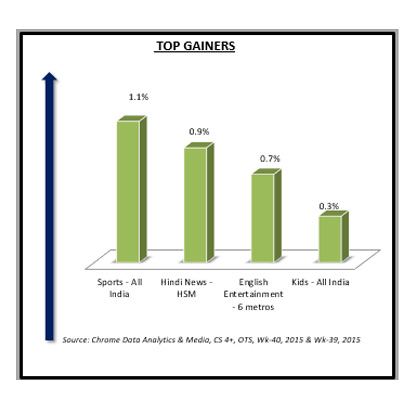
    MUMBAI: The sports genre across India led the pack with a growth of 1.1 per cent with DD sports at the top of the chart with 74.4 per cent opportunity to see (OTS) in week 40 reported by Chrome Data Analytics and Media.


    Second on the list is the Hindi News genre in Hindi Speaking Market (HSM), which witnessed 0.9 per cent growth. India TV bagged the pole position in the section with 95.5 per cent OTS.


    English Entertainment grabbed the third slot in the six metros with growth of 0.7 per cent with Zee Café led the section with 49.3 per cent OTS.


    The Kids’ genre witnessed a rise of 0.3 per cent with Nickelodeon on the top with 78.6 per cent OTS.


    Amongst the losers this week were English Movies, Business News, Infotainments and Hindi general entertainment channels (GECs).


    The English Movie section in six metros witnessed a drop of 3.2 per cent with Movies Now securing the first position with 57.4 per cent OTS.


    Business News in six metros dropped by three per cent with CNBC Awaaz securing the top slot with 72.9 per cent OTS.


    The Infotainment channels genre across India dropped by one per cent. DD Kisan with 81.2 emerged as the most affected channel in the genre.


    This was followed by the Hindi GEC genre, which saw a fall of  0.7 per cent and bagged the fourth berth with DD National leading the tally with 96.4 OTS.

  • What spells success for Indian sports leagues?

    What spells success for Indian sports leagues?

    MUMBAI: The sports industry in emerging markets is changing rapidly today. Amongst the various changes that is impacting sports and its allied businesses, is the emergence of sports leagues.


    According to a white paper released in collaboration between GroupM ESP and IIM –Ahmedabad, the success of the league is dependent on factors such as the sport and its fan base, the performance of the national team for the sport, design of the league, initiatives to build the fan experience, relationship of the league with relevant sports associations and the involvement of celebrities in the league.


    By studying what worked and what didn’t, the report brings to light best practices in the formation and running of sports leagues in a manner that will make them successful.


    Sports – The game is changing


    Over the past 10 years, the sports firmament has changed fundamentally. There has been an increase in the marketing of sports as well as a rise in the use of sports marketing purposes.


    Research indicates that there has been a sharp increase in the governmental support to sports as it is believed to increase societal and economic welfare of the country as well as promote the nation on the global front.


    Increased economic activity has also contributed to the growth of sports and its following. Today, sports serves two purposes: One, to be a platform to create marketing opportunities for brands and secondly, to actually create value for sports fans.


    These twin purposes go hand in hand, and serve the business and industry as well as the sports fans. For brands and advertisers, it is a win-win situation, in so much as when they pay to sponsor or promote a sport; the sporting event offers them a platform to reach their audience.


    As per an industry study report, sports industry in both mature and emerging economies has been growing at a rate faster than the GDP. As of 2011, the size of the industry was estimated at $620 million, growing at a rate of 6 per cent. While the sports economy has always been strong in North America and Europe; in the recent past, it is experiencing a major push in emerging markets.


    The report further states that all the BRIC nations have shown impressive growth in sports (India – 17 per cent, China – 20 per cent, Brazil – 7 per cent and Russia – 53 per cent).The growth of sporting events in emerging markets has been accompanied with the rise of several sports leagues.


    Professional sports leagues like the Major League Baseball (MLB), National Basketball Association (NBA), National Football League (NFL), English Premier League (EPL) etc have achieved great success in North America (US and Canada) and Europe.


    The report states that these leagues have gained worldwide popularity and fan following and in turn has inspired the setting up of similar sport leagues in emerging countries such as India, South Africa, and Sri Lanka.


    With a number of new sports leagues being formed in the recent past, the report highlights interesting set of differences.  Some of these leagues are in infancy, a few others are already defunct, and there are a few which seem to have attained some degree of maturity.


    As per an industry study, it is estimated that in India, the proportion of spending by average household on education and recreation will rise from 5 per cent in 2005 to 9 per cent in 2025. This, coupled with the rise in middle-class segment (from 4 per cent to 41 per cent from 2005 to 2025) will present a huge opportunity for business of sports to cater to recreational needs of such a large population.


    Interest in sports has increased with economic, educational and social advancement of the society. These trends underlie the development and popularity of sports leagues. A brief overview of the various leagues operating within sports in India was analysed as follows:


    Hockey – Federation rivalry stymies the initial leagues


    There have been several attempts to set up Hockey Leagues in India. The first such attempt was with The Premier Hockey League which started in 2005, but folded up by 2008. Then came the World Series Hockey in 2012. These leagues have been able to attract fans as they presented a more exciting format of the game through minor modification of the rules. However, they failed to sustain interest in the game. Reason: existence of two rival national hockey federations which were involved in disputes. This impacted the participation of players in the leagues.


    The country currently has Hockey India, a national federation, which has started the Hockey India League (HIL) that has run two seasons and has performed better than the two earlier avatars.


    Cricket – Success after a false start


    The professional league trend in cricket began with the launch of the Indian Cricket League (ICL), which was started by Zee Group, a television broadcast company. The BCCI in its wisdom did not endorse ICL and banned players contracted with BCCI from playing in ICL matches. It also exerted pressure on the International Cricket Council, the international cricket federation to stop other national federations from supporting ICL.  With this concerted denial of support, ICL folded up in 2008, three years after it opened shop.


    BCCI then launched Indian Premier League (IPL) in 2008, which forever changed the face of professional leagues in the country. IPL has attracted the best of the international players from across the globe.


    Kabaddi – The Indian contact sport that has touched the heart of millions


    The Pro Kabaddi League (PKL) was started in 2014 with eight teams from different cities. The league is supported by the national and international Kabaddi federations. The teams follow the system of salary caps and its owners are personages from the industry, movies, and sports business. The first season of PKL enjoyed unprecedented viewership and fan following. Another league – The World Kabaddi League which began at around the same time as PKL could not duplicate the success of the latter, even though it had a number of film stars as owners of teams in their league.


    Badminton – Shuttling towards increased popularity


    Badminton started becoming increasingly popular in India and attracted huge following with the emergence of some world-class players. The Indian Badminton League (IBL) is managed commercially by a sports management firm and has the backing and support of the Badminton Association of India. It started the competitive games in 2013, and was fairly popular as it was able to attract some foreign players, including the world’s number one. It failed though to get some of the best Chinese players. Indian Badminton League has recently been facing issues related to scheduling due to other international tournaments.


    Findings

    • Fan acceptability of Leagues – Rather than financial viability, fan acceptability seems to be a better measure of predicting future success of leagues.  To sports leagues and businesses, sportsmen and others who are investing their time, effort and money in sports leagues, this is an important parameter to track and follow-up with concerted action to improve the chances of success.
    • Choice of Sports – The choice of sports can impact the success of a league. Higher the fan base of a sport, the more the fan base of the leagues in that sport. Also, better the performance of the national team, in a particular sport, the higher is the acceptability of the league in that sport. Managers, sports persons and sponsors investing in a league will benefit from analysing the two factors mentioned above, even as they analyse the probable future of the sporting league. Starting a league for a sport that has a large fan following and a national team that is performing at par may be a way to ensure its early survival and growth.
    • Design of the League – The design of the league, more specifically the salary structure can impact the success of the league. Salary caps tend to distribute talent across teams, and lead to more intense competition which has a positive effect on the success.
    • Team Location – Regional teams can help in building team character. Thus, regional team locations enable association with fans of that particular region resulting in a captive fan base, while providing a competitive spark with respect to other regional teams.
    • Game Format and Scheduling – Fans respond positively to minor changes in the game format, but are alienated by major changes. The timing and scheduling of games can impact the success of the league.
    • Fan Experience – The more the social media initiatives by the league, the more the fan acceptability.  Improve the TV viewing experience through engaging broadcast and improve fan acceptability. Employ greater in-stadia engagement for higher fan acceptability of the league.
    • Players – When top regional players, famous foreign players and world class sportsmen participate in the league games, what happens is a cascading of their respective following into the league following. So each of these people are stakeholders in enhancing fan engagement and acceptance.
    • League – Federation Leadership -The relationship between the league and the federation can impact the success of the league. Starting a league in harmony and full cooperation with the federation that controls the game is almost a hygiene factor for the success of the league.
    •  

    Celebrity involvement


    Celebrity involvement is a key factor in increasing acceptability and marketability of the league. Stars in the game and stars outside the game are a good combination for league success.


     

  • BBC World News to showcase major sport events

    BBC World News to showcase major sport events

    MUMBAI: With the FIFA Women’s World Cup beginning in Canada this weekend, BBC World News TV and bbc.com/sport are gearing up to bring audiences a truly global perspective on sports.


    From football to Formula One, rugby to basketball and tennis to golf, the BBC’s international news services will be on hand to bring global audiences the action, expertise and analysis as well as capturing the passion of fans.


    The channel will showcase popular sporting shows such as Sport Today and Football Focus will have top interviews with former Open Golf champions Tom Watson and Greg Norman and football’s Alexis Sanchez (Arsenal, Chile), plus dedicated previews, highlights and specialist analysis of the most important moments in sport this season.


    Meanwhile audiences can also follow all the summer’s action with BBC Sport online with dedicated pages for all the sporting action, live text commentary of all the major events along with video, clips, news headlines, gossip and analysis. People can also follow the best of the sports on offer on Twitter and Facebook.


    Football will gear up for the FIFA Women’s World Cup followed by the UEFA Champions League Final and later witness Copa America.


    Tennis, on the other hand will showcase the Wimbledon, US Open and recaps from the action at USTA Billie Jean King National Tennis Center on BBC World News.


    While the channel aims to cater to all sport lovers, it couldn’t have missed the racers. Followers of Formula One can also expect to be kept up to date with every race throughout the summer, including the British Grand Prix from 3 – 5 July.


    On the Golf front, Sport Today Extra will be in the presence of golfing royalty this summer as the team interview golfing legends and former Open champions, Tom Watson and Greg Norman on 11 July and 8 August respectively. It will be followed by the 144th Open Golf Championship, live from St Andrews from 16 – 18 July on BBC World News TV.


    Some of the events in cycling and cricket get underway in July, with the Tour de France commencing on 4 July and the Ashes series between England and Australia starting in Cardiff on 8 July.


    It will also show some Sailing events like ‘The Spirit of Yachting’, some athletics with World Athletics Championships in Beijing and the Diamond League and Rugby events like the Rugby World Cup in September this year.

  • Chrome week 19: No gainers

    Chrome week 19: No gainers

    MUMBAI: Week 19 of opportunity to see (OTS) data collated by Chrome Data, Analytics & Media witnessed no gainers.


    On the losers’ front, the English Movies genre in the eight metros was affected the most with a drop of 6.1 per cent. Movies Now lead the chart with 61.7 per cent OTS.


    Second on the list was the English Entertainment genre with 5.2 per cent drop, wherein Comedy Central topped the category with 49 per cent OTS.


    Sports genre noted a drop of 2.6 per cent in all India and last but not the least Hindi general entertainment channels (GECs) across Hindi speaking markets (HSM) registered a 1.5 per cent drop with Zee TV as the most affected with 96.3 per cent OTS. 

  • James Murdoch bets big on Star India; expects $1 billion EBIDTA  by 2020

    James Murdoch bets big on Star India; expects $1 billion EBIDTA by 2020

    MUMBAI: The country’s leading broadcaster – Star India is betting big on the future. Star India, which has made a mark in the general entertainment as well as the sports broadcasting space, is looking at turning the company into a billion dollar entity by the turn of the decade, said 21st Century Fox co-chief operating officer James Rupert Murdoch.


     “We love the India business. It has now evolved enormously from Hindi entertainment to regional language broadcasting and now we are a national platform. The sports business for us is a new pillar and we are looking at the business in a long-term time frame. And if we keep innovating and investing in putting more creative and innovative content on screen, Star India will become a billion dollar EBIDTA by the turn of the decade,” said Murdoch at the just concluded Asia Pacific Pay-TV Operators Summit 2015 held in Bali.


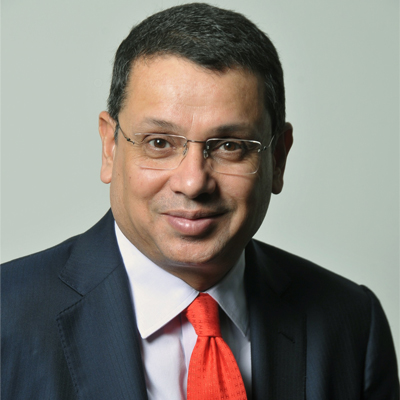
    Addressing the gathering at APOS, Star India CEO Uday Shankar said, “Media content has a huge role in shaping the sensibilities of the society and this role should not be underestimated.”


    Stressing on the role of sports, Shankar added, “I am prejudiced towards aspirational content and cynical about cynical content. This is something we have always kept in mind while creating all of our content and it is the same philosophy that we are bringing to sports as well. Sports has a huge role to play in empowerment, especially in a country like India, where we need to make the society believe that even an uneducated person can aspire to something greater if he is talented in a sport. This is what has worked with Kabaddi in a big way.”


    Star has applied the same entertainment business philosophy into sports. “We are creating content with deep local affinity using the audience aggregation power that cricket gave you. Sports broadcasting has been plagued by laziness and lack of innovation, treated merely as a distribution agent of acquired rights, which is what we have tried to change with multiple local leagues. If it is your team that’s playing, even if it is not the best team, you would be deeply passionate about it. Creating a hierarchy of leagues across the country can be huge empowering phenomenon,” opined Shankar.


    Speaking about content creation and regionalization, he said, “India is a giant country with varied cultures and tastes. We used Asianet as a beach head for the south and elevated the quality of content dramatically with sharper storytelling, involving the best of the creative fraternity and breaking the caste divide between film and TV. For logistic reasons outsourcing production might make sense, but unless you internalize the core creative skill, you will not be able to sustain success, which is why we have build a robust internal creative team to ensure this.”


    Star India’s recently launched video on demand (VOD) platform Hotstar has become a talking point of sorts. “Our objective behind Hotstar was quite simple actually – a lot of audiences were consuming our content on other screens, but we were unhappy with the inability to control their viewing experience. We realised we own all of this IP and so came Hotstar. I do not think that this is a ‘free model.’ We need to keep the consumer at the center while thinking about this and in a market like India, where data costs are still pretty high, the consumer is still paying a lot for the data – so it’s not particularly consumer friendly to have them pay twice, especially at such a nascent stage.”


    Shankar is also buoyed by the over-the-top (OTT) services space as it allows for democratisation of creativity. “However this is not the same as saying that anyone can create content,” he said.


    He also stressed on the use of big data and analytics by the network. “At Star, we use a lot of data and we value it deeply. However, let’s not become data monkeys. Data helps understands patterns but to understand these patterns and take a leap to what should be created next, will still require creativity. No matter how much data we have, I don’t believe we will be able to automate the definition of the next blockbuster,” concluded Shankar.

  • Sporting entities to evolve by building digital and social assets: GroupM ESP

    Sporting entities to evolve by building digital and social assets: GroupM ESP

    MUMBAI: The year 2014 saw the sports landscape in the country being altered as maiden sports leagues were introduced. But what will be the road ahead for the category? GroupM ESP (Entertainment and Sports  Partnerships) has released its top 10 trends for 2015 to look out for in sports and entertainment marketing.


    The report states that with the rise of leagues across various sporting formats and with increase in co-branded promotions, the opportunities for brands to associate with movies and sports are also increasing. Positioned at the intersection of media and marketing, the study predicted the following for the year ahead:


    1) An increased role and usage of celebrities as digital influencers.

    2) Sporting entities will evolve by building digital and social assets to drive their valuation.

    3) A blurring gap between the entertainment and sports category.

    4) “Associative” to “Associative + Integration + Surround + Social.”

    5) From Advertisers to Sponsors.

    6) New avenues for traditional licensing – for example, branded real estate.

    7) TV fiction characters to be seen as brand ambassadors

    8) Non-cricket sports to help expand the sports business ecosystem

    9) Sports businesses to help build strong grassroots engagement through experiential programs

    10) And finally, music concerts to grow bigger than award shows


    Commenting on the trends, GroupM ESP national director Vinit Karnik said, “As we scale up our practice, 2015 will see a change in the way consumers interact with the sports and entertainment category. Sporting entities will evolve by building digital and social assets to drive their valuation and brands will increase role and usage of celebrities as influencers especially across digital assets.”


    He further adds that celebrities have been using the digital medium extensively – from promoting their movies to inviting fans to attend a social cause – celebs have been making use of the medium in a great way. “With millions of followers, celebrities have the power to influence their fans and effectively get their message forward,” Karnik added.


    He informs that in order to increase the fan base, sporting franchisees and leagues will develop fan following around them by efficient use of the digital medium. “With immense focus on digital rights of sporting leagues, digital video sites will be competing with television broadcasters for eyeballs in the near future,” he concluded.


  • The year of improved sports marketing and production

    The year of improved sports marketing and production

    The year 2014 may have seen a few new leagues coming up but cricket very clearly rules the roost both from an on ground and on air perspective.  While gap between cricket and other sports have shortened, it’s still quite significant.  Indian Super League (ISL) has begun well with aggressive marketing and managed to garner eyeballs for Indian football. ISL has also garnered encouraging response from advertisers. For the first time a non-cricket sports has more than six central on ground sponsors.  Though lot of work need to be done in the grass root development of football, it’s been a great beginning considering its first season.

    Moving onto FIFA, the market in India for the sport is growing every four years as can be seen from the last three editions.  We have beaten the benchmarks of 2010 in 2014. It also generated lot of hype that helped garner newer audiences and fan base. Overall football, as a sport is growing and FIFA being the biggest football tournament has managed to score on all counts. The cumulative efforts over the last five to eight years, by  FIFA, European Soccer Leagues and the broadcast community backed by audience desire to see a more local flavor of football has helped in the formation of the ISL. 

    The surprise package of 2014 was the Pro Kabaddi League (PKL), a pleasant surprise I must say. It was a league which was very well marketed and packaged with fantastic production value. While everyone thought of Kabaddi as rural sports, it’s quite interesting to see viewership numbers ticking from metros.  Looking forward to season 2 of PKL with a hope that it continues to attract audience and build stickiness.

    Indian Badminton League (IBL) launched in 2013 with top international talent and lot of fan following, missed the show in 2014. Hope to see IBL back with bigger and better show in 2015. The Hockey India League (HIL) also showcased fabulous production quality and packaging. HIL has also managed to grab reasonable response from advertisers till now. Currently with the fabulous winning performance of team India, in 2015 we would like to see a better marketing of HIL to attract and hold audience attention.

    The Champions Tennis League (CTL) and the International Premier Tennis League (IPTL) both failed to generate buzz because of lack of marketing efforts. CTL has been a bit disappointing with respect to the production value, while IPTL’s production was world class. Expectations from IPTL were quite high considering the participation of big current stars and legends like Roger Federer, Novak Djokovic, Pete Sampras, Serena Williams etc…. Aspirational and emotional connect with IPTL was very high for the fans who have been following tennis for more than two decades. It was like a dream coming true to see the likes of Roger Federer, Novak Djokovic, Pete Sampras, Serena Williams or even Sania Mirza playing in India. There was high interest in fans to go and see their heroes play live and get to meet them or get a closer glimpse of them.  But would that translate into TV viewership is something we will have to wait and watch. Therefore while CTL’s structure is towards building affinity for tennis as a sport with a hope that more Indian start playing the game. IPTL is clearly going after the experience of getting up and close with the big international stars and ride on their popularity to garner eyeballs. However considering the structure of both leagues, the overall objective of both leagues is little unclear.

    Marketing and production values of these sports have been a key highlight this year.  Sport marketing in India has been ahead of the curve in terms of marketing and production value. Great production values along with a greater thrust on marketing has led to a stronger audience and advertising interaction.

    ICC Cricket World Cup 2015 is the biggest sporting event in 2015 and will continue to attract audience in large numbers. The advertising pie will grow and be bigger than 2011 as other sports are still catching up and are in the development phase.


    (These are purely personal views of GroupM ESP national director entertainment sports and live events Vinit Karnik and indiantelevision.com does not necessarily subscribe to these views)