Tag: Space

  • ISRO successfully flight tested India’s Reusable Launch Vehicle-Technology Demonstrator (RLV-TD)

    ISRO successfully flight tested India’s Reusable Launch Vehicle-Technology Demonstrator (RLV-TD)

    MUMBAI: On May 23, 2016 ISRO successfully flight tested India’s first winged body aerospace vehicle operating in hypersonic flight regime.   

    In this experimental mission, the HS9 solid rocket booster carrying RLV-TD lifted off from the First Launch Pad at Satish Dhawan Space Centre, Sriharikota at 07:00hr IST.  After a successful flight of 91.1second, HS9 burn out occurred, following which both HS9 and RLV-TD mounted on its top coasted to a height of about 56 km. At that height, RLV-TD separated from HS9 booster and further ascended to a height of about 65km.  

    From that peak altitude of 65 km, RLV-TD began its descent followed by atmospheric re-entry at around Mach 5 (five times the speed of sound). The vehicle’s Navigation, Guidance and Control system accurately steered the vehicle during this phase for safe descent. After successfully surviving a high temperatures of re-entry with the help of its Thermal Protection System (TPS), RLV-TD successfully glided down to the defined landing spot over Bay of Bengal, at a distance of about 450km from Sriharikota, thereby fulfilling its mission objectives. The vehicle was successfully tracked during its flight from ground stations at Sriharikota and a shipborne terminal. Total flight duration from launch to landing of this mission of the delta winged RLV-TD, lasted for about 770seconds.

    In this flight, critical technologies such as autonomous navigation, guidance & control, reusable thermal protection system and re-entry mission management have been successfully validated.


  • Eutelsat 9B satellite soars into space

    Eutelsat 9B satellite soars into space

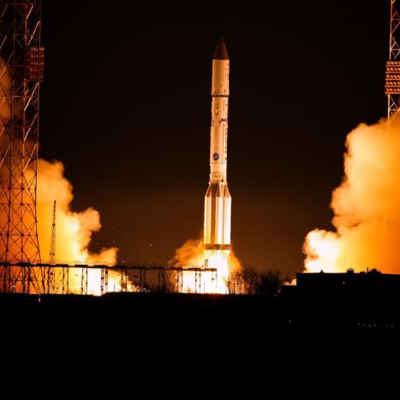
    MUMBAI: Eutelsat Communications’ Eutelsat 9B satellite was successfully launched into geosynchronous transfer orbit by ILS using a Proton rocket that lift off from the Baikonur Cosmodrome.


    Separation of Eutelsat’s new satellite occurred after a 9 hour 12 minute Proton flight. Partial deployment of the satellite’s solar panels, that represents the first critical post-launch operation, took place two hours later. Following further manoeuvres and in-orbit tests, Eutelsat 9B will be positioned at 9 degrees East in March to assume broadcasting of over 350 TV channels currently served at this position by Eutelsat 9A and provide expansion capacity for new services.


    Eutelsat 9B also marks an industry first as the host satellite for the inaugural data relay payload for the European Data Relay System (EDRS) being implemented through a Public Private Partnership (PPP) between ESA and Airbus Defence and Space.


    Commenting on the launch, Eutelsat chairman and CEO Michel de Rosen said, “Our congratulations to ILS and Krunichev for a flawless launch that sees a new Eutelsat satellite propelled on its way to geostationary orbit. This sophisticated satellite programme reflects outstanding collaboration between Eutelsat, ESA, Airbus Defence and Space, ILS and Krunichev. We look forward to putting Eutelsat 9B to work for the benefit of our broadcaster clients and to the inauguration of the ground-breaking European Data Relay System that is a powerful illustration of the complementarity of geostationary and low earth satellites for fast transmission of data flows back to earth.”

  • Eutelsat 9B satellite soars into space

    Eutelsat 9B satellite soars into space

    MUMBAI: Eutelsat Communications’ Eutelsat 9B satellite was successfully launched into geosynchronous transfer orbit by ILS using a Proton rocket that lift off from the Baikonur Cosmodrome.


    Separation of Eutelsat’s new satellite occurred after a 9 hour 12 minute Proton flight. Partial deployment of the satellite’s solar panels, that represents the first critical post-launch operation, took place two hours later. Following further manoeuvres and in-orbit tests, Eutelsat 9B will be positioned at 9 degrees East in March to assume broadcasting of over 350 TV channels currently served at this position by Eutelsat 9A and provide expansion capacity for new services.


    Eutelsat 9B also marks an industry first as the host satellite for the inaugural data relay payload for the European Data Relay System (EDRS) being implemented through a Public Private Partnership (PPP) between ESA and Airbus Defence and Space.


    Commenting on the launch, Eutelsat chairman and CEO Michel de Rosen said, “Our congratulations to ILS and Krunichev for a flawless launch that sees a new Eutelsat satellite propelled on its way to geostationary orbit. This sophisticated satellite programme reflects outstanding collaboration between Eutelsat, ESA, Airbus Defence and Space, ILS and Krunichev. We look forward to putting Eutelsat 9B to work for the benefit of our broadcaster clients and to the inauguration of the ground-breaking European Data Relay System that is a powerful illustration of the complementarity of geostationary and low earth satellites for fast transmission of data flows back to earth.”

  • K Raheja Corp’s new brand campaign centres around ‘space’

    K Raheja Corp’s new brand campaign centres around ‘space’

    MUMBAI: Known for enhancing the quality of life through best offerings across real estate, retail and hospitality, K Raheja Corp launched its latest marketing campaign pegged on ‘space.’


    Crafted to showcase one of the most sought after, but largely fading feature in residential offerings ‘space,’ the campaign communication is simple and succinct with the tagline – ‘Space makes all the difference.’


    Developed for Raheja Vistas Premiere – Pune, the property is now open sales for phase II of its project.


    The phased ad campaign will roll out in the Pune market across print, radio and digital.


    The print ads juxtapose cramped lettering with well laid out text to elucidate the need for, and value of – space. The thought is the same in the radio campaign, which relies on an innovative script showcasing an aural experience of – being cramped, to bring alive the value of space to a listener.


    Conceptualised by Utopeia Communicationz, the campaign aims to drive home the invaluable message that ‘Space is the ultimate luxury’: 20 acres of space for spacious floor plans; grand parking spaces; a 7-acre green land with best in class amenities; space that allows one to enjoy the luxury of privacy; peacefully enjoy festivals and special occasions; space in a gated, serene community.


    In the run-up to the festive season, the first phase of the print and radio campaign debuted late last month in print along with radio across the stations of Radio City and Radio Mirchi.


    The online campaign is expected to break in the first week of September and will extend through the festival of Ganesh Chaturthi.


    Speaking about the campaign, K Raheja Corp director Vinod Rohira said, “In times where space is a luxury, the availability of liberal amounts of it is definitely a huge advantage, and we have focused on this single feature to showcase the merits of Raheja Vistas Premiere. A meticulous creation, we are confident of the property delivering excellently to the needs of a discerning audience base. Timed for the festive season, with a carefully selected media mix across print, radio and digital we look forward to this campaign successfully meeting our business objectives.”

  • Seth MacFarlane’s Cosmos documentary to premiere at White House Film Festival

    Seth MacFarlane’s Cosmos documentary to premiere at White House Film Festival

    MUMBAI: On Friday, February 28, the White House is hosting the first-ever Student Film Festival, featuring the work of more than a dozen young filmmakers who created short films celebrating the role of technology in the classroom.


    The Filmmaker-in-Chief, President Barack Obama was at Buck Lodge to celebrate progress on ConnectED when he recorded the video on his iPad. ConnectED is an ambitious project to connect 99% of American students to next-generation broadband and wireless technology within five years. In Adelphi, he announced that some of America’s largest companies answered the President’s call to action towards that goal by pledging more than $750 million in commitments to deliver cutting-edge technologies to classrooms, including devices, free software, teacher professional development, and home wireless connectivity.


    Building on the President’s eagerness to connect students to technology, and his newfound interest in filmmaking, The White House excited to host the first-ever White House Student Film Festival. In November, we called for Kindergarten to 12th grade students around the country to create short films on the role of technology in their classroom, and students responded with nearly 3,000 entries. In collaboration with the American Film Institute, the White House will screen the finalists’ works this Friday along with a star-studded cast including Kal Penn, Bill Nye, Neil deGrasse Tyson, and Conan O’Brien.


    In addition to the celebration of the student films and the President’s remarks, FOX and National Geographic Channel will treat the attendees to a sneak peek of the first episode of the upcoming television series, Cosmos: A Spacetime Odyssey, a US documentary executive produced by Seth MacFarlane (Family Guy, Ted, The Cleveland Show) which celebrates the importance of Science, Technology, Engineering, and Math (STEM).

  • 2014’s first space mission to be India’s GSAT-14

    2014’s first space mission to be India’s GSAT-14

    MUMBAI: The first time it was about to launch in August 2013, a technical snag forced an abortion. But now, India’s Indian Space Research Organisation’s (ISRO’s)  twenty third communication satellite GSAT-14 by the is all set to be launched into space on 5 January 2014 on the Geosynchronous Satellite Launch Vehicle (GSLV)-D5.  The launcher will propel the bird into a Geosynchronous Transfer Orbit (GTS) after which it will use its own propulsion system to reach its geostationary orbital home at 74 degrees east longitude.


    The mission is important for ISRO which has been seeking to get a piece of the satellite launch action globally. But it has found things difficult since four out of the seven launches of GSLV have been failures and three previous attempts to use indigenous cryogenic engine have also ended up in a mess.


    The previous attempt to blast off GLSV into space in August 2013 was aborted following a fuel leak which developed in its engine hours before launch. ISRO worked on it and gave it a better metal covering, following which it has decided to give it another shot.


    A three stage rocket – the first stage runs on solid fuel, the second on liquid fuel and third on a cryogenic engine – the GSLV- D5 will be carrying the 1982 kgs (lift off mass) GSAT-14, which will be replacing GSAT-3 that was decommissioned in 2010. The new satellite’s structure is based on ISRO’s two ton weighing (I-2K satellite bus). The satellite has six Ku band (51.5 dBW EOC-EIRP) transponders, six C band (36 dBW EOC-EIRP) transponders and two Ka band beacons and will be co-located with INSAT-3C, INSAT-4CR and KALPANA-1.


    Most of the C- and Ku-band capacity on GSAT-14 will be utilized for long distance education and telemedicine, while the Ka band transponders will help in studying rain and atmospheric effects. This ninth operational geostationary satellite is expected to have a mission life of 12 years and will be able to provide enhanced broadcasting as compared to GSAT-3 for the whole of India.


    According to the ISRO website, the mission has three main objectives- to augment the in-orbit capacity of extended C and Ku-band transponders and to provide a platform for new experiments such as fiber optic gyro, active pixel sun sensor, Ka band beacon propagation studies and thermal control coating experiments.


    The 29 hour countdown to the launch began at 11:18 am on 3 January with the launch time set as 4:18 pm on 4 January from its launch pad at Satish Dhawan Space Centre (SDSC SHAR) at Sriharikota in Andhra Pradesh. GSLV-D5 is expected to have a 17 minute, eight second flight duration. If successful, this will be 2014’s first space launch as SpaceX’s launch of Thaicom-6 has been postponed from 3 January to between 6 and 9 January. The Elon Musk backed company decided to go in for a later liftoff as problems had emerged with Falcon 9 rocket’s fairing.


    If ISRO’s GSLV-D5 successfully plants GSAT- 14 into orbit, it is likely to have a beneficial spinoff which it badly needs. It could lead to orders to build more rockets that can carry payloads of up to four tonnes. Till now ISRO has been using the Polar Satellite Launch Vehicle (PSLV) that carries loads of around a tonne.


    The mission will be telecast live on Doordarshan and on the web from 3: 52 pm on Sunday.

  • Eutelsat 21B satellite lofted in space, commercial launch by mid-Dec

    Eutelsat 21B satellite lofted in space, commercial launch by mid-Dec

    MUMBAI: Eutelsat 21B satellite, which will have a fleet of 40 transponders, was lofted into space on Sunday by an Ariane 5 rocket from Kourou, French Guiana.


    Manoeuvres to circularise the new satellite’s orbit and place it into its operational configuration are now underway, managed by Eutelsat from its Rambouillet teleport, using a global network of earth stations. This will be followed by in-orbit testing before Eutelsat 21B enters full commercial service in mid-December.

    Commenting after launch and first manoeuvres, Eutelsat CEO Michel de Rosen said, “Eutelsat 21B is the first of seven satellites we will launch by mid-2015 to increase our commercial flexibility and our overall resources by almost 30 per cent. We are delighted to see this new satellite on its way to an orbital location that is a point of reference for customers providing professional video, data and government applications in Europe, North Africa, the Middle East and Central Asia.”


    The 40-transponder Eutelsat 21B Ku-band satellite will occupy the 21.5° East position, which has become a location of choice for broadcasters, news agencies, telcos, enterprises and government administrations. Its deployment is expected to enable Eutelsat to expand capacity at this sought-after location by more than 50 per cent.

    The satellite will replace Eutelsat 21A which will continue commercial service at another orbital location. Eutelsat’s 70.5° East orbital position that sits at the crossroads between Europe, Africa, Asia and Australia.


    Eutelsat’s launch programme progresses with the lift-off, scheduled for early December, of the Eutelsat 70B satellite, designed to more than double resources at Eutelsat’s 70.5° East orbital position that sits at the crossroads between Europe, Africa, Asia and Australia.