Tag: South India

  • PVR expands into South India with second multiplex in Chennai

    PVR expands into South India with second multiplex in Chennai

    MUMBAI: PVR Cinemas has expanded its presence in South India by launching its second multiple property in Chennai.


    The five-screen multiplex is at The Grand Mall, Velachery in Chennai. The company’s first multiple in Chennai is at the Ampa Mall.


    With this, PVR now has a a screen count of 482 screens at 108 properties pan India across 44 cities. In southern India, PVR now has 110 screens in 17 properties.


    The newly launched property in the region is spread over an area of 50,000 sq ft with a capacity of 1275 seats.


    PVR Cinema CEO Gautam Dutta said, “We have received an overwhelming response from the audience here and we ore even more enthusiastic to launch our second multiplex in Chennai. South is on essential market and we have made constant endeavours to reach out to the movie lovers in the city. We have left no stones unturned to bring them an experience filled with convenience, comfort and the best cinematic experience.”


    The opening of this multiplex has been designed understanding the market and every other aspect of cinema viewing in Chennai. The artwork in the foyer is a collage of iconic conversations from movies that defined trends in Kollywood; it is a tribute to Tamil cinema.


    The cinema also boasts of 2K Christie Digital projection, Dolby Digital 7.1 surround sound, 3D enabled screens and state-of-the-art technology.


    PVR joint managing director Sanjeev Kumar Bijli added, “As we aim to excel in our domain by providing movie connoisseurs with a premier experience, we feel pleased to launch our second property in Chennai. We would like to thank the mall developer, PSR Associates for giving us the perfect location which is strategically positioned and stands as one of the most prominent hubs attracting huge footfalls. We are very hopeful to receive a similar positive response from the audience here for our second multiplex as well.”

  • Broadcast media urged to help flood-affected people in South India

    Broadcast media urged to help flood-affected people in South India

    NEW DELHI: All television and radio channels have been asked by the Government to send relevant and vital information brought out by concerned government agencies for the people of Tamil Nadu and other southern Indian states affected by torrential rains and floods.

    In an advisory, the Information and Broadcasting Ministry said it was imperative that all information is broadcast that can assist those affected.

    The advisory noted that Doordarshan and All India Radio apart from some other channels had been disseminating information about the efforts of the government and rescue agencies and even weather-related information, help-lines, and contact numbers of personnel that can be of help to the affected people.

    Considering the enhanced gravity of the situation, it stressed the imperative need for dissemination of critical and vital information regarding all aspects of the disaster on real-time basis.

  • Actor Siddharth to endorse chocolate brand Luvit

    Actor Siddharth to endorse chocolate brand Luvit

    MUMBAI: As they say it in South India, “Ushaar” meaning beware. The theme behind the new campaign of this chocolate brand tells you to beware if someone shares it with you. Luvit, a brand by Global Consumer Products, has appointed actor Siddharth as its brand ambassador.


    The brand also recently launched its clutter-breaking commercial, which turns conventional logic of sharing on its head.


    The brand will offer nine variants and 14 SKUs and is primarily targeted to youth aged from 15 – 30 years.


    The TVC, which features Siddharth, shows various stories in which a person shares their Luvit chocolate with a hidden agenda. The advertising message is simple: the best way to enjoy a Luvit is alone. It is not just the right way but the only way. But at the same time, you can get urge to share it and ask yourself, “What’s in it for you?” because a chocolate this delicious is only given away to get something in return.


    The music video stars Siddharth with Santhosh Narayanan’s music and is a fresh concept along with execution. The catchy tune and vibrant never-seen-before advertising is expected to strike a chord with the audience.


    The TVC is combination of Tamil and English with a tagline “If someone shares, ushaar!” and that’s what captures the essence of the brand. The ad will be of 50 seconds, along with edits of 20 seconds.


    Global Consumer Products EVP sales & marketing Anuradha Narasimhan said, “The objective of our communication package was to impactfully and effectively launch LuvIt Chocolates as a young, vibrant, indulgent brand targeting Indian youth. We didn’t want to focus on specific product attributes as much as drive home the message that LuvIt Chocolates are so delicious that they are Best Enjoyed Alone. We are delighted that we have Original-Chocolate Boy Siddharth as the face of our brand. It was great fun working on the branding codes and seeing them come alive across multiple media formats in a young, pop and connecting way. We broke away from many category codes and are delighted to have put out this insightful campaign which I am sure will resonate will everyone in our audience.”


    Karishma Lintas EVP Kishore Subramanian added, “The biggest challenge for us on LuvIt was to find an insight space which gave the brand a unique identity which resonated with the youth. And the brand’s take on sharing actually being a matlabi act, gave us just that.”


    The creative duo from Karishma Lintas – Shiv Parameswaran & Arjun Kumar said, “This was one of those campaigns where every creative person lent their unique flavour to “ushaar.” The choice of chocolate boy Siddharth was perfect to bring alive the brand’s youthful character. Then we brought on board the current youth icon Santosh Narayanan, who musically spun the world of “ushaar.” And finally Suresh Eriyat and co at Studio Eeksaurus gave the film life by creating this asterisk-filled world of Ushaar.”


    The campaign will be supported on television, OOH, digital, on-ground malls and hangouts and radio. The target markets are South India and Tier-I cities being the primary focus in the launch stage.


    “Even in static mediums, we’ve consciously adopted the vibrant colours of the packaging, as well as the visually striking device of the asterisk. This gives us the edge over the work currently seen in the category,” added Parameswaran.

  • Tata Sky targets south India during festive season

    Tata Sky targets south India during festive season

    MUMBAI: Last year, DTH operator Tata Sky ventured into the Malayalam market by getting Mohanlal on board as its brand ambassador. Now, it has targeted all the remaining three states in one go in its bid to expand in the south of India.


    The DTH operator has signed on Tollywood star Mahesh Babu to represent the brand in Andhra Pradesh and Telangana and Sudeep for Karnataka. It has refrained from signing one for Tamil Nadu but has refreshed its push with a new TVC campaign.


    ‘Better kante best’ is the tagline being used in Telugu to proclaim its 23 Telugu channels along with knowledge, English and Hindi news channels in the base pack. Babu will propagate this tag line through his TVCs.


    The ad campaign featuring Sudeep is built on the premise that people have gotten used to adjusting to things in life but with Tata Sky’s offerings, there is no need to compromise while choosing its STB. Sudeep will enhance this ‘no compromise’ theme in his TVCs.


    Kannada viewers will have 14 local channels along with knowledge and English news channels in the base pack.


    For Tamil Nadu customers, an advertising campaign will be activated across TV, print, outdoor and online media by conveying the message to Tamil customers who make purchases after careful evaluation that Tata Sky will be their preferred choice due to its quality. With packs starting at Rs 180, new connections will get the Tamil language pack free along with the base pack.


    The TVC campaign states ‘Ovvoru vishaiyathaiyum alasi aranju mudivu panravunga, set top box-inu varumbodhu kandippa Tata Sky-dhan choose pannuvanga!” (Those who decide everything after careful evaluation, choose a Tata Sky set top box).


    Customers of the southern states can avail an offer of an additional regional pack free for one whole year.


    The customer case service has been strengthened with additional call centre support, on-ground manpower and trained personnel to deal with increasing enquiries during the upcoming festive season.


  • Adversioning advertising gains currency

    Adversioning advertising gains currency

    MUMBAI: A national jewellery brand had to reach out to the diverse markets in south India. It needed a solution that would allow it to simultaneously beam on a national television channel different creatives for the diverse markets in the region, each featuring a regional celebrity.


    Thanks to technology solutions, the jewellery company could get its different creatives beamed to relevant demographics at the same time on the same channel.


    The concept is called adversioning or geo-targeted advertising in the media world.


    Technology for such simultaneous telecast of different advertisements on the same channel has been available for a few years now but advertisers have begun to use it on a significant scale only recently.


    Advertisers are increasingly making use of geo-targeting. These include fast moving consumer goods major Hindustan Unilever.


    The geo-targeted advertisements in value terms now account for about 20 per cent of total ads on television. In the US, the proportion of such ads is almost 40 per cent. According to GroupM, total advertising spend on television in 2013 was Rs 16,860 crore.


    But the potential for geo-targeted ads in India is seen to be much, much higher considering the extent of diversity in the country, says SureWaves founder Rajendra Khare. SureWaves is a technology solution provider for geo-targeted advertising and had provided its service to the national jewellery brand but decline to disclose the name of the brand.


    Khare says it makes sense for any advertiser to opt for geo-targeted advertising to not only break the language barrier but also to target differently the different the socio-cultural groups across the country with a sharp and direct emotional connect.


    So, the next time when you are on a trip to Chennai, don’t be surprised if you come across an ad by Fastrack Cabs on a national channel.


    The Indian market is a complicated one. From regional differences to numerous brands, one needs to stand out in a clutter to catch the attention of as many consumers as possible.


    Apart from SureWaves, there is amagi Media Labs that offers advertisers and broadcasters solutions for geo-targeted advertising.


    Geo-targeting or adversioning is done with the help of a barcode system and cloud-based infrastructure on which TVCs are stored. The technologies solutions then enable playing of different ads in different regions on the same air-time band on a particular channel.


    There’s a possibility of making available different solutions to meet different needs. For instance, Carat Media which handles baby products maker Libero’s account, wanted to reach out to non-Marathi female audience in Maharashtra. Amagi’s technology enabled Libero to use channels with a national footprint for the launch campaign of Libero in a specific market like Maharashtra.


    Amagi which had to answer a lot of questions when it started out in 2008 feels that those doubts have now been put to rest.


    “Today, largest national players like HUL, GSK too want to follow a regional plan and have different communication depending on the region,” says Amagi’s co-founder KA Srinivasan.


    Geo-targeting or adverisioning implies customised broadcast of creative communication to different markets in the same ad slot. In other words, it means splitting up of the national beam of a broadcaster into local beams akin to what national newspapers do for their local editions.


    ‘How can we sell a standardised product to local and different consumers?’ has been a dilemma for most marketers. However, with the adversioning concept, things are supposed to change.


    According to GroupM Trading (CTG) south Asia Managing Partner Prasanth Kumar, who is a big votary of adversioning, says, “clients can benefit in multiple ways as spill-over reduces, national channels can be used to run local promotions, the same 30 second slot can be used for multiple creatives (different brands in different markets, different language versions in specific markets). Majority of the clients who have used this availability are local clients.”


    There might be companies which don’t feel the need to make an ad locally oriented, but there are a few which opt to geo-target ads. One of the main reasons a brand may geo-target ads is because it only offers services/products within specific areas. There is a huge and compelling demographic component involved with geography that can influence click-through-rate (CTR) and conversion rates as well.


    Recalling how cable operators’ years ago would show local advertisements, Havas Media India managing director Mohit Joshi says if we take a look at the southern market, one can see a lot of local players which isn’t the case in the northern part of the country. “The concept makes sense for local clients/marketers a lot as it gives them a chance to target their TG.”


    But will the local marketers be able to find their place and compete with national players? Answers Kumar, “Yes. Local advertisers form a large part of the 2,000 plus clients who have tried this concept. They see value in placing their ads on national channels as these channels were earlier much more difficult to afford and local players have specific market requirements.”


    On the same lines, Pipal Majik CEO CD Mitra highlights how brands too have been emphasizing on “localisation” and if adversioning helps them achieve it then many will opt for it.


    “For example, if a particular tea brand wants to sell its particular blends in certain regions then this is the perfect solution for them to advertise in a certain regional beam of a national channel.”


    Talking about the cost of geo-targeted ads, experts say creative production cost is just a small segment of the overall marketing budget a brand allocates.


    The credit for the growth of the format and news, movies and GEC channels experimenting with it goes to the fact that vernacular media has been growing at a much quicker pace than the national media, Kumar elaborates.


    “The reason for the growing importance of Class B and Class C towns for advertisers, the growing education levels, expansion of vernacular publications into new markets with categories like retail, real estate along with FMCG is fuelling the growth,” he adds.


    Khare adds that a marketer needs to utilize both national as well as regional channels to reach out to as many people as possible. “It is not national vs. regional, but how one can utilize both for its benefit. We have to also understand the importance of spot TV which is the most cost effective way for advertisers to market.”


    Technology plays an important part of the concept to become a part of life, soon. Joshi says, “If the technology is not there to support the concept then it will surely fall flat in its face. We as an industry will have to invest in it to see it grow and become an integral part of advertising soon.”


    Apart from this, industry professionals feel that pricing too plays an important role here. The competition between national and local players will vary and also depend on it. “Broadcasters in the end need money. If they get it from local players or national ones, it doesn’t matter. Hence, stakeholders have to come up with attractive pricing and strategies to make it real,” says Mitra when asked if broadcasters would opt for local marketers over national ones.


    Zee TV has been selling ad spots split into regional beams since late last year and has had a good experience with it. Zeel chief sales officer Ashish Sehgal says, “The concept has helped us  increase number of clients if we offer them a strategic plan which will help them reach out to their TG better.”


    He further says the sum of revenues from a divided ad spot has been higher than the revenue it would have got having sold it as one national beam.


    Sehgal says Zee TV has seen an increase in local marketers through geo-targeting. “In the past few months, around 25-30 SMEs have come to us to use the platform.”


    Bennett Coleman & Co president corporate development Sunil Lulla says adversionsing is very much a reality now with many brands and broadcasters using it.


    However, he says that a broadcaster has to be clear about this with the clients otherwise it can hurt some advertisers who pay for a national beam but sometimes local/regional beams could be sold to another client. “We (broadcasters) have to understand that there is a big (regional) market which can be tapped through this and it will benefit everyone.”

  • Raj TV looking at raising Rs 200 crore through stake sale

    Raj TV looking at raising Rs 200 crore through stake sale

    MUMBAI: Raj TV Network is keen on further strengthening its presence in its core market of south India and also expanding its reach to the diaspora from the four states of Tamil Nadu, Kerala, Karnataka and Andhra Pradesh.


    The television network is on the lookout for equity investors – financial or strategic – to fund its growth plans. The company has appointed Destimony Securities as its advisor for the equity stake sale.


    “By getting in investors, we are looking at raising approximately Rs 200 crore,” Destimony Securities MD and CEO Sudip Bandhopadhyay told Indiantelevision.com.


    Raj TV Network plans to revamp its clutch of south Indian GECs, music and news channels and also on furthering its brand in the Telugu market.


    The network operates 12 channels – four in Tamil, three in Telugu, two in Kannada, two in Malayalam and one in Hindi.


    Raj TV Network also has a large library of Tamil movies which has not yet been tapped gainfully.


    “We have a huge inventory of Tamil movies that needs to be monetised. Alongside, the large diaspora of the four states in the South needs to be captured,” Bandhopadhyay said.


    Ernst & Young had in 2007 valued Raj TV Network’s movie collections at Rs 325 crore.


    The network is currently busy revamping its Telugu channels  —  Raj Musix Telugu, Raj Telugu News and Vissa.  The relaunch of the Telugu channels is expected sometime next month. Raj TV Network also plans to rebrand Vissa to prefix the Raj brand.


    Apart from this, Raj TV Network has ambitious plans to make its presence felt in northern parts of the country.


    “We don’t just want to build the brand name in the south but also move to other regional markets as well,” says Raj TV MD M Raajhendhran.


    The network is already present in a few Hindi speaking markets with Raj Parivar, which currently features only songs. It has long term plans to start GECs and other regional music channels as well in north India. Bhojpuri is one of the markets Raj TV Network is considering. Additionally, it is also looking at the Bengali market.


    In the third quarter ended 31 December 2013, Raj TV Network reported a 53.98 per cent rise in net profit to Rs 4.99 crore (20.01 per cent of revenue during the quarter) from Rs 3.24 crore (18.55 per cent of revenue of that quarter) a year ago.

  • MEBC 2013: Human capital challenges of the radio industry post Phase III

    MEBC 2013: Human capital challenges of the radio industry post Phase III

    BENGALURU: The Digital March-Media and Entertainment in South India – Deloitte-FICCI released a report at the FICCI-MEBC 2013 in Bangalore.


    On the impact of Phase III of licensing on South India, the report says that 229 of the 839 frequencies being auctioned are in 83 cities of the four Southern states. Phase III is expected to result in 294 frequencies (existing plus planned) in South India alone. About 90 per cent of the cities for which frequencies will be auctioned belong to Tier 2 or Tier 3 categories.


    This would help radio expand its reach to the masses.


    Phase III auction of licenses of radio frequencies, is expected to generate substantial employment across the country. Thus, with the launch of new stations in 283 cities across the country, experts in the industry foresee demand for people proficient in regional languages for which regional dialect and diction training may also be required.


    The radio industry will face human capital challenges. The industry believes that the skill gaps are largely owing to a scarcity of educational institutes offering programs for radio. This in turn limits the sources for recruitment. This leaves the industry with either hiring graduates and training them in-house or relying on alternative sources of hiring e.g. walk-in-interviews, theatre etc. The issue is only expected to escalate once Phase III licenses are auctioned across India.Quoting industry sources, the report says that retention is never a challenge for key management / leadership team. It’s the support staff that is a challenge. Currently, the industry relies on on-the-job training to compensate for the lack of training courses.


    External trainers from abroad are also commissioned to train people on creative thinking skills and show conceptualisation. Trainers are often hired to train sound engineers and technicians. Resources are also trained in-house on handling radio transmission equipment and software.

  • MEBC 2013: Radio rocks in South India – Deloitte Report

    MEBC 2013: Radio rocks in South India – Deloitte Report

    BENGALURU: The Digital March-Media and Entertainment in South India, a Deloitte-FICCI report was released at FICCI-MEBC 2013 in Bangalore.


    The report says that the radio industry in India enjoys greater acceptance in the South than in the rest of the country and thus stands out amongst its peers. This is indicated by relatively higher average radio listenership in cities like Bengaluru where people spend about 20 hours /week on radio while those in Delhi and Mumbai spend 13-14 hours/week.


    Radio has become an integral part of the entertainment industry in South India and thus has been used as a tool for promotions like film and TV. The film industry in Tamil Nadu (TN) has tied up with various radio stations with an aim to keep the listeners abreast with the music premiers and activities related to the film. Not just the filmmakers but also the broadcasters use this medium as propping up their new shows says the report.


    It also says that the South Indian Media and Entertainment (SIM&E) industry is slated to grow from its current estimated size for FY-2013 of Rs 23,900 to Rs 43,600 crore in FY-2013 at an CAGR of 16 per cent.


    Radio, which stands third behind new media and television in terms of growth, will rise at a CAGR of 19 per cent in the four southern states of TN, Andhra Pradesh (AP), Karnataka and Kerala, from an estimated present size of Rs 420 to Rs.830 crore by FY-2017.


    The report also goes on to say that the national and local advertisers are increasingly realizing the importance of radio.

  • Niche channels to dominate TV in future

    Niche channels to dominate TV in future

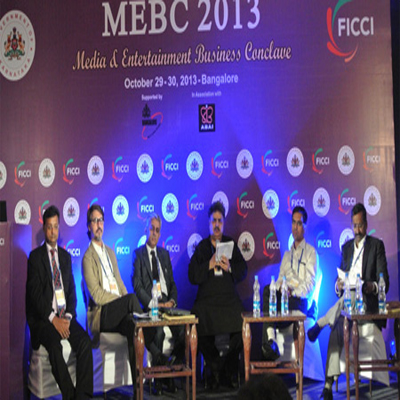
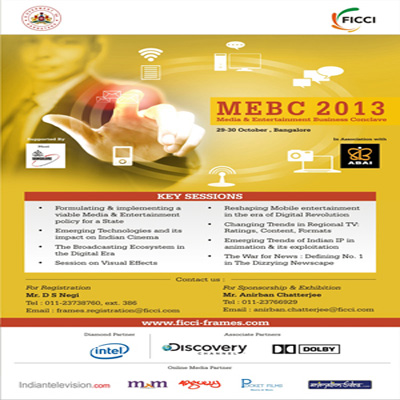
    BENGALURU: At the opening ceremony of the FICCI MEBC (Media and Entertainment Business Conclave) – South, which was held on 29 and 30 October, Ministry of Information and Broadcasting Secretary, Bimal Julka highlighted the fact that digitisation is at a growing trajectory in the country and by the end of the next year we shall all be living in digital homes.


    According to data provided by a FICCI Deloitte report on media and entertainment in south India, television constitutes 56 per cent of the market share with Rs 13,470 crore out of the total of Rs 23,900 crore. Digitisation is going to help the segment grow at a CAGR of 20 per cent in the next four years.


    While the digital world is changing phenomenally, we wonder how the broadcasting industry is adapting to the change. This, and various other points were discussed in a session on “the broadcasting ecosystem in the digital era” which included BECIL chairman K Subramanian, IBM global services head (media and entertainment) and ED Raman Kalra, Deloitte Coimbatore partner-audit C R Rajagopal, Amagi Media Labs co founder Srinivasan K A and Whats on India COO Sugato Banerjee formed the panelists, while MXM India CEO and editor in chief Pradyuman Maheshwari moderated the session.


    The session kick started with Subramaniam highlighting the humongous task that was undertaken in DAS (Digital Addressable System) phase I to install about 75 lakh STBs and led to nearly 95 per cent digitisation in 38 cities. Five out of 38 are in South India, according to the report. He added that in all this DTH had taken a backseat except for Chennai where the DTH penetration is about 40 per cent and digitisation is lagging due to political turmoil.


    Banerjee also supported it by saying that phase I and II saw DTH take a step back and digital penetrate strongly in Mumbai, Delhi and Kolkata.


    Banerjee also highlighted certain issues that popped up during the process of digitisation. “In a city like Mumbai where people live in buildings, having a cable run through the building is easy. With DTH, the dish needs to be facing the satellite. In places where houses are far away from each other, cost of running the cable from home to home is higher and more efforts are needed. If some of these places don’t even get electricity for hours why would they want to pay for STBs?” he remarked.


    There was a time when there was a scarcity of channels but now they are in abundance. According to Banerjee, there are about 700 working channels in the country but it is unrealistic to have so many channels in the digital arena. The rising number of channels has led to narrowing down of viewership. “Five years ago there was no food channel in the country and now there are five. The long tail will give more choice to viewers and fringe channels have benefitted due to digitisation especially in the urban cities,” said Banerjee.


    At the same time, the growing number of channels will put pressure on its visibility. “Now, the issue would be to bring one’s channel to viewers notice,” said Srinivasan.
    Viewership will be segmented leading to an increase in the number of niche channels.  “Broadcast is a term that doesn’t seem to suit the current scenario. Now it is time to ‘narrow-cast’,” said Srinivasan.


    According to Kalra, their IBM global survey on consumer insight has shown that people don’t want to be categorised in demographics. “Consumers want content tailor-made for them. The biggest challenge in the future will be to get direct content for people and then make them spend for it,” he said.


    At the inaugural session of the event, Film Federation of India president Ravi Kottarakara raised the issue of service tax being a big hindrance on the industry. The same was also brought up by Rajagopal at the session. “Not having enough capital is a challenge for the industry to create things. Taxation needs to be looked into as well as interesting financial modules need to open up,” he said.


    At the same time, there is also the issue of paying for individual channels in future as consumers are used to paying a small amount for a big pack of channels. But Kalra pointed out that a person who could pay Rs 300 for a movie now, as compared to Rs 25 a few years ago, will definitely have the capacity to pay more for TV.


    However, Banerjee chose to disagree and said, “There is a difference between making them pay and the willingness to pay.”


    Although carriage fees will disappear in the digitised world, Banerjee said it will reappear in another form of placement fees as to which channel will appear first. According to industry sources, carriage fees range from Rs 3-5 lakhs. The industry also lacks advertising funding as compared to print. “Print has about 2 lakh advertisers but TV has just 12,000,” said Subramaniam.


    TV consumption on multiple screens is also set to grow. As on March 2013, 143 million users in India were mobile internet users (according to the FICCI Deloitte report). Its analysis report also showed that video consumption had increased from two hours to three hours from 2010 to 2012. “There will be monetisation of content as more connected devices emerge. Only then we will know which genre is being seen and its statistics,” said Subramaniam.

  • New media to lead growth for south Indian media and entertainment industry

    New media to lead growth for south Indian media and entertainment industry

    BENGALURU: The Digital March-Media and Entertainment in South India, a Deloitte-FICCI report was released on the eve of FICCI-MEBC 2013 in Bengaluru. The two day event commences on 29 October.


    Note: This is for the year ended 31 March 2013.


     The report says that the South Indian Media and Entertainment (SIM&E) industry is slated to grow from its current estimated size for FY-2013 of Rs 23,900 crore to Rs 43,600 crore in FY-2013 at an CAGR of 16 per cent.


    The internet continues to have a profound effect on consumers’ viewing habits and the proliferation of devices is altering their media consumption behavior. With the increasing popularity of mobile broadband (3G) and the impending launch of 4G LTE services, mobile phones are expected to emerge as the preferred platform for consuming content. India already has over 65 million smartphone users currently.


    In south India, new media, with an estimated size of Rs 690 crore in FY-2013 will grow at 23 per cent CAGR to reach Rs 1600 crore in size by FY-2017, followed by television which will grow at a CAGR of 20 per cent from a present estimated size of Rs 13,470 crore to Rs 27,960 crore.


     The television industry in south India is on a transformation path, driven by the government’s digitisation mandate, says the report. It is one of the most flourishing regional media segment in terms of availability of content, reach and distribution. Over the years, it has seen increased action from regional as well as national advertisers. In fact, regional advertisers now contribute almost 40 per cent of the TV industry’s advertisement revenues in states such as Tamil Nadu and Kerala.


     Radio will grow at a CAGR of 19 per cent from an estimated present size of Rs 420 crore to Rs 830 crore by FY-2017. The radio industry enjoys greater acceptance in the south than in the rest of the country and thus stands out amongst its peers. This is indicated by relatively higher average radio listenership in cities like Bengaluru where people spend about 20 hours / week on radio while those in Delhi and Mumbai spend 13-14 hours / week says the report.


    Films with a present estimated size of Rs 2,680 crore will grow at a CAGR of 12 per cent to reach Rs 4,220 crore by FY- 2017.  The report says that the south Indian film industry with 831 films, accounted for over 50 per cent of total films certified across India. The number of films certified increased by 36 per cent over 2011, primarily driven by a spike in cable  and satellite (C&S) rights’ prices. However, the number of films released increased by only eight per cent during the same period as some producers chose not to release their films due to the high marketing costs associated, and as a result of a correction in the C&S rights’ prices in some of the markets.


     Print, a laggard relatively, will grow at eight per cent from the present Rs 6,880 crore to Rs 9,020 crore by FY-2017. South India, driven by a high literacy rate and a sizable vernacular readership base (30 per cent of total readership in India) is one of the strongholds of the Indian print industry. Amongst the four regional states, Tamil Nadu and Andhra Pradesh account for about 58 per cent of the total revenue. Most of the markets in the region are dominated by English print in terms of revenue except Kerala, where vernacular prints accounts for nearly 90 per cent of the revenue. However, the advertising revenue from vernacular print in the region is estimated to grow at twice the pace of that of English, largely driven by local advertisers and increasing focus of national advertiser’s beyond tier I cities.


    Among the four southern states or southern sisters as they are known, Tamil Nadu with a FY-2013 SIM&E estimated size of Rs 8,420 crore will grow at a CAGR of 17 per cent to reach Rs15,850 crore by FY-2017. SIM&E in Andhra Pradesh with a FY-2013 estimated size of Rs 7,140 crore will reach an estimated size of Rs 12,740 crore by FY-2017 at a CAGR of 16 per cent.


    SIM&E in Karnataka with an estimated FY-2013 size of Rs 4,340 crore will grow at a CAGR of 15 per cent to reach Rs 7,710 crore by FY-2017. The smallest in terms of size of SIM&E, Kerala with a FY-2013 estimated size of Rs 3,350 crore will grow to Rs 5,7,30 crore by FY-2017 at a CAGR of 14 per cent.