Tag: South Africa

  • The show this season will be a blockbuster: Raj Nayak

    The show this season will be a blockbuster: Raj Nayak

    MUMBAI: Colors’ adrenaline pumping reality show, Khatron Ke Khiladi, is all set to return after a hiatus of nearly two years.

    The fifth season of the show will premiere on 22 March and will be aired every weekend at 9pm. Season five will transport 15 celebrity contestants to the dense forests of South Africa, where they will be seen battling untold odds, performing high-octane stunts and generally overcoming their deepest fears.

    With a tagline that reads ‘Darr Ka Blockbuster’ and stunt maestro-action filmmaker Rohit Shetty as host, Colors hopes to raise the bar even further with the upcoming season of its show.

    The daredevils participating in this edition include Ranvir Shorey, Nikitin Dheer, Mugdha Godse, Dayanand Shetty, Rajniesh Duggal, Rochelle Maria Rao, Gauhar Khan, Kushal Tandon, Gurmeet Choudhary, Debina Bonnerjee, Karanvir Bohra, Teejay Sidhu, Pooja Gor, dancer Salman Khan and Geeta Tandon.

    The channel has roped in Idea Cellular as the presenting sponsor, Gionee smartphone as the powered-by sponsor, and Mahindra & Mahindra, Amul Macho, Adjavis and Bajaj Electricals as associate sponsors.

    Colors officials chose to remain tight-lipped about the financial details of the show. Industry sources reveal that the channel could be charging anywhere close to Rs 2 lakh to Rs 2.5 lakh per 10 seconds of air time on the show.  “Moreover, the channel is spending close to Rs 2.5 crore per episode,” reveals the source.  

    In terms of the total ad revenue, the industry source adds, “Colors may well end up being in the black on this loss leading show as I believe the total revenue from advertising will tot up to about Rs 30 crore-35 crore this season.”  An advertising and promotional war chest of Rs 3 crore-5 crore has been kept aside for marketing Khatron Ke Khiladi

    So will season five be bigger than its predecessor? “With every season of Khatron Ke Khiladi, our aim is to raise the entertainment quotient and create edge-of-the-seat content to engage audiences’ week-after-week,” says Colors CEO Raj Nayak. “Be it contestant selection or programming and creative inputs, our teams ensure that viewers get the opportunity to witness the perfect amalgamation of action and entertainment as contestants push their boundaries to face their primal fears.”

    And why was Akshay Kumar replaced with Shetty this time around? “We share a great working relationship with Akshay Kumar, who hosted the last season, and it was a great experience working with him. This season was however about having a stunt visionary, who would not only drive contestants to perform better, but also be the architect of the stunts.  We wanted the host to own the stunts this time around,” reasons Nayak. “Who other than the stunt maestro himself (Shetty) to take on the mantle of hosting an action-packed adrenaline-charged show like Khatron Ke Khiladi?”

    With Shetty as stunt architect, Colors is looking to really push the envelope in that department. “Shetty will bring with him his own style of hosting and mannerisms that will add to the show’s entertainment quotient. Known for creating larger than life action sequences, he has entertained the masses with his films and I have no doubts that the show this season will be a blockbuster,” says Nayak.

    What made Endemol and Colors retain Cape Town, South Africa as the location of the shoot? In an earlier interview with indiantelevision.com, CEO of Endemol India, Deepak Dhar said that the South African team was well-equipped to come up with the kind of high-calibre stunts required this season.  Dhar described it as a ‘really mean season’ with high- level stunts and animals coming on the show as well. He said it would be packed with edgy content and explore some of the most interesting locales of South Africa, be it stunts involving choppers, cars, bikes or even underwater.

    An observer states that both Endemol and Colors would have found it quite difficult to make it as edgy as they did if the filming was to be done in India.

    More on season five:

    Unlike earlier seasons, it will not see partners holding contestants’ hands while performing some of the most challenging tasks. Also, each episode will feature three types of stunts performed by three sets of contestants.

    A 360-degree approach to KK5

    Colors is betting big on season five of Khatron Ke Khiladi. Not surprisingly, the channel has devised a 360-degree marketing and digital campaign to engage with its audience.

    It has designed an overall outreach programme including over 4,500 spots on television, 75 plus editions of key print, over 9,000 radio spots, OOH covering 70 cities, integrations for 17 days across 17 stations of Radio Mirchi, and DTH imprints to grab the attention of its target audience.

    To begin with, distinctive black and yellow hoardings have been placed at various consumer touch points across 70 cities in the country one week prior to the launch, to send out the key message of the show.

    On the cards is an adventure-based mobile game called ‘Khatron Ke Khiladi – The Game’, designed by Gameshastra Solutions, which can be downloaded on iOS and android platforms.

    On Twitter, the show has a dedicated page called @KKKonColors, which currently has over 4,000 followers. The Facebook page has more than 627,000 likes. There’s constant chatter about the contestants, trivia about the shoot and South Africa, bloopers and more to keep social media buzzing about the show.

    Colors has partnered with Radio Mirchi as its exclusive radio partner, who will engage listeners over a period of 17 days through 17 stations across the country. Radio Mirchi will review the show’s blockbuster opening on its premium property ‘Blockbuster Budhwar’ along with small segments during the day called ‘Meri Life Ka Blockbuster’ that will highlight the karnamas of real-life khiladis in the entertainment industry.

  • The Closest, Deadliest Encounters

    The Closest, Deadliest Encounters

    MUMBAI: Explorer Steve Backshall returns on his mission to find the world’s deadliest animals. In the new series DEADLY 60 ON A MISSION, Steve and his trusty crew go in search of the biggest, fastest, most venomous animals in his deadliest series ever. From lethal beauties to killer beasts, his journey takes him to some of the most hostile and remote places on Earth in order to determine the deadliest top 60.

    Starting April 1st, every night at 9 pm on Animal Planet, DEADLY 60 ON A MISSION is a highly concentrated dose of incredible adventure, high adrenaline and utterly hair raising encounters that are unbeatably deadly.

    Filmed on location around the world from Sri Lanka to Nepal,Peru to Australia, the team hits the ground running – and they’re bringing the viewers along for the ride.Swimming unprotected with wild alligators, paragliding alongside an Egyptian vulture, being lowered by helicopter into a crocodile nest in Australia, a close encounter with the most venomous snake on earth; this is a record breaking series with the planet’s top predators.

    Each episodeof DEADLY 60 ON A MISSIONsees animals deadly enough to warrant a treasured place on Steve’s list.However, the search is never straight forward as the crew does whatever it takes to get the ultimate close encounter, facing some of the harshest territories known to man…or beast. From diving in the fresh water swamps of Florida on the hunt for Alligators to exploringthe remote island of Komodo on a quest for the Komodo Dragon – the world’s largest lizard, capableof killing a buffalo – the series makes viewers feel asthough they’re at the heart of the action, and part of thegang.

    Each animal is assigned three killer facts andrated on the Deadly 60 scale as viewers are immersedin the quest for the world’s most lethal predators. Inaddition, the specials allow viewers to see behindthe scenes and find out just what it takes to be part ofthe Deadly 60 team as they’re on the hunt in the world’swildest places.

    Some of the highlights of the series are:

    In South Africa, the crew looks for one of the most iconic deadly animals – the ferocious great white shark.On this mission Steve also goes in search of the fastest animal on land, uses some of the latest camera technology on a trio of Africa’s deadliest snakes before being charmed by the astonishing snake stomping secretary bird.

    Steve Backshall and his crew travel to Australia and New Zealand in search of more lethal predators. Steve has his most dramatic encounter ever as he dangles beneath a helicopter and is dropped onto the nest of a wild saltwater crocodile. Steve heads out in search of the largest toothed predator on the planet – the mighty sperm whale.

    On a mission to track down some of the largest deadly animals Asia has to offer, Steve and his crew are chased by a group of ravenous, three metre long Komodo dragons, the world’s largest venomous lizard! Steve then heads to Nepal in search of more deadly giants. He enlists the help of an elephant to track down a very grumpy rhinoceros and stalks the forests in search of the largest cat on earth, the highly elusive and endangered Bengal tiger. He also has a chance encounter with a nest of giant honeybees before taking to skies to paraglide with an Egyptian vulture above the foothills of the Himalayas.

    Join Steve Backshall as he continues his search for the planet’s deadliest predators with a visit to Florida in the USA. He dives into the crystal clear waters of the Silver Springs river to swim with a wild alligator before wading into a swamp to try and catch a slippery amphibian, the weird and wonderful amphiuma. Steve then heads to the drier pine woodlands on the trail of America’s largest serpent, the eastern diamondback rattlesnake.


  • Chrome Data: Mandela helps Infotainment channels gain OTS

    Chrome Data: Mandela helps Infotainment channels gain OTS

    MUMBAI: Last week, the world woke up to the news of the demise of Madiba aka Nelson Mandela. As the world came to terms with the loss of the man who changed and helped shape the history of South Africa, social media and media went berserk.

    Leave aside news channels, even the infotainment channels competed with each other to come up with more special segments on the revolutionary-turned-prisoner-turned-president-turned-legendary.


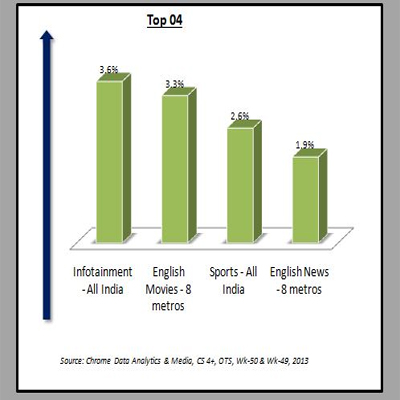
    And it shows in week 50’s  opportunity to see (OTS) data provided by Chrome Data Analytics & Media which keeps a tab on around 73 million TV homes nationally in analogue cable TV, digital cable TV and DTH. Infotainment channels were the biggest beneficiaries of the week with a gain of 3.6 per cent. Discovery Channel garnered the highest OTS among the players in the segment with its 89.1 per cent on an all India basis.


    Close behind was the English movies genre with a 3.3 per cent increase in the eight metros. As most channels gear up to air the biggest blockbusters to wrap up the year, movie buffs aren’t complaining. Sony Pix scored a 88.7 per cent in its OTS during week 50.


    Despite India losing to the Proteas in South Africa, sports buffs continued to tune into the action on the greens. The genre did appear in the top four categories with a  2.6 per cent gain. Ten Sports, the channel airing the matches, gained the most with 78.7 per cent OTS across India.


    The Delhi election aftermath did catch people’s attention with News channels in the eight metros seeing a jump of 1.9 per cent. Arnab Goswami’s Times Now topped the charts with 91.3 per cent OTS.  


    As for the bottom four categories, English entertainment channels saw a huge drop of 7.5 per cent in the eight metros. AXN registered 81.8 per cent OTS in the genre while others lagged behind.


    Religious channels saw a minor fall in the Hindi speaking market (HSM) at 0.6 per cent. Aastha channel continued to top the genre with a 97.9 per cent OTS.  Next in the line was the Hindi movie channel genre which sank 0.3 per cent with Star Gold continuing its golden run in the HSM with its 96.8 per cent OTS.


    Hindi News channels in the HSM region too saw a 0.3 per cent fall. Aaj Tak got the highest OTS at 93.6 per cent.

  • ‘It is in the interest of the Indian content makers if Glow TV works’:KAGISO MEDIA ED AND KAGISO BROADCASTING CEO OMAR ESSACK

    ‘It is in the interest of the Indian content makers if Glow TV works’:KAGISO MEDIA ED AND KAGISO BROADCASTING CEO OMAR ESSACK

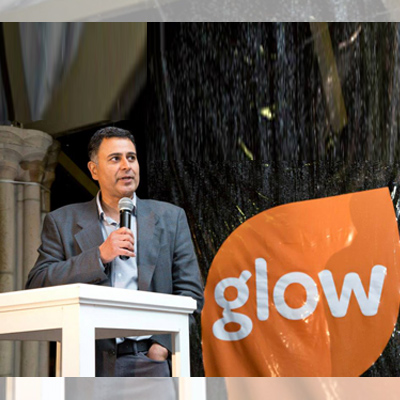
    With six radio stations – East Coast Radio, Jarcaranda FM, Heart 104.9, iGagasi, Ofm and Kaya fm – already in its kitty, the South Africa based Kagiso Media Broadcast has ventured into television with the launch of its first free-to-air (FTA) channel, Glow TV, which calls itself ‘eastern inspired’ and has Indian content accumulated from across the globe. Glow TV, a partnership between Kagiso Broadcast and Nolava Television that mainly works as content source provider, is just about a month old and is looking at creating original content in phase two.

    Kagiso Media ED and Kagiso Broadcasting CEO Omar Essack was in India recently to acquire content for Glow TV, which already boasts of shows such as season one and two of chat show Koffee with Karan and fiction show Bade Achhe Lagte Hain.

    Essack, who is of Gujarati descent, believes Glow TV will appeal not just to Indians but everyone in South Africa. In a conversation with indiantelevision.com’s Vishaka Chakrapani, Essack speaks about Glow TV’s uniqueness, appeal of Indian content in South Africa, Kagiso Media’s future plans and his expectations from the TV and digital mediums after a successful run in radio.

    Excerpts from the interview…

    What was the purpose of your India visit?

    This trip is about building relationships. All the big players in India don’t know who we are and we want to let them know our ambitions. Glow TV is our first channel but the intention is to grow and have more such channels. South Africa’s population is 50 million, out of which there are 1.5 million Indians, but our vision is a cross over. We are cherry-picking Indian content, packaging it and presenting what we think is a uniquely South African proposition – content where Indians make an appearance. This trip was to acquire programming and increase our rights. Helped by our JV with Microsoft; we want to do digital content for online and mobile as well.

    What kind of content are you looking at from India?

    As of now, we have about six hours of content repeated four times a day. We are also scouting good programming in Tamil and Telugu. The first question is whether it will work with black and white audiences; maybe a film like Cocktail would. Our target audience is females between 25 and 35 years and our primary relation for movies in India is Eros Entertainment.

    What are the shows that you currently have?

    We have a telenovela from Brazil called India – a love story that has Brazilian actors and is set in India, Rio de Janeiro and Dubai. Going forward, we are looking at more content from South Africans featuring India. The heart of our channel is to allow people with different cultural experiences to enjoy this eastern experience, which is accessible to them. We have spoken to Star, Zee and a production company that does unique content for YouTube as well as unique content in English that isn’t available on mainstream TV in India in the English language. This will help us connect with our audiences.

    What is the viewership of Glow TV and what marketing initiatives do you have in place for it?

    Glow TV currently has about 5000 STBs through Open View HD that cost about $89 (each). We are looking to find opportunities on digital platforms as well. There’s DSTV that is a big pay TV provider, which has FTA channels only at entry level. The reason we launched now is that in South Africa, it is Christmas, and people have got their bonuses on 13 December. We are assuming if we do a lot of marketing, people will buy more of the boxes.  About $9-10 million is going into marketing for Open View HD, and Glow TV is putting in $ 1.4 million, using its radio stations and websites to advertise. Our stations Jarcaranda and East Coast Radio have two million listeners each. Our primary audience is not Indians, which is why we are stretching the channel so hard.

    Soaps such as Kya Hua Tera Vada and Bade Achhe Lagte Hain are quite popular in India

    Was it easy to convince your board of directors to venture into TV?

    That was our biggest challenge since we are very successful and profitable in radio, when we thought of venturing into TV, our board was nervous. Glow TV is a proof of consent. They told us to show them we could work and bring in revenue and if we could, they would give us more money for Glow and more channels. We don’t have too much for movies but enough for shows but they are older ones that have been seen behind pay walls, which will now be FTA.

    Did you undertake any research before you stepped into TV media?

    An AC-Nielsen survey showed that when a Bollywood movie was shown on our version of Doordarshan i.e. South Africa Broadcast Corporation (SABC), a million people saw it at 2 in the afternoon, out of which 700,000 were blacks. This research convinced us that Glow could work across different ethnicities. They won’t pay to go see it at a movie theatre or for subscription but if it’s free, they will watch it.

    What is your budget for Glow?

    We are working on a lean budget but I am glad that a lot of the content makers here like Sony, Eros, Zee, Star and BBC understand we are a start-up and that we are working on a tight budget. So it is in their interest if this channel succeeds because if we are successful, we can be a big customer tomorrow. By 30 June next year, we will know if we have touched the targets that the board set for us. If we can’t prove ourselves by then, the whole deal is off.


    We are cherry-picking Indian content, packaging it and presenting what we think is a uniquely South African proposition – content where Indians make an appearance.

    What kind of advertisers do you have?

    We are currently looking at increasing viewership but are also offering advertisers a proposition. We are selling ad slots at low rates but we are also giving them our ecosystem to reach out to a large audience. Through radio, TV, digital and Glow TV put together, we are giving a 30 sec slot at a couple of hundred dollars. On our radio stations, the morning show slot is $2500. So, we are giving a radio station at a lower rate. We call this ‘glow watt bundles’. The only disadvantage of launching in October is that most advertisers are already committed. So whoever we spoke to, said they can only commit to us in January. First, National Bank and Nedbank are close to signing but they want exclusive deals from January. A soda company is going to sponsor Kaun Banega Crorepati.

    What are your plans for pay TV?

    Yes, we do not want to restrict ourselves to FTA and are looking at pay TV channels in the future. The licence we are applying for is not specifically for digital, terrestrial or satellite TV. It’s called a technology-neutral licence. We can apply that licence for any technology in the future. We may say the digital, terrestrial space is too crowded, or the pay TV satellite space is too crowded. Some of the future technology we don’t even know yet. A licence is not a guarantee. We then need to apply for spectrum. Any media company needs to be on both free and pay. If we prove ourselves, we can try our limits not just for channels but for future things like VOD.

    What kind of local content are you looking at getting from Urban Brew Studios, your own production house?

    Urban brew will get local content for our channels. We have a group in the company that harvests data and helps us know about consumer consumption patterns. One interesting finding is that we don’t have a lot of sitcoms coming out of South Africa but the US has a lot that are popular here as well. Also, there isn’t a soap opera channel with South Africans made in the country. So these are some ideas.

    Sanjeev Kapoor’s cookery skills is set to charm South African audiences

    Your company has also delisted itself from the Johannesburg Stock Exchange. What led to this decision?

    The company has delisted, we bought out 49 per cent and have made the final payment to shareholders. The main motivation is that we want to invest in new areas and our shareholder (Kagiso Tiso holdings), which bought us out is committed to investing for expansion across Africa and they have the appetite to do that.  Most of our shareholders that owned our stock owned it because we are a productive dividend payer and so, twice a year, they would surely get dividends. Going forward, if we require investment to do the things we are looking to, we may not pay dividends on a regular basis because we are looking at investing as we expand into Africa. And that may not have suited some share holders.

    What was the price paid to shareholders?

    It was a premium of 30 per cent of the price that was listing at that time. There were some who resisted it but in the end, it was an attractive price.

  • TV channels drop all else to air Mandela

    TV channels drop all else to air Mandela

    MUMBAI: The lion of South Africa roars no more. Nelson Mandela, who emerged from prison after 27 long years to lead South Africa out of decades of apartheid as his country’s first black president, passed away last night at his home in Johannesburg surrounded by his family members.


    Mandela or Madiba, as he was fondly called, proved to be as much a symbol of South Africa’s struggle against racial oppression as one of integrity and resilience when after being freed from prison in 1990 he negotiated a peaceful end to apartheid and urged forgiveness for the white government that had imprisoned him.


    It doesn’t come as a surprise that the man who was a phenomenon during his lifetime, is set to make history, even in death. Ever since the news of his demise, social media is aflutter with #RIPNelsonMandela trending on Twitter, Facebook full of Mandela posts and Google News showing close to 1,000 results on him. All publications, big or small, are digging out articles on him for their readers’ information and interest. Not to be left behind, TV channels while news channels have gone berserk showing features around the leader, even the infotainment channels are competing with each other to come with even more special segments on the revolutionary-turned-prisoner-turned-president.


    So, if National Geographic Channel is showcasing Mandela: His Life and Legacy on Saturday, December 7 at 11 pm and December 8 at 1 pm; Discovery is airing The Making Of Mandela again on 7 December at 9 pm and 8 December at 8 pm. Similarly, History TV18 is narrating the story of South Africa’s political transformation under Mandela’s leadership with Miracle Rising: South Africa airing tonight (9 pm) while TLC has a special line-up for audiences.


    With Mandela having motivated Indians as much as he did the South Africans, television channels started digging for features as soon as they came to know about his passing away.


    So what about the programmes that had been lined-up previously? “It’s not easy, but I think in a highly competitive environment where viewer interest can be ephemeral it becomes almost mandatory,” says A+E Networks TV18 VP and head marketing Sangeetha Aiyer, adding that they had to drop Hidden Cities at 9 pm and one of the channel’s biggest shows – Pawn Stars at 10 pm from the regular line-up to accommodate the program on Mandela.


    Drawing a parallel to how the channel aired a biography on Steve Jobs two years ago after his sudden demise and how it dropped the regular line up to air a show called The Killing Fields of Sri Lanka when the international community was bearing down on Sri Lanka for war crimes committed by its army, she says: “The effect was quite humbling as the show created a stir in Tamil Nadu and was even discussed in Parliament.”


    Coming back to Mandela, NGC has dropped its popular series Taboo. National Geographic and FOX International Channels VP, marketing Debarpita Banerjee, says that shows based on big events and people always bring more viewers. “Our rich and diverse library has always offered contextually relevant shows like Trapped in Kedarnath, Inside the Mahakumbh, 26/11 specials, 9/11 specials, that have fared extremely well. In fact, shows like Trapped in Kedarnath, 9/11 special went on to become one of the top three shows of the infotainment genre. Most of these special features have largely been based on events that have turned into the country’s news headlines. We realise that there are people curious to know more about events that have impacted their lives,” she says.


    Business-wise, it isn’t a good deal for channels to change the line-up at such short notice as they rarely find sponsors. Add to that the tough market that makes it even more difficult. With sponsorships taking a few weeks, finding an advertiser for a show that is to be aired in a few hours is difficult for any channel and thus, none of the channels got funders.


    However, since the curiosity around the topic is huge, the promotions become big. “For our regular viewers, we promote the shows heavily on the channel along with all our social media platforms. Pertinent shows like these are also promoted heavily on our news network where we can reach out to relevant audiences,” says Aiyer.


    “Getting sponsors is but naturally difficult on such short notice, however, our prime focus for such features is to ensure that we have the most relevant and well researched content put together by our programming team and then, try and promote it well so that our viewers are aware of such a show. We reach out to our captive audience of over 4 million fans on Facebook along with running promos, graphic-overs on the channel itself,” concludes Banerjee.

  • India fourth in phishing attacks

    India fourth in phishing attacks

    NEW DELHI: India has ranked fourth in phishing attacks in the third quarter of 2013, said RSA, a division of EMC.

    India received three per cent of the total attack volume, said  RSA  in a statement.

    Other countries targeted by phishing attacks were US (53 per cent), Germany (17 per cent), UK (eight per cent) and South Africa (three per cent). In top countries by attacked brands’ India ranked third with seven per cent of the total phishing volume worldwide. The US with 27 per cent and UK with 12 per cent topped the chart.

    RSA identified 46,119 phishing attacks in September globally with a rise in 36 per cent increase as compared to the month of August (33, 861). Phishing attacks in the month of September also mark the highest number of attacks in this quarter while July 2013 saw 45,232 numbers of attacks. Top countries to host these phishing attacks include US (42 per cent), Canada (nine per cent), Germany (five per cent) and UK (four per cent).

    The total amount of losses incurred in third Quarter of 2013 was $1.66 billion.
    Brands in the US, UK, India, and Australia were targeted by almost 50 per cent of phishing attacks in Q3 2013.

    US remained the top country on the chart, targeted with 53 per cent of the total phishing volume in Q3 2013.

    US incurred a loss of over $882 million followed by Germany with $294 million and UK with $133 million.

    Meanwhile, cyber attack is likely to cost the average home user $418 in multimedia files, but a lot of this loss could be prevented if users purchase digital content after checking that the content is secure.

    Kaspersky Lab in a statement that users can lose files in a number of different ways: losing a device, having a device stolen, or falling victim to malicious users.

    According to the B2B International survey, 27 per cent of respondents encountered a cyber attack in the last one year. At the same time, over 60 per cent of users who were victims of malware that either damaged or destroyed data admitted that they had not been able to fully restore their files. During the same period, approximately 14 per cent of users dealt with the loss, theft or crash of their device.

    Respondents in the 16-24 age group would face an average loss of $670, while those in the 25-34 group would incur an average loss of $455; users aged 45 and older would lose an average of $227.

    Residents of China and Russia were likely to incur the highest average losses at $816 and $807 per user, respectively. This figure is considerably lower in Europe ($378) and North America ($342).

    In order to protect digital assets, users not only need to back up their data on a regular basis – they also need to secure their personal devices against malicious attacks designed to steal or extort data. Smartphones and tablets should also have additional tools to help locate a lost device or to mitigate the potential damages of device theft.

  • Mandela: Long Walk to Freedom enjoys success in South Africa

    Mandela: Long Walk to Freedom enjoys success in South Africa

    Mandela: Long Walk to Freedom has got really good reviews on the home turf. The film has won rave reviews from South Africans who flocked to its opening night. Directed by Justin Chadwick and the script written by William Nicholson, the film has managed to make Mandela’s life story a highly watchable film.

    The fact that it is faithful to history is making it even more popular, even in the US, where it had a limited. The film that stars Elba as the South African revolutionary and Naomie Harris as Mandela’s wife, Winnie, an activist in her own right, has grossed $73,000 within two days.

  • Single window service for film shooting to become operational shortly: Tewari

    NEW DELHI: A single window service for promoting cinema tourism is all set to become operational shortly.

    Speaking at the Cinemascape 2013 conclave in Mumbai today, Information and Broadcasting Minister Manish Tewari observed that India with its rich heritage and diverse geography has great potential as a destination for film shooting but the current system of multiple clearances at various levels made it an unattractive destination for filming.

     “Increasingly therefore, most Indian filmmakers have gravitated towards foreign destinations for outdoor shoots. Any lost opportunity is a revenue loss for the country,” he remarked.

    India has a great potential to become a destination for film shooting but the current system of multiple clearances at various levels make it an unattractive destination for filming, says Manish Tewari

     Tewari said the government has now decided to address the issue by establishing a single window service for granting clearances for film shootings in India. He informed that a Committee on Promotion and Facilitation of Film Production in India has been set up. It is chaired by the secretary in the ministry, with senior representatives from the Ministries of External Affairs, Home Affairs; Tourism; Culture; Railways; Civil Aviation; Defence and Department of Revenue etc.

     The state governments have been asked to nominate the nodal officers for film clearance. The minister said Standard Operating Procedures are being developed to accord clearances for film shooting by domestic and foreign producers in India.


    Tewari stressed on the need for a sound legal architecture for promoting cinema as a form of creative expression. While conceding that law and order is a state subject, he said film certification falls in the central domain. He said, “There is an urgent need to update laws relating to film certification and exhibition and I am happy to inform that the committee headed by Justice Mukul Mudgal has submitted its recommendation along with a model bill to replace the existing Cinematograph Act 1952.”

     He said the recommendations of the committee as well as the model bill will be published on the website of the ministry to seek wider public consultation. The minister assured the film fraternity that by the middle of 2014, India would have a contemporary law to deal with cinema.

     Dwelling on the issue of taxation and fiscal incentives for the film and entertainment sector, the minister called upon the industry representatives to set up a committee of experts to draw a comprehensive strategy, which could then be submitted to the Finance Minister on behalf of his ministry.

    Participating in a panel discussion, noted film maker Mukesh Bhatt said 76 different permissions have to be obtained for film shooting in India, while Indian producers are given a red carpet welcome in some of the cine-tourism nations like Switzerland, New Zealand, South Africa, Thailand, Malaysia and Singapore. Bhatt acknowledged that the Ministry’s effort is a welcome first step.

  • 69% Indians feel SMS is an easier way to express than in person: Ipsos Study

    69% Indians feel SMS is an easier way to express than in person: Ipsos Study

    MUMBAI: Seven in ten (69 per cent) Indians admit they say things in that they would not say voice-to-voice or person-to-person; compared to 43 per cent globally, finds a new poll conducted by Ipsos OTX – the global innovation center for Ipsos.


    “Text or Email is comparatively an impersonal medium and people feel less hesitant to speak their mind. Perhaps that is the reason why majority of Indian would rather avoid saying things in person or over phone,” said Ipsos – head marketing communication Biswarup Banerjee.


    “For example people prefer to share sensitive comments like – “I love you.” “Our relationship is over.” “You are fired.” “I failed in exam.” in writing rather than saying over the phone or face-to-face to avoid embarrassment when they are physically involved,” added Banerjee.


    Demographically in India, age appears to be the most significant variable as those under the age of 35 (75 per cent) are considerably more likely than those aged 35-49 (67 per cent) and those 50-64 (52 per cent) to text/email things they won’t say out loud. Education is also a significant factor as seven in ten (69 per cent) of those with a high level of education say they do so compared with 100 per cent among those with low education. Both Indian women (70 per cent) and men (68 per cent) feel more comfortable texting or emailing sensitive subject rather than voicing it out.


    Strong majorities in China (90 per cent) and South Korea (80 per cent) say they text or email things they would not say over the phone or in person. Seven in ten of those in Indonesia (76 per cent), India (69 per cent) and Saudi Arabia (67 per cent) say so. Following next are Turkey (58 per cent), Brazil (48 per cent), Japan (46 per cent), South Africa (45 per cent), Argentina (42 per cent), Mexico (42 per cent) and Russia (39 per cent). Only three in ten or less in most of the countries surveyed say they reserve some communication for text or email: Canada (34 per cent), Australia (33 per cent), France (33 per cent), Great Britain (32 per cent), Poland (32 per cent), Belgium (31 per cent), Italy (31 per cent), United States (30 per cent), Germany (25 per cent), Hungary (24 per cent), Spain (24 per cent), Norway (22 per cent) and Sweden (22 per cent).


    Ipsos conducted this study among 18,502 adults in 25 countries in the month of August.

  • Katie Holmes to be part of The Giver

    Katie Holmes to be part of The Giver

    Mumbai: Katie Holmes has finalised a deal to be a part of ‘The Giver’, a drama from the Weinstein Company and Walden Media. The movie is directed by Phillip Noyce.


    Brenton Thwaites plays the lead role in the movie that talks about a world where there is no sickness, racism or conflict.


    Thwaites plays the role of a young boy who is selected for his life service as Receiver of Memories with ‘The giver’ (Jeff Bridges) who is an old man teaching the boy to use his unique gifts of the senses.


    Meryl Streep plays the society’s chief elder, an authoritarian woman who assigns young kids tasks to do.  Holmes will be playing the mother of Thwaites. Her role is that of a strict obeyer of the rules of the society that can be named as an antiseptic society.


    Michael Mitnick has scripted the adaptation and will be shot in South Africa.
    The movie is eying a budget of around $25 million.