Tag: Sourav Ray

  • Is AI becoming a better friend to the youth than humans: Cheil India’s new report

    Is AI becoming a better friend to the youth than humans: Cheil India’s new report

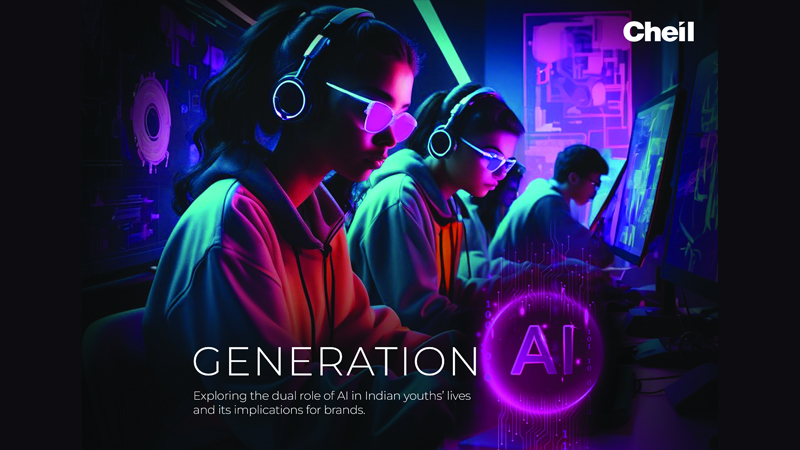
    Mumbai: Artificial Intelligence is dawning a new digital age, and the Indian youth are leading the charge, reveals a new report by Cheil India. The report, titled ‘Generation AI – Exploring the dual role of AI in Indian youths’ lives and its implications for brands, dives deep into AI usage by Gen Z students (aged 16 to 25) in India, covering their academic and personal uses of AI tools on an everyday basis. It includes quantitative and qualitative research findings from over 1200 students across the country.

    Cheil SWA president and CEO Limseob Chung said, “Over 68 per cent of the youth have a more positive perception of AI now than last year. Brands must adapt to this new reality where LLMs are the new best friends that the youth seek advice from. The caution regarding AI adoption is giving way to more optimism as the once-sceptics are turning into super users.”

    “We found 73 different usage scenarios for AI and this is just the tip of an iceberg yet to emerge” said Cheil SWA COO Sanjeev Jasani. “While it’s no surprise that more students are motivated to utilise AI for learning purposes, their personal uses are way more varied and interesting, ranging from daily life hacks to creativity to connecting with others.”

    Cheil India chief strategy officer Sourav Ray explained, “AI plays two roles: as the Liberator in academics, freeing students from the constraints of traditional education, and as the Conqueror in personal life, helping the youth seize new opportunities and face their fears.”

    AI as the liberator from traditional education

    On the academic side, there are six segments of AI usage by the youth:

    1. Troubleshooter: 33 per cent of students use AI to solve academic problems, mainly male students in schools and undergraduate studies. This liberation from academic grunt work is being sought majorly by around 54 per cent male students.

    2. Automator: 16 per cent automate school work and assignments, focusing more on co-curricular activities. This segment consists largely of college and university students.

    3. Instructor: 77 per cent believe AI enables self-paced learning, acting as a non-judgmental, tireless private tutor. Students appreciate this freedom to learn at their own pace.

    4.    Navigator: 15 per cent use AI as a scheduler or time-manager, especially before exams. STEM (29 per cent) and Business (27 per cent) students are the most common users in this segment.

    5. Explorer: Eight per cent use LLMs to explore new topics outside their current field of study, seeing AI as a career counsellor and guide.

    6. Mentor: Six per cent use AI as a co-builder of new ideas or ventures, they are mostly STEM (31 per cent) and Business (24 per cent) students. This segment is not just using AI; they are also creating future applications and businesses around AI.

    AI as the conqueror in personal life

    Gen Z has found an ally in AI, which shape-shifts into trusted confidants, creative collaborators, and relationship coaches. The 5 segments identified are:

    1. Genie: 31 per cent use AI for daily life hacks, from suggesting home décor tips to travel itineraries.

    2. Savant: 31 per cent expect AI to provide expert advice, replacing visits to specialists. This includes medical diagnosis, legal advice, astrology, make-up tips, coding help, and more.

    3. Co-creator: Many use AI as creative partners, generating inspiration for ideas or bringing those ideas to life with simple prompts. The most commonly used AI creative tool is Canva, followed by other tools like Designs.AI, Adobe Firefly, Figma and DallE.

    4. Wingman: Eight per cent seek AI’s help in social situations, particularly introverts or youth with social anxiety. This segment has 54 per cent male users, who are primarily residing in Metros.

    5. Buddy: While 72 per cent believe AI will soon understand them better than many people, there are few who are using it to conquer loneliness (11 per cent). This segment actively seeks a friend or a therapist in AI, discussing personal issues or having intimate conversations. The report calls this “human-machine symbiosis” once only shown in sci-fi movies, but now happening in real life.


    The flipside: A cautionary tale of over-dependence on AI

    However, not everything is rosy in ‘AI-land’. The report also highlights the rising concerns among the youth. 41 per cent fear that overdependence on AI will reduce creative or critical thinking skills. Nearly 40 per cent doubt the quality of AI-generated outputs, calling them too generic or superficial. In academic spheres, while there is broader acceptance of AI in everyday learning, 56 per cent still hold the conventional view that using AI is a form of cheating.

    If AI is affecting the way we think independently, the question, therefore is: Will the famous Descartes quote “cogito ergo sum” still hold true in the age of AI?

    How should brands navigate this new AI world order

    The report also provides specific insights for brand builders and business leaders on navigating the future:

    1.  High-involvement experiences: Brands need to understand the level of AI involvement among youth before creating AI-enabled solutions. The report shows how the needle needs to move from ‘transactional exchanges’ in low-involvement users to ‘relational experiences’ in highly-involved ones.

    2.  To each their own brand: Customers are becoming so AI-dependent that their purchase journeys are beginning with a prompt. Brands might soon need to achieve AI-enabled hyper-personalization, creating distinctive new identities and offerings for each consumer.

    3.  Brands as AI: Brands that have traditionally focused on building a personality over time need to now start thinking about ‘brand personification’. Future consumers will prefer interacting with brands as if they are friends or mentors. Imagine a 16-year-old asking Nike about weight loss or asking Dove about building confidence. This might be the right time to start developing “brand LLMs”.

    4.  Empathy is the key: AI solutions must act with empathy, addressing human vulnerabilities to either liberate youth from their issues or help them conquer new frontiers. The question every brand need to ask is: What will we as a brand do with AI that either liberates or conquers?

  • Aim to balance short term goals with long term vision: Cheil India’s new CSO Sourav Ray

    Aim to balance short term goals with long term vision: Cheil India’s new CSO Sourav Ray

    New Delhi: Transitioning into a new role amidst a global pandemic is a doubly challenging responsibility. Still, for Cheil India’s recently appointed chief strategy officer Sourav Ray it is the most exciting part about his move.

    In an exclusive conversation with Indiantelevision.com, Ray shared, “What we have been experiencing in the recent past is that the strategy and strategists are increasingly gaining more importance both from a client and agency perspective. Clients understand that the old ways are not going to help them navigate this new normal, and they are more open to and interested in working with a strategist.”

    He adds that it creates a positive environment for the strategists as clients are more open to take risks and try out new things.

    “Earlier, the role of strategist was mostly limited to upper-funnel communication with the clients, but now, they are equally involved in lower-funnel conversations too. So, now we are looking at not just creating awareness and interest but also help in driving the purchases too,” he elaborated.

    For Ray, the first item on his agenda in this new role is to drive commerce for the agency and clients. “Given the situation, each industry is dealing with the same question, where to get the business from? Every discussion with clients, no matter if it is about building brand awareness or exploring ways to sell; whether it’s through e-commerce or omnichannel experience, or introducing new platforms, the core of each conversation is business.”

    However, while dealing with this short-term crisis, Ray is not losing view of long-term goals for the agency.

    “The best thing about Cheil is that we keep having conversations about our long-term plans so that nothing just happens and impacts us. We are always prepared for whatever is coming. Right now, I aim to balance the short-term vision with the long-term goals, drive acceleration for ourselves and the clients.”

    He wrapped the conversation by saying, “Change is going to be the only constant for us at Cheil; sometimes, the speed of the change will be furious like it is right now, sometimes it is going to be slower.”

  • Cheil India appoints Sourav Ray as chief strategy officer

    Cheil India appoints Sourav Ray as chief strategy officer

    NEW DELHI: Cheil India has appointment Sourav Ray as chief strategy officer (CSO). He will advance the integrated planning and strategy for the company.

    Ray is being promoted internally and will be succeeding Atika Malik with immediate effect.

    He brings over 20 years of strategic planning and brand-building experience to his new role. He has a strong track record in stewarding brands in India, Hong Kong, and China across leading agencies like Ogilvy, Leo Burnett, Bates 141, and Havas Worldwide. He has worked on a diverse set of clients covering FMCG/CPG, mobile devices, finance, media, pharmaceuticals, lifestyle, travel, B2B technology, and the social sector.

    Cheil India COO Sanjeev Jasani said, “We wanted to hand-pick someone who had the balance of a classic strategy background and the ability to formulate a strategy that’s relevant for today. Sourav is that person. He has a depth of experience which, together with his curiosity and understanding of the new nuances of today’s marketing landscape, will elevate our strategic offering. I look forward to some great work from him.”

    “Cheil is a unique agency with a hugely diverse set of minds. I don’t need to point out the uncertain times that we all are in. This organisation can harness the power of diversity and create connected experiences that matter and provide positive value to our clients. I have been deeply interested in work that drives change; brand/business transformations, behavioural change, or even social change. In my new role, I look forward to helping clients integrate the idea of the brand with the digital reinvention of people and businesses to tell great stories,” added Ray.

    Follow Tellychakkar for the consumer facing news & entertainment

  • Sourav Ray joins Euro RSCG as chief strategy officer

    Sourav Ray joins Euro RSCG as chief strategy officer

    MUMBAI: Euro RSCG has appointed Sourav Ray as chief strategy officer. He will report to Euro RSCG CEO Sushant Panda.

    The post was left vacant when Narayan Devanathan left the agency to join Dentsu Marcom in September 2011.

    Ray comes in from Bates 141 China where he served as national planning director.

    A masters in management from IISWBM, Ray’s first stint was with Ogilvy & Mather Mumbai in 1995 as senior account executive. He then moved to Leo Burnett Delhi as account director. In 2000 he moved back to Ogilvy & Mather Delhi as planning director.

    In 2004 he shifted to Ogilvy & Mather, Hong Kong and inn 2007 he joined Bates 141 China as national planning director.